
Scotland’s unnatural larder: SNH has lost the plot

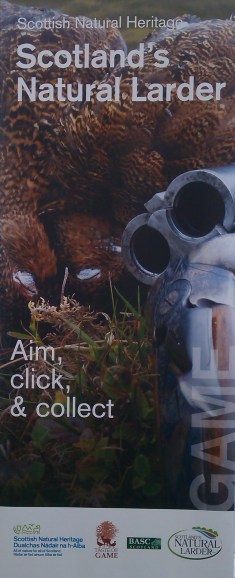
Aim Click Collect June 2015If you’d been at the Royal Highland Show last week you might have seen this SNH poster. You might also have seen Environment Minister Dr Aileen McLeod posing in front of it.

What is it?

It’s part of an SNH campaign called Scotland’s Natural Larder, being run jointly with BASC Scotland, and coincides with the Scottish Government’s Year of Food & Drink.

According to an article in SNH’s latest magazine (The Nature of Scotland, Spring/Summer 2015, page 10):

The aim of Scotland’s Natural Larder project is to encourage people to eat natural produce that has been sustainably harvested or hunted” and “A key focus is helping people understand the close links between the health of the environment and sustainable management“.

According to SNH, ‘Game meat is healthy, natural and delicious’ (see here).

According to BASC, ‘Game meat is healthy, sustainable and delicious’ (see here).

So the key words being bandied about by the Government’s statutory nature conservation agency (as well as by BASC, which is less surprising) about shot red grouse (look at the poster) is that they are ‘healthy’, ‘natural’, ‘sustainable’ and ‘delicious’.

Forget about the word ‘delicious’ because whether grouse tastes delicious or not is entirely subjective and pretty irrelevant. But what about those other words? ‘Healthy’, ‘natural’ and ‘sustainable’? Really? Who are they trying to kid? How about ‘unhealthy’, ‘unnatural’ and ‘unsustainable’?

Unhealthy

Red grouse are shot with lead ammunition. Lead is a poison. Lead is highly toxic to humans. The health risk of lead poisoning has been well-documented and has resulted in the removal of lead from petrol, paint, fishing weights and water pipes. In 2012, the Food Standards Agency published guidance on eating game shot with lead ammunition:

The Food Standards Agency is advising people that eating lead-shot game on a frequent basis can expose them to potentially harmful levels of lead. The FSA’s advice is that frequent consumers of lead-shot game should eat less of this type of meat” (see herehere and particularly here).

Red grouse on intensively managed driven grouse moors are also routinely exposed to chemicals in the form of medicated grit. The chemicals in this grit are used to kill the parasitic strongyle worm. This drug is highly persistent, according to SLE (see here). Moorland managers are advised to remove the medicated grit one month before the start of the grouse-shooting season. Who decided one month was a suitable period of time for withdrawal and who monitors whether the medicated grit is actually being withdrawn at that time? Is there any information about the effect on humans from eating red grouse that have residual levels of medicated grit still in their bodies?

There’s also a new disease spreading through red grouse populations – ‘respiratory cryptosporidiosis’, also known as ‘bulgy eye’. Apparently the protozoan responsible isn’t known to be infectious to humans (see here) and a prominent figure from the grouse-shooting industry claims ‘grouse are perfectly safe to eat if they are diseased [with bulgy eye]’ (see here). Hmm, sounds yummy. Wonder what his medical qualifications are?

Does any of this convince you that eating red grouse is a ‘healthy’ option?

Unnatural

Red grouse is frequently described as ‘natural’ by those with a vested interest in driven grouse shooting. It might be considered ‘natural’ if it has been killed by walked-up shooting but what about the grouse that have been killed by driven grouse shooting? Intensively managed driven grouse moors are anything but natural. Red grouse are found in artificially-high densities on these moors as a result of several unnatural management techniques, including the use of medicated grit (see above), the frequent burning of heather (see here for the environmental damage caused by this practice), the [legal] and unregulated annual mass slaughter of predators (foxes, stoats, weasels, corvids) and mountain hares, not to mention, of course, the widespread illegal killing of raptors.

What’s ‘natural’ about red grouse that have been shot on an intensively driven grouse moor?

Unsustainable

Concerns over the unsustainability of driven grouse shooting are growing – so much so that Marks & Spencer removed red grouse from sale last year (see here) because they weren’t able to guarantee their grouse had come from a responsible, sustainable source. There are plenty of other concerns, too (see here for a good overview).

So how does SNH justify its claim that red grouse have been ‘sustainably’ harvested?

What on earth is SNH playing at? Why is this statutory conservation agency actively promoting an industry with such shocking ecological credentials and claiming that eating this product (red grouse) is good for us and good for the environment?  Let’s ask them. Emails to SNH Chief Executive Susan Davies: susan.davies@snh.gov.uk

GWCT reputation Dented

IMG_4874 (2) - CopyIt took the GWCT quite a while to post anything on their website about the CBE that their Chief Executive, Teresa Dent, was awarded in the Birthday Honours’ List. Maybe they were as surprised as the rest of us.

Whilst RPS has nothing against Teresa Dent personally (we’ve never met), it’s a bit difficult to know quite what she and GWCT have done to deserve this ‘honour’.  After all, the emblem of the GWCT, the Grey Partridge, is at rock-bottom despite a pile of good research and a GWCT membership of large landowners who ought to be implementing all of the GWCT’s bright ideas on the subject. Not exactly the biggest conservation success story is it? I’d rather be in charge of an organisation with the Avocet as its logo (whatever cricketing legends might say about it)!

The GWCT spouts a lot about its scientific reputation but, as Mark Avery pointed out on his blog years ago, they seem to be resting on their past laurels rather a lot (see here and here). But they are still going on about how they are a (?) or the (?) ‘leading wildlife research charity’ (e.g. see here), a name-tag rarely given to GWCT by anyone else these days.  What science has GWCT contributed to the Hen Harrier debate recently?  They don’t even seem to believe the results of their own eyes and their own research at Langholm – rating the project as a failure (see here) when others rate it as a clear success (see here). GWCT really have lost the plot!

It’s difficult to know what Teresa Dent thinks about anything as she is rarely seen in public outside of shooting circles. It is much more common to hear the GWCT’s Andrew Gilruth spouting nonsense about Hen Harriers, brood meddling and re-tweeting YFTB nonsense on Twitter.

The GWCT news item about Teresa Dent’s CBE can’t even explain what she has done! It rather cryptically says she has told people things they don’t want to know. Could this possibly mean that she sits her chairman, Ian Coghill, down and tells him that lead ammunition ought to be banned and he ought to get used to the idea? Or maybe it means that she has a word with Hawk and Owl Trust Chair Philip Merricks and tells him that brood meddling is a daft idea? Or does she tell the Moorland Association (‘a sad morons’ coalition’, for you anagram fans) and Scottish Land and Estates (‘dated tactless shits, anon’) that their members had better start getting out of driven grouse shooting before land prices drop as a ban approaches? No? Probably not.

The news item seems to think that the GWCT Council were announcing something – the announcement was made a couple of days ago by Number 10 – we all noticed it then, but the GWCT spent the weekend dozing, or dreaming of days gone by when the world outside of shooting cared what they said, and cared a little for them too.

The news item sums up the GWCT these days: vague, self-congratulatory, wrong and late.

Illegal tampering with traps – results of BASC Scotland ‘study’ shows not widespread

Earlier this month we read a fascinating article published in Fife Today about the alleged illegal tampering of traps (see here).

Landowner Sir Robert Spencer-Nairn (Rankielour Estate) was talking about how he’d installed CCTV cameras ‘following a spate of incidents’ where ‘vicious’ crows had been released from traps to ‘wreak damage in the countryside’ (yep, you get the idea – he has links with GCT so what do you expect?). The article also suggested that Police Scotland  ‘is reporting a rise in the number of traps being tampered with’.

Is that right? Well, how about we look at the evidence.

Regular blog readers may recall former Environment Minister Paul Wheelhouse telling the RACCE Committee in November 2013 that there wasn’t any evidence to support or refute claims from the game-shooting industry of widespread trap interference/damage, but that a study (funded by Scottish Government – i.e. tax payers) was about to begin to try and assess those claims (see here).

That year-long study began in April 2014 and finished at the end of March 2015. BASC (Scotland) issued a press release in February 2014 to announce the start of the study, and it’s really worth a read (see here) – especially the comments attributed to Mike Holliday (BASC Scotland), Tim (Kim) Baynes (Scottish Land & Estates Moorland Group) and Alex Hogg (SGA), who all claimed that trap interference was widespread (ooh, is that the old victim card being played once more?). As well as BASC, the study was reportedly widely supported by SLE, SGA, GWCT (Scotland), Scottish Countryside Alliance, Scottish Assoc for Country Sports and NFU Scotland. Pretty good coverage then.

So how did the study go? What were the findings? An FoI has revealed all. See here:

FoI April 2015_ Illegal interference with traps and snares BASC – Copy

It turns out that this alleged problem isn’t widespread after all.

Let’s just ignore the fact that none of the data were independently verified, and assume that the gamekeepers who submitted the data were honest (because gamekeepers never lie, right?). In which case, there were 19 alleged trap interference/damage incidents throughout the year-long ‘study’. BASC has actually submitted 25 alleged incidents, but 6 of these can be immediately discounted because they allegedly took place before the study had begun and one of them didn’t even involve alleged disturbance or vandalism: “Snares being used with tag number belonging to another person”.

Of the 19 which apparently took place during the official study period, only 11 were reported to the police. Interesting then, that the article in Fife Today states ‘Police Scotland is reporting a rise in the number of traps being tampered with‘. On what evidence is Police Scotland making this claim?

If you look closely at the details of the 19 alleged incidents, you’ll notice that over one third of them took place on a single estate in Crieff. If those alleged incidents did actually take place, it suggests that there is a localised problem in that particular area; the claim of the problem being ‘widespread’ simply isn’t supported by these figures.

And what about Fife, home to Sir Robert Spencer-Nairn, who claimed in Fife Today that there had been ‘a spate of incidents’? According to the BASC data, there were only two reported incidents in Fife during this year-long study. Do two incidents (one of which didn’t even involve the release of ‘vicious’ crows from a trap) constitute ‘a spate of incidents’ or is this indicative of wildly exaggerated claims?

According to the FoI, BASC Scotland will be analysing the data and submitting a report to the Scottish Government. We look forward to reading it, especially to find out how the data were independently verified, how they assessed whether a trap/snare had been deliberately interfered with as opposed to accidentally damaged (e.g. see here) and how they justify the claim that trap interference is ‘widespread’.

Botham off-target

There’s an amusing article in today’s Mail on Sunday from Ian Botham, frontman of the increasingly-ludicrous You Forgot the Birds ‘campaign’, funded by the grouse-shooting industry.

It follows on from last week’s attempt by YFTB to discredit the RSPB (see here). This time, Botham is playing the victim card and is threatening legal action because he thinks that the RSPB has accused him of killing birds of prey (see here).

Playing the victim card is nothing new from the game-shooting industry – we’ve seen it played over and again, especially when video evidence, collected by the RSPB’s Investigations teams, has been used to successfully convict criminal gamekeepers of wildlife crimes. It’s all just so unfair.

Botham also claims that the RSPB is ‘constantly slurring gamekeepers as criminals’. Poor, slurred gamekeepers. Why ever would anyone think their industry is a hot bed of criminal activity against protected wildlife? Perhaps this has something to do with it:

In January 2012, the RSPB reported that since 1990, over 100 gamekeepers had been convicted of raptor persecution crimes (here).

And here’s a list of 29 gamekeepers convicted of wildlife crimes in the last 5 years alone, many of whom were convicted thanks to the work of the RSPB:

Feb 2011: Gamekeeper Connor Patterson convicted of causing animal fights between dogs, foxes and badgers.

May 2011: Gamekeeper Ivan Mark Crane convicted of using an illegal trap.

May 2011: Gamekeeper Ivan Peter Crane convicted of using an illegal trap.

May 2011: Gamekeeper Dean Barr convicted of being in possession of a banned poison.

May 2011: Gamekeeper James Rolfe convicted of being in possession of a dead red kite.

June 2011: Gamekeeper Glenn Brown convicted of using an illegal trap.

October 2011: Gamekeeper Craig Barrie convicted of illegal possession & control of a wild bird

Dec 2011: Gamekeeper Christopher John Carter convicted of causing a fight between two dogs and a fox.

Dec 2011: Gamekeeper Luke James Byrne convicted of causing three animal fights and possession of three dead wild birds (heron, cormorant, buzzard).

Jan 2012: Gamekeeper David Whitefield convicted of poisoning 4 buzzards.

Jan 2012: Gamekeeper Cyril McLachlan convicted of possessing a banned poison.

April 2012: Gamekeeper Robert Christie convicted of illegal use of a trap.

June 2012: Gamekeeper Jonathan Smith Graham convicted of illegal use of a trap.

Sept 2012: Gamekeeper Tom McKellar convicted of possessing a banned poison.

Nov 2012: Gamekeeper Bill Scobie convicted of possessing and using a banned poison.

Jan 2013: Gamekeeper Robert Hebblewhite convicted of poisoning buzzards.

Feb 2013: Gamekeeper Shaun Allanson convicted of illegal use of a trap.

Feb 2013: Gamekeeper (un-named) cautioned for illegal use of a trap.

May 2013: Gamekeeper Brian Petrie convicted for trapping offences.

June 2013: Gamekeeper Peter Bell convicted for poisoning a buzzard.

July 2013: Gamekeeper Colin Burne convicted for trapping then battering to death 2 buzzards.

Sept 2013: Gamekeeper Andrew Knights convicted for storing banned poisons.

Dec 2013: Gamekeeper Wayne Priday convicted for setting an illegal trap.

Feb 2014 Gamekeeper Ryan Waite convicted for setting an illegal trap.

May 2014 Gamekeeper Derek Sanderson convicted for storing five banned poisons.

July 2014 Gamekeeper Mark Stevens convicted for setting illegal traps.

October 2014 Gamekeeper Allen Lambert convicted for poisoning 11 raptors, illegal storage and use of pesticides & possession of a poisoner’s kit.

December 2014 Gamekeeper George Mutch convicted for illegal use of traps, illegal killing of a goshawk, illegal taking of a goshawk, illegal taking of a buzzard.

May 2015 Gamekeeper James O’Reilly convicted for illegal use of leg-hold traps and illegal use of snares.

It’s not that they’re all at it; on the contrary, we personally know some fantastic gamekeepers who contribute a massive amount to wildlife conservation. The problem is, they are few and far between and many within the gamekeeping industry are most definitely at it. You don’t get population-level effects on a species’ distribution and abundance (think hen harriers, golden eagles, peregrines, red kites) if ‘only a few rogues’ are at it.

In a lot of ways, Botham’s attack on the RSPB is a soft target. They’re high profile and subject to strict conditions laid down by the Charity Commission – there’s only so much they can say and do (although some of us think that they could do more than they already are, even within those constraints). However, it’s not the RSPB that Botham & his grouse-shooting industry mates should be worried about. It’s not just the RSPB who are aware of what is going on. He (and the industry he is representing) should perhaps be more concerned about the growing rise in ordinary members of the public who are finding out the truth about the game-shooting industry. We know what’s going on and we’re not hampered by Royal Charters or other bureaucratic constraints. And we’re getting louder and stronger by the day. It’d be foolish to underestimate us.

You forgot the biology

Well, well, well. The ‘campaign’ group You Forgot the Birds, headed up by that well known ornithological expert (ahem) Sir Ian Botham, is back.

You might remember them from last year, when they tried, unsuccessfully, to discredit the RSPB, resulting in widespread derision and the rejection of their complaints to the Charity Commission.

This time they’ve surpassed all expectations. They’re accusing the RSPB of ‘deliberately looking the other way’ while hen harriers die because they’re more interested in using the species as an ongoing ‘fundraising tool’.

This accusation is centred on the recent events in Bowland, Lancashire, where three male hen harriers, all with active nests, (un)mysteriously ‘disappeared’ (see here).

We have a copy of the group’s press release (thanks to the journalist who sent this). It reads (slightly edited) as follows:

You Forgot the Birds campaign.

The mysterious disappearance of endangered birds of prey in Lancashire has become a whodunnit with the RSPB implying that gamekeepers are to blame and the gamekeeper’s champion, Sir Ian Botham, saying that the RSPB is deliberately looking the wrong way – and has ulterior motives.

Embargo 00.01 Tuesday 19 May 2015

England’s hen harriers are close to extinction and the RSPB is too ideologically blinkered to do anything to help.  This is the view of Sir Ian Botham who is responding to the news that at the Bowland Estate in Lancashire, RSPB officials are watching abandoned eggs on hen harrier nests instead of transferring them into incubators.  The fledglings could then be released back into the wild.

“The RSPB uses hen harriers as a fundraising tool and is forever blaming gamekeepers for their low numbers” says Sir Ian Botham, “but the real culprits are the ‘sit on their hands and do nothing’ RSPB officials who keep blocking government attempts to help the birds recover.”

Under a Natural England licence the RSPB could save the eggs at Bowland.  Officials at Defra have proposed a similar scheme to increase hen harrier numbers on grouse moors but this has been obstructed by the RSPB.

“The RSPB are deckchair conservationists with binoculars who sit and watch failing nests. They campaign, they complain, they blame – but they are rubbish at conservation.  Year after year the RSPB fails to live up to its name and protect birds.  If you want to protect birds from predators you need gamekeepers not the RSPB” says Sir Ian.  Uncontrolled fox populations are a major problem for hen harriers.

His criticism came after the RSPB, without producing any evidence, blamed the disappearance of the hen harriers on wildlife crime and offered a £10,000 reward for a conviction.

Sir Ian in response is offering a £10,000 reward to the first conservation group which moves the abandoned eggs into an aviary and then releases the fledglings back into the wild.  A similar process has already successfully raised harrier numbers in France.

While there are more than 1,000 hen harriers in Scotland, in England the numbers remain pitifully low.  Last year there were only four successful nests south of the border – three of which were on grouse moors.

“No bird lover can accept this impasse.  The current situation is an embarrassment to both Defra and to Natural England and provides stark evidence that the RSPB puts ideology and fundraising far ahead of the birds it claims to protect,” says Sir Ian who is spokesman of the You Forgot The Birds campaign.

The RSPB receives more than £1m of grants from the EU and the Heritage Lottery Fund for its hen harrier programme and would risk not getting further grants if hen harrier numbers increased.

Defra officials want excess hen harrier chicks on grouse moors to be raised in aviaries so that bird numbers increase while allowing the moors to remain economic.  The highly respected Hawk and Owl Trust has offered to help implement the scheme.  However the RSPB continues to object to the plan and is putting pressure on the Trust to back down.

Contact

Ian Gregory xxxxx xxxxx

You Forgot The Birds   www.youforgotthebirds.com

Notes:

  1. The Scottish hen harrier population is 505 territorial pairs (Hayhow et al. 2010)
  2. The grouse industry suspects that the RSPB’s offer of a £10,000 reward over the Bowland Estate hen harriers is an attempt to deflect responsibility away from its failure to protect birds on land that it controls.
  3. The RSPB has not produced any evidence that the birds are dead. Nor has it explained why it thinks that they have not been taken by predators e.g. eagle owls, peregrine falcons or goshawks.
  4. If a gamekeeper was responsible for the birds disappearing then how was this not detected by the RSPB’s extensive network of people and remote cameras in Bowland?
  5. The RSPB has ‘previous’ for playing media games with hen harriers: for more than six months it delayed reporting the deaths of two hen harriers at a wind farm. (The RSPB campaigns for wind farms and has even built a turbine at its headquarters.)
  6. At Bowland a Natural England Licence would allow conservationists to use portable incubators, dummy eggs (in case the parents return) and supplementary feeding (to encourage females to remain when their partners have abandoned a nest). If the fledged birds were returned to the place where the eggs were taken from there would be no breach of IUCN guidelines.
  7. The You Forgot The Birds Campaign thinks that the RSPB is fearful that if it reverses its position on the Defra scheme, the resulting growth in hen harrier numbers would show how its years of opposition have been hugely damaging for this endangered species.
  8. The RSPB’s claim that unrestricted hen harrier numbers can co-exist with grouse moors is proving unfounded at the Langholm Project in Scotland.  This longstanding experiment, which is partly funded by the RSPB, uses “diversionary feeding” of hen harriers in an attempt to reduce their predation of grouse.  However grouse numbers on the moor remain so poor that there has not been one day’s shooting in seven years – this is not economically viable.
  9. The You Forgot The Birds Campaign is funded by the British grouse industry.

END

It’s hard to know where to begin, and to be honest, we can’t really be arsed to go through it sentence by sentence, but there are two points that are worthy of some attention.

1. The two hen harrier nests (with their eggs) were abandoned by the females at some point between 30th April (when both males ‘disappeared’) and 6th May, when the RSPB announced the news. Botham’s press release was embargoed until today (19th May). Botham is offering £10K to any conservation organisation who will take the eggs, incubate them, and then release the subsequent fledglings. It’s not clear how he thinks that eggs containing embryos that have been dead for between 13-19 days can now be successfully incubated. It’s biologically impossible.

He may well argue that had the RSPB intervened when the nests were first abandoned, the eggs could have been saved. Well, that’s potentially a biological possibility, although this scenario doesn’t take in to account the difficulty of knowing precisely when the nests were abandoned, and thus when to intervene. The nests were being closely observed and the people watching the nests will have seen the females leave. But at that stage, they wouldn’t have known whether the females had left temporarily (to find food for themselves in the absence of their male partners) and were coming back, or whether they’d abandoned the nests for good. Intervening at that early stage and removing the eggs could have been disastrous, not to mention illegal. By the time the nest observers realised the females weren’t returning, the eggs would have chilled and the embryos would already be dead.

However, that’s not what he’s arguing. His press statement is clearly written in the present tense – he seriously thinks that the eggs will still be viable, two weeks after they were abandoned. He’s either a deeply religious man with faith in the concept of resurrection (£10 grand for a miracle rebirth – what a bargain), or his understanding of biological principles is as strong as his Twitter account password. Perhaps he should change his nickname from Beefy to Mincey, as in ‘thick as….’

2. The second point worthy of mention is the final sentence in the ‘notes’ section of the press release:

The You Forgot The Birds Campaign is funded by the British grouse industry‘.

How interesting. But what is meant by ‘the British grouse industry’? A few individuals with a vested interest in grouse shooting, or an organisational body that represents those who own grouse moors? Mark Avery has attempted to find out the answer to that (here).

Whoever or whatever the ‘British grouse industry’ is, we owe them a debt of gratitude for choosing Mincey Botham as their spokesperson.

Article about this story in today’s Telegraph here.

Response from RSPB Conservation Director Martin Harper here

SSPCA investigations lead to two poisoning convictions

sspca logo 2Eight and half months after the close of the public consultation on whether the SSPCA’s investigatory powers should be increased (see here) and we’re still waiting for a decision from Environment Minister Dr Aileen McLeod.

Regular blog readers may recall that those against an increase of powers included Police Scotland and many organisations with vested interests in game shooting. They gave a variety of reasons for their opposition, which can be read here. They include issues about ‘accountability’ and ‘lack of training and competence’, amongst others.

Interesting, then, that in the last couple of months, criminal investigations led by the SSPCA have resulted in the conviction of two poisoners. In both cases, the poisoners had targeted cats by laying poisoned baits laced with antifreeze (see here and here).

Apart from the obvious point that cats are not raptors, what is so different about the principle of investigating cat poisoning crimes and raptor poisoning crimes? The principles seem pretty similar – somebody deliberately laces bait with poison and then deliberately lays it out to target an animal. The investigators need to identify who laid out the poisoned baits and thus who was responsible for the crime.

The Crown Office didn’t seem to have any issue with the standard of investigation in the two cat poisoning crimes, otherwise they wouldn’t have decided to prosecute.

The Sheriffs didn’t seem to have any issue with the standard of investigation in the two cat poisoning crimes, otherwise they wouldn’t have convicted the offenders.

The main difference between cat poisoning crimes and raptor poisoning crimes is the politics. One offence typically involves ordinary members of the public (as far as cat poisoners can be described as ‘ordinary’), while the other offence typically involves those associated with game shooting.

Interesting, isn’t it?

(Mis)understanding predation

Imagine, if you will, a future government policy for raptor ‘control’ based on the biased, uninformed and unscientific opinion of someone like Robin Page.

‘Ah, that’d never happen’, you might say. ‘Government policy on biodiversity and species protection has to be based on peer-reviewed scientific evidence, not on the prejudices of those with a vested interest in game shooting, right?’

Well, not necessarily.

Moorland Forum logo - Copy

A new ‘study’ being carried out by Scotland’s Moorland Forum is seeking to use such prejudicial opinions to inform the debate around predator-prey interactions, which will lead, inevitably, to further calls for licences to ‘control’ (kill) raptors, particularly buzzards.

Certain members of the Moorland Forum have been pushing for licences to kill raptors for over a decade (because of the perceived impact of raptors on game birds such as pheasants and red grouse), although so far with little success. This time they’ve changed tactics. Instead of focusing on the (perceived) impact of raptors on game birds, they’re also looking to see whether they can make a case against raptors for their (perceived) impact on certain species of wader.

The ‘study’ has been named ‘Understanding Predation’ (see web page here) and it will combine a review of the scientific literature relating to predator-prey relationships, as well as the opinions of ‘stakeholders’. Incredibly, these opinions are to be given the same weight in this ‘study’ as the scientific evidence. Personal opinions are usually termed ‘anecdotal evidence’ and definitely not ‘scientific evidence’, and for very good reason. But apparently in this ‘study’ opinions are to be referred to as ‘local ecological knowledge’ – perhaps as a way to make them sound more scientifically credible. It doesn’t wash. Anecdotal evidence can be useful, no doubt about that, but to give it the same measure of importance and usefulness as peer-reviewed science is just laughable.

As an example, have a look at the comments that have been made on the Understanding Predation blog (see here). Each of these comments will apparently be used as part of the ‘study’. Apart from one or two exceptions, the majority of the comments made so far are by gamekeepers – some of them prominent members of the Scottish Gamekeepers’ Association. Seriously, have a read and see the ‘quality’ of the comments that are going to be used to inform this ‘study’. If Robin Page chooses to post his ridiculously flawed article as a comment, then that, too, will be used as part of the study’s result.

There’s also a questionnaire for participants to fill in (see here). We have serious issues with the design of this questionnaire, not least because the questions are leading and inherently devised to place predation as an issue of concern. There’s also plenty of potential for the person filling in the questionnaire to lie. Information is sought about the individual’s interests, occupation and experience. What’s to stop gamekeepers filling this in, claiming to be scientists or claiming to be staff members of prominent conservation organisations, in order to create an illusion that conservationists are concerned about the supposed negative impact of raptors on other bird species?

It’s interesting to look down the list of organisations that have been invited to participate in this ‘study’. The usual suspects are all there, including Songbird Survival. We wonder whether they will be highlighting the results of a study they funded that found no evidence that an increase in predators was associated with large scale population declines in songbirds (see here).

The ‘study’ apparently welcomes input from members of the public so we’d encourage you to participate, either by adding a comment to the project’s blog (here) and/or filling in the questionnaire (here). We’d also encourage you to highlight any concerns you have about the study design – make sure the organisers are aware of your views, either via the comment boxes on the questionnaire or via the project blog.

Robin Page’s anti-raptor rhetoric torn to shreds

In response to Robin Page’s idiotic rant against raptors that was published in the Daily Mail yesterday (see here), the Guardian has published a cracking retort.

When Page (Boring Ape) was asked why he hadn’t cited any scientific evidence to support his claim that raptors are causing population declines in other avian species, he said: “I don’t want to, why should I?“.

It’s a shame the grouse-moor-owning editor of the Daily Mail didn’t ask him the same question before deciding to publish.

The article in the Guardian, written by Karl Mathiesen, includes comments from Ben Sheldon (Professor of Field Ornithology, Oxford University), Jeff Knott (Head of Nature Policy, RSPB), Chris Packham and Mark Avery.

Well worth a read.

Guardian article here.

Anti-raptor rhetoric continues

The Daily Mail has published an article today written by Robin Page (Boring Ape for you anagram fans) which claims that ‘do-gooders’ (that’ll be conservationists) are letting ‘killer birds’ (that’ll be raptors) ‘terrorise the countryside’ (that’ll be behaving as natural predators).

He doesn’t quite go as far as saying raptors will kill your children and bring a plague on your houses, but he does suggest that your pets aren’t safe while these ‘aggressive killers’ are on the loose.

The anti-raptor rhetoric is nothing new from the Boring Ape – he’s been at it for years (see here). Safe to say he’s not best known for his grasp of science, ecological principles, and especially predator-prey relationships. He is quite good though at cherry-picking data and presenting them out of context. He implies that the hen harrier population doesn’t need to be increased, using national (UK) population figures to support this claim but omitting to mention that (a) the UK population overall is in decline and (b) the English population is on its knees, thanks to the illegal persecution it suffers at the hands of gamekeepers on driven grouse moors.

No surprise, either, that his latest offering has been published by the Daily Mail; editor Paul Dacre just happens to own a grouse shooting estate in Scotland.

Daily Mail article here

The Boring Ape will be taking part in a debate on raptors next weekend (assuming he hasn’t been carried off by one of those frightening sparrowhawks), pitted against Mark Avery at the Norfolk and Norwich Festival (see here).

UPDATE 12th May 2015: Robin Page’s anti-raptor rhetoric torn to shreds (see here).

Aftermath

Thur 7 May - Copy

This photograph of Mark Avery occupying a grouse butt in the North York Moors was supposed to illustrate a post entitled ‘Henry’s Tour: Day 25’, which was going to be all about voting for the environment in today’s general election. Circumstances have dictated a change of plan.

In the aftermath of yesterday’s appalling news that three adult male hen harriers have ‘disappeared’ from three active nests in the Forest of Bowland, emotions have been running high.

Many of us were engulfed by a thick red mist and we reacted angrily on social media last night – and quite right too. No apologies from us on that score. It felt personal and that’s exactly how it needs to feel if we’re to maintain this fight because it’s going to be a long-running and bloody battle.

This morning the red mist has subsided but has been replaced with a deep burning anger that won’t be shrugged off, nor appeased by superficial expressions of sadness from those within the grouse-shooting industry.

In the midst of last night’s fury it was tempting (and indeed some of us were tempted) to suggest some radical, unlawful action. That’s hardly surprising given the almost entirely absent political will and enforcement measures that could stop this travesty. But calmer heads must prevail; unlawful activity is what we’re protesting against so we have to stick within the law ourselves.

That doesn’t mean that our resolve has been tempered. Far from it. If anything, yesterday’s news has only served to inflame that resolve. It just means we have to be smarter, more creative and even more visible than before. Make no mistake, this is a war and we’re not going to run for cover now.

There were a lot of phone calls made last night and there will be many more meetings of minds as we work out our next moves. For now, there are several ways you can channel your anger:

1. Occupy the butts.

Go to a grouse moor, find a grouse butt, take a photograph of yourself occupying the butt. In the very near future there will be a webpage where these images can be posted. Finding one of these butts is easy – you don’t have to walk for miles across the moors – a lot of them are right there by the roadside. Grouse butts are normally marked on OS maps at 1:25000 scale. Try www.streetmap.co.uk and zoom in on your favourite moor.

It’s not illegal to stand in a grouse butt and take a photograph, as long as you are not damaging it nor interfering with ‘lawful activity’ (i.e. disrupting a driven grouse shoot). Some people have suggested doing this on the Inglorious 12th – that’s not a good idea. We’d encourage you to visit a grouse butt at any time between now and Hen Harrier Day (Sun 9th August) – just 3 months away – before the shooting starts on 12th August.

2. Vote Hen Harrier as the National Bird.

This is a campaign organised by David Lindo (The Urban Birder) to try and find the nation’s favourite bird. To be honest, we haven’t paid much attention to it before now, partly because we are supporting RSPB Scotland’s petition to name the golden eagle as Scotland’s national bird (although it has since become mired in ludicrous bureaucracy as Ministers argue whether there’s a ‘need’ for a national bird – see here), and partly in respect of nationalist sensitivities. However, what is clear is that the hen harrier’s plight needs far greater public awareness than it currently has and an easy way to raise that awareness is to get this species noticed in a ‘national’ (UK) albeit unofficial poll. Incredibly, it has already made the final ‘top ten’ so in many ways this is already a success, but the closer it gets to being voted as number one, the more publicity it will receive. Voting closes at midnight tonight. You can vote here.

Finally, this isn’t over. The only thing necessary for the triumph of evil is that good people do nothing.