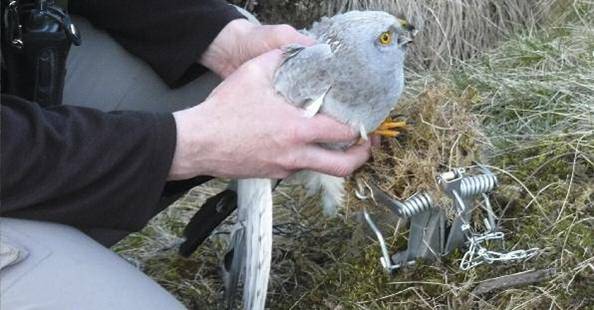
Convicted gamekeeper Glenn Brown was a member of the National Gamekeepers’ Organisation

Well finally, the National Gamekeepers’ Organisation has responded to one of the many emails we know were sent to them asking whether convicted gamekeeper Glenn Brown was one of their members (see here).

Here is the reply sent to one of our readers today:

From Ann Robinson-Ruddock (NGO) – “Thank you for your enquiry. I can confirm that Mr Brown was a member of the NGO but that following his convictions he has resigned“.

Fascinating. I guess we now know why the NGO has been reluctant to make a public statement on its website since Brown’s conviction in June 2011. Although to be fair, perhaps they’ve waited seven months to see whether his appeal, based on the assertion that he’d been ‘framed’ by the RSPB, was successful. We found out a week ago that his appeal  had failed, some might say spectacularly. Yet still the NGO has failed to make a public statement.

Wouldn’t you expect an organisation, that not only promotes itself as a member of the Partnership for Action against Wildlife Crime, but states on its website that “Our organisation has a strict disciplinary code  and does not tolerate those who bring the gamekeeping profession into disrepute“, to make a big song and dance about publicly condemning Brown’s criminal activities, and making sure that everyone knew he’d been expelled from the organisation? What we get instead is a delayed private response, that says Brown has resigned, and no mention of condemnation or expulsion.

Is there any wonder that conservationists are so cynical when it comes to trusting the sincerity of the National Gamekeepers’ Organisation? At least when twice-convicted gamekeeper David Whitefield was outed as being a member of the Scottish Gamekeepers’ Association in December 2011, the SGA had the sense to immediately and publicly admit that he was a member, outrightly condemn his criminal activities and kick him out of the club (although the phrase they used was ‘suspended’ rather than ‘expelled for good’ – see here). UPDATE: the SGA has now reportedly given Whitefield “a life ban” (see here).

Come on National Gameepers’ Organisation – when the Scottish Gamekeepers’ Association is making you look bad you know your public credibility rating is probably at rock bottom!

Thank you to the contributor who sent us the NGO email and thanks to everyone who contacted the NGO and pressurised them for an answer.

Is he, or isn’t he?

Last Tuesday (24 Jan), Derbyshire gamekeeper Glenn Brown lost his appeal against his conviction for seven offences under the Wildlife & Countryside and Animal Welfare Acts (see here).

On 25 January 2012, we asked whether Glenn Brown was a member (or now an ex-member) of the National Gamekeepers’ Organisation (NGO), and encouraged readers to contact the NGO and ask for themselves. I don’t know about you, but the NGO has so far ignored the email we sent to them about it.

Interestingly, the NGO was very quick to post a statement on its website recently about the conviction of a Norfolk head keeper and his apprentice for animal cruelty offences (see here). The NGO stated that neither of the offenders were members of the NGO, and this statement was posted the day after the two were sentenced (sentenced on 11 Jan, NGO web statement posted 12 Jan 2012). UPDATE 8 FEB 2012: the NGO has now removed the statement on its website about the Norfolk head keeper and his apprentice.

So, why the silence over Glenn Brown? Was he a member of the NGO or not? It’s a simple enough question, isn’t it?

If anyone else wants to ask the NGO, you can contact them at: info@nationalgamekeepers.org.uk

Alice in Wonderland: curiouser and curiouser!

Are you sitting comfortably children? Then I’ll begin…

Once upon a time there was a girl called Alice, who fell down a rabbit hole and entered a fantasy world (‘Wonderland’) where everyone spoke gibberish and nothing made sense. In Wonderland, (also known as the Countryside Alliance HQ), Alice thought it was “absurd” that those evil-doers at the RSPB could claim that there were only four breeding pairs of hen harrier in England in 2011. Everybody in Wonderland knew that even though all the scientific studies proved otherwise, the hen harrier in England was not on the verge of extinction as an English breeding bird, that over 2,000 harriers were not ‘missing’ from the UK countryside, and in no way was anyone connected with game shooting responsible for the supposed decline.

To back up her theory, Alice suggested that “the hen harrier is more numerate than 7 out of the 15 species of birds of prey in this country“. Of course, everyone in Wonderland knew that the hen harrier is able to think and express itself effectively in quantitative terms (or, put more simply, the hen harrier is able to use numbers, i.e. it is “numerate”). How absurd to think otherwise! It’s those fools at the RSPB who are innumerate – they think two and two makes four, when clearly it makes 330 (which coincidentally is the predicted number of breeding hen harrier pairs that the scientist boffins clowns say are ‘missing’ from the oh-so wildlife-friendly grouse moors of northern England).

That’s the end of this fairytale – tune in next time to find out why the holocaust never happened. Night night, children, and beware of falling down rabbit holes! Although to be honest, there’s not much chance of that as most of them are stuffed with the corpses of illegally killed raptors.

For those of us living in the real world and not some kind of fantastical Wonderland like Alice and her chums, you might be interested in this newsblast that was written by Alice Barnard, Chief Exec of the Countryside Alliance (although not for much longer – see here) that arrived in my inbox this morning:

“The RSPB’s bird of prey officer has recently been claiming that the status of the hen harrier in England is so precarious due to illegal killing that he believes one wet spring or a fire at the wrong time of year could result in it becoming extinct. However, as the RSPB knows only too well, the term extinction is defined by the death of the very last of a kind, and its use to describe the future of the hen harrier is therefore nothing short of absurd; as is its claim that there are only 4 breeding pairs left in England.

In addition to Britain, the hen harrier occurs in a multitude of countries across the northern hemisphere, including North America, Europe and Asia. It has an extremely large population which is currently thought to be 167,000 breeding females, with no significant decline in that population globally. Internationally it is classified as a species of “Least Conservation Concern”, and with 663 pairs in the UK, the hen harrier is more numerate than 7 out of the 15 species of birds of prey in this country. Although only 4 pairs may have bred successfully in England in 2011, many hen harriers can be observed moving around the country throughout the year. The issue, therefore, is that of poor breeding success; not extinction.

There are numerous factors that can result in the poor breeding success of hen harriers, and in 2009 the RSPB and Natural England reported that it was entirely due to natural causes; not illegal persecution as all too frequently claimed by the RSPB. Indeed there have been no confirmed cases of persecution against the species for the last 5 years.

The fact is that hen harriers are vulnerable to predation by foxes and other birds of prey, lack of available prey, unintentional disturbance and by weather and accidental fires; or a combination of any of these. It also appears that there are other factors at play of which we are currently unaware, such as on the Isle of Man, where the RSPB’s 2010 survey found that the population of hen harriers had halved, for reasons still unknown.

We will continue to challenge the RSPB’s assertions of persecution against birds of prey as part of our promotion and defence of the shooting community and the valuable conservation work they do.

Alice Barnard, Chief Executive, Countryside Alliance”.

Here is a link to the RSPB press release to which Alice may be referring (see here). Let’s hope that in her new position as Chief Exec of “a leading Education charity“, Alice does not need to use comprehension skills (the RSPB press release clearly states that they are referring to an ENGLISH hen harrier extinction, not a global one as Alice tries to infer), nor literacy skills (look up the word ‘numerate’, love). Maybe she’d be better sticking to fairytales – she does those quite well.

So who is set to replace Alice in Wonderland? Step forward some military guru, former head of the UK field army, the amusingly named Lieutenant General Sir Barney White-Spunner (see here). Are they expecting a war?

‘Bumper’ grouse season proves raptors aren’t having a ‘significant impact’

The 2011 grouse season closed on Saturday. According to an article in the Shooting Times, it’s been a “bumper season“, and, “many moor owners, keepers and shooters around the UK will be reflecting on one of their best years in decades” (see here for article).

In another review, this time just of the Scottish grouse season, Robert Rattray, head of CKD Galbraith’s Sporting Letting Department, comments on the performance of some well-known grouse moors (including Glenogil, Millden and Invercauld) and he writes: “The 2011 grouse season will be looked upon as one of the best in recent living memory, and in many instances a distinct improvement on the 2010 season, in itself regarded as one of the best seasons for a decade or more” (see here for his report).

All very interesting. So much for the supposed ‘significant impact’ of raptors on gamebirds, repeatedly trotted out by the gamekeeper and landowner associations in their quest to legalise persecution. If, as they claim, they are not already killing everything with a hooky beak that dares to even look at their grouse moor, then it seems to me that they’re managing to [legally] kill a record number of red grouse without having to go after the raptors. So what’s the problem?

Of course, there are some who’ll read this blog and will have a different perspective – that is, the 2011 grouse season was a ‘bumper’ one precisely because anything with a hooky beak in the vicinity of the grouse moors had already been killed off.

Things to do list #2

In the November 2011 edition of Birdwatch magazine, Mark Avery calls for our views about hen harriers and grouse moors. He says that if we send our views to the Birdwatch editor, they’ll be summarised and sent to a range of organisations including the Moorland Association, the Game and Wildlife Conservation Trust, the RSPB and the Scottish Raptor Study Groups.

Is there any value in doing this? Do you think the anti-harrier brigade will pay any attention to our views? Why would they? It’s been illegal to kill harriers since 1954 – this hasn’t stopped anyone doing it, and has pushed harriers to the very brink of extinction as a breeding bird in England, and severely depleted their numbers in parts of Scotland, so why would the harrier killers stop now?

The alternative is to do nothing, giving the grouse-shooting fraternity the chance to use our silence as an indication that we simply don’t care. We can’t let that happen, can we?

In Avery’s Birdwatch article, he writes a small piece about the harrier problem, but given the limited page space he can’t explain the problem in detail. He then offers three possible options on how to deal with the harrier/grouse issue, and asks readers to comment on them, or alternatively, suggest other options. Avery’s three options are paraphrased here:

A: Just forget it. Conservationists are fighting a losing battle and should turn their attention to more important issues.

B: Keep up the fight and keep publicising illegal persecution because if we lose the harrier, other species will surely follow. Keep talking to the ‘good guys’ in shooting who also want to see an end to harrier persecution.

C: Forget about trying to work with grouse shooters – they’ve had their chance to put their house in order and have failed miserably. Instead, lobby for an outright ban on grouse shooting.

If you want to comment on the issue, email your views to: editorial@birdwatch.co.uk. You’ll need to write before the end of November.

If you want some detailed background reading on the issue, we recommend reading Avery’s earlier articles about the harrier-grouse problem that he’s written on his personal blog (see here), and some of our earlier blog posts on harriers (see here, here, here, here, here, and here).

To subscribe to Birdwatch magazine online, click here.

It’s oh so quiet

Is it just us, or is anyone else curious about the deafening silence of landowner and gamekeeper organisations following last week’s report about the discovery of poisoned bait on Glenlochy Estate (see here)?

For two organisations (Scottish Land and Estates and Scottish Gamekeepers Association) who have been making (welcome) press statements about their condemnation of criminal raptor persecution, and their desire to ‘stamp it out’ of their industry, it seems a bit of a missed opportunity. We wonder whether Glenlochy Estate is a member of the SLE? We wonder whether any Glenlochy Estate gamekeepers are members of the SGA? We don’t know, because neither group publishes their membership lists for public scrutiny. And to be fair, neither group is obliged to publish that information, but you’d think that in light of the recent discovery, which isn’t the first for this particular area (see here), these groups would want to grab every opportunity available to publicly distance themselves from what appears to be another incident of alleged wildlife crime on a Scottish sporting estate. Wouldn’t you?

Poisoning by numbers

Last week the RSPB published its annual UK-wide report on raptor persecution (Birdcrime 2010, see here). We said we’d comment on the report once we’d had a chance to read it. Others chose to comment on the day of its release, or to be more accurate, their commentary was probably written prior to the release and was probably based on the content of the RSPB’s press release, rather than on the actual report’s content (see here).

Birdcrime 2010 held few surprises for many of us. The report carried details of raptor persecution incidents (confirmed, probable and possible) that had been reported throughout 2010, so by not publishing the report until November 2011, many of the items could be considered ‘old news’ (or at least those incidents that had been previously reported in the media – as usual, there were several incidents recorded in this report that were not made public at the time they occurred). That’s not to say the report has no value – it is an immensely important document because it is still the only publication to collate these national statistics in one place. It would just be more useful if it could be published at the beginning of the following year to which the report relates, rather than at the end of the following year, but limited RSPB staff resources may prevent this.

One advantage of publishing the report so late is that information can be provided on the outcome of criminal proceedings for those persecution incidents that actually made it to court. For example, the report provides some previously unpublished information about the trial of gamekeeper Glenn Brown, who was found guilty in June 2011 of operating an illegal trap to take birds of prey (amongst other crimes) on Howden Moor in the Peak District in April and May 2010 (see here, here and here). According to Birdcrime 2010, Judge Caroline Goulbourn “ruled that she viewed the attack on the integrity of the RSPB investigations staff by Bertie Woodcock QC on behalf of Knights Solicitors as an aggravating factor in the case. In addition, she criticised Brown’s employer, Geoff Eyre, who leases Howden Moor from the National Trust, for being evasive and reluctant to answer questions” [Birdcrime 2010, p.17].

Incidentally, there is further detail about this case that has been written in the RSPB’s newsletter, Legal Eagle 65. On page 2 the following has been written: “During the ten day trial, the prosecution relied on expert evidence including Prof Ian Newton, Dr Mick Marquiss, Stewart Scull, Dr Alisdair Wood and Guda van der Burght. The defence case, led by Bertie Woodcock QC, centred on the fact that Brown was not using the trap and the entire investigation was a set up with RSPB officers acting in bad faith throughout”. It’s good to see that Judge Goulbourn ruled against this, although what will happen at Brown’s impending appeal remains to be seen. Legal Eagle 65 reports that this appeal “is expected to take place in 2012”.

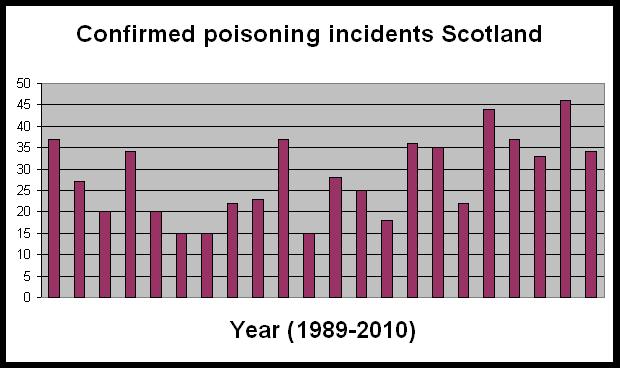
In addition to the case studies of earlier persecution incidents, Birdcrime 2010 reports that annual poisoning figures were down from 2009 (128 reported poisoning incidents in 2010, compared to 153 in 2009). It also reports that the 2010 figure is below the average for the last five years (2005-2009 average of 150 incidents). Unsurprisingly, it is this aspect that has been picked up on by the game-shooting lobby (e.g. see here). There has also been much made in the media this year about the ‘low’ poisoning figures for 2011 (e.g. see here) – although the published figures only relate to the first half of 2011; figures from June 2011 onwards are not yet available. So is this a sign of progress, as many of the game-shooting lobby would have us believe, or is it indicative of something else? For example, the lower figures could well be an indication that the gamekeepers have finally seen the light and have decreased their poisoning efforts. On the other hand, it could be an indication that gamekeepers are either (a) getting better at hiding their crimes, (b) switching to other persecution methods such as shooting, which is less likely to be detected, or (c) reporting efforts by the authorities have fallen. At this point I don’t think that either ‘side’ can claim a ‘victory’ in the on-going war of words. It is far too early to tell. For example, if you look at the graph that was published in the RSPB’s earlier report, The Illegal Killing of Birds of Prey in Scotland in 2010 (see here), then this reported decline in poisoning incidents can be seen in much clearer context. The graph I’m referring to appears on page 11 of that report and shows the number of confirmed poisoning incidents in Scotland from 1989-2010. The graph has been recreated for this post – see below (thanks to the contributor who sent it!).

If you look closely at the graph, you will see a great deal of variation between years in the number of confirmed poisoning incidents. Of particular interest are the years 1994 and 1995 – in these two years, confirmed poisoning incidents dropped to a low of 15 from a previous high of 35+. However, if you then look at the following three years, the number of confirmed incidents steadily rose until they reached 35+ again. In 1999, the figure dropped again to 15, and from then until 2010, that figure has steadily risen and fallen, although never reaching the low of 15 again. So what does that tell us? I’m fairly sure that in the years 1994 and 1995, the game shooting lobby would have declared a ‘victory’ as the figures had dropped so much, and would have shouted from the hilltops that they’d changed their ways.  I’m also fairly sure that in the following three years when the figures rose again, the conservationists would have declared a ‘victory’ and pronounced that their claims of widespread persecution had been vindicated. Either way, it is clear that neither ‘side’ can draw conclusions just based on an annual figure; for a trend to be detected, we need to see long-term figures.

But do these figures actually provide the full picture? If you read the recent paper on historical persecution at Atholl Estate (see here), then it’s pretty obvious that the ‘official’ persecution figures are meaningless, in the sense that they don’t tell the whole story. And from a conservation perspective, the figures, whether accurate or not, are not really that important. To steal a line from the recent paper on peregrine persecution on grouse moors (see here), “….it is the population level impact that is important, rather than the number of confirmed persecution cases”. We now have peer-reviewed scientific studies that have shown how persecution on grouse moors is having a population level impact on several vulnerable species (golden eagle, hen harrier, red kite and now peregrine). We have yet to see any peer-reviewed scientific studies that can counter these findings and show that these species are NOT impacted by persecution on grouse moors at a population scale. Why do you think that is, and more to the point, what are our politicians going to do about the published findings, apart from telling us that the Scottish government’s support for grouse shooting “goes beyond words“? (see here). Let’s hope that support doesn’t go beyond action as well.

New collection of evidence protocol for incidents of raptor crime

We have been passed a document that shows the new protocol for the collection of evidence in raptor persecution crimes. The protocol has apparently been agreed by the Scottish Raptor Persecution Priority Delivery Group (SRPPDG). This group includes representatives from the Scottish Government, Scottish Natural Heritage (SNH), Scottish Gamekeepers Association (SGA), Scottish Land and Estates (SLE), Royal Society for the Protection of Birds (RSPB), Scottish Raptor Study Groups (SRSG), Science and Advice for Scottish Agriculture (SASA), National Wildlife Crime Unit (NWCU), British Association for Shooting and Conservation (BASC) and the Scottish police.

Here it is, and we have added a few comments at the end:

COLLECTION OF EVIDENCE PROTOCOL FOR INCIDENTS OF RAPTOR CRIME

1.      Introduction

1.1    Police have a duty to investigate crime and all Forces have a single point of contact with regard to wildlife offences. Each Force also has a number of Wildlife Crime officers specially trained to deal with offences against raptors in a manner consistent with legal prosecution procedure.   This includes knowledge regarding relevant legislation, power to enter and search land, authority to seize evidence, requirements for corroboration, safeguarding chains of evidence and forensic capabilities.  Consequently, all crime or suspicious activity relating to raptor persecution should be reported to the Police.  

1.2    Such incidents could include reports of dead or dying birds, egg stealing, nest interference and disturbance, raptors caught in traps or devices set to catch them, suspected poisoned baits, incidents involving commercial operations and suspicious activity.

1.3    As crimes against raptors can occur in remote countryside, all investigations are risk-assessed by Police with regard to health and safety implications.

1.4    The specific legislation covering matters to do with raptor crime (including their nests) is the Wildlife and Countryside Act 1981 (as amended).

1.5    This protocol is intended for all groups and members of the public who are not authorised by statute to conduct criminal investigation into offences against raptors.

1.6   If evidence of suspected raptor persecution is found by members of the public, the protocol outlined below should be followed.  Occasions may arise when the public decide to choose between preserving a crime scene in accordance with prosecution procedures, and interference for the sake of human or animal welfare, or for reasons of urgency.  Consideration should always be taken with regard to all risks posed by equipment, live species or carcasses.  Any interference with a legitimate operation may result in prosecution.  Consequently, the protocol outlined below has been recognised as the recommended method of evidence recovery with regard to raptor crime.

2.      Protocol

2.1.   Incidents of raptor crime are often found by members of the public.  Those which, on the basis of the information available, are suspected of being a crime, must be reported to the police.  Any evidence should be neither handled nor interfered with at this stage. 

2.2    Any crime that is in progress or has just been committed, or where the suspect(s) is still in the vicinity, the Police should be contacted (if possible) using ‘999’ and the caller should be guided by the operator.  In all other cases where facilities allow, the caller should immediately contact their respective Police Force call centre, ask if possible to speak with a wildlife crime officer, and provide them with the following information:

  • Explain what has been seen or found and why crime is suspected.
  • Provide an estimate of how long the bird has been dead if a carcass is found.
  • Give descriptions of any suspects and vehicles seen.
  • Give a GPS reading or a grid reference of the crime spot (if possible).
  • Provide reasons if suspecting the presence of pesticides.
  • Divulge any other potential risk hazards.
  • Give any key landmarks to assist Police in finding the location at a later time.
  • Note if there are power lines overhead or any obvious sign of how the bird died.
  • Give any details known of the estate, farm, owner or employees

 The caller will then be guided by the Police as to what steps to take.

2.3    If the caller is unable to contact the Police immediately or has to leave the location, the caller should follow the course of action outlined below:

Carcasses

         In the event of finding a carcass in an area easily accessible to Police, to:

  • Record the grid reference.
  • Photograph the carcass and any other item that might appear to be obvious evidence (if possible).
  • Leave the carcass where found.
  • If the carcass looks like a bait, where possible cover it over with available branches or vegetation to lessen the risk of predation.
  • Report it to the nearest Police Station.

  In the event of finding a carcase in a remote area, to:

  • Record the grid reference.
  • Recover the carcass only if suitably equipped and deliver it to the nearest Police Station, or
  • Photograph the evidence (if possible), cover it over with available branches or vegetation to lessen the risk of predation and report it to the nearest Police Station. 

  Injured Birds

         In the event of finding a live, injured raptor suspected to have been the victim of crime:

  • Record the grid reference.
  • Moving the bird is entirely at the risk and assessment of the finder.
  • Contact the Police at the earliest opportunity to arrange further specialist veterinary assistance.

Traps

         In the event of finding an unlawful trap:

  • Record the grid reference.
  • Make the trap inoperative only if safe to do so and if sure that it has not been lawfully set, otherwise do not interfere with it and report it to the nearest Police Station. 

Nest Disturbance

         In the event of finding physical nest disturbance in an area accessible to Police:

  • Record the grid reference.
  • Photograph any carcass and/or other item that might appear to be obvious evidence (if possible).
  • Leave the carcass and/or items where found.
  • Report it to the nearest Police Station

 In the event of any physical nest disturbance in a remote area:

  • Record the grid reference.
  • Photograph the nest and any other item that might appear to be obvious evidence (if possible) and report it to the nearest Police Station.
  • Recover any item that may appear to be obvious evidence only if corroborated and able to do so without destroying or contaminating fingerprints/DNA, and deliver it to the nearest Police Station.

 Shooting

         In the event of finding a shot raptor:

  • Ensure one’s own safety.
  • If a dead bird is found, follow the procedure for ‘Carcasses’ if safe to do so.
  • If the bird is still alive, follow the procedure for ‘Injured Birds’ if safe to do so.     

2.4    The police will follow up reports of suspected wildlife crime, including a scenes-of -crime examination if appropriate, within a time-scale appropriate to the effective investigation of the type of incident.

2.5    If a suitable response to an incident by the police is not possible within the time-scale needed for effective investigation, the police may make specific requests of the member of the public and that, if relevant, the crime scene is preserved until a scenes-of-crime examination can be carried out.

2.6    All efforts must be made to preserve evidence in a manner compatible with the standards required for admissibility as evidence in court by following the principles within this protocol.

2.7    Where there is evidence of an offence, costs of any necessary examinations will be met by the police. 

2.8    Any subsequent media release should be in accordance with existing protocols and must not compromise any subsequent Police investigation.

2.9    Some agencies have specific powers enacted by law to collect evidence under prescribed circumstances.  Those powers remain unaffected by this protocol but the organisations concerned are bound by alternative working arrangements with the Scottish Police.

It’s interesting that the protocol emphasises (in bold) that suspected raptor crimes should be reported to the police. It’s also noticeable that the protocol does not include the additional reporting of suspected raptor crime to the RSPB. Whilst the police have a statutory duty to investigate wildlife crime, we all know too well that some forces are better at this than others. Even former Environment Minister Roseanna Cunningham acknowledged as much (see here). If another agency (e.g. RSPB) has also been informed about the suspected incident, then increased pressure can be applied to ensure the police do actually investigate the incident. The RSPB has a track record of doing this (e.g. see here), but if the suspected incident is only reported to the police, then who will check whether the incident has been investigated? This protocol does not provide for any follow-up procedures.

Not only that, in a recent report by the National Wildlife Crime Unit (Strategic Assessment, February 2011; see NWCU 2011_02 strategic-assessment), the following statement appears in the section about recent peregrine persecution:

Almost half of these reports originated from the RSPB but were not reported by the police force the offence occurred in“. (Page 30, paragraph 6.12).

So again, if a suspected raptor persecution incident is only reported to the police, and that particular police force then fails to report the incident to the NWCU, then the NWCU’s annual figures on raptor persecution incidents will be flawed.

Thanks to the contributor who brought this document to our attention.

RSPB ‘may have been brainwashing children in schools’

We didn’t think it was possible to top the recent claim by the Scottish Gamekeepers Association that eagles might eat children (see here). How wrong we were. Their latest considered opinion is that the RSPB  ‘may have been brainwashing children in schools’.

This claim follows the article in the Telegraph last week where it was reported that Scottish landowners were upset about a cartoon in an RSPB kids magazine (see here). It’s not clear who wrote the latest SGA tirade, but we’re assuming it’s a view held by the organisation as a whole, seeing that it’s published on their website.

The article accuses the RSPB of ‘sponging off children’ and discusses ‘the incredible success raptors have enjoyed in the countryside since the cessation of DDT’. It also accuses the RSPB of ‘poisoning young minds’. An ironic choice of verb.

To learn more about the evil RSPB, read the full article on the SGA website here

Meanwhile, south of the border, Mark Avery continues his series about what he calls ‘the raptor haters’ on his blog. This month it’s well-known ‘countryman’ Robin Page. Well worth a read (here).

Tip of the iceberg

Anyone who has been reading the ‘official’ annual raptor persecution reports over the last few decades will be familiar with the phrase, “These figures represent the tip of the iceberg”. Conservationists have long held the view that many illegal raptor persecution incidents go unreported, given the remote locations involved and the cultural and social pressures that inhibit certain sectors of the rural community from speaking up about these crimes. Most reports of poisoned, shot, or trapped raptors come from people who have found them by chance, for example hill walkers and dog walkers. The game shooting lobby, in response to the ‘tip of the iceberg’ statement, usually asks, “Where’s the evidence?” The numerous (and ever-increasing) glut of peer-reviewed scientific publications, that show a clear correlation between persecution and upland grouse moors, are usually dismissed as ‘pseudo-science’ by the landowners and gamekeepers, and the conservationists are often accused of conducting some sort of smear campaign against the game shooting industry.

No doubt we will hear all of this, and more, in the coming few days once the RSPB Birdcrime 2010 report has been published later this week. For certain, the report will contain the statement, “These figures represent the tip of the iceberg”, or words to that effect.

So, if the gamekeepers want evidence, here’s some that was unwittingly provided by….er, gamekeepers. It comes in the form of a recently (Sept 2011) published paper in the journal Scottish Birds, which is published by the Scottish Ornithologists’ Club. The paper was written by R.L. McMillan and is entitled, ‘Raptor persecution on a large Perthshire estate: a historical study’. Unfortunately we’re not allowed to publish the whole paper here (you have to be a member of the SOC to get access, or google the author and ask him for a PDF for your personal use) but here is the abstract:

The Atholl Game and Vermin Lists provide an almost continuous record from 1867 until 1988 and in many respects are unique for a large estate in Scotland. Large numbers of raptors and owls were destroyed by gamekeepers during the latter part of the 19th century and into the late 20th century. The implementation of legislation to protect predatory birds appears to have made little difference to persecution levels. Gamekeepers on individual beats seemed able to decide whether they killed predators or not. A few gamekeepers chose not to kill any birds of prey. Some persecution continued well into the late 20th century and a comparison between estate records and incidents recorded by the authorities strongly suggests that a substantial amount of illegal persecution was not recorded.

The paper provides a detailed insight into the extent of raptor persecution on Atholl Estate,  covering the historical period when it was legal to kill raptors (pre-1954), and the current period when it is illegal to kill raptors (1954 onwards). Gamekeepers on the nine beats at Atholl Estate were required to submit annual report cards that recorded the number of game and ‘vermin’ [including raptors!] that was killed on each beat. According to the paper, McMillan writes of Atholl Estate:

To maintain the estate record of game and vermin killed, the individual shooting beats were required to complete a card by the end of February each year and this contained details from the preceding year. The same printed card had been in use for many years and this included hawks, owls and ravens. Although the estate factor regularly checked the returns on these cards, it was only when a member of staff expressed concern that protected birds were included in the returns, that a new form was introduced for the 1988/89 season which excluded protected species”.

The historical records covering part of the period (1867-1911) when it was legal to kill raptors don’t provide any surprises, showing that 11,428 ‘hawks’ were killed on Atholl Estate, in addition to 3,731 owls. Sadly the records do not distinguish between different species of ‘hawks’ or owls and McMillan has interpreted the term to include every raptor and owl species that would typically occur in the area.

The more recent records, however, are of far more interest. They show the period covering the introduction of the 1954 Protection of Birds Act (making it illegal to kill all raptors except sparrowhawks, which weren’t protected until 1961) and McMillan’s graphs of persecution incidents show that the legislation was ignored on the two beats whose records he analysed. In fact on one beat, McMillan shows that persecution actually increased at the time the Act was implemented.

But the most interesting part of this paper comes in Table 3. It is a comparison of gamekeeper records from just one Atholl Estate beat, with the ‘official’ RSPB data for the whole of Scotland, from the period 1980 – 1988. The RSPB data only include details of raptors that have been killed (so not details of ‘suspected’ incidents). Here’s an overview of McMillan’s findings:

1980/81: Atholl Estate beat = 19 raptors killed; RSPB official data for all of Scotland= 9 raptors killed.

1981/82: AE beat = 21; RSPB all Scotland= 23.

1982/83: AE beat = 36; RSPB all Scotland= 16.

1983/84: AE beat = 36; RSPB all Scotland  = 13.

1984/85: AE beat = 25; RSPB all Scotland= 12.

1985/86: AE beat = 22; RSPB all Scotland= 8.

1986/87: AE beat = 14; RSPB all Scotland= 13.

1987/88: AE beat = 30; RSPB all Scotland  = 15.

So, in each of the years listed, with the exception of 1981/82, the ‘official’ RSPB figures for the WHOLE of Scotland were lower than the number of illegally persecuted raptors on just one shooting beat. Does anyone need any clearer evidence that the ‘official’ statistics of illegal raptor persecution are just the tip of the iceberg?!! Of course, there are plenty of arguments that could be made about the reliability of the gamekeepers’ records – i.e. keepers could have inflated the number to earn a bonus, or alternatively keepers could have reduced the number for fear of providing potentially incriminating evidence. McMillan deals with these and other issues in the paper. And for those who think the persecution stopped when Atholl Estate stopped recording it in the 1988/89 season, McMillan reports that “between 1989 and 1999, a number of incidents were logged by the RSPB on several shooting beats on the Atholl Estates, not all of which were confirmed, but which included shootings of raptors, trapping of birds including golden eagle and the deliberate destruction of broods of hen harrier and peregrines“.

It’s worth bearing in mind that these figures in Table 3 are from just ONE beat on just ONE sporting estate. You don’t need much imagination to guess what these figures would look like if records from every sporting estate in Scotland were included in the analysis. This should provide some perspective when we read the ‘official’ figures in the RSPB Birdcrime 2010 report later this week.

It should be noted that under the current management, Atholl Estate regularly provides a home for breeding golden eagles, peregrines, hen harriers and other raptors.

Full paper citation: McMillan, R.L. (2011). Raptor persecution on a large Perthshire estate: a historical study. Scottish Birds 31(3): 195-205.

Atholl Estate website here

Thank you to the contributor who alerted us to this publication.