

2012 wildlife crime conference: Ruaraidh Nicolson (ACPOS)

This is blog number three in our series looking at the presentations made at the recent 2012 police wildlife crime conference. This time we’ll hear from Assistant Chief Constable of Strathclyde Police, Ruaraidh Nicolson, who is also the new lead on wildlife crime at ACPOS [Association of Chief Police Officers in Scotland]. For more info on Ruaraidh, see here.

Ruaraidh Nicolson (ACPOS)

Minister, Chief Constable, ladies and gentleman, I’m delighted to welcome you to the 19th Scottish police wildlife crime conference. I suppose I should firstly mention, er, the fantastic setting here and we all come back here on a very, very regular basis and all police officers actually get trained here, its of particular relevance with its beautiful surroundings and ready access to so many diverse habitats which benefit our wildlife. What better place then for a conference such as this. An environment which, as of 2008, Scottish Natural Heritage commissioned report has shown has a value of over £17 billion to the Scottish economy, and which employs one in seven of all full-time workers in Scotland. My previous chief officer colleagues who have opened these conferences have done so from their position of representing ACPOS from the operational policing business area. However, recognition that wildlife crime impacts seriously on Scotland’s valuable natural heritage and that it is probably linkaged to serious organised crime groups has influenced to move to where it now rightly sits, and that’s within crime business area, and that’s actually where I come in to all this; I’m the secretary for crime business area and as the ACPOS lead now, volunteered as Nevin said, on wildlife crime, er, I am delighted to open this important conference today.

ACPOS crime business area is committed to impacting on crime affecting the environment and has incorporated criminal investigation and environmental crime in to one specific portfolio area, and of course this is underpinned by all six of our ACPOS guiding principles: leadership, partnerships, customer focus, excellence, learning, and diversity. These principles are what our business in tackling wildlife crime are built upon, and indeed each are equally relevant to achieving the successful outcomes which our country expects. The clear benefits to an intelligence-led approach to addressing criminality are well established. This involves linking the sourcing and development of intelligence to tried and tested policing and partnership methods, to impact on operational activity, to disrupting criminality and ultimately to changing behaviour, which will be the important part of the work that we’re doing.

The investigation and disruption of all aspects of wildlife crime fits very well within this successful model. However, to ensure further success in such activity we must continue to stimulate and maintain the submission of high quality information. Without information on the people responsible, criminal methods, locations of interest, and activities known to criminals involved in damaging our natural environment, they are on the front foot and we are not. That’s something that I’m not prepared to accept.

We must explore and develop new sources of intelligence. The role of the Partnership Against Wildlife Crime, in providing such intelligence, cannot be overstated. Every piece of information is crucial, no matter how small that might be. Our experience tells us that the development of intelligence is like building a jigsaw: start at the corners and work your way into the middle, but every piece is very, very important to the overall picture of what we’re doing.
We must progress the development of the national intelligence model and the Scottish intelligence database. We live and work in times of austerity and the public expects police and partners to operate efficiently. But they also rightly expect that we also operate effectively. By use of the national intelligence model and the Scottish intelligence database we are well placed to have the right people doing the right things at the right time in the right way. This is no more than good business sense and it is what the public expect, but it’s also importantly what our environment deserves.

We must encourage the increased use of tasking and coordinating to focus on intelligence-driven work, linking partners effectively results in the best use of resources, together with the right skills and the right powers. This is not just about police; it’s about every person in this room today and beyond, so you all have a part to play in what we’re actually trying to achieve here.

We must further develop memoranda of understanding with Partnership Against Wildlife Crime partners and with pertinent agencies to assist in the sharing of appropriate information and intelligence. We need to continue to formalise our information sharing, help share our assets and continue to build our relationships and trust. A critical aspect of this intelligence-led approach is that success is best achieved when close and effective partnerships are forged and developed across the spectrum of those individuals and bodies that have an interest in the crimes being perpetrated. The Partnership Against Wildlife Crime provides an excellent example of this being applied and I am confident that we have made significant steps to address wildlife and environmental crime, and I know that the benefits are there for all to see, and there was reporting on Radio Scotland this morning in terms of some of the work that’s already been done. However, and this is what today’s about, there is much, much, much more to be done.

Of course I can’t speak today without mentioning police reform. While this is undoubtedly the single biggest organisational challenge undertaken in the history of Scottish policing, it brings with it great opportunities to exploit the collective expertise, resources and passion that currently exists across eight territorial force areas. Real law enforcement impact towards wildlife crime will only be achieved if we fully harness the full extent of the problem. We need to demonstrate to those involved in damaging our wildlife and our environment that we know who they are, and that we will make use of the same policing assets that we are applying to other investigations, detection and disruption of all forms of criminality. The message to people involved in such crime is simple: Scotland relishes its wildlife and environment and damage to these will not be tolerated.

Modern criminal investigation thrives on the benefits that intelligence brings. 2011 saw re-focus of the Scottish wildlife crime tactical tasking and coordinating forum. Identification of those responsible for damaging our wildlife and environment is at the heart of this. But there’s a need to drive activity at most local policing levels to make sure that enforcement and prevention activities are locally relevant and impacting. But also in order that local police officers grow their own knowledge of those people within their communities who are intent on harming their environment. And of course vice versa. We want local criminals to grow their knowledge that local police officers have them in their sights.

If we can continue to grow our approach to addressing local issues relating to wildlife and environmental crime, this will help us develop much broader knowledge of those individuals that operate within the wider national and international arena. We will target criminals involved in wildlife and environmental crime from every angle possible, locally, nationally and internationally. But the truly effective approach for Scotland must start with locally relevant and effective police and partnership activity. There should be no gaps in commitment, whether this is from policing, partner agencies or the public, and I entrust you to broaden their complete contempt of wildlife and environmental crime within your community and to take personal responsibility to drive forward exposure of those committing such crime in order that enforcement organisations can most effectively disrupt those behaviours.

So my message for the forthcoming year is clear. Scottish policing will continue to actively pursue those involved in damaging our wildlife and the environment. We will work closer with partners to be more effective in painting the intelligence picture. We will develop and broaden awareness among our staff about crime that affects our wildlife and the environment. We will make sure that the policing mechanisms in place to target other forms of criminality are equally applied to those issues affecting our natural environment. And finally we will use our intelligence regarding other forms of criminality as a vehicle to help us disrupt and detect those harming our wildlife, environment, and we will use our intelligence regarding those involved in wildlife and environmental crime to disrupt and detect those involved in other forms of crime”.

[Well done Ruaraidh for managing to deliver an understandable presentation. Yes, it was still littered with bureaucratic jargon but at least it was put together coherently, and in amongst all that business-speak was a message of clear intent. Can that good intent be turned into tangible results? That remains to be seen but he should be given the chance to have a go; at least he wasn’t suggesting national police operations with gamekeepers!]

2012 wildlife crime conference: Nevin Hunter (NWCU)

This is the second blog in the series focusing on presentations made at the recent police wildlife crime conference in Scotland. This time we look at what the new head of the National Wildlife Crime Unit, Nevin Hunter, had to say. (For background info on Nevin, see here).

Nevin Hunter, NWCU

“Ok, you know we’ve got UK priorities, erm, you’ve heard mention already of the national intelligence model and the way in which we try and work and deal with wildlife crime and I’m not going to focus on that too much, I’m going to focus on some other aspects. Erm, you know, everything we’re about now is about harm reduction really in terms of, of, wildlife crime, erm, you know, we’re looking at national crime threats and four distinct areas of work because many of you will be aware of this in terms of its enforcement but as I’ve gone around speaking to a number of people from, erm, a number of different partner organisations over the last few weeks I’ve been trying to stress something really and that, that actually a lot of the prevention, intelligence and enforcement has been having a fourth element to it that, and that’s all around reassurance because if we want to get people to engage with us and support us in the fight against wildlife crime we’ve got to think about that as a virtuous circle if we can, if we can, er, have effective prevention, we get good intelligence, we get effective enforcement, that is going to build reassurance amongst those people who are supporting us, erm, that will then lead in itself to more preventative actions, intelligence, enforcement and that’s what I talk about in terms of virtuous circle, so it’s really important that we continue to build upon that.

Erm, I put this slide up just for one reason alone. We are the UK National Wildlife Crime Unit and, er, it’s really important that everybody understands we’ve got the UK perspective, you know, we’ve shown over the last few years, erm, things like Operation RAMP that we really can deliver at an international level, erm, some of you know me well, in the last three and a half years I’ve spent seconded to, to Animal Health, erm, dealing with CITES endangered species issues, erm, and bird registration issues and have been, you know, I wrote the UK operation order for Operation RAMP that a number of you in the audience will have been involved with, er, albeit that I was working then with the civil service, erm, dealing with, with those types of issues. Erm, but we can do this work, what we’ve got to remember though, erm, you know, we’ve shown we can operate at an international level, er, we can provide operational support, erm, and I’ve got mutual administrative systems and regional mutual assistance treaty, right, we can, we can do that type of work, we’ve shown we can do that and we’ve really built on that and we’ll continue to do so but I look at it a lot of the work we do that at an international level is core business to us now and we know how to deal with that, we, you know, CITES is a priority we can deal with that sort of work but I’m very conscious coming in to this role with the UK National Wildlife Crime Unit it’s really important to me that we start delivering and really thinking about the priorities that we’ve got in the UK.

Erm, now you can’t, you can’t actually get a picture of a black hole but one of the issues that people regularly, sort of regularly flag to me up that, er, the last several weeks the feeling at times that, that the National Wildlife Crime Unit can be seen as a bit of a black hole in that lots of things come in to us but you guys and girls out there are dealing with things operationally on the ground what you see come out from us. Now that doesn’t mean that we’re not working hard, you know, I, I know how hard the people in the unit worked, I worked really closely with Brian and the team over the last few years, erm, they all work incredibly hard, erm, dealing with a number of priority areas but I’m very conscious that your perception of us out there may not be as good as it could be in terms of where we’re delivering at a UK level. We really do deliver at an international level, that’s quite clear. Erm, and I want to look at, focus about, erm, perhaps things that we ought to be looking at, now these are my perceptions and some of them are my views so please, erm, I hope I’m not going to insult anybody but I think you need to think about these things.

Erm, I think there needs to be a re-focus on the UK wildlife crime priorities, are all of these relevant, erm, are they things that we can deliver on? Erm, we need to perhaps consider and review how we deliver the processes, can we define these better for wildlife crime, erm, those of you who see it and most of you certainly from a policing point of view will get copied in to the strategic and tactical assessments that we make, they are, they’re very long documents and when I’ve gone around speaking to people the vast majority of people have said we don’t read all of them, we read the little bits that are of interest to us, but there’s a huge amount of time spent in the unit putting those documents together. Now, concerns are raised about how relevant they are in terms of how timely they are, er, because we’re trying to process a mass of information, get that into those types of documents, erm, and we are doing it, that, in the best way we can, is it the fact that we’ve got a large number of priorities, the fact we’re being asked to produce very large documents actually as effective are we being as effective as we can be with that?

Erm, I see that role for the head of the unit going ahead now is going to be to drive action by the priority delivery groups, er, and when I talk about that I’m talking about outcomes, erm, I went to a meeting recently with Mr Crompton and Brian Stuart, erm, and Mr Benyon the UK Minister and I know that ministers, you know, across the UK are looking at the whole issues, it’s about outcomes now, we’ve got to be outcome-driven so we’ve got to be looking at how we deliver, we’ve got wildlife crime priorities in the UK and I’ll be making sure we deliver those, er, and I see it as a role for me in the future with my team to help drive through those UK priorities.

Erm, in terms of operation ways, erm, way ahead, erm, I think we need to make sure that we make the priorities relevant to you. We’ve got to be looking at effective disruption of criminality, yeah? If we’re going to use the national intelligence model to its best effect we need to get it in there and disrupting criminality, yeah? It needs to be and there’s a role for me and my team in that. We need to make it relevant to you, erm, so I see now that there should be a role of operational support from the head of unit, erm, you know, when we get large complex investigations, erm, from a policing point of view we’re going to look at silver command type structure, bronze, silver, gold command as you’ll be aware of from a policing point of view, you know, we’ve got to be thinking then about what roles, erm, what roles somebody like a silver commander, a lot of silver commanders are going to be involved, erm, perhaps we’re looking at inspectors, chief inspectors, superintendents probably going to be involved with some of these complex cases with no understanding of wildlife crime. You may have gone and made a business case to them to get the job and to run it, erm, but is there a role for somebody like me to come and provide the tactical advisor bit for an operational silver commander to make sure they’re able to make the best decisions and I don’t think we’ve played that role in the past, erm, but with my sort of background now I bring that into the, into the equation to be able to support and when we may get complex operations, erm, and I think that that’s a way in which we can connect with you.

I think we need to be looking as well at, erm, if we look, if there’s a perception that we might be a bit of a black hole, yeah? You want to see stuff, and this is what people are telling me, you want to see stuff coming out of the unit, er, I know Colin and others within the unit have discussed over the last year or two about whether we could look at something like a weekly dissemination to yourselves. Erm, the national domestic extremism unit produces a weekly update of all extremism issues around the UK, erm, going out to all forces across the UK giving updates of the major issues. Perhaps we need to be looking at that, erm, if you’ve got ideas on that or things you’d like to see us bring in to that type of document please let us know. Now we may have to look at it in terms of integrity within the unit in terms of our staffing because we are challenged at the moment but we want to move towards something where not only are you putting information and intelligence into us, you know we welcome intelligence all the time, but we want to be putting stuff out to you because we need, we need that virtuous circle again, we need you to be linked in to what we’re doing and to see you actually getting stuff coming out of us.

Erm, I think we can look as well at, to consider platforms, erm, such as the police on-line knowledge area, now that’s hosted at the moment by the national police improvement agency, erm, and under something called POKA, that’s as I say the police on-line knowledge area, er, it’s effectively a secure messaging, er, system, message boarding system. Now I’ve been talking about this via email and discussion the last few weeks and that’s an opportunity perhaps if we could put, develop wildlife communities, er, coordinate that according to in terms of the police communities where we can then start to share, er, information, knowledge, understanding, er, will we get any of the sort of developments that the, er, sheriff was talking about earlier on, can we feed things into there, feed peoples experiences so that you’ve got an opportunity to look at things that may be going on across the, er, Scotland and the wider UK, er, where we can learn from because we need to take these opportunities.

Ok, just to finish off, enforcement challenges, erm, I think key for what we do in the future has got to be about support the majority of people to undertake lawful activities, that’s key about what we do. Erm, targeting the minority of those who undermine, er, and, and who operate at local, national and serious and organised levels, you know, we’ve got, we’ve got to look at that and, and I flagged that up and I’ll give you two examples of why I think it’s, ok, we’ve got to mean business and I’m flagging two issues here, poaching, ok? It’s really important that we harness the energy of people like gamekeepers, factors, landowners and others to tackle across Scotland, er, and the rest of the UK with a, with something like potentially a national operation. That’s one of the things that, er, in the last few weeks I’ve been speaking to, er, Scottish Land Estates and, er, National Gamekeepers down in, down in the south of the border now, you know, is there potential for things like operations, national operations and we need to harness those energies. Whilst we want people like gamekeepers on side, erm, and there’s also the potential that when looking at raptor persecution that we, you know, anybody who’s allowed to use, uses or allows to be used things like carbofuran and that sort, that’s a photograph on there from a poisoning incident, erm, erm, that I dealt with several years ago down in Devon, similar types of things, somebody’s been squirting carbofuran granular form on to a pheasant poult, putting it out to try and kill buzzards, erm, people have got to understand that there’s potential that if they’re, if they’re doing that then now, you know, there’s a likelihood they’ll go to jail, now the finger gets pointed all the time at gamekeepers so I’m saying on the one hand well let’s work with gamekeepers to potentially push forward things like anti-poaching initiatives, work with them at the same time saying we need help to deal with the persecution of raptors, erm, so we’ve got to, got to get people on our side, erm, and that I see as something that I’ve got a big part to play in trying to drive things forward and show that we’re tackling the UK priorities.”

[Jesus Christ. Somebody needs to get these NWCU people on to a public speaking training course. Although in all fairness to Nevin, it looks as though he wasn’t properly briefed about his audience. Even so, get rid of the jargon, get rid of the bureaucracy and simplify your message. E.g. “Hello everyone, I think NWCU has a good track record at an international level but I recognise that we’ve been a bit shit at a national level and I intend to address that issue. We need your help to accomplish that”. Who cares about which model is used, or whether the commander has a bronze, silver or gold certificate for cycling proficiency? WE DON’T CARE, NEVIN! What we care about is whether you and your team can get results and bring more of those who continue to persecute raptors and other wildlife, to justice. That’s it. A helpful hint: launching a national operation in partnership with gamekeepers is unlikely to improve your unit’s credibility with the raptor workers. Just saying…]

2012 wildlife crime conference: Charlie Everitt (NWCU)

The 2012 annual police wildlife crime conference took place a couple of weeks ago. Quite a few of this year’s presentations were relevant to raptor persecution so we’ll be commenting on these in due course. To start off the series we’ll focus on what Charlie Everitt had to say. Charlie is the Scottish Investigative Support Officer at the UK National Wildlife Crime Unit (NWCU). See here for more details.

Charlie Everitt: Update on Raptor Persecution

Scottish Raptor Persecution Priority Delivery Group, and that’s a mouthful, erm, has been concentrating more on poisonings just at the moment, and also on processes so that we can get things right in order to take things forward for core purposes. Consequently we’re just finishing off and hoping to sign off at the next meeting an evidence gathering protocol. Now this is guidance and best practice for organisations who are likely to come across raptor persecution victims, er, giving advice and guidance on who they should contact, how the, er, any carcasses should be recovered and where they should be handed in to, so it’s giving best practice in order to maximise our chances for convictions in court so we get the process right. So that should be signed off, er, at the next meeting.” [See here for a previous blog about an earlier draft of this protocol. We haven’t seen the final version yet but look forward to seeing it in the near future].

“And similarly we’re looking at, er, another protocol with regards to satellite tagged birds, and this is a case where we have birds that have been satellite tagged and maybe the tag, er, stops giving off a signal, erm, or the signal remains stationary, just a protocol as to what we should do, er, in order to take the next step in order to recover the satellite and to investigate what’s happened. So just to make sure that we are lawful in what we are doing. So that’s a protocol as well that should get signed off very soon.

And the third angle, and it’s taking up a fair bit of time, is looking at a very new approach to the whole raptor, erm, raptor persecution issue. Now I can’t really say a great deal more on this at the minute, it’s in its early stages of development just now but when it is it will be put through tests and if it is fit for purpose it will be rolled out and, erm, yes you’ll all be made well aware of it when it does emerge.

We’ve also been looking to the use of science to try and benefit from what science can deliver to us. Now the science of course can back up intelligence and information crucially and the science has been used to good effect when combined with information and intelligence in a presentation to Northern Constabulary last year about the red kites on the Black Isle and their failure to manage to expand from there. So I think that was a good example of just how the two can sit together.” [Eh?]

“The Raptor Study Group of course do a lot of good work with regards to monitoring, erm, raptors and are able to work out where black holes might appear where we should have raptors and where there might not be some. Now there might be good reason for these black holes appearing, [no shit, Sherlock!] er, but what it does do, as I say, when you mix the intelligence and information with the science we get the fuller picture of what might be happening on the land there.

And the final thing we’re looking at doing is to ensure that we can capture all the information from the Raptor Study Group because they’re the people who are out on the land and if they do have any snippets of information we want to make sure that we capture all that intelligence and information in the National Wildlife Crime Unit through the five X five X five system, so that’s, er, er, another area which I’m looking to address very soon.

Now we’ve had some prosecutions, er, either concluded, erm, or, er, occurring during 2011, er, just run through some for you just as an update. In May a shoot manager in Skibo was fined £3,300 for possessing 10.5 kilograms of carbofuran, er, that was the biggest haul we’ve ever recovered in Scotland. And also in May last year a keeper from Moy was fined £1,500 for the possession of a dead red kite. On in October a ‘keeper from Huntly was fined £250 for the illegal use of a cage trap and possession of an illegally trapped buzzard. In November two photographers from London and Norwich were fined £600 and £500 respectively for recklessly disturbing a pair of white-tailed sea eagles at a nest in Mull. In January of this year a former gamekeeper from Biggar was ordered to carry out 100 hours of community service for poisoning four buzzards with alphachloralose and this is a guy who had been convicted before back in 2008. And also in January of this year a, er, another keeper from Lamington was fined £635 for possession of carbofuran. Now for me I think that’s a really good return for one year’s worth of work, er, and there used to be years when we only got two or three convictions in a year, now we have a good number and, er, I think buried inside all of those results is excellent partnership working which I think we must recognise with all our partner agencies.”

[We believe it’s misleading to use these cases as an indicator of success. What Charlie failed to mention is that in some of these cases (Skibo, Moy and Lamington) the only successful charges related to ‘possession’. Nobody was actually charged for poisoning the raptors that were found at each of these sites (and in the Moy case, there were also other offences that related to the illegal use of spring traps, for which nobody was charged). It looks like the Crown Office has gone for the minimum charge possible (i.e. possession) just to secure a conviction. To put this in context, it would be like claiming a success if someone had gone on a killing rampage using a car but was only convicted for not having any road tax. One of the other cases mentioned (Biggar – i.e. David Whitefield from Cullter Allers Farm, who already had a previous conviction for wildlife crime) was given a pathetic 100 hours community service order for poisoning four buzzards! Not good enough and certainly not an indication of ‘a really good return for one year’s worth of work’].

“The 2011 poisoning figures as the Minister suggested was significantly down, er, er, which is great news and very, very welcome to us to hear. Erm, all I’ll say is let’s see if we can continue that downward trend for the next three to five years and actually, and then, erm, solidify into a trend so that we do have this downward movement in poisonings but very grateful for anything where we have a drop in poisonings and that is, erm, excellent news.”

[Charlie failed to distinguish between reported poisoning incidents and actual poisoning incidents. There’s quite a difference and this should put the 2011 poisoning figures into context. He also failed to acknowledge the other methods of illegal killing and their impact on the overall issue of raptor persecution in Scotland. See here for previous blog on this].

“The hotspot maps meantime continue to help the police to focus their attention and, erm, identify where the areas need to be for resources to be deployed.

Now a few years back Lothian & Borders police had a pesticides dog that was able to sniff out carbofuran but it was very quickly withdrawn after there were some health and safety concerns. Well I’ve been having this chat with some of the dog handlers across Lothian & Borders and, er, they have told me that that dog is now available again for any searches, er, which Scotland want to undertake with regards to carbofuran. So that’s I think a positive move they’ve managed to sort out any health and safety issues there and just to put a little bit of context into that, Spain now have 15 dogs that can sniff out carbofuran and other poisons. Carbofuran poisoning has dropped by 40% since the early 2000s so we can think about the impact of the dogs.”

[Again, Charlie has only given half the story here. Yes, in parts of southern Spain (but not all!) the number of reported poisoning incidents has dropped by 40% since sniffer dogs were employed from 2004 onwards. However, crucially, there has also been a concurrent effort to increase enforcement against the poisoners. This includes the use of fines that have a real deterrent (up to €200,000 [~£167,000!]) as well as prison sentences; the temporary closure of the hunting area where poison has been detected; the suspension of hunting rights where the hunting methods are considered to have an unsustainable effect on natural resources; the employment of specialised units (x 3, containing 18 dogs) to patrol areas for the detection of poison – these patrols include ‘emergency inspections’ after poison has been reported, as well as ‘routine inspections’ of hotspots where the use of poison is suspected; and the use of three toxicology labs for poison testing. This is particularly interesting as when poison has not been detected in the first lab, but the use of poison is still suspected based on forensic evidence found at the crime scene (e.g. presence of certain insects), then the carcass/bait is submitted to one of two other labs that use more powerful techniques. In 2010, poison was detected in 38% of these carcasses/baits even though it was undetected at the first lab.

So yes, Charlie, the use of one single sniffer dog in Scotland is a positive move, but without the wider enforcement measures as outlined above, we’d be exceptionally naïve to expect that what has been achieved in parts of southern Spain will be replicated here in Scotland].

“Vicarious liability is also, erm, very much in discussion at the moment and I think last year I described myself as being cautiously optimistic about it. Well this year I’m very optimistic about it, er, with all the work that has been going on, er, behind the scenes and, er, what I would say is that this is not something that is just going to be a case of well we can’t get the person who has put out the poison so let’s just go and charge the landowner, this is going to require a lot of work, er, by any police forces looking into it, er, and looking to, to, er, look at charges of vicarious liability. The industry have also looked into it and have indeed a number of organisations in order to understand what they need to do to fulfil their obligations and that is to be welcomed because it does give us a minimum standard across the, er, industries which is as I say very, very welcomed.

So I was interested in the Minister’s comment as well that, erm, I got the impression that he wasn’t really looking for many prosecutions from this, erm, he was hoping that this would sort of be a Sword of Damocles if anybody was to continue poisoning so, er, I think with some of the work that’s been going on in the Raptor Priority Delivery Group that I think that is a very realistic possibility that we will get things sorted before we ever have to resort to vicarious liability.

One final thing, well another thing I’d just like to, er, just bring to your attention is a egg collector who was, lived down in London, erm, and his house was searched, a number of eggs removed including some golden eagle and osprey, erm, eggs which had been taken from Scotland. The CPS did some work, er, with one of the partner organisations and sought an ASBO against him and although he’s currently in jail, when he re-emerges he will not be allowed to enter Scotland during the nesting season for the next ten years. Now that’s a very powerful piece of legislation and a powerful condition to put on him and it’s something which I’ve asked for them to see if we can get hold of the paperwork to look at the procedure to see if we can do some, mirror something like that up in Scotland because it’s not just for, erm, for egg collecting that this is relevant, I can see other angles of hare coursing, er, deer coursing and the like so, er, that is going to be an interesting development to see what how it transpires.

Finally on the raptor persecution side, these are the guys who make up the Scottish Raptor Persecution Priority Delivery Group. Now there have been articles that are out in the public domain where we actually have organisations, people from organisations that are representative of the group, trying to drive wedges in against other organisations which, er, are in that group as well, which is often very disruptive and really doesn’t help us with the trying to take the full raptor persecution debate forward. What I would say to you is that if you do have an issue which you would like to discuss in, er, er, in an appropriate forum, rather than having a, er, er, a rant shall I say for a better word in, er, other media, here is a foum which you could bring this to through your representative in order to get a good full informed debate amongst all the organisations that need to be consulted in it. So that’s what I’d urge you to do if you do have any issues and you want to bring forward then please do not hesitate to contact them through your, through your representative.” [We think this rebuke was aimed at the Scottish Gamekeepers Association who recently published an article that suggested raptor workers could be laundering eggs and chicks on the black market – see here for previous blog on that].

Unravelling the ‘relationship’ between Hopetoun and Leadhills Estates

Last week we blogged about the recent article in The Scotsman and on the Deadline News website, relating to criticism of the RSPB for deciding to hold their inaugural Scottish Birdfair at Hopetoun House (see here).
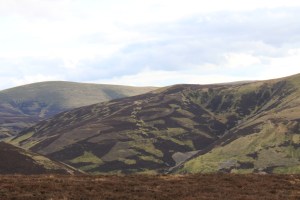
To begin with, readers should be clear that the location of the Scottish Bird Fair is Hopetoun House, in West Lothian, near Edinburgh. Hopetoun House is the historical family seat of the Hopetoun family (see here) and is home to the current Earl of Hopetoun (Andrew, who is also a Director of Scottish Land & Estates – see here). According to his SLE profile, Andrew is Chairman of Hopetoun Estates and Deputy Chairman of the Hopetoun House Preservation Trust, and, “These two organisations manage Hopetoun House and its related estates, mostly at Hopetoun near Edinburgh and around Leadhills in the Scottish Borders” [South Lanarkshire].

We are not aware of any alleged raptor persecution incidents taking place at Hopetoun House or its surrounding [West Lothian] landholdings and indeed, raptors such as buzzards and tawny owls are reportedly resident in the grounds of Hopetoun House and on the surrounding estate.

However, we believe that the criticism of the RSPB’s decision to hold their bird fair at Hopetoun House was not in relation to Hopetoun House per se, but rather it was probably in relation to the Hopetoun Estate’s alleged connection with Leadhills Estate in South Lanarkshire.

Leadhills Estate, as many readers will be aware, has been at the centre of dozens of allegations of raptor persecution (e.g. see here), and several gamekeepers there have been found guilty of wildlife crime offences (e.g. see here and here). Leadhills Estate is situated on land that is owned (but apparently not managed) by Hopetoun Estates and, if you believe the RSPB and the Earl of Hopetoun, that is the full extent of the relationship, as Leadhills Estate is reportedly let on a long sporting lease.

After the original article (criticising the RSPB) was published in The Scotsman, various statements were made by, and on behalf of, both the RSPB and the Earl of Hopetoun, to clarify the relationship between Hopetoun Estates and Leadhills Estate (see here and here). In essence, both were keen to highlight that Hopetoun Estates has nothing whatsoever to do with the management of Leadhills Estate and therefore there should not be an ‘issue’ about the RSPB holding its bird fair on land managed by Hopetoun Estates. The most significant comment, made by an un-named spokesperson for the Earl of Hopetoun, was:

More importantly, Hopetoun Estate has no role whatsoever in the management of Leadhills Estate. Leadhills Estate is run on a sporting lease completely separately and there is no connection between Hopetoun Estate and the sporting management of Leadhills Estate”.

This is a very interesting statement, mainly because it seeks to put distance between Hopetoun Estates and Leadhills Estate. However, if “Hopetoun Estate has no role whatsoever in the management of Leadhills Estate“, then how do Hopetoun Estates explain that they were one of the formal objectors to South Lanarkshire Council’s proposed ‘Core Paths Plan’ in January 2011, in which they objected to a proposed footpath network across a working grouse moor on Leadhills Estate? Here is a PDF of their objection statement: Hopetoun Estates objection statement

Looking at some of the comments made in the Hopetoun Estates’ objection statement, it would appear that this stated separation (between Hopetoun Estates and Leadhills Estate) may not be quite as clear cut as Hopetoun Estate and the RSPB would like us to believe. Of particular relevance are the comments made in section Q8, reproduced here:

Our [Hopetoun Estates] particular concerns include potential detriment to our farming and sporting interests due to dogs and the disruption they cause to birds, wildlife and sheep (especially at lambing and hatching). We are concerned about the implications of Health & Safety as landowner due to the actions we and/or our tenants carry out over the Estate including the use of vehicles and firearms. Walkers, cyclists and horse-riders will inevitably be in conflict with the use of quad bikes, 4x4s etc – the speed issue alone, coupled with the rugged terrain, blind summits, corners etc. offers significant cause for concern. Further to this, there may be times (shoot days, or when certain land management actions are being carried out) when we would require the closure of the Core Paths for H&S reasons. We are concerned about the cost implications to ourselves of undertaking such a closure and one would have to provide the manpower to police such closures during shoot days. Maintenance of the tracks are also a concern as horses and bikes can significantly break up the surface of the tracks which allows water to get into the body of the track and cause significant damage potentially making the track impassable for our Estate vehicles”.

Hmmm.

Now, Hopetoun Estates were one of several formal objectors to the Core Paths Plan (see here). Others of interest here include Leadhills Sporting Ltd (sporting agents with land management responsibilities at Leadhills Estate – see here); Allershaw Farming Ltd (which is listed elsewhere as a company involved with ‘Hunting, Trapping & Game Propagation and Related Service Activities’ and whose two listed directors just happen to have exactly the same names as the two directors listed at Leadhills Sporting Ltd – imagine the coincidence of that!); and Lord Linlithgow’s Accumulation Trust, whose address on the objection statement is given as ‘Hopetoun Estates Office, West Lothian’!!

What is striking about all four of these objections is the similarity of (most of) the paths they object to, and the reasons they provide for their objections.

Here are the four PDFs – compare and contrast and draw your own conclusions:

Hopetoun Estates objection statement

Leadhills Sporting Ltd objection statement

Allershaw Farming Ltd objection statement

Lord Linlithgows Accumulation Trust objection statement

Does anybody still think that “Hopetoun Estate has no role whatsoever in the management of Leadhills Estate” ?

Naturally, we’d be happy to publish any clarifications that Hopetoun Estates may care to provide.

strange anomaly over photographic evidence

Compare and contrast this case (where a photographer’s evidence was used to convict badger baiters and the photographer was commended as “brave and courageous” by the judge, see here), with the recent OneKind crow cage incident (see here).
Strange, isn’t it?

Still waiting for a response from Scottish Environment Minister Stewart Stevenson to clarify what is and isn’t acceptable evidence in suspected wildlife crime incidents in Scotland.

Thank you to the contributor who sent us the link.

Vicarious liability – what’s it all about?

There’s been a lot of talk recently about the new offence of vicarious liability and whether it will finally address the issue of illegal raptor persecution in Scotland. Some see it as the ultimate enforcement tool that will stamp out raptor persecution on shooting estates once and for all. Others see it as an unnecessary burden on purportedly law-abiding landowners, land managers and gamekeepers who have managerial responsibilities. The truth is that nobody knows for certain just how effective this new legislation will be, and until there have been some ‘test’ court cases, that uncertainty will remain.

We had hoped that the Scottish Government would provide detailed information and advice about the new legislation, but they haven’t. The following overview is our current understanding of the issue and has been put together after reading various articles and documents and we’ve included a list of useful links for further reading at the end of this blog post.

The new offence of vicarious liability in relation to the persecution of wild birds (where one person may potentially be legally responsible for the actions of another person) came in to force on 1 January 2012, as a provision in the Wildlife and Natural Environment (Scotland) Act 2011. It was introduced as an amendment to the draft WANE Bill in November 2010 by former Scottish Environment Minister, Roseanna Cunningham. It was a direct response to the unrelenting problem of illegal raptor poisoning and the apparent inability/unwillingness of the game shooting lobby to get their own house (grouse moors) in order (see here and here for background).

Interestingly, upon its enactment on 1 January 2012, it was widely touted as being aimed at ‘the few’ or ‘the minority’ who are persistently culpable in this area of wildlife crime (see press statements from Scottish Government, Scottish Land & Estates and National Wildlife Crime Unit here). Strange that the actions of a ‘few’, or the so-called ‘minority’, could cause the creation and introduction of a new offence, don’t you think? Isn’t it more likely that the government recognised that these crimes are carried out by so many, and to such a wide extent, that new legislation had to be brought in as the only measure capable of dealing with crime on this scale? Anyway, we digress….

When will the offence of criminal vicarious liability apply? According to the provisions in the WANE Act, it will apply to certain wildlife offences, but not all. There are three main areas of wildlife crime for which a person can be held vicariously liable:

1. Intentionally or recklessly killing, taking, disturbing wild birds and their nests.

There are exceptions, such as killing certain game birds or other species that are permitted to be killed, taken or disturbed under a general licence (e.g. crows), but in general, it is an offence to interfere with certain wild birds (including raptors), their nests and their nest contents, and it is also an offence to obstruct or prevent these birds from using their nests.

2. Prohibited methods of killing or taking wild birds.

This relates to the setting or placing of articles that could cause bodily injury to a wild bird. This includes the setting of various traps (including spring traps), snares, hooks, lines, birdlime, electrical devices for killing, stunning or frightening, and any poisonous, poisoned or stupefying substance.

3. Possession of pesticides.

Anyone found in possession of a pesticide containing at least one prohibited ingredient will be guilty of an offence (unless they have a specific approval order for its use). Prohibited ingredients currently include Aldicarb, Alphachloralose, Aluminium phosphide, Bendiocarb, Carbofuran, Mevinphos, Sodium cyanide and Strychnine (as named in the Possession of Pesticides (Scotland) Order 2005).

We understand that the maximum penalty for any of the offences is six months imprisonment and/or a £5,000 fine. If the offence was committed in respect of more than one bird, nest or egg etc, they will be treated as separate offences and carry separate penalties. In other words, the maximum penalty applies to a single offence only. So if someone is convicted of being vicariously liable for the killing of two protected birds, they could face up to 12 months imprisonment and/or a £10,000 fine etc.

Who can be prosecuted for the offence of vicarious liability? Well, that will depend very much on the circumstances of each individual case, and specifically the managerial involvement of each individual person. In general terms, however, anyone who either has the legal right to kill or take wild birds, or manages or controls the exercise of that right, and anyone who secures the provision of certain shoot-related ‘services’ from someone else may be vicariously liable for offences committed by another person. This could include, either singly or in combination, landowners, trustees, directors & officers (such as in a limited company), farmers, crofters, shooting tenants, shoot syndicate members, factors, agents, gamekeepers and contractors who procure or provide services relating to habitat management or shoot management.
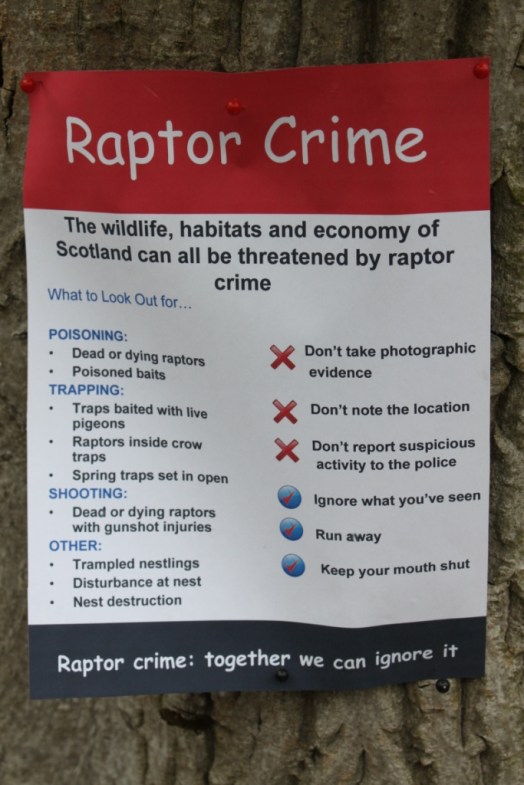
Before somebody can be prosecuted for the offence of vicarious liability, the prosecutor must demonstrate that the primary offence took place and that the offence was committed by a third party who has a specific relationship to the person being charged with vicarious liability. The person who committed the primary offence need not be prosecuted in order for a prosecution to be brought against the person in management or control. This seems a bit odd though, because if it can be shown that the primary offender committed the offence, then why wouldn’t he be prosecuted? Although perhaps it covers situations such as the primary offender emigrating, or dying, or having a plea-bargaining agreement with the prosecutor whereby he doesn’t get prosecuted in return for providing information about another crime or another person.

There is, of course, a defence to the charge of vicarious liability. The accused has to demonstrate to the court that:

(a)    he did not know the offence was being committed; AND

(b)   he took all reasonable steps AND exercised all due diligence to prevent the offence being committed.

It is not yet known what a court will accept as reasonable steps and due diligence, but the word ‘all’ may be significant (as in ‘all’ reasonable steps and ‘all’ due diligence). Much will depend on the specific circumstances of each case, but what does seem clear is that doing nothing will not be an adequate defence. As a minimum, the defendant should be able to show, with written documentary evidence, that work procedures have been evaluated, risks have been assessed, training has been offered if deemed necessary, a system of checks are in place and that regular reviews have been undertaken. These procedures are not dissimilar to the way a health and safety system operates so it should not be beyond the capabilities of someone with managerial responsibilities to undertake this type of procedural audit.

There is a significant amount of interest in how effective the new legislation will be, and we will watch with interest as the (inevitable) cases are brought before the courts.

It should be noted that the offence of vicarious liability (in relation to the persecution of raptors) is only currently applicable in Scotland. Other parts of the UK have not yet adopted this approach, although it has been reported that legislators in England are watching to see how well it works in Scotland. As illegal raptor persecution is just as much of a problem in England, conservationists have launched a petition to have the issue of vicarious liability debated in the English Parliament. The petition needs 100,000 signatures to trigger the parliamentary debate – please visit the petition site (here) and sign it!

FURTHER READING

Wildlife and Natural Environment (Scotland) Act 2011 (the full text of the Act here).

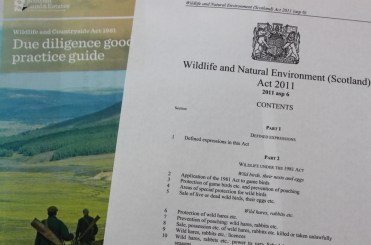
Scottish Land & Estates, the representative body of Scottish landowners, has written a guide about the issue of vicarious liability called ‘Due Diligence Good Practice Guide’. It has a foreword by Scottish Environment Minister Stewart Stevenson and it is said to have been endorsed by the PAW Scotland Executive. You might think that such endorsements would mean the guide is freely available, but you’d be wrong. It’s only free to SLE members; if you’re an interested member of the public you have to pay the princely sum of £30 (thank you to the three contributors who each sent us a free copy!). It is an interesting read though, and is by far the most useful guide we’ve seen so far.  Especially helpful is the presentation of various case studies involving different sectors of the shooting sector (e.g. large grouse moor, medium-sized owner occupied mixed estate, farm syndicate shoot etc) and the discussions about who might be liable to prosecution in each scenario. It’s been prepared by several ‘legal eagles’ who specialise in wildlife law but perhaps most surprisingly, thanks are given to James Hodge of Baikie Hodge Ltd. Would this be the same Baikie Hodge Ltd. with connections to Millden Estate (see here) and also Leadhills Estate (see here to download the PDF)? Interesting! If you want to pay £30 for a hard copy of the guide, contact SLE via their website here.

Solicitor Robert Scott-Demspter’s article on vicarious liability in the Scottish Field here [Scott-Dempster is also acknowledged as a contributor in the SLE’s guide].

Law firm Lindsay’s rural bulletin on vicarious liability here.

Law firm Turcan Connell’s briefing note on vicarious liability here.

Law firm Brodies’ article on vicarious liability here

An article on VL in The Journal of The Law Society of Scotland (Aug 2012) here

Eyes wide shut

It’s often said that the number of reported raptor persecution incidents in Scotland represents just the ‘tip of the iceberg’, which means that many more incidents probably remain undetected and thus unreported (see here for an earlier blog post about this). This shouldn’t come as a surprise to any of our regular readers, who understand that the combination of remote locations, increasingly-aware gamekeepers and some less-than-interested police forces can often result in an inaccurate (under)-estimation of the number of persecution incidents taking place each year.

With the imminent publication of the Scottish government’s 2011 Raptor Poisoning Map, due out any day now if they follow the pattern of previous years, we’ll soon hear claims from the game-shooting lobby that poisoning figures have dropped. We’ll also hear from the conservationists that the officially reported figures may have dropped but that the real extent of persecution remains unreported. The poisoning maps are a good example of this, because apparently they only show the areas where poisoned birds have been detected. What they don’t show, we’re told, is the areas where poisoned baits have been discovered. If that’s true, why do you think poisoned baits are not mapped and reported?

The Raptor Poisoning Maps also don’t show the extent of other types of illegal raptor persecution, such as shooting, trapping, nest disturbance, egg-smashing, chick killing etc. Nor do they show the last known locations of satellite-tracked raptors that have mysteriously ‘disappeared’ into thin air. Perhaps it’s time that the Scottish Government started to publish other maps to depict the extent of these various other incidents. Why don’t they do this already?

Inevitably, many potentially illegal incidents will slip through the net. We’ve been told of one such incident that happened very recently on a shooting estate in Scotland. We’ve been asked not to identify the estate or the gamekeeper for operational reasons.

So, a member of the public (let’s call him John) goes for a walk on this estate and sees what he thinks is a buzzard, in some distress, flapping around with a Fenn (spring) trap dangling from one of its legs. John is fairly clued up and immediately calls the police to report it. It’s a Sunday afternoon, so the Police Wildlife Crime Officer isn’t available (?!). Instead, an ‘ordinary’ police officer is sent to investigate. Mr Police Officer heads onto the estate to look for the distressed buzzard. He is met en-route by a certain gamekeeper, who asks him what he’s looking for. Mr Police Officer explains, and Mr Gamekeeper tells him that, by pure coincidence, he is also looking for a missing Fenn trap that has disappeared from a site where he had set it (legally), inside a tunnel to prevent non-target species from getting caught. His explanation for what had probably happened went something like, ‘Oh, the buzzard must have got inside the tunnel and then got caught in the jaws of the trap and flew off with the trap still attached’. Mr Police Officer apparently believed this explanation and off they went together to find the buzzard. They located it, and Mr Police Officer apparently asked Mr Gamekeeper what to do, and Mr Gamekeeper said the buzzard wouldn’t survive and it would be best if he killed it and disposed of the body, which he duly did. No body, no trap, no evidence, end of story.

The following day, two people visited the area where the buzzard had been found. Mr Gamekeeper appeared, challenged them, apparently told them to ‘get ‘arf my land’ (although his language was reportedly more colourful than that) and then told them ‘come back and collect your car tomorrow’, before dashing off down the road to block the exit with a tractor and trailer, preventing the visitors from leaving. The police were called, and eventually Mr Gamekeeper was instructed to remove his tractor.

The incident in question may or may not have been a case of persecution. Mr Police Officer clearly thought is was just an accident, which of course it could have been. Had he been aware of this estate’s history though, he might have viewed the incident differently. The estate in question has a well-documented track record of alleged raptor persecution (although none of the incidents have ever resulted in a prosecution). The incidents include the reported discovery of at least three poisoned raptors, and multiple nesting failures of breeding hen harriers in suspicious circumstances. In addition, at least two gamekeepers on the estate have a reputation for what might be generously called ‘obnoxious behaviour’ towards members of the public, dating back over a number of years, including claims of alleged assault (prosecution failed) and the deliberate blocking-in of vehicles to inconvenience visitors (presumably to discourage them from further visits). The police would be well aware of this history. Whether Mr Police Officer knew is not known, but hopefully he has now passed on the details of this latest incident to the Police Wildlife Crime Officer. If nothing else, the WCO could pay Mr Gamekeeper a visit to make sure his Fenn traps are being set legally (ie. covered).

We’re told that this estate is one of the 250+ that have signed up for the new Wildlife Estates Initiative. Unfortunately this cannot be verifed yet as the Initiative doesn’t seem to be interested in transparency at this stage of its development, even though one of its stated aims is ‘to introduce an objective and transparent system that demonstrates how wildlife management undertaken by Scottish landowners, in line with the principles of biodiversity conservation, can deliver multiple benefits for society and rural communities’. We’re all looking forward to the time when the Initiative is opened up to public scrutiny.

Clarification needed on how to report a wildlife crime

Following yesterday’s blog on the lack of prosecution for the apparent crow-beating incident (here), a comment made by Libby Anderson (acting CEO of animal protection charity OneKind) raises a pertinent question that deserves to be followed up.
Libby wrote the following comment on the OneKind blog (and we hope she doesn’t mind us reproducing it here) –

It is frustrating that such compelling evidence has not been allowed to get into court. And ironically, the Partnership Against Wildlife Crime (PAW) Scotland has just issued guidance to the public about reporting wildlife crimes – including looking out for suspicious vehicles and taking photographs or video.  But wouldn’t that be “surveillance” too …? ” (Her comment can be viewed here on the OneKind blog).

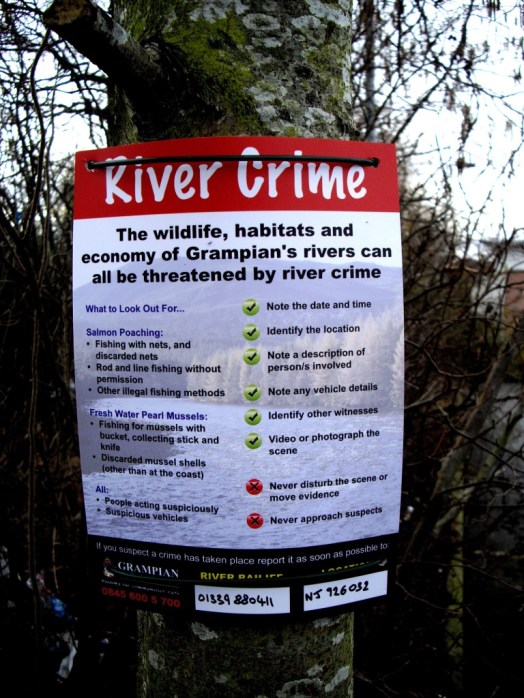
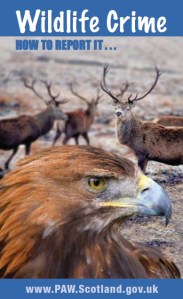
This is an important and timely question. As Libby points out, PAW Scotland has, quite rightly, recently made a very big deal about providing advice to the public on how we should report incidents of suspected wildlife crimes. PAW Scotland has funded a big publicity drive on this issue, led by Grampian Police, who produced an information card called ‘Wildlife Crime: How to Report It’ (see here to view the card). They printed 30,000 of these cards, for distribution across Scotland (see here for our earlier report on this initiative). The advice on these cards is, amongst other things, to video or photograph the scene.

PAW Scotland has also added a new section to its website, specifically explaining the law that governs the use of traps and snares, and the action that should be taken if a member of the public suspects illegal activity. This action includes getting photographic evidence (see here).

If you’ve read the OneKind blog, written by the investigator who filmed the alleged crow-killing incident, it appears he followed the PAW Scotland advice: He suspected illegal activity, he filmed it, and he reported it to the police. It seems the police shared his suspicions, otherwise why would they have passed the evidence to the COPFS?

So, why then did COPFS (and the Lord Advocate) decide not to prosecute? Their official reason, according to the OneKind blog, was:

This decision was made because the prosecutors believed that I was carrying out surveillance on the estate when in fact my visit, which I had made very clear to the procurator Fiscal, was of an education one and was to gather film and photographic material of the various ways legal snares are set to capture wild animals.”

Is this the sort of treatment that any of us can expect if we see suspicious activity and decide to report it to the police? If it is, then we would suggest the system needs urgent revision. It is clear that PAW Scotland (which happens to be chaired by the Scottish Environment Minister, Stewart Stevenson), needs to provide clarification on this issue as a matter of urgency if we are to have any confidence in the reporting system currently in place.

The Minister could ask COPFS to provide a detailed explanation of why, in this case, a decision not to prosecute was made, especially in light of the OneKind investigator’s statement of why he was on that land at the time he witnessed the alleged offences. We think there is precedent for COPFS to provide an explanation – see here, section 7).

The issue here is not whether the alleged actions of the gamekeeper were lawful or unlawful (that can only be decided by a court, and obviously in this case, the opportunity for a court hearing is not going to happen). The issues here are:

1) who is eligible and who is ineligible to report a suspected wildlife crime, and

2) what standard of response can the public expect to receive from the law enforcement authorities when they report an incident of suspected wildlife crime?

If you want to send an email to Environment Minister (and Chair of PAW Scotland) Stewart Stevenson, to ask for clarification on these issues, here’s his email address: ministerforenvironment@scotland.gsi.gov.uk

Questions to ask him might include:

1. Can I expect to be accused of lying if I report a suspected wildlife crime to the police?

2. Can I expect my integrity to be questioned if I report a suspected wildlife crime to the police?

3. If the answer to the above two questions is ‘no’, why was a decision not to prosecute made in the alleged crow-battering incident (you’ll need to provide a link to the OneKind blog so the Minister knows to which case you are referring).

4. Please can you provide me with a definitive list of legitimate reasons that allow me to be on a piece of land, recording a suspected wildlife crime?

5. Please can you provide me with a definitive list of illegitimate reasons for being on a piece of land, recording a suspected wildlife crime?


SSPCA continues to perform well in advance of govt consultation to increase their powers in wildlife crime investigations

A year ago in February 2011, former MSP Peter Peacock put forward an ammendment to the then Wildlife and Natural Environment (Scotland) Bill [known as the WANE Bill], to increase the investigatory powers of the SSPCA, to help with the effective investigation of wildlife crime, and particularly raptor persecution crime. The ammendment didn’t make it into the final WANE Act but former Environment Minister Roseanna Cunningham said it could be considered, after public consultation, in a later Criminal Justice Bill. Seven months later, in September 2011, MSP Elaine Murray raised the issue again (see here).

In November 2011, MSP Elaine Murray again raised the issue, and this time was told by the current Environment Minister, Stewart Stevenson, that the Scottish Government intended to begin a consultation during the first half of 2012 (see here).

So far we haven’t seen any movement on the impending consultation but there’s still another four months to go and when we do see some movement, we’ll blog about it here.

Meanwhile, the SSPCA has continued to enhance its hard-earned reputation for successfully bringing criminals involved in wildlife crime to justice. In terms of catching raptor persecutors, this was most recently demonstrated by the successful prosecution of gamekeeper David Whitefield, who was convicted of poisoning four buzzards on a shooting estate in South Lanarkshire (see here).

Their success doesn’t end there. Just last week, the SSPCA was instrumental in securing a ground-breaking conviction of a man who was guilty of keeping dogs used to fight against wild animals, including foxes and badgers (see here, here and here). A conviction for this type of crime isn’t novel – we’ve blogged about it all too often in recent months. What was ground-breaking about this case was that we believe it was the first conviction in Scotland for this type of offence (involving wildlife) under the Animal Health & Welfare (Scotland) Act 2006 – legislation usually reserved for incidents not involving wildlife. Perhaps this will start a trend and we’ll begin to see more use of this Act when dealing with raptor persecutors, for example, in cases where buzzards (or other protected raptor species) are illegally held in crow traps.

We look forward to following the public consultation in the coming few months on increased investigatory powers for the SSPCA.