
Raptor Persecution: still a national disgrace

The following article has been published in the autumn edition of Wild Land News, the magazine of the Scottish Wild Lands Group (visit their website here). The magazine should be posted online in the near future and we’ll provide a link when it’s available. Congratulations to the SWLG’s magazine editor, Calum Brown, for providing a platform for this subject. UPDATE: Magazine now published online. Link here.

Raptor Persecution: Still A National Disgrace. By Bob McMillan.

Bob McMillan has had a lifelong interest in birds of prey. He retired as Assistant Chief Constable in Tayside Police in 1998 at which time he was the ‘lead officer’ on wildlife crime in Scotland on behalf of ACPOS. He represented Scottish Raptor Study Groups on PAW Scotland and the Raptor Priority Persecution Group until 2011. He now lives on Skye and runs the website www.skye-birds.com

My childhood in the 1950s had been spent in a rural village near Dunblane in south Perthshire surrounded by sporting estates. To see a Buzzard or a Kestrel was a rarity, let alone a Hen Harrier. An early interest in birds was cultivated by older friends, one of whom had found breeding Harriers on a moor on the nearby Cromlix estate. He subsequently studied and photographed the birds, much to the consternation of the local estate which eventually took out a civil action and interdicted him from the ground. Twice prosecuted for breach of interdict, the case remains unique amongst individuals who have put themselves on the line to protect birds of prey from the illegal actions of gamekeepers and sporting estates.

Eddie Blake from Dunblane died recently. Somewhat eccentric, he received little support for his actions from the ornithological establishment who shunned him. In 1952 Blake had recorded the first breeding record of Montagu’s Harrier in Scotland on Braco Moor. Though the pair returned the following year, the female was shot. There have only been five recorded breeding attempts in Scotland and the last of these was in 1955. Montagu’s Harriers might still be breeding in Scotland today were it not for persecution, but rarely merit a mention alongside formerly extinct species such as Osprey, Red Kite and White-tailed Eagle.

When I joined the police service in 1963 my final interview was by the Chief Constable at Callander Police Station. Bedecked in tweeds and with two spaniels at his heels, George Glendinning was every inch the country squire. Any discussion about Blake’s interdict was strictly off limits but I later learned that Glendinning was a regular shooting guest on Cromlix estate. The influence of landowners on local policing was profound in the 1960/70s and vestiges of it remain today. Rural police officers had access to free fishing and shooting, which invariably meant an immediate response to suspected poachers, or for that matter, to ‘suspicious trespassers’ who were simply enjoying their Scottish right to roam. Many gamekeepers were Special Constables. Rural shoots in Perthshire would have been unsustainable had it not been for the many police officers who acted as ‘beaters’ at pheasant shoots on their days off. Though trained and aware of wildlife crime, such cultural influences would make them strongly anti-poaching, and more likely than not to turn a blind eye if an occasional Sparrowhawk was accidentally ‘taken out’ during a Pheasant drive. The police response to reports of illegal trapping or poisoning of birds of prey, up until the end of the 1980s, was likely to be ambivalent. Some raptor enthusiasts would argue it remains fairly unpredictable to this day.

Despite most raptors having legal protection since 1954, persecution by gamekeepers and those with sporting interests in grouse moors and lowland estates remains a major problem. In 1998 Scottish Raptor Study Groups carried out an assessment of the extent of the illegal killing of raptors in Scotland. Published by the Scottish Office, it was launched at the Scottish Wildlife and Countryside Fair at Kinross, where the late Donald Dewar, then Secretary of State for Scotland, expounded the view that persecution of birds of prey was a national disgrace. As a retiring Assistant Chief Constable in Tayside Police, who took the lead on wildlife crime in Scotland, my last public duty was to meet Donald Dewar at the event. In the context of the persecution of raptors, this was a major political statement, and the expression “a national disgrace” was used by many others subsequently. The reality was that the expression had been conjured up by a senior civil servant and Donald Dewar posed the question as to whether he could actually say it. The fact that he decided to say it represented a major politicisation of the issue, though not necessarily a turning point.

Having found my first poisoned Golden Eagle at an eyrie in Perthshire 40 years ago these problems were not new to me, as was the case for other raptor enthusiasts. What was new, however, was that senior politicians and officials of agencies such as Scottish Natural Heritage were, for the first time, prepared to speak out against the problem. Raptor persecution was by no means rare, and the killing of adult birds and destruction of nests continued or even increased during the 1990s. Donald Dewar also said that the Government, and the soon to be Scottish Parliament, “will take all possible steps to eliminate persecution.” Fifteen years on from this statement, perhaps finally, some progress is being made.

The Partnership for Action on Wildlife Crime (PAW) brings together the Police, HM Revenue and Customs, and representatives of Government Departments and voluntary bodies with an interest in wildlife law enforcement. It provides a strategic overview of enforcement activity, considers and develops responses to strategic problems, and looks at issues of strategic concern. Its main objective is to support the networks of Police Wildlife Crime Officers (PWCO). As part of the overall UK-wide structure, PAW Scotland has existed for at least 20 years. Although it has been responsible for many preventive initiatives post-devolution, and despite Donald Dewar’s commitment, it lacked strategic support from a number of the key agencies.
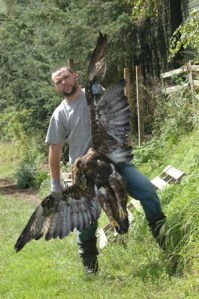
Since the SNP administration came to power that has significantly changed, initially under the leadership of the then Minister for Environment Michael Russell and, since then, through subsequent ministers. A major turning point was the Borders Golden Eagle poisoning incident in 2007 which led to two parliamentary debates on Wildlife Crime and the police thematic inspection ‘Natural Justice’. This led to the publication in September 2008 of the Scottish Wildlife Crime Reduction Strategy which is being implemented through a PAW Scotland plenary and executive group, and a number of sub-groups.

The persecution of raptors had been a major factor in influencing this new strategic commitment, and although a Raptor Persecution Priority Group was established, it has been slow to make progress and is still to report. The pro-shooting lobby has been extremely influential within PAW Scotland and within this group. In terms of the protection of raptors, much of this has muddied the waters and not been particularly constructive. Whilst it is important to have a partnership approach to deal with these problems, some question whether it is appropriate that the perpetrators, in the main gamekeepers and the sporting estates which condone these crimes, should be part of it. (More details of the work of PAW Scotland can be found at http://www.scotland.gov.uk/Topics/Environment/Wildlife-Habitats/paw-scotland/).
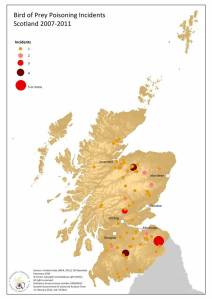
The accurate recording of wildlife crime incidents involving raptors is a major challenge and most will be aware that the RSPB in Scotland produce an annual report. Annual maps of incidents (‘maps of shame’) can also be found on the website above. A major challenge is to make sure that all wildlife crime incidents are reported to the police, preferably to Wildlife Crime Officers who are known locally. It is equally important to make sure that RSPB Investigations staff are also aware of any incidents reported to the police. Wildlife crimes such as suspected shooting or poisoning of birds, destruction of nests or eggs, or reckless disturbance should be reported at the time and without delay. The remains of dead birds of prey, irrespective of age or condition, may be important evidence and require forensic examination. Advice on what to do if you find a suspected incident is available on the PAW Scotland website.

Recently-published research showed that illegal persecution remained particularly prevalent on grouse moors, and for raptor workers and those who visit wild land this is perhaps nothing new. The recent recovery of a poisoned Golden Eagle in Morar and a shot White-tailed Eagle on Skye confirms that birds are at risk throughout the Highlands, not just on sporting estates. Some local populations face the prospect of significant decline unless action is taken. In areas of Scotland such as the Black Isle the re-establishment of the Red Kite continues to be jeopardised by illegal persecution, and each year brings further reports of the destruction of Hen Harriers and Peregrines.

Satellite telemetry is now being used extensively on several species of birds of prey, primarily intended to trace the movements of young birds to gather information which assists their long-term conservation. An unintended outcome from this new science is that when signals indicate a bird has stopped moving, follow-ups have established that birds have been trapped, shot and poisoned. Without satellite telemetry these crimes would never be known about. The Golden Eagle ‘Alma’, poisoned in 2009, is one such example. Unfortunately a significant number of recent persecution casualties involving our large raptors have been found in this way, supporting the argument that reported incidents represent the tip of the iceberg.

The ‘Natural Justice’ thematic inspection recommended dedicated Wildlife Crime Officers in every force. The reality is there are now fewer WCOs than existed when the inspection was carried out. Strathclyde, the largest force in Scotland, have had no full-time post for some years. With a single national police force just months away there is little evidence that there is any genuine commitment on the part of the police service to meet many of the earlier recommendations. Whilst we can work in partnership, increase awareness, improve legislation and ensure landowners and employers accept vicarious responsibility, we can achieve nothing without a properly trained and professional police service which can rise to the challenge. Regrettably, the number of successful prosecutions remains extremely low, and there is a need to ensure that, in terms of enforcement and investigation, the limited resources dedicated to this field of work are properly supported so that much of the political and public relations rhetoric can be converted into tangible results.

I was part of a delegation from Scottish Raptor Study Groups which met Roseanna Cunningham when she was Minister for Environment in November 2010, and we recommended that a dedicated investigative unit be established, comprising trained WCOs and specialists from the RSPB, SSPCA and SNH, with a remit to cover the whole of Scotland, untrammelled by force boundaries. Many will argue, politicians amongst them, that only a few rogue estates and gamekeepers are involved, but any review of the so-called ‘maps of shame’ and the RSPB maps which preceded them, would find that hundreds of estates have been involved in incidents during the last ten years. Uniquely, there are also several estates with histories of persecution going back 30 years. As long as the police have responsibility to investigate such crimes, there is a need for them to develop a cutting edge and target the perpetrators. There would never be a better time to establish a specialist unit than now.

Some fifty years on from my childhood days in south Perthshire I will certainly be able to see Buzzards, Kestrels, Sparrowhawks and even Red Kites when I visit. Unfortunately Hen Harriers remain absent from the moors of Cromlix and Braco. Golden Eagles show little sign of expanding their range, and there is a real risk that fifteen years on from the branding of the problem ‘a national disgrace’, the fate of some of the iconic species which occupy our wild land remains in the balance.
Glen Orchy: a hollow victory

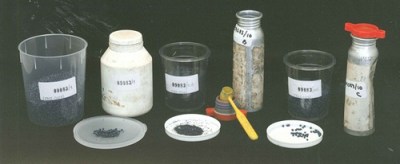
Last Friday, Tom McKellar, an employee of Auch Estate, an Argyll sporting estate in Bridge of Orchy, was convicted of possessing the illegal poison Carbofuran and was fined £1,200 (see here). This conviction should be a cause for celebration, and in some respects it is, but there is also an overwhelming sense of disappointment and frustration. We had all thought this was a pretty clear-cut case, with lots of investigative resources thrown at it, a strong evidential trail and a known suspect. We were further encouraged by a statement given by the then Scottish Environment Minister, Roseanna Cunningham, who said:

I am truly appalled that yet another golden eagle has been illegally killed in Scotland – the second this summer. Illegal poisoning is simply inexcusable and while the perpetrators are certainly beneath contempt they are in no way above the law“.

Given the nature of the alleged offences (wildlife & firearms), we were certain that a custodial sentence was inevitable. How stupid were we?

It all started to unravel in December 2010, 18 months after the poisoned eagle was found dead in Glen Orchy. We learned that Tom McKellar had been convicted of possessing two illegal handguns, but instead of receiving the mandatory five-year prison sentence, he was given just 300 hours community service and a commendation from the judge who reportedly told him: “There is no doubt you are an outstanding individual” (see here). There was little mention in the media about the poisoned golden eagle or the stash of illegal poison that had been found at McKellar’s house during the original police search. We were suspicious that the wildlife crimes were being ignored and that COPFS had decided to just take on the firearms offences because, in the eyes of the law, these are greater crimes than the poisoning offences and would normally result in a custodial sentence.

Based on these suspicions, we blogged about the case in January 2011, and suggested that no charges were being brought against anyone for poisoning that eagle. We also encouraged readers to contact the Scottish Government to complain. Many did, and all hell let loose. The Scottish Government responded by saying that the firearms offences were being dealt with separately, at a court with a higher authority than a Sheriff Court, and that the wildlife offences were still ‘being dealt with’. A well-known prosecutor threatened us, indirectly, with legal action. For what? Expressing an opinion? As it turns out, we were right all along, nobody has been prosecuted for poisoning that golden eagle, although we’ve had to wait for over three years to have this confirmed.

It then all went quiet for a while, at least publicly. It’s not known whether COPFS bowed to pressure to take forward the wildlife crime prosecution or whether they had actually been pursuing the charge all along, but that it took over three years for the case to conclude is probably quite telling.  Not that it really matters now anyway; what matters is the outcome.

So, a conviction was eventually secured, although this was just for ‘possession’ of a banned substance; in our opinion this is the least significant charge of any that could have been brought. McKellar admitted during interviews that he had laid out poisoned baits ‘in the past’, and yet he wasn’t charged for that. Were the words ‘in the past’ significant in the decision not to press charges for that offence? What does ‘in the past’ mean, anyway? Two years ago? Two weeks ago? Two days ago? Two hours ago? In addition to the poisoned golden eagle, a Carbofuran-poisoned fox was found and also a dead sheep laced with Carbofuran. Someone was clearly still putting out poisoned baits, but COPFS accepted McKellar’s claim that he wasn’t responsible. It’s unfortunate that these types of offences are only dealt with as summary cases in a Sheriff Court. It would have been interesting to hear what a jury might have thought had the charges been heard in a higher court. Again, we’ll never know and we have to accept that McKellar is guilty of nothing more than possessing the banned poison Carbofuran (oh, and possessing two illegal handguns).

It’s hard not to think that McKellar has come out of all this relatively lightly. It’s also hard to believe that his punishments will act as any sort of deterrent to other would-be criminals. He avoided a mandatory five-year prison term for the firearms offences, and he was fined just a fraction of the amount that he could have been fined for possessing the illegal poison Carbofuran. It appears that he has also kept his job. Auch Estate is currently up for sale (for a mere £8.4 million) and a look at the sales particulars (Auch Estate sales brochure 2012), dated August 2012, indicates that the new owner has to take on the current Estate employees under the TUPE regulations, including Farm Manager Tom McKellar. These sales particulars also show that almost £700,000 was paid in grants and subsidies during 2011; it would be interesting to know whether there will be any forfeiture of these payments following McKellar’s conviction, although based on previous experience, this information is exceptionally difficult to access, even though it’s public money! It would also be interesting to hear whether McKellar’s employer is being investigated, after McKellar reportedly claimed it was his employer who had provided him with the Carbofuran (see here). Wouldn’t it also be interesting to find out whether Auch Estate is a member of Scottish Land & Estates? And whether McKellar, as an employee of a sporting estate, is a member of the Scottish Gamekeepers’ Association? Needless to say, neither of these organisations has made any public statements about McKellar’s conviction last Friday.

Other question marks include a strange bit of (non)-reporting by SASA. The poisoned golden eagle found at Glen Orchy was listed in SASA’s 2009 annual report. However, the dead fox found nearby that was reported to have been poisoned by Carbofuran did not appear in the SASA report. Neither did the dead sheep also found nearby that was reportedly laced with Carbofuran and used as poisoned bait. Why weren’t these two animals included in SASA’s list of confirmed poison cases for 2009? Perhaps SASA didn’t do the toxicology tests. If they didn’t, then who did? If SASA did do the tests, but failed to include the animals in their report, what confidence does this give us when SASA release their annual poisoning statistics? Are other cases missing? We only knew about the fox and the sheep because the RSPB had listed them in their annual report.

A further question mark hangs over a related issue. The media has reported that the poisoned golden eagle found dead in Glen Orchy had been killed with the banned pesticide Carbofuran. However, if you look at the 2009 SASA report, the following chemicals are listed as being detected in this bird’s body: Carbofuran, Methiocarb, Sodium Cyanide and Strychnine. Now, we have it on good authority, although this has not been formally verified, that a second individual was searched during the police raid back in June 2009. This individual, XXXXX XXXXX is believed to be a gamekeeper in Perthshire but is not an employee of Auch Estate; he was just there on the day the police arrived to conduct their search. We understand that the police found Mr XXXXX to be in possession of a bottle of Strychnine and a container of decanted Cyanide. Now look again at the chemicals detected in the body of the dead golden eagle. As far as we are aware, no charges have been brought against Mr XXXXX, not even for possession. If this turns out to be an accurate report, then something has gone seriously wrong with this investigation. A lack of resources can’t be blamed on this one, given the array of organisations involved with the investigation, including multiple police forces with specialist wildlife crime officers as well as the National Wildlife Crime Unit. So what happened? Did Mr XXXXX slip through the net and if so, how? Do you think we’ll hear anything about this or do you think it’ll be quietly pushed under the carpet?

In summary then, yes, a conviction was secured (McKellar) and we should be pleased about that. McKellar’s illegal stash of Carbofuran and his illegal cache of handguns have been taken out of circulation and so we should also be pleased about that, too. But this is not what could be called a successful outcome; far from it. It’s deeply unsatisfactory and shares striking similarities with other recent, high-profile cases which also concluded unsatisfactorily, such as Moy Estate and Skibo Estate. In all three cases, and in countless other lower-profile cases, sporting estate employees have only been charged with the lesser offence of possession. Charges have not been brought against anyone for the illegally-killed raptors found in each location, nor for laying the illegal poisoned baits or for putting out the illegal traps. On a superficial level then, the convictions for possession look good and the authorities can claim they are successfully addressing the issue of wildlife crime. Scratch below the publicity gloss though and you find that very little progress has been made; charges, if they’re brought at all, are not reflecting the full extent of the crimes uncovered, and on conviction the sentences are not reflecting the seriousness of these crimes.

Linklater: “I stand by everything I wrote”

A couple of weeks ago we blogged about an article penned by the well-known advocate of ‘raptor control’, Magnus Linklater (see here).

He’s back again, this time as a guest blogger on Mark Avery’s ‘Standing up for Nature’ blog (see here). For a masterclass in arrogance and ignorance, you’d struggle to find a better example than his latest offering. You might think that “one of the country’s most respected journalists” (according to his editor) would have gone away to consider the factual inaccuracies that were pointed out by many knowledgeable readers of his original article, and then come back to discuss each point in turn. He didn’t manage to do that. Instead, he dug in his heels and stated, “I stand by everything I wrote“.

As is becoming more and more obvious, Linklater’s views seem to be representative of the majority of those involved in grouse-shooting, especially landowners and gamekeepers, judging by current and previous comments made by these groups. It’s easy to try and deflect attention from the real issue (continuing illegal raptor persecution) by attacking the UK’s largest conservation charity (RSPB), who just happen to be involved in exposing these illegal practices. What isn’t as easy is to convince an increasingly well-informed public that [driven] grouse-shooting shouldn’t now be banned.

For our anagram-loving readers, here’s another one: Kill Tuns Manager

Leadhills & Hopetoun: getting closer to the truth? Part 2

This post is a continuation from Leadhills & Hopetoun: getting closer to the truth? Part 1 (see here).
So, thanks to help from the ever-resourceful Andy Wightman (website here) and another contributor who wishes to remain anonymous, we’re now in a position to examine some of the statements made by the Earl of Hopetoun and his spokesman, about the relationship between Hopetoun Estate and Leadhills Estate.

Let’s start with a statement made by the Earl himself, in a letter he wrote to the Scotsman in March 2012 (see here). His letter was in response to an earlier Scotsman article about the Hopetoun / Leadhills relationship (see here).

In his letter, the Earl writes: “Leadhills Estate is not “also known as the Hopetoun Estate” – Hopetoun Estate is the land owned by the family near Hopetoun House”.

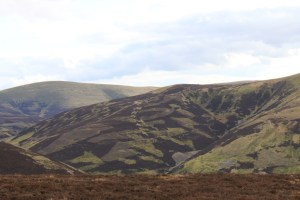
Now take a look at the photograph accompanying this post. This was sent in by a Leadhills village resident, who says it’s one of two signs in the village. The contributor wrote this: “I can assure that nobody in Leadhills (I live in Leadhills) refers to the estate as “the Leadhills Estate”. Locals have always known it as “the Hopetoun Estate”.

Hmm. Perhaps the apparent inaccuracy of the Earl’s statement is just a result of an absent landlord not really in tune with local views, as opposed to an attempt to distance Hopetoun Estate from Leadhills Estate? You can draw your own conclusions.

Let’s now take a look at the detail of the shooting lease between Hopetoun and Leadhills Sporting Ltd that covers the management of the Leadhills Estate grouse moor. Please bear in mind what we said in Part 1: the lease we are examining was acquired from the Land Register in September 2008, two months after the change of Directors at Leadhills Sporting Ltd. This lease may not be the lease in current use. (Incidentally, a contributor is sending us a copy of the lease he acquired in 2011 so when we receive that we can compare and contrast the content of both copies to see what, if anything, has changed).

Before we start, it’s worth reminding ourselves of the statement published on the Deadline News website (here) attributed to the Earl of Hopetoun’s spokesman:

More importantly, Hopetoun Estate has no role whatsoever in the management of Leadhills Estate. Leadhills Estate is run on a sporting lease completely separately and there is no connection between Hopetoun Estate and the sporting management of Leadhills Estate”.

It’s similar to a statement the Earl made in his letter to the Scotsman:

I must underline the view of the RSPB spokesman in stating that there is a long-term sporting lease in place at Leadhills and that Hopetoun does not have any responsibility for the shooting there”.

The lease makes for a fascinating read, once you get to grips with the obligatory long-winded legal jargon and the cramped-up presentation of the clauses. It tells us, amongst other things, how much rent the Tenant (Leadhills Sporting Ltd) has to pay to the Landlord (Hopetoun), and how much additional rent must be paid if the three year rolling average of grouse shot in each season exceeds 1,750 brace (3,500 birds). It tells us how many days of walked-up and driven grouse shooting the Landlord is entitled to, as well as how many walked-up rabbit shooting days and how many guests he is permitted for each day. It tells us that the Tenant must comply with the provisions of the Wildlife & Countryside Act 1981 and all other statutory provisions affecting the preservation of wildlife. It tells us that the Tenant shall permit a minimum of three and a maximum of four of the gamekeepers employed by the Tenant to assist the Landlord with the Landlord’s pheasant shoot in West Lothian for a maximum of five days in each pheasant shooting season. It even tells us how many coats of paint, and the type of paint, the Tenant must use periodically to maintain the interior and exterior of buildings.

So, it’s quite a detailed lease but its thoroughness is probably no different to thousands of other leases whereby a Landlord wants to ensure his Tenant keeps his property in good order. The bit about permitting 3-4 of the Tenant’s gamekeepers to assist on the Landlord’s pheasant shoot in West Lothian is perhaps a bit unusual but none of the above clauses give us any reason to doubt that Hopetoun “has no role whatsoever in the management of Leadhills Estate”. And indeed, the Earl’s stated condemnation of wildlife crime is supported by the inclusion of the clause about compliance with the relevant legislation.

All good then?  Well, almost. There are several clauses that deserve closer attention:

Clause 5.6.

Prior to the fifteenth anniversary of the Date of Entry the Tenant shall furnish the Landlord with the Curriculum Vitae of and all references pertaining to any proposed new Head Keeper and obtain the approval of the Landlord before employing a new Head Keeper which approval shall not be unreasonably withheld or a decision thereon unreasonably delayed. Following the fifteenth anniversary of the Date of Entry the Tenant shall keep the Landlord fully informed and shall jointly undertake the whole selection process for the employment of a new Head Keeper. This shall be in addition to obtaining the approval of the Landlord as aforesaid which approval shall again not be unreasonably withheld or a decision thereon unreasonably delayed.

Clause 5.8.

The Tenant shall produce a management regime and programme of improvements in respect of the Grouse Moor to be specified in a draft management plan within six months of the Date of Entry. The said draft management plan shall take account of the presumptions in the foregoing Clause 5.7 [these relate to “effective” vermin control, a “proper” heather-burning regime, road, lunch hut & butt maintenance, habitat management, heather improvement policies, provision of equipment for gamekeepers, H&S policy and an “appropriate” shooting policy] and shall thereafter be adjusted and agreed between the parties. The agreed management plan (“The Management Plan”) shall be revised and updated at the fifth anniversary of the Date of Entry and every five years thereafter such revisals to be adjusted and agreed between the parties.

Clause 5.12.

The Tenant shall meet with the Landlord/Landlord’s agent (unless otherwise agreed) twice yearly in January and July when the parties will review the Management Plan, the current and proposed works pertaining to the Let Subjects and the Grouse Moor and all matters pertinent to the management of a top class driven grouse moor.

Clause 8.1.

The Landlord shall be entitled to resume the Shooting Right for any purpose from any part of the Grouse Moor subject to a limit of 100 acres in total for the duration of this lease.

So, for clarity:

1) This lease shows that the Landlord (Hopetoun) has to approve the hiring of any new Head Keeper at Leadhills Estate for the first 15 years of the lease. Wouldn’t that count as being involved in the sporting management of Leadhills Estate?

2) This lease shows that after the 15th year, the Landlord (Hopetoun) will jointly undertake (with Leadhills Sporting Ltd) the whole selection process for the employment of a new Head Keeper. Wouldn’t that count as being involved in the sporting management of Leadhills Estate?

3) This lease shows that the Landlord (Hopetoun) will jointly discuss the draft management plan with the Tenant and will adjust and agree its content. Wouldn’t that count as being involved in the sporting management of Leadhills Estate?

4) This lease shows that the Landlord (Hopetoun) will jointly revise and update “The Management Plan” at the 5th anniversary and every five years afterwards. Wouldn’t that count as being involved in the sporting management of Leadhills Estate?

5) This lease shows that the Landlord (Hopetoun) or his agent will meet twice yearly with the Tenant to review “The Management Plan” and “all matters pertinent to the management of a top class driven grouse moor”. Wouldn’t that count as being involved in the sporting management of Leadhills Estate?

6) This lease shows that the Landlord (Hopetoun) can have shooting rights of up to 100 acres of any part of the moor for the duration of this lease. If this entitlement is used, wouldn’t that count as being involved in the sporting management of Leadhills Estate?

So, who still thinks “Hopetoun Estate has no role whatsoever in the management of Leadhills Estate”? Or that “Leadhills Estate is run on a sporting lease completely separately and there is no connection between Hopetoun Estate and the sporting management of Leadhills Estate“?

Here’s a copy of the lease so you can read it and draw your own conclusions: LAN171259[1] Read from page 9 onwards.

We’ll re-visit this issue once we’ve received the lease dated 2011.

Leadhills & Hopetoun: getting closer to the truth? Part 1

You may recall back in March we blogged about the RSPB’s baffling decision to hold their inaugral Scottish Birdfair at Hopetoun House. This decision raised eyebrows (see here and here) due to the alleged connection between Hopetoun Estate and the ‘notorious’ Leadhills Estate.

At the time, the RSPB defended their choice of venue by saying:

We understand that there is a clear separation between land managed in hand by Hopetoun Estate in West Lothian, and the Leadhills Estate, which is let on a long lease to American tenants. It is the American sporting tenants on Leadhills Estate, through a UK sporting agent, who employ and manage the land and the employees at this site, and who are therefore ultimately responsible with ensuring that birds of prey are protected on this land. We accept that Hopetoun Estate do not condone any illegal practices on their land.”

A spokesperson for the Earl of Hopetoun is reported to have said this:

The Earl of Hopetoun’s position on wildlife crime is unequivocal. He has constantly condemned any such activity. More importantly, Hopetoun Estate has no role whatsoever in the management of Leadhills Estate. Leadhills Estate is run on a sporting lease completely separately and there is no connection between Hopetoun Estate and the sporting management of Leadhills“.

Those last two sentences were designed to leave us in no doubt. We were barking up the wrong tree. Or were we?

We’ve since received a copy of a lease agreement made between the Leadhills Estate landlords (Andrew Victor Arthur Charles Hope, Earl of Hopetoun and his father Adrian John Charles Hope, Marquess of Linlithgow) and the sporting tenants (via the agency Leadhills Sporting Limited). The information provided in this lease suggests that the management of the Leadhills Estate grouse moor is perhaps not quite as straightforward as some have claimed.

Before we discuss the lease content, readers should be made aware that this particular lease may not accurately reflect the content of the current lease. The lease we’re about to discuss relates to a 20-year agreement (between Hopetoun & Leadhills Sporting Ltd) running from 2003 to 2023. However, five years into the lease in 2008, it was reported that the sporting rights at Leadhills were being sold on (see here). We understand that the current lease is for 16-years duration and is still held by Leadhills Sporting Ltd, albeit with a personnel change at Leadhills Sporting Ltd – Edward Dashwood & Mark Osborne, along with several others, had all resigned from the company by July 2008, and at least two new Directors were appointed in the same month. The big question is, was the content of the lease that we’re about to discuss carried over to the new tenants, or was the content considerably changed for the new tenants? This is important, because if the content wasn’t changed and is still current, then it looks like somebody might have been telling porky pies about the role of Hopetoun in the sporting management of Leadhills grouse moor. And we’re not talking those mini pork pies that you get in packs of six in the posh supermarkets. We’re talking big fat pork pies you get in your local butchers shop.

For Part 2, click here

Red kites accused of ‘annihilating’ other birds

The Scottish Gamekeepers’ Association is calling for a government probe to investigate the impact of reintroduced red kites in Galloway, following claims that the kites are ‘annihilating’ other birds, including lapwings, oystercatchers and sand martins.

Unsurprisingly, the claims have been made by a farmer, a pigeon racer and a gamekeeper.

Alex Hogg said: “I think everyone would agree that protection of one species, when it is to the detriment of others, is a flawed way to achieve ecological balance“. Er, what, like the protection of 40 million exotic pheasants and unnaturally-high populations of red grouse to the detriment of buzzards, kites, harriers, sparrowhawks, goshawks, eagles, peregrines, owls, corvids, foxes, stoats, weasels? How about a government probe into that?

Hopefully the SGA’s request will be met with the same contempt the Scottish Government gave to their earlier request to evaluate the risk to small children posed by reintroduced sea eagles.

SGA’s article on the red kite ‘problem’ here.

Not counting properly, and accountability

On the subject of counting, in his latest blog the ever-sharp Alan Tilmouth examines Alex Hogg’s apparent inability to count (see here). This is well worth a read if you’re interested in understanding what ‘evidence’ the game-shooting industry uses to support its claims that raptors (especially buzzards) are decimating pheasant poults.

On the subject of accountability, George Monbiot has written a response to Magnus Linklater’s latest attack on the RSPB. This is also well worth a read, especially as Monbiot confirms Linklater’s association with game-shooting and uses it to suggest that journalists should be made to declare their interests so that readers can judge the independence of the journalist’s opinions. Monbiot’s article here.

Magnus Linklater’s article

A fascinating article appeared in The Observer on Sunday, reproduced in The Guardian, presumably timed to coincide with the Inglorious 12th. Called ‘Why the claws are out for the RSPB‘, it would score pretty highly on the shite-o-meter and is exactly what we’ve come to expect from Magnus Linklater, whose name produces the amusing anagram ‘Glum Anal Stinker’.

It would take forever to address every single inaccuracy in the article and to be honest, in keeping with the theme, who can be arsed? Fortunately there are more hardy critics who have ripped the article to shreds in the comments section underneath the article (see here). Magnus has something of a track record, going back several years, for slagging off the RSPB and for advocating raptor ‘control’ (see here, here, here etc etc….yawn). Rumour also has it that he might just have grouse-shooting interests in Perthshire, although these alleged ‘credentials’ were not revealed in his mini-biography at the top of the article.

The SGA described this article on their Facebook page as “quality investigative journalism“. That ringing endorsement should probably tell you all you need to know about the ‘quality’ of this piece. Ironically, the article has probably been the best advert for joining the RSPB in the last ten years! You can join here.

RSPB: 1  –  Magnus: 0

Compare and contrast

How very curious. Have you heard about the new project set up by SNH and University of Exeter to fit satellite tags to basking sharks on the west coast of Scotland (see here)? The purpose of this fantastic project is to help solve some of the mysteries about basking shark behaviour and to identify important marine areas that may need greater protection.

Apart from the scientific importance of this research, a substantial effort has been made to engage with the general public, which is a good thing seeing as though we, as tax-payers, have helped fund part of the project. First of all we were asked to help name eight of the tagged sharks, and then a dedicated website was launched, where we can follow the daily movements of each named shark, in close-to-real time (see here). We can even subscribe to receive daily project updates!

Now, compare and contrast the glut of detail available from the basking shark sat-tagging project (which has only been running for several short weeks), with the barely discernible detail available from the hen harrier sat-tagging project at Langholm Moor, which has been running for several years and which, incidentally, we as tax- payers also helped to fund. The ‘detail’ (and that word is used generously!) of the hen harrier sat-tag data can be seen here.

Interesting difference, eh?

Blundering Benyon gives evidence at wildlife crime inquiry

Everyone’s favourite Minister Richard Benyon has been giving evidence at the House of Commons Environmental Audit Committee’s inquiry into wildlife crime (see here, here and here for earlier blog posts about this inquiry).

Some of the topics on which Benyon was questioned included #buzzardgate, hen harriers, the introduction of vicarious liability in England, the legislation concerning possession of illegal poison, and the independence of Natural England.

So how did he do?

He started off badly when questioned about the need for legislation to criminalise the possession of certain poisons. The legislation is already in place in Scotland but a loophole in the English legislation means that ‘possession’ (rather than ‘use’) is still not an offence – see here for an RSPB press release last year on this very topic. Bungling Benyon suggested that the current legislation was adequate and didn’t require updating. He was picked up on this a bit later by the Committee Chair, who insisted on clarifying whether there was a difference between ‘possession’ and ‘use’ in the legislation. Benyon chose the safe option and asked whether he could make the clarification in writing at a later date, presumably to give himself time to actually go and read the legislation.

On the issue of whether to introduce vicarious liability legislation in England for raptor persecution crime, Benyon commented that there were no plans to introduce VL but he will watch the impact of it in Scotland. That’s fair enough. Why waste time and funds to introduce something that may be completely useless as a tool to combat raptor crime until you’ve seen whether it can make a difference in Scotland. It was suggested to Benyon that some might say the Scottish government takes wildlife crime more seriously than their English counterparts. Benyon rejected that and said there are wildlife crime measures that are making a difference and the legislation is adequate. Unfortunately he didn’t give any examples.

When asked about #buzzardgate, he basically said he loved buzzards but that some of the people protesting about the ‘study’ had misunderstood the research. Er, what was there to misunderstand? Benyon and his game-shooting cronies wanted to spend our money removing native buzzards from the wild, on private shooting estates, for the benefit of mass-introduced non-native species that are bred for the sole purpose of being killed for sport. “I recognise that it hit a wall of credibility“, said Benyon. Too bloody right it did.

When asked whether he was doing anything specific to protect the hen harrier, Benyon stated, “Yes, we are“. He said he was looking at the possibilty of a project that might work, but he didn’t want to provide any specific details because “it is at a very conceptual stage“. Hmm. Could this be the controversial plan to introduce a so-called ‘ceiling’ for hen harrier numbers, a concept that has been knocking around since 2008 (see here and here)? We’ll have to wait and see.

Benyon was then asked: To what extent are you satisfied that Natural England is making sufficient use of its civil enforcement powers in relation to SSSIs? Benyon’s response: “…….It is also very important that Natural England is an arm’s length body with the neccessary statutory basis that they have, and that they are able to operate the laws and sanctions that they have freely and unencumbered“. Now that’s an interesting statement! If you’ve been following Mark Avery’s superb analysis of what went on in the Walshaw grouse moor fiasco (see here for his 23rd blog entry on the subject), you’d be hard pressed to believe that Natural England acted “freely and unencumbered”. There’s still plenty more to be uncovered about what happened between Natural England and Walshaw Moor Estate but rest assured that Mark Avery will have a good go at getting to the bottom of it. Benyon’s statement may just come back to haunt him.

To read the full transcript of Benyon’s evidence to the Environmental Audit Committee, see here. Bear in mind that this is the uncorrected version; the corrected version should be posted shortly.

The EAC has now finished compiling the written and oral evidence in this inquiry and a report should be published in due course.