“Raptors are thriving on gamekeepered ground”, claims the SGA

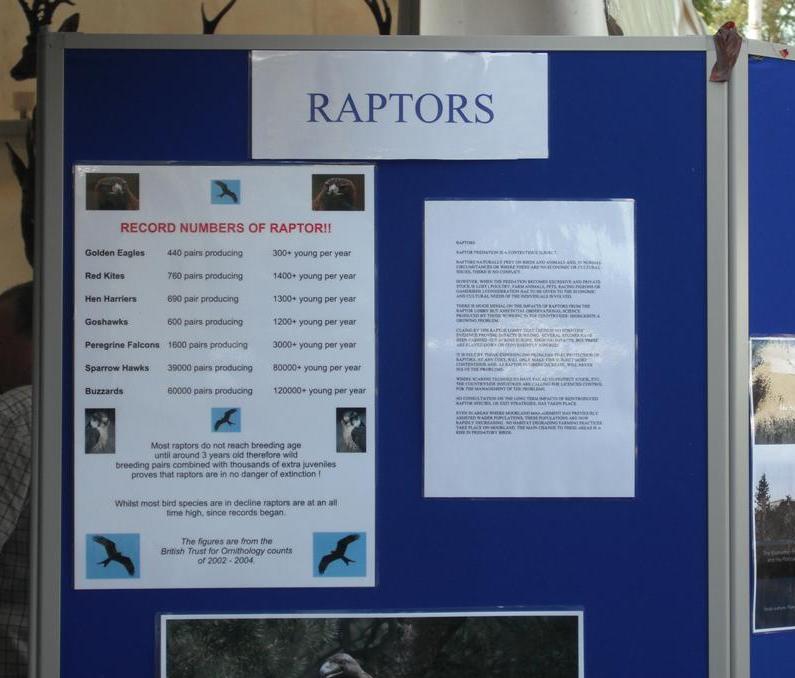
There were some interesting sights at the 2013 Scottish Game Fair in early July, including this poster on the Scottish Gamekeepers’ Association stand, entitled “Record Numbers of Raptor!!”[sic].

SGA Gamefair 005a

Any casual visitors to the SGA stand could be forgiven for thinking that raptors are doing just fine and there’s no cause for concern; that’s the message the SGA clearly wanted to portray. But let’s just look a bit more closely at their ‘information’, shall we?

You might think, given that this was the Scottish Gamekeepers’ Association at the Scottish Game Fair, their raptor figures would just relate to raptors in Scotland. You’d be wrong. Rather disingenuously, they used data relating to raptor figures in the UK as a whole, not just Scottish data, thereby potentially misleading the public to believe that Scotland holds a significantly higher number of breeding raptors than it actually does.

For example, the SGA claims there are 760 pairs of red kites producing 1400+ young per year. Actually, the number of breeding pairs monitored in Scotland in 2012 was 214, with 314 fledged. This is thought to be ‘close to an accurate population estimate’ according to the Scottish Raptor Study Group.

Another example: the SGA claims there are 600 pairs of goshawks producing 1200+ young per year. Actually, the number of breeding pairs in Scotland is more like 150, with an estimated 200 occupied territories in total.

And another example: the SGA claims there are 1600 pairs of peregrines producing 3000+ young per year. Actually, the last national survey of peregrines in Scotland showed 542 breeding pairs, an 8% decline from the previous national survey.

And here’s yet another example: the SGA claims there are 690 pairs of hen harriers producing 1300+ young per year. Actually, the last national survey of hen harriers in Scotland showed 505 pairs, a 20% decline from the previous national survey.

In fact, the data they’ve provided for every species on this list, with the exception of the golden eagle, are a gross exaggeration of the respective Scottish populations of these birds. Did they choose these figures to deliberately mislead the public? Surely not.

In addition to using potentially misleading population figures, the SGA also chose to use data from 2002-2004. That’s a bit odd given that far more up to date data for many species (i.e. from as recently as 2011) are freely available in the public domain (see here). Now, what possible reason could they have for ignoring the more recent facts and figures? Surely nothing to do with the fact that these more recent data directly contradict the following SGA statement:

That whilst most bird species are in decline raptors are at an all time high, since records began”.

Conveniently, this statement fails to mention the 20% decline in the Scottish hen harrier population, and the 8% decline in the Scottish peregrine population, not to mention the severely constrained Scottish populations of red kites, golden eagles and goshawks, all linked to the effects of illegal persecution taking place on gamekeepered land across Scotland. Funny that, isn’t it?

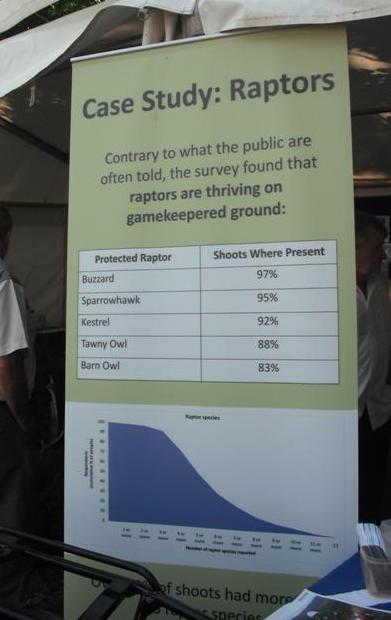
Even funnier is this photo (below), also pictured at the SGA stand. According to this, ‘Raptors are thriving on gamekeepered ground’. Conveniently (again), the list of raptor species they chose to illustrate this lie statement does not include hen harriers, peregrines, red kites, golden eagles or goshawks. Their statement is right up there with another SGA classic: “Professional gamekeepers do not poison raptors” (see here).

SGA Gamefair 006a


Gamekeepers and golden eagles: the facts

The Scottish Gamekeepers’ Association issued a press release this morning about how great gamekeepers are for golden eagle conservation.

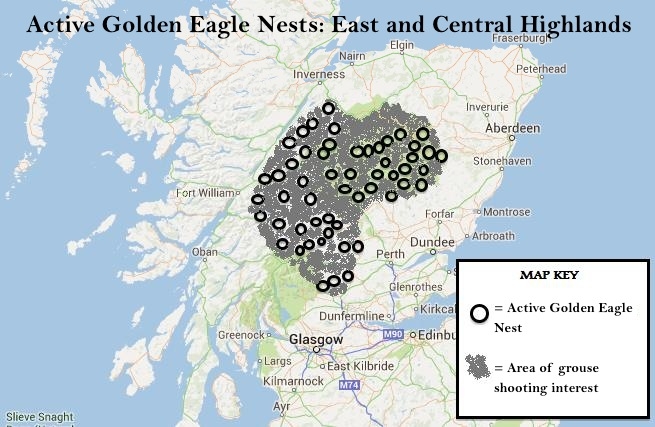
They produced the following map in an attempt to suggest that golden eagles are doing well on grouse moors in central and eastern Scotland:

SGA eagle bollocks

They claim that there are at least 55 active golden eagle nests in the keepered grouse areas of East and Central Scotland, based on the results of a ‘survey’ they did, presumably of gamekeepers.

To the uninformed, this map suggests that golden eagles are breeding at a relatively high density on grouse moors in this region. But don’t be fooled! What this map doesn’t show, because of the ridiculous scale at which it has been produced, is the number of vacant golden eagle territories on grouse moors in East and Central Scotland. (It also ignores the grouse moors of Southern Scotland, probably because breeding golden eagles in that area are virtually non-existent, with just a couple of exceptions, but let’s just brush over that shall we?).

There is no disputing that golden eagles do breed successfully on some Scottish grouse moors. That is a fact. There are a number of enlightened land owners who welcome golden eagles on their grouse moors and do an excellent job in providing them with a home and a good supply of food. We’ve blogged about a few of them before and we applaud their efforts. The problem is, there aren’t enough of them. That is also a fact. The best way to demonstrate this is to look at the level of occupancy of golden eagle territories in different parts of Scotland. The following data are from the 2008 Golden Eagle Conservation Framework – a government-funded comprehensive scientific review of golden eagle ecology and conservation in Scotland:

Golden Eagle Territory Occupancy:

Western Isles = 91%

Western Highlands = 89.5%

Argyll West & Islands = 81.5%

Central Highlands = 48%

Cairngorms Massif = 42.4%

North East Glens = 17.6%

That’s pretty stark. Golden eagles in areas of western Scotland (with little if any grouse shooting interests) occupied over 80% of the available territories; golden eagles in the central and eastern Highlands (grouse moor hell) had an occupancy rate of below 50%, and in one region (North East Glens) it was a shocking 17.6%. Why is it that all those available golden eagle territories in the East and Central uplands are vacant? What’s stopping them from breeding there? Hmmm, whatever could it be?

The SGA press release also talks about the ‘stability’ of the golden eagle population over the last 20 years, presumably to make you think that golden eagles are doing ok so what’s all the fuss about? What they fail to say is that that ‘stability’ of approx 430 pairs masks some very big differences in regional abundance. For example, there has been a substantial increase of golden eagles in the Western Isles over the last ~20 years, largely thanks to a reduction in illegal persecution in that region. In contrast, there has been a significant decrease in the number of golden eagles in the central, eastern and southern uplands (hence all those vacant territories), thanks largely to illegal persecution on driven grouse moors. That is a fact, backed up by a suite of scientific peer-reviewed studies. That’s why the population appears to be ‘stable’ – because all the losses in the east are being counterbalanced by the gains in the west.

What the SGA also fail to mention is that the ‘stable’ population of ~430 pairs is nowhere near what the population could be. It’s been estimated that there is enough habitat for at least 700 golden eagle territories in Scotland – the population of ~430 pairs is being suppressed at an unnaturally low level and failing to expand into some areas of its former range. Why? Illegal persecution. Read the Conservation Framework (below) if you want to examine the details. The facts are all there.

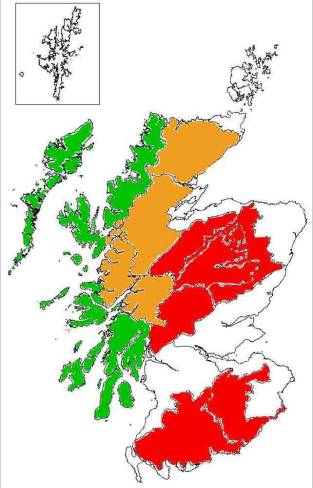
Here is a map from the Framework report, showing the conservation status of golden eagles in 2003. Green areas = region in favourable conservation status; Amber areas = region in unfavourable conservation status but failed in only 1 test (i.e. a marginal failure); Red areas = region in unfavourable conservation status, with failure in more than one test. It’s pretty bloody obvious in which areas golden eagles are in trouble – yep, that’s right, areas managed for driven grouse shooting. Another fact.

GE conservation status 2003

There was another element to the SGA’s press statement this morning. They claimed they had recently expelled four (unidentified) members from the SGA club for wildlife offences. If they have done this then it is very welcome news and we applaud them for booting out those criminals. It has been something we’ve been asking them to do for a very long time and hopefully this will be the start of a growing trend.

BBC News article here

Scotsman article here

RSPB response here

Golden Eagle Conservation Framework here

UPDATE 24 January 2014: See here for details of the VACANT golden eagle sites on upland grouse moors.

Questions for the Environment Minister

Following yesterday’s announcement by Environment Minister Paul Wheelhouse on his proposed further measures to tackle the illegal persecution of Scottish raptors (here), we’d like to follow up by asking him for some clarifications on the latest measures, and for some updates on previously-promised measures. If you want to cut and paste these questions and send them yourself, or adapt them in your own letter, or simply cut and paste this blog’s URL to your own letter, please feel free. His email address appears at the foot of this page.

Question 1.

Please can you clarify whether the Lord Advocate has instructed COPFS to accept covert video footage as admissible evidence in prosecutions for alleged raptor persecution incidents?

Question 2.

Please can you clarify the timescale for SNH’s review for introducing potential restrictions on the use of General Licences in areas where they have good reason to believe crimes against wild birds have been committed? In other words, when can we expect the review to be completed? Also, will their review be made publicly available?

Question 3.

Please can you advise whether there will be a prosecution under the new vicarious liability legislation following the recent conviction of gamekeeper Peter Bell, found guilty of poisoning offences on the Glasserton and Physgill Estates (here)? If you don’t know the answer (which would be surprising, given that you said in March 2013 that you would be “keeping an eye on this particular area [i.e. vicarious liability] with interest“, see here), please can you provide the contact details of someone who can answer the question?

Question 4.

Please can you tell us the status of the Scottish Government’s first annual report (2012) into wildlife crime? As you know, under the Wildlife and Natural Environment (Scotland) Act 2011, there is a now a requirement (under section 26B) that ‘Scottish Ministers must, after the end of each calendar year, lay before the Scottish Parliament a report on offences relating to wildlife’ (see here for copy of the WANE Act 2011). You mentioned in March 2013 that your policy officials ‘are currently working on’ this report (see here). When can we expect this report to be available?

Question 5.

Please can you tell us when, exactly, will you open the consultation regarding the increase of SSPCA powers to broaden the range of their work  investigating wildlife crime? As you know, this consultation was first suggested by former MSP Peter Peacock as an amendment during the WANE Act debates, way back in February 2011. The then Environment Minister Roseanna Cunningham rejected it as an amendment but suggested a consultation was in order (see here). Seven months later in September 2011, MSP Elaine Murray lodged a motion that further powers for the SSPCA should be considered (see here). In November 2011, Elaine Murray MSP formalised the question in a P&Q session and the next Environment Minister, Stewart Stevenson, then promised that the consultation would happen in the first half of 2012 (see here). Nothing happened so in September 2012 we asked you, as the new Environment Minister, when the consultation would take place (see here). In response to one of our blog readers in October 2012 your policy officer said: “The consultation has been delayed by resource pressures but will be brought forward in the near future“. Nine months later and we’re in July 2013 – almost 2.5 years after Scottish Ministers committed to undertaking the consultation. Where is it?

Email: ministerforenvironment@scotland.gsi.gov.uk

Environment Minister announces ‘further measures’ to tackle raptor persecution

The Environment Minister Paul Wheelhouse has today announced what he calls ‘further measures’ to tackle the on-going problem of illegal raptor persecution in Scotland. Here is his statement in full:

Since I took on responsibility for this portfolio, I have been clear that one of my priorities is to bear down on the illegal persecution of raptors that continues to blight the Scottish countryside and tarnish Scotland’s reputation.  These outdated, barbaric and criminal practices put at risk the conservation status of some of our most magnificent wildlife.  They also harm our reputation as a country which values its environment and wildlife and undermine the growing tourism sector that is built on that reputation.

We have achieved much since 2007. We have a robust legal framework that protects birds of prey and their nests, including the new vicarious liability provisions.  We have dedicated resources in Police Scotland and the Crown Office and Procurator Fiscal Service (COPFS).  We are leading the way in the UK in the development of wildlife crime forensics work, and we continue to work at building a broad-based alliance through the Partnership for Action Against Wildlife Crime (PAW Scotland).  

In 2012 we saw a very welcome reduction in poisoning cases.  However a number of recent reports, some of which are in the public domain and some of which are still subject to police enquiries, suggest that there is still a problem with the use of poison as well as cases involving illegal trapping and shooting.  I have decided therefore that the time is right to bring forward some further measures which I hope will deter those involved in illegal activities. 

Wildlife crime, and raptor persecution in particular, often takes place in remote locations or in the dark of night.  By its very surreptitious nature, the likelihood of being seen by a member of the public who can report the matter to the authorities is small.

I have spoken with the Lord Advocate, who maintains a close personal interest in all wildlife crime.  We are both keen to maximise the opportunity for offences to be detected and offenders to be tracked down.

The Lord Advocate has instructed the specialist prosecutors in the Wildlife and Environmental Crime Unit to work with Police Scotland to ensure that law enforcement utilises all investigative tools at their disposal in the fight against wildlife crime.

This work will take place within the National Wildlife Crime Co-Ordinating Forum – a group attended by police Wildlife Crime Liaison Officers from across Scotland and the police’s full-time Scottish Wildlife Crime Co-Ordinator, as well as senior police officers, the National Wildlife Crime Unit, Scottish Government officials and the specialist prosecutors from the Wildlife and Environment Crime Unit within COPFS.

Secondly, in my capacity as Chair of PAW Scotland, I intend to establish a group to carry out a review and report to me on how wildlife crime is treated within the criminal justice system, including examining whether the penalties available for wildlife crime properly reflect the seriousness of the damage caused to vulnerable wildlife and fragile habitats and ecosystems.  

Thirdly, I will be asking Scottish Natural Heritage in their capacity as the authority for licensing decisions under section 16 of the Wildlife and Countryside Act to examine how and in what circumstances they can restrict the use of General Licences to trap and shoot wild birds on land where they have good reason to believe that crimes against wild birds have taken place.  These General Licences allow the holders to carry out actions that would otherwise be unlawful if undertaken, without any reference to SNH.  We regard the use of General Licences as a privilege that should not be extended in circumstances where there is evidence that their use may be facilitating illegal activities. 

In putting together these measures I have sought to focus only on those individuals and businesses where there are very good reasons to believe they are involved in illegal practices.  I am very keen to avoid anything that places an unfair burden on the majority of shooting businesses that are law-abiding and responsible members of the rural community.  I should also say that I think it is important that wildlife crime is treated in exactly the same way as other types of crime. This means information about cases should be handled in the same way as in other types of crime and that the police and prosecutors are allowed the time and space to carry out whatever investigations they believe to be necessary according to their own professional judgement. We should not descend into allowing trial by leak and accusation. There is a responsibility on us all to avoid that. 

In conclusion I wish to reiterate that eradicating raptor persecution in Scotland remains a high priority for the Scottish Government.  It is not however the sole responsibility of the Scottish Government.  Law enforcement clearly has a key role to play and I am confident that we are ratcheting up the pressure on those committing acts of illegal persecution. However,  everyone involved in the Scottish countryside, and in particular those involved with shooting, should make abundantly clear their disapproval to the minority whose actions are tarnishing the reputation of Scotland’s country sports”.

So, this is the much anticipated ‘action’ against illegal raptor persecution that’s been promised since last autumn when Paul Wheelhouse was appointed. Whilst we welcome his willingness to engage with the issue (in stark comparison to his English counterpart who won’t even admit there’s a problem), we see these latest measures as tiny baby steps in the right direction, and not the decisive hefty stamp that could have been delivered.

The first four paragraphs of his statement are just introductory comments with the usual rhetoric, such as, “We have achieved much since 2007”. Actually, we haven’t. Raptors are still being illegally killed on land managed for game-shooting and more often than not the criminal(s) involved are not being prosecuted. In the few instances where they are prosecuted, there is evidence of extensive plea-bargaining resulting in convictions only for the minor offences, not for the major crimes.

In 2012 we saw a very welcome reduction in poisoning cases. No, we didn’t. What we saw was a reduction in the number of reported poisoning cases; that’s a very important distinction. Members of the game-shooting industry (and government, it seems) have made much of this claim, using it as an example of how the industry is cleaning up its act. They won’t be able to make the claim for much longer – we understand that there have been several poisoning incidents already in 2013 and we’re only half-way through the year. Naturally, once again the public haven’t (yet) been informed about these poisonings even though they took place several months ago. We’ll come back to this issue.

The first ‘new’ measure that Wheelhouse is introducing is this:“The Lord Advocate has instructed the specialist prosecutors in the Wildlife and Environmental Crime Unit to work with Police Scotland to ensure that law enforcement utilises all investigative tools at their disposal in the fight against wildlife crime.

This is interesting, particularly because it immediately follows this paragraph:

Wildlife crime, and raptor persecution in particular, often takes place in remote locations or in the dark of night.  By its very surreptitious nature, the likelihood of being seen by a member of the public who can report the matter to the authorities is small.

Does this mean that prosecutors in Scotland are being told by the Lord Advocate that they should now accept covert video surveillance as admissible evidence? If this is the case then it would be a very welcome step indeed. Covert film footage is routinely accepted as admissible evidence in England, but in Scotland it continues to be blocked by the Crown Office prosecutors. Why? We don’t know – we’ve never heard a satisfactory explanation. If our assumption is correct (and of course it may not be) and covert footage is to be accepted, then Wheelhouse deserves a good deal of credit for this single measure. We’ll be watching this potential development with great interest.

His second measure is to establish (yet another) group within the framework of PAW Scotland, “to carry out a review and report to me on how wildlife crime is treated within the criminal justice system, including examining whether the penalties available for wildlife crime properly reflect the seriousness of the damage caused to vulnerable wildlife and fragile habitats and ecosystemsWe’re not so impressed with this plan; it seems to be reinventing the wheel. A similar review was carried out in 2008 (Natural Justice 2008) following the poisoning of the last remaining breeding female golden eagle in the Scottish Borders in 2007. That review made many recommendations to improve the efficiency of detecting and prosecuting wildlife crime in Scotland, some of which have since been implemented but many have not. It would perhaps have been a good opportunity for Wheelhouse to critically evaluate the implementation of those recommendations made five years ago, rather than start off the process again from scratch, which just leads to further delays in addressing the actual problem.

The third and final new measure is what we would call a fig-leaf approach to tackling illegal raptor persecution. Wheelhouse says: “I will be asking Scottish Natural Heritage in their capacity as the authority for licensing decisions under section 16 of the Wildlife and Countryside Act to examine how and in what circumstances they can restrict the use of General Licences to trap and shoot wild birds on land where they have good reason to believe that crimes against wild birds have taken place.  These General Licences allow the holders to carry out actions that would otherwise be unlawful if undertaken, without any reference to SNH.  We regard the use of General Licences as a privilege that should not be extended in circumstances where there is evidence that their use may be facilitating illegal activities

At a superficial level, a restriction on the use of the General Licence sounds like a positive action. But let’s just think about the practicalities. First of all, Wheelhouse suggests that the General Licence may be restricted where SNH have “good reason to believe that crimes against wild birds have taken place”. That sounds like SNH would require a lower burden of proof to show that crimes against wild birds have taken place than say, for example, a criminal conviction. In real terms, how would that work? What would constitute ‘good reason’? The discovery of a poisoned or shot bird on a particular piece of land? In legal terms that’s not enough evidence for a conviction because the estate in question could legitimately argue (no matter how implausible) that the dead bird had been planted by someone with a grudge against them, or that the bird had been poisoned/shot elsewhere and just happened to fly on to their estate where it finally succumbed to its injuries. We can be certain that if SNH tried to use such evidence as giving them ‘good reason to believe that crimes against wild birds have taken place’ they would face a strong legal challenge by the estate’s lawyers. So then we’re back to the current situation whereby a conviction in a court of law is the only acceptable proof that the crime was committed by someone associated with the estate where the dead bird was found and those convictions are, as we all know, almost as rare as rocking horse shit.

But even if SNH could use a lower burden of proof as reason to believe a crime had been committed, there would still be difficulties. The use of General Licences is barely monitored or enforced due to the high volume of people operating under their terms. By their very nature, a General Licence is not actually issued to an individual – you don’t have to apply to use one and there isn’t even a competency test that you must first pass – it’s an open ‘licence’ that anyone can use to carry out what would otherwise be unlawful activities, such as the killing of so-called ‘pest species’ such as crows. We occasionally see a prosecution for an offence relating to a General Licence, e.g. when the operator of a crow cage trap has failed to meet the licence’s terms and conditions, but these prosecutions are rare and incidental. No statutory authority is regularly monitoring the use of General Licences (e.g. SNH don’t do it, the police don’t do it)  – we don’t even know how many people are operating under the General Licences because the operators are not required to submit annual returns. So, if SNH did ‘restrict the use’ of a General Licence on a particular piece of land, who would be enforcing that restriction? How would we know whether a restriction was in place? Would the location and name of the estate be published? For how long would the restriction be in place? What would be the penalty if an estate was found to be flouting the restriction?

All in all, this proposed new measure has glaring loopholes that in practical terms would be very difficult to close. It’s hugely disappointing that the Minister has taken this route instead of another option that is already available to him in the provisions of the Wildlife & Countryside Act – that is, the ability to enforce a (temporary) ‘closed season’ on the hunting of a particular game bird species in a particular area (or in this case, a specific estate). For example, in exceptional circumstances a Minister can impose a temporary moratorium on shooting specific species during periods of prolonged severe weather. The authority to impose such restrictions is already there in the legislation – it wouldn’t require the lengthy drafting of new legislation – if he wanted to enforce a temporary ban on, say, driven grouse shooting on a particular moor, he could do so. This measure would fit with his approach of only targeting the criminals, not the ‘law-abiding majority’ (his words, not ours) so why isn’t he pursuing it? Just another missed opportunity.

One final point about the Minister’s statement – the bit in his penultimate paragraph where he says this:

I should also say that I think it is important that wildlife crime is treated in exactly the same way as other types of crime. This means information about cases should be handled in the same way as in other types of crime and that the police and prosecutors are allowed the time and space to carry out whatever investigations they believe to be necessary according to their own professional judgement. We should not descend into allowing trial by leak and accusation. There is a responsibility on us all to avoid that

We whole-heartedly agree that wildlife crime should be treated in exactly the same way as other types of crime. This means that these crimes should be properly publicised in the media, just as other crimes are, and especially when they involve the discovery of potentially-fatal poisons that put the general public at significant risk. We hold very strong opinions on this and are adamant that it is not in the public interest for the police to keep these crimes hidden from view for months on end. Until we see an end to this ridiculous culture of silence we’ll continue to blog about these crimes with a measured, accurate and responsible approach.

We’ll be blogging later this week with some specific questions for Paul Wheelhouse….

Scottish Land & Estate’s response to the announcement here.

RSPB Scotland’s response here.

Scottish Gamekeepers’ Association response here.

BASC Scotland’s response here.

More false allegations about this blog

About two months ago the landowners’ organisation, Scottish Land & Estates, made a series of false allegations about this blog (see here).

It seems they just can’t help themselves. Two days ago (14th June 2013) they published the following on their website, in response to our blog about the discovery of poisoned baits on Leadhills Estate (our original article here) –

Information about police investigation leaked by anonymous website

Confidential information about an active police investigation on a grouse moor has again been leaked to the media.

This relates to an incident in March at Leadhills Estate where according to the police, some items were removed for scientific analysis and a number of people were detained, but no charges have been made. An anonymous website, allegedly with close links to the animal rights movement, found out confidential information that Government science laboratory analysis of the items had tested positive for carbofuran and published this confidential information, resulting in media coverage on 11th June.

Although there were no birds of prey involved, the whole land management and shooting industry is very concerned about a possible attempted poisoning after such a sharp drop in such incidents over the last three years. However, little is known about the detail of this case and it is vital that nothing is done or said which might risk prejudicing the legal process or cause unjustifiable damage to the reputations of anyone connected to the estate. Questions certainly need to be asked about the leaking and publication of material information about the case while this is still under active police investigation.

The media stories included a comment from Scottish Land & Estates which said: “It would be inappropriate to comment while the facts of the matter have still be established. As an organisation, we are actively involved in the Partnership for Action Against Wildlife Crime and our membership undertakes an enormous amount of good work in this area.”  The Scottish Gamekeepers Association also said “Because this appears to be subject of a live investigation, it would not be appropriate to comment other than to reiterate that the Scottish Gamekeepers’ Association does not condone illegal poisoning.”

Here is the link to the article on their website.

Let’s start with their sub-header: “Confidential information about an active police investigation on a grouse moor has again been leaked to the media”. This may well be an active police investigation but in terms of reporting restrictions that is irrelevant. What is important is when the actual criminal case becomes active. Once the criminal case, not the police investigation, becomes active, this then triggers certain reporting restrictions relating to the Contempt of Court Act 1981. Under Scottish law, a criminal case becomes active once an arrest warrant has been issued, or someone has been arrested, or someone has been charged. Thus, in this instance, SL&E’s use of the phrase ‘an active police investigation’ is misleading as it suggests information has been leaked in contempt.

Now let’s look at their first paragraph, and particularly the sentence: “An anonymous website, allegedly with close links to the animal rights movement, found out confidential information that Government science laboratory analysis of the items had tested positive for carbofuran and published this confidential information, resulting in media coverage on 11th June”. They don’t name the ‘anonymous website’, but as we were the only anonymous website to publish the original article then we have to assume they are referring to us. In which case, we would like to know the basis of their claim that we allegedly have close links to the animal rights movement. In our view this is a crudely attempted slur on our credibility. The stereotypical image of the animal rights movement as portrayed in the media has traditionally focused on the illegal activities of those involved in campaigns against animal testing laboratories – the image of a black-clothed, balaclava-wearing extremist intent on breaking the law by fire-bombing business premises, vehicles and homes or digging up human remains, all in the name of ‘defending the rights of animals’, immediately springs to mind. Is that the image that Scottish Land & Estates are trying to attribute to us? If it is, it looks like they have scored another own goal. We would argue that that stereotype is no longer valid – look at the thousands of people who recently protested in London against the badger cull. They could legitimately be portrayed as being members of the animal rights movement and yet that crowd included serving Members of Parliament and even QCs. Law-breaking terrorists marauding through London causing damage & inciting fear, or concerned professionals legitimately and peacefully exercising their right to protest? We wholeheartedly support the lawful badger cull protesters and if that defines us as having ‘close links to the animal rights movement’ then so what? We are happy to have that association, although we’d argue that it doesn’t amount to anything like ‘close links’. But if SL&E are trying to suggest that we are ‘closely linked’ with criminal activities then that is a much more serious allegation that our lawyers would be most interested in examining.

Sticking with their first paragraph, let’s move on to their claim that we published “confidential information” (about the Carbofuran) “resulting in media coverage on 11th June”. This is utter bollocks. We deliberately did not name the type of poison that had been used to lace the poisoned baits in our original article. SL&E should try reading our article again and pay closer attention this time. Carbofuran was actually first mentioned in the BBC’s article, which was published several hours after ours on 10th June, and which we added as an update to our original article later that evening. We’ll be happy to accept an apology from Scottish Land & Estates in relation to their false allegation against us.

But so what if we had mentioned Carbofuran? This isn’t ‘confidential information’ – look at the quarterly poisoning stats published by SASA – they always name the poison(s) they’ve detected in the course of on-going police investigations, and quite rightly so; this is a matter of massive public interest. Look at any other area of crime involving banned substances – the police always publish the name of the banned substances that they’ve seized, e.g heroin, cocaine etc. As an example, here is a news item from just yesterday detailing the seizure of cannabis and the name of the premises where it was reportedly found. This type of reporting is very, very common – if you don’t believe us just take a look at Police Scotland’s website and look at the frequency with which these seizure stories appear. Funny isn’t it, that those investigations are publicised within a matter of days and yet those news reports don’t prejudice the outcome of any subsequent criminal case, do they? So why should the reporting of alleged raptor persecution investigations be treated any differently?

Moving on to their second paragraph and the following sentence: “However, little is known about the detail of this case and it is vital that nothing is done or said which might risk prejudicing the legal process or cause unjustifiable damage to the reputations of anyone connected to the estate. Little is known about the detail of this case precisely because of our restraint in the publication of details! Check out the first sentence of paragraph three in our article:

Because this is an on-going police investigation there is only limited detail that we’re prepared to publish at this stage”.

Are those the words of people intent on prejudicing the legal process? No, they’re not. They’re the words of responsible bloggers who could easily have published a mass of detail, such as the number of poisoned baits found, the specific site location, the way the baits were stored, the specifics of the meat used, and the name of the poison used to lace the baits. We could even have posted photographs from the scene. We deliberately didn’t include any of this material evidence in our article.

Their last sentence in paragraph two reads: “Questions certainly need to be asked about the leaking and publication of material information about the case while this is still under active police investigation”. Questions certainly do need to be asked, but not about the leaking and publication of material information, for all the reasons we’ve stated above. No, other more relevant questions need to be asked, such as:

  • Why didn’t Police Scotland publicise this inquiry when it first started three months ago?
  • What relationship does Scottish Land & Estates have with Leadhills Estate, i.e. is Leadhills (Hopetoun) Estate a member of SL&E and if so, will SL&E be temporarily suspending that membership pending the outcome of the police investigation?
  • Should Scottish Land & Estates be allowed to continue to participate on the PAW Scotland Raptor Persecution Priority Delivery Group without this level of transparency?

SL&E also published a further article two days ago, relating to media coverage (here & here) of the alleged felling of the white-tailed eagle nest tree on Invermark Estate. Read their article here. In this article, SL&E state that the estate has been ‘fully cooperating’ with the police inquiry. You wouldn’t expect anything else from a law-abiding estate. Hopefully that ‘full cooperation’ includes full and complete witness statements from everyone involved with the Estate from the top down. Anything less, such as ‘no comment’ interviews would not, in our opinion, be in the spirit of what we’d call ‘full cooperation’, even though such responses are entirely legal.

Also in this article, SL&E argue that it was inappropriate for information about the case to be released before the outcome is known. This sounds like a philosophy whereby there should be a blanket media ban on publishing any information relating to alleged raptor persecution incidents until the outcome of the police case is known. That would probably suit the game-shooting industry down to the ground: if this ridiculous philosophy was in place, none of us would be any the wiser to the hundreds of illegally-killed raptors found on shooting estates over the last 25+ years because the majority of these cases have not resulted in charges being brought and are, therefore, still technically considered to be ‘on-going’ police investigations. To put it in a broader context, if the philosophy was given a wider application we wouldn’t know anything of, for example, Operation Yewtree or the recent Woolwich murder.

Scottish Land & Estates would do well to put their influence to better use and focus their efforts on ousting the criminal element from within the game-shooting industry instead of wasting time promoting censorship of responsible reports on matters of legitimate public interest.

Who’s fooling who?

Spinoculars at the ready, folks….

According to a new website, ‘Cairngorms Nature is a new partnership where people and organisations come together, regardless of sector or background, with one thing in common – a desire to safeguard and enhance the outstanding nature in the Cairngorms National Park’ (see here). An admirable project with an ambitious five-year action plan (see here) to be overseen and delivered by a ‘strategy group’ (see here for members).

Look closely at the detail of this action plan and you’ll find some barely believable action points that include:

Page 60 – Action: Restore the full community of raptor species. Key Partners:

(a) SGA and SLE to trial innovative techniques to increase raptor populations;

(b) Police Service, SLE, SGA, BASC to raise awareness and understanding, provide advice and training on wildlife legislation;

(c) Police Service to monitor wildlife crime in the national park;

(d) CNPA, SNH, SLE, SGA, RSPB to support collaboration to reduce conflicts in species and wildlife management.

Page 62 – Key species for focused action: Golden eagle. Key Actions:

(a) RSPB, CNPA, HFW and SNH to continue and expand Raptor Track project to gather data, raise awareness and understanding, and provide advice and guidance for land managers;

(b) SLE, SGA and SNH to work with moorland managers to manage mountain hare populations for the benefit of golden eagles.

In other unbelievable news, the latest SNH magazine has been published (#17, see here) and includes two contributed articles: one written by an employee of Scottish Land and Estates (page 34) and one by an employee of the Scottish Gamekeepers’ Association (page 54). Both articles, as well as a gushing editorial from SNH Chief Executive Ian Jardine (page 3) would have us believe that these two organisations are dedicated to protecting Scotland’s wildlife.

This magazine also includes an article about Scotland’s so-called Big Five, including the golden eagle (page 13). This is a carefully worded piece that totally ignores the species’ unfavourable conservation status and the reasons for that. The best line has to be: “There are reckoned to be around 440 pairs in Scotland, located mainly in the Highlands and Islands but with a presence in the Borders and Southern Uplands too“. I suppose “a presence” is one way of describing the golden eagle’s precarious status in southern Scotland, where they are barely hanging on by the tip of their talons thanks to the effect of illegal persecution (e.g. see here).

And finally, if you haven’t read enough guff,  the SGA’s Bert Burnett treats us to his thoughts on climate change [since deleted from SGA website] – a worthy contender for a scholarship at the Sarah Palin Institute of Scientific Understanding.

7.3% conviction rate for raptor crime in Scotland

One of our regular features on this blog has been to look at the number of illegally killed eagles over a period of time, and to compare that figure with the corresponding number of prosecutions (current stats are 27 dead or ‘missing’ eagles in seven years vs zero prosecutions).

We thought it’d be interesting to take a wider view and calculate the number of confirmed raptor persecution incidents (all species, not just eagles) and compare those with the corresponding number of convictions.

A few caveats first:

1. Persecution figures are only based on data from 2003-2011 inclusive, because we haven’t yet seen the confirmed data from 2012. We could have used persecution data from 1989 but the corresponding conviction data are unavailable pre-2003. We used 2012 conviction data as these relate to crimes that took place as far back as 2009.

2. The persecution data include other birds (e.g. ravens) but not mammals.

3. Only ‘confirmed’ incidents are included in the analysis; we have not included ‘probable’ or ‘possible’ incidents.

4. The number of confirmed incidents refers to the number of individual birds found, as opposed to the actual number of incidents per se. We don’t have access to information that would inform whether an incident involved more than one individual bird so we treated them all as separate incidents. We don’t think this is an unreasonable approach – indeed it’s how prosecutors treat incidents of other crime when they decide on the number of charges to bring, e.g. prosecutors in the case against the alleged Boston bomber will treat each victim as a separate charge against the alleged bomber, the same with the alleged kidnapper and rapist in the recent Cleveland, Ohio case.

So here’s what we found:

Confirmed incidents of poisoning, shooting, trapping, nest destruction 2003-2011 = 450.

Successful prosecutions 2003-2012 = 33.

Number of unsolved persecution crimes 2003-2011 = 417.

The conviction rate for raptor persecution crime in Scotland is a shocking 7.3%.

Scottish birdfair: more revealing details emerge

Last week we blogged about the continuing controversy over RSPB Scotland’s decision to once again hold their Scottish Birdfair at Hopetoun House. In defence of their decision, RSPB Scotland made the following statement:

In essence the Hopetoun House site is owned by an independent charity – and has been for many years“.

We argued that RSPB Scotland were being disingenuous by failing to mention that the Earl of Hopetoun is the Deputy Chairman of this ‘independent’ charity, the Hopetoun House Preservation Trust (HHPT) (see here).

Since then, we decided to look a bit closer at the stated independence of this charity. Thanks to Andy Wightman, we’ve obtained a copy of the HHPT’s most recent Consolidated Report and Accounts (dated 31 December 2011). It’s quite revealing.

The report lists the HHPT trustees. We already knew that the Earl of Hopetoun was the Deputy Chairman, but what we didn’t know is that the Earl, and his father, as well as being ex officio trustees, are also members of the Executive Committee, along with two of the other seven trustees.

So what? Well, according to this report, under the heading ‘Structure, Governance and Management’ (page 3):

The Trust [HHPT] is controlled by a Board of Trustees which meets twice a year. The Executive Committee, which meets regularly, is responsible for the day to day running of the trust“.

It’s funny, but in everday use the term ‘independent’ is usually used to mean unconnected, autonomous, unallied, ‘free from all ties’. Does this term accurately reflect the relationship between the Hopetoun family (who own Leadhills Estate) and the Hopetoun House Preservation Trust (the management body of the Scottish Birdfair venue)?

For the benefit of the decision-makers at RSPB Scotland, a copy of the report is provided here:

HHPT CONS 2011 DRAFT 180412

By the way, at the end of last week’s article we said we’d soon be blogging again about Leadhills Estate and that readers should prepare to be shocked (or not). Just to clarify, today’s blog entry is not the article to which we referred. That one’s coming up soon…

Scottish Birdfair critic ‘misguided’, says RSPB

The controversy over the Scottish Birdfair venue (Hopetoun House) continues. If you’re new to this saga, click here and here for background.

Following the results of our research last year where we uncovered some interesting links between Hopetoun and Leadhills Estates (see here, here and here), it seems one of our blog readers has been sharing our results with the wider public, and by all accounts to good effect. In response, earlier this week RSPB Scotland sent the following letter to Birdfair exhibitors [thanks to the contributors who sent us copies of this letter] –

Dear Scottish Birdfair 2013 exhibitor,

We understand that some of you may have recently been contacted on social media channels about the 2013 Scottish Birdfair by a private individual who is concerned about our choice of venue at Hopetoun House. This individual, a Mr Ronnie Graham, believes that there is a link between the venue and Leadhills estate –  alleged to be involved in illegal crime against birds of prey.

We wanted to write to reassure you that contrary to this individual’s assertions, holding the Scottish Birdfair at Hopetoun House on 11-12th May does not give cover to alleged and convicted lawbreakers, nor does it signal any lacking of our commitment to tackle wrongdoing against birds without fear or favour.

In essence the Hopetoun House site is owned by an independent charity-and has been for many years. The farms beyond the house and grounds, together with land in Dumfries known as Leadhills is owned by the Earl of Hopetoun. The Earl has apparently let the sporting on the Leadhills (ie the shooting) to a third party on quite a long lease. This sporting group manage the ground and employ the keepers. The Leadhills has been a wildlife crime blackspot – and the RSPB has been at the forefront of exposing this, and continues to press for action to tackle this criminality.

We do not doubt for a minute that Ronnie Graham has strongly held and genuine views – views we share. But we think he is misguided in his target – which should be the sporting tenant at Leadhills and the enforcement of the law by the responsible authorities. We have discussed this with him several times but he is not open to persuasion. His current activities could even jeopardise what will be the biggest Scottish gathering of bird and wildlife enthusiasts which we need to harness to pressure Scottish Government to take more action for raptors. The forces ranged against birds of prey are no doubt laughing as we squabble amongst ourselves.

RSPB Scotland has been at the vanguard of trying to stop such crimes over the past century, and we are committed to continuing our resolute opposition to the despicable perpetrators of raptor crime. The director of RSPB Scotland, Stuart Housden OBE, expresses exactly this sentiment in a recent blog here.

If you have any concerns about the event in light of any contact that you have received from a such third party on this, or any other, issue, please do not hesitate to contact us.

With kind regards, The Scottish Birdfair Team.

James Reynolds

Head of Media and Communications

RSPB Scotland

An interesting letter, although the author doesn’t seem to know where Leadhills is (it’s in South Lanarkshire, not Dumfries) and he also appears to have forgotten to include one significant (inconvenient?) detail:  the letter says, “In essence, the Hopetoun House site is owned by an independent charity – and has been for many years“. Yes, but what teensy weensy yet crucial detail is missing from this statement? Could it be that the Earl of Hopetoun is the Deputy Chairman of that ‘independent’ charity (Hopetoun House Preservation Trust)? Look, it even says so on his Director’s biography on the Scottish Land and Estates page here. Isn’t it a bit disingenuous of RSPB to omit that detail?

We’ve been through the Hopetoun/Leadhills arguments many times before (see links above) and don’t intend to repeat them. We’ve laid out the evidence from our research and people can read it and make up their own minds about whether they think Hopetoun Estate is involved or not involved with the management of Leadhills Estate. The Earl is on record as saying Hopetoun Estate has ‘no role whatsoever’; we think differently and so it follows that we also think that the RSPB’s decision to hold the Scottish Birdfair at Hopetoun House is baffling, not least when you consider it’s the RSPB’s own Investigations Team who have spent years documenting dead birds and poisoned baits at Leadhills (see here); they’re probably as astonished as anyone about the venue choice.

The RSPB’s letter suggests that Ronnie Graham’s efforts are ‘misguided’. Rubbish! On the contrary, in our view it’s the RSPB decision-makers who have been misguided by choosing Hopetoun House as their Scottish Birdfair venue, not just once, but twice!

We’ll be blogging about Leadhills again in the not too distant future….prepare to be shocked, although you probably won’t be.

UPDATE 11th May 2013: Here is more information about the ‘independent’ charity to which the RSPB refer. It wouldn’t be our definition of ‘independent’.

New hen harrier ‘initiative’ is outrageous

A new ‘initiative’ has been launched today aimed at ‘conserving’ the hen harrier in Scotland. Having read the press release, we’re almost at a loss for words.

This ‘initiative’ (pathetic window dressing designed to disguise the real issue) calls on members of the public to report sightings of hen harriers to ‘help PAW Scotland to build valuable information on these birds’.

According to Ron Macdonald, Head of Policy and Advice at SNH:

The public can be of great help by reporting sightings and helping us build a picture of the reasons why these birds aren’t doing as well as we would expect. Using sightings from the public, we can assess whether to use some of the new technology at our disposal such as satellite-tagging or camera monitoring, or even where neccessary share information with the National Wildlife Crime Unit“.

This ‘initiative’ then, suggests that all will be well for hen harriers if only we knew where they were so we could put satellite tags on them and work out what’s going wrong for them. It’s an astonishing inference! The location of hen harrier breeding sites have been known and watched for decades by raptor fieldworkers – there’s no mystery about where they’re trying to breed or why they’re failing. “Helping us build a picture of the reasons why these birds aren’t doing as well as we would expect“?! For god’s sake man, try reading the Hen Harrier Conservation Framework published in 2011 (see below for link) – you know, that report that, er, SNH commissioned. That report sets out very clearly what the main issue is: Illegal persecution is the biggest single factor affecting hen harriers and it is having a dramatic impact on the population in northern England and in Scotland:

  • The potential national hen harrier population in Scotland is estimated (conservatively) to be within the range 1467-1790 pairs.
  • The current national hen harrier population in Scotland as recorded during the most recent (2010) national survey is 505 pairs, more than a 20% decline from the numbers recorded during the 2004 national survey.
  • In Scotland, the hen harrier has a favourable conservation status in only five of 20 regions.
  • Two main constraints were identified: illegal persecution, and in one region, prey shortages.
  • The species is particularly unsuccessful in the Central Highlands, Cairngorm Massif, Northeast Glens, Western Southern Uplands and the Border Hills. There is strong evidence in these grouse moor regions that illegal persecution is causing the failure of a majority of breeding attempts.
  • A study published by Redpath et al (2010) found only five successful hen harrier nests on the estimated 3,696km2 of driven grouse moors in the UK in 2008; an area of habitat estimated to have the potential to support approx 500 pairs.
  • In 2012, only one breeding pair was recorded in England (estimated potential for over 300 pairs).

For SNH to pretend they don’t know why hen harriers are in trouble is simply outrageous. They know exactly why – the studies have been done, the birds have already been sat-tagged, we all know what happens to them.

And why on earth is this ‘initiative’ being launched by PAW Scotland? PAW is the Partnership for Action against Wildlife crime. Where’s the action on wildlife crime in this initiative? It has all the hallmarks of being the handiwork of the game-shooting ‘partners’ in PAW Scotland.

In our opinion this is a cynical attempt to persuade the general public that measures are being taken to address the hen harrier issue while deliberately ignoring the widely-known central problem: illegal persecution on driven grouse moors.

PAW Scotland press release here

Hen Harrier Conservation Framework 2011

UPDATE 2pm: Environment Minister Paul Wheelhouse gets a grilling on BBC Radio Scotland’s Good Morning Scotland programme (listen here, starts at 1.43.45). Well done journalist David Miller for asking exactly the right questions. The Minister does not cover himself in glory and seems to think this latest initiative is a novel approach to working out why hen harriers are in decline. He’s clearly unaware that there have been several national surveys (dating back to 1988!!) that have previously documented exactly the areas where hen harriers are missing and exactly why they’re missing. The Minister may not know it but his government advisors (SNH) certainly understand that this latest ‘inititative’ is nothing more than a scandalous time-wasting ploy to delay tackling the hen harrier killers.

Hen harrier caught in an illegal trap on a grouse moor