Environment Minister faces more questions on tackling wildlife crime

Environment Minister Paul Wheelhouse is facing a busy few weeks as he comes under increasing pressure, not just from the public but also from politicians, about the problems of effectively addressing wildlife crime in Scotland.

Back in his office today after the Xmas break, he will have been met with a backlogged barrage of emails concerning the poisoned golden eagle ‘Fearnan’ (see here), in addition to complaints about the latest ridiculous police appeal for information concerning the dead buzzard “that had not died of natural causes” (see here).

Today, MSP Christine Grahame (SNP Midlothian South, Tweeddale & Lauderdale) lodged the following question in parliament:

Question S4T-00552: To ask the Scottish Government, in light of the recent discovery of six badger carcasses near Peebles, whether it is content with Police Scotland’s resource allocation for detecting and preventing wildlife crimes.

This question is due to be heard in Chamber tomorrow (7th Jan 2014).

The badger incident she refers to was reported on the BBC website on Saturday 4th January 2014 (see here). The appeal for information made by Police Scotland was in stark contrast to the appeal for information they put out about the dead buzzard “that had not died of natural causes“.

The badger appeal came out less than 24 hours after the six skinned badger carcasses had been discovered; the buzzard appeal didn’t come out until 25 days after the carcass had been found.

The badger appeal provided a vivid description of what state the badgers were in when found (i.e. skinned). The buzzard appeal just said the bird “had not died of natural causes“.

The badger appeal gave a precise location of where the victims had been found, including their position (‘east banking’) on a named road (‘Bonnington Road’) that led to a named farm (‘Bonnington Farm’). The location provided in the buzzard appeal was given as ‘near the village of Tomatin’, with no indication of scale.

The badger appeal even gave a precise time of when the carcasses were discovered. The buzzard appeal did not.

You couldn’t get two more different appeals for information. One (the badger appeal) was timely, detailed and informative. The other was anything but.

sspca_badgeChristine Grahame’s question is bang on the money. It’ll be interesting to see how Wheelhouse responds. Perhaps he’ll mention the long-promised public consultation on increasing the powers of the SSPCA to allow them to investigate more wildlife crime than they are currently allowed.

We have blogged A LOT about this promised consultation. The consultation was first suggested by former MSP Peter Peacock as an amendment during the WANE Bill debates, way back in February 2011. The then Environment Minister Roseanna Cunningham rejected it as an amendment but suggested a consultation was in order.

Seven months later in September 2011, MSP Elaine Murray lodged a motion that further powers for the SSPCA should be considered. In November 2011, Elaine Murray MSP formalised the question in a P&Q session and the next Environment Minister, Stewart Stevenson, then promised that the consultation would happen in the first half of 2012. Nothing happened.

In September 2012 we asked Paul Wheelhouse, as the new Environment Minister, when the consultation would take place. The response, in October 2012, was:

The consultation has been delayed by resource pressures but will be brought forward in the near future”.

Nothing happened, so nine months later in July 2013 we asked again. In August 2013, this was the response:

We regret that resource pressures did further delay the public consultation on the extension of SSPCA powers. However, I can confirm that the consultation document will be published later this year“.

The end of 2013 came and went, and still nothing.

So, nearly three years after Scottish Ministers committed to undertaking this consultation, where is it?

Questions to Mr Wheelhouse at the usual address: ministerforenvironment@scotland.gsi.gov.uk

SNH still licensing mountain hare culls

Last month a leading upland ecologist claimed that Scottish landowners were causing ‘massive declines’ of mountain hares on grouse moors around Deeside, Aberdeenshire and blamed SNH for failing in its statutory duty to protect this species (see here).

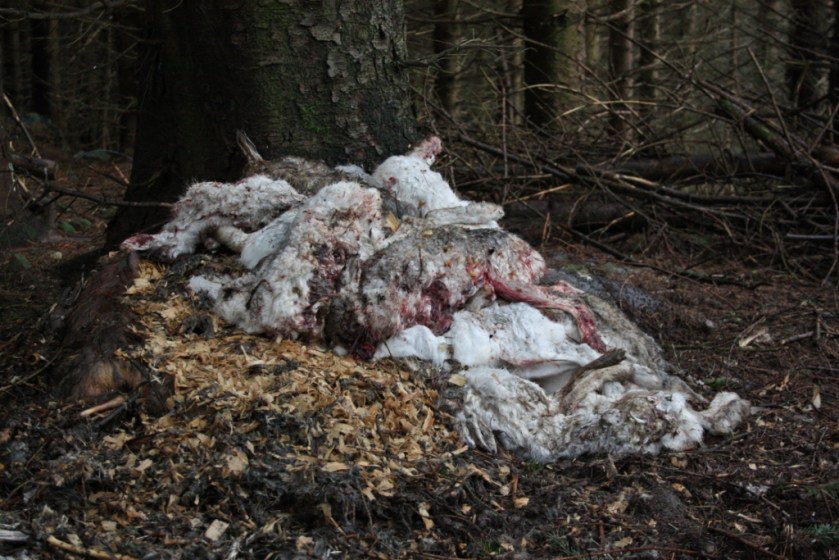
We followed up that article with some gruesome photographs showing piles of culled mountain hares left to rot on another grouse moor, this time in the Angus Glens (see here). Unregulated mountain hare culling, it seemed, was widespread.

We encouraged blog readers to contact SNH to ask them about what we thought was their long-term failure to implement an effective monitoring scheme to protect mountain hare populations. SNH responded with their usual let’s-buy-ourselves-some-time line that ‘further research was forthcoming’.

Around the same time, MSP Alison Johnstone lodged a series of parliamentary questions about mountain hare culling and how it affected mountain hare populations (see here).

Environment Minister Paul Wheelhouse has now responded to those questions (his answers presumably provided by SNH, the licensing authority). The bottom line is, SNH is still issuing licenses to allow the killing of mountain hares in the closed season, even though they admit that they are still unable to assess mountain hare abundance and therefore cannot possibly know what sort of impact, if any, these culls are having on the conservation status of the species. Quite remarkable. Where’s the precautionary principle?

Here are the parliamentary questions and answers:

Question S4W-18470: Alison Johnstone, Lothian, Scottish Green Party, Date Lodged: 19/11/2013

To ask the Scottish Government what information it holds (a) on the health of mountain hare populations and (b) that is relevant to assessing whether mountain hare are in a favourable conservation status.

Answered by Paul Wheelhouse (04/12/2013):

The National Gamebag Census data for mountain hare compiled by the Game and Wildlife Conservation Trust shows no significant trend in the data between 1961 and 2009, despite marked cyclical fluctuations which are known to exist in around half of mountain hare populations.

A questionnaire survey commissioned by Scottish Natural Heritage (SNH) in 2006-07 (SNH Commissioned Report 278) concluded that there was no evidence of an overall change in the distribution of mountain hares when compared to a similar study in mid 1990s. However, there may have been localised declines and possibly extinctions, undetectable at the 10km scale at which the data were collected and analysed.

The findings of this report provide SNH with an impression of the overall range of the species and some information on the numbers controlled, but SNH need more detailed information on hare abundance before it can be in a position to make a reliable assessment of the impact that culling is having on the population as a whole. To this end, SNH commissioned a study in 2008 into developing improved monitoring methods (Commissioned Report 444), but unfortunately, due to two severe winters hampering the fieldwork, the results did not provide SNH with the statistical relationship needed to progress this work. SNH therefore propose to develop a further programme of research, with the intention to commencing further fieldwork later in 2014. The exact detail of this work programme is still to be agreed.

Question S4W-18471: Alison Johnstone, Lothian, Scottish Green Party, Date Lodged: 19/11/2013

To ask the Scottish Government what conservation action is planned to protect mountain hare populations.

Answered by Paul Wheelhouse (04/12/2013):

In order to properly inform licence applications and to have a better understanding of the effects of culling on hare populations, a cost-effective and easily-applied method of reliably estimating hare numbers is required. This is the immediate priority and, once developed, will enable better monitoring schemes to be developed, and provision of information on population status will be improved also. Such data would then be used to inform future management decisions concerning the species, as necessary.

Question S4W-18472: Alison Johnstone, Lothian, Scottish Green Party, Date Lodged: 19/11/2013

To ask the Scottish Government what information it holds on the number of mountain hare that are culled annually and the impact of this on golden eagles (a) dispersing from, (b) likely to be recruited to or (c) nesting in natura sites for which golden eagles are a designated interest.

Answered by Paul Wheelhouse (03/12/2013):

The Scottish Natural Heritage (SNH) Commissioned Report 278 indicated that a total of 24,529 mountain hares were harvested in 2006-07 across 90 sporting estates (of these, 11,906 were reported to have been taken by 26 estates). This represents 7% of the 1995 published Scottish population estimate of 350,000 and is subject to a 50% margin of error.

SNH Commissioned Report 278 on the distribution of Mountain Hare in Scotland shows hares present in all or part of the Special Protection Areas (SPAs) designated for golden eagles.

The Report also indicates that the vast majority of hare control occurs in the central and eastern Highlands. In these areas, Report 278 suggests that there is a mixed picture of hare distributional change between 1995-96 and 2006-07 with no clear pattern of decline. The 2006-07 data are the most recent SNH holds.

(a) Golden eagles take several years to reach breeding age and juvenile birds disperse from their parent’s breeding territory and range over the Highlands and islands to varying degrees i.e. the young birds are not tied to the SPAs.

As breeding adult birds are territorial, these young birds mainly use areas of suitable habitat that does not form part of a territorial range. Some of the areas these birds will be using will be areas where hare control is being carried out. SNH Report 278 indicates that more hares are controlled from September to February, although levels of hares removed for tick control are fairly similar across the year.

(b) Young golden eagles often return and try to settle close to where they were born although some settle elsewhere. The SPAs therefore are reliant on the wider golden eagle population to support recruitment. Only a proportion of the young eagles survive to reach breeding age and it is unknown what, if any, effect the reductions in hare numbers will have on recruitment.

(c) Live prey is of key importance for chick development and successful breeding. As with (a) and (b) there is a potential impact through reducing available prey and/or requiring the birds to prey more on grouse.

Question S4W-18473: Alison Johnstone, Lothian, Scottish Green Party, Date Lodged: 19/11/2013

To ask the Scottish Government what information it holds on a link between the culling of mountain hare and the incidence of (a) louping ill or (b) other diseases transmitted by sheep ticks or other hare parasites to red grouse.

Answered by Paul Wheelhouse (03/12/2013):

The scientific evidence on this subject has been reviewed in a 2009 paper in the Journal of Applied Ecology “Culling wildlife hosts to control disease: mountain hares, red grouse and louping ill virus” by A Harrison et al.- see http://onlinelibrary.wiley.com/doi/10.1111/j.1365-2664.2010.01834.x/abstract.

The authors conclude that there is no compelling evidence base to suggest culling mountain hares might increase red grouse densities.

Question S4W-18474: Alison Johnstone, Lothian, Scottish Green Party, Date Lodged: 19/11/2013

To ask the Scottish Government how it controls the culling of mountain hare.

Answered by Paul Wheelhouse (04/12/2013):

Mountain hare are protected by a close season during which no culling can be carried out by any method except under licence granted by Scottish Natural Heritage (SNH). Mountain hare are also covered by Regulation 41 of The Conservation (Natural Habitats, &c.) Regulations 1994 which prohibits the use of certain methods of taking or killing wild animals, including the use of traps which are non-selective according to their principle or their condition of use. The use of such traps can be licensed by SNH. The use of such traps is not permissible under the terms of a general licence but can be licenced by SNH.

Question S4W-18475: Alison Johnstone, Lothian, Scottish Green Party, Date Lodged: 19/11/2013

To ask the Scottish Government how many applications it has (a) received and (b) granted for the culling of mountain hare since 2011, broken down by (i) year, (ii) purpose and (iii) area.

Answered by Paul Wheelhouse (03/12/2013):

Licences are required to control mountain hares at any time using certain otherwise prohibited means, or to kill them by any method during the “closed season”. Scottish Natural Heritage (SNH) is the licensing authority.

SNH received one application for the control of mountain hare by snaring in 2011. SNH granted that licence in 2012 and it has been amended twice. The licence was granted for the purpose of preventing serious damage to woodland.

SNH received five applications for the control of mountain hare in 2012. Two of these applications were refused. All of the remaining three were to shoot hares out-of-season and for preventing serious damage to woodland. One was in Highland, one in Moray and one in Aberdeenshire.

SNH received three applications for the control of mountain hare in 2013. Two of these were applications to renew licences issued in 2012 (one in Moray and one in Aberdeenshire). The remaining application was for another site in Moray, and again was for the purpose of preventing serious damage to woodland. Licences were granted for all three, and all three relating to shooting hares out-of-season.

MH1

‘Out of control’ buzzards need culling, says sporting estate landowner

It seems barely a month goes by without some idiot with a vested interest in game-shooting spouting off about the need to kill the plague of buzzards that has infested the countryside.

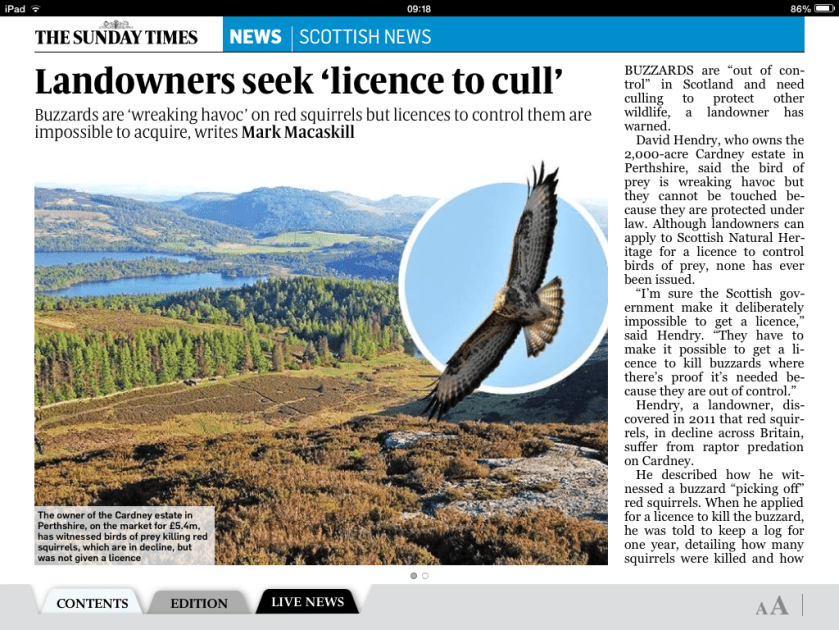
An article in yesterday’s Sunday Times reported that buzzards in Scotland are ‘out of control’ and ‘need culling to protect other wildlife’, according to David Hendry, the owner of Cardney Estate in Perthshire.

It’s no surprise that Hendry is at the centre of this latest claim. This former Chairman of the Scottish Gamekeepers’ Association has been calling for licensed raptor culling for over a decade, to include buzzards, sparrowhawks and peregrines (e.g. see here, here, here and here).

This time his justification for wanting a buzzard-killing licence was because he’d witnessed a buzzard eating red squirrels on his estate. Fortunately, his licence application to SNH was turned down because, surprise surprise, there was no evidence linking predation by the buzzard with a decline in the red squirrel population.

If we applied Hendry’s logic across the board, we would see requests for licences to kill golden eagles and a whole other suite of generalist predators whose diet may sometimes include red squirrel. It’s what predators do, Mr Hendry – they eat stuff. Get over it.

According to the article, Hendry’s desire to get a buzzard-killing licence was supported by Alan Stewart, the former Tayside Police wildlife crime officer who now works for the National Wildlife Crime Unit and who apparently has been mates with Hendry for years.

However, Stewart has written on his own blog that he was ‘mis-quoted’ in the Sunday Times article – apparently he wouldn’t support a ‘general cull’ of any bird of prey, but he would support a licence application to kill this particular red squirrel-eating buzzard, especially “since I knew the landowner concerned would not have abused any licensing privilege agreed“.

Good god. So a native bird eating a native mammal is cause for the bird to be killed??! Thankfully, the National Wildlife Crime Unit has no role whatsoever in the objective and scientific decision-making process concerning the granting of raptor-killing licences.

It’s bizarre that both Hendry and Stewart think that a buzzard is having such a detrimental impact on the estate’s wildlife that it needs be killed. According to Stewart, Cardney Estate has “an absolute wealth of wildlife” [despite the out-of-control buzzard, eh?] and Hendry’s pheasant and partridge shoots both seem to have managed just fine, with 677 birds shot on just one day in 2010 (see here).

Thanks to the contributor who sent in the following copy of the Sunday Times article:

Hendry1

Hendry 2

‘Persecution of sporting estates is bad for birdlife’ says NGO Chairman

A fascinating article has appeared on the Shooting Times website today, written by regular columnist Lindsay Waddell, who also just happens to be the Chairman of the National Gamekeepers’ Organisation.

His opening words are these:

Protection of predators and persecution of sporting estates are bad for birdlife“.

His rationale for this statement appears to be that there are no takers for the lease of what he calls a ‘prestigious moor’ (hmm, wonder what makes it a ‘prestigious’ moor?) and that soon it may be lost to conifer plantation and wind turbines, and all of this is due to the ‘relentless persecution of estate owners and those employed as gamekeepers‘.

What he doesn’t say is how he defines ‘the relentless persecution’ of estate owners and gamekeepers. Is he defining media reports as ‘persecution’? Perhaps he thinks that any publicity about the discovery of a poisoned golden eagle on a sporting estate with a long history of similar incidents is ‘persecution’ of the estate owner? Or maybe he thinks that the publication of video footage showing a gamekeeper bludgeoning buzzards to death with a fence post is ‘persecution’ of the gamekeeper? Or perhaps any commentary about yet another gamekeeper being charged with yet another alleged wildlife crime is ‘persecution’ of the gamekeeping industry?

Ironically, he goes on to suggest that had this level of ‘persecution’ been directed at any other group of workers, they would have had some form of legal redress available! Funny that – we have long argued that had any other group of workers been caught carrying out the type of sustained & widespread criminality that is regularly taking place on some sporting estates, the criminals would have been locked up a long time ago and the ‘business’ forced to close.

What Lindsay fails to grasp, even though it’s really not that hard, is that if the illegal killing of raptors, by many gamekeepers on many sporting estates, would stop, then the game-shooting industry may be viewed a lot more favourably than it is now. Unfortunately, the illegal killing continues, and organisations like the National Gamekeepers’ Organisation don’t help matters when they refuse to expel members who have been convicted of wildlife crimes (e.g. see here).

There’s some other guff at the end of his article about how predators are apparently eating all the prey and the conservation agencies should stop protecting predators blah blah blah….

In the meantime, watch this space for some more reports about dead raptors that have been discovered on sporting estates up and down the country having been poisoned/shot/trapped/bludgeoned…reports that the game-shooting industry would rather you didn’t know about.

Shooting Times article here

No evidence of animal rights activists ‘setting up’ estates

RACCEOn Wednesday, Environment Minister Paul Wheelhouse gave evidence to the Rural Affairs, Climate Change and Environment Committee (RACCE) at Holyrood about the government’s 2012 Wildlife Crime Report. We said we’d be watching the proceedings with interest, given Scottish Land & Estate’s claim that raptor persecution receives too much media attention (see here).

We did watch the live session and on the whole we thought that Wheelhouse did quite well, although we did think that some of the questions put to him by some of the RACCE Committee Members revealed a certain level of influence from those with a vested interest in game-estate management.

Quite a few questions related to the ‘setting up’ of estates and ‘interference’ of legal traps by supposed animal rights activists – in fact one of the panel tried to push him into admitting that it was a ‘legitimate concern’ (for estate owners/gamekeepers). Wheelhouse, though, was pretty firm in his response. He argued that it was legitimate to discuss how big a problem trap-tampering is because currently there isn’t any evidence to support the assertion that it is even a problem, although he did acknowledge that of course, trap-tampering was possible.

Trap interference/damage was one of the issues raised by SLE in their evidence to the RACCE Committee (see here) – they claimed it was ‘another group of increasing wildlife crimes’ that should be included in the Government’s annual Wildlife Crime Report. Trap interference and/or damage is a pretty interesting definition of what constitutes a wildlife crime, don’t you think?

And apparently, trap interference is not necessarily a criminal offence anyway, let alone a ‘wildlife crime’! Here’s what lawyer David McKie wrote on the subject in the last edition of the SGA’s member newsletter (McKie often acts as a defence agent for gamekeepers accused of wildlife crime) –

As a matter of law, there is a significant difference between interference and vandalism.

Vandalism would involve the breaking of a crow cage trap by someone punching or kicking a hole in it, for example, or the deliberate smashing up of a Fenn trap. It would also include the cutting of snares.

Interference does not necessarily involve a criminal offence….That can involve the removal of traps from their set location, the release of decoy birds or the pulling of snares.

The police can probably not charge the individual with interference“.

Fascinating! And before anyone tries to accuse us of encouraging trap interference and/or damage, this information is published here purely for the purpose of intellectual discussion.

It emerged during the RACCE session that BASC is currently conducting some research to evaluate the scale of trap interference/damage so we’ll look forward to seeing those results – we’ll also be looking closely at the methods they used to make their evaluation – especially if the research is based solely on the word of gamekeepers.

Anyway, for those of you who missed seeing Paul Wheelhouse at the RACCE Committee on Wednesday you could always watch the Holyrood TV video archive (here – only available for 28 days). There is also an official text report of the meeting available to download: RACCE wildlife crime 27_11_2013

See if you can spot the bit when Angus MSP Graeme Dey claims that wildlife crime policing in Tayside is the ‘gold standard’!!!

Landowners unhappy with raptor persecution publicity

Tomorrow (Weds 27th Nov), Environment Minister Paul Wheelhouse will give evidence on the government’s Wildlife Crime Report (2012) to the Rural Affairs, Climate Change and Environment  (RACCE) Committee at Holyrood.

The session will begin at 10am in Committee Room 3 and can be watched live on Holyrood TV (see here).

An interesting piece of written evidence has been submitted for the RACCE Committee to consider (see here, scroll down to page 11). It comes from Scottish Land and Estates and they are basically saying that raptor persecution receives too much media attention whereas poaching should be the focus of enforcement and publicity. They justify this by saying that poaching is the most commonly recorded wildlife crime (as shown in the government’s 2012 Wildlife Crime Report).

What they don’t say is that raptor persecution is clearly happening on a scale far greater than the police-recorded figures – so much so that its effect is having population-level impacts on species such as golden eagles, hen harriers, red kites and goshawks. Population-level impacts are not caused by ‘a few incidents’ – they are caused by widespread, systematic incidents. They also forget to mention the cack-handed way Police Scotland continue to deal with reported raptor persecution incidents, leading to poor recording and what we would call less than reliable figures.

It’s not the first time that SLE has tried to stifle media attention on raptor persecution incidents. Earlier this summer, CEO Doug McAdam wrote to the Environment Minister to complain about news coverage of certain crimes against raptors. So too did an ‘Industry Co-ordination Group’ – believed to include the following organisations: BASC, Scottish Gamekeepers’ Association, Scottish Countryside Alliance, Scottish Association of Country Sports and Scottish Land and Estates. A Freedom of Information request revealed the Minister’s responses, and all credit to him as he told them to piss off and focus on the real issue, that is, trying to stop the continuing illegal persecution of raptors in Scotland (although obviously he didn’t phrase it like that).

Here are copies of his letters: FOI Scot Gov 2013 media coverage raptor persecution

It’s no surprise that SLE want to put a stop to damaging media reports about raptor persecution incidents, especially if such incidents take place on estates owned by SLE members. It’s also no great surprise that they should be so interested in poaching; some of us think that poaching isn’t actually a wildlife crime at all – it’s more about ‘theft’ from super-rich landowners that just happens to involve wildlife. It doesn’t make any difference to the deer or the fish whether their death is caused by someone operating with or without the landowner’s permission, but it matters a great deal to the landowner, either because they’re losing money (from people who will pay to kill deer and fish)  or because they just don’t like the idea of someone else taking what the landowners perceive to be their property.

But is there another reason why landowners want to reduce the amount of media coverage that raptor persecution incidents receive? Look closely at the penultimate paragraph in the Minister’s letter to the Industry Co-ordination Group –

You mention the decision by Natural England to issue licences to control buzzards and your view that there should be open debate on how or whether, we manage common raptors. As far as Scotland is concerned I have been careful to remind anyone who asks about our position, that the provision allowing control of avian predators remains on the statute book and that SNH as the licensing authority will give careful consideration to any application. As far as debate is concerned, I am happy to discuss issues that are raised with me, but as you will be aware, the continuing levels of illegal persecution will inevitably and understandably produce an emotional response to this question from many members of the public“.

Surely the game-shooting industry’s intention isn’t to keep raptor persecution incidents out of the media to fool the general public into thinking that illegal persecution has stopped, in order to smooth the way for buzzard-killing licences to be issued?

We’ll be watching the Minister’s speech with great interest tomorrow.

Animal rights activists killing thousands of hen harriers

The long-awaited publication showing the results of the UK 2010 Hen Harrier Survey is finally here. Published in the scientific journal Bird Study, the paper (see here) documents significant declines across many parts of the UK.

No surprises there then.

England had a heady 12 pairs in 2010 (a country with sufficient habitat to support an estimated 323-340 pairs, according to the Hen Harrier Conservation Framework).

Scotland had 505 pairs in 2010 (a country with sufficient habitat to support an estimated 1467-1790 pairs).

Wales bucked the trend with at least a 33% increase to 57 pairs (none of which were found on habitat classified as grouse moor).

It should be remembered that these results are from 2010; there have been further documented declines since then, including just two (failed) breeding attempts in England this year and a consistent downward trend of breeding success in Scotland, according to the latest report from the Scottish Raptor Monitoring Scheme (see here).

The paper also documents a severe decline on the Isle of Man (49%) and bizarrely suggests that ‘there are no obvious drivers for this’. Eh? Could it possibly be anything to do with the systematic elimination of harriers on the mainland, reducing the number of birds available to travel to the Isle of Man? Just a thought.

So, where are the missing 962-1285 breeding pairs of hen harriers in Scotland?

And where are the missing 322-339 breeding pairs of hen harriers in England?

Widespread declines are indisputable. The relationship in England and Scotland between areas of reported declines and land managed for intensive driven grouse shooting is also indisputable. But what happened to all those birds? Those with a vested interest in the grouse-shooting industry will tell you it’s all down to climate change/habitat change/lack of prey/cold spring/wet spring/late spring/early spring/being eaten by golden eagles/too many foxes/too many buzzards/too many ravens/too many sparrowhawks/the work of animal activist extremists hell-bent on killing hen harriers to make the gamekeepers look bad…in fact they’ll blame anything except the blindingly fucking obvious.

Hen Harrier photo by Gordon Langsbury

“Massive declines” of mountain hares on Scottish grouse moors

Here we go again.

A leading ecologist has accused Scottish landowners of causing “massive declines” of mountain hares on grouse moors around Deeside, Aberdeenshire.

In an excellent article published in The Herald today (and on journalist Rob Edwards’ website, see here), Dr Adam Watson claims that what is going on is a ‘national scandal’ and accuses SNH of failing in their duty to protect this important keystone species.

To counter this argument, Tim Baynes of Scottish Land and Estates claims that even though thousands of hares are destroyed each year, this was ‘less than 10% of the population’.

That’s an interesting argument, especially given the uncertainty of the actual population size of this species. The most up-to-date UK population estimate appears to have been made in a 1995 publication (Harris et al 1995). The estimate given then was in the region of 350,000 individuals, with 99% of these living in Scotland. However, the authors recognised that this figure may be either overestimated or underestimated by a whopping 50%!

It would appear that Baynes is basing his (flawed) ‘no-impact’ argument on an SNH-commissioned study that showed at least 25,000 mountain hares were culled on Scottish estates during 2006/2007. That study demonstrated no impact on the hare’s distribution (at that time) but was not able to determine whether there was an impact on the hare’s abundance (which is the key point when estimating population size!) because no reliable measures of estimating abundance for this species were available.

What Baynes also failed to mention was that the 25,000 culled only related to information provided by 90 estates; a further 102 estates (68 driven grouse estates and 34 walked-up grouse estates) did not provide any information to the survey, so the actual figure culled was likely to be considerably higher.

It’s also ludicrous for Baynes to be referring to a (fairly dodgy) population estimate from 1995 – that was 18 years ago! The latest information, just published by the BTO, suggests a 43% decline in mountain hares between 1995-2012 (see here).

Talking of ludicrous, Alex Hogg of the Scottish Gamekeepers’ Association is also quoted in The Herald article, claiming that gamekeepers have ‘no alternative but to suppress the numbers of mountain hares on grouse moors because of the dangers of Louping Ill Virus, which can infect humans’. However, here is an article that suggests humans are “rarely” affected by the Louping Ill Virus! And here is an article about a scientific publication that suggests there is “no compelling evidence base” that culling mountain hares can stop the spread of Louping Ill Virus!

A tick-borne disease that seems to be of more concern to humans is Lyme Disease. And what spreads Lyme Disease? Pheasants, amongst other species (see here). Given Mr Hogg’s concern for human health, can we expect to see him advocating a moratorium on the release of 43 million pheasants, per year, into our countryside?

The crux of The Herald article is that SNH is failing in its statutory duty to protect the mountain hare. This is a European-protected species and thus SNH has a duty to ensure the species’ conservation status is maintained and that their populations are managed sustainably. Given previous concerns about the species’ conservation status, the Scottish Government recently introduced a closed season for mountain hares as part of the WANE Act (see here), although it’s hard to judge just how effective that will be given the lack of monitoring and enforcement.

To be fair to SNH, they have previously tried to establish an effective monitoring programme for the mountain hare. They commissioned several reports on the subject between 2005-2010 but these reports all recommended a clear need to develop ‘reliable, robust and easily implemented survey methods’. As far as we can tell, nearly four years later they still haven’t done so and according to Dr Watson’s findings of “massive declines” of mountain hares in Deeside, in addition to the BTO’s findings of a 43% decline between 1995-2012, it would appear that SNH need to prioritise their monitoring scheme with some urgency. Asking moorland managers to ‘talk to us if they are thinking of culling hares in large numbers’ (see SNH quote in The Herald) is not going to stand up as evidence when SNH are finally taken to court for breaching European conservation laws.

New wildlife crime reporting app launched

PAW crime app screen 2A new smartphone app has been launched by PAW Scotland to help the general public to record and report suspected wildlife crime in Scotland.
Using the free app, the public can complete an on-screen reporting form and can upload scenes of crime photos that are automatically tagged with a GPS reference. This information is then sent directly to Police Scotland via email.

The app was the brainchild of former Police Wildlife Crime Education Officer, Andy Turner, who is now employed as Wildlife Crime Officer for SNH. Here is a short video of Andy explaining how to report wildlife crime and his introduction to the new app.

The government has issued a press release about the new app here.

It is good to see anything that raises awareness of wildlife crime in Scotland, although just how effective this new app will be remains to be seen; rural mobile phone coverage is not brilliant in large parts of Scotland – will this app work if you’re standing on a remote grouse moor looking at a poisoned eagle?

There are other concerns, too. Comments made in the government’s press release suggest that the reporting of wildlife crime is a problem in Scotland. That is simply not the case. Many people are reporting suspected incidents – it’s the police follow-up that is lacking in many areas. Not everywhere – there are some excellent Police Wildlife Crime Officers who can be relied upon to follow up every single reported incident – but it’s a bit of a lottery – if you happen to be in an area where (a) there isn’t a Police WCO or (b) there is a Police WCO but they are unreliable, then reporting an incident via this app won’t make a blind bit of difference.

A more serious concern as far as we’re concerned is the exclusion of other investigatory agencies. In his video, Andy makes a point of saying that Police Scotland is the investigatory agency for wildlife crime – and blatantly ignores the statutory reporting status of the SSPCA. This app will not forward reported incident details to other investigatory agencies such as the SSPCA or the RSPB – the information just goes directly to Police Scotland. That is certainly not ideal. By excluding the other agencies, there won’t be anybody to follow up / chase up Police Scotland to ensure that the incident is actually being investigated. As we’ve seen time and time again, when Police Scotland are left to their own devices then many reported incidents just get buried /hidden / unpublicised / forgotten.

We would encourage anybody who is reporting a suspected wildlife crime to the police, either using the app or not, to also notify at least one of these two agencies at the same time (if not before!) –

RSPB Scotland Investigations: 0131-317-4100

SSPCA 24hr hotline: 03000-999-999

If you haven’t already added these numbers to your phone, now is the time to do it.

Whilst Andy Turner deserves credit for helping to raise awareness at least, we doubt very much whether the use of this new app will improve prosecution or conviction rates. Do you think we would have seen a prosecution or conviction for the Leadhills poison baits had the incident been reported via this app? Of course not! Although had the poisoned baits been reported via this app we the general public would still be very much in the dark about that crime because Police Scotland have refused to issue a press statement about it, eight months after the discovery. If they are being provided exclusive information via this app then we can expect to see much more of the same. That, for us, is unacceptable.

No prosecution for poisoned baits found on Leadhills Estate?

leadhills estateEight months ago (March), a significant haul of pre-prepared poisoned baits was discovered on Leadhills Estate in South Lanarkshire. The baits comprised chopped up pieces of rabbit, liberally sprinkled with the banned poison Carbofuran, that had been placed inside two gamebags that had been hidden inside a wood next to a grouse moor.

The discovery was made by fieldworkers from Project Raptor and they duly reported their finding to the police. We waited for a press release and an appeal for information from the police but nothing came, so three months later (June) we blogged about it (here) because, unlike the police, we considered it a newsworthy item in the public interest, as apparently did BBC Scotland (here).

Recently, an update on the police investigation appeared on Project Raptor’s website:

24th October 2013. Project Raptor have contacted South Lanarkshire police and they have now informed us that evidence gathered from the two game bags has come back negative. This means that unless further evidence comes their way then this case is just another in a long line of wildlife crimes that have taken place within the Leadhills area over the years that will never be solved”.  See here for full update.

When Project Raptor says that ‘evidence gathered from the two gamebags has come back negative‘ they do not mean that the analysis of the poison came back negative – SASA has already confirmed the poison found on those baits was Carbofuran and they included the incident in their quarterly report on poisoning incidents. Rather, what we think Project Raptor is referring to is that any fingerprint or DNA testing that might have been done on the two gamebags has come back negative.

This means that there is no evidential link between the two gamebags and any individual person and therefore it is not possible to charge anyone for committing an offence in relation to these items.

This case is an excellent example of just how difficult it is to bring illegal poisoners to justice. It’s not the fault of the police that there isn’t enough evidence, although to be frank they are not blameless in this particular situation – had they had the foresight and interest to install a covert camera overlooking the site where the poisoned baits had been found they may well have caught the criminal(s) in the act of retrieving the bait or even adding more bait to the secret stash. They could (should) also have conducted a thorough search of the surrounding area, particularly the adjacent grouse moor, to see whether any of the baits had already been placed out on the hill. Given that one of the bags was full (of bait) and the other bag was only half-full, this would have been a reasonable assumption, especially given the reported history of poisoned baits being found on this estate (see here). Instead, the police decided to arrive on site in two marked police vehicles (thus alerting everybody to their presence and allowing any nearby criminal to hide any other incriminating evidence) and they quickly removed the gamebags and left the site without conducting a wider search. On top of all that, they still have not issued a press release about this case, giving us the impression that they’re just not all that bothered. At the very least they should be alerting the general public to the potential threat of people and their pets stumbling across what is a fatally toxic poison in a publicly-accessible area.

So is that it, then? Will the discovery of these baits (which we believe to be the biggest stash of pre-pared baits found since 32 poisoned baits were found on Glenogil Estate in 2008) just be conveniently ignored and everyone carries on as usual? For certain, these baits will not feature in any ‘official’ raptor persecution statistics because, as we were recently told by the Environment Minister’s office, where poisoned baits have been discovered but ‘no raptors were involved’ they cannot be listed as a raptor persecution incident. We don’t actually know whether ‘no raptors were involved’ at Leadhills because the police didn’t conduct a search to look for poisoned carcasses!

It looks certain that no action will be / can be brought in the criminal courts. But what about other types of action?

There’s the possibility of civil action – we will wait to see whether any single farm payments are withdrawn from Leadhills Estate by the Scottish Executive (as they were from Glenogil Estate in 2008 – see here) although we suspect any such action would be strongly challenged by the estate precisely because there is no evidential link between the baits and any employee of Leadhills Estate.

Great, isn’t it?

Is there any other type of action? Well, yes, there is. What we would really like to see is action taken by Scottish Land and Estates, the representative body of Scottish landowners. The only response we saw from SLE about the discovery of the poisoned baits on Leadhills Estate was a false accusation levelled at this blog for reporting the incident! (see here).

Interestingly, in a comment made on Mark Avery’s blog today, SLE Chief Executive Doug McAdam claims, “…..a range of partners, Scottish Land and Estates included, invest a significant amount of time and resource into working with and through PAW Scotland to help achieve this [eradication of golden eagle persecution], not just for golden eagles though, but all wildlife crime” (see here for his full comment).

So what, exactly, has SLE done about the continuing issue of alleged and confirmed illegal raptor persecution on Leadhills Estate? We’ve asked this time and time again but the question is just met with silence every time.

We’re not sure that Leadhills Estate is a member of SLE, although given that the owner of Leadhills Estate (Lord Hopetoun) also just happens to be a Board member of SLE, it would be quite strange if Leadhills Estate wasn’t an SLE member. Why doesn’t SLE publicly condemn the crimes that are alleged and confirmed at Leadhills Estate? If Leadhills Estate is an SLE member, why hasn’t SLE kicked them out, just as they did with Glasserton Estate earlier this year following the conviction of their gamekeeper (see here). McAdam may argue that nothing has been proven at Leadhills in relation to the latest discovery (in terms of a legal evidential link) and that would be accurate, but there is a long, long, long, long list of alleged and confirmed incidents from this estate, dating back decades (see here), several of which have resulted in criminal convictions.

It seems to us that SLE is repeatedly turning a blind eye to reported activities on this estate that the rest of us can see very clearly. Why would they do that if they’re so keen to eradicate raptor persecution?