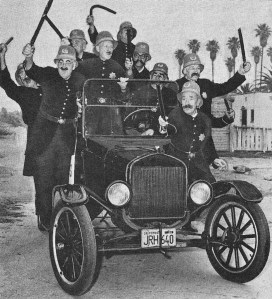
Gamekeepers “the doctors & nurses of the countryside”

Ah, Alex Hogg, the SGA Chairman – he’s the gift that just keeps giving.

He and his son Kyle featured in an ITV Border Life programme that aired on Monday and Alex gave us another one of his classic quotes:

We kill animals because probably we’re the doctors and nurses of the countryside. Animals don’t have an old folks home to go to; when their teeth fall out they’ll starve to death so we’ll probably shoot that animal before that happens“.

What a deluded analogy. Doctors and nurses heal the sick; gamekeepers kill most species that might threaten the number of gamebirds available, er, to be killed. Where’s the similarity between these two professions?!

He also says he’s proud that things haven’t changed in 150 years of gamekeeping: “It’s part of our natural heritage, almost“.

What he meant of course was 150 years of gamekeeping has had a devastating impact on our natural heritage, wiping out several species (some of which have since been reintroduced by conservation organisations) and reducing others to a fraction of their former range and abundance.

If you want a laugh, you can watch the programme here (look for programme aired Jan 12th).

New petition puts more pressure on SNH to protect mountain hares

There’s been a lot of publicity recently, and quite rightly, about the unregulated mass slaughter of mountain hares on Scottish grouse moors (e.g. see here, here, here and here).

However, this issue isn’t new.

Nine years ago (yes, nine), a complaint was made to the EU that Scotland was in breach of European law (Habitats Directive) because SNH was allowing the unrestricted killing of mountain hares on grouse moors without knowing whether those culls were affecting the species’ conservation status. The complaint was made by Neil Macdonald, a former wildlife officer with Tayside Police. His complaint was publicised by environmental journalist Rob Edwards, here.

According to Edwards’ report, SNH accepted that there could be a problem. SNH’s scientific director Colin Galbraith was quoted as follows:

The culling of mountain hares on some Highland estates is an issue that SNH is aware of and takes very seriously“.

So what happened to that EU complaint? Well, according to Dr Adam Watson (we blogged about his tirade against SNH’s failure to protect mountain hares here) this is what happened:

EU staff did follow this up, by requesting SNH for its views and advice. I have been told that SNH senior staff responded to the EU by asserting that they would have informed the EU if they had been aware of such severe problems. Thus the EU then ended their pursuit of Macdonald’s complaint‘ [quoted from page 132 of Watson’s book Mammals in north-east Highlands (2013)].

So here we are, nine years on, and what’s SNH doing? Calling on grouse moor managers to practice ‘voluntary restraint’ on hare culling – in our opinion, a pointless effort (see here). Oh, and conducting more ‘trials’ to work out how to count mountain hares. Seriously, we can do full face transplants, we can communicate immediately with millions of people around the globe with a single click, we can land a robot on the surface of a comet…..but we can’t figure out how to count hares on a few hill sides? Come on.

And as we predicted, SNH’s latest ‘trials’ are being used as an excuse by the Government to delay any immediate action to protect mountain hares. In December, Alison Johnstone MSP asked a Parliamentary question on what action the Scottish Government is taking to protect hares. This question was answered last week by Environment Minister Aileen McLeod (although to be fair to her, her response is probably just a regurgitation of what SNH has told her). Here’s what she said:

Question S4W-23615: Alison Johnstone, Lothian, Scottish Green Party, Date Lodged: 10/12/2014

To ask the Scottish Government, further to the answer to question S4W-18470 by Paul Wheelhouse on 4 December 2013, whether it will provide an update on the information regarding mountain hares.

Answered by Aileen McLeod (06/01/2015):

Scottish Natural Heritage (SNH), the James Hutton Institute and the Game & Wildlife Conservation Trust, acting on the advice of several mountain hare experts, have started work on field trialling a range of methods of assessing mountain hare numbers, to develop a better monitoring strategy and to improve the quality of the information used to assess population status and the sustainability of hare management measures. This programme of work is due to be completed in 2017.

Until this study is complete, and because of recent concerns about the status of mountain hares, SNH has developed a joint position statement on the subject of hare culling following consultation with key stakeholders representing moorland managers, namely Scottish Land & Estates and the Game & Wildlife Conservation Trust. The statement is evidence-based and argues that large scale culls of mountain hares to reduce tick loads, and thus to benefit grouse and other bird survival, are only effective when other tick-carrying animals are removed as well, or where they are absent. The intention is to work with estates to put in place effective but sustainable management of mountain hares. More information about the joint position statement can be found on the SNH website

http://snh.presscentre.com/News-Releases/SNH-GWCT-SL-E-position-on-large-scale-culls-of-mountain-hares-to-reduce-louping-ill-15f.aspx

In addition, a review of sustainable moorland management is currently being undertaken by a sub-group of experts from SNH’s Scientific Advisory Committee chaired by Professor Alan Werritty. This includes the management of mountain hares as one of a number of issues connected with sustainable moorland management practices. This review is due to be completed by March 2015.

Earlier in 2014, SNH was provided with additional hare count data, collected over many years in some cases. These quantitative data are potentially very useful, as previous evidence of local declines was largely based on anecdote. This information has been made available to the above SNH Scientific Advisory Committee sub-group as part of the review process.

END

If, like us, you don’t think SNH is doing anywhere near enough to protect this iconic species from the indiscriminate slaughter that continues across Scotland’s driven grouse moors, you might want to consider signing a petition which calls on SNH to confer immediate protected species status on the mountain hare and thus put an end to this barbaric, disgusting butchery. Please sign it HERE.

mountain hare cull angus glens large

The face of ‘modern landownership’ in Scotland

This is a belter. Surely inspired by the Gloria Gaynor classic, a Scottish estate owner has erected signs on his land telling the RSPB they’re ‘not welcome’.

Go on now go

Walk out the door

Just turn around now

‘Cause you’re not welcome anymore

John Mackenzie, who owns the massive Gairloch and Conon Estates, said he’d put up the signs because:

It is years of frustration and anger boiling over. Landowners, farmers and gamekeepers have always been an easy target, blamed by the society [RSPB] for the poisoning and shooting of raptors“.

Er, wouldn’t that have something to do with the fact that the majority of those convicted for poisoning and shooting raptors are, erm, gamekeepers working on shooting estates?

He went on to say he was “irritated” to find out that the RSPB had been “driving around looking at things themselves“. How dare they!

Ironically, the Conon Estate is close to the area where 22 raptors were found dead last spring in what has been termed the Ross-shire Massacre – 16 of them confirmed illegally poisoned (still no information on the other six).

Poor old Laird MacKenzie. He knows he can’t stop the RSPB, or anyone else for that matter, accessing his land, but he thought he’d stick up his signs anyway. Bless.

We wonder how his actions fit in with the recently launched Landowners Charter? Prepared by Scottish Land & Estates and published last September, this charter ‘sets out a commitment to the principles and responsibilities of modern landownership in Scotland’. The ‘four pillars’ of this charter are for landowners to be open, inclusive, enabling and responsible.

Not rude, arrogant, intolerant and stupid, then?

Bring on the land reform.

Article in Daily Mail here

Article in Daily Telegraph here

Article on BBC news website here

Pointless call for ‘voluntary restraint’ on Scottish grouse moor mountain hare massacres

mountain hare cull Angus glensScottish Natural Heritage, in partnership with the Game & Wildlife Conservation Trust and Scottish Land & Estates, has issued a press release (here) calling for ‘voluntary restraint’ on the large scale culling of mountain hares on Scottish grouse moors. Some of you may have read about it a few days ago on Mark Avery’s blog here.

In the original press release (which was amended one day later), it was stated:

The bold step by SNH, SLE and GWCT should help ensure that future management is sustainable“.

What a steaming pile of tosh. This doesn’t come anywhere near being “a bold step”. A bold step would have been for SNH to exercise the precautionary principle and enforce an immediate and indefinite moratorium on the wide-scale, unregulated mass slaughter of mountain hares until the effect of such killing on the mountain hare population can be rigorously assessed.

The concept of calling for voluntary restraint from grouse moor managers is farcical. So many of them have refused even to adhere to 60-year-old conservation legislation (i.e. not to poison, trap or shoot protected raptors) so the chances of them volunteering restraint to not slaughter a partially-legitimate quarry species is pretty minimal.

Asking for voluntary restraint on hare-killing is also not a new approach. Last year SNH said: “We don’t support large, indiscriminate culls of mountain hares and advise moorland managers to talk to us if they are thinking of culling hares in large numbers” (see here).

And even way back in 2003, Scotland’s Moorland Forum published a document called Principles of Moorland Management. On page 27 it says the following:

We do not recommend the indiscriminate culling of hares; apart from the direct impact on the hare population, there may also be the indirect effect of a reduction of the food supply for larger raptors, including eagles. In certain circumstances, however, culling may be considered necessary……but further advice should be sought from SNH before embarking on a cull programme“.

So how many grouse moor estates, do you think, contacted SNH for advice before embarking on a cull programme?

According to allegations made by leading upland ecologist Dr Adam Watson and based on decades of scientific fieldwork, not many. In his 2013 book, Mammals in north-east Highlands, Watson writes:

I know of no grouse-moor estate within the range of the mountain hare that has not practiced or does not practice heavy killing of hares, with the exceptions of Edinglassie, Invermark, Glen Muick and Balmoral (but most of Balmoral is deer land rather than grouse moor). The only other heather-moorland areas that I know which are free from heavy killing are those owned by non-sporting agencies or by individuals primarily interested in wildlife conservation, such as the RSPB at Abernethy, SNH at Inshriach, the National Trust for Scotland at Mar Lodge, and Miss Walker of the Aberlour shortbread company, who owns Conval hills near Dufftown“.

He goes on to name various estates who, he alleges, “have been reducing the numbers of mountain hares greatly“, some dating back to the 1980s. His named estates include Altyre, Castle Grant, Lochindorb, Farr, Millden, Glenogil, Glen Dye, Dinnet, Invercauld, Tillypronie, Glen Buchat, Candacraig, Allargue, Delnadamph, Crown Estate, Fasque, Cabrach, Glenfiddich, Glenlochy, Gannochy, Fettercairn, Cawdor, Corrybrough, Moy, Glen Lyon.
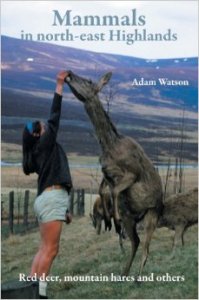
Adam Watson Mammals in NE Highlands[Incidentally, this book is a goldmine of information about what goes on on the grouse moors of NE Scotland. Ignore the bizarre front cover and Watson’s somewhat erratic writing style – this book is crammed with details gleaned from decades of Watson’s scientific field work and is well worth its £9.99 price tag. There’s even an allegation that “In 2010, Millden Estate released red grouse from elsewhere, for shooting“. If that’s true it raises a number of issues, not least whether they had a licence to translocate red grouse].

Watson’s observations, and those of others, have led to a number of high-profile media reports about the mass slaughter of mountain hares on Scottish grouse moors (e.g. see here, here and here) and even Parliamentary questions (see here and here). Tellingly, MSP Alison Johnstone (Lothian, Scottish Green Party) has recently followed up on the answers provided last year and on 10th December 2014 she lodged a further question (due to be answered on 7th Jan 2015) requesting an update on how SNH intend to assess whether mountain hares are in a favourable conservation status. We already know how this question will be answered – the Environment Minister will simply recite the content of the latest SNH press release.

In addition to calling for ‘voluntary restraint’, the press release tells us that the three organisations will be ‘developing a reliable and cost-effective field method’ to form the basis of a long-term monitoring programme. Previous attempts at this have failed miserably, and some correspondence from earlier this year between Dr Watson [AW] and SNH about these ‘field methods’ is really quite illuminating: (thanks to the blog reader who sent us these)

AW letter to SNH 14 February 2014

SNH response to AW 7 March 2014

AWresponse to SNH 15 March 2014

In Dr Watson’s view (shared by many of us), these further ‘trials’ simply represent more procrastination from SNH but will be used by them (and probably by GWCT & SLE) to proclaim that “Everything’s ok, we’re sorting it”. That may fool some but the awful, bloody reality will probably not change.

A final point. We are fascinated to see that this ‘joint initiative’ is coming from not only SNH but also GWCT and SLE. The call for ‘voluntary restraint’ on the mass killing of mountain hares seems to be slightly at odds with activities carried out on Lochindorb Estate when it was owned by the GWCT’s former Scottish Committee Chairman, Alasdair Laing (e.g. see here). As for SLE, their view on the destruction of thousands of mountain hares on Scottish grouse moors can be read here.

To read our previous blogs on mountain hares, click here [and scroll down through the posts]

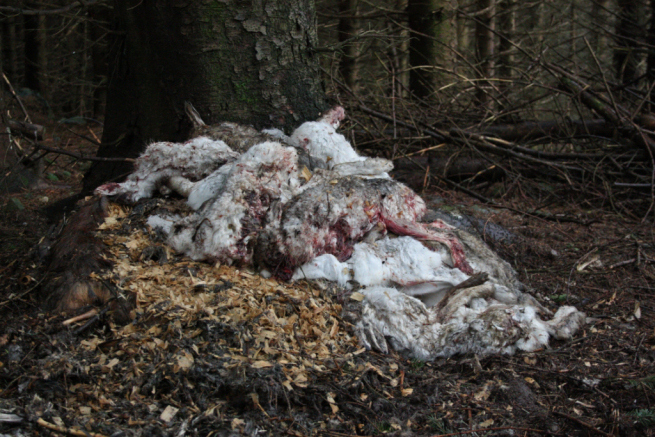
To view some shocking, sickening photographs of the mass killing of mountain hares on a grouse moor go here.

Come on, Aileen

Aileen McLeod MSPWe didn’t know what to expect from the newly-appointed Environment Minister when she took on her role a little over a month ago. Dr Aileen McLeod’s political experience had been largely focused on European policy work, although she was clearly highly educated and we knew she’d be well advised by the wildlife crime policy officers in Holyrood. Nevertheless, it would inevitably take time for her to achieve the level of insight and knowledge of her predecessor, Paul Wheelhouse MSP, who had the benefit of two years in office and was beginning to achieve considerable momentum against the raptor killers, until he was pushed out to another department in the Cabinet reshuffle in November.

Obviously, the jury is still out on Dr McLeod’s effectiveness and we need to give her a bit of time to get her bearings, although we fully expect her to adopt the Government’s stated intolerance of wildlife crime and to do everything she can to ensure that the raptor killers are brought to justice.

Two recent statements show that she has a thoughtful and measured approach, although we have cause to question a few of her comments.

First off, she has responded to the concerns of the Rural Affairs, Climate Change and Environment (RACCE) Committee, who wrote to her (see here) after taking evidence on wildlife crime from Police Scotland, COPFS and the former Environment Minister.

Here is her response: Environment Minister response to RACCE Committee Dec 2014

On the whole, her response is non-contentious and is pointing in the right direction, but she does say a couple of odd things. On the issue of the detection and prosecution of wildlife crime she says:

Reported crime numbers also reflect not only public awareness of wildlife crime, but also confidence that there will be an appropriate response from the authorities. Police Scotland has worked hard to ensure that consistent structures and resources are in place throughout Scotland and we expect this to produce improved results in wildlife crime reporting“.

We haven’t seen any evidence of this, in fact the complete opposite. We would agree that Police Scotland has been consistent, but not in a good way; consistently poor responses to reports of wildlife crime (with a handful of exceptions) seems to have been the norm for a very long time.

On the subject of the absence of species potentially indicating criminal activity (i.e. the absence of certain raptor species from vast swathes of driven grouse moors) she says:

We know that there may also be other non-criminal explanations for the absence of species. Nevertheless I agree that this would be useful work for the PAW Scotland Science sub-group to take forward“.

What other non-criminal explanations are there for the absence of certain raptor species from driven grouse moors? All the science (and there has been plenty of it, some dating back almost two decades) indicates a direct link to the illegal persecution of raptors on those moors. Sure, natural factors such as habitat, climate, prey availability, predation etc can and do affect the natural distribution of species, but we’re talking about species that have either ‘disappeared’ from their former natural ranges or their breeding attempts in parts of those ranges consistently fail. It’s no coincidence that these areas just happen to be managed as driven grouse moors.

On the subject of increasing the investigatory powers of the SSPCA she says:

I am also aware of the need to carefully balance a number of factors such as resources, accountability and proportionality in coming to a decision on whether to extend further powers to the SSPCA as regards wildlife crime“.

‘Proportionality’ is an interesting word. It suggests that the measure of extending the SSPCA’s powers should be fair, reasonable and appropriate. Who would argue that extending the SSPCA’s powers would be a dis-proportionate response to the rising level of wildlife crime in Scotland and Police Scotland’s inability to cope? Well we already know the answer to that – see here and here. The question is, will the Environment Minister consider it a disproportionate measure? We’ll find out soon enough, although if the last sentence of her letter to the RACCE Committee is anything to go by, she’ll do the right thing:

Tackling wildlife crime is a key priority for the Scottish Government and one that I am keen to take forward robustly in my new role“.

Other statements in her response letter were very encouraging, and we particularly welcome her intention to consider including the locations of illegally placed poison baits and traps on the annual PAW raptor persecution maps. That’s something that we (and others) have been asking for for a long time (e.g. see here).

We were also pleased to see a (diplomatic) dig about Police Scotland’s ridiculous press statement on the cause of the Ross-shire Massacre (here is some background on their idiotic statement, in case you missed it). Dr McLeod says:

Police Scotland’s press release on 24 October was designed to bring about a reduction in speculation that was widespread across social media on this high profile case. I am confident that lessons will have been learned on the need to be very careful with wording of such communications“.

She went a bit further in a recent statement published in the Scottish Farmer (here), where she announced NFU Scotland as a new member of PAW. In that statement she reiterated that the Ross-shire Massacre was the result of criminal activity. In other words, it wasn’t the result of an accidental poisoning.

 So, all in all a good start from her, with just a couple of questionable statements. Come on, Aileen, let’s see what you can deliver in 2015…

RSPB responds to sea eagle diet nonsense

Last week we blogged about the ridiculous article written by Auslan Cramb that was published in the Telegraph, claiming that sea eagles eat more lamb than fish (see here).

Now Richard Evans, Senior Conservation Policy Officer for RSPB Scotland, has written a brilliantly scathing response to the article. You can read it here.

“Vicious killers”

vicious killersSometimes, we despair.

This is one of those times.

From yesterday’s Farming Life, written by Dan Kinney:

At last I see some green shoot of common sense about hen harriers, that most vicious of raptors which, when hunting, quarter moorland like pointers or setters, a mere couple of feet above the heather……..”

Full article here

We could mock the author, we could bemoan the lack of education, we could laugh at the 19th Century attitude, we could try to reason against the prejudice. We could do all these things, but the most useful thing we can do is to join the Golden Eagle Trust, a charitable organisation dedicated to the restoration of Ireland’s lost birds. This is the group behind the successful reintroduction to the Irish Republic of the golden eagle, the white-tailed eagle and the red kite, and who are working hard to protect other species, including the beleaguered hen harrier.

Twenty Euros will pay for a year’s membership and help this small team to continue their vitally important work. And God knows it’s needed. Please support them and buy your membership online here

Photo from Peter McAllister (@petermc0104)

Sea eagles demonised, again

It seems barely a month goes by without someone trying to demonise white-tailed eagles in Scotland.

This time it’s the handiwork of Telegraph ‘journalist’ Auslan Cramb, with an article headlined:

Sea eagles eat more lamb than fish, despite their name, according to research.

We really shouldn’t be surprised that this scaremongering drivel has been churned out by Cramb. He’s the same ‘journalist’ who in October falsely claimed that ‘Wind turbines have killed more birds of prey than persecution this year‘ – a claim we demonstrated was false here.

His latest claim is based on the results of a series of photographs that were taken at a white-tailed eagle’s nest in Argyll between January and July this year. Yes, that’s right, footage from a single nest, filmed during a single period. Hardly representative, is it?

According to SNH, this eagle pair brought in 117 prey items to the nest. 67 of these (57%) were unidentifiable. Of the items that were identifiable, 21 items were mammals, 14 were birds, 7 were fish and ‘8 or 9’ were lambs.

So this camera at this particular eagle’s nest, during this particular period, filmed one or two more lambs than fish. Does that justify the scaremongering headline that sea eagles eat more lamb than fish? Hardly. But then a headline such as ‘Pair of sea eagles enjoy a varied, generalist diet’ isn’t really what the raptor killers want the public to believe, is it?

The article also fails to explain that these ‘8 or 9’ lambs could well have been taken as carrion (i.e. the lambs were already dead and the eagles simply scavenged the carcasses).

To try and pass these results off as a conclusive scientific study is pure desperation. It’s what’s known as ‘utter bollocks’ in scientific terms. Trying to determine raptor diet using a single method (such as nest camera footage) is a well-known problem that is beset with bias. There are numerous methods of obtaining such data (e.g. analysis of regurgitated pellets, analysis of prey remains, camera footage) and considerable research has shown that a combination of methods should be used, rather than a single one. The additional issue of using a sample size of one (nest) is just laughable. It is also well known that the diet of individual eagle pairs can vary across years in western Scotland, as reported by sea eagle experts Mike Madders and Mick Marquiss in 2003.

The most recent, properly conducted, scientific study on white-tailed eagle diet in western Scotland was published in 2013. That study included the analysis of pellet and prey remains from 16 sea eagle nests on Skye, Mull, Lewis and Harris, over an eight year period. The study found that 49.6% of the eagles’ diet comprised seabirds, 19.2% sheep, 13.4% lagomorphs and 6.1% fish. However, the authors acknowledged that the estimation of fish in the eagles’ diet was probably under-estimated due to the methods of dietary analysis that they used.

The purpose of installing the camera at the Argyll eagle pair’s nest was part of an on-going effort to understand the conflict between sea eagles and farming/crofting interests in western Scotland. This is a long-standing and controversial issue that we’ve blogged about a lot (here is an example). It would appear that if farmers/crofters want to deter sea eagles there’s a simple solution – attach a small black plastic box to the lamb’s neck (about the size of a matchbox). Why? Because a load of lambs were radio tagged during an earlier study into alleged lamb-killing eagles and the results showed that not one single lamb was killed by an eagle. The crofters claimed the eagles had been ‘put off’ because of the radio collars/tags. (They also claimed that the eagles had been given supplementary food during the study period, and that some eagles had been ‘bird-napped’ to remove them from the study area!).

UPDATE 22nd December 2014: RSPB Scotland responds to this idiotic Telegraph article here

Ross-shire Massacre: 9 months on

KeystoneCopsIt’s been nine months since 22 raptors (16 red kites + 6 buzzards) were illegally killed in a mass poisoning incident near Conon Bridge, Ross-shire.

Still no word from Police Scotland on the name of the ‘illegally held substance’ that was used to kill these birds.

Still no arrests.

Still no charges.

Still no prosecution.

Still no justice.

Police Scotland’s handling of this investigation continues to astound….

You may remember, back in October, some senior officers from Police Scotland gave evidence on this case to the Parliamentary Rural Affairs, Climate Change & Environment Committee (RACCE). The police were being questioned about their idiotic recent press release which had stated: “These birds were most likely not targeted deliberately but instead were the victims of pest control measures“.

We were particularly interested in what Assistant Chief Constable Malcolm Graham had to say to the RACCE about this press release:

We put out information into the public domain that we thought was going to clarify what we thought our best assessment was, lay behind the intent of the acts that we’re investigating, and from everything that we have done, in combination with a number of other agencies who are active in this field AND WHO SUPPORTED THE PRESS RELEASE THAT WE PUT OUT [Emphasis by RPS], we wanted to say that it didn’t appear that the activity had sought to deliberately target the birds that had been killed“.

We were intrigued about who these “other agencies” were that had supposedly “supported the press release that we put out” because, to be blunt, we didn’t believe ACC Malcolm Graham’s claim.

So in October we encouraged blog readers to email ACC Graham to ask him for clarification on the identity of these “other agencies“. There was no response for six weeks. So last week we encouraged blog readers to consider writing to the Information Commissioner to put in a formal complaint about Police Scotland’s refusal to respond. That prompted the following letter from Police Scotland, sent on 11th December 2014:

Dear XXXXX XXXXX

ACC Graham has asked me to reply to your email on his behalf.

I can confirm that a number of organisations both governmental and non-governmental have assisted the police in this enquiry from the outset. Significantly, both the RSPB Investigations Team and the SSPCA Special Investigations Unit have been involved and offered professional opinions at various times based on their experience of the the killing of birds of prey and the use and impact of poisons.

When drafting the press release these considered opinions along with those given by others were taken in to consideration. The press release reflected the belief at this time that the birds of prey were not the intended target of the illegal poison. However, as stated in the press release the illegal killing of the 16 poisoned birds remains a crime and therefore subject to a criminal investigation.

Regards,

Sergeant Andrew Mavin

Scottish Wildlife Crime Coordinator

Specialist Crime Division

Police Scotland

Glasgow West End Police Office

609-611 Dumbarton Road

Glasgow

G11 6HY

An interesting response, eh? We already know that RSPB Scotland didn’t support the press release (see here), and neither did Environment Minister Paul Wheelhouse (see here). The SSPCA didn’t respond to our queries so we don’t know whether they supported the release or not but we could take an educated guess.

While we wouldn’t go as far as to suggest that Police Scotland gave misleading evidence to a Parliamentary Committee, we would suggest that their evidence (specifically, their claim that “other agencies who supported the press release that we put out“) deserves further scrutiny and we’ll be writing to the RACCE about this.

Meanwhile, we await with interest to see whether the new Cabinet Secretary for Justice, Michael Matheson, responds to MSP Dave Thompson’s request for a review of the police handling of this investigation.

Previous blogs on the Ross-shire Massacre here