Last month a local campaign group called Friends of the Dales launched a new campaign to raise awareness of illegal raptor persecution in the Yorkshire Dales National Park (see here).
This new campaign from the local community follows the recent collapse of the Yorkshire Dales National Park Bird of Prey Partnership (due to its failure to tackle crimes against birds of prey), and the news that since 2015, 29 Hen Harriers have gone ‘missing’ in suspicious circumstances and almost 40 other raptors have been found poisoned, trapped or shot in the Yorkshire Dales National Park since 2015, including Peregrines, Hen Harriers, Red Kites and Buzzards.
The Friends of the Dales group is planning a series of events as part of its campaign, and it kicked off with a webinar delivered by Kate Jennings, Head of Conservation and Species Policy at the RSPB, who gave a detailed overview about raptor persecution in the UK.
The webinar was recorded and is now available to watch on the Friends of the Dales YouTube channel here.
For more information about the Eyes on the Skies campaign, visit the Friends of the Dales website here.
Three Peregrine chicks that hatched on Worcester Cathedral all died within a few weeks, earlier this spring. Two of the dead chicks were retrieved and sent for post mortem and the results have now shown they died from ingesting poison.
The name of the poison hasn’t been published but a statement by the group who monitor the adult Peregrines at Worcester Cathedral (‘Peregrine Falcons in Worcester’) says, ‘Both birds had internal bleeding consistent with death from poison‘, which suggests the poison was probably a Second Generation Anti-coagulant Rodenticide (SGAR).
The adult breeding pair (known as ‘Peter’ and ‘Peggy’) are fine.
The BBC News website has an article on the news (here) and states that West Mercia Police had received a report but the investigation has closed due to ‘evidential difficulties’.
One of the adult Peregrines at Worcester Cathedral. (Photo from Worcester Cathedral)
A recent report written by Dr Ed Blane and published on the Wildlife Poisoning Research UK website shows that there has been a substantial increase in Peregrine exposure to SGARs, and especially to the poison Brodifacoum. The same issue is affecting Foxes and Otters.
This follows a report published last year ‘Collateral Damage‘ by Wild Justice which reported an alarming increase in SGARs exposure in Buzzards and Red Kites and was heavily critical of the Rodenticide Stewardship Scheme and how the government was ignoring the evidence.
As a result, the Health & Safety Executive, which controls the approval regime in the UK for rodenticides and decides what can and cannot be used, ran a public consultation in September 2025 to look at alternatives to SGARs.
A young Buzzard was found in a field in Leominster, Herefordshire last week, unable to fly.
An x-ray revealed at least two shotgun pellets lodged in its body. It’s not known when the bird was shot, or where.
Photo by Sasha Norris
Photo via Sasha Norris
The Buzzard is currently receiving expert veterinary care from Dr Sasha Norris of Hereford Wildlife Rescue with assistance from Holmer Veterinary Surgery in Hereford and Battle Flatts Veterinary Clinic in Yorkshire.
Sasha reports that the Buzzard was ‘alert, bright and eating well’ this morning.
Following the excellent news yesterday that the Scottish Agriculture Minister Jim Fairlie MSP has committed to closing the loophole on grouse moor licences (here), RSPB Scotland Director Anne McCall has issued the following statement:
“I am feeling cautiously hopeful following an announcement by Jim Fairlie MSP, Minister for Agriculture and Connectivity, promising the Scottish Government will fix an unintended loophole in last year’s landmark legislation to make land management more sustainable through an amendment to the Natural Environment Bill.
“When the Wildlife Management and Muirburn Act was passed in 2024, it was monumental. Scotland finally had legislation to provide a meaningful deterrent to stop the illegal killing of birds of prey linked to grouse moor management, with NatureScot empowered to remove a grouse shooting licence when illegal killing is confirmed to them by Police Scotland.
The illegal killing of birds of prey is directly linked to the management of moorland for Red Grouse shooting. Photo: Ronnie Gilbert
“However, it has become clear that the wording of the legislation means its implementation does not match the original intention of the Scottish Parliament and risks failing Scotland’s wildlife. Currently, landowners can register for a licence for just the land specifically used for shooting. This means that even if a crime was confirmed in another part of the landowner’s holding, for example neighbouring woodland where some birds of prey breed, the licence may not be removed, unless that crime could be specifically linked to management of the grouse moor.
“Our team that works alongside public enforcement agencies to investigate wildlife crime knows all too well how often birds are killed in woodland or nearby farmland rather than on the moors themselves, and that obtaining the level of proof the current licence conditions demand would be exceedingly difficult, especially on a land-holding that may have other gamebird shooting interests.
“An amendment to the Wildlife and Countryside Act, via the Natural Environment Bill, to ensure that a whole sporting estate is included in any grouse shooting licence will remove the unintended loophole in the legislation and ensure that Scotland truly takes a major step forward for wildlife protection and accountability.
“This approach has secured cross-party support thanks in no small part to efforts by Mark Ruskell MSP in highlighting the issue and the risk to Scotland’s reputation.
“We will be keeping a close eye on this, along with other crucial changes to the Natural Environment Bill, as it passes through Parliament“.
ENDS
The Natural Environment (Scotland) Bill is currently at Stage 2 of its passage through the Scottish Parliament. Amendments can be lodged by MSPs up until 13 November and these are expected to be debated on 19 November 2025.
The Scottish Government has committed to closing the loophole on the grouse moor licences that were sabotaged last year by the powerful grouse shooting lobby.
If you recall, grouse moor licensing was introduced as part of the Wildlife Management & Muirburn (Scotland) Act 2024, as a result of the continued illegal killing of birds of prey on grouse moors and the associated difficulties of identifying an individual suspect and prosecuting them.
The idea was that a licence to shoot Red Grouse could be amended / withdrawn / revoked by NatureScot if evidence showed that illegal raptor persecution had taken place (importantly, based on the civil burden of proof, i.e. balance of probability, rather than the criminal burden of proof, i.e. beyond reasonable doubt). It was expected that the licence would cover an estate’s entire landholding, not just the areas where Red Grouse are shot, because raptor persecution crimes often take place beyond the boundary of the moor (e.g. in woodland).
However, last November, the licences were significantly weakened after legal threats from the grouse shooting industry. Instead of now covering an entire estate, it was announced that the licence holder could decide on the extent of the area the licence covered, specifically the area where Red Grouse are ‘taken or killed’.
Effectively, this could mean simply drawing an arbitrary line around their grouse butts, denoting the reach of a shotgun pellet, and argue that THAT is the area where they take/kill grouse and thus that should be the extent of the licensable area:
Photo of a line of grouse-shooting butts by Richard Cross, annotated by RPUK
There has been a year of prolonged campaigning to get this loophole closed, led by Green MSP Mark Ruskell and RSPB Scotland, and this work has now paid off.
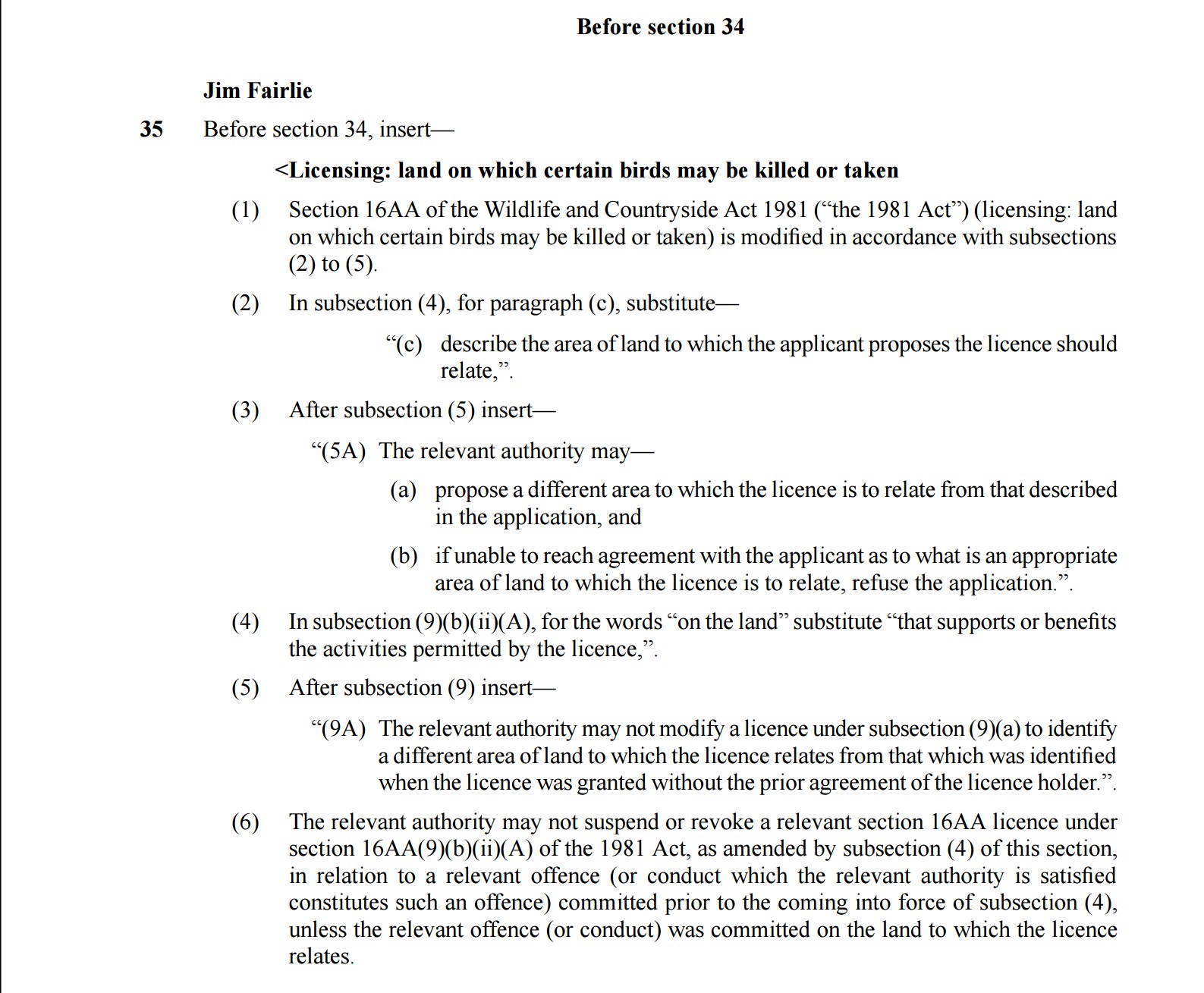
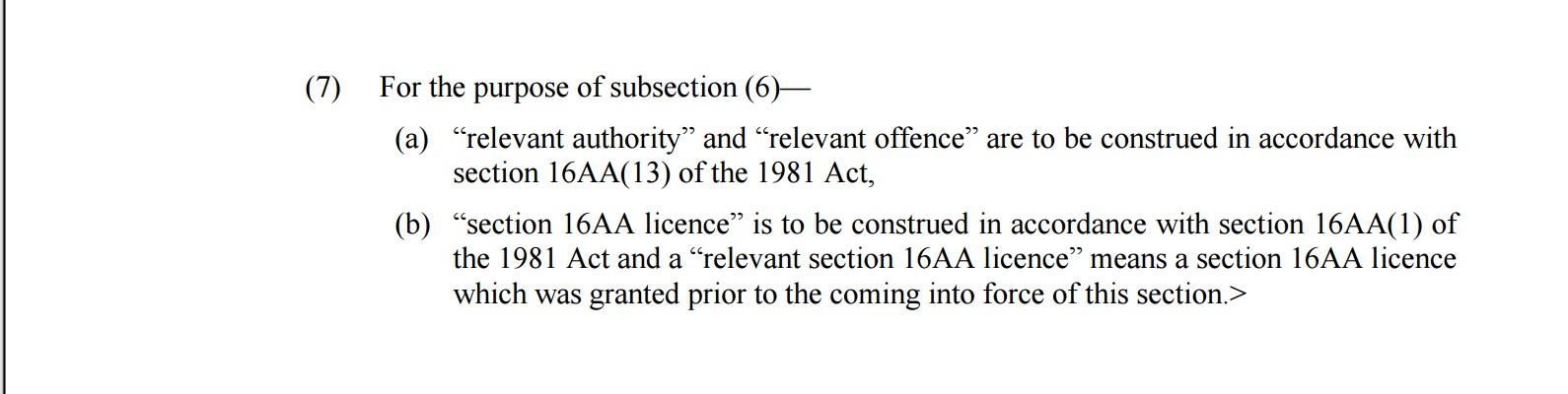
In a letter to the Scottish Parliament’s Rural Affairs & Islands Committee (the committee scrutinising the Natural Environment (Scotland) Bill), published today, Agriculture Minister Jim Fairlie has committed to introducing an amendment at Stage 2 of the Bill to close off this loophole.
We haven’t yet seen the details of Mr Fairlie’s proposed amendment but the deadline for MSPs to submit amendments at Stage 2 closes on 13 November 2025, so we shouldn’t have long to wait.
There’s more to say about this welcome move, and all the hard work that has gone on behind the scenes to reach this stage. I’ll be blogging more about this and I’ll also be discussing it at this weekend’s REVIVE conference in Perth (tickets still available – here).
For now, I see this as very, very good news.
UPDATE 4 November 2025: Statement from RSPB Scotland Director on proposed amendment to close grouse moor licence loophole (here)
UPDATE 14 November 2025: Scottish Minister Jim Fairlie provides rationale behind proposed amendment to close loophole on grouse shoot licence (here)
It’s another gamebird shooting season and that means shot Pheasants and Red-legged Partridges being illegally dumped (fly-tipped) by the side of a road.
Thanks to the blog reader who alerted me to the latest incident, posted a few days ago on Facebook – a pile of shot Pheasants and Red-legged Partridges found dumped just off Bellwood Road in Penicuik, south Scotland.
Shot & dumped Pheasants & Red-legged Partridges (photo from Facebook)
It’s likely these birds were given to a shoot participant to take home and he/she decided to dump them instead because they couldn’t be arsed to prepare them for cooking and besides, they’d already served their purpose as live targets shot for entertainment.
Regular blog readers will know that the dumping of shot gamebirds is a common and widespread illegal practice that has been going on for years, despite the repeated denials by the shooting industry. Who else do they think is doing this if not the people involved in gamebird shooting?! The disposal of animal by-products (including shot gamebirds) is regulated and the dumping of these carcasses is an offence.
Previous reports include dumped birds found in Cheshire (here), Scottish borders (here), Norfolk (here), Perthshire (here), Berkshire (here), North York Moors National Park (here) and some more in North York Moors National Park (here) and even more in North Yorkshire (here), Co. Derry (here), West Yorkshire (here), and again in West Yorkshire (here), N Wales (here), mid-Wales (here), Leicestershire (here), Lincolnshire (here), Somerset (here), Derbyshire’s Peak District National Park (here), Suffolk (here), Leicestershire again (here), Somerset again (here), Liverpool (here), even more in North Wales (here) even more in Wales, again (here), in Wiltshire (here) in Angus (here), in Somerset again (here), once again in North Yorkshire (here), yet again in West Yorkshire (here), yet again in mid-Wales (here), even more in mid-Wales (here), more in Derbyshire (here), Gloucestershire (here) more in Cheshire (here), some in Cumbria (here), some more in the Scottish Borders (here) and again in Lincolnshire (here), in Nottinghamshire (here) and even more in Lincolnshire (here).
Unless someone was seen dumping these shot gamebirds there’s no way of knowing who did it or from which gamebird shoot they originated. There’s no requirement for shoot managers to fit identifying markers to their livestock, which would make them traceable, because gamebird ‘livestock’ absurdly changes legal status to ‘wildlife’ as soon as the birds are released from the rearing pens for shooting (see Wild Justice’s blog on Schrodinger’s Pheasant for details).
Obviously, it’s irresponsible (and illegal) to dump shot gamebirds at any time but especially so when the UK Government (and the Scottish and Welsh Governments) has declared a nationwide Avian Influenza Prevention Zone (AIPZ) due to the heightened risk of the spread of highly pathogenic Avian Influenza (Bird Flu) amongst captive and wild birds.
These declarations make it a legal requirement for all bird keepers to follow strict and enhanced biosecurity measures to help protect their flocks from the threat of Avian Influenza. In some areas, the risk is considered so severe that mandatory housing measures have also been declared.
I’m sure this won’t be the last example of the thoughtless, feckless and unaccountable actions of the gamebird shooting industry this season, who yet again do what they like, when they like and to hell with the consequences because there aren’t any.
Earlier this month the Scottish Government announced a delay, for the second time, of the implementation of muirburn licensing after caving in to pressure from aggressive lobbying by the grouse shooting industry (see here).
The very same day this announcement was made, prescribed muirburn, started (legally) by gamekeepers on a grouse moor in the Cairngorms National Park, got out of control and developed in to a wildfire, causing damage to the neighbouring Muir of Dinnet National Nature Reserve (see here and here).
A blog reader has sent in this photo of the aftermath of that fire, showing part of the torched moorland and an ‘information’ board that stands nearby, apparently produced by the Grampian Moorland Group (gamekeepers) and endorsed with the logos of a number of shooting industry organisations, as well as the Cairngorms National Park Authority. I doubt it’s meant to be ironic, but it is.
The text on that ‘information’ board deserves close attention, so here’s a zoomed-in version for your amusement:
Many other grouse moors have also been torched this month – standard practice at this time of year and set to continue for the next six months until the muirburn season ends on 31 March 2026.
Imagine that! Six months of setting fire to one of the most sensitive and important habitats for carbon sequestration, in the middle of a climate emergency, with the blessing of a Government that is ignoring the will and intent of the Scottish Parliament by delaying the implementation of the Wildlife Management & Muirburn (Scotland) Act 2024. And all because it doesn’t want to upset wealthy landowners. It’s astonishing.
Grouse moor set alight on Invercauld Estate, Cairngorms National Park, Oct 2025 (photo from blog reader)
Grouse moor set alight in the Monadhliaths, Oct 2025 (photo from another blog reader)
Had the Scottish Government adhered to the will of Parliament, the torching of grouse moors, carried out to increase the number of Red Grouse available for shooting, would not be happening.
Muirburn licensing, which would only permit the fires under very limited circumstances (and not for the purpose of increasing Red Grouse stocks for shooting), was supposed to have been in place by the start of the 2025/2026 muirburn season on 15 September 2025, following the Scottish Parliament voting in favour of it 18 months previously.
However, in June 2025 the Scottish Government announced it was delaying implementation until 1 January 2026 because the grouse shooting industry had laughably argued that it wasn’t practical or fair for the licences to begin in September 2025 (see here).
Since then, the grouse shooting industry has continued its lobbying and now wants the licences dropped altogether because of what it calls the ‘need’ for muirburn to ‘control the fuel load’ – the amount of combustible vegetation which could influence the intensity and spread of wildfires. The lobbying was successful, leading to Minister Jim Fairlie’s announcement earlier this month that licensing would now be delayed until the start of next year’s muirburn season in autumn 2026.
But as Scottish Greens MSP Ariane Burgess pointed out,
“During the scrutiny of the Wildlife Management and Muirburn Act we took detailed evidence on the role of muirburn in wildfire risk. There is very little credible evidence to support the hunting and shooting lobby’s ridiculous claim that these practices have any role in preventing wildfires“.
This theme continues today in another excellent blog written by Professor Douglas MacMillan and posted on the Parkswatchscotland website. Professor MacMillan shows compelling evidence that ‘the practice of muirburn actually made no difference to the extent of the Dava mega-fire‘.
In January this year, Defra declared the whole of England (and Scotland) an Avian Influenza Prevention Zone (AIPV), after increased outbreaks of Highly Pathogenic Avian Influenza (HPAI, also known as Bird Flu).
In addition to this, throughout the year various mandatory housing orders for bird flocks were introduced and then relaxed in a number of high-risk counties.
However, as from Thursday 30 October 2025, mandatory housing measures will come into force once again across a large number of counties in England, following another increase in the number of detected HPAI outbreaks.
Here is the declaration announcing the mandatory new housing measures, as well as details of all the other biosecurity etc measures still in place across England:
Amidst all this, conservationists have argued that the release of ~60 million non-native gamebirds for shooting created more risk for the spread of this highly contagious disease, especially when research revealed that a large number of shooting estates were not even declaring they had birds, making it impossible for Defra and APHA (Animal & Plant Health Agency) to monitor and manage the risk.
Defra and Natural England responded by withdrawing General Licence 45 (the licence permitting the release of gamebirds on or within 500m of a Special Protected Area (SPA)) and heavily reducing the number of individual licences for the same purpose (see here). In August, enhanced mandatory biosecurity measures were also introduced, including for game bird shoots, and these remain in place.
Over the last month, a series of new Bird flu outbreaks have been detected – nine in England, one in Wales and one in Northern Ireland. These outbreaks have been mostly at commercial poultry facilities but worryingly one of the current outbreaks is at the Wildfowl & Wetlands Trust Martin Mere Reserve in Lancashire. According to a BBC News report the outbreak was in an enclosed area away from visitors and the reserve has now reopened again after shutting for several days last week.
Here’s the list of current Avian Influenza outbreaks:
ENGLAND
Nr Newington, Swale, Kent (AIV2025/71), 27 Oct 2025. Centred around grid ref TG8705566097.
Nr Cumwhitton, Cumbria (AIV2025/62), 28 Sept 2025. Centred around grid ref NY4981852576.
Nr Lakenheath, Suffolk (AIV2025/70), 26 Oct 2025. Centred around grid ref TL7140385506.
Nr Penrith, Cumbria (AIV2025/69), 25 Oct 2025. Centred around grid red NY4960129288.
Nr Bedale, Thirsk & Malton, North Yorkshire (AIV2025/68), 25 Oct 2025. Centred around grid ref SE2558892790.
Nr Burscough, Lancashire (AIV2025/66), 24 Oct 2025. Centred around grid ref SD4265514539.
Nr Penrith (again), Cumbria (AIV2025/65), 18 Oct 2025. Centred around grid ref NY4926628701.
Nr Wybunbury, Cheshire (AIV2025/64), 13 Oct 2025. Centred around grid ref SJ7412046475.
Broughton, nr Stockbridge, Hants (AIV2025/63), 11 Oct 2025. Centred around grid ref SU3061332391.
WALES
Llandrillo, Denbighshire, 25 Oct 2025. Centred around grid ref SJ0309339758.
NORTHERN IRELAND
Nr Omagh, County Tyrone, 9 Oct 2025 (no further details available).
UPDATE 12 November 2025: Compulsory housing orders across England, Wales & Northern Ireland to combat ‘significantly elevated threat’ of Highly Pathogenic Avian Influenza (Bird Flu) here.
The absurd claim that White-tailed Eagles had ‘snatched’ five Shetland pony foals on South Uist hit the headlines at the end of August.
A crofter / farmer named Donald Cameron said that five of his Shetland pony foals had disappeared between May and July when they were a few weeks old, and that he could see ‘no other explanation’ other than they’d been taken by White-tailed Eagles.
The average healthy weight for a Shetland pony at birth would be around 20-27kg, with rapid daily weight gain up to around 36-45kg at a month old. White-tailed Eagles in the Western Palearctic weigh between 3.5-5kg (males) and 4.5-7kg (females).
The premise that an eagle could ‘snatch’ and then carry away something that is three times heavier than itself is plainly nonsensical.
On hearing Donald Cameron’s claims about the loss of his five Shetland ponies, NatureScot organised for expert eagle biologists to examine the prey remains in two White-tailed Eagle nests closest to Cameron’s croft. There was no trace of any Shetland pony body parts (and even if there had been, it still wouldn’t mean that the eagles had killed the ponies; it’s far more plausible that they could have scavenged a carcass). The only mammalian prey found were rabbits and Brown Rat, with most of the remains being seabirds, ducks and geese.
This fits with the findings of a recent and extraordinarily robust recent scientific paper, examining the diet of breeding White-tailed Eagles across Scotland over a 20-year study (1998-2017), where seabirds and wetland birds featured prominently in the diets of eagles on the Uists:
The same paper demonstrated that the number of lamb remains found in eagle nests has declined over the last 20 years:
On the rare occasion where eagles may still take the odd live lamb, there’s a Sea Eagle Management Scheme, run by NatureScot, where support is available for those who experience sea eagle predation impacts.
But Donald Cameron is not satisfied. He claims that the examination of the two closest White-tailed Eagle nests was ‘inconclusive’ and also claims that the eagles are “decimating everything we have”.
In the most recent sensationalist scaremongering article from The Telegraph on this subject (6th October 2025 – they’re really dragging out this story), it says that Mr Cameron believes the White-tailed Eagles are responsible for the so-called ‘eerie silence’ on Loch Druidibeag.
The article begins with this:
‘Visiting Loch Druidibeag 20 years ago, you might have spotted swans perched on the water, geese on the banks and curlews surveying the sheep grazing the slopes that rise dramatically from the water’s edge.
‘But today, the waters have fallen silent. Eerily so. Now, the only thing that moves in the loch, on the island of South Uist in the Outer Hebrides, is a battered rowing boat bobbing beside a jetty as waves lap against the shore.
‘Donald John Cameron’s family have farmed this land for generations. But he believes an ancient foe is responsible for the eerie silence – and that it has also snatched away some of his most cherished animals‘.
I put this claim to an ecologist who has lived and worked in the Outer Hebrides for many years:
“All bollocks! No change to the bird life in the Druidibeag area as far as I can see. It’s a great place for wildlife. Several hundred Mute Swans on Loch Bi just to the north“.
Funnily enough, a few years ago a journalist was sniffing around on a story about Loch Bi. A local farmer / crofter had told him that he’d seen White-tailed Eagles feeding on the carcasses of dead Mute Swans on Loch Bi, and he reckoned the eagles had killed them all. The story never appeared in the media after NatureScot informed the journalist that Bird Flu had killed the swans, and the eagles were doing what they do best – scavenging the remains.
Back to the latest article..
It continues: ‘… there are thought to be 150 pairs of the bird [WTE] now living on the island. In fact, the eagles are now an all too familiar sight for farmers.
‘Lambs have allegedly been abducted in the dead of night, dogs have been attacked and Mr Cameron claims his Shetland pony foals were snatched by the eagles.
‘Although conservationists have insisted there is no evidence eagles took the foals, it is easy to understand Mr Cameron’s concern. The White-tailed eagle’s wingspan can go to eight feet and it’s sharp talons mean it’s thought to be capable of snatching animals weighing up to 12kg‘.
FFS. There aren’t 150 pairs of WTEs on South Uist! Back to my ecologist friend:
“There are seven known territories on South Uist, with one or two other locations where pairs may be establishing so 7-10 pairs would be the best estimate. In the areas where the ponies are there are two territorial pairs“.
And since when have ‘sharp talons’ had any bearing on the weight that an eagle can carry?! The main physiological features that determine how much a raptor can lift/carry are primarily related to muscle strength, wing surface area and body weight. It’s utter nonsense to argue about the sharpness of its talons in this context.
It’s farcical to be writing about these things, and talking about lambs being ‘abducted in the dead of night’, but it all plays into the demonisation of raptors in general, but particularly of White-tailed Eagles.
It’s just the latest in a long history of baseless accusations made about this species, although this is the first time that the eagles have been accused of taking Shetland ponies – usually they’re accused of being a threat to babies and toddlers (e.g. see here and here), which of course feeds into sensationalist headlines that editors know will sell copy.
Mr Cameron told one journalist that the ponies were ‘like my pets’. Yep, if there’s one thing that will stir up irrational fear in the public, apart from threats to babies and toddlers, it’s threats to people’s pets. Just ask Donald Trump – I suspect he knew exactly what he was doing when he falsely accused immigrants from Haiti of killing and eating dogs and cats in Ohio:
“In Springfield, they’re eating the dogs, the people that came in, they’re eating the cats. They’re eating the pets of the people that live there.”
False hysteria would be funny if it didn’t have real world consequences. There are horrific consequences for those immigrants, of course, and for the eagles, those consequences are also very real. The Telegraph article claims that Jon Gillies, the Chief Executive of the company that manages the South Uist Estate, is calling ‘for the right to shoot down the eagles‘.
The article says: ‘He says this year’s attacks have led him to stop taking his show cocker spaniel on walks with him in the hills because “I don’t want my dog to be killed”. And he thinks the law that allows crofters to shoot a dog if it attacks animals should be extended to sea eagles.
‘Mr Gillies says: “I think that a crofter should have the right to protect their livestock, and I don’t believe that livestock should be sacrificed to protect another species.”
‘The 62-year-old, who grew up on the island, said: “I remember as a boy when local people would take matters into their own hands by going into the hills and burning out golden eagle nests because everybody thought they were taking sheep. Once the fear gets into people’s minds, that’s how they respond“‘.
EXACTLY! It’s all about generating fear and the media has a lot to answer for.
That photograph of a White-tailed Eagle standing on a bloodied dead lamb, with the eagle’s beak covered in blood and wool, is a case in point. It’s used over and over again whenever there’s a scare story about eagles killing lambs but the context is never provided by the newspaper.
Photo taken from The Telegraph article published 6 Oct 2025
I think this photo is used to add ‘credibility’ to the scare stories – a reader will look at it and think, ‘Oh, well there must be some truth in this story because look, there’s a photo of an eagle that’s killed a lamb ‘on a hillside in Scotland”.
But that photograph is staged, using a captive eagle and a dead lamb. The scene was set up by Pete Cairns, a brilliant conservation photographer who, ironically, uses powerful imagery to explore conflicting attitudes towards predators. Here he is on Twitter (X) in 2022, responding to the mis-use of this very photograph:
I have no idea what happened to Mr Cameron’s five Shetland ponies. Maybe they were stolen? Locals tell me the ponies are left to roam freely across miles of rugged moorland and they’re small enough to shove inside a van without anyone noticing. There are credible reports of Shetland pony theft in southern England in recent years (e.g. here, here, here, here and here).
Maybe it’s those pesky translocated sea eagles from the Isle of Wight? Cue journalist from The Telegraph making some phone calls…
The BBC’s Highland Cops programme has entered its third series and episode 2 features the police investigation in to an active Goshawk nest that had been shot out on a sporting estate near Kingussie, on the western side of the Cairngorms National Park.
This investigation took place in June 2024 – see here for the police’s appeal for information at the time.
Screengrab from BBC Highland Cops programme
Officers had received a report of the active Goshawk nest being found abandoned in suspicious circumstances in a forest near Loch Gynack, and the programme follows experienced wildlife crime officer PC Dan Sutherland throughout his investigation.
The commentary from Dan is excellent – he speaks calmly and with authority about the link between illegal raptor persecution and gamebird shooting estates, and how the criminals have been getting away with their crimes for so long. That’s not opinion or conjecture, it’s based on factual evidence, and I applaud him for being prepared to say it on camera, knowing full well that it will attract vicious retaliation from some within the gamebird shooting industry, including, I have no doubt, official letters to his superior officers demanding punitive action against him.
Dan visits the abandoned Goshawk nest where he finds empty shotgun cartridges at the base of the tree and a shotgun wad is found lodged in the bottom of the nest.
The nest is removed for forensic examination, along with several nearby tree branches. They’re taken to the Kincraig Wildlife Highland Park for x-rays, which reveal a large number of shotgun pellets:
As Dan says, the evidence is damning.
He then teams up with PC Gavin Ross from the National Wildlife Crime Unit (NWCU) and they set out to visit all the people who legally own shotguns in the area, to either rule them out of the enquiry or to see if they can provide assistance.
The first person they visit is a gamekeeper who lives on the estate. They knock at his house and a woman speaks to them through a crack in the door, telling them he’s not in. As the officers leave to go and visit the next person on their list, Dan gets a phone call from a solicitor who tells him that none of his clients will be talking to the police without him being present.
“It’s the nature of the beast”, says Dan.
Dan and Gavin comment to one another that the speed of the solicitor’s phone call is probably some kind of record – coming in less than ten minutes after they’d knocked on the gamekeeper’s door. Their wry smiles tell you this is a common occurrence and was not unexpected. It puts a halt to their investigation until they can organise a time to meet with the shotgun owners and their legal representative.
PC Gavin Ross & PC Dan Sutherland take a call from the gamekeeper’s solicitor (screengrab from BBC Highland Cops).
If someone had shot out a Goshawk nest on my land, potentially killing any adults or chicks present on the nest, and the police knocked on the door to see if I could assist, I’d be welcoming them in with open arms, breaking out the tea and posh biscuits and offering up all the assistance I could muster to help them find the culprit, especially if there was evidence that armed criminals had been active on my property. I certainly wouldn’t be calling in my attack dog solicitor to warn off the cops. Why would I?
At the end of the programme there’s an update on the case – the police did meet with the shotgun owners and their solicitor. The text on the screen says:
‘However, with no new leads the case has been closed‘.
I guess it was probably the usual ‘no comment’ interviews, then.
According to Andy Wightman’s excellent Who Owns Scotland website, Loch Gynack is situated on the Glenbanchor & Pitmain Estate, whose owner, Pitmain Holding Ltd, is registered in Grand Cayman:
It’s not the first time a police investigation has taken place there in relation to suspected wildlife crime. In 2019, four Greylag Geese were found poisoned at Loch Gynack – toxicology results showed they’d ingested the banned pesticide Carbofuran, so dangerous that it’s an offence to even possess this chemical in Scotland, let alone use it.
The birds had been found by estate workers who reported the incident to the police. There wasn’t any information about whether poisoned bait had been discovered and so no information about where they’d come in to contact with the Carbofuran, although given how fast-acting it is and the fact the geese were found dead together in one place, I’d think it unlikely they’d been poisoned far away.
Nobody was charged and the estate was not subject to a General Licence restriction.
Back to the Goshawk case…
The police were first notified about the abandoned Goshawk nest on 8 June 2024. This was after the enactment of the Wildlife Management & Muirburn (Scotland) Act 2024 on 30 April 2024, which introduced a licence for grouse shooting in Scotland.
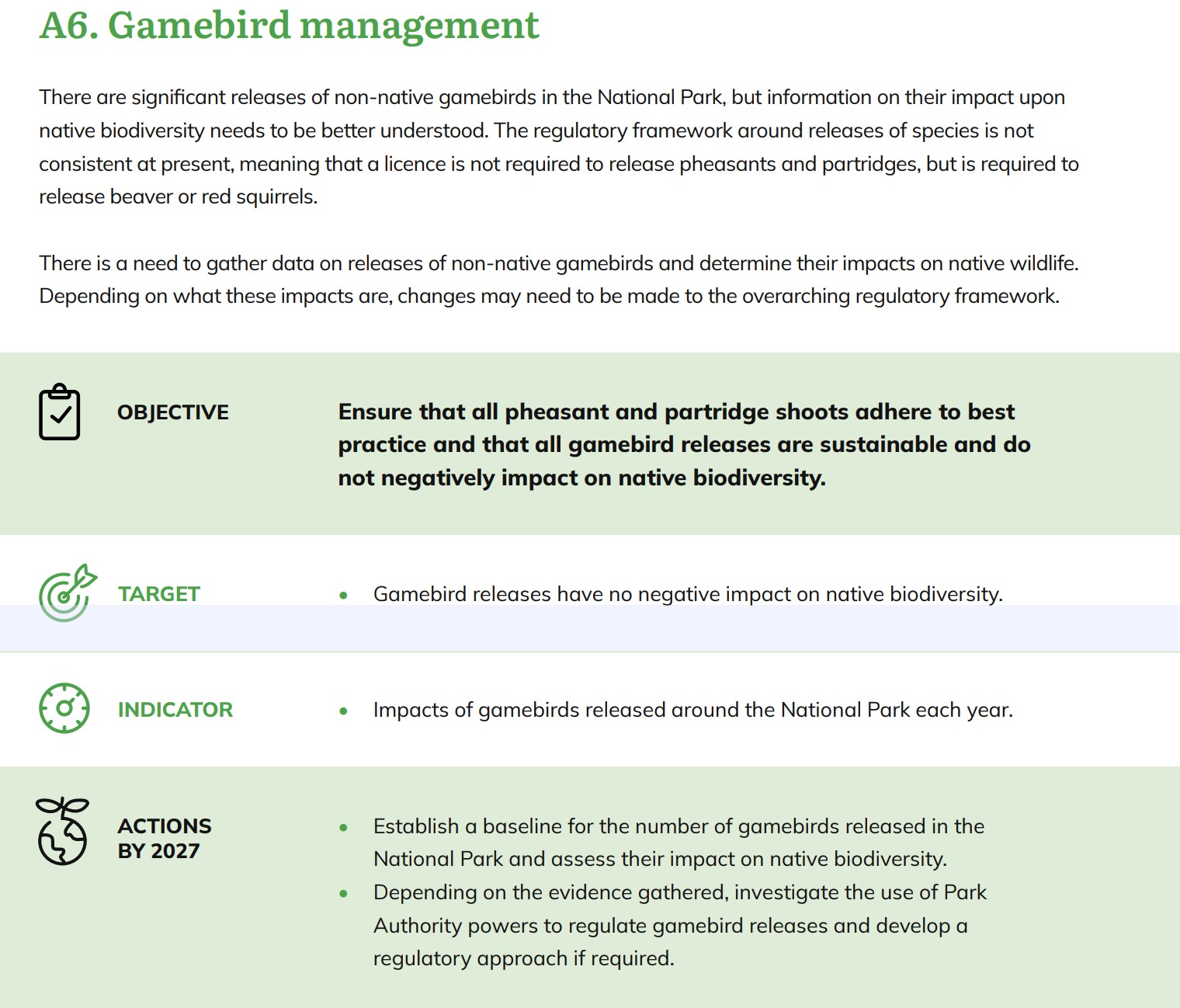
I don’t know whether the Glenbanchor & Pitmain Estate applied for a grouse shooting licence in 2024. I don’t even know if they still shoot Red Grouse there (they certainly have done previously – e.g. see here and here) or whether they’ve switched to Red-legged Partridges and Pheasants as alternative quarry due to low grouse stocks, in which case they’d be exempt from needing a grouse shooting licence because the Scottish Government refused to include the shooting of RLPs and Pheasants as part of the requirement for a grouse shooting licence, despite being warned about this massive loophole.
It would be interesting to know whether (a) Pitmain Estate did apply for a grouse shooting licence in 2024, (b) if so, did NatureScot grant them a licence even though this wildlife crime investigation was ongoing, and (c) if the estate does have a five-year grouse shooting licence, will the licence be withdrawn following this incident or was the Goshawk nest beyond the area where the licence applicant indicated Red Grouse are ‘taken or shot’ (yet another loophole)?
Aside from the questions around a potential grouse shooting licence, I’ve been interested in whether NatureScot would impose a General Licence restriction following the police investigation in to the shot out Goshawk nest.
In June this year I submitted an FoI to NatureScot to ask about the status of any pending General Licence restriction decisions. My main focus was on the case concerning a Golden Eagle called ‘Merrick’ who had been shot and killed whilst she was sleeping in the Scottish Borders in October 2023.
You’ll already know that NatureScot has still not made a decision on whether to impose a General Licence restriction as a result of that crime, two years after it happened (see here).
But as well as asking about the Merrick case, I also asked how many other cases were pending.
NatureScot wrote back to me in July and said this:
You can see that the case involving the shot out Goshawk nest is included on the list (‘an incident that occurred in the Highland Council area in June 2024‘).
NatureScot says it asked Police Scotland in December 2024 for the information package NS would need to begin the process of considering whether to impose a General Licence restriction.
Seven months on, in July 2025 when NatureScot responded to my FoI, Police Scotland hadn’t provided the information to NatureScot.
The Highland Cops programme demonstrates the evidential difficulties faced by the police when investigating suspected wildlife crimes, particularly those that take place on privately-owned gamebird shooting estates, and the lengths the police will go to to find out who was responsible. It was the very reason that the Scottish Parliament introduced grouse shoot licensing as part of the Wildlife Management & Muirburn (Scotland) Act 2024.
The efforts made by PC Dan Sutherland and his colleagues were exemplary in this case. But someone, somewhere, has dropped the ball in the later stages of the enforcement process by not providing an information package in a timely manner. That’s just not good enough.
The Highland Cops episode (series 3, episode 2) is available on the BBC iPlayer here. It’s well worth an hour of your time.