Last month I wrote (here) about how the DEFRA Secretary of State, Therese Coffey, is preparing to make a decision about the phasing out of toxic lead ammunition by gamebird shooters; a welcome move after years and years of the Westminster Government ignoring the scientific evidence about the poisonous effects of toxic lead ammunition on wildlife, the environment and human health.
However, I also wrote how the Health & Safety Executive (HSE) was due to publish an opinion report for the Minister on 6th August 2023, along with establishing a 60-day public consultation on its findings, which HSE was legally obliged to report by 6 November 2023. But in August, HSE told stakeholders (shooters and conservation organisations) in confidence that publication had been delayed by ‘unforeseen clearance issues‘, which meant that the opinion report was no longer deliverable by 6th November 2023.
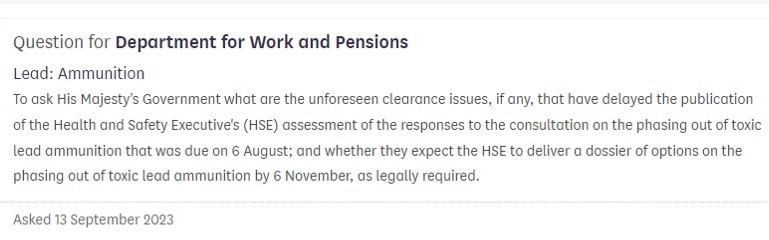
Green Party Peer Natalie Bennett read the blog piece and subsequently lodged a Parliamentary question about what, exactly, those ‘unforeseen clearance issues‘ were that were holding up the decision-making process:
On 27th September 2023, Viscount Younger of Leckie, the Parliamentary Under Secretary of State at the Department for Work & Pensions (Minister for Lords) responded with this:
So the delay was confirmed, but the Minister was unable/chose not to explain what the ‘unforeseen clearance issues‘ were and instead quite blatantly skirted around the question, which just makes me even more suspicious of what’s going on behind the scenes.
I’ve also since been told that HSE contacted the stakeholders again once this written answer had been published, to repeat the fact that ‘clearance issues‘ were the reason for the delay but didn’t elaborate about what those ‘clearance issues‘ were.
The delayed/revised delivery date has yet to be announced.
It’s worth remembering that the DEFRA Secretary of State (currently Therese Coffey) is legally required to make a decision on the phasing out of toxic lead ammunition within three months of receiving the opinion report from HSE.
New Scientist has just published a thought-provoking opinion piece (republished below), written by Alick Simmons (the former UK Deputy Chief Veterinary Officer) on the inadequacy of UK legislation that’s supposed to protect wildlife.
It’s hard to think of a more authentic, credible voice on this subject than Alick. He’s recently authored a highly-acclaimed book, Treated Like Animals – Improving the lives of the creatures we own, eat and use (2023 Pelagic Publishing), which can be found here.
Alick’s article in New Scientist is a short summary piece but a must-read for anyone wanting to counter the unsubstantiated claims of the game shooting industry that is so desperate to cling on to its medieval practices that it thinks a quick rebrand from ‘snares’ to ‘humane cable restraints’ is going to convince policymakers that everything’s just fine as it is.
If Alick’s article resonates and you feel you want to do something practical, you might want to fill in the Scottish Government’s consultation on the use of snares (as well as increased powers for the SSPCA), which closes tomorrow (Tues 3rd October 2023).
The Scottish Government is proposing to (a) prohibit the use of a snare or other type of cable restraint for the purpose of killing or trapping a wild animal; (b) prohibit the use of a snare or other type of cable restraint in any way that is likely to injure a wild animal and (c) provide Scottish SPCA inspectors who are acting under their existing powers under the 2006 Animal Welfare Act, with additional powers to search, examine and seize evidence in connection with specific offences under the Wildlife and Countryside Act 1981. This is all part of the Wildlife Management and Muirburn (Scotland) Bill which is currently making its way through Parliament.
REVIVE, the coalition for grouse moor reform, has provided a handy guide for consultation responses which you’ll find here.
Earlier this week, Police Scotland issued a press statement about the conviction of two men in relation to a wildlife crime investigation on a pheasant and partridge shooting estate in Stewartry, Dumfries & Galloway.
David Excell, 54, pleaded guilty to trapping and killing a pine marten on the estate, in addition to failing to comply with the conditions of his firearms licence. He was fined £9,700 and his firearms licence has been revoked.
The Pine Marten is a protected species. Photo by Laurie Campbell
Kenneth McClune, 61, pleaded guilty to failing to comply with the conditions of his firearms licence. He was fined £840 and his firearms licence was also revoked.
At a superficial level this seems like a good result and a half-decent fine, at least for David Excell. The revocation of the firearms licences is also very welcome, although it would have been useful to know whether the two individuals also held shotgun certificates and whether those had also been revoked. (My understanding is that a shotgun certificate isn’t automatically revoked even if a firearms certificate has been – see here).
However, even though the convictions are welcome, there is something very odd about this case.
Firstly, the statement from Police Scotland was (deliberately?) vague, excluding the date the offences took place, the name of the estate where the offences took place and the occupations of the two guilty men. Is there some ‘shielding’ going on here?
Secondly, the police statement also included a gratuitous reference from the Police Wildlife Crime Officer in defence of shooting estates in general:
“The actions of a few individuals do not reflect the positive steps taken by most land owners and managers to maintain and encourage wildlife in our countryside“.
Eh? Why on earth is this statement included in a press release about a man convicted of wildlife crime, and perhaps more seriously, on what qualified evidence has this claim been based?
Some would argue that the intensive and systematic (currently lawful) killing of wildlife on sporting estates (up to an estimated quarter of a million animals per year on grouse moors alone), undertaken entirely on the basis of increasing gamebird stocks for shooting, is not ‘maintaining and encouraging wildlife in our countryside‘. Some species will benefit, for sure, but other species definitely don’t. Either way, this isn’t a pronouncement that should be coming from Police Scotland.
But the oddest thing of all about this case is that I believe it is linked to this 2021 Police Scotland investigation into the alleged killing of birds of prey on an unnamed estate in Stewartry, but there’s no mention of this in the Police Scotland statement.
So either (a) I’m wrong that the allegations of raptor persecution relate to this case and there’s another, entirely separate case relating to another Stewartry estate going on; or (b) the allegations about raptor persecution do relate to this case but are being heard separately (which would be odd but not inconceivable, especially if those allegations relate only to the two other men charged in October 2021); or (c) the allegations of raptor persecution do relate to this case but have been quietly dropped.
Some clarification is needed. Watch this space.
UPDATE 16 November 2023: Charges dropped for raptor persecution offences committed on Overlaggan Estate, Dumfries & Galloway (here)
Raptor Persecution UK will be represented at a public demo outside DEFRA HQ in London tomorrow (Thurs 28 Sept 2023) where many individuals and organisations will gather to tell the Government it needs to put nature at the front of policy decisions, not shoved in a bag inside a cupboard in a locked room and forgotten about.
The demo has been organised by the indefatigable Chris Packham and his team, in response to the latest State of Nature Report which has been published this evening.
The demo will be peaceful, there won’t be any glue, or paint or illegality, just lots of voices from a broad array of organisations whose members want to send a message to DEFRA and the Westminster Government that we’ve all had enough.
The demo in London will take place from 8am-2pm (details here) and there are other demos taking place in Bristol, Reading, York and Newcastle (details here).
Hope to see some of you in London. If you can’t make any of the locations, please follow on social media and help amplify the message using #RestoreNatureNow
Thanks
This Thursday from 8am-2pm we're taking our message of #RestoreNatureNow to DEFRA offices across England .
It will be peaceful – no paint , powder or glue .
Nature doesn't have a voice , but we do . Nature can't act , but we must .
Anyone who’s been following this blog for any length of time will be aware that the illegal killing of raptors takes place all over the UK, although there are some counties where crimes against birds of prey occur more frequently than in others.
In the most recent Birdcrime report (2021) published by the RSPB, the top three counties with the highest number of confirmed raptor persecution crimes that year were Norfolk (13 incidents), Dorset (12) and North Yorkshire (10). Over a ten-year period, by far the worst county for raptor-killing is North Yorkshire, which is hardly a surprise given its large size that includes vast areas managed for gamebird shooting, including in the lowlands and uplands:
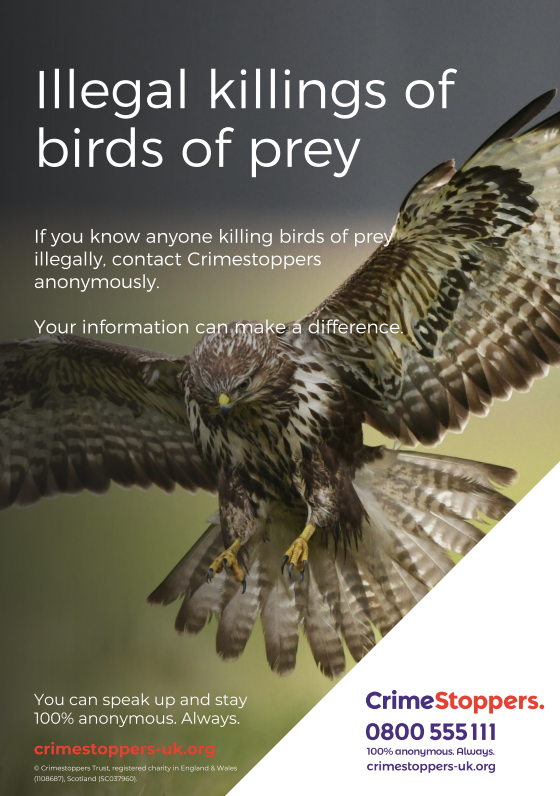
So it was good to see a campaign last week by the charity Crimestoppers, focusing on the illegal killing of raptors in Yorkshire. They published a webpage (here) with information about what signs to look out for and how to report these offences, and this poster was doing the rounds on social media:
A similar awareness-raising campaign featured in Derbyshire Police’s Rural Crime Team newsletter in the summer, re-published on Derbyshire Wildlife Trust’s website (here).
In the article, the Police downplayed the significance of raptor persecution on driven grouse moors, claiming it was ‘historical’, but the information about other aspects of raptor persecution were quite relevant, especially the theft of peregrine eggs and chicks, which Derbyshire sees a fair bit of (e.g. Derbyshire Police recently charged a man with disturbance and egg theft at a peregrine site and he’s due in court next month – here).
It was amusing to see the list of partners that Derbyshire Police claim to be working with to tackle raptor persecution – I wonder how many times members of the Moorland Association and the National Gamekeepers Organisation have assisted police enquiries other than giving ‘no comment’ interviews – but it was good to see the police acknowledge the use of night vision equipment to target roosting raptors:
‘Most offences of shooting birds of prey involve the use of shotguns, although rifle shooting using powerful scopes or night vision aids is also used to kill perched birds at considerable distances‘.
Earlier this month, an RSPB claim that some gamekeepers were using night vision equipment to kill roosting birds of prey made the headlines (here), much to the consternation of the game-shooting industry. Derbyshire Police’s ‘partner’, the National Gamekeepers Organisation, had this to say about it:
‘There is no proof whatsoever that night vision has been used to target raptors; no proof that gamekeepers have been involved in any way, and indeed no proof that the birds are in fact dead. This is simply another attack by the RSPB on gamekeepers and the shooting sector more widely‘ (see here).
But then the game-shooting industry still denies that raptor persecution is even a thing, so they’re hardly going to acknowledge the more devious tactics used by the raptor-killers in their midst, are they?
Yesterday a friend sent me a link to a recent claim made by the grouse shooting industry that ‘Natural England hen harrier data reveals just 2% suffered persecution‘.
The article, published on the dodgy astro-turfing C4PMC (Campaign for Protection of Moorland Communities) website (see here for background on this murky outfit) has since been widely shared on social media by the usual suspects, in an attempt to counter my rolling list of missing/dead hen harriers in the UK since 2018 (currently reporting 110 birds but there are more to come).
The grouse shooting industry REALLY doesn’t like this rolling list, or the accompanying posters, because it lays bare their criminal activities with proven data sources (from Natural England and the RSPB) to back up each and every one of those listed ‘missing’/killed hen harriers.
My friend had never heard of C4PMC but knew the article was dodgy just from its introductory blurb, which describes me as an “animal rights activist” – he knows I’m not, and suggested I’d been labelled this way in an attempt to undermine my credibility. It’s a common tactic to create a wholly false impression of someone – the Daily Mail also tried this defamatory ploy a few years ago when it described me as an “anti-hunt extremist” and an “animal rights extremist“, presumably egged on by the loathsome Countryside Alliance, but was later forced to apologise and correct the article (see here).
Personally, I don’t read the C4PMC website ever since it published a particularly malicious ‘advent calendar of hate’ a few years ago, targeting well known conservationists, broadcasters, authors and politicians with vindictive and spiteful personal attacks, posted online every day in the run-up to Xmas during a lockdown period; so misjudged that even many of their own supporters from within the grouse-shooting industry thought they’d gone too far.
But given that my friend had drawn my attention to this latest article about hen harrier persecution being as low as 2%, I thought I’d take a look.
I’m glad I did, because it’s hilariously and hopelessly inaccurate. It’s apparent that whoever writes for C4PMC can’t count, can’t think, and can’t even copy data from a published source.
In a nutshell, C4PMC has published a list of satellite-tagged hen harriers, supposedly copied from Natural England’s public spreadsheet, showing the fates of NE’s satellite-tracked hen harriers since 2017, and has attempted to analyse those fates and present them as factual.
There are many problems with how they’ve done this (which I’ll describe below), but C4PMC’s first and most obvious mistake is to present the data from only 82 hen harriers, whereas Natural England’s spreadsheet shows the fate of 97 hen harriers. For some inexplicable reason, C4PMC has ‘forgotten’ to include 15 hen harriers (the ‘forgotten’ harriers are highlighted in blue in the document below).
Then when I started to analyse C4PMC’s ‘results’, I noticed that they’d completely changed the status of some of the birds – nine of them in fact – so for example, where Natural England has recorded a harrier as ‘Missing Fate Unknown’ in Cumbria in May 2020, C4PMC has recorded the same harrier as ‘Alive and well and living in France’ in September 2023!
C4PMC even included one harrier on its list that doesn’t actually exist in Natural England’s spreadsheet (highlighted in pink in the document below). C4PMC just made it up!
To show you the extent of C4PMC’s catalogue of ineptitude, I’ve produced a table to compare Natural England’s data with C4PMC’s misinterpretations (highlighted in red in the document below):
It’s quite obvious that any conclusion C4PMC has drawn from its inaccurate and unreliable ‘analysis’ is going to be flawed, given how many harriers they’ve left out and how many fates they’ve changed.
But it still doesn’t answer the question about how they calculated hen harrier persecution to be as low as 2%. It took me a while but then it dawned on me – to calculate the 2% figure, C4MPC has only included the two hen harriers confirmed to have been illegally killed (Free and Asta) and has totally ignored all the harriers listed by Natural England as ‘Missing Fate Unknown’ (i.e. those suspected of being/most likely have been, illegally killed).
This is a very strange approach to take but is absolutely what we’ve come to expect from the grouse shooting industry. Even Natural England acknowledges that illegal persecution is still rampant; the only ones still in denial are those within the grouse shooting industry itself (including the Chair of the Moorland Association, who last month told BBC Radio 4, “Clearly, any illegal [hen harrier] persecution is not happening” (here)). Why Natural England continues to view this industry as a ‘partner’ when that industry so blatantly ignores/denies what’s so obviously going on is beyond me, I’m afraid (although the £75,000 ‘donation’ received by NE might have something to do with it).
I’ve done a quick calculation for C4PMC, as they obviously need some/lots of help. Counting up all the harriers listed by Natural England as ‘Missing Fate Unknown’ (but excluding all those listed as likely to have been predated, or carrying failed tags, or have been found dead outside the UK), there’s a grand total of 34 hen harriers listed as ‘missing’ (in suspicious circumstances and likely to have been illegally killed in the UK), which out of 97 tagged birds amounts to a 35% persecution rate.
That’s over a third of Natural England-tagged harriers suspected to have been killed illegally, which funnily enough closely corresponds with the fates of satellite-tagged golden eagles in Scotland (here) and the fates of hen harriers satellite-tagged by the RSPB (here).
Imagine that, actual data backing up actual science.
And let’s not forget, these are the tagged birds. How many un-tagged hen harriers is the grouse shooting industry also killing?
A trial date has now been set for a man accused of killing a goshawk at a pheasant-rearing farm in Wales.
Thomas Edward Jones, 38, appeared again at Welshpool Magistrates Court on 19 September 2023 where he pleaded not guilty to the shooting and killing of a goshawk at Pentre Farm in northern Powys in July 2022, where tens of thousands of pheasants are reportedly reared for the game shooting industry.
The trial will begin on 6 November 2023.
Goshawk. Photo by Mike Warburton
PLEASE NOTE: As this is a live court case comments won’t be accepted until criminal proceedings have concluded. Thanks for your understanding.
For anyone who still wants to pretend that the grouse shooting industry isn’t responsible for the systematic extermination of hen harriers on grouse moors across the UK, here’s the latest catalogue of crime that suggests otherwise.
[This male hen harrier died in 2019 after his leg was almost severed in an illegally set trap that had been placed next to his nest on a Scottish grouse moor (see here). Photo by Ruth Tingay]
This is the blog I now publish after every reported killing or suspicious disappearance.
“They disappear in the same way political dissidents in authoritarian dictatorships have disappeared” (Stephen Barlow, 22 January 2021).
Today the list has been updated to include the nine most recently reported victims, all gone since May 2023 (see here and here).
I’ve been compiling this list only since 2018 because that is the year that the grouse shooting industry ‘leaders’ would have us believe that the criminal persecution of hen harriers had stopped and that these birds were being welcomed back on to the UK’s grouse moors (see here).
This assertion was made shortly before the publication of a devastating new scientific paper that demonstrated that 72% of satellite-tagged hen harriers were confirmed or considered likely to have been illegally killed, and this was ten times more likely to occur over areas of land managed for grouse shooting relative to other land uses (see here). Incidentally, a further scientific paper published in 2023 by scientists at the RSPB, utilising even more recent data, echoed these results – see here).
2018 was also the year that Natural England issued a licence to begin a hen harrier brood meddling trial on grouse moors in northern England. For new blog readers, hen harrier brood meddling is a conservation sham sanctioned by DEFRA as part of its ludicrous ‘Hen Harrier Action Plan‘ and carried out by Natural England (NE), in cahoots with the very industry responsible for the species’ catastrophic decline in England. For more background see here and for a critical evaluation of the trial after 5 years see this report by Wild Justice.
Brood meddling has been described as a sort of ‘gentleman’s agreement’ by commentator Stephen Welch:
“I don’t get it, I thought the idea of that scheme was some kind of trade off – a gentleman’s agreement that the birds would be left in peace if they were moved from grouse moors at a certain density. It seems that one party is not keeping their side of the bargain“.
With at least 110 hen harriers gone since 2018, there is no question that the grouse shooting industry is simply taking the piss. Meanwhile, Natural England pretends that ‘partnership working’ is the way to go and DEFRA Ministers remain silent.
Data compiled by RPUK. *No hen harriers brood meddled in 2018
‘Partnership working’ according to Natural England appears to include authorising the removal of hen harrier chicks from a grouse moor already under investigation by the police for suspected raptor persecution (here) and accepting a £75k ‘donation’ from representatives of the grouse shooting industry that prevents Natural England from criticising them or the sham brood meddling trial (see here). This is in addition to a £10k ‘donation’ that Natural England accepted, under the same terms, in 2021 (here).
So here’s the latest gruesome list. Note that the majority of these birds (but not all) were fitted with satellite tags. How many more [untagged] harriers have been killed?
February 2018: Hen harrier Saorsa ‘disappeared’ in the Angus Glens in Scotland (here). The Scottish Gamekeepers Association later published wholly inaccurate information claiming the bird had been re-sighted. The RSPB dismissed this as “completely false” (here).
5 February 2018: Hen harrier Marc ‘disappeared’ on a grouse moor in Durham (here).
9 February 2018: Hen harrier Aalin ‘disappeared’ on a grouse moor in Wales (here).
March 2018: Hen harrier Blue ‘disappeared’ in the Lake District National Park (here).
March 2018: Hen harrier Finn ‘disappeared’ near Moffat in Scotland (here).
18 April 2018: Hen harrier Lia ‘disappeared’ in Wales and her corpse was retrieved in a field in May 2018. Cause of death was unconfirmed but police treating death as suspicious (here).
8 August 2018: Hen harrier Hilma ‘disappeared’ on a grouse moor in Northumberland (here).
16 August 2018: Hen harrier Athena ‘disappeared’ on a grouse moor in Scotland (here).
26 August 2018: Hen Harrier Octavia ‘disappeared’ on a grouse moor in the Peak District National Park (here).
29 August 2018: Hen harrier Margot ‘disappeared’ on a grouse moor in Scotland (here).
29 August 2018: Hen Harrier Heulwen ‘disappeared’ on a grouse moor in Wales (here).
3 September 2018: Hen harrier Stelmaria ‘disappeared’ on a grouse moor in Scotland (here).
24 September 2018: Hen harrier Heather ‘disappeared’ on a grouse moor in Scotland (here).
2 October 2018: Hen harrier Mabel ‘disappeared’ on a grouse moor on the edge of the Yorkshire Dales National Park (here).
3 October 2018: Hen Harrier Thor ‘disappeared’ next to a grouse moor in Bowland, Lanacashire (here).
23 October 2018: Hen harrier Tom ‘disappeared’ in South Wales (here).
26 October 2018: Hen harrier Arthur ‘disappeared’ on a grouse moor in the North York Moors National Park (here).
1 November 2018: Hen harrier Barney ‘disappeared’ on Bodmin Moor (here).
10 November 2018: Hen harrier Rannoch ‘disappeared’ on a grouse moor in Scotland (here). Her corpse was found nearby in May 2019 – she’d been killed in an illegally-set spring trap (here).
14 November 2018: Hen harrier River ‘disappeared’ on a grouse moor in the Nidderdale AONB (here). Her corpse was found nearby in April 2019 – she’d been illegally shot (here).
16 January 2019: Hen harrier Vulcan ‘disappeared’ in Wiltshire close to Natural England’s proposed reintroduction site (here).
28 January 2019: Hen harrier DeeCee ‘disappeared’ in Glen Esk, a grouse moor area of the Angus Glens (see here).
7 February 2019: Hen harrier Skylar ‘disappeared’ next to a grouse moor in South Lanarkshire (here).
22 April 2019: Hen harrier Marci ‘disappeared’ on a grouse moor in the Cairngorms National Park (here).
26 April 2019: Hen harrier Rain ‘disappeared’ on a grouse moor in Nairnshire (here).
11 May 2019: An untagged male hen harrier was caught in an illegally-set trap next to his nest on a grouse moor in South Lanarkshire. He didn’t survive (here).
7 June 2019: An untagged hen harrier was found dead on a grouse moor in Scotland. A post mortem stated the bird had died as a result of ‘penetrating trauma’ injuries and that this bird had previously been shot (here).
5 September 2019: Wildland Hen Harrier 1 ‘disappeared’ on a grouse moor nr Dalnaspidal on the edge of the Cairngorms National Park (here).
11 September 2019: Hen harrier Romario ‘disappeared’ on a grouse moor in the Cairngorms National Park (here).
14 September 2019: Hen harrier (Brood meddled in 2019, #183704) ‘disappeared’ in the North Pennines (here).
23 September 2019: Hen harrier (Brood meddled in 2019, #55149) ‘disappeared’ in North Pennines (here).
24 September 2019: Wildland Hen Harrier 2 ‘disappeared’ on a grouse moor at Invercauld in the Cairngorms National Park (here).
24 September 2019: Hen harrier Bronwyn ‘disappeared’ near a grouse moor in North Wales (here).
10 October 2019: Hen harrier Ada ‘disappeared’ on a grouse moor in the North Pennines AONB (here).
12 October 2019: Hen harrier Thistle ‘disappeared’ on a grouse moor in Sutherland (here).
18 October 2019: Member of the public reports the witnessed shooting of an untagged male hen harrier on White Syke Hill in North Yorkshire (here).
November 2019: Hen harrier Mary found illegally poisoned on a pheasant shoot in Ireland (here).
November 2019: Hen harrier Artemis ‘disappeared’ near Long Formacus in south Scotland (RSPB pers comm).
14 December 2019: Hen harrier Oscar ‘disappeared’ in Eskdalemuir, south Scotland (here).
December 2019: Hen harrier Ingmar ‘disappeared’ in the Strathbraan grouse moor area of Perthshire (RSPB pers comm).
January 2020: Members of the public report the witnessed shooting of a male hen harrier on Threshfield Moor in the Yorkshire Dales National Park (here).
23 March 2020: Hen harrier Rosie ‘disappeared’ at an undisclosed roost site in Northumberland (here).
1 April 2020: Hen harrier (Brood meddled in 2019, #183703) ‘disappeared’ in unnamed location, tag intermittent (here).
5 April 2020: Hen harrier Hoolie ‘disappeared’ on a grouse moor in the Cairngorms National Park (here)
8 April 2020: Hen harrier Marlin ‘disappeared’ on a grouse moor in the Cairngorms National Park (here).
19 May 2020: Hen harrier Fingal ‘disappeared’ on a grouse moor in the Lowther Hills, Scotland (here).
21 May 2020: Hen harrier (Brood meddled in 2019, #183701) ‘disappeared’ on a grouse moor in Cumbria shortly after returning from wintering in France (here).
27 May 2020: Hen harrier Silver ‘disappeared’ on a grouse moor on Leadhills Estate, Scotland (here).
2020: day/month unknown: Unnamed male hen harrier breeding on RSPB Geltsdale Reserve, Cumbria ‘disappeared’ while away hunting (here).
9 July 2020: Unnamed female hen harrier (#201118) ‘disappeared’ from an undisclosed site in Northumberland (here).
25 July 2020: Hen harrier Harriet ‘disappeared’ on a grouse moor in the Yorkshire Dales National Park (here).
14 August 2020: Hen harrier Solo ‘disappeared’ in confidential nest area in Lancashire (here).
7 September 2020: Hen harrier Dryad ‘disappeared’ on a grouse moor in the Yorkshire Dales National Park (here).
16 September 2020: Hen harrier Fortune ‘disappeared’ from an undisclosed roost site in Northumberland (here).
19 September 2020: Hen harrier Harold ‘disappeared’ on a grouse moor in the Yorkshire Dales National Park (here).
20 September 2020: Hen harrier (Brood meddled in 2020, #55152) ‘disappeared’ next to a grouse moor in North Yorkshire (here).
24 February 2021: Hen harrier Tarras ‘disappeared’ next to a grouse moor in Northumberland (here)
12th April 2021: Hen harrier Yarrow ‘disappeared’ near Stockton, County Durham (here).
18 May 2021: Adult male hen harrier ‘disappeared’ from its breeding attempt on RSPB Geltsdale Reserve, Cumbria whilst away hunting (here).
18 May 2021: Another adult male hen harrier ‘disappeared’ from its breeding attempt on RSPB Geltsdale Reserve, Cumbria whilst away hunting (here).
24 July 2021: Hen harrier Asta ‘disappeared’ at a ‘confidential site’ in the North Pennines (here). We learned 18 months later that her wings had been ripped off so her tag could be fitted to a crow in an attempt to cover up her death (here).
14th August 2021: Hen harrier Josephine ‘disappeared’ at a ‘confidential site’ in Northumberland (here).
17 September 2021: Hen harrier Reiver ‘disappeared’ in a grouse moor dominated region of Northumberland (here)
24 September 2021: Hen harrier (Brood meddled in 2021, R2-F-1-21) ‘disappeared’ in Northumberland (here).
15 November 2021: Hen harrier (brood meddled in 2020, #R2-F1-20) ‘disappeared’ at the edge of a grouse moor on Arkengarthdale Estate in the Yorkshire Dales National Park (here).
19 November 2021: Hen harrier Val ‘disappeared’ in the Lake District National Park in Cumbria (here).
19 November 2021: Hen harrier Percy ‘disappeared’ in Lothian, Scotland (here).
12 December 2021: Hen harrier Jasmine ‘disappeared’ on a grouse moor (High Rigg Moor on the Middlesmoor Estate) in the Nidderdale AONB in North Yorkshire (here).
9 January 2022: Hen harrier Ethel ‘disappeared’ in Northumberland (here).
26 January 2022: Hen harrier Amelia ‘disappeared’ in Bowland (here).
10 February 2022: An unnamed satellite-tagged hen harrier ‘disappeared’ in a grouse moor dominated area of the Peak District National Park (here). One year later it was revealed that the satellite tag/harness of this young male called ‘Anu’ had been deliberately cut off (see here).
12 April 2022: Hen harrier ‘Free’ (Tag ID 201121) ‘disappeared’ at a ‘confidential site’ in Cumbria (here). It later emerged he hadn’t disappeared, but his mutilated corpse was found on moorland in the Yorkshire Dales National Park. A post mortem revealed the cause of death was having his head twisted and pulled off. One leg had also been torn off whilst he was still alive (here).
April 2022: Hen harrier ‘Pegasus’ (tagged by the RSPB) ‘disappeared’ on a grouse moor at Birkdale in the Yorkshire Dales National Park (here).
May 2022: A male breeding hen harrier ‘disappeared’ from a National Trust-owned grouse moor in the Peak District National Park (here).
May 2022: Another breeding male hen harrier ‘disappeared’ from a National Trust-owned grouse moor in the Peak District National Park (here).
14 May 2022: Hen harrier ‘Harvey’ (Tag ID 213844) ‘disappeared’ from a ‘confidential site’ in the North Pennines (here).
20 June 2022: Hen harrier chick #1 stamped to death in nest on a grouse moor in the Yorkshire Dales National Park (here).
20 June 2022: Hen harrier chick #2 stamped to death in nest on a grouse moor in the Yorkshire Dales National Park (here).
20 June 2022: Hen harrier chick #3 stamped to death in nest on a grouse moor in the Yorkshire Dales National Park (here).
20 June 2022: Hen harrier chick #4 stamped to death in nest on a grouse moor in the Yorkshire Dales National Park (here).
17 August 2022: Hen harrier (brood meddled in 2022, #R1-M1-22) ‘disappeared’ on moorland in the Yorkshire Dales National Park (here).
September 2022: Hen harrier ‘Sullis’ (tagged by the RSPB) ‘disappeared’ on a grouse moor in Cumbria (here).
5 October 2022: Hen harrier (brood meddled in 2022, #R3-M2-22) ‘disappeared’ on moorland in the Yorkshire Dales National Park (here).
10 October 2022: Hen harrier ‘Sia’ ‘disappeared’ near Hamsterley Forest in the North Pennines (here).
October 2022: Hen harrier (brood meddled in 2021, #R1-F1-21) ‘disappeared’ in the North Sea off the North York Moors National Park (here).
December 2022: Hen harrier female (brood meddled in 2020, #R2-F2-20) ‘disappeared’ on moorland in Cumbria (here).
1 December 2022: Hen harrier male (brood meddled in 2021, #R1-M1-21) ‘disappeared’ on moorland in the Yorkshire Dales National Park (here).
14 December 2022: Hen harrier female (brood meddled in 2022, #R3-F1-22) ‘disappeared’ on moorland in the North Pennines AONB (here).
15 December 2022: Hen harrier female (brood meddled in 2022, #R2-F1-22) ‘disappeared’ on moorland in the Yorkshire Dales National Park (here).
30 March 2023: Hen harrier female (brood meddled in 2022, #R1-F3-22) ‘disappeared’ in Yorkshire (here). Notes from NE Sept 2023 spreadsheet update: “Final transmission location temporarily withheld at police request“.
1 April 2023: Hen harrier male (brood meddled in 2022, #R2-M1-22) ‘disappeared’ in Yorkshire (here). Notes from NE Sept 2023 spreadsheet update: “Final transmission location temporarily withheld at police request“.
April 2023: Hen harrier ‘Lagertha’ (tagged by RSPB) ‘disappeared’ in North Yorkshire (here).
April 2023: Hen harrier ‘Nicola’ (Tag ID 234078) ”disappeared’ in North Yorkshire (here).
April 2023: Untagged male hen harrier ‘disappeared’ from an active nest on RSPB Geltsdale Reserve in Cumbria (here).
April 2023: Another untagged male hen harrier ‘disappeared’ from an active nest on RSPB Geltsdale Reserve in Cumbria (here).
April 2023: Untagged male hen harrier ‘disappeared’ from an active nest in Durham (here).
4/5 May 2023: Satellite-tagged male hen harrier called ‘Rush’ ‘disappeared’ from a grouse moor in Bowland AONB in Lancashire (here).
17 May 2023: Satellite-tagged hen harrier called ‘Wayland’ ‘disappeared’ in the Clapham area of North Yorkshire, just north of the Bowland AONB (here).
31 May 2023: Hen harrier male (brood meddled in 2022, tag #213932, name: R2-M3-22) ‘disappeared’ in Northumberland (grid ref: NY765687) (here).
11 June 2023: Hen harrier male (brood meddled in 2021, tag #213922, name: R2-M1-21) ‘disappeared’ at a confidential site in the Yorkshire Dales National Park. Notes from the NE spreadsheet: “Final transmission location temporarily withheld at police request“ (here).
12 June 2023: Hen harrier male (brood meddled in 2020, tag #203004, name: R1-M2-20) ‘disappeared’ on a grouse moor in Co. Durham (grid ref: NY976322) (here).
6 July 2023: Satellite-tagged female hen harrier named ‘Rubi’ (tag #201124a) ‘disappeared’ on a grouse moor in Co. Durham (grid ref: NY911151) (here).
23 July 2023: Hen harrier female (brood meddled in 2023, tag #55154a, name: R1-F1-23) ‘disappeared’ on a grouse moor in Co. Durham (close to where ‘Rubi’ vanished), grid ref: NY910126 (here).
29 July 2023: Hen harrier female (brood meddled in 2020, tag #55144, name: R2-F2-20) ‘disappeared’ at a confidential site in the North Pennines. Notes from the NE spreadsheet: “Dead. Recovered – awaiting PM results. Final transmission location temporarily withheld at police request“ (here).
9 August 2023: Satellite-tagged hen harrier called ‘Martha’ ‘disappeared’ on a grouse moor (Westburnhope Moor) near Hexham in the North Pennines (here).
11 August 2023: Satellite-tagged hen harrier called ‘Selena’ ‘disappeared’ on a grouse moor (Mossdale Moor) in the Yorkshire Dales National Park (here).
11 August 2023: Hen harrier female (brood meddled in 2023, tag #201118a, name: R3-F1-23) ‘disappeared’ in Co. Durham (grid ref: NZ072136) (here).
15 August 2023: Satellite-tagged hen harrier called ‘Hepit’ ‘disappeared’ on a grouse moor (Birkdale Common) near Kirkby Stephen in the Yorkshire Dales National Park (here).
24 August 2023: Hen harrier female (brood meddled in 2023, tag #55155a, name: R1-F2-23) ‘disappeared’ at a confidential site in Northumberland. Notes from the NE spreadsheet: “Final transmission location temporarily withheld at police request“ (here).
August-Sept 2023: Satellite-tagged hen harrier called ‘Harmonia’ ‘disappeared’ in the Yorkshire Dales National Park (here).
To be continued…….
Not one of these 110 incidents has resulted in an arrest, let alone a prosecution. I had thought that when we reached 30 dead/missing hen harriers then the authorities might pretend to be interested and at least say a few words about this national scandal. We’ve now reached ONE HUNDRED AND TEN hen harriers, and still Govt ministers remain silent. They appear not to give a monkey’s. And yes, there are other things going on in the world, as always. That is not reason enough to ignore this blatant, brazen and systematic destruction of a supposedly protected species, being undertaken to satisfy the greed and bloodlust of a minority of society.
And let’s not forget the response from the Moorland Association Chair (and owner of Swinton Estate) Mark Cunliffe-Lister, who told BBC Radio 4 last month that, “Clearly any illegal [hen harrier] persecution is not happening” (here).
Yesterday I blogged about eight satellite-tagged hen harriers that have gone ‘missing’ / been killed this year since Natural England’s last update in May 2023; eight birds that Natural England somehow forgot to mention in its annual round up of the season (see here).
Today there’s another one to add to the list – a young bird called ‘Harmonia’ who was tagged as a chick this year by the RSPB on United Utilities-owned land in the Forest of Bowland AONB.
According to an RSPB blog published yesterday (here), Harmonia vanished in the Yorkshire Dales National Park at some point between June and September 2023, along with two other young female hen harriers that had also been tagged in Bowland this year (Hapit & Selena, whose suspicious disappearances were reported by the RSPB last month – here).
Yorkshire Dales National Park. Photo: Ruth Tingay
The RSPB hasn’t revealed any more detail about Harmonia’s suspicious disappearance at the moment, presumably because this incident is being investigated (or not!) by North Yorkshire Police, but the Yorkshire Dales National Park has long been recognised as a hotspot for the illegal killing of birds of prey (e.g. here) and an awful lot of satellite-tagged hen harriers seem to vanish there. By my reckoning at least 19 have ‘disappeared’ there since 2018, although this figure is the bare minimum – there are likely to be more but Natural England /North Yorkshire Police have withheld location details in many cases.
Harmonia brings the total number of ‘missing’/killed hen harriers (that are known about) to 21 this year, which is the equal highest number since brood meddling began in 2018. The grand total of ‘missing’/killed hen harriers since brood meddling began in 2018 is now 110 birds, and of those, 23 were brood meddled birds.
Data compiled by RPUK. *No hen harriers brood meddled in 2018 although licence was in place.
Earlier this year Natural England shamefully extended the brood meddling licence for a further two years (here), claiming that there was insufficient evidence to test whether attitudes within the grouse shooting industry had changed for the better towards hen harriers.
I’d argue that there are 110 pieces of evidence to demonstrate that attitudes have not changed for the better – indeed, I know of several more ‘missing’/dead hen harriers still to be reported in the public domain, which will take this year’s total well past 21 dead/missing birds, the highest level of persecution since the licence to brood meddle was issued in 2018.
I’ll add Harmonia and the eight other ‘missing’/killed hen harriers to the rolling list of victims, which last month stood at 101 ‘missing/killed birds and is now at 110.











 Raptor Persecution UK