Case against Inverinate Estate gamekeeper to continue in October

The case against Andrew Malcom Slaughter, gamekeeper on the Inverinate Estate, Lochalsh, will continue at Inverness Sheriff Court on 12 October 2011 for a debate. This is an intermediate step in procedure when legal points are considered.

Slaughter is charged with offences under the Wildlife & Countryside Act 1981 and the Agriculture (Scotland) Act 1948. Background info on this case can be found in blog posts on 23 March 2011, 8 April 2011 and 28 April 2011.

Derbyshire gamekeeper trial: adjourned until June

The trial of gamekeeper Glenn Brown, accused of seven offences under the Wildlife & Countryside Act & the Animal Welfare Act, came to a temporary close on 13 May 2011. The charges relate to his alleged activities on Howden Moor in the Derwent Valley, Derbyshire. The trial has now been adjourned until 13 June 2011, when a verdict is expected at Chesterfield Magistrate’s Court.

For background info see blog posts 11 April 2011, 27 April 2011, 28 April 2011 and 9 May 2011.

2nd Red kite shot in Cumbria

Another one of the red kites reintroduced to Cumbria last year has been found shot dead, according to the BBC. This is the second kite from this group to have been killed this way in an 8-month period. The bird was killed by a single shot-gun blast and police are now investigating.

Border Regional News video story: http://www.itv.com/border/red-kite-shot-dead37788/

BBC news story: http://www.bbc.co.uk/news/uk-england-cumbria-13429000

Derbyshire gamekeeper trial extended

The trial of Glenn Brown, the Derbyshire gamekeeper facing 7 charges under the Wildlife & Countryside Act and the Animal Welfare Act, will continue this week at Chesterfield Magistrates Court.

Amongst other things, Brown is accused of using a crow trap to illegally trap raptors on Howden Moor in the Derwent Valley. See blog posts 11 April 2011, 27 April 2011 and 28 April 2011 for background info to this case.

Landowners demand right to kill protected birds

Not content with the annual mass slaughter of millions of animals across Scotland (e.g. hares, rabbits, foxes, crows, stoats), landowners are pushing the Scottish government to issue licences to kill protected birds, including raptors.

According to an article in today’s Scotsman, in a forthcoming documentary on illegal raptor persecution in Scotland, Douglas McAdam of the SRPBA puts forward the argument for licences, claiming that they will reduce the incentive for landowners and gamekeepers to illegally poison and shoot protected species.

So what’s wrong with this logic? Well, in my opinion, nothing if you are a criminal, wanting to commit a crime but not be prosecuted for it. Perhaps we should all ask the government for a licence to walk into shops and take what we want? It would certainly be an incentive to stop the criminal activity of shoplifting but the only ones to benefit would be the shoplifters, not society as a whole. Who would benefit from the licensed killing of protected birds? The landowners. The rest of society would be left all the poorer for the loss of our magnificent species.

There’s nothing illegal about the SRPBA asking for the issue of licences – they are perfectly entitled to do this, and there is even a provision in the Scottish legislation to allow for the issue of licences. Fortunately, so far, our government has not been swayed by the argument and has called instead for a reduction in raptor persecution. So far this year there isn’t any evidence that raptor persecution is on the decline – the discovery of poisoned buzzards, poisoned bait, and most recently another poisoned golden eagle, tells us that these filthy criminal activities are continuing with impunity on Scottish shooting estates.

Of course, this isn’t the first time we have heard about the call for licences. The SGA has been campaigning for over ten years for the right to kill protected raptors, including hen harriers and buzzards. We have covered this topic extensively – see here, here, here, here, here, here, here and here.

No doubt these licence requests will persist – regardless of all the scientific evidence that shows how badly damaged our raptor populations already are thanks to the efforts of landowners and gamekeepers across Scotland.

Scotsman article about forthcoming documentary: http://www.scotsman.com/environment/Landowners-demand-right-to-cull.6764420.jp

BBC news: http://www.bbc.co.uk/news/uk-scotland-13339288

TV documentary about raptor persecution in Scotland

A one-hour documentary investigating the deaths of rare, protected birds on Scottish sporting estates will be aired next Tuesday on BBC 2 Scotland.

“Fair Game? Scotland’s Sporting Estates” is on at 9pm, Tuesday 10 May 2011.

Our thanks and congratulations to BBC director and producer Stephen Magee for bringing this dirty little secret to the attention of mainstream viewers. We hope the programme will be available to viewers in the rest of the UK on the BBC iPlayer.

http://www.bbc.co.uk/programmes/b0116lfs

Two part-time gamekeepers convicted for trying to kill raptors

Two part-time gamekeepers in England have been convicted of trying to kill raptors with an illegal pole trap. Ivan Peter Crane, and his son, Ivan Mark Crane, were found guilty at Market Harborough Magistrates Court on 21 April 2011 following an investigation by Leceistershire Police, aided by the RSPB.

RSPB investigators discovered the pole trap in August 2010, set on a fencepost next to a pheasant-rearing pen. They undertook surveillance and filmed both men walking and driving past the trap. Lecistershire Police raided Astley Grange Farm, East Langton, Lecistershire, and seized the illegal trap. Both men initially denied any knowledge of the trap but later pleaded guilty in court.

Crane (senior) was fined £1,000 and Crane (junior) was fined £500. Both were ordered to pay £80 costs. Crane (senior) was further fined £2,000 in relation to the illegal and unsafe storage of pesticides on the farm.

Well done to Leceistershire Police and RSPB for securing a conviction.

Full story: http://www.rspb.org.uk/community/blogs/investigations/archive/2011/05/04/caught-on-camera.aspx

Case against Moy gamekeepers adjourned for 3rd time

Further to blog posts 3rd June 2010, 4th June 2010, 23rd March 2011 and 8th April 2011…

The case against Moy Estate gamekeepers Wayne Grant and James Rolfe was today adjourned for the third time at Inverness Sheriff Court. Neither of the accused made an appearance and the case continues without plea on 19 May 2011.

Case against Skibo Castle gamekeeper opens at Inverness Sheriff Court

Following blog post 12 May 2010…

A year on from the discovery of THREE poisoned golden eagles, 1 buzzard and 1 sparrowhawk in or close to the grounds of Skibo Castle Estate, the case against one of the gamekeepers opened today at Inverness Sheriff Court.

The case against Dean Barr, originally from Northern Ireland, is to be continued on 26 May 2011. The charges against him are not yet being reported as he has not yet entered a plea. Last year, Mr Barr made a public statement in The Daily Record suggesting that the dead birds had been ‘planted’ by the RSPB – see blog post 22 June 2010 here: https://raptorpersecutionscotland.wordpress.com/2010/06/22/skibo-gamekeeper-blames-rspb-for-stuff-turning-up/

Golden eagle found poisoned on North Glenbuchat Estate, Aberdeenshire

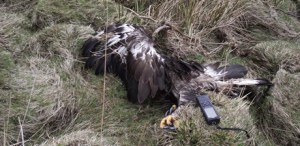
An investigation is underway after the discovery of a dead golden eagle found poisoned on the North Glenbuchat Estate in Aberdeenshire. The young eagle, being tracked by satellite, was found dead on 29 March. Tests have confirmed the eagle had been poisoned by Carbofuran. Grampian Police raided the estate yesterday and items have been removed for forensic testing but nobody has been charged as yet. Well done to Grampian Police for publicising this incident.

 BBC news story here: http://www.bbc.co.uk/news/uk-scotland-north-east-orkney-shetland-13292307

This is not the first time that North Glenbuchat Estate has been at the centre of a wildlife crime investigation. In July 2006, the head gamekeeper at North Glenbuchat was convicted of three offences: killing a wild bird, possession of birds’ eggs, and possession of a proscribed pesticide under the Wildlife & Countryside Act 1981. The head keeper, who had been employed at the estate for 30 years, was fined £850 (see here).

So, here we go again. Another year, another golden eagle found poisoned on a Scottish sporting estate, despite the rhetoric of the SRPBA and the SGA that this is a ‘rare’ event and they’re doing their best to put a stop to it. These continuing persecution incidents are nothing short of bloody outrageous.