2012 wildlife crime conference: Stewart Stevenson (Scottish Government)

This is the fourth blog in the series focusing on presentations made at the recent police wildlife crime conference in Scotland, this time from Stewart Stevenson MSP, the Scottish Environment Minister. The following comprises the first two thirds of his presentation; the final third isn’t really relevant here.

Stewart Stevenson, Scottish Environment Minister

[Some jovial preamble that isn’t relevant here]…”This conference doesn’t, er, stand in a vacuum, it’s, er, carrying on from terrific effort over many years to create what is in effect, er, the biggest and most successful, er, wildlife, er, crime event in the UK and I’m sure that under the new management we’ll see, er, us building on past successes in that regard.

And of course, wildlife crime is something which in resource terms is comparatively small, er, in, in the, in the big picture so many people in this room and beyond who are engaged in fighting wildlife crime are doing so as an addition to, er, broader responsibilities, er, that, that constitute regular, er, day jobs and indeed many, er, make huge contribution in unpaid work outside hours, er, to get the job done, get the results and get the convictions, er, that are very important in sending out the right kind of messages, er, to people involved in, er, wildlife crime, but of course again as the Assistant Chief Constable made reference to, it’s often the case, er, that the Mr Bigs of our crime networks, erm, are engaged in wildlife crime, there’s correlation when you look at the maps often between where the Mr Bigs live and clear demonstration of wildlife crime, er, taking place in an area and unlike their activities as Mr Bigs, protected behind lawyers and accountants, really Boards of Management, their engagement perhaps in wildlife crime is, is less protected and may often be a very good way of getting into criminal, criminal networks and more broadly disrupting them so I hope that, er, when the police make operational decisions, because it’s only for me to seek to persuade but not to direct, er, that that is, er, part of the, the, the thinking.

I’ve been the Minister for Environment and Climate Change for coming up for a year now and I’m absolutely gobsmacked as I go across Scotland by the, the work that’s going on in the environment generally, whether it’s conservation work on red squirrels, whether it’s protecting our small number of capercaillies, whether it’s innovative technologies out to produce cleaner sources of fuel, it’s all based on the commitment of dedicated individuals and we in government are immensely, er, proud that people make that commitment and very grateful indeed.

Now this is the first, er, Tulliallan conference since the passage of the Wildlife and Natural Environment Bill in 2011, the Act does contain, er, a number of new provisions that are very relevant to this conference and I know that, er, the Sheriff for example will be explaining the WANE Act, er, a bit later, I’m not over-egging the pudding, Sheriff, I hope, erm, I, er, won’t be able to, to listen to it myself but then I’m not part of the enforcement agency. There was a passionate debate in Parliament about many aspects of it and I think at the end of the day we achieved, er, a good and equitable balance, there was a huge cross-party support, er, for the final form that it took. But the passage of that Bill is a very clear indication, er, that Parliament, er, takes an important view of this and, er, the, the, the importance that, er, the BBC Radio Scotland this morning gave to this conference and the publication, er, of, erm, the poisoning figures for, er, raptors shows that the media see this as an important agenda as well.

The new legislation, er, a number of things are relevant to this conference, comprehensive revision of the law relating to game and the poaching of game, new closed seasons for hares, new regulations for snares, a major revision of the Deer Act backed up by a new code of practice, a new approach to invasive non-native species, I’ll just say a little something, one of the things I tripped over, just to illustrate, er, the issue of invasive non-native species…[goes into anecdote about American Signal Crayfish]…There’s new offences, a new code of practice to come on, on this regard, and there’s a new requirement that we provide an annual report to Parliament on wildlife crime.

Now, I’m not going to talk through the legislation, others are better equipped to do that. There are officials here from the Scottish Government who’ll be happy to interact with you, er, on the subject. But let me just pick up a couple of issues from it – during the course of the Bill it was apparent that there was a prevailing feeling among MSPs that we needed to take some tougher legal powers to combat the problem of illegal raptor persecution in Scotland. Er, it’s been a high priority since we took office, it is of course an issue that not only threatens some of our rarest wildlife such as the hen harrier, but it casts a disproportionately unpleasant shadow on our reputation as a country known for its high quality natural environment. The environment is a key part of our identity, it’s part of our brand and it’s vital to our export success, er, in many ways and of course wildlife tourism is a very important economic contributor.

So, the concept of an attractive, well-managed, er, natural environment can be badly damaged by any idea that it’s a place where some people can still put out dangerously toxic materials to poison some of our more spectacular wildlife. And of course, when you put poisons out in the environment, you never know what the effect will be; a dog walker can be exposed to them, domestic animals can be poisoned and indeed human beings without knowing, er, what’s going on. It is a tiny minority but it disproportionately, er, scars, er, our landscape so we’re continuing to work with our partners in PAW to change attitudes, make that minority even smaller in future, and eventually see it disappear.

So part of our response has been to introduce vicarious liability, er, provisions. There are two aspects to that. That small minority in the past of land managers who may have given a nod and a wink to their employees in relation to persecution of birds of prey, that addresses that issue, those who turn their back on doing the right thing. But now there is no doubt that their behaviour will not escape the reach of the law, they risk finding themselves in the dock as well as the unfortunate employee, the gamekeeper, whoever.

The second aspect is probably more important in the long run. We want to send a message to all land managers that inaction, benign or otherwise, is simply not good enough. Land managers need to be proactive in ensuring all employees and contractors understand legal obligations and responsibilities, they have to take all reasonable steps and exercise due diligence. And I want to pay a tribute to Scottish Land and Estates, because they have been very supportive in getting that message out, working with government, er, to develop guidance for land managers. So this is not about the industry as a whole being a problem, quite the opposite, they are a huge contributor, er, to determining best practice, to getting the message out, achieving a proportionate and proper legal balance between the many interests that there are in, in, in the country and they’ve been enormously helpful. It is just a tiny minority, and they want to see them eliminated as much as everyone else, er, does.

We’re certainly not looking for a string of prosecutions, indeed, I will measure success if there are none, because that would be absolutely ideal in a context of, of good behaviours in, in our countryside. Sustained improvement, proactive management, especially in areas that we’ve identified as being at high risk where previous history show there’s been bird or prey prosecution, we know that this is one of a range of measures in itself it doesn’t, er, solve the problems.

Now I don’t want to just speak about, er, raptor persecution, a couple of, er, other aspects of, of the work that I want to speak about, the first is the annual poisoning hotspots maps which are published today which show a significant reduction, er, in the number of birds, er, poisoned in the last year, and that’s very, very welcome but there’s still too many, er, it’s not necessarily an inescapably a long-term trend although the suggestions are that it probably is. We want to get to a position where it’s zero, ah, we’re not quite there yet. Partnership working is an important part of making sure that we get the outcomes, the input of the RSPB and Scottish Land and Estates working together give this annual exercise and reporting credibility, demonstrates that shared commitment that’s going to make a real difference, and I particularly like when I see the pack that you have as delegates to have material from RSPB and Scottish Land and Estates, showing that shared commitment, er, to this agenda.

Second, er, raptor related point, just to say something about the success of the Raptor Persecution Priority Delivery Group, it’s been working extremely well and I thank Alan Smailes, formerly of Grampian Police, my local police force, for his tireless commitment and role, he brought energy and frankness to the group and made, er, a real difference. Since, er, Alan’s recent retirement, Superintendent Ewen West from Tayside has taken over the reigns and continues where Alan left off. Real progress is being made, er, as meetings are held usually every six weeks, er, with excellent attendance. There are some developments in the pipeline in the group that have the potential to have a real impact on, on unlawful raptor pred persecution and again it’s partnership working that will make the real difference.”

[On the whole Stewart did quite well, and when you compare his attitude to that of his counterparts in England, he is streets ahead in that he at least acknowledges that raptor persecution is a problem. However, this oft-repeated insistence that raptor persecution is only being carried out by a ‘tiny minority’ is simply not supported by the facts.

There was also concern about his apparent brown-nosing of SLE that didn’t quite fit in with the fact that his government introduced vicarious liability specifically because they recognised that many land owners and land managers are often the instigators of illegal raptor persecution (if it was just a tiny minority then surely the government wouldn’t have bothered with all the hassle of introducing new legislation to combat it). In an interview on BBC Radio Scotland on the morning of the conference, Stewart took every opportunity to promote SLE and in doing so, carefully side-stepped some rather well-informed questions from the interviewer. See here for the full transcript recently posted on the SLE website. He also seems to have conveniently forgotten the communication he had last autumn with SLE Director Lord Hopetoun, who seemed to have a different view to Stewart about the benefit of vicarious liability legislation – see here].

The next instalment in this series will focus on the presentation given by Des Thompson (SNH), who also has an apparent aversion to criticising land owners.

Case against alleged buzzard shooter adjourned again

In January 2012 we blogged about John Winn Roberts, a man accused of shooting a buzzard at a quarry site on the Isle of Wight in November 2011 (see here). He was up in court on 20th January where he pleaded not guilty to shooting the buzzard and his case was adjourned until 22 March 2012.

In court on 22 March 2012, this case was further adjourned and is now expected to result in a one-day trial at the end of April.

This case is not connected to the recent buzzard shooting on the Isle of Wight reported yesterday (here).

Is this convicted gamekeeper a member of the SGA?

Last Tuesday (3 April 2012), Scottish gamekeeper Robert Christie of the Lindertis Estate was convicted at Forfar Sheriff Court of wildlife crimes (see here).

Nine days later, we are still waiting for the Scottish Gamekeepers Association (SGA) to issue a public statement condemning the criminal activities that led to the conviction and also clarifying Christie’s SGA membership status. Was he an SGA member at the time he committed the offences (2010)? If so, is he still a member now he has a criminal conviction?

It’s unusual for the SGA to be so coy about the membership status of a convicted gamekeeper. To their credit, in each of the cases that have been heard so far this year (and even in one case that didn’t even make it to court – the crow trap video case), the SGA has been quick to publicise whether the accused/convicted gamekeeper was an SGA member.

So why so coy this time? Perhaps we should give them the benefit of the doubt and assume that they just got caught up in the Easter holidays and haven’t got around to making a statement yet. Although they have managed to find the time to add various other news items to their website, including an announcement about a forthcoming snaring training course at a choice of venue that certainly raised our eyebrows (see here).

If anyone has tried to contact the SGA about Christie’s membership status we would be very interested to hear about it. For anyone who wants to ask them now, here are the SGA’s contact details:

Email: info@scottishgamekeepers.co.uk

Tel (Perth Office): 01738 587515

Isle of Wight police appeal for witnesses after buzzard found shot dead

Take note, Northern Constabulary – it’s really not that difficult to put out a timely press release when investigating a raptor persecution crime, as your police colleagues on the Isle of Wight demonstrate here:

Specialist police wildlife crime officers on the Isle of Wight are appealing for witnesses following the discovery of a dead buzzard believed to have been shot. The buzzard’s body was found on 30 March 2012 at Lower Road, Adgestone near Sandown.

Anyone with information should contact Wildlife Crime Officer PC Nick Massey at Ryde Police Station by phoning 101.

Isle of Wight News (Ventnor Blog) here

BBC news story here

Egg thief Matthew Gonshaw – more delay in latest case

The latest case against convicted egg thief Matthew Gonshaw was heard at Inverness Sheriff Court on 5 April 2012 (case continued from 8 March 2012).

This case has once again been continued and will next be heard at the end of April.

For background, see previous blog here

Police, Camera, (No) Action

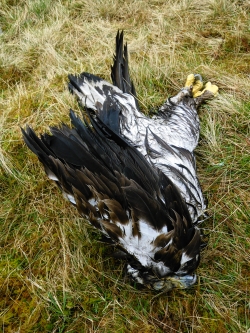
We’ve recently learned about the suspected shooting and decapitation of a white-tailed eagle on the Isle of Skye. Incredibly, this incident, concerning one of Scotland’s most iconic conservation species, has been a well-kept secret for almost a year!

The freshly-dead sea eagle was discovered on a Skye beach by a member of the public in late April 2011. This person is a member of the medical profession and in his opinion, the eagle had been shot by a rifle and its head had been removed with a sharp implement, probably a knife. It was also his opinion that the bird had been thrown from a cliff-top onto the beach; the rocks on the cliff-top above where the body was found are well-known sea eagle perching spots. Photographs of the shot, head-less eagle were taken and the incident was reported to the regional RSPB office and to the police (Northern Constabulary).

For a variety of reasons (and none of them sinister), the carcass was not retrieved from the beach for another two weeks. This unfortunate delay meant that the carcass was in an advanced state of decomposition. It was sent for post-mortem but this apparently proved inconclusive. We don’t know who conducted the post-mortem (the bird does not appear in the SASA reports so we assume it wasn’t tested for poisoning).

According to our sources, the police investigation was limited, at best. The dead eagle was discovered on the Easter weekend; many visitors would have been in the vicinity as this location is a popular tourist destination. A press release might have drawn potential witnesses from amongst the visitors, and also would have alerted local people to the incident. We understand that many locals were not informed, let alone asked for any potential intelligence leads.

The only public comment about this incident is a one-liner on the Skye Birds website (see here) dated 27 March 2012. Why all the secrecy? Was it deliberate, or another poorly-resourced investigation, or just incompetence? Not for the first time, questions should be asked of Northern Constabulary. It’s also surprising that the RSPB were not more vocal about this case. Sure, the RSPB doesn’t have a statutory duty to investigate wildlife crime (unlike the police), but it does have the ability and resources to publicise suspected wildlife crimes and you might have expected more from them when the suspected crime involved one of their own flagship reintroduction species.

Giant eagle in dining etiquette atrocities

Police in the Highlands are warning sheep farmers to be on high alert after a spate of incidents involving a giant eagle and a jar of mint sauce.

They believe the enormous bird is responsible for dining etiquette atrocities in the lambing fields of Perthshire. One farmer, who wished to remain anonymous for fear of reprisals by gangs of ill-mannered eagles, said he had seen this ginormous eagle staggering around his field, dressed in a hoodie and swigging from a bottle of Lambrini while stuffing lamb cutlets into its beak. “That lamb was wasted on that brute. Doesn’t it know that lamb should be smothered in chopped rosemary and garlic and cooked at 200 degrees centigrade for 125 minutes? To eat it raw like that, after spooning mint sauce over its intestines, just goes to show what an uncultured savage it is. The Scottish government has got a lot to answer for, bringing back these uncouth barbarians.”

Albert Hogburn of the Modern Poisoners Society said: “We’ve said all along that these eagles are a danger to society, and now we’ve been proved right. Nobody listened to us but I bet they will now. You can’t teach an eagle new tricks, or table manners, which is why we like to teach them another kind of lesson. Let them eat our poisoned bait, that’ll learn ‘em”.

Donald Spewing-Moore of the Royal Bird Protection Society said: “For fuck’s sake, can’t a man eat his easter eggs in peace? Call me back on Tuesday when I’m in the office“. He later phoned back and apologised for his bad language, blaming it on the stress of being beaten on the Wii by his mother-in-law.

The Courier reports another attack that may have been carried out by the same eagle, here.

Why convicted gamekeeper Robert Christie only got a telling off

Two days ago we blogged about Scottish gamekeeper Robert Christie (Lindertis Estate) who was convicted at Forfar Sheriff Court after pleading guilty to wildlife crimes (see here).

Since then there has been a fair bit of press coverage but the media hasn’t really picked up on the fact that Christie’s ‘punishment’ was just an admonishment (effectively a telling off), even though the available penalties included a fine of up to £5,000 and/or a six month prison sentence.

However, an article published in yesterday’s Courier did include commentary about the penalty:

“…Sheriff Kevin Veal at Forfar decided not to impose a penalty on gamekeeper Robert Christie after hearing the ‘immediate and draconian consequences’ connected with breaching a trapping licence could render the 57-year-old unemployable for the rest of his working life”.

Christie’s solicitor, David McKie (who also happens to be the SGA’s solicitor – see here), reportedly commented:

There are implications under the general licence – if the court imposes anything more than an admonition the licence is automatically withdrawn for five years“.

Was what Christie did the crime of the century? No of course it wasn’t, but what it was, without a doubt, was a criminal offence under the wildlife legislation. It seems astonishing that the Sheriff would decide not to impose any penalty, especially given the current high priority that the Scottish Government has placed on tackling wildlife crime.

What we are seeing yet again is an inconsistency in sentencing (compare Christie’s penalty with that of Aswanley Estate gamekeeper Craig Barrie who was recently fined £520 for illegal use of a trap, see here) and the sense that wildlife crime is still not being taken seriously by some Scottish courts. Do you think this defence would be acceptable for other offences, such as a drink driving taxi driver? ‘Oh, sorry m’Lord, yes I was drunk when I drove my car and I really should have known the consequences of doing this as driving is my profession but the immediate and draconian measure of losing my licence will also mean I lose my job’.

Talking of taking wildlife crime seriously, the Scottish Gamekeepers’ Association has not yet issued any public statement of condemnation for Christie’s actions, nor have they said whether he is/was an SGA member. To find out about Christie’s SGA membership status, send an email to: info@scottishgamekeepers.co.uk

Article in the Courier here

Scottish gamekeeper ‘admonished’ for wildlife crimes

Scottish gamekeeper Robert Alexander Christie (58) was convicted today at Forfar Sheriff Court for wildlife crimes relating to the illegal use of a crow cage trap. He was ‘punished’ by receiving an admonishment.

Christie pled guilty to taking a wild bird, possessing a wild bird, and using an illegal trap by failing to adhere to the terms of the general licence (this general licence governs the use of crow cage traps in Scotland).

The offences took place on the Lindertis Estate near Kirriemuir, Angus on 8 August 2010. Lindertis Estate is listed as a sporting estate providing pheasant and partridge shooting (see here). A tawny owl was rescued from inside a crow cage trap in a wood on the estate by a member of the public. The owl was reportedly in poor condition (severely malnourished and unable to hold its own bodyweight on its legs) when it was found and it was sent to a vet for treatment. The owl was released back into the wild on 13 August.

The crow cage trap reportedly did not contain food or shelter, and a tray of water contained green algae, and the trap did not have an identification tag, all contrary to the terms of the general licence.

Christie has 24 years of gamekeeping experience and has been employed as a full-time gamekeeper on this estate for approximately 18 years.

Also due to appear in court was Christie’s employer, who according to Burke’s Peerage is a hereditary peer: The Rt Hon The Lord Colyton, although in the court listing his name was given as Alisdair John Munro Hopkinson. Charges against Hopkinson related to allegedly causing/permitting the gamekeeper to use an illegal trap (Wildlife & Countryside Act). However, charges against Hopkinson were not proceeded, perhaps because Christie pled guilty.

This case was prosecuted by one of the new specialist wildlife fiscals, Shona McJannett. She is quoted as saying:

Today’s conviction highlights the importance of ensuring that crow cage traps are operated legally in terms of the general licence. The protection of our wildlife is a priority and a robust view will be taken by the Crown Office and Procurator Fiscal Service in relation to any reports alleging breach of these general licence conditions.”

Now, it’s refreshing news to hear that COPFS will take a ‘robust view’ of this type of wildlife crime and hopefully they will continue to prosecute these cases, but the penalty handed out by the court doesn’t quite match the Fiscal’s view of the seriousness of the offence. Christie’s ‘punishment’ (the admonishment) is effectively no punishment at all. It’s basically a ‘telling off’ (see here for a definition) and because he wasn’t given a more serious penalty (e.g. a fine) it means he is NOT banned from continuing to operate crow cage traps under the general licence. What sort of deterrent is a telling off? What message does this send to other wildlife criminals? Does anyone think Christie will lose his job now he’s got a conviction for wildlife crime?

It is not known whether Christie is a member of the Scottish Gamekeeper’s Association. Anyone interested in finding out can ask the SGA by emailing: info@scottishgamekeepers.co.uk. We would be very interested to learn whether he is a member, and if so, does his wildlife crime conviction mean that he is now barred from the club professional body?

Despite the pathetic ‘penalty’ (can you even call it that?), big kudos to the SSPCA for leading on this investigation, and well done also to COPFS for prosecuting; it’s not often we have cause to congratulate COPFS but on this occasion its deserved.

If you are out and about in the Scottish hills and glens and  come across a trapped raptor caught inside a crow cage trap (or any other trap for that matter), then you should call the SSPCA hotline immediately: 03000-999-999

SSPCA press release here

News article on Deadline News website here

COPFS press release here

See here for another blog on why Christie only got a telling off

STOP PRESS: One of our readers (thank you!) has contacted us to say he thinks this is the same estate that we blogged about last June (see here). Obviously we’re unable to confirm or refute this as the name of the estate in the June blog was kept a big secret, although the location is very similar!

Head, sand, buried

Yesterday we blogged about the availability of the written evidence submitted to the UK parliament’s audit on wildlife crime (see here).

Today we’ve read all the written evidence and our expectations of who might have said what were fully met. Although there’s no substitute for reading things for yourself and drawing your own conclusions, there were a few things that stood out…

One common theme was the use of RSPB vs NWCU (National Wildlife Crime Unit) raptor persecution statistics, with groups such as the National Gamekeepers’ Organisation and the Moorland Association claiming that only the NWCU figures should be used to determine the ‘true scale’ of the problem. The Countryside Alliance goes one step further and says that it objects to what it calls ‘scene-of-the-crime involvement of third party campaigning organisations and charities such as the RSPB’ and calls for urgent guidance to clarify ‘that all crimes and suspected crimes should be reported to the police’. No great surprises there – it’s the usual knee-jerk reaction to the RSPB, but what is interesting is that they forgot to mention just how unrepresentative the NWCU figures actually are! Why are they unrepresentative? Well according to the written evidence of the Association of Chief Police Officers (ACPOS), not all police forces submit their wildlife crime data to the NWCU, and even if data have been submitted, it’s not always possible to identify which incidents were wildlife crimes as they are not allocated to a specific code! So yes, it is easy to see why these groups want to get rid of the RSPB stats and replace them with the NWCU figures!

Another point of interest was a statement from the Moorland Association on hen harriers. We thought the second paragraph contained particularly sinister undertones:

The scale of crime against the hen harrier and its impact on the hen harrier population has been overstated and is misleading. A lack of breeding success on grouse moors does not automatically mean that laws have been broken. There are many, many more birds in England than four successfully nesting pairs, which can be seen over grouse moor during migration and at winter roost sites.

Until a full set of special rules allowing the positive management of hen harriers breeding on grouse moors is forthcoming from the Environment Council’s Hen Harrier Dialogue, moorland owners are within their rights and the law to deter the birds from settling on their moors to breed.”

We assume that ‘positive management’ in this context refers to either killing or otherwise removing (translocating) any harriers that are considered ‘surplus’ to an agreed acceptable number (known as a ‘ceiling’). We understand that the Environment Council is seriously considering a ‘ceiling’ on hen harrier numbers for grouse moors; a controversial and long-running argument that we’ll write about another time. But what does the Moorland Association mean when it says ‘moorland owners are within their rights and the law to deter birds from settling on their moors to breed’?

The other comment we found particularly interesting was one made by the Countryside Alliance:

The recent publication of out of date research into the breeding success of peregrine falcons on grouse moors is a further example of counterproductive allegations against shooting which resulted in misleading coverage in the media. As a result of this, the National Wildlife Crime Unit circulated a clarification to all Police Wildlife Crime Officers in the UK, and to all Partnership for Action Against Wildlife Crime members, in which it was drawn to the attention of those studying the research paper that the data used was out of date, and that in using such information there was a clear danger that the research paper might be misunderstood as representing the current situation, which it did not.”

The publication being referred to is the recent paper by Amar et al (2011) which showed that the breeding productivity of peregrines nesting on grouse moors in Northern England was 50% lower than the productivity of peregrines breeding on non-grouse moors (see here for earlier blog on this). Now, why would the NWCU feel it necessary to send an email to wildlife crime police officers and other PAW partners about how to interpret this paper? Did they think that these people were so stupid that they couldn’t read and understand the paper for themselves? Why did the NWCU think that the data used in the paper (collected between 1980-2006 from 141 nesting ranges) were unrepresentative of the current situation? Has the NWCU collected and analysed more recent data to demonstrate that the current situation is different? How does sending this email fit in with the NWCU’s stated primary role of ‘assisting in the prevention and detection of wildlife crime’? What sort of message does this email give to those involved with the fight against raptor persecution? Here is a peer-reviewed scientific publication in a prestigious journal that points directly to the significant relationship between grouse moors and raptor persecution. Isn’t this exactly the sort of publication that the NWCU’s Charlie Everitt was referring to in his speech at the recent wildlife crime conference when he said: “We’ve also been looking to the use of science to try and benefit from what science can deliver to us”?

The thing is that the data used in the paper were part of a long-term data set that clearly showed a trend in poor productivity (i.e. not a snap shot but a long-term picture over 26 years), and this trend also mirrored that of other studies that have shown a clear relationship between low raptor survival and grouse moors (go and read some of the golden eagle papers that have been produced over the last ten years). The NWCU appear to have missed this point in their scrabble to appease the grouse-shooting lobby; so much for their intelligence-led approach to combating raptor persecution, eh?

All the written evidence submitted to the audit committee so far can be read here.