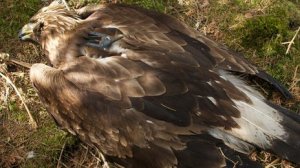
 A new motion was lodged in the Scottish Parliament on Monday 22nd October 2012 concerning the death of the Glen Esk golden eagle:
Motion S4M-04516: Nigel Don, Angus North and Mearns, Scottish National Party.
Death of Golden Eagle
That the Parliament condemns what it sees as the recent brutal killing of a golden eagle in Glen Esk, Angus; considers that the golden eagle is one of Scotland’s most iconic species and understands that 11 golden eagles have been illegally killed since 2007; notes also that 2013 will be the Year of Natural Scotland; urges the Police Service of Scotland to ensure that police officers have the training and resources required to tackle wildlife crime effectively; considers that golden eagles more than earn their keep by attracting tourism to rural Scotland, and asks the Scottish Government to assess what further measures it might take to protect what are considered these magnificent birds.
Here is a desciption of what a Scottish parliamentary motion is.
Here is the full text of this particular motion.
While very welcome (and probably a direct result of all the letters of complaint and media coverage) this motion raises some interesting questions:
It was proposed by 1 MSP (whose constituency includes Brechin) and was supported by 26 others. There are 129 MSPs in the Scottish Parliament. Where’s the support of the other 122? Did your MSP support it? If not, why not?
Note the phrase, “….what it sees as the recent brutal killing of a golden eagle in Glen Esk, Angus” and then compare it with the official line given by Environment Minister Paul Wheelhouse MSP:
“The reports may suggest that the circumstances of this incident were suggestive of an offence however there is no hard evidence and it remains possible that there is an alternative explanation“.
It seems Nigel Don MSP and the 26 MSPs who supported his motion do not share the Environment Minister’s view on what happened to that eagle. Apparently nor do the police (see here). We would encourage you to write again to Mr Wheelhouse and ask him to provide the evidence that leads him to suggest that this eagle’s death was not the result of criminal activity. Email: ministerforenvironment@scotland.gsi.gov.uk. It’s important that this issue is clarified; any doubt that this eagle did not die as a direct result of criminal activity will be used by the Dark Side to support their continual denial about the extent of illegal raptor persecution.
Another interesting question concerns the number of known illegal deaths of golden eagles. The motion says 11 golden eagles have been illegally killed since 2007. Our figures suggest that ten have been discovered (see here):
Peebles (2007); Glen Orchy (2009); Alma (2009); Skibo 1 (2010); Skibo 2 (2010); Skibo 3 (2010); Farr (2010); Glenbuchat (2011); Lochaber (2012); Glen Esk (2012).
So where’s the information about the 11th one? And why limit the figure to golden eagles? What about white-tailed eagles? If they’re included during this time frame, then the number of eagles known to have been illegally killed is at least 14:
GlenQuoich (2007); Glenogil (2009); Farr (2010); Skye (2011).
If the time frame was increased one year further, to 2006, then at least 16 eagles are known to have been illegally killed:
Dinnet & Kinord (2006); Glen Feshie (2006).
And then there’s all the known ‘missing’ eagles, which brings the total to at least 25:
WTE radio-tagged Bird ‘N’ disappeared in Angus Glens (2007); WTE carcass removed in suspicious circumstances from Lochindorb (2010); 4 x golden eagle leg rings found in gamekeeper’s possession on Moy Estate (2010); sat-tagged golden eagle ‘disappeared’ in Monadhliaths (2011); sat-tagged golden eagle ‘disappeared’ in eastern glens (2012); sat-tagged golden eagle ‘disappeared’ NE of Cairngorms (2012).
And then the most recent one, the shot golden eagle found on the border of Buccleuch Estate (2012) – that brings the total to 26.
And we haven’t included any other of the known persecuted raptor species in this list!
So, well done Nigel Don MSP for highlighting a significant and on-going problem – we look forward to seeing a response from the Scottish Government.

 Today’s BBC Radio 4 ‘Saving Species’ programme will be discussing raptor persecution at 11am today.
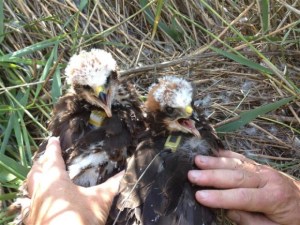 In July 2012, Roy Dennis and friends sat-tagged two marsh harriers at a nest in Moray.
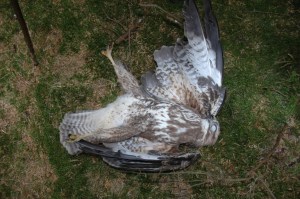 In June 2012, Roy Dennis and friends attached a satellite tag to a young buzzard near Nethybridge. Named ‘Buzz’, he was thought to be the first sat-tagged buzzard in Scotland.
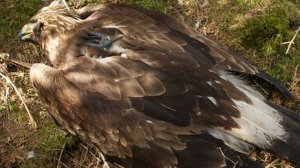 Let’s start with the sat-tagged golden eagle that was found dead, with two broken legs, in a lay-by in Aboyne in May. This is the eagle whose death was not reported until four months after it was found dead (see
