 Following on from yesterday’s blog entry, The curious incident of the eagle in the night-time (see here), we have an update…
First of all, a big thank vote of thanks to all of you who tweeted and shared the story on Facebook to help raise awareness about this situation. Special thanks to five Twitter users in particular: @TripleSter; @RareBirdAlertUK; @benjaminbittern; @Cekaelta; @ChrisGPackham.
Secondly, another big vote of thanks to everyone who made an effort and sent an email to Tayside Police’s Chief Constable to ask whether the death of this golden eagle was the subject of a criminal investigation. Your efforts have had an impact – a Tayside Police spokesman has responded by writing a comment on the blog. We’re reproducing it here so it doesn’t get buried:
“We are concerned regarding this matter and, along with our partners in Grampian Police and the RSPB Investigations Unit, as well as our own Wildlife and Environment Officer, are continuing to undertake enquiries. Please be assured that Tayside Police will continue to investigate all circumstances surrounding this incident with a view to identifying those responsible and holding them to account for what is a terrible deed. Anyone who has information that can assist us should call 0300 111 2222, or speak to any officer“.
 Before we discuss their comment, we’d like to acknowledge Tayside Police for engaging in the discussion. Although they have a duty to respond to emails sent to them by members of the public, they aren’t obliged to post comments on blogs or a similar forum and they deserve some credit for doing so in this instance.
Now, let’s get down to what they said:
They are concerned. That’s good.
They are continuing to make enquiries. That’s very good, but can we clarify that “this matter” / “incident” / “terrible deed” is in fact a CRIME? There seems to be a reluctance to use this term. This is an important distinction to make as it will affect the official wildlife crime stats that the police now have to provide to the Scottish Government each year (this requirement was brought in with the WANE Act) and also the ‘stats’ that the persecution-deniers trot out each year to ‘prove’ that illegal raptor persecution is ‘in decline’.
They are conducting their enquiries in partnership with Grampian Police and the RSPB Investigations Unit. That’s also very good.
They will “continue to investigate all circumstances surrounding this incident with a view to identifying those responsible and holding them to account for what is a terrible deed”. That sounds very good but is it anything more than just a media sound bite designed to placate an increasingly frustrated general public? It’s been six months, nearly seven months, since that eagle was found dead in early May 2012. What chances of finding any evidence now or in the future, so long after the event?
In the interests of transparency, we’d like to ask some further questions about the investigation to date. Obviously we don’t wish to jeopardise an on-going criminal investigation and so Tayside Police may not wish to answer these questions, although it is common practice for police forces to release some information during criminal inquiries so let’s see if they’re able to help this time. The questions that we’re asking should not have any negative effect on their continuing enquiries because it’s probably fair to say this investigation is now dead in the water; nobody is going to be brought to justice for the death of this eagle. We also know that the Scottish Gamekeepers Association is conducting its own ‘inquiry’ and that information about this investigation may have been passed to them by Tayside Police. If so, we hope the police will not treat us any differently.
We’d be interested to learn whether, during the early stages of the investigation, attempts were made to recover evidence from a wider search area of the land where the eagle was motionless for 15 hours before it was moved north to the lay-by where it was left to die? Also, were attempts made to recover evidence (e.g. eagle feathers or blood) from any vehicles or buildings that may have been used in this crime?
We’d also be interested to learn why Tayside Police haven’t publicised this incident, either at the time the dead eagle was discovered, or in the following months (e.g. with an appeal for information)? Tayside Police regularly post news items, appeals for information and investigation updates in the news section of their website; we wonder why this case was treated differently?
We also understand that there might have been some sort of approach by a defence agent wishing to access the dead eagle and/or the post-mortem results and we suspect this might have been an attempt to discredit the findings of the official post-mortem. i.e. to challenge the conclusions drawn by experts at the Scottish Agricultural College lab that the eagle’s severe leg injuries could have been caused by a spring-type trap. Did Tayside Police provide the findings of the official post-mortem to any defence agent?
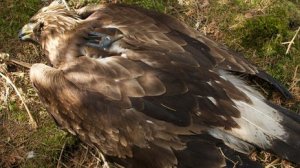 And finally, we go back to the Environment Minister’s statement about this incident. In whose interest was it to suggest that this was not a criminal offence? Who advised the Minister that the eagle’s injuries could have been the result of anything other than a criminal offence? It probably wasn’t the RSPB Investigations Unit given they put out a press release stating that they believed the eagle had been caught in an illegally-set trap (see press release here). That only leaves the police, unless of course the Minister’s office is taking advice from a defence agent, and that would certainly seem absurd. If it was Tayside Police, and we’re not saying it was, doing so would appear to undermine a criminal investigation before it even got off the ground (no pun intended).
Surely a government minister would not release a statement unless he was sure the advice he had being given was accurate? So, did Tayside Police advise the Minister’s office that the eagle’s injuries could have been caused by something other than a spring-type trap? If they did, it’d be interesting to know what the Minister’s office was told could have caused the eagle’s injuries other than a spring-type trap.
We’re calling on our blog readers to help find answers to these questions by asking Tayside Police, en-masse, to provide clarification on the above points. Just writing about the issues on a blog can help raise awareness but it’s unlikely to produce tangible results – the police aren’t obliged to respond (although, as mentioned above, Tayside Police, to their credit, did so yesterday and for that we applaud them). However, they are obliged to respond to individual emails from the general public.
This is an opportunity to shine a light on the investigation of raptor persecution crimes in the Tayside region. Regular blog readers will be well aware that the death of this golden eagle is not an isolated incident; this region has seen more than its fair share of illegal raptor persecution in recent years, including the discovery of poisoned golden eagles, white-tailed eagles, buzzards, red kites, sparrowhawks, tawny owls, crows, as well as a series of poisoned baits. Very few of these crimes have resulted in prosecutions.
Here’s a summary of the questions to be asked:
- Is the death of this golden eagle being treated as a CRIME?
- Were attempts made to recover evidence from a wide search area?
- Were attempts made to recover evidence from vehicles and buildings?
- Why hasn’t Tayside Police publicised the death of this eagle?
- Did Tayside Police provide details of the post-mortem to any defence agent?
- Did Tayside Police advise the Minister’s office that the eagle’s injuries could have been caused by anything other than a spring-type trap? If so, what did they say could have been the cause of the injuries?
Please send questions to Tayside Police Chief Constable Justine Curran: justine.curran@tayside.pnn.police.uk

 We were expecting a verdict yesterday on the Lochindorb Estate hare snare trial, but Sheriff Abercrombie had other ideas.
 Thanks to the contributor who sent us a recent copy of the following article published in the Press & Journal (dated 28 Nov 2012) -:
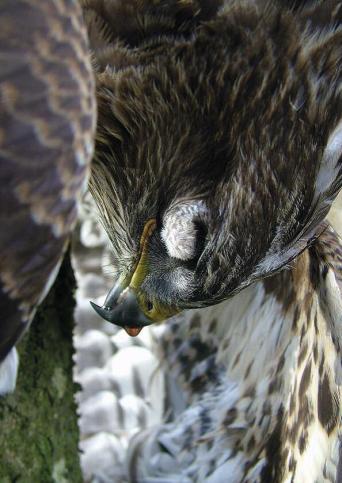 RSPB Scotland has just published its latest report, The Illegal Killing of Birds of Prey in Scotland in 2011. You probably won’t be surprised or shocked by the content, especially if you’ve read the previous 17 annual reviews. In fact, when you read this 18th review, you might get a strong sense of déjà vu.
 Once again the occupations and interests of those convicted for illegal raptor persecution crime have been analysed (data from 2003-2011 inclusive). 87% of them were gamekeepers (7% pigeon racers, 3% pest controllers, 3% farmers).
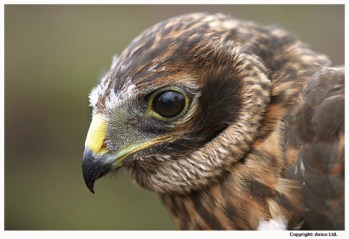 Regular blog readers will know we’ve been following the story of the two Langholm hen harrier chicks since the summer: the female chick, ‘Blae’ was reported dead in early September and her sibling, ‘Barry’ was reported ‘missing’ just a couple of weeks later. Since then we’ve been critical of the lack of information that’s been made available to the public (previous blog entries
 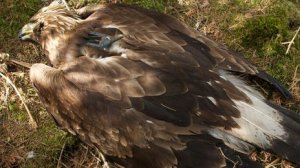 Six months ago, a dead golden eagle was found close to a lay-by on a quiet road in Aberdeenshire. The bird’s satellite-tracking data showed it had remained motionless on an Angus grouse moor for 15 hours, before inexplicably moving 15km north to the lay-by, in the dead of night, where it was found dead several days later. A post-mortem conducted by the Scottish Agricultural College laboratory in Aberdeenshire concluded that the eagle had suffered two broken legs due to trauma “that could be consistent with an injury caused by a spring type trap“. The SAC said the severity of the eagle’s injuries “would prevent the bird from being able to take off“.
 Here’s
 Raptor Persecution UK