Press release from Police Scotland (28 June 2024):
APPEAL FOR INFORMATION AFTER GOSHAWK NEST FOUND ABANDONED NEAR LOCH GYNACK
Police are appealing for information after a suspected attempt to target birds of prey in the Strathspey area.
On Saturday, 8 June, 2024, officers received a report of an active Goshawk nest having been found abandoned in suspicious circumstances, within a forest near Loch Gynack.
Enquiries were carried out at the site, in partnership with RSPB Scotland, showing the nest had been deliberately targeted with a shotgun. The nest and damaged branches were taken for x-ray with the assistance of staff at the Kincraig Highland Wildlife Park.
Police Constable Daniel Sutherland, Highland and Islands Wildlife Crime Liaison officer, said: “All birds of prey are fully protected under the Wildlife and Countryside Act 1981 and it is illegal to kill them. I am asking anyone in the local community who may be able to help with our enquiries to come forward.
“The area is close to popular walking paths from Newton More. If you were walking in the area during May or early June, and may have seen or heard anything suspicious, then please get in touch.”
Anyone with information is asked to contact Police Scotland on 101, quoting reference CR/0211821/24, or make a call anonymously to the charity Crimestoppers on 0800 555 111.
ENDS
UPDATE 24 October 2025: BBC’s Highland Cops programme features investigation into shot out Goshawk nest in Cairngorms National Park (here)
Blog readers may recall a press release in April 2024 from North Yorkshire Police detailing the execution of a search warrant on an unnamed grouse moor in the Yorkshire Dales National Park, in relation to the illegal persecution of hen harriers (see here).
This hen harrier was euthanised after suffering catastrophic injuries in an illegal trap set next to its nest on a grouse moor in Scotland in 2019. Photo by Ruth Tingay
The very first line of that press release said this:
“On Wednesday, (17 April 2024), a National Harrier Task Force operation was held at an undisclosed location in the Yorkshire Dales“.
That was the first time I’d heard of the ‘National Harrier Task Force’ but I’ve since learned much more about it.
I’ll begin this blog with the reproduction of a press article about the new Taskforce that appeared on a relatively obscure website (CandoFM) in May 2024, then I’ll provide some of my own commentary on this new initiative.
Here’s the press article:
Hen Harrier Task Force Launched To Tackle Illegal Persecution
A new task force has been launched to tackle the illegal persecution of hen harriers, one of the rarest bird of prey species in the UK.
The National Wildlife Crime Unit (NWCU) will use innovative technology and strategic partnerships to detect, deter and disrupt offenders.
Given the rarity of hen harriers, significant resource is invested in their conservation. Satellite tags are fitted to the birds to research their ecology, but these tags have also revealed a concerning amount of illegal killing.
Criminals are intent on targeting this vulnerable species and operate with impunity. There have been no successful prosecutions in recent years despite the efforts of the police and partners.
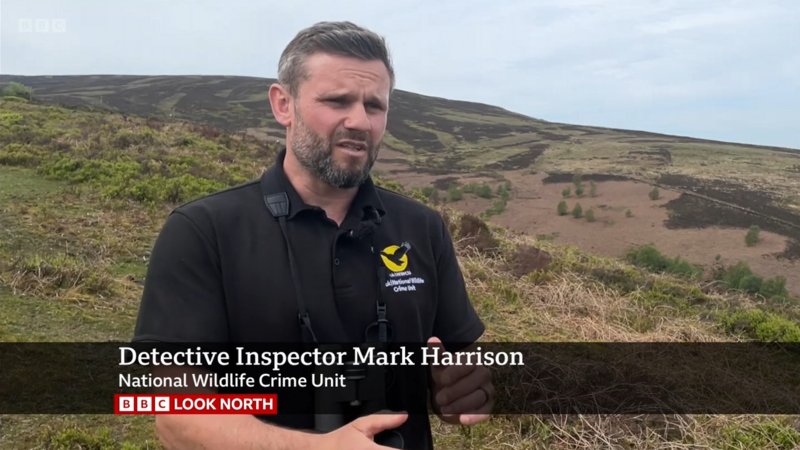
In response, the launch of the Hen Harrier Task Force, led by Detective Inspector Mark Harrison of the NWCU, represents a pivotal shift in combating wildlife crime.
“The persecution of birds of prey is not just a wildlife issue; it’s serious crime blighting our countryside,” said DI Harrison. “With the launch of the Hen Harrier Task Force, we are determined to disrupt illegal activity and protect this vulnerable species.”
Central to the bird of prey task force’s approach is standardising reporting practices and improving the police response to incidents. Police and partners will work together to ensure resources are deployed swiftly and investigative opportunities are maximised. The task force will also bring together partners to engage with local communities and raise the profile of hen harrier persecution in a unified effort against wildlife crime.
“We cannot tackle this problem alone,” emphasised DI Harrison. “Through proactive partnerships and community engagement, we can strengthen our response and hold perpetrators to account.”
The task force will tackle crimes involving satellite tagged birds of prey. It is data-led, relying on analysis of police data and hotspot mapping. The NWCU has identified crime hot spots where they can focus enforcement efforts, as well as other areas of historic vulnerabilities where they will be seeking to revisit and raise their presence with landowners and land users. These meetings are an opportunity to highlight the issues/risks and identify ways to prevent further incidents from occurring.
Rather than purely focusing on the wildlife aspect of the crime, DI Harrison has tasked his team with taking a holistic view of the criminality and considering all types of offences. Criminals will often steal and destroy the satellite tags to conceal their offending. This could constitute criminal damage, theft and fraud. In the last few years alone, £100,000 worth of satellite tags have been lost in circumstances suspected to be criminal. The apparent use of firearms adds a further level of seriousness to these cases.
Recent examples of this include Anu, a hen harrier in South Yorkshire, which had its satellite tag deliberately cut off by someone possibly using scissors or a knife. Asta, a hen harrier in North Yorkshire, is another example. Although the dead bird was not found, its tag was recovered from a dead crow. The NWCU suspect that fitting the tag to a crow was an attempt to make it look like the hen harrier was still alive and hide the fact that it had been illegally killed. Unfortunately, the crow also died from unknown causes.
The task force’s multifaceted approach includes:
Improved incident response: Standardised reporting processes enable rapid response to suspicious incidents, ensuring investigative opportunities are maximised.
Innovative technology: From tracking drones to specialised detection dogs, the task force uses innovative tools to overcome logistical challenges and enhance evidence collection in remote areas.
Strategic partnerships: The taskforce brings together law enforcement, government agencies, non-governmental organisations, landowners and communities to tackle crime in hotspot areas.
Community awareness Initiatives: Building on successful models like Operation Owl, the task force seeks to boost public support and encourage vigilance against wildlife crime.
As the task force gains momentum, the team will be dedicated to protecting the UK’s hen harriers. Through collaboration and innovation, it is set to make a lasting impact in the fight against wildlife crime.
About the Hen Harrier Task Force
The Hen Harrier Task Force is an initiative led by the UK National Wildlife Crime Unit and supported by seven police forces (Cumbria, Derbyshire, Durham, Northumbria, North Yorkshire, South Yorkshire and West Yorkshire), DEFRA, the RSPB, National Gamekeepers’ Organisation, British Association for Shooting and Conservation (BASC), The Wildlife Trusts, GWCT, national parks, Country Land and Business Association (CLA), Natural England and The Moorland Association to combat the persecution of hen harriers in the UK. The taskforce aims to detect, deter, and disrupt offenders involved in wildlife crime by using technology and improving partnership working.
ENDS
My initial reaction to this new Taskforce was one of deep cynicism. Given some of the organisations involved, it just looks like yet another pseudo-‘partnership’ that will achieve nothing other than providing a convenient vehicle for DEFRA and its raptor-killing mates within the grouse shooting industry to be able to pretend that they have a zero tolerance approach to the illegal killing of hen harriers because they are all ‘cooperating’ on this Taskforce.
It’s a ploy that’s been utilised many times before and has simply facilitated the continued illegal killing of hen harriers (and other raptor species) without anyone being held to account. The RPPDG (Raptor Persecution Priority Delivery Group) is a prime example – established thirteen years ago in 2011 and has served no useful purpose in terms of tackling raptor persecution, but has provided numerous Government Ministers with an opportunity to appear to be dealing with it. Utter greenwashing.
Those of you with long memories will remember Operation Artemis, another police-led initiative launched twenty years ago in 2004 designed to work in ‘partnership’ with grouse moor owners to tackle the illegal killing of hen harriers. Here’s some info about it from the RSPB’s 2004 Birdcrime Report:
As described by the RSPB, Op Artemis was not well-received by the shooting industry, even resulting in an article published in The Times where the then Chief Executive of the Countryside Alliance, Simon Hart (who later became Chief Whip for the Conservatives) said the police operation was “part of a wider witch-hunt against gamekeepers“.
Operation Artemis stumbled along until 2007 when it was closed down after achieving nothing at all. Here are two more write-ups about it from the RSPB’s Birdcrime Reports in 2006 and 2007 respectively:
Given the complete failure of Operation Artemis to effectively tackle the illegal killing of hen harriers on driven grouse moors, how will this latest initiative, the National Hen Harrier Taskforce, rolled out some 20 years later, be any different?
Well, there are some positive differences.
This time around, the police have the benefit of access to hen harrier satellite-tracking data (provided by Natural England and the RSPB) which has allowed the National Wildlife Crime Unit (NWCU) to identify clear persecution hotspots, i.e. the estates where a disproportionate number of hen harriers are killed / ‘go missing’ in comparison to the rest of the species’ range.
These wildlife crime hotspots have been known for years but this time the NWCU has done its own analysis on the tag data and, even though it has drawn the same conclusions as the RSPB previously, because the hotspots have been identified by the Police it cuts off any opportunity for estate owners to claim that the data are ‘biased’ or ‘fabricated’ simply because the data belonged to the RSPB. In other words, the estate owners/managers can’t so easily dismiss the data as not being credible.
Another major difference this time around is that the police officer leading the Taskforce, Detective Inspector Mark Harrison, is taking a much more strategic approach. He’s not only looking at the offence of killing a hen harrier – he’s looking at the wider, associated offences such as theft (of very expensive satellite tags) and firearms offences. In combination, these crimes amount to a considerable and serious level of offending and can open the door to the police receiving permission to undertake covert tactics, including surveillance and communications monitoring.
To reach that stage, certain steps have be taken first as part of a longer-term strategy. These include police visits to the known hotspot estates (and I understand that there have now been several of these visits in addition to the one in the Yorkshire Dales National Park that was reported in April). If, after these visits, hen harrier persecution continues to be suspected at those hotspots, the police will then be in a position to demonstrate to senior officers that the ‘nicely nicely’ approach has been tried but hasn’t worked and so permission to begin more covert tactics is more likely to be granted.
Permission should be granted just on the basis of suspected firearms offences taking place. If the estate owners / managers / gamekeepers are denying any knowledge of the offences (which is what they’ve been doing for 30+ years) then the police can legitimately conclude that ‘someone’ [apparently unidentified] is running around an estate committing firearms offences and is clearly a threat to the public. As the fundamental role of the police is a duty to protect the public then I can’t see how permission to deploy more covert tactics can legitimately be withheld under these circumstances.
Of course none of these ideas are anything new – we’ve all been saying for years that if estate owners / managers / gamekeepers claim not to know who’s committing firearms offences on their land then there’s a serious concern that armed individuals are running amok and those estate owners / managers / gamekeepers should be fully supportive of the police doing everything they can to find them, just as any of us would if armed criminals were operating on our property.
However, the difference this time is that here we have a senior police officer, with a background specialism in covert surveillance (and thus a deep understanding of what hoops need to be jumped through to get permission for covert ops), prepared to push the envelope and take a more radical approach and actually implement this strategy instead of just talking about it, and I applaud him for that. Whether he’ll be allowed to stay in post for long enough to carry through with this strategy remains to be seen.
Another new initiative with this Hen Harrier Taskforce is a ‘mutual aid agreement’ between a number of police forces. One of the big issues in tackling wildlife crime, and particularly raptor persecution, has always been the availability of a wildlife crime officer to attend the scene promptly to secure evidence. We all know that the police are stretched, budgets are stretched, and it’s not always possible to get an officer on scene quickly – sometimes delays run into days and weeks, which is ridiculous. The mutual aid agreement means that a number of regional police forces have committed to making officers available at short notice for cross-border searches if the local officers can’t attend in time. If that works in practice, it should be good.
Once on scene, the Taskforce is also utilising a wide array of new techniques and equipment to aid any searches. These include the use of drones working within the range of satellite tag signals and the use of specialised detection dogs trained to search for bird corpses, amongst other things.
This all sounds very promising, on paper. Although to be fair, the Taskforce has already started the strategic plan by paying visits to those known persecution hotspots and has given fair warning to the estates about what they can expect if the persecution continues.
The only issue I have with that approach at the moment is that those crime hotspot estates have not been publicly named. The police say this is because they’re trying to build relationships of trust. I say they’re shielding the criminals. I have been told that the decision not to name hotspot estates is ‘not set in stone’ and may be revisited.
Let’s see.
I wish the Taskforce well and, given the current rate of ongoing hen harrier persecution on grouse moors, I’ll expect to see results in the not-too distant future.
UPDATE 17 July 2024: Is the Moorland Association already trying to sabotage the police’s new National Hen Harrier Taskforce? (here)
NatureScot is advertising six Licensing Officer posts in anticipation of its increased workload, not least the forthcoming grouse moor management licences that have been introduced through the Wildlife Management & Muirburn Act 2024.
Three positions are temporary until 31 March 2025 and three positions are permanent.
Salary – £31,719 per annum, 35 hours per week.
Location – Scotland (home and hybrid working will be considered)
Closing date – midday, 12 July 2024.
Job purpose summary
The post-holder will be a key member of NatureScot’s busy licensing team which sits within the Wildlife Management Activity, undertaking a range of duties to support the delivery of NatureScot’s statutory licensing function.
The NatureScot Licensing Team issue about 5000 protected species licences throughout the year. Licences enable actions that would otherwise be illegal. They cover certain types of activity such as disturbance to protected birds and animals, and are issued for purposes such as preserving public health and safety, preventing serious damage to livestock, development, science and research.
We aim to provide an efficient and responsive licensing service that enables people to manage protected wildlife effectively, balancing legitimate needs of individuals and business with our regulatory responsibilities.
Key Responsibilities and Accountabilities
Processing and issuing protected species licence applications, including assessing applications against the licensing tests and writing Statement of Reasons for issued licences;
Processing licence returns and licence amendments;
Assist in dealing with Freedom of Information requests, collating large volumes of requested information accurately and other reporting as required;
Undertake monitoring to ensure licence holders are complying with the conditions of their licence, and report any licensing breaches to Licencing Manager/ Wildlife Crime Officer as appropriate.
Skills Required (Please refer to these in your Supporting Statement)
Good understanding or experience of NatureScot’s licensing functions and approach, including knowledge of policy and legislation
Understanding and experience of wildlife management approaches and the need for wildlife management.
Good knowledge of Scottish protected species ecology
Ability to source, collate and analyse data from a variety of sources
Effective team working within a busy team including any experience of matrix management
Good communication skills (written and verbal) including the ability to effectively deal with a wide range of stakeholders and to understand and appreciate their needs including in relation to novel and contentious cases.
Good organisational and time management skills to effectively prioritise a high volume of reactive and proactive workload.
Can demonstrate ability to work using own initiative and to ask for help when required
Can demonstrate accuracy and attention to detail when undertaking day to day tasks
Prerequisites Required
Right to work in the UK
To undertake a Disclosure Scotland Application
Although Gaelic language is not a prerequisite it is a desirable skill in support of our commitment to our Gaelic Language Plan.
For further details and to apply, please see here.
The Scottish Gamekeepers Association (SGA) has a track record of submitting pointless petitions to the Scottish Parliament that needlessly tie up valuable parliamentary time (e.g. see here).
[‘Pointless’ as in had the SGA done its research it would already know that what it was proposing was already established policy].
Another pointless SGA petition crashed and burned yesterday, this time after almost two years of consideration.
This one (Petition number PE1966) was lodged on 7 September 2022 and called for, ‘The Scottish Government to formally recognise local knowledge and ensure it is given full consideration alongside scientific knowledge throughout consultation, decision-making processes and in policy development, specifically within the conservation arena‘.
It was lodged at a time when the SGA felt more aggrieved than usual, on the back of the Scottish Government announcing that it intended to bring in grouse moor licensing to deal with the decades-long criminality associated with the illegal killing of raptors on Scottish grouse moors. I’m guessing that the petition was timed in a desperate attempt to influence the passage of the Wildlife Management & Muirburn Bill. If that was indeed the intention, the SGA failed miserably.
The text of petition PE1966 was what I’d call a word salad – lots of scientific-sounding sentences that looked like they’d been cut and pasted from various academic sources but when strung together were neither coherent or convincing. You can judge it for yourself here:
Obviously PE1966 was received with great enthusiasm by the Petitions Committee, whose current membership includes the SNP’s Fergus Ewing MSP, who also just happens to be an SGA-member, has previously described himself as “a friend in Government” [to the SGA] and has controversially donated to the SGA’s fundraising auction.
In addition to Fergus Ewing, the Committee is chaired by Conservative Jackson Carlaw MSP, whose questionable behaviour, along with that of Fergus Ewing, has been the subject of an earlier blog (see here).
The Committee took the opportunity (as is its role) to ask questions of NatureScot and the Scottish Government about the SGA’s complaints, including a missive from Fergus Ewing about why the SGA wasn’t represented on the NatureScot Board (yes, seriously!).
The responses from both the Scottish Government and NatureScot easily rebutted the challenges and effectively handed the SGA it’s arse on a plate – you can read the various correspondence letters here. (Click on ‘Citizen Participation and Public Petitions Committee Consideration‘ and then click on ‘Written Submissions‘).
This resulted in Petition 1966 going absolutely nowhere and it was formally closed during yesterday’s session, but not before Ewing & Carlaw had a chance to regurgitate some slurs on the SGA’s behalf.
I find it somewhat ironic that the SGA is complaining about its views not being taken seriously by politicians when a number of its members have, for several years, openly engaged in the most vile and misogynistic online abuse of some of Scotland’s politicians, especially towards former Minister Lorna Slater and former First Minister Nicola Sturgeon.
Here’s one of many recent examples, this one published in March this year:
This deeply offensive tweet was viewed 422 times on Twitter and received one repost and 5 likes. Not a single person challenged him about it.
Posted on Twitter under the name of Bob Connelly with a username of @curlybob69, this person describes himself as a Perthshire gamekeeper and he’s wearing an SGA pin badge in his header photo:
An identical profile is used for a Facebook account under the same name:
This looks like the same gamekeeper called Bob Connelly who featured in an article published by The Courier a couple of years ago, which laughingly asked, ‘Are gamekeepers victim of a hate campaign‘??!! (see here).
I wonder if it’s the same Bob Connelly who is listed at Companies House as a Director of the Scottish Gamekeepers Association’s Charitable Trust?
Is posting repugnant, misogynistic online abuse towards a female politician fitting behaviour of a charity Trustee? That would be a question for the SGA.
Is posting repugnant, misogynistic online abuse towards a female politician fitting behaviour of a Director of an organisation that’s demanding parliamentary time, attention and recognition? That would also be a question for the SGA but also for the politicians.
Is posting repugnant, misogynistic online abuse towards a female politician fitting behaviour of a shotgun certificate/firearms licence holder? That would be a question for the Chief Constable of Police Scotland.
Two mainstream BBC TV programmes, Landward and Countryfile, last week included features on raptor conservation projects in south Scotland – both worth watching on BBC iPlayer if you missed them.
Landward featured the brilliant George Smith, a volunteer from the Scottish Raptor Study Group, who has been monitoring peregrines across south Scotland for almost 40 years. He’s filmed visiting peregrine nest sites to ring chicks (under licence) and to collect DNA samples (also under licence).
It was a direct result of George’s dedicated and meticulous research that led to the recent conviction of part-time gamekeeper Timothy Hall and his son, Lewis Hall, for the illegal laundering of wild peregrines that were stolen from nests in south Scotland and then sold on to falconers in the Middle East, allegedly for enormous profit according to the Crown.
Worryingly, some more peregrine nests that George is monitoring this year have failed in suspicious circumstances and Police Scotland are currently investigating.
This episode of Landward is available on BBC iPlayer here (peregrine segment starts at 7 min 48 sec) and is available for the next 11 months.
Countryfile had two features of interest to readers of this blog. First was an overview of the conservation restoration work going on at the Tarras Valley Nature Reserve, the former Langholm grouse moor that was bought out from Buccleuch Estates by the Langholm community in 2022. Tarras Valley NR Estate Manager Jenny Barlow provides a commentary on the significance of the reserve and describes some of the projects underway.
Then Dr Cat Barlow from the South Scotland Golden Eagle Project took a presenter out into the hills in search of one of the satellite-tagged golden eagles that had previously been translocated to south Scotland to boost the formerly tiny remnant population. Cat discusses the project’s successes as well as the ongoing threat of illegal persecution, highlighted by what Police believe was the illegal shooting and killing of golden eagle ‘Merrick‘ last October, very close to the boundary of the Raeshaw Estate in south Scotland. Unfortunately Cat didn’t discuss the suspicious disappearances of a number of the translocated sub-adult eagles from the Western Isles that are rumoured to have ‘vanished’ when they dispersed north from southern Scotland. The piece also includes some of the important educational work the project is undertaking with local school children in south Scotland in an attempt to improve the future protection of eagles in this region.
This episode of Countryfile is available on BBC iPlayer here (Tarras Valley segment starts at 39 min 10 sec and South Scotland Golden Eagle Project segment starts at 46 min 30 sec). This episode is only available for another 26 days.
In February this year, part-time gamekeeper Timothy Hall, 48, and his son Lewis Hall, 23, were sentenced after they’d pleaded guilty to the illegal laundering of wild peregrines that had been stolen from sites across southern Scotland and were sold on to falconers in the Middle East (see here).
Young peregrines at a nest site in Scotland. Photo (taken under licence) by Ruth Tingay
Not guilty pleas were accepted by the court in December 2023 from wife and mother Suzanne Hall, a serving officer with Police Scotland, but she had a reserved fraud charge against her and was at the time reportedly suspended from Police Scotland on full pay (see here). I don’t know whether that situation has changed.
Despite their offences passing the threshold for a custodial sentence, Timothy Hall was ordered to complete 220 hours of unpaid work and Lewis Hall was ordered to complete 150 hours. These sentences were considered to be staggeringly inadequate given the extent of the Halls’ offending (see here).
However, the Crown Office reported that Lewis Hall would also be subject to action under the Proceeds of Crime Act, where profits from criminal activity can be confiscated.
Last week a hearing took place at Jedburgh Sheriff Court where it was revealed the Crown is seeking to recover £164,028.80 from Lewis Hall.
Hall’s defence lawyer, Liam Alexander, requested a further hearing to allow his client to pass on documentation to a forensic accountant to support Hall’s defence.
Sheriff Peter Anderson allowed the continuation but said as there had already been several of these, he set a proof hearing date of 4th September 2024, where all the available evidence will be heard and the sheriff will decide the outcome.
UPDATE 10 October 2024: Scottish court orders convicted peregrine launderer Lewis Hall to pay back thousands under Proceeds of Crime Act (here)
Part of the Wildlife Management & Muirburn (Scotland) Act 2024, which requires that the shooting of all red grouse will require a licence, is set to be in place for the opening of the grouse-shooting season on the Inglorious 12th August 2024.
For new readers, this Act was introduced as the Scottish Government’s response to the continued widespread illegal killing of birds of prey on grouse moors. It will work on the basis that all red grouse shooting must now be licensed in Scotland and if, on the civil burden of proof (i.e. the balance of probability) sufficient evidence is found that the licence has been breached (including evidence of illegal raptor persecution), the licence can be withdrawn as a sanction, preventing the shooting of red grouse on a particular estate for a given period.
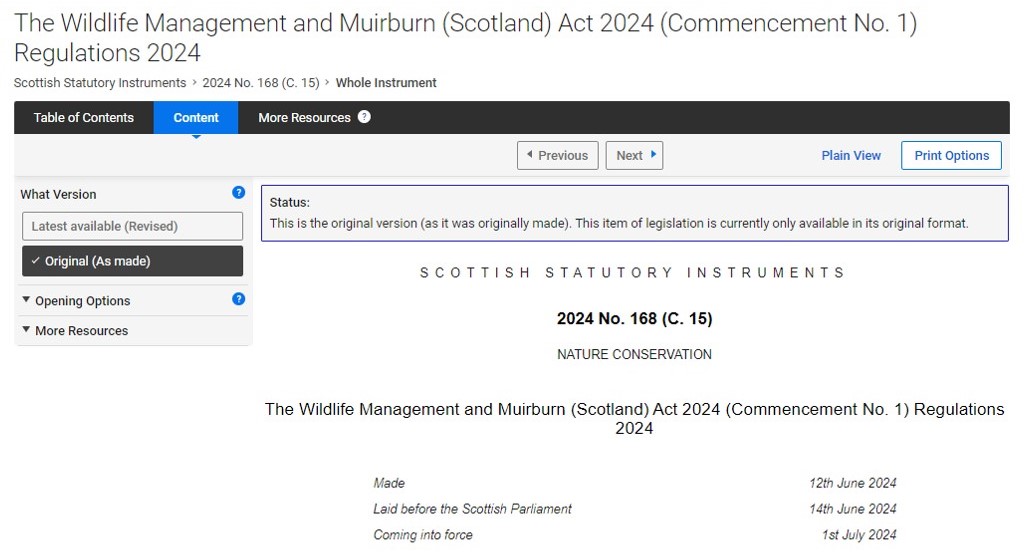
The Act achieved royal assent on 30th April 2024 (see here) and we’ve been waiting for a formal commencement date (i.e. when the Act becomes legally enforceable).
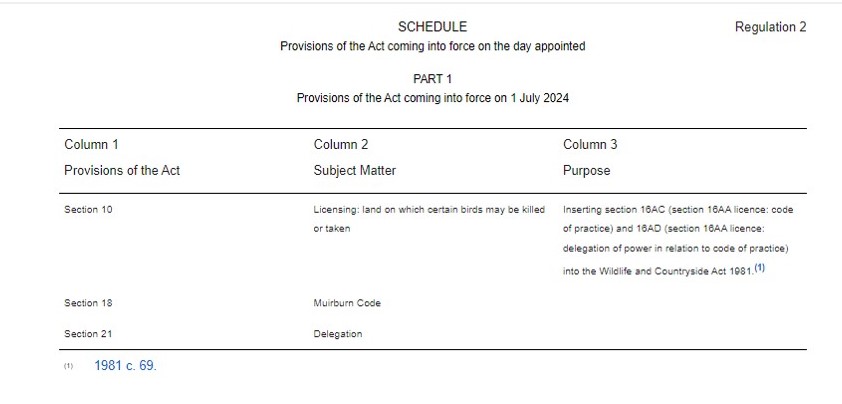
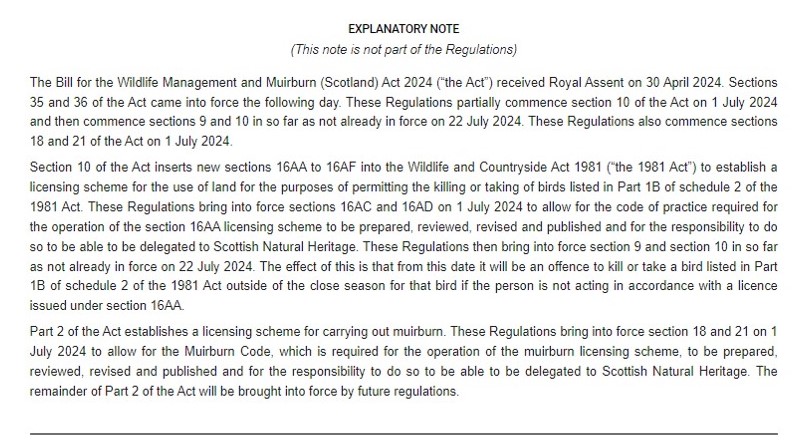
The legislation required for commencement has now been published and confirms the widely anticipated expectation that the grouse shooting licence would be ready for the start of this year’s season (complete with the associated Grouse Moor Code of Practice) and that the Muirburn licence won’t be ready until at least next year.
The commencement legislation in the form of a statutory instrument can be read here (and is reproduced below). It’s a necessarily turgid piece of technical legalese but the most important information is the commencement date, and that all looks on track.
Grouse moor owners will shortly be applying to NatureScot for their 16AA licences, which ties them to comply with the associated and soon-to-be-completed Grouse Moor Code of Practice. It’ll be interesting to see how long it takes for an estate to breach the terms of its licence and how any subsequent enforcement and sanction is handled.
Here’s the statutory instrument announcing the commencement dates:
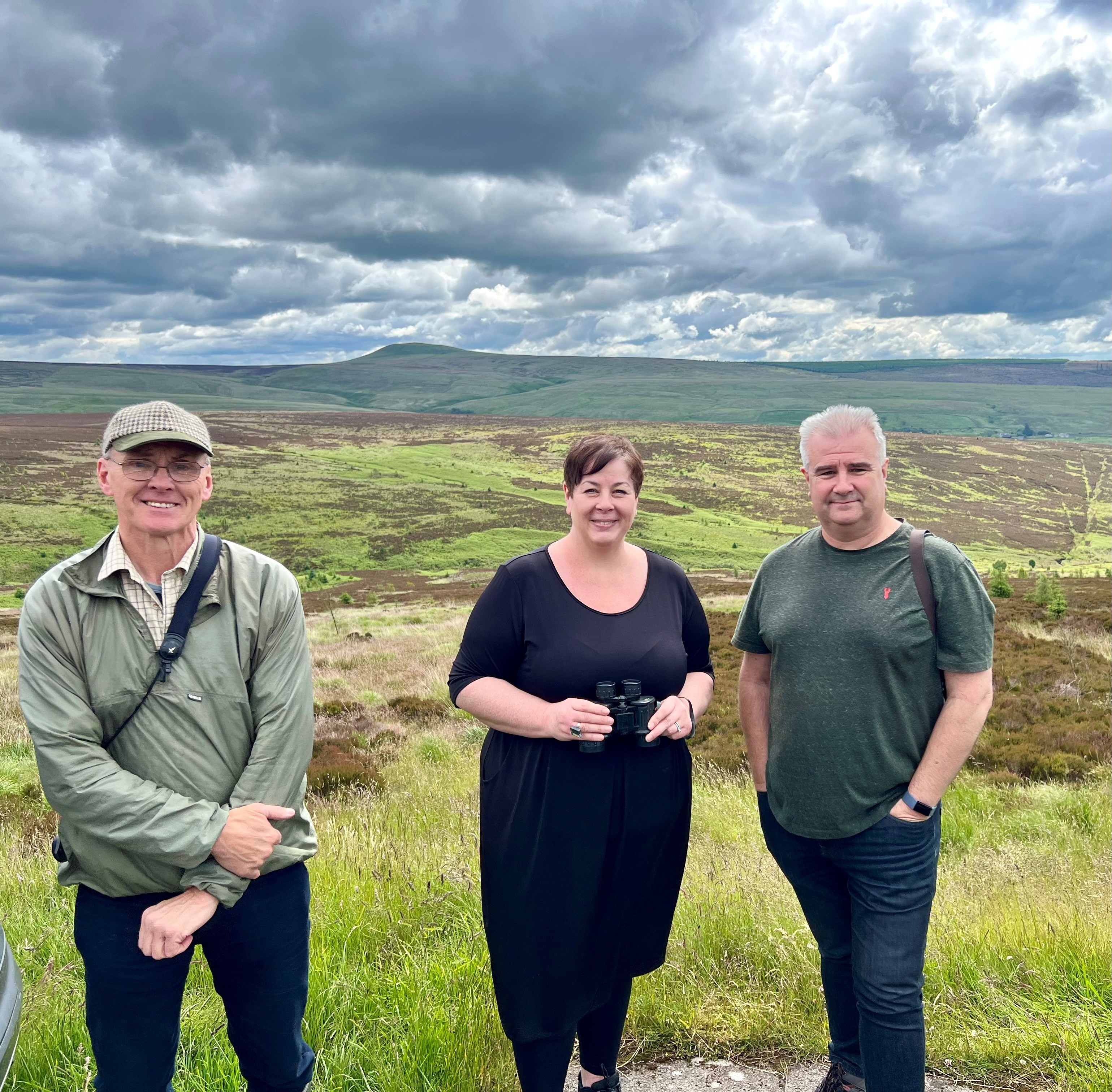
Elena is the Scottish Parliament’s Hen Harrier Species Champion, an initiative set up by Scottish Environment LINK to encourage MSPs to champion threatened and iconic species and habitats.
She was lucky enough to see a food pass between the breeding adults during her visit.
Strangely, the chairman of the Scottish Gamekeepers Association, Alex Hogg, recently told a parliamentary committee that the Tarras Valley Nature Reserve was a “species desert” and “there is nothing there at all” [now that it’s no longer being managed as a driven grouse moor].
I’ll return to Hogg’s parliamentary evidence session in a separate blog because it was quite something and it even prompted the RSPB to write to the committee to correct his false claims.
Press release from Rewilding Britain (19 June 2024):
412% INCREASE IN JOBS AT SCOTLAND REWILDING SITES, RESEARCH SHOWS
First rewilding job creation statistics for Scotland come as Rewilding Nation calls grow
Rewilding has boosted job numbers at sites across Scotland by more than 400% while tackling the nature and climate emergencies, new research by Rewilding Britain shows.
An analysis of 13 major rewilding projects covering almost 60,000 hectares between them has revealed a 412% increase in jobs since rewilding began. The varied sample includes sites owned or managed by charities, communities, private landowners, and public bodies.
The first findings of their kind for Scotland come as calls grow for the Scottish Government to declare Scotland the world’s first Rewilding Nation and commit to nature recovery across 30% of land and sea.
“These remarkable job creation figures show how rewilding can turbocharge social and economic benefits for people, while offering hope for reversing biodiversity loss and tackling climate breakdown,” said Kevin Cumming, Rewilding Britain’s Rewilding Director and Deputy Convenor of the Scottish Rewilding Alliance.
“This is yet another powerful illustration of why the Scottish Government should declare Scotland a Rewilding Nation. The choice and the opportunity for the country is huge – for jobs and local economies, and for better health, food production, re-peopling, and access to fresh water and clean air.”
Full-time equivalent jobs across the rewilding sites have increased five-fold from 24 before rewilding began to 123 now. The variety of jobs has boomed too, and includes nature-based hospitality and tourism, estate management, ecology, environmental monitoring, rewilding interventions, recreation, and education.
Benefits for people’s health and wellbeing, and opportunities for gaining valuable skills and experience, have also surged thanks to combined volunteer numbers at the sites increasing from zero to 435.
Tarras Valley Nature Reserve at Langholm, a former grouse moor now owned by the local community and the focus of a large-scale rewilding project. Photo by Ruth Tingay
The sites began rewilding at different times, and are all over 100 hectares in size. Together they cover a total of 59,496 hectares, of which 43,233 hectares are rewilding. They are all members of the Rewilding Britain-managed Rewilding Network, which brings together and supports projects across Britain.
The largest recorded rise in jobs is at Trees for Life’s 4,000-hectare Dundreggan estate near Loch Ness. Since the rewilding charity’s purchase of the former deer stalking estate in 2008, jobs have soared from one to 36, while volunteer numbers have risen from zero to 100.
At Dundreggan, Trees for Life is restoring the Caledonian forest and its wildlife. Last year, the charity opened the world’s first Rewilding Centre on the estate in the Highlands, to showcase how rewilding can give people inspiring experiences, create jobs and benefit rural communities.
At the community-owned Tarras Valley Nature Reserve in Dumfries and Galloway, jobs have already risen from one to six. The 4,250-hectare nature restoration project on Langholm Moor was created after the town of Langholm raised £6m to buy the former grouse moor between 2020-2022.
The pioneering buyout led to the creation of the vast new reserve to support community regeneration, address climate breakdown, and restore nature. Emerging opportunities include conservation grazing, regenerative farming, restoration of peatlands and native woodlands, and eco-tourism.
Rewilding Britain will continue to add new job creation data from a growing number of rewilding sites as it becomes available.
Despite growing praise for its rewilding progress, Scotland is one of the most nature-depleted countries on Earth. Intensive agriculture and climate breakdown are having the biggest impacts on habitats and wildlife, with other threats including non-native forestry, pollution, and introduced species, research shows.
The Scottish Rewilding Alliance’s Rewilding Nation Charter, calling on the Scottish Government to declare Scotland a rewilding nation, was launched this spring and has already been signed by thousands of people.
Rewilding 30% of Scotland can be achieved by restoring habitats including peatlands, native woodlands, wetlands, rivers and seas, with no loss of productive farmland, says the Alliance.
Press release from REVIVE, the coalition for grouse moor reform in Scotland, ahead of today’s debate on the Agriculture Bill:
AGRICULTURE BILL AMENDMENTS COULD STOP BIG FARMING PAYOUTS FOR GROUSE SHOOTING ESTATES
REVIVE, the coalition for grouse moor reform, has welcomed amendments to the Agriculture and Rural Communities (Scotland) Bill that could end generous public funding for grouse shooting estates.
The Stage 3 bill is due to be debated by the Scottish Parliament this afternoon (Tuesday 18 June).
The amendments (#37, #38 and #39) were submitted by Scottish Greens MSP Arianne Burgess. They seek to address the issue of shooting estates being indirectly supported by farm subsidies, with some estates receiving hundreds of thousands of pounds of public money each year.
The amendments would allow ministers to:
#37: rule out specific land uses from getting agricultural subsidies in the future;
#38: end public funding for estates where the primary activity on the land is driven grouse shooting;
#39: ensure that wildlife criminals and irresponsible owners cannot benefit from public funding.
Driven grouse moor landscape in the Cairngorms National Park. Photo by Ruth Tingay
Eliza Chiswell, REVIVE Campaigner, said:
“REVIVE welcomes Ariane Burgess MSP’s amendments to the Agriculture Bill that would potentially stop grouse shooting estates from receiving public money.
“At its launch in 2018, REVIVE expressed shock that shooting estates could be receiving subsidies and it continues to be very concerned that large sums of public money is indirectly supporting, amongst other things, the killing of hundreds of thousands of foxes, stoats, weasels and crows so that more hundreds of thousands of grouse can be shot for entertainment.
“It is deeply worrying, for example, that an estate like Invermark, which is “principally a sporting estate” [see here] in 2023 received public money to the tune of £213,545 [see here].
“REVIVE has asked its supporters to tell all MSPs that these amendments have strong public support because they ensure that valuable public money supports food production rather than shooting. We hope the amendments receive strong cross-party support and prove to be successful.”
ENDS
The Scottish Greens have also issued a press statement ahead of today’s debate:
The Scottish Government must curb public subsidies for shooting estates and instead use it to support small farmers and the transition to greener agriculture, say the Scottish Greens.
The call comes ahead of the Scottish Parliament voting on the Agriculture and Rural Communities (Scotland) Bill, which will have its final vote this week.
The Scottish Greens rural affairs spokesperson, Ariane Burgess MSP, will be moving amendments that would end subsidies for land that is dominated by grouse moors and boost support for small farmers.
Shooting estates are being indirectly supported by farm subsidies, with one example cited by the REVIVE coalition as having received over £200,000 a year. This allows them to continue the damaging practices of widespread burning of peatland vegetation and the unnecessary killing of our wildlife.
Ms Burgess, said: “It’s grossly unfair that enormous shooting estates are benefiting from subsidies paid for by the taxpayer.
“This is public money that should be invested in supporting farmers and rural communities to transition to net-zero, but instead it’s being pocketed by giant landowners and is effectively subsidising the management of Scotland’s uplands for bloodsports.
“My amendments would prohibit subsidies for driven grouse moors, and ensure that Scottish Ministers cannot hand out public money to wildlife criminals. I hope that all MSPs who are concerned about animal welfare will support these amendments.
“The last 14 years have been painful for a lot of people. The last thing we should be doing in a cost of living crisis is handing out subsidies to wealthy landowners for organised cruelty.”
Ms Burgess will also be moving amendments that would support farmers to reduce the environmental impacts of the agriculture industry and assist small to medium scale farmers, crofters and growers to purchase land for food production.
Ms Burgess added: “Small scale farmers play an invaluable role in our food production and in their communities, but, with the current pressures, many are finding it harder to run a sustainable business.
“Many of them are young and new entrants, and I hope that this bill will provide them with extra support to allow them to purchase and enhance the land around them.”
ENDS
The Stage 3 debate on the Agriculture Bill is expected to start around 3pm in the main chamber and can be watched live on Scottish Parliament TV here.










 Raptor Persecution UK