‘Persecution of sporting estates is bad for birdlife’ says NGO Chairman

A fascinating article has appeared on the Shooting Times website today, written by regular columnist Lindsay Waddell, who also just happens to be the Chairman of the National Gamekeepers’ Organisation.

His opening words are these:

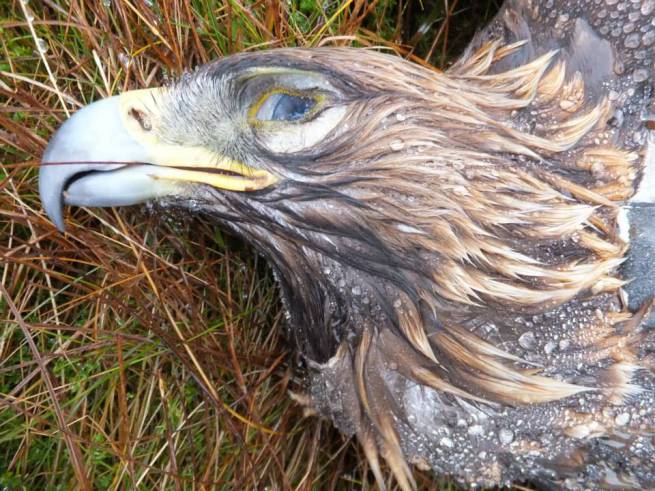
Protection of predators and persecution of sporting estates are bad for birdlife“.

His rationale for this statement appears to be that there are no takers for the lease of what he calls a ‘prestigious moor’ (hmm, wonder what makes it a ‘prestigious’ moor?) and that soon it may be lost to conifer plantation and wind turbines, and all of this is due to the ‘relentless persecution of estate owners and those employed as gamekeepers‘.

What he doesn’t say is how he defines ‘the relentless persecution’ of estate owners and gamekeepers. Is he defining media reports as ‘persecution’? Perhaps he thinks that any publicity about the discovery of a poisoned golden eagle on a sporting estate with a long history of similar incidents is ‘persecution’ of the estate owner? Or maybe he thinks that the publication of video footage showing a gamekeeper bludgeoning buzzards to death with a fence post is ‘persecution’ of the gamekeeper? Or perhaps any commentary about yet another gamekeeper being charged with yet another alleged wildlife crime is ‘persecution’ of the gamekeeping industry?

Ironically, he goes on to suggest that had this level of ‘persecution’ been directed at any other group of workers, they would have had some form of legal redress available! Funny that – we have long argued that had any other group of workers been caught carrying out the type of sustained & widespread criminality that is regularly taking place on some sporting estates, the criminals would have been locked up a long time ago and the ‘business’ forced to close.

What Lindsay fails to grasp, even though it’s really not that hard, is that if the illegal killing of raptors, by many gamekeepers on many sporting estates, would stop, then the game-shooting industry may be viewed a lot more favourably than it is now. Unfortunately, the illegal killing continues, and organisations like the National Gamekeepers’ Organisation don’t help matters when they refuse to expel members who have been convicted of wildlife crimes (e.g. see here).

There’s some other guff at the end of his article about how predators are apparently eating all the prey and the conservation agencies should stop protecting predators blah blah blah….

In the meantime, watch this space for some more reports about dead raptors that have been discovered on sporting estates up and down the country having been poisoned/shot/trapped/bludgeoned…reports that the game-shooting industry would rather you didn’t know about.

Shooting Times article here

Another Scottish gamekeeper accused of alleged wildlife crimes

The trial of a Scottish gamekeeper accused of a series of alleged wildlife and animal welfare crimes has been adjourned until later this month.

49-year old gamekeeper James Marsh, of Middle Ballewan near Blanefield, Stirling is facing trial for offences alleged to have taken place near Duntreath Castle in April 2012.

We understand the charges include the trapping of a Tawny Owl in a Larsen trap and related welfare offences, and various other charges relating to the possession of a Jay and associated welfare offences.

Marsh denies the charges.

His trial at Stirling Sheriff Court was adjourned in mid-November and will next be heard on 19th December.

RSPB Scotland publishes 2012 persecution report

sam4RSPB Scotland has today published its annual persecution report which documents the known and suspected incidents of  illegal raptor killing throughout Scotland in 2012.

It’s a shame it’s taken so long to get it published, but that minor criticism aside, massive kudos and appreciation to them for their continued meticulous collection of these data and especially their willingness to publish them. Without these reports the general public, and probably the government, would be unaware of exactly what’s going on in our countryside. If we relied upon the ‘official’ figures (i.e. those ‘approved’ by the likes of Scottish Land & Estates, the Scottish Gamekeepers’ Association, Police Scotland etc) we wouldn’t know the half of it.

The 2012 report, just like all the previous 18 reports, makes for grim reading. Sure, it documents a reduction in the number of birds known to have been illegally poisoned last year; some people (guess who?) have spent much of 2013 shouting about this as being evidence of the game-shooting industry cleaning up its act – we know better – the 2013 figures (to date) show no such reduction and in fact show an increase in known poisoning incidents…but more of that next year. Let’s focus on the 2012 report for now.

Three things caught our attention in this report. The first thing was the Foreword by Stuart Housden, RSPB Scotland Director. This is the hardest-hitting Foreword of his that we’ve read. In the past it’s been a bit wishy-washy, with too many platitudes aimed at the landowning and gamekeeping communities and suggestions that the raptor killers are just an unrepresentative minority. This time it’s quite different:

It is evident that a significant number of individuals or estates illegally persecute birds of prey“.

Is this subtle change of language an indication that RSPB Scotland is tiring of the whole ‘partnership-working’ pretensions? Let’s hope so.

The second thing to catch our attention was an entry in Table 3 (page 24): Confirmed incidents of illegal killing or attempted killing (excluding poisoning) of birds of prey in Scotland, 2012

The entry of interest is this:

‘February. Buzzard caught in illegal spring trap. Nr Edzell, Angus’.

There isn’t any further detail about this incident, and it certainly hasn’t been publicised by the Police (no surprise there). However, for reasons that we can’t go in to right now, we are particularly interested in the details of this incident and would ask any blog reader with specific information to contact us, in confidence: raptor.persecution.scotland@hotmail.co.uk

The third thing that caught our attention was the Case Study: Poisoning in Progress (pages 19-20). This case relates to the discovery of poisoned corvids and poisoned bait found in the Borders in May 2012.

We’d blogged about this case in Sept 2012, criticising the Police for not publicising the discovery of poisoned birds and poisoned bait (see here). We also blogged about it in October this year, after the incident was excluded from the ‘raptor persecution’ section in the  Government’s ‘official’ 2012 Wildlife Crime Report (see here). We asked blog readers to contact the Environment Minister and ask why this incident had been excluded. Here is part of the reply received by one of our readers:

You ask why a bird poisoning incident was omitted from the Scottish Government’s first annual report into wildlife crime. I can advise you that the incident in question was not listed in the section on raptor crime because no raptors were involved“.

Now, have a read of the Case Study in the RSPB’s report. Guess what was found at the scene? “The feathers and bones of two dead buzzards, lying beside the old, dried-out carcases of two rabbits, in a wood beside a partridge rearing pen. A dead crow was also found a short distance away“.

That’s a pretty clear indication that raptors were indeed involved.

According to the Case Study report, the rabbits were covered in dead insects (a sure indication of the presence of poison) and they were submitted for toxicology analysis, along with the crow. The buzzards were not submitted as they were considered too decomposed.

The results – all contained the pesticide Bendiocarb.

There was no police follow-up, no search, no nothing. Why not, when there was clear evidence of long-term poisoning at the site? And even better, the site is a very well-known raptor persecution blackspot in the Borders, where many other poisoned raptors have previously been discovered.

It’s just the same old familiar pattern, same shit, same locations, different year. The sooner the Government launches its public consultation on increasing the powers of the SSPCA to allow them to investigate raptor persecution, the better. (Where is that consultation anyway? We heard it would be launched in mid-Oct. No sign yet…)

Anyway, well done and thanks again to RSPB Scotland – funny, lots of poisoning, trapping and shooting incidents but not a single ‘death by tree’ report!!

Download the report: The Illegal Killing of Birds of Prey in Scotland 2012

SGA suggests that trees are ‘biggest threat’ to golden eagles

Ah, bless. According to Alex Hogg, Chairman of the Scottish Gamekeepers’ Association, the ‘biggest threat’ to golden eagles in Scotland is trees.

In a remarkably ignorant article in the Herald, our friend Hogg suggests that the government’s plans to create more woodlands will mean that within the next few decades, ‘golden eagles will have nowhere to expand its range’.

The journalist (and that’s being kind) refers to the SGA as a ‘conservation body’ and cites the 2008 Golden Eagle Conservation Framework to support the notion that tree-planting is a potential constraint on golden eagle breeding success.

Had the journalist, and Mr Hogg for that matter, bothered to read the Conservation Framework report in detail, he might have noticed the following statements:

Currently, commercial afforestation is not considered a marked constraint on golden eagles

and

A number of lines of evidence indicated that illegal persecution of eagles, principally associated with grouse moor management in the central and eastern Highlands, is the most severe constraint on Scottish golden eagles“.

Strangely, the phrase ‘illegal persecution of eagles’ doesn’t feature anywhere in the Herald piece.

The journalist and Mr Hogg also failed to acknowledge the recently-announced strategy published by Forestry Commission Scotland which provides guidance and advice on designing and managing new woodlands to benefit golden eagles (see here).

Another Hogg quote, about the government’s planned tree-planting scheme: “Scotland will not look like the country it is now. It will look more like Norway“. Funnily enough, golden eagles in Norway appear to be thriving – see here.

If we were cynics, we might think that this article was yet another attempt to deflect attention from the on-going illegal killing of golden eagles on Scottish grouse moors…

Herald article here

2008 Golden Eagle Conservation Framework here

No evidence of animal rights activists ‘setting up’ estates

RACCEOn Wednesday, Environment Minister Paul Wheelhouse gave evidence to the Rural Affairs, Climate Change and Environment Committee (RACCE) at Holyrood about the government’s 2012 Wildlife Crime Report. We said we’d be watching the proceedings with interest, given Scottish Land & Estate’s claim that raptor persecution receives too much media attention (see here).

We did watch the live session and on the whole we thought that Wheelhouse did quite well, although we did think that some of the questions put to him by some of the RACCE Committee Members revealed a certain level of influence from those with a vested interest in game-estate management.

Quite a few questions related to the ‘setting up’ of estates and ‘interference’ of legal traps by supposed animal rights activists – in fact one of the panel tried to push him into admitting that it was a ‘legitimate concern’ (for estate owners/gamekeepers). Wheelhouse, though, was pretty firm in his response. He argued that it was legitimate to discuss how big a problem trap-tampering is because currently there isn’t any evidence to support the assertion that it is even a problem, although he did acknowledge that of course, trap-tampering was possible.

Trap interference/damage was one of the issues raised by SLE in their evidence to the RACCE Committee (see here) – they claimed it was ‘another group of increasing wildlife crimes’ that should be included in the Government’s annual Wildlife Crime Report. Trap interference and/or damage is a pretty interesting definition of what constitutes a wildlife crime, don’t you think?

And apparently, trap interference is not necessarily a criminal offence anyway, let alone a ‘wildlife crime’! Here’s what lawyer David McKie wrote on the subject in the last edition of the SGA’s member newsletter (McKie often acts as a defence agent for gamekeepers accused of wildlife crime) –

As a matter of law, there is a significant difference between interference and vandalism.

Vandalism would involve the breaking of a crow cage trap by someone punching or kicking a hole in it, for example, or the deliberate smashing up of a Fenn trap. It would also include the cutting of snares.

Interference does not necessarily involve a criminal offence….That can involve the removal of traps from their set location, the release of decoy birds or the pulling of snares.

The police can probably not charge the individual with interference“.

Fascinating! And before anyone tries to accuse us of encouraging trap interference and/or damage, this information is published here purely for the purpose of intellectual discussion.

It emerged during the RACCE session that BASC is currently conducting some research to evaluate the scale of trap interference/damage so we’ll look forward to seeing those results – we’ll also be looking closely at the methods they used to make their evaluation – especially if the research is based solely on the word of gamekeepers.

Anyway, for those of you who missed seeing Paul Wheelhouse at the RACCE Committee on Wednesday you could always watch the Holyrood TV video archive (here – only available for 28 days). There is also an official text report of the meeting available to download: RACCE wildlife crime 27_11_2013

See if you can spot the bit when Angus MSP Graeme Dey claims that wildlife crime policing in Tayside is the ‘gold standard’!!!

Case against gamekeeper George Mutch: part 4

Criminal proceedings against Scottish gamekeeper George Mutch continued today at Aberdeen Sheriff Court. His case was continued without plea for the 4th time.

His 5th court hearing will be on 16th December.

Mutch, of Kildrummy Estate in Aberdeenshire is understood to be facing six charges of alleged wildlife crime under Sections 1 & 5 of the Wildlife & Countryside Act. These sections relate to the protection of wild birds and prohibited methods of killing and taking wild birds.

For previous posts about this case see here, here and here.

Landowners unhappy with raptor persecution publicity

Tomorrow (Weds 27th Nov), Environment Minister Paul Wheelhouse will give evidence on the government’s Wildlife Crime Report (2012) to the Rural Affairs, Climate Change and Environment  (RACCE) Committee at Holyrood.

The session will begin at 10am in Committee Room 3 and can be watched live on Holyrood TV (see here).

An interesting piece of written evidence has been submitted for the RACCE Committee to consider (see here, scroll down to page 11). It comes from Scottish Land and Estates and they are basically saying that raptor persecution receives too much media attention whereas poaching should be the focus of enforcement and publicity. They justify this by saying that poaching is the most commonly recorded wildlife crime (as shown in the government’s 2012 Wildlife Crime Report).

What they don’t say is that raptor persecution is clearly happening on a scale far greater than the police-recorded figures – so much so that its effect is having population-level impacts on species such as golden eagles, hen harriers, red kites and goshawks. Population-level impacts are not caused by ‘a few incidents’ – they are caused by widespread, systematic incidents. They also forget to mention the cack-handed way Police Scotland continue to deal with reported raptor persecution incidents, leading to poor recording and what we would call less than reliable figures.

It’s not the first time that SLE has tried to stifle media attention on raptor persecution incidents. Earlier this summer, CEO Doug McAdam wrote to the Environment Minister to complain about news coverage of certain crimes against raptors. So too did an ‘Industry Co-ordination Group’ – believed to include the following organisations: BASC, Scottish Gamekeepers’ Association, Scottish Countryside Alliance, Scottish Association of Country Sports and Scottish Land and Estates. A Freedom of Information request revealed the Minister’s responses, and all credit to him as he told them to piss off and focus on the real issue, that is, trying to stop the continuing illegal persecution of raptors in Scotland (although obviously he didn’t phrase it like that).

Here are copies of his letters: FOI Scot Gov 2013 media coverage raptor persecution

It’s no surprise that SLE want to put a stop to damaging media reports about raptor persecution incidents, especially if such incidents take place on estates owned by SLE members. It’s also no great surprise that they should be so interested in poaching; some of us think that poaching isn’t actually a wildlife crime at all – it’s more about ‘theft’ from super-rich landowners that just happens to involve wildlife. It doesn’t make any difference to the deer or the fish whether their death is caused by someone operating with or without the landowner’s permission, but it matters a great deal to the landowner, either because they’re losing money (from people who will pay to kill deer and fish)  or because they just don’t like the idea of someone else taking what the landowners perceive to be their property.

But is there another reason why landowners want to reduce the amount of media coverage that raptor persecution incidents receive? Look closely at the penultimate paragraph in the Minister’s letter to the Industry Co-ordination Group –

You mention the decision by Natural England to issue licences to control buzzards and your view that there should be open debate on how or whether, we manage common raptors. As far as Scotland is concerned I have been careful to remind anyone who asks about our position, that the provision allowing control of avian predators remains on the statute book and that SNH as the licensing authority will give careful consideration to any application. As far as debate is concerned, I am happy to discuss issues that are raised with me, but as you will be aware, the continuing levels of illegal persecution will inevitably and understandably produce an emotional response to this question from many members of the public“.

Surely the game-shooting industry’s intention isn’t to keep raptor persecution incidents out of the media to fool the general public into thinking that illegal persecution has stopped, in order to smooth the way for buzzard-killing licences to be issued?

We’ll be watching the Minister’s speech with great interest tomorrow.

Animal rights activists killing thousands of hen harriers

The long-awaited publication showing the results of the UK 2010 Hen Harrier Survey is finally here. Published in the scientific journal Bird Study, the paper (see here) documents significant declines across many parts of the UK.

No surprises there then.

England had a heady 12 pairs in 2010 (a country with sufficient habitat to support an estimated 323-340 pairs, according to the Hen Harrier Conservation Framework).

Scotland had 505 pairs in 2010 (a country with sufficient habitat to support an estimated 1467-1790 pairs).

Wales bucked the trend with at least a 33% increase to 57 pairs (none of which were found on habitat classified as grouse moor).

It should be remembered that these results are from 2010; there have been further documented declines since then, including just two (failed) breeding attempts in England this year and a consistent downward trend of breeding success in Scotland, according to the latest report from the Scottish Raptor Monitoring Scheme (see here).

The paper also documents a severe decline on the Isle of Man (49%) and bizarrely suggests that ‘there are no obvious drivers for this’. Eh? Could it possibly be anything to do with the systematic elimination of harriers on the mainland, reducing the number of birds available to travel to the Isle of Man? Just a thought.

So, where are the missing 962-1285 breeding pairs of hen harriers in Scotland?

And where are the missing 322-339 breeding pairs of hen harriers in England?

Widespread declines are indisputable. The relationship in England and Scotland between areas of reported declines and land managed for intensive driven grouse shooting is also indisputable. But what happened to all those birds? Those with a vested interest in the grouse-shooting industry will tell you it’s all down to climate change/habitat change/lack of prey/cold spring/wet spring/late spring/early spring/being eaten by golden eagles/too many foxes/too many buzzards/too many ravens/too many sparrowhawks/the work of animal activist extremists hell-bent on killing hen harriers to make the gamekeepers look bad…in fact they’ll blame anything except the blindingly fucking obvious.

Hen Harrier photo by Gordon Langsbury

MSP wants answers about mountain hare culling

MH1Last week we blogged about the claims made by a leading upland ecologist that mountain hares were suffering “massive declines” in parts of Aberdeenshire due to uncontrolled culling on grouse moors (see here).

We followed it up with some grim photographs showing piles of dead mountain hares that had been left to rot on an Angus grouse moor (see here). We also encouraged readers to contact SNH to ask them about what we saw as their long-term failure to implement an effective monitoring scheme to protect this species. Many of you did contact SNH (thank you) and here is their generic reply:

Good afternoon

Thank you for your email which was sent to one of our members of staff. We have received a quite a few similar responses. We can’t answer them all individually but we would like to clarify a few points to explain what we have been doing and propose to do.

Firstly, a close season on hare control was introduced in 2011 to protect the species during the main part of the breeding season (March – July inclusive). Without conclusive evidence that hare populations are declining generally across Scotland as a result of over-exploitation, full all year round protection could not be justified at the time.

Because hare populations are naturally cyclical, monitoring overall trends over time is complex and problematic. SNH has been working closely with the leading UK experts on this species since 2005, to increase our understanding of their current status and to develop a reliable and cost-effective method of assessing their numbers.

We would like to reiterate the following points:

SNH does not support indiscriminate, large scale culls of mountain hares and, while moorland managers are advised to consult SNH if they propose such measures, the only cases that we are currently able to regulate directly, are in relation to licensable activities where the number of hares allowed to be taken is restricted.

We have heard of allegations that some estates systematically remove mountain hares as a prey base for golden eagles, but it is very difficult to prove this to be case, given the range of other legitimate reasons for controlling hare numbers (but not eradicating them.) SNH condemns any systematic attempt to reduce hare numbers for this reason and we would emphasise that, not only is it extremely bad practice, it demonstrates no understanding of the ecology of predators such as eagles, namely that if mountain hares become scarce or absent, the predator will switch increasingly to other more available prey such as red grouse.

We are currently working with both the James Hutton Institute and the Game & Wildlife Conservation Trust to develop a further programme of research, building on previous work, to address the fundamental question of how best to count hares, with the intention of commencing further fieldwork later in 2014.

These are complex issues which we will continue to tackle. We hope this information has been helpful.

Customer Relations Team, Scottish Natural Heritage

AlisonJohnstoneMSPSince then, Alison Johnstone MSP (Lothian, Scottish Green Party) has lodged the following parliamentary questions:

Question S4W-18470: To ask the Scottish Government what information it holds (a) on the health of mountain hare populations and (b) that is relevant to assessing whether mountain hare are in a favourable conservation status.

Question S4W-18471: To ask the Scottish Government what conservation action is planned to protect mountain hare populations.

Question S4W-18472: To ask the Scottish Government what information it holds on the number of mountain hare that are culled annually and the impact of this on golden eagles (a) dispersing from, (b) likely to be recruited to or (c) nesting in Natura sites for which golden eagles are a designated interest.

Question S4W-18473: To ask the Scottish Government what information it holds on a link between the culling of mountain hare and the incidence of (a) louping ill or (b) other diseases transmitted by sheep ticks or other hare parasites to red grouse.

Question S4W-18474: To ask the Scottish Government how it controls the culling of mountain hare.

Question S4W-18475: To ask the Scottish Government how many applications it has (a) received and (b) granted for the culling of mountain hare since 2011, broken down by (i) year, (ii) purpose and (iii) area.

Expected answer date is 4th December 2013.

This is the second time this year that parliamentary questions have been asked about mountain hares, although last time the focus was more on the use of snares to trap/kill the hares (see here).

There’ll be a great deal of interest in the answers to this latest batch.

Petition to name golden eagle as Scotland’s national bird

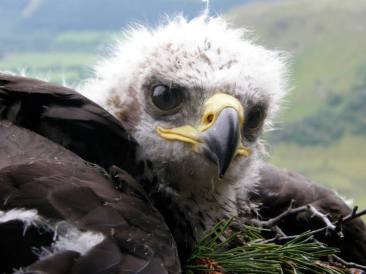
RSPB Scotland has launched an on-line petition to have the golden eagle named as Scotland’s national bird.

Capitalising on the golden eagle being recently voted as the nation’s favourite animal (in SNH’s ‘Big Five’ Campaign), the RSPB is hoping that Scottish Ministers will formally designate the species as a national symbol and thus show their commitment to protecting this bird from the appalling persecution it continues to suffer.

An RSPB spokeswoman said:

The petition urges ministers to formally designate the species as a national symbol, placing it alongside the lion rampant, Saltire and Scottish thistle as emblems of the country. There are currently just 431 pairs of golden eagles in the whole of Scotland. Owing to centuries of persecution, this most charismatic of birds has been almost entirely confined to the more remote areas of the country, such as the mountains and glens of the west coast and on the western isles, with numbers held at artificially low levels and many territories vacant. Its restricted range and tendency to favour the more remote and dramatic areas has made it become a coveted sight for any visitor who appreciates Scotland’s magnificent wildlife spectacles. But now RSPB Scotland is pressing for the adoption of the golden eagle as Scotland’s national bird, helping to raise its profile, turn around its fortunes and see it return once again to its former range thus increasing the chances of a sighting for visitors and local people.”

Stuart Housden, Head of RSPB Scotland said:

It is a stirring symbol of strength and pride, qualities well befitting to a modern Scotland and its people. 2013 is the Year of Natural Scotland – a period where the Scottish Government is celebrating our most impressive natural heritage. What better legacy can we provide for this initiative than to officially designate the eagle as Scotland’s national bird and join together for its future conservation? It would formally recognise the place this species has unofficially occupied in our culture for many centuries, and show our commitment and desire to protect and conserve it, and our wider national heritage, for generations to come.”

Please consider signing the petition – if nothing else, it will put further pressure on those who continue to shoot, poison and trap this species. Signing is easy – it takes seconds – the closing date is 6th December 2013. Please sign here.