 In March this year, the Scottish Government launched a public consultation on the possibility of giving the SSPCA increased powers to investigate more types of wildlife crime (see here).
This is an important proposal that, if accepted by the government, could have a particular impact on the number of criminals successfully prosecuted for illegally destroying our wildlife, especially those carrying out raptor persecution crimes.
The SSPCA already has statutory powers to investigate some wildlife crimes, but not all. Currently, they are restricted to investigating wildlife crime offences that involve an animal in distress. They have legal powers under the Animal Health & Welfare (Scotland) Act 2006 to gather evidence and report their findings directly to the Crown Office without needing to involve the police. They are well trained, highly experienced and have a strong track record of helping to bring offenders to justice.
So why are these proposed additional powers needed? That’s simple – if the additional legal powers are implemented it would mean that the SSPCA could also investigate wildlife crimes where an animal has already been illegally killed, or instances where an animal has not yet been illegally killed but is likely to be.
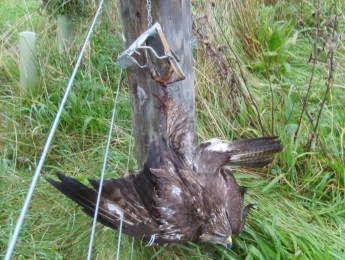
For example, today, if a member of the public found a buzzard hanging in an illegal pole trap (see photo) and called the SSPCA to report it, the SSPCA could ONLY investigate that crime if the buzzard was still alive (suffering/in distress). If the buzzard had already died from its injuries, the SSPCA would not have the authority to investigate the crime and would have to call the police. How stupid is that? The investigation process and procedures would be identical whether the buzzard was alive or dead, but because the buzzard is dead, in law it can’t be categorised as ‘suffering’ because in legal terms a dead animal cannot suffer, and therefore the SSPCA does not have the regulatory powers to investigate. Similarly, if they found another illegal pole trap set nearby (that hadn’t actually caught anything yet), the SSPCA could not investigate that offence – they couldn’t even dismantle the trap – they would have to wait for the police to attend.
Now, if they were given the proposed additional legal powers (under the Wildlife & Countryside Act), the SSPCA would be authorised to investigate any one of the above scenarios.
It’s a no brainer, isn’t it? We all know too well that the police often struggle to investigate wildlife crime, either due to a lack of resources, unavailability of a specialist police wildlife crime officer, or just because senior officers don’t see wildlife crime as a priority. Sometimes the police respond very quickly but more often than not, they can’t attend at short notice which means that crucial evidence is either removed by the perpetrator or it deteriorates to such an extent that it’s no longer useful. Sometimes they don’t even bother to attend at all. The government itself has previously acknowledged that wildlife crime enforcement by the police can be hit or miss. So why would anyone, with an interest in seeing improved wildlife crime enforcement, object to the addition of 63 fully-trained SSPCA inspectors (at no cost to the tax payer – the SSPCA is funded by SSPCA members – it doesn’t receive any government funding for its work), joining the ranks of those authorised to investigate these disgraceful crimes?
Well, surprise surprise, the Scottish Gamekeepers Association objects. The following message was sent out to SGA members earlier this month (via email – interestingly this information has not been posted on the SGA website) –
Dear Member, help us to help you.
In March, Scottish Government issued a consultation on whether more investigative powers should be handed to SSPCA inspectors in suspected wildlife crime incidents.
The SGA believes the granting of more powers to SSPCA would be disastrous and flies in the face of what would be deemed fair and just. Unlike Police, SSPCA are not publicly accountable, have previously sought convictions of gamekeepers with insufficient evidence and campaign to ban snares. They are also critical of rearing game birds for shooting and carry agendas regarding species protection.
Help us to tell Scottish Government loudly and clearly that this move is WRONG.
ALL responses must be made by September 1st, 2014. There is no room for apathy. Please submit your response by clicking this link
Responses can be emailed or sent hard copy. Details of where and how to send are in File attachments. The first File explains the consultation, the second is the one to complete. On question 3 of Respondent Information Form, please respond as an Individual – the SGA will make a separate submission as an organisation.
How we would want people to answer:
Question 1: NO
[Question 1 is: Do you agree that the law in Scotland should be changed to give the SSPCA the powers as set out in section 4.1?]
Question 2: (in your own words but key points are: 1/ how can a charity with a campaigning role against the use of snares be charged with impartially investigating cases involving snares? 2/ The police are accountable to public – charities are not.) Also, If you know of cases poorly handled by SSPCA, please include.
[Question 2 is: Please set out your reasons for your answer to Q1]
Question 3: N/A.
[Question 3 is: If you would prefer to see changes to the SSPCA’s powers to investigate wildlife crime other than those set out in section 4.1, please describe them]
END
So let’s look at the SGA’s position in a bit more detail. They say that giving increased powers to the SSPCA to investigate a wider suite of wildlife crimes would be “disastrous“. Disastrous for whom? Disastrous for those carrying out these crimes? Yes, without a doubt! But why would the SGA object? They claim to have a strong interest in fighting wildlife crime, reminding us repeatedly that they are an active member of the Partnership for Action Against Wildlife Crime. So how would bringing in more trained, experienced personnel to investigate wildlife crime be “disastrous”? Surely they’d be pleased to see more criminal gamekeepers brought to justice? Wouldn’t they?
They also say that giving increased powers to the SSPCA to investigate a wider suite of wildlife crimes “flies in the face of what would be deemed fair and just“. Eh? Fair and just for whom? Is it fair and just that criminal gamekeepers keep getting away with their appalling offences? Is it fair and just to society that The Untouchables can continue to illegally destroy our natural heritage without being brought before the courts?
They also say that, “unlike Police, SSPCA are not publicly accountable“. In our experience, the Police are nowhere near ‘publicly accountable’ – repeatedly refusing to account for their inaction or blunders on numerous wildlife crime investigations, hiding behind the old mantra ‘it’s a live investigation so it would be inappropriate to comment’. Besides, the SSPCA presumably has to act within the code of conduct dictated by the Charities Commission or a similar Scottish authority and so they are, essentially, publicly accountable.
They also say the SSPCA “have previously sought convictions of gamekeepers with insufficient evidence and campaign to ban snares“. The first part of this statement reveals a fundamental failure to understand how prosecutions are undertaken in Scotland. As a statutory reporting agency, the SSPCA is authorised to submit a report of an alleged offence to the Crown Office, but it is the Fiscal’s decision alone to determine whether sufficient evidence exists to proceed with a prosecution. The SSPCA (and the police for that matter) do not have the authority to make that decision. So, if, as the SGA claims, previous prosecutions have been attempted with insufficient evidence to support the charge, that’s down to poor decision making by COPFS and nobody else.
The second part of the statement (about the SSPCA campaigning to ban snares) is accurate, but so what? Has this campaigning affected their ability to investigate wildlife crimes that involve snared badgers that have been found in distress? No, of course it hasn’t, so why should it affect their ability to investigate a wildlife crime where a badger has been found already dead in a snare? As discussed above, at the end of the day it’s the Fiscal’s job to decide whether the prosecution should proceed, and that decision will be based on (a) whether a prosecution would be in the public interest, and (b) whether the reporting agency (e.g. SSPCA) has provided sufficient evidence to support the charges. Whether or not the reporting agency also campaigns for a ban on snares is totally irrelevant to the due process of the criminal justice system.
To conclude then, the public consultation for providing increased investigative powers to the SSPCA is due to close on Monday 1st September. That’s a little under two weeks. We strongly support the proposal and have campaigned for three years to get the government to put it on the table. Last year, we calculated that the conviction rate for raptor crime in Scotland was a pathetic 7.3% (see here). Wouldn’t it be good, indeed shouldn’t we expect, that better enforcement measures are introduced to tackle the vast majority of the remaining 92.7% of confirmed raptor crimes? A simple way to address this issue would be to put more trained personnel on the ground, at no cost to the tax payer. You’d have to be pretty stupid, and/or have a vested interest in raptor persecution, not to support this proposal, wouldn’t you?
If you do support the proposal because you’re sick to the back teeth of The Untouchables getting away with the systematic destruction of protected raptors (and other species – including badgers), then here’s your chance to influence government policy:
1. You can participate in the public consultation by downloading the response form from the government’s website (see here), filling it in and emailing it back to them. You can also read the full consultation document through this link.
2. You can also sign this petition, launched earlier this year by a member of the public, calling on the Scottish government to increase the investigatory powers of the SSPCA. This petition is due to close imminently as it’ll be handed in to the Environment Minister this Thursday (21st Aug) so if you’re going to sign it you need to do it quickly.
Thanks.

 We’re heading to London to listen to a debate on ‘Hunting and its impact on Conservation’ being held at the Royal Society tomorrow evening.
 The Scottish animal welfare charity OneKind has published its formal response to the public consultation on whether the SSPCA should be given increased powers for investigating more types of wildlife crime.
 The Law Society of Scotland has published its formal response to the consultation on whether the
  A petition calling for increased investigatory powers for the SSPCA was handed over to Environment Minister Paul Wheelhouse last week, with over 6,000 signatures.
 We visited the
  Raptor Persecution UK