Wildlife crime penalties: have your say

There has long been dissatisfaction with the penalties handed out to those convicted of wildlife crime. Yesterday’s sentencing of convicted mass raptor poisoner Allen Lambert of Stody Estate merely served to highlight the issue, again. But what we perceive to be unacceptably lenient penalties is certainly nothing new, and especially those sentences given to people (usually gamekeepers) associated with the game-shooting industry.

There’s a huge lack of public confidence in the way the judiciary deals with these criminals, with many people often talking about corruption, vested interests, biased judges/sheriffs etc. We’ve all come to expect unduly lenient measures – you only have to look at the comments on social media even before Lambert’s sentence was announced – people were predicting a metaphorical ‘slap on the wrist’, and in essence, that’s indeed what he got, even though the judge had stated that Lambert’s crimes “had crossed the custody threshold“.

Quite often (although apparently not in Lambert’s case), the accused’s employer (typically a wealthy landowner) will even fork out for a Queen’s Counsel (QC) to put forward the accused’s defence. A QC is considered to be an exceptional lawyer of outstanding ability – it’s hardly a level playing field to pit a QC against an ‘average’ public prosecutor, leading to even more public concern about the perceived ‘fairness’ of these trials and any subsequent punishment.

Sentencing for wildlife crimes has been hit or miss in both Scotland and England. For most wildlife crime offences (although not all), the maximum sentence available for each offence is a £5,000 fine and/or a six month custodial sentence. So for example, if someone had been convicted of poisoning two buzzards, they could potentially be hit with a £10,000 fine and a 12 month custodial sentence. As far as we’re aware, the maximum sentence has never been given. Instead, a large dollop of judicial discretion has been applied, resulting in weak and inconsistent penalties and a growing level of frustration amongst the general public who wish to see justice being done.

For example, in 2011, a gamekeeper in South Lanarkshire was convicted of poisoning four buzzards with the banned pesticide Alphachloralose. His sentence? An admonishment (basically a telling off). The maximum penalty available to the Sheriff was a £20,000 fine and/or a two-year custodial sentence. What was even more astonishing about this case was that the gamekeeper had been convicted of another wildlife crime three years earlier (illegal use of a crow cage trap in which he’d caught a buzzard), on the same land, for which he’d received a £300 fine. So the poisoning of four buzzards with a banned pesticide was his second conviction and yet he was given the most lenient penalty available.

A few months later, and just down the road in South Lanarkshire, a second gamekeeper was convicted of possessing the banned pesticide Carbofuran, which had been found in his vehicle. No charges were brought for the discovery of a dead buzzard and a pheasant bait (both tested positive for Carbofuran) found on land where this gamekeeper worked. His sentence? A £635 fine for possession (maximum sentence available was a £5,000 fine and/or a six month custodial sentence).

Things may be about to change in Scotland. Environment Minister Paul Wheelhouse has, to his credit, instructed a review of wildlife crime penalties. The group’s remit is:

“To examine and report on how wildlife crime in Scotland is dealt with by the criminal courts, with particular reference to the range of penalties available and whether these are sufficient for the purposes of deterrence and whether they are commensurate with the damage to ecosystems that may be caused by wildlife crime”.

Now, while we don’t for one minute think that a potential increase in penalties will be the great panacea to stopping wildlife crime (for that to happen there also needs to be a significant change in investigation and enforcement procedures…..it’s pointless having a severe penalty in place if the criminal knows the chances of being caught are virtually nil…but more on that in due course), it is nevertheless an encouraging step, assuming of course that the review committee recommends an increase in penalties. They may not – see here for our previous comments on the membership of this review committee, which inexplicably includes the owner of a game-shooting estate.

This is where you come in. There is an opportunity for you to share your views with the review committee by answering a simple questionnaire that includes some carefully-thought out questions. The deadline for responding is two weeks today (21st November 2014) and the questionnaire can be filled in on-line and emailed to the committee. Please click here to download.

This is an excellent opportunity to have your say and perhaps have some influence on future wildlife crime sentencing options. Although the review is only applicable to sentencing options in Scotland, you do not have to live in Scotland to participate – it’s open to anyone from anywhere. And who knows, if improvements are made in the Scottish system then it provides more leverage for calls to do a similar review of wildlife crime penalties in England, Wales and Northern Ireland.

The review committee is due to report its findings (and recommendations) early in the New Year.

Stody Estate mass poisoner gets…..10 week suspended sentence

Gamekeeper Allen Lambert, convicted of mass raptor poisoning at Stody Estate, Norfolk, has been given a 10 week suspended sentence for poisoning 11 raptors (suspended for one year), a six week suspended sentence for possession of firearms and dead buzzards (suspended for one year) and has been ordered to pay £930 prosecution costs and an £80 victim surcharge.

This sentence will infuriate many. Lambert’s crimes contributed to one of the worst incidents of mass raptor poisoning in the UK. Although it’s not the worst incident, it’s right up there near the top of the list and is certainly the worst mass poisoning of raptors uncovered in England.

District Judge Peter Veits said Lambert’s crimes ‘had crossed the custody threshold’ but that his sentence would be suspended. Why? Sentencing is supposed to serve two purposes. It’s supposed to be a deterrent, not only to the convicted criminal, but also to others who may be contemplating committing the same crime. It’s also supposed to provide a punishment to the perpetrator for having acted criminally.

Does a suspended jail sentence meet any of these aims? No, it certainly does not.

What a wasted opportunity for the judiciary to send out a clear message to those who continue to commit abhorrent wildlife crimes. It’s so rare to actually get a conviction for poisoning; usually it’s the much lesser charge of ‘possession’ of banned poisons [in Scotland] or ‘storage’ of illegal poisons [in England] but here’s a gamekeeper who has been found guilty of actually poisoning 11 protected raptors. Sure, the judge’s sentencing options are constrained within statutory boundaries but the sentence in this case is nowhere near as strong as it could have been. Some of Lambert’s crimes are offences under the Wildlife & Countryside Act. Under this legislation, the maximum sentence, calculated for EACH offence is a £5,000 fine and a six month custodial sentence. That’s just for poisoning 11 birds – in Lambert’s case there are numerous other offences to consider, including firearms offences which usually carry a custodial sentence.

A suspended custodial sentence and a less than £1000 ‘fine’ (prosecution costs) for what Lambert did is absurdly lenient. According to the RSPB, since 2001, four gamekeepers have received suspended custodial sentences for persecution offences. During the same period, 12 egg collectors have actually been jailed. The inconsistency in wildlife crime sentencing is remarkable.

In Scotland there is currently a wildlife crime penalty review underway, at the behest of Environment Minister Paul Wheelhouse. There is an opportunity for you to participate, by filling in a questionnaire which seeks views on whether penalties for wildlife crime offences in Scotland are sufficient deterrent. The closing date is 21 November. Full details here.

So, Lambert’s pretty much got off scot free, but what of his (now former) employers, the Stody Estate? According to the BBC, ‘there is no evidence the estate owner, Charles MacNicol, knew about the poisonings. He wouldn’t tell BBC News whether he knew, or whether he condemned the killings’. Lambert was not sacked by Stody Estate, but instead was allowed to take early retirement, according to ITV news.

What we do know is the Stody Estate has received millions in agricultural subsidies over the years (see here), and as a result of blog readers’ efforts, the Rural Payments Agency is understood to be investigating to see whether financial penalties can be applied for cross-compliance offences (see here).

UPDATE 8/11/14: Here are the judge’s comments on Lambert’s sentencing:  DJ Peter Veits sentencing 6 Nov 2014

Media coverage of Lambert’s sentencing

RSPB press release here

BBC news here

BBC news video here

RSPB Investigations blog here

Daily Mail here

ITV news here

Norfolk Eastern Daily Press here

Telegraph here

Guardian here

Independent here

Norfolk Constabulary press statement here

Lambert 9 bz

Sentencing due for Stody Estate mass poisoner

Allen Lambert, the mass poisoning gamekeeper from Stody Estate, Norfolk, will be sentenced today following his convictions last month.

What sort of sentence does a convicted mass poisoner deserve? He was found guilty of poisoning 10 buzzards and 1 sparrowhawk. He was found guilty of the illegal storage and use of some of the most dangerous pesticides in the world. He was found guilty of having equipment capable of being used to prepare poisoned baits. He was found guilty of having nine dead buzzards in his possession.

Let’s hope the magistrate views this case with the seriousness it deserves.

Previous blogs on this case here, here, here.

GWCT concerned about missing gamekeepers

The Gamekeeper Welfare Conservation Trust (GWCT) aired concerns today about the fate of satellite-tagged gamekeepers that have mysteriously vanished in the last few months…..

Reservoir Cats at their satirical best – read the full story here

reservoir-cats

What we learned from last week’s RACCE mtg on wildlife crime

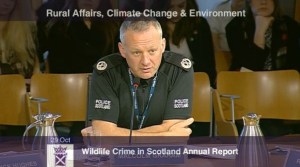
RACCELast Wednesday, the Scottish Government’s Rural Affairs, Climate Change and Environment Committee (RACCE) met to hear evidence on wildlife crime from two senior Police Scotland cops and a senior Fiscal from the Crown Office.
We’ve already blogged about what was said during the meeting about that ludicrous Police Scotland press statement on the Ross-shire Massacre (here). Needless to say, we were unimpressed.

But the discussion on that press statement was only a small part of a two-hour hearing. There was plenty of other discussion about various aspects of wildlife crime enforcement in Scotland and we learned a lot. For those of you who were unable to watch the video, the official transcript of the meeting has now been published in full: HERE.

So what did we learn? For a start, we learned that the RACCE Committee is full of very well-informed MSPs. They asked a lot of good questions and in some cases were quite dogged about pushing the Police for a proper answer. What was less impressive was their sometimes ready acceptance of what can only be described as weak and unsubstantiated responses from the Police and the Crown Office. Nevertheless, it was good to see both the Police and COPFS being asked to be accountable for a change – let’s hope we see more of that.

If you haven’t watched the video, we thoroughly recommend you take some time to read the minutes. Here are a few things that caught our attention:

1. In future years, the Government’s annual wildlife crime report will use data from calendar years instead of a mish mash of calendar and financial years, which makes any sort of analysis near impossible. That’s good.

2. Police Scotland are of the view that the wildlife crime figures are “not the tip of the iceberg“. Their view is apparently based on a “feeling” as opposed to hard evidence. Assistant Chief Constable Graham said:

I do not have the sense that we are dealing with the tip of the iceberg, but I do have a sense that there are undoubtedly crimes that are not reported to the police and therefore go unrecorded. I could not judge what level that is at, but it does not feel as if we are getting only the tip of the iceberg“.

Detective Chief Superintendent Robbie Allan said: “I agree that the numbers are not the tip of the iceberg“.

Unfortunately, the Committee did not question them further on their “feelings” – it would have been interesting to have asked them how they account for the absence of breeding golden eagles and hen harriers on most land that is managed for driven grouse shooting, how they account for entire populations of raptors being constrained from their full distribution potential in prime breeding habitat that just happens to be managed for driven grouse shooting, how they account for all the unoccupied historical breeding sites, many of which just happen to be on driven grouse moors, why the majority of ‘missing’ satellite-tagged raptors are just happening to ‘disappear’ on driven grouse moors, and why most academics who publish on national and international wildlife crime enforcement widely accept that under-reporting is one of the main obstacles in the way of tackling wildlife crime.

Apparently under-reporting is not an issue in Scotland, because “it doesn’t feel that way” to Police Scotland.

3. The Police and SNH will meet monthly, starting in early November, to share information that could lead to the restriction of General Licences on land where wildlife crime is suspected. That’s very good. Although we still maintain that the General Licence restriction is not a restriction at all – it can easily be circumvented by the landowner/sporting agent/gamekeeper by them simply applying for an individual licence – we blogged about this here. The withdrawal of the General Licence is not a restriction at all; its simply a minor inconvenience which will mean the landowner/sporting agent/gamekeeper having to fill in an extra form. That’s it.

4. The admissibility of video evidence was discussed. Apparently it’s all about “proportionality and necessity” and “Police Scotland will not be routinely deploying these tactics“. In other words, The Untouchables are free to carry on as usual.

5. There was some discussion about the training of police wildlife crime officers. We’ll leave this one for now because we intend to examine this subject in greater detail in the near future.

6. Patrick Hughes from COPFS claimed: “The majority of animal welfare cases that we see are reported to us by Police Scotland, although some come from the SSPCA“. Really? That would be staggering. Unfortunately, Mr Hughes was not asked to substantiate this claim with any data. This would be a ripe topic for anyone with a mind to submit an FoI to the Crown Office: _EnquiryPoint@copfs.gsi.gov.uk (take note of the underscore at the start of this email address).

7. The subject of water bailiffs was discussed (pleased to see that some of those MSPs, and/or their advisors, are reading this blog!). We recently blogged about the substantial powers that water bailiffs have, including the power of arrest (see here). These bailiffs are appointed by landowners, to act in the landowners interests, they are not publicly accountable and have only the merest hint of any ‘training’. Why then, is there such opposition to extending the investigatory powers of the SSPCA, which wouldn’t even include the power of arrest, and whose inspectors already use wide powers when investigating animal welfare crimes? Well, according to Police Scotland (who, you’ll remember, objected to the proposed increase of powers to the SSPCA), the water bailiffs’ powers “are not used routinely” and “We do not have experience of water bailiffs who think that they are in a position to apprehend people“. Strange, then, that to ‘qualify’ (term used loosely) as a water bailiff, the candidate is encouraged to sit a test on the contents of the water bailiff training manual, which includes a considerable amount of detail about their powers of search and arrest.

8. Patrick Hughes of the Crown Office confirmed that currently two cases are proceeding under the vicarious liability legislation. According to him, the VL provision is “effective”….because the landowners have told him it is. On that basis, he’ll no doubt believe that raptor poisoning has stopped because Alex Hogg said the SGA had ‘stamped it out’ (see here).

Tomorrow, the Environment Minister will be giving evidence on wildlife crime to the RACCE Committee. You can watch live from 10am HERE.

First vicarious liability prosecution: part 3

Criminal proceedings continued today against Ninian Robert Hathorn Johnston Stewart in the first known vicarious liability prosecution under the WANE Act 2011.

Mr Johnston Stewart, the landowner of Glasserton & Physgill Estates, is charged with being vicariously liable for the criminal actions of Glasserton gamekeeper Peter Bell, who was convicted in 2013 of laying poisoned bait which killed a buzzard (Carbofuran) and possession of three banned pesticides (Carbofuran, Strychnine and Alphacloralose) (see here).

Today’s hearing was continued for an intermediate diet on 8th December 2014.

Previous blogs on this case here and here

Case against Scottish gamekeeper William Dick: part 4

Criminal proceedings continued today against Scottish gamekeeper William Dick.

Dick, 24, of Whitehill Cottages, Kirkmahoe, Dumfries is accused of bludgeoning and then repeatedly stamping on a buzzard. The offences are alleged to have taken place in Sunnybrae, Dumfries in April 2014. Dick has denied the charges.

Today’s hearing was a notional diet and the next hearing will be an intermediate diet on 24 February 2015. A provisional trial date has been set for 23 March 2015, pending the outcome of the intermediate diet in February.

Previous blogs on this case here, here, here

SGA: “The Ukip of the natural world”

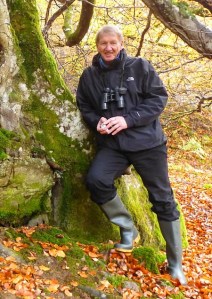
Jim CrumleyThere’s an interesting piece in today’s Courier written by Jim Crumley, discussing the number of raptors killed by wind turbine collision versus illegal persecution (see here for earlier blog post on this issue).
Crumley is no fan of wind farms, but is even less enamoured with the Scottish Gamekeepers’ Association, who he describes as “The Ukip of the natural world, and with whom I agree about almost nothing at all“.

Read the Courier article here

Visit Jim Crumley’s personal website here

‘Record breaking’ grouse season: but at what cost?

A ‘leading’ sporting agency is predicting that the 2014 Scottish grouse-shooting season will be one of the best for years, with ‘record bags’ being recorded on grouse moors across the country (see here).

It’s unfortunate that the grouse-shooting industry continues to measure a ‘good’ season based on the number of birds that are killed, not on the ‘quality’ of the shooting.

You can only get ‘record’ bags if the grouse are kept at artificially-high densities. That artificial high density is only possible if natural predators are removed (killed) on a massive scale. As we know, this happens on driven grouse moors both legally (e.g. stoats, weasals, corvids, foxes etc) and illegally (e.g. hen harriers, golden eagles, peregrines, buzzards, goshawks etc).

You can look at today’s headline one of two ways. Wouldn’t it be interesting if the names of the ‘record-breaking’ grouse moors were made public, so that their track record on raptor persecution can be cross-referenced?

Of course, the grouse-shooting industry will deny all involvement and/or knowledge of illegal raptor killing. If that was true, then wouldn’t it show that there’s no need to issue licences to kill protected species as the industry seems to be doing very well without them?

Ross-shire Massacre: more on that Police Scotland press release

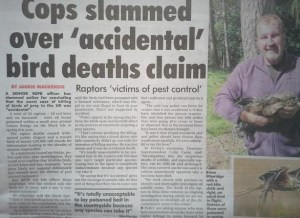
Brian Etheridge statementA week ago, Police Scotland issued a ludicrous press statement concerning the illegal poisoning of 22 raptors in Ross-shire. They said that they could CONFIRM that the birds “were most likely not targeted deliberately but instead were the victims of pest control measures“.
We’ve blogged quite a bit on that press statement already (see here, here, here, here). Our main issue with it is that the police appear to have ruled out intent (i.e. inferring the birds were accidental victims) before they’ve even identified a suspect. How could they possibly know what the intent was without first having a confession from the poisoner? We also take issue with them citing ’16’ victims instead of 22 victims. It may well be that they only have confirmed poisoning results from 16 of the 22, but to completely ignore the other six birds merely diminishes the scale of this crime.

We are not alone in this view. An article in the North Star quotes the RSPB’s Brian Etheridge (he’s the guy who has worked with the Black Isle red kite population for 19 years and was heavily involved in the discovery of the poisoned birds) as folllows:

It’s a very stupid statement. That’s almost justifying the killing. It’s like saying that a drunk driver who kills somebody didn’t go out with the intention of killing anyone. He was just drunk and it was an accidental death“.

Last week, we invited blog readers to contact two of the partner agencies involved in this investigation (RSPB Scotland & SSPCA) to formally ask whether they agreed with the content of the Police Scotland statement. The SSPCA is yet to respond, but Ian Thomson, Head of Investigations at RSPB Scotland has issued the following statement:

The use of poisoned bait, deliberately placed in the open countryside, is an indiscriminate and criminal act, whatever the intention of the perpetrator, and is aggravated in this case by the fact that an illegal chemical was used.

Whether these birds were killed deliberately or otherwise is irrelevant. Someone placed a fast-acting and very toxic poison out in the open, in an area well-known as being frequented by protected birds of prey, including a significant part of the north of Scotland red kite population. The resulting deaths were an entirely predictable result. It is very fortunate that the members of the local community who discovered poisoned birds did not become victims themselves.

The placing of poisoned bait, just a few miles from the popular Tollie red kite feeding station, was not only a reckless attack on local wildlife but also on the local tourist economy.

 I hope this provides clarification of our position”.

END.

Now, while Mr Thomson’s statement doesn’t really answer directly the question he was asked (and to be fair, we’d have been surprised if he had, given that the RSPB has to work in partnership with the police), it is nevertheless very revealing. He specifically mentions poisoned bait – something Police Scotland has so far failed to do, but more importantly, if you read between the lines, it’s pretty obvious that RSPB Scotland isn’t too happy about the Police Scotland statement: “Whether these birds were killed deliberately or otherwise is irrelevant” and “The resulting deaths were entirely predictable“. Indeed.

The Police Scotland statement came in for further scrutiny at the Scottish Government’s Rural Affairs Committee hearing on Wednesday. The session was all about wildlife crime and two senior police officers, as well as a rep from COPFS, gave evidence to what turned out to be an impressively well-informed Committee. We’ll be blogging more on what was said at that hearing in due course, but suffice to say it was extremely illuminating. The official transcript apparently won’t be available until Monday, but in the meantime we thoroughly recommend you watch the video of the hearing (available here).

Malcolm GrahamSo, what was said about the Police Scotland press statement during that hearing? Quite a lot! The discussion on this specific item lasted for 18 minutes (see video 01.20-01.30 and then 01.34-01.42) and those well-informed Committee members clearly expressed their concern about the Police Scotland statement.

The police officers (ACC Malcom Graham, pictured left, and DCS Robbie Allan) tried to defend their position – notably, they didn’t apologise for any of the confusion their statement had caused – but their defence wasn’t very impressive. They did state, clearly, that they hadn’t intended to infer the poisonings were accidental, and they did confirm a criminal investigation was on-going. That was good, but they couldn’t justify why they thought the birds “were most likely not targeted deliberately” and quite surprisingly, they claimed that their partner agencies had been in support of the press release! Here’s part of what Assistant Chief Constable Malcolm Graham had to say:

 “We put out information into the public domain that we thought was going to clarify what we thought our best assessment was, lay behind the intent of the acts that we’re investigating, and from everything that we have done, in combination with a number of other agencies who are active in this field AND WHO SUPPORTED THE PRESS RELEASE THAT WE PUT OUT [Emphasis by RPS], we wanted to say that it didn’t appear that the activity had sought to deliberately target the birds that had been killed“.

We find it very hard to believe, given the formal press statement issued by RSPB Scotland, that they were in any way supportive of the Police Scotland statement. So who were these “other agencies who are active in this field” who “supported the press release“? We’re very interested in this and perhaps Assistant Chief Constable Malcolm Graham would like to be given the opportunity to explain, given how keen on public accountability Police Scotland claim to be. Perhaps he wouldn’t like to explain, but we’ll never know unless we ask. Emails to: ACC.CrimeMCPP@scotland.pnn.police.uk