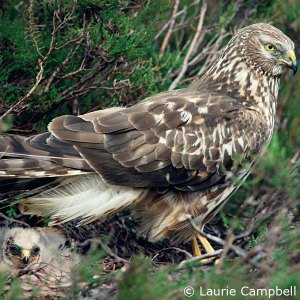
 Over the last year or so (and especially over the last few months) there has been an increasing amount of media coverage regarding the political and ecological status of hen harriers in the Republic of Ireland. Much of the media coverage has come from one particular Irish newspaper, heavily influenced by political spin doctors (the equivalent of the Telegraph/Daily Mail in the UK). When these newspaper articles are shared with a UK audience on social media, without an accompanying critique or even a vague understanding of the politics behind each story, a one-sided view of the situation can be accepted as being ‘factual’.
To counter this, we’ve invited a guest blog from somebody who understands both the conservation needs of hen harriers in the RoI and the political landscape in which the story is set. The author wishes to remain anonymous, for obvious reasons.
Hen Harriers in the Republic of Ireland: a crash course
Over the past decade, hen harriers have become a bird of controversy in Ireland as the uplands that were once of little interest or use for humans, apart from commonage or small-scale turf (peat) cutting but form the bulk of its breeding grounds, have come into sharp focus as the next property boom. Despite the economic crash brought on in part by widespread land and property speculation it is apparent that Irish hen harriers are sitting on some valuable real estate. See here: http://www.ifa.ie/compensation-or-remove-the-designation-clear-message-from-farmers-at-ifas-hen-harrier-meeting/#.VL5wWixRa18
But first a little historical background. Hen harriers were clearly widespread and quite commonly found across much of the Irish uplands and foothills where classic harrier habitat existed into the 19th century but apparently disappeared from some of its former haunts (Down, Fermanagh, Derry and Wicklow) by the early 20th century (Ussher & Warren 1900). At least some of these declines have been attributed to human persecution of birds of prey on the large landed estates which also resulted in the extinction of golden and white-tailed eagles as well as marsh harriers around this time. Further declines apparently followed in the first half of the 20th century when it was erroneously reported that harriers had become extinct as a breeder in Ireland (Kennedy et al 1954), although birds had continued to breed in the midlands and south-east (Watson 1977). Undoubtedly harriers were under-recorded and likely continued to breed elsewhere at least in small numbers. However, the first Breeding Atlas estimated some 75 pairs breeding in 1964 rising to 200-300 pairs by the early 70’s (Sharrock 1976, Watson 1977). However numbers apparently decline again in the late 70’s in parts of its range (O’Flynn 1983).
The apparent increase in harrier numbers and range beginning in the 1950’s and its subsequent decline in some areas is largely attributed to its adoption of a novel habitat, commercially planted non-native conifers, in the uplands and their subsequent maturation leading to this habitat becoming unattractive to harriers once the forest canopy closes. However much former habitat that remained unplanted was also lost to agricultural reclamation of marginal lands including drainage and reseeding for livestock grazing.
Today hen harriers are Amber listed (medium concern) in the most recent assessment of Birds of Conservation Concern in Ireland (Colhoun & Cummins 2013). Six Special Protection Areas (SPAs) have to date been designated for the species protection in RoI: Stack’s to Mullaghareirk Mountains (Kerry-Cork & Limerick), Mullaghanish to Musheramore (N Cork), Slievefelim to Silvermines Mountains (Tipperary), Slieve Bloom Mountains (Offaly), Slieve Aughty Mountains (Clare-Galway) and Slieve Beagh (Monaghan-N Ireland). Recent semi-decadal national surveys in the RoI have shown the Irish hen harrier population to be apparently stable: 102-129 pairs in 1998-2000; 132-153 pairs in 2005; 128-172 pairs in 2010 (confirmed + possible pairs). However, this apparent overall stability masks a seriously worrying decline (-18%) within the six SPAs. As a whole the hen harrier population is now largely confined to the uplands in the south-west (Munster) with other small populations in the midlands (Slieve Blooms) and the north-north west (Monaghan-Cavan- Leitrim-Donegal). Since 2010 populations in most of the former strongholds in the south-west have declined still further.
Hen Harriers in Ireland: can we see the harriers for the trees?
As alluded to above, hen harriers and hen harrier real estate are under serious pressure from a number of quarters. High on this list is further habitat loss/change resulting from further afforestation in the uplands, increasing numbers of windfarms even within harrier SPAs, further losses in areas outside SPAs within little or no formal protection, and a potentially seriously flawed agri-environment scheme which only covers environmental measures on grassland, a little-known and non-existent habitat for breeding harriers…..heather moorland and other important habitats such as Calluna-Eriophorum bog, scrub etc seem to have not made it onto the radar of the Dept? See P28 here: https://drive.google.com/file/d/0B1U6Mi7IC789TTlmcFVDdmdkTzQ/view?pli=1 . This despite detailed submissions to the Rural Development Programme by the Irish Raptor Study Group (IRSG). Even the advice of its own National Parks & Wildlife Service (NPWS) appears to have been ignored in designing the scheme.
Firstly, most hen harriers in Ireland have now been nesting in young conifer plantation for several decades. Although this habitat was quickly adopted by nesting harriers it has functioned as somewhat of an ecological trap. Harriers like it for nesting, not because they like young trees to nest in, rather the nice thick luxurious growth of scrub vegetation that provides good cover for ground nests. However pairs, especially those now using second-rotation forestry (forest on its second planting) don’t do so well, having reduced breeding success. Of course, forestry is managed to maximise timber production and not harrier numbers and/or nest success, even within SPAs. Despite their designation, in 2007 some 1,188 Ha of new forestry has been planted in the SPAs. The average forest cover in the SPAs is some 53% as opposed to 11% nationally. Predictions are that with further forest maturation the hen harrier population will continue to decline over the next 20 years.
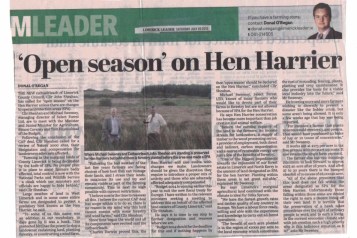 But if that isn’t enough the private forest lobby has been busy winning over the farming organisations with offers of lucrative tax-free grants for private forestry, leading to calls by the Irish Farmers Association for an end to a moratorium on new forestry in the SPAs (see here http://www.ifa.ie/no-planting-policy-and-threat-response-plan-delays-in-hen-harrier-spas-unacceptable-ifa/#.VL5mTyxRa18. Private forestry has also been courting national and local politicians (councillors) and upping the ante against hen harriers. This manifested itself embarrassingly in a call for an “Open season on Hen Harriers” in July 2013 by the then Chairman of Limerick County Council. See here: https://raptorpersecutionscotland.wordpress.com/2013/07/23/council-leader-calls-for-open-season-on-hen-harriers/ .
The unedifying sight of what should be a representative of ‘all the people’ of the county rattling the cage for his forestry chums was a new low and brought an apology of sorts. But the damage was, of course, done. We all knew what you really meant Cllr. Sheahan! See: http://www.limerickleader.ie/news/columns-opinion/letters/august-10-hen-harriers-raptor-group-has-its-say-cllr-sheahan-responds-1-5373262
More recently in a debate in the Dáil (Irish parliament) TDs (MPs) in hen harrier SPAs have supported the lobby for further afforestation in SPAs. The Minister of State at the Dept. of Agriculture, Food & the Marine, Tom Hayes, publicly stated that they can “come up with an arrangement by next September that we can bring to Europe….where we can explain to the officials there that the overall blanket ban (on forestry) should be lifted, that this should apply only to the designated areas in which the hen harrier actually is in place and one should be able to plant in areas other than that specific area” (Dail debate 19/6/14).
The previous Minister for Arts, Heritage & the Gaeltacht (yes, different Dept. I know, you still with me?) instigated a Threat Response Plan (TRP) to identify actions required by public authorities to cease, avoid, reverse, reduce, eliminate or prevent threats to the hen harrier. This report is due in June 2015. Worries are that the actions will be watered down due to pressure from vested interests (see http://www.ifa.ie/sectors/forestry/hen-harrier/ ). No conservation objectives have been set for the harrier SPAs as yet despite a requirement to do so within six years (due 2013). A draft of the TRP is due to be open to consultation with various stakeholders. Word is that the two environmental reps on the consultation are from Birdwatch Ireland and An Taisce (Ireland’s National Trust), the latter with no expertise on harriers or indeed birds, while the Irish Raptor Study Group are not as yet represented.
In yet another but significant development in the harrier SPA tale, a new lobby group, Farmers with Designated Land (IFDL) has been rallying support both regionally, nationally and more recently at EU level for a better deal for farmers within harrier SPAs. See here: http://www.seankelly.eu/news-and-events/277-kelly-government-must-compensate-4-000-landowners-affected-by-hen-harrier-rules . The previous hen harrier farm scheme expired in the last RDP cycle and was opted into by less than 10% of farmers. Although initially pushing for a lifting of the moratorium on private forestry in SPAs, the IFDL have now apparently dropped this from their agenda in favour of increasing the level of supports through the RDP. See here: http://www.independent.ie/business/farming/hen-harrier-designation-is-costing-farmers-up-to-650ac-30751686.html . One thing that became clear following some digging for answers is that during the last RDP, the Dept. of Agriculture had an allocation of €528 million available for NATURA sites but only €93 million was delivered to support farmers and much needed conservation measures for threatened bird species on designated land. So where did the mullah go?
It remains to be seen how this will all play out and what if anything the political machinations mean for hen harriers. Meanwhile one thing is for sure; hen harrier numbers in many of the SPAs are dropping as fast as a sky-dancing male. Since 2010, all the available evidence suggests that populations in the Mullaghareirks and West Limerick hells, a former stronghold, have continued to fall and that raises the prospect of NO breeding hen harriers in some areas while more and more of its former moorland habitat becomes closed canopy conifer forest, yet more windfarms get planning permission in SPAs to add to the hundreds of turbines already there and millions may be spent on an agri-environment scheme that threatens to deliver little or nothing for harrier conservation.
 Windfarms, harrier persecution and those ghost SPAs
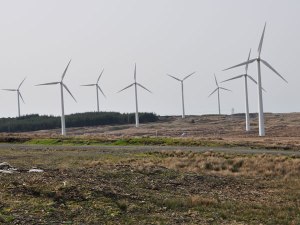
Of course, no harriers, or a severely depleted harrier population, is a problem for conservation and NPWS-reporting to the EU on the state of the SPAs. But on the flipside, planning permission and the inconvenient occurrence of breeding harriers in areas targeted for wind development become a hell of a lot less contentious. So this begs the question, are harriers declining in some areas with the help of humans who figure, ‘no harriers, no problem’? Over the past 5-10 years there has been some unequivocal evidence of harrier persecution, coincidentally in areas where planning permission has been, or is subsequently submitted, for windfarm development. Also with that there has been rumour and hints that something untoward is going on. Typically this is harriers displaying in a traditional site but subsequently ‘disappearing’. These reports have emanated mostly from one breeding area with the Stacks & Mullaghareirks SPA in the south-west. In 2010 three dead harriers were handed in by an unknown individual to the local NPWS ranger. To our knowledge, no investigation was ever instigated and these deaths did not appear in the first Irish BOP Poisoning and Persecution Report. See here: http://www.npws.ie/publications/archive/2011%20Bird%20of%20Prey%20Poison%20and%20Persecution%20Report-July2013.pdf . Our guess is that human persecution has been overlooked as a contributory cause for decline in some areas and is grossly underestimated, largely because little data exists. While hen harriers in Ireland haven’t suffered the high levels of persecution well documented in Scotland (there are no driven grouse shoots in Ireland and no privately owned moors given over to maximising grouse numbers) we cannot be complacent and assume Irish hen harriers aren’t also becoming targets where their presence is thought to conflict with land use.
Meanwhile some important areas for breeding harriers have not been designated although on the original list of none candidate SPAs (cSPAs), most notably the Ballyhouras in North Cork/South Limerick, which held 12-13% of the national population in 2005 and 8-9% in 2010. Why was this site not designated in 2007 along with the other six SPAs, some of which the Ballyhouras have consistently held greater numbers and higher densities? Unlike most of the other sites the Ballyhouras are almost wholly owned by Coillte, the state forestry company. Despite claims that the site wasn’t designated because the population was considered “not to be viable” because of the extent of forestry (so where does that leave all the other heavily afforested SPAs, where’s the viability analyses?) it appears that Coillte didn’t want to be hindered in their forestry activity, and more recently by their involvement in windfarm developments (two windfarms now permitted), by designations and the decision was a political one. Two other cSPAs, the Nagles and the Kilworth & Knockmeldown Hills, have also been ‘delisted’ although all more than meet the criteria for designation.
2015 is going to be an interesting and perhaps defining year. The hen harrier TRP could and should be a watershed for hen harrier conservation but will it deliver for harrier conservation? A national hen harrier survey (different from the proposed 2016 national survey due to take place in the UK) has recently got the go-ahead for 2015. The results of the survey will be timely given the pressures on hen harriers and their habitat.

 North Yorkshire has the dubious distinction of being the UK’s worst known raptor persecution blackspot – a title it has held for several years (see
 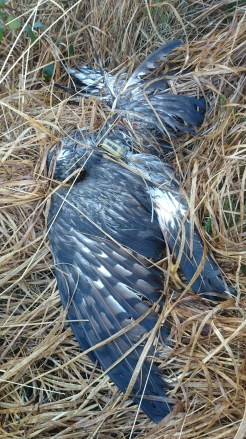 With depressing familiarity, news has emerged of the illegal killing of yet another hen harrier.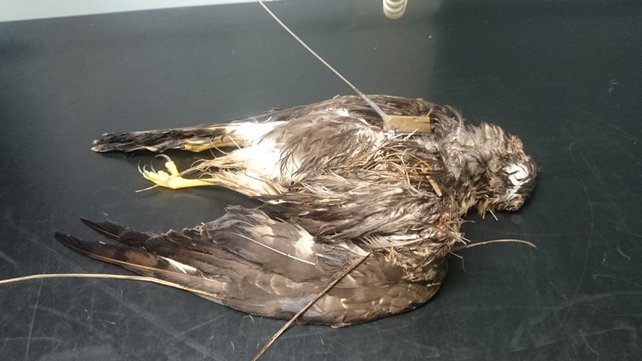
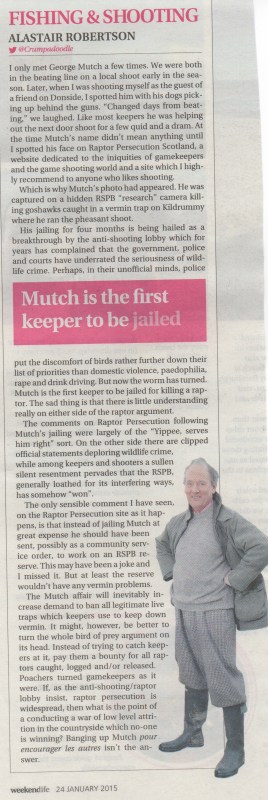 The fall-out from the shock custodial sentence for raptor-killing gamekeeper
 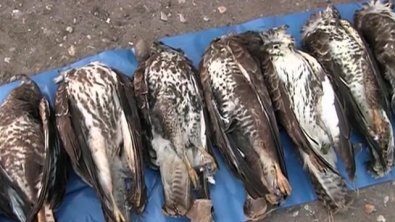 On 1st October 2014, gamekeeper Allen Lambert from the Stody Estate in Norfolk was found guilty of poisoning 10 buzzards and one sparrowhawk, which had been found dead on the estate in April 2013. He was also convicted of storing banned pesticides & other items capable of preparing poisoned baits (a ‘poisoner’s kit’), and a firearms offence (see
  You may remember last May, the Cairngorms National Park Authority (CNPA) wrote to the then Environment Minister, Paul Wheelhouse, to tell him that the continuing incidents of raptor persecution and ‘disappearing’ birds in the eastern part of the Cairngorms National Park “threatens to undermine the reputation of the National Park as a high quality wildlife tourism destination“. The Minister was invited to a meeting of ‘stakeholders’ to discuss ways to address the on-going problem (see
  Today, the Scottish Government has published its analysis of the public responses to the SSPCA consultation. It is quite extraordinary.
 Raptor Persecution UK