 It’s not been an impressive week for Scotland’s Environment Minister’s office, and the poor performance continues…
Do you remember back in May this year, when Scottish gamekeeper James O’Reilly was convicted of committing four wildlife crime offences on the Cardross Estate in Stirlingshire, including the setting of gin traps, one of which caused such injury to a buzzard that the bird had to be euthanised? See here for a recap.
O’Reilly received what we consider a typically pathetic sentence – a 240 hour Community Payback Order – and we encouraged blog readers to contact Environment Minister Dr Aileen McLeod to ask when the Government-commissioned Wildlife Crime Penalties Review report would be published.
Here’s the response received by one of our readers:
Dear XXXXXX
Thank you for your letter of 21 May 2015, to the Minister for Environment, Climate Change and Land Reform, Dr Aileen McLeod. I have been asked to respond on the Minister’s behalf.
Your letter, headed “Wildlife Crime Penalties Review”, asks when the review of the penalties for wildlife crime will be published. The review has taken longer than anticipated due to the volume of material considered and the range of issues which has arisen. The group are currently working on the draft report and we expect this to be with the Minister before the summer recess. The Minister will wish to consider the report carefully and at this juncture we are not able to provide details of when any of the recommendations might be implemented.
You also raise a concern about the recent conviction of a gamekeeper who received a 240 hour Community Payback Order (CPO). Sentencing is a matter for the Scottish Courts, however CPOs are not intended to be a “soft option”, they are an effective alternative to custody – individuals released from a custodial sentence of six months or less are reconvicted more than twice as often as those given a CPO. There are also penalties for breaching a CPO, including an electronic monitoring sanction for non-compliance, so offenders cannot simply ignore the court’s punishment.
I hope that you find this response helpful.
Yours faithfully,
Karen Hunter Wildlife Crime Policy Officer
END
The third paragraph of this response is astounding. “CPOs….are an effective alternative to custody – individuals released from custodial sentences of six months or less are reconvicted more than twice as often as those given a CPO“. From where has this statement been lifted? It may well be applicable to easily-detectable crimes such as theft but the statement is entirely out of context and cannot possibly be applicable to assessing the reconviction rates of offenders involved in wildlife crime because there’s only ever been one custodial sentence for a raptor-killing criminal and that was only handed out in January this year (to gamekeeper George Mutch). That means that there aren’t any data on the deterrent effect of CPOs vs custody for wildlife crime offenders so making a statement to suggest that CPOs are more effective is disingenuous at best, and that’s being generous.
In addition, it’s well established that conviction rates (let alone reconviction rates) of wildlife crime offenders in no way reflect the actual offending rate – see the recently published LINK report for the low rate of prosecutions, let alone convictions, for reported wildlife crimes in Scotland. So to suggest that CPOs are an effective deterrent for addressing wildlife crime is absolute nonsense.
For all we know, a high percentage of convicted wildlife crime offenders are reoffending left right and centre – they’re just not being caught! Equally, of course, they may not be reoffending. Or, given the lengthy delays involved in bringing criminal prosecutions, they may have reoffended but the cases are still going through the system (remember that CPOs only came in to force in 2011, and we’re still waiting for some trials relating to offences that were alleged to have occurred several years ago). The point is, the limited data available do not provide for a robust assessment of the effectiveness of CPOs vs custodial sentences for wildlife crime offenders, so officials in the Environment Minister’s office would do well not to try and fob us off with such glib tosh.
Meanwhile, in a parallel universe, the North Wales Police and Crime Commissioner, Winston Roddick, is calling for tougher sentencing powers to allow the courts to deal with convicted raptor killers. His efforts are being supported by wildlife presenter Iolo Williams – see here.


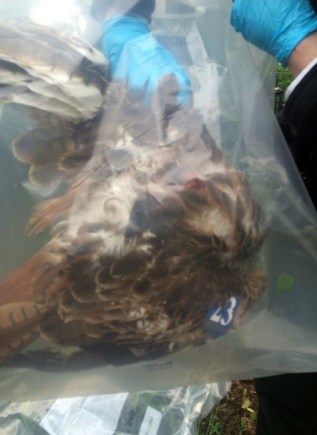 A female red kite, born in Wales and released in Northern Ireland as part of the reintroduction project there, has been found shot dead.
 The Police and the RSPB are appealing for information following the discovery of a shot peregrine last month.
 Raptor Persecution UK