
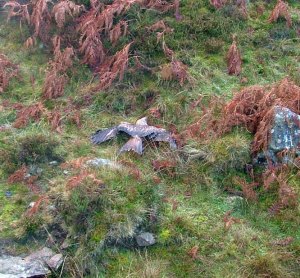
 The following press release has been issued today by FoRK (Friends of Red Kites) –
POISONING OF RED KITES CONDEMNED
Three red kites have been found illegally poisoned in a blow to efforts to re-establish a thriving population across north east England.
One found near a grouse moor died from Carbofuran poisoning despite the use of the chemical being banned in Britain since 2002. The two others were found together and died as a result of poisoning by Aldicarb, a widely-used pesticide which has been implicated in deliberate poisonings elsewhere in Britain.
The bodies of all three were recovered and sent for post-mortem examination after tip-offs from the public.
The three deaths, revealed by Friends of Red Kites (FoRK), the voluntary group set up to protect and monitor the population, brings the region’s total number of known kite casualties from illegal poisoning to ten in recent years.
FoRK has condemned the killings but fears that the known deaths are just the tip of the iceberg and that many more dead birds are never found. It believes that persistent persecution, mainly through illegal poisoned baits, is among factors preventing the birds from spreading from their core Derwent Valley sites.
The bird killed by Carbofuran was found near Edmundbyers, Co Durham. The two others were found at High Spen, Gateshead, and included a wing-tagged female from a nearby breeding site which had produced young for the previous four years.
Previous poisoning involved two kites found dead in Hexhamshire and a breeding pair killed near Whittonstall whose chicks then perished in the nest. Other local kites were found poisoned in Teesdale and Wharfedale, Yorkshire. Another bird, which moved to Scotland, was found poisoned in the Cairngorms. Other kites have been found in suspicious circumstances but have been dead too long for scientific examination.
Allan Withrington, FoRK Kite Welfare Officer, said: “These poisonings are appalling and totally unacceptable. Carbofuran has been illegal in this country for many years but is still apparently the poison of choice of those who illegally put out poisoned baits to target raptors, crows and foxes.
Leaving poisoned baits in the open is not only illegal but completely indiscriminate as the deaths of many bird and animals, including dogs and cats, has shown over the years.
We will be continuing to do everything possible to expose those responsible and work with the police, farmers, landowners and other conservation organisations to protect the red kites and other species.”
The most recent available figures from the RSPB show that there were 76 confirmed cases of illegal poisoning in Britain in 2013, including 19 from Carbofuran and 5 from Albicarb. Twenty-one red kites were among the victims which also included buzzard, white-tailed eagle, golden eagle and marsh harrier. Raven, magpie, sparrowhawk and even a collared dove also died along with two dogs and two cats.
Britain’s single worst recorded wildlife poisoning incident occurred in April 2014 with red kites being the main victims. 16 kites and six buzzards were found dead near Inverness. Despite a major investigation by Police Scotland and rewards totalling £32,000 being offered no-one has been charged.
ENDS
There are a number of interesting facets to this press release. Firstly, no dates are given for when these birds were found poisoned. We can’t be certain, but the press release may refer to three poisoned kites that were discovered in Co Durham in 2014: two in November 2014 and one in December 2014, according to government statistics. It’s possible that the three kites mentioned in the above press release were poisoned this year, but the published government stats only cover the first quarter of 2015 (up until March) and no poisoned kites in Co Durham are present in those figures. These days we have to wait more than six months to find out what’s actually been going on more recently so if they were poisoned after March 2015 we might find out about it ‘officially’ sometime after Christmas.
The second interesting point about this press release is it has come from FoRK. Here’s how FoRK describe themselves:
The Friends of Red Kites (FoRK) is a constituted, membership-based, community organisation which was formed by volunteers in 2009 to continue to encourage an active interest in the conservation of the red kite population in Gateshead’s Lower Derwent Valley and to continue to monitor their health & welfare.
FoRK is the successor to the funded Northern Kites Project which was responsible for the re-introduction of 94 young red kites in the core area between 2004 – 2009. In 2006 red kites began to breed in the region for the first time after an absence of 170 years.
Interesting then that a voluntary, community-based organisation has issued this press statement, and not the police and not Natural England. Has FoRK issued this press statement because they’re tired of waiting for action by the authorities? Was there a police follow up? Was there a follow up by Natural England? If these three birds were poisoned in November and December 2014, why haven’t the police or Natural England said anything? Could their (apparent) silence / inaction have anything to do with the localities of the poisoned carcasses? Check out the village of Edmundbyers on a Google Earth map – see all those weird rectangular shapes on the hills surrounding the village? They’re the tell-tale muirburn strips (burnt heather) that indicate that this area is dominated by driven grouse moors.
Say no more.
Petition to ban driven grouse shooting – PLEASE SIGN HERE
Friends of Red Kites (FoRK) website here

 The Countryside Alliance has launched an attack on Chris Packham and is urging the BBC to sack him. The basis of their argument is that Chris, in their opinion, is ‘abusing his position’ as a BBC presenter to ‘promote an extreme agenda’ (see
  Never ones to miss an opportunity to stick the boot in on the RSPB, those wildlife crime-fighting heroes at the Scottish Gamekeepers’ Association have mis-kicked, again.
 Well, well, well.
 It’s also interesting that SLE don’t mention the Newlands Estate’s membership of the Wildlife Estates Scotland initiative in their press statement. Not a word. That news has been gleaned from ITV (see
  One year ago today saw the closure of the Scottish Government’s public consultation on increasing the SSPCA’s investigatory powers in relation to wildlife crime investigations, and particularly in relation to raptor persecution.
 Raptor Persecution UK