General Licence restrictions reinstated on Raeshaw and Burnfoot Estates

On 4th November 2015, SNH announced its decision to apply General Licence restrictions to four properties in response to raptor persecution crimes that had occurred there.

General Licence restrictions are a relatively new sanction in the fight against raptor persecution, brought in by former Environment Minister Paul Wheelhouse in July 2013 and have been available for SNH to use since 1st January 2014 (see here). The restriction orders announced by SNH in November 2015 were the first to be applied.

There were two restriction orders. Restriction #1 applied to parts of the Raeshaw Estate (a grouse moor in the Borders) and parts of the neighbouring Corsehope Estate, where, as we understand it, gamekeepers from Raeshaw Estate also carry out ‘pest’ control.

Restriction #2 applied to parts of the Burnfoot Estate (a grouse moor in Stirlingshire) and parts of the neighbouring Wester Cringate Estate, where, as we understand it, gamekeepers from Burnfoot Estate also carry out ‘pest’ control.

The specific reasons for applying these restriction orders have been shrouded in secrecy. We do know the general reasons behind both of them because an SNH spokesperson mentioned them during a radio interview in early November (see here). We know that the restriction on the Raeshaw and Corsehope Estates relates to “the illegal placement of traps” and the restriction on the Burnfoot and Wester Cringate Estates relates to “issues associated with poisoning birds of prey and illegal use of traps“.

We have speculated previously about what these incidents might be, by cross-referencing reported (published) incidents of raptor persecution in the two areas concerned but we really should emphasise that it was only speculation. It is highly probable that other incidents that may have occurred have not been recorded in the public domain so it’s impossible for us to state, unequivocally, which incidents have triggered the General Licence restriction orders on these estates. Only SNH and Police Scotland (who provided the evidence on which SNH has based its decision) know the actual reasons for applying the General Licence restrictions on these particular estates (and presumably the estates’ lawyers are also now aware of the evidence) and so far they haven’t been willing to be transparent about those reasons.

The restriction orders were due to begin on 13th November 2015 and run for three years, ending 12th November 2018. We blogged about these restriction orders and the implications to the estatesĀ here.

However, on 19th November 2015, six days after the restriction orders had begun, SNH suspended both restriction orders because the Estates were appealing SNH’s decision to enforce the restrictions. We blogged about that here and the following notices appeared on SNH’s website:

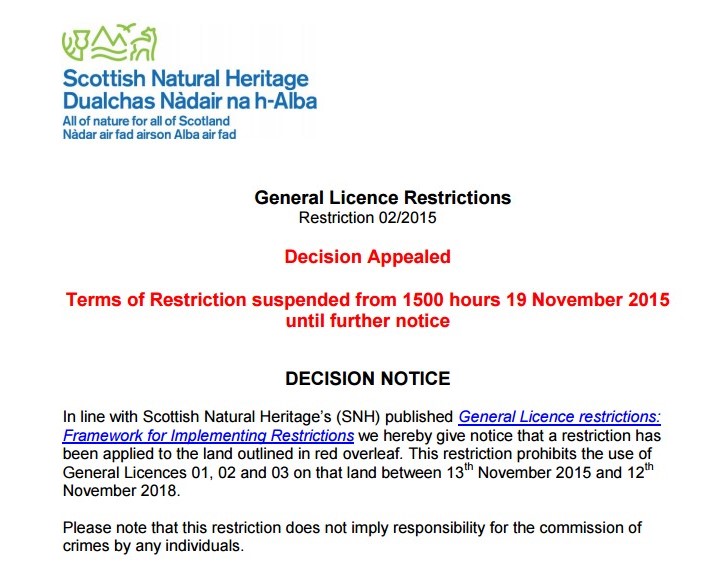
SNH GL restriction 1 SUSPENSION - Copy

SNH GL restriction 2 SUSPENSION - Copy

It all went quiet since the appeal process began but then yesterday, quietly, two and a half months on from the suspension, the following appeared on SNH’s website:
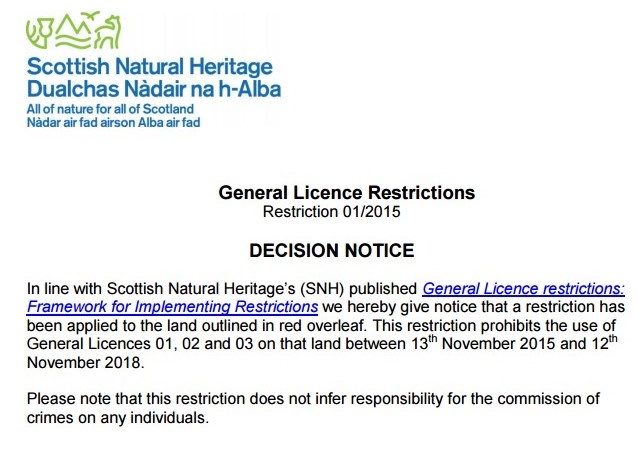
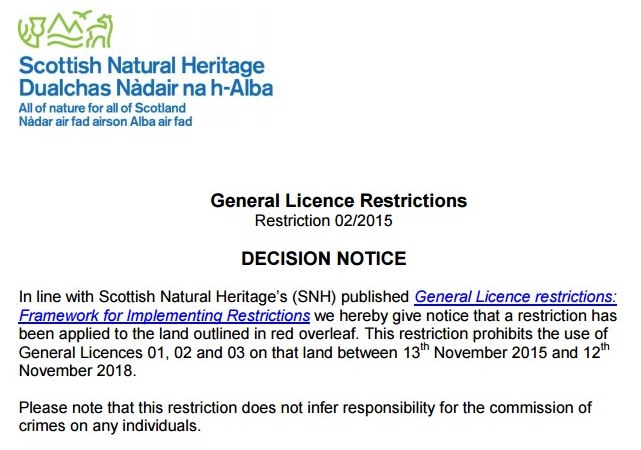
GL restriction 1 - Copy

GL restriction 2 - Copy

It would appear, then, that the Estates’ appeals have failed and SNH has decided to go ahead and apply the restrictions. From our perspective, SNH deserve credit for pushing ahead and sticking to their guns on this, although it’s disappointing that they didn’t issue a press statement yesterday to announce their decision and instead it’s been left to those of us who monitor these things to bring it to the public’s attention. Nevertheless, if the evidence of raptor persecution crimes on these estates is sound (we don’t know that it is but presumably SNH think it’s sound or they wouldn’t have applied the restrictions), then a three-year ban on the use of General Licences could have a considerable impact on the game-shooting activities of these estates, and perhaps more importantly, should also be a good deterrent for others.

It sounds good on paper, and it is a way of penalising estates where raptor persecution occurs but the evidence isn’t good enough to meet the criminal standard of proof needed to charge a named individual and take him/her to court – a regularly occurring problem in this area of wildlife crime. However, it’s not quite as good as it sounds.

First let’s just review what these General Licence restriction orders mean:

Basically, the following activities, usually permitted under General Licences 1, 2 and 3, are now not permitted on these estates until 13th November 2018 –

The killing or taking of the following species:

Great black-backed gull, carrion crow, hooded crow, jackdaw, jay, rook, ruddy duck, magpie, Canada goose, collared dove, feral pigeon, wood pigeon, lesser black-back gull, and herring gull.

The use of the following methods to kill/take these species are not permitted:

Pricking of eggs, oiling of eggs, destruction of eggs and nests, use of Larsen trap, use of Larsen Mate trap, use of Larsen Pod trap, use of multi-catch crow cage trap, shooting with any firearm, targeted falconry, and by hand.

So one of the main questions now is, how will the restriction orders be enforced? Who is going to monitor whether any of the above activities are still taking place on these estates? Daily checks by SNH? Daily checks by Police Scotland? Of course that’s not going to happen. Perhaps intermittent, and one would hope, unannounced, checks will take place, but again, that seems unlikely given the scarcity of available resources. A restriction order will only be effective if it is suitably enforced and we just don’t see how it can be, especially as we anticipate more and more General Licence restriction orders being made across the country. Incidentally, there was a discussion about this very topic at a recent RACCE parliamentary meeting but we’ll be blogging about that separately in the near future.

The second issue is that even though the General Licence restrictions are now in place, the affected estates still have a get-out clause because individuals from those estates can apply to SNH for an individual licence that would allow them to continue the activities that were previously permitted under the General Licence. This clause just makes a mockery of the whole principle of General Licence restrictions. What’s the point of applying a General Licence restriction order if it can be side-stepped so easily? According to SNH (see here), individual licences will be considered on merit on a case-by-case basis, and as such may not be available to all who apply, but those who do apply successfully will apparently be ‘subject to strict conditions and compliance monitoring measures’. Again, how will those ‘strict conditions’ be enforced and who will monitor them?

The third issue is whether these General Licence restriction orders will remain in place for the full three year term. The Estates have been through SNH’s appeal process, and failed, but there is now a strong possibility that they could opt to try for a Judicial Review if they feel that SNH has acted unfairly in applying these restrictions to their properties. That would be quite interesting on a number of levels, not least in that it might offer us (the public) some transparency about these cases and inform us about the evidence used by SNH to make their decisions.

In the meantime, if any of you are out and about on these four estates and you notice that the (above listed) traps are in use or you see gamekeepers shooting at any of the (above listed) species, you should report it immediately. Here are the maps which show the areas where the General Licence Restriction Orders are in place:

Parts of RAESHAW ESTATE & CORSEHOPE ESTATE in the Borders:

Raeshaw Corshope GL restriction map 2015

Parts of BURNFOOT ESTATE and WESTER CRINGATE ESTATE in Stirlingshire:
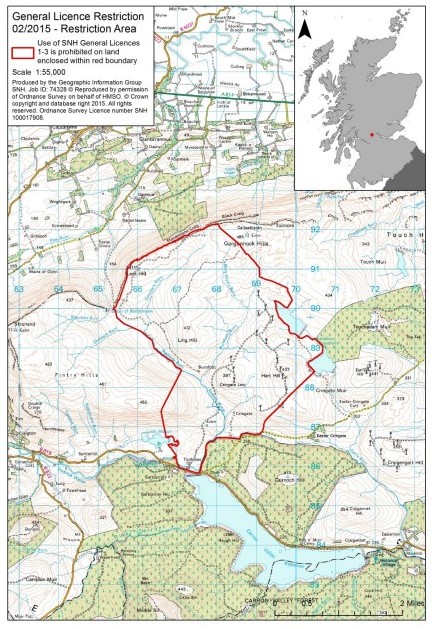
Burnfoot Wester Cringate GL restriction map 2015

Catastrophic decline of breeding hen harriers on grouse moors in NE Scotland

A new paper has been published today, describing the catastrophic decline of breeding hen harriers on grouse moors in north east Scotland.

This won’t be totally unexpected news to many readers of this blog; it’s well known, and has been known for over 30 years, that hen harriers are illegally killed on most driven grouse moors in the UK. This paper can be added to the piles of other scientific papers that have documented the illegal persecution of certain raptor species on grouse moors (e.g. hen harriers, peregrines and golden eagles – see here for a brief list of some of those papers).

But what’s different about this latest paper is that it shows it’s not just grouse moor managers screwing over hen harriers in North East Scotland – it’s also the government’s statutory nature conservation advisor, Scottish Natural Heritage.

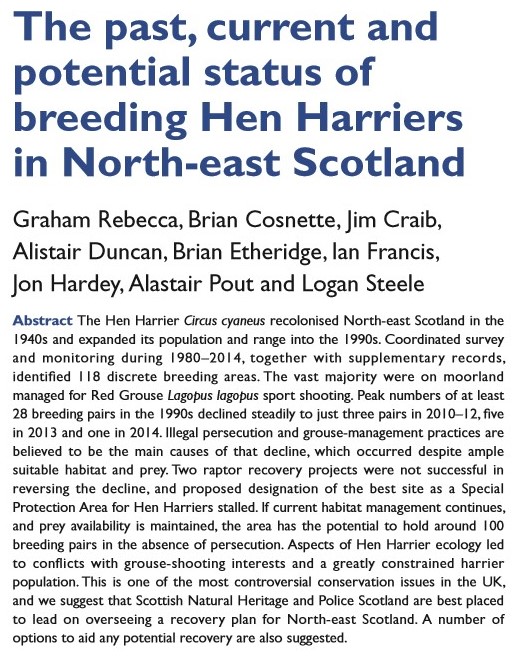
The paper has been published in the February 2016 edition of British Birds (vol 109, pages 77-95). Unfortunately we’re not permitted to provide a full copy of the paper here – you have to subscribe to BB to access that – but we can publish the abstract and we can discuss the contents. Here’s a screen grab we took of the abstract:

Rebecca et al HH paper - Copy

The paper’s authors are all members of the North East Raptor Study Group (NERSG) and/or the RSPB, and they have drawn on their own data (comprehensive and thorough monitoring from 1980-2014 where the vast majority of hen harrier breeding attempts were believed to have been recorded) as well as a wide array of other data that were collected as part of national surveys for other moorland priority species by various statutory and NGO agencies.

From these data (which included studies on habitat and prey availability), 118 hen harrier breeding areas were identified as being suitable, 87% of which were on managed grouse moors. In 2014, only one hen harrier breeding attempt was recorded. To say that is pretty damning would be a gross understatement. It’s as shameful as the data from the grouse moors of the neighbouring Angus Glens, where there hasn’t been a single record of a hen harrier breeding attempt since 2006 (see here). It’s important to reiterate that these data are from Scotland. Usually the bad news stories about hen harriers are from English sites, and the grouse-shooting industry will often point to Scotland as a reason why we shouldn’t be concerned – ‘Ah, there’s hundreds of hen harriers in Scotland and they’re all doing fine, what’s the big fuss about?’ (see here). Forget ‘concern’; this latest paper, along with several others, shows exactly why we are right to be outraged.

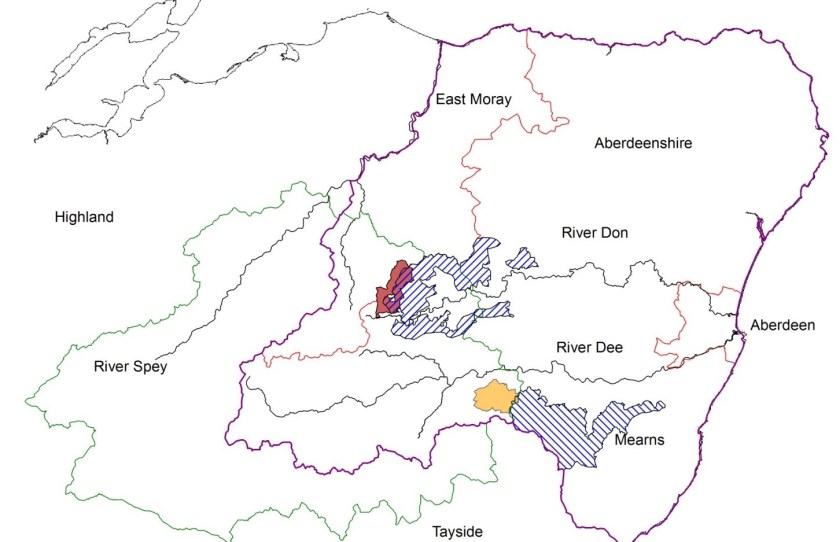
As mentioned earlier, this paper not only puts grouse moor managers in the frame (again), but it also reveals SNH’s role in this sordid tale. Before we discuss that, it’s worth looking at this map to get your bearings. The purple boundary depicts the monitoring area of the NERSG, including the following important areas for hen harriers: lower Deeside (blue back-slashed hatch), upper Donside (blue forward-slash hatch), the Glen Tanar Hen Harrier SPA (orange zone), and the Ladder Hills potential SPA (brown zone). The green border shows the Cairngorms National Park boundary as of 2014.

NERSG monitoring area - Copy

The following text is para-phrased from the paper:

In the mid-late 1990s, SNH was considering the Ladder Hills as a proposed Special Protection Area (pSPA) for hen harriers and in 1995 and 1999 SNH approached the NERSG and RSPB for information regarding Annex 1 species that were using this area. The NERSG and RSPB strongly suspected that illegal persecution of hen harriers (and other raptors) was taking place at the Ladder Hills: in 1998 (a national Ā hen harrier survey year), eight of the nine hen harrier nests located in the Ladder Hills failed, with no obvious biological causes, and most pairs disappeared between survey visits (harriers often attempt to re-nest following a natural failure). In 1999 only three pairs were located in the Ladder Hills.Ā Based on the data received, in early 2000 SNH proposed the Ladder Hills SSSI as an SPA, with hen harrier as the main qualifying interest.

Subsequent discussions between NERSG and RSPB with SNH revealed that landowners had objected to the proposal, claiming there were insufficient numbers of hen harriers and questioning the authenticity of earlier data. In some years data was collected by NERSG members with informal access and in others by workers with full access arrangements. ‘Full access arrangements’ means that RSPB fieldworkers participating in the 1998 national hen harrier survey were required to liaise fully with Estates over access and report their findings (to the Estates), and in extreme cases were accompanied by a gamekeeper during survey visits. We’ll come back to this.

In late 2000, the SNH position was that raptor persecution was likely on the Ladder Hills, but also that other factors such as habitat condition and prey availability might have also been contributing to the low occupancy and poor productivity of hen harriers. NERSG and RSPB did not support the ā€˜habitat and prey deficiency’ hypothesis and were convinced that human interference was the primary cause of the decline, yet this was difficult to prove.

A decision on SPA classification was deferred in 2000–03 while SNH commissioned further population survey and monitoring, and assessed prey availability and habitat suitability. In 2002 and 2003 these studies extended to other areas in Aberdeenshire and Moray to enable comparison. The assessment concluded: “There are large areas of breeding habitat with suitable nest sites available across the site and no evidence of lack of prey” (R. MacDonald, SNH Area Manager, Grampian, in litt. to Ian Francis, February 2004). Nevertheless, breeding numbers did not recover and the site was removed from the pSPA list following review. Concurrently, the site was designated as an SAC under the EU Habitats Directive and is now also part of the recently established Cairngorms National Park.

The paper’s authors welcomed the SAC and subsequent National Park designations, but do not consider them as appropriate substitutes for an SPA for hen harriers. They say that in the 1990s they had one of the best areas in the UK for this species. Grouse moor owners and managers did not agree with this assessment (and possible SPA designation) presumably because they believed their management would be open to greater scrutiny. The authors contend that SPA designation should have been pursued using either the average hen harrier breeding figures from the 1990s, as had been done for similar notified pSPAs in Scotland, or on the basis of the suitable ecological conditions, with the expectation that harriers would recolonise the area with protection.

The authors point out that the Scottish Government appears committed to eradicating hen harrier persecution and enhancing its breeding status but the Ladder Hills scenario is inconsistent with these objectives. There was no support for the ā€˜habitat and prey deficiency’ hypothesis following the commissioned research, and no reasons were given for the non-designation of the pSPA. The habitat and prey availability at the Ladder Hills SSSI/SAC are still considered suitable for breeding hen harriers and if harriers were to recover in North East Scotland, the site should be reconsidered as a pSPA.

[End of para-phrasing].

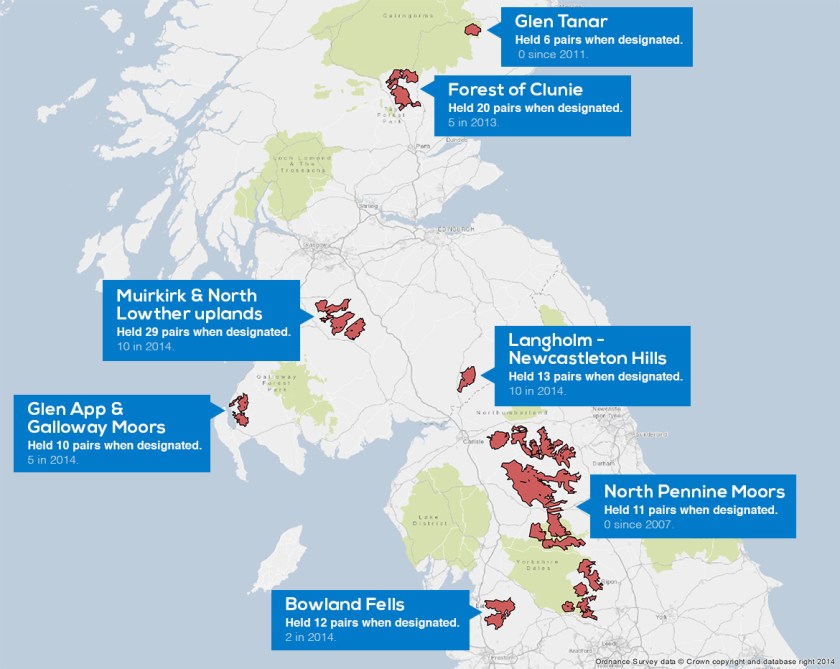
The Ladder Hills case study provides a fascinating insight to several things. First of all, it shows just how weak SNH has been in standing up to influential landowners. We’ve known this for some time but to learn that it was happening as far back as 16 years ago is surprising (to us at least, maybe not to some older readers of this blog). Even after commissioning further research to identify potential threats to hen harriers (which ruled out lack of suitable habitat and lack of prey availability as potential causes), and despite accepting that persecution was indeed one of the causes of breeding hen harrier failures in this region, SNH dropped their proposal to designate the Ladder Hills as a Special Protection Area. What’s the point of commissioning research (with tax payers money) if you’re then going to totally ignore the findings? Talk about not fit for purpose! SNH buckled when they were in a position, with strong supporting evidence, to create an SPA for this species. Not that designating a site as an SPA will automatically lead to species protection – look at all the other hen harrier SPAs in the UK (see map below, taken from RSPB’s Hen Harrier Life+ Project website – they’re all failing miserably – but at least the designation would have given conservationists some leverage to apply some pressure with European legislative backing.

HH SPA map

The second point of interest from this paper is the revelation that RSPB fieldworkers who were participating in the 1998 National Hen Harrier Survey were required to inform Estates about their survey visits and any subsequent survey results pertaining to their land, and in some cases were accompanied to those sites by the Estates’ gamekeepers. Is it just coincidence that many of the hen harrier nests that were recorded in NE Scotland during that survey year ‘mysteriously’ failed, and the number of sites found the following year dropped significantly from previous years? We don’t think so. Two + two = four, not five.

This issue of ‘transparency and trust’ is quite timely, given the blog we wrote four days ago about landowners wanting access to raptor study group data (see here). Tim (Kim) Baynes of the lairds’ lobby group Scottish Land and Estates stated that ‘The persecution of raptors is becoming a thing of the past, but there is also a duty on [the] raptor lobby to engage and share information“. Given the contents of this latest paper, he’s having a bloody laugh. Indeed, the authors write: “Levels of trust and cooperation between most raptor enthusiasts and grouse-moor estates in NE Scotland are at an all time low“. And who can blame them?

The authors discuss several potential solutions to help conserve hen harriers in NE Scotland, including the use of buffer zones around nest sites (already routinely used by SNH to protect harriers at windfarm development sites), the use of nest cameras, the use of supplementary feeding, and encouraging more golden eagles to reach natural densities in these areas as they’re predicted to naturally suppress the hen harrier population. All good suggestions, but all doomed to failure if the grouse-shooting industry is allowed to continue behaving with impunity.

UPDATE 4th Feb 2016

Two other blogs have been written about this paper and are both well worth a read:

Mark Avery here

Ian Thomson (Head of Investigations, RSPB Scotland) here

More shameless spin-doctoring from the Gift of Grouse

Gift of GrouseTim (Kim) Baynes, Director of the grouse-shooting industry’s propaganda campaign, The Gift of Grouse, is shameless. He must be to have penned his latest bout of spin-doctoring, this time pointing the finger at raptor workers.

Before we begin, here’s a definition of a spin doctor:

A person whose job involves trying to control the way something is described to the public in order to influence what people think about it“.

Ladies and gentlemen, the spin doctor is IN.

The following article, authored by Tim (Kim) Baynes, appears in today’s Courier and is entitled: ‘Trust needs to develop quickly between raptor groups and land management‘.

Despite the grouse season ending more than a month ago, our moorland continues to fire passions on all sides.

Since Jim Crumley’s last column, The Courier letters’ pages have been alive with debate. Yet, much of the criticism levelled at estates does not reflect what I see on our moors.

The Gift of Grouse campaign demonstrates the benefits of moorland, including species conservation.

Since then, a number of reports have been publicised. One looked at species present on Invermark, the estate cited by Jim Crumley. It found that 81 different bird species were breeding or feeding there, including a range of ā€˜red-listed’ most at risk birds. Amongst those present were 10 species of raptor including peregrine, golden eagle and hen-harrier.

Similar is happening on many Scottish estates. Yet disappointingly, the politics of the past – pitting raptor enthusiast versus gamekeeper – are still being played. The RSPB’s report uses incidents from two decades ago to influence present-day policymaking.Ā  But, official figures from the past five years demonstrate raptor incidents are now in the teens per annum, with only some linked to land management. There is always work to be done but the law is tough on anyone convicted of wildlife crime, and even higher sentences are likely soon.

At the heart of this is continuing mistrust between some raptor enthusiasts and land managers. There are also internal rivalries within the raptor groups on who monitors which area, and this leads to secrecy. This is a serious issue as land managers need to know which birds are on their land in order to better manage them, but the survey results are often not shared with them, even when funded by bodies such as Scottish Natural Heritage.

To break down mistrust, we must develop ways of maximising both raptors and prey species alongside grouse.Ā  It should not be an either/or scenario. The persecution of raptors is becoming a thing of the past, but there is also a duty on raptor lobby to engage and share information. Trust is developing in some places but it needs to spread – and rapidly.

ENDS

Oh god, where to begin?

For context, perhaps we should begin by pointing out to those who don’t already know, Tim (Kim) Baynes is employed by the lairds’ lobby group Scottish Land & Estates as Director of the Scottish Moorland Group. The Scottish Moorland Group is chaired by the one and only Lord Hopetoun – he of the Leadhills (Hopetoun) Estate – an estate with one of the worst records of illegal raptor persecution in the country.

Tim (Kim) is right in his assertion that there is distrust between some raptor workers and some landowners. Of course there is, and with bloody good reason!

Scottish Land & Estates (SLE) portrays itself as a wildlife-crime-fighting organisation and frequently points to its membership of the Partnership for Action Against Wildlife Crime (PAW Scotland) as evidence of this. SLE has consistently stated that it is working hard to eradicate wildlife crime, and particularly illegal raptor persecution. The thing is, many raptor workers simply don’t believe them. Why not? Well probably because SLE has not sought to expel several member estates that have been implicated, over many years, in raptor persecution crimes. It would be an easy thing for them to do, but they haven’t done it. Until they do, raptor workers (and the general public) are justified to view SLE and their land-owning members with deep suspicion.

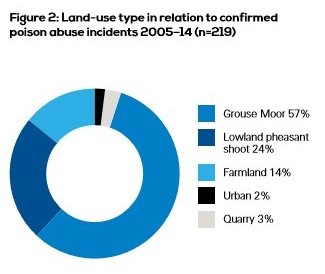
Another good reason for distrusting SLE is their continued denial of the extent of illegal raptor persecution, and their denial that the grouse-shooting industry (some of whom are members of SLE) is in any way implicated with these crimes (e.g. see here and here for just two recent examples). Where clear evidence has been provided, (e.g. 81% of all reported poisoning incidents in Scotland between 2005-2014 were on land used for game-shooting – see here), SLE has simply dismissed the figures and slagged off the RSPB for providing them (here).

RSPB persecution review 1994 2014 land use

In his article for the Courier, Tim (Kim) tries to claim that grouse moors are ‘good’ for species conservation and refers to a recent ‘study’ of breeding birds on Invermark Estate to back up this claim. The problem is, the full details of that ‘study’ (and a couple of others) have not been made available for public scrutiny, despite several requests to see it, and therefore has naff all credibility, especially when the ‘study’ of breeding birds was conducted, er, outside of the breeding season (see here).

But what interested us the most about Tim’s (Kim’s) article in the Courier was his (false) accusations (he’s good at those) about the raptor study groups. He said:

There are also internal rivalries within the raptor groups on who monitors which area, and this leads to secrecy.Ā This is a serious issue as land managers need to know which birds are on their land in order to better manage them, but the survey results are often not shared with them, even when funded by bodies such as Scottish Natural Heritage”.

This is absolute rubbish. The Scottish Raptor Study Group comprises 12 regional branches. These branches organise raptor monitoring within clearly-defined geographic regions, to avoid over-lapping and thus avoid ‘double-counting’ as well as ‘double disturbance’ of sensitive species. All the raptor workers who monitor Schedule 1 species are licensed (by SNH) to do so. These Schedule 1 disturbance licences are issued for specific areas; so if you have a licence to monitor, say, golden eagles in one area, you can’t use the same licence to monitor them in another area unless your licence specifically includes another area. Again, this is to regulate the amount of disturbance to sensitive species. There is no “internal rivalry” – raptor workers simply get on with monitoring in their own patch.

Raptor workers DO share their data – they provide their results to the Scottish Raptor Monitoring Scheme (SRMS) and have been doing so since 2002! Tim (Kim) is obviously annoyed that landowners aren’t given access to those data “in order to better manage” those species. We all know what he means by “better manage” and that is precisely why raptor workers would be reluctant to share location data about highly persecuted species with dodgy landowners. Duh!

Tim (Kim) tries to imply that raptor workers are funded by SNH and as such, the data they collect should be made publicly available. Again, he either misunderstands the system or he’s trying to spin it so that raptor workers look like the bad guys. The truth is, raptor workers are not ‘funded’ by SNH, or by anyone else. SNH does provide SOME funding to the SRSG, but this amounts to a small contribution towards raptor workers’ fuel costs. It certainly doesn’t cover the full fuel costs (the funding is actually well below the commercial mileage rate claimed by consultants) and it does not cover the thousands and thousands of hours of time that raptor workers put in to their monitoring efforts. As such, the data collected by raptor workers belong to the individual raptor worker; not to SNH, not to the SRSG, and not to anybody else. These raptor workers are volunteers – nobody pays for their time, experience and expertise. They can do what they like with their data. That they contribute those data to the SRMS is to their credit, and they do so because they know their data will be useful to conservation and scientific organisations who want to keep tabs on species’ populations. Tim (Kim) Bayne’s inference that raptor workers are the problem is disgraceful.

Trust him and the grouse-shooting industry? Not a bloody chance. Not until we see SLE expelling the estates where persistent raptor persecution continues. Not until we see SLE supporting the work of RSPB Scotland’s investigations team. Not until we see SLE acknowledging the extent of illegal raptor persecution. Not until we see healthy, sustainable breeding populations of raptors such as golden eagles, hen harriers, peregrines, over Ā a period of years, on driven grouse moors in central, eastern and southern Scotland.

By the way, Kim, you still haven’t provided an explanation for why hen harriers have been absent as a breeding species in the Angus Glens since 2006 (here). Try and spin-doctor your way out of that.

E-petition to ban driven grouse shooting is back online!

epetition 21Jan2016 - CopyMark Avery has asked us to let you know that his e-petition to ban driven grouse shooting is back online, we think until midnight tonight.

For some strange reason the petition was closed prematurely last night, a day earlier than it should have been. It has now been re-instated.

So far, 33,170 UK citizens have signed it. Please share amongst your friends, family & work colleagues for a final push today. Ā CLICK HERE TO SIGN.


Case against gamekeeper William Curr, Glenogil Estate: part 4

Criminal proceedings have continued against Glenogil Estate gamekeeper William Curr, who is accused of various snaring offences alleged to have taken place in the Angus Glens in August and September 2014.

An intermediate diet was called at Forfar Sheriff Court on 19th January 2016 and the provisional trial date of 9th February was dumped. There will now be a further intermediate diet on 12th April and a new provisional trial date has been set for 9th May 2016.

Previous blogs on this case here, here and here.

Reward doubled for info on peregrine poisoning at Clee Hill, Shropshire

Peregrine male poisoned at Cleehill 2015 Shorrock1 cropThe reward for information leading to the arrest and conviction of the person(s) responsible for poisoning a peregrine at Clee Hill, Shropshire has been doubled.

The male peregrine was found dead in a quarry on 15th June 2015 (see here). This is a notorious raptor persecution blackspot: two peregrines were poisoned there in 2010 and another one in 2011. All four peregrines (including the latest victim) were poisoned with Diazinon.

A generous donor has contributed to the original reward offered by the Shropshire Peregrine Group and the RSPB, and the reward currently stands at £2000.

If you have any information about this crime please call the police on 101 quoting reference #6495 of 15/6/2015.

Photograph of the poisoned peregrine by Guy Shorrock.

Vicarious liability prosecution: Andrew Duncan (Newlands Estate) part 3

Criminal proceedings continued yesterday against Andrew Walter Bryce Duncan, who is alleged to be vicariously liable for the crimes committed by gamekeeper William (Billy) Dick in April 2014.

Gamekeeper Dick was convicted in August 2015 of killing a buzzard on the Newlands Estate, Dumfriesshire by striking it with rocks and repeatedly stamping on it (see here). Dick was sentenced in September 2015 and was given a £2000 fine (see here), although we understand he may be appealing his conviction.

Proceedings against Andrew Duncan, 71, who is believed to be responsible for the pheasant shoot on Newlands Estate, began in August 2015 and a provisional trial date was set for 23rd November 2015 (see here). However, at an intermediate diet hearing in October, the November trial date was dumped and a notional diet hearing was set for 18th January 2016 (see here).

A notional diet hearing is where an actual trial date may be set.

However, at yesterday’s hearing proceedings were adjourned again for another notional diet and a debate, to take place on 11th March 2016.

Vicarious liability in relation to the persecution of raptors in Scotland (where one person may potentially be legally responsible for the criminal actions of another person working under their supervision) came in to force four years ago, on 1st January 2012. To date there have been two successful convictions: one in December 2014 (see here) and one in December 2015 (see here).  One further case did not reach the prosecution stage due, we believe, to the difficulties associated with identifying the management structure on the estate where the crimes were committed (see here).

Appalling Police Scotland response to two suspected raptor crimes

BOPwildlifecrimeposter2015 - CopyRegular blog readers will know that we’ve frequently had cause to criticise Police Scotland’s response to suspected wildlife crimes that have been reported to them. Well, we’re about to do it again over their mishandling of two recently reported suspected wildlife crime incidents, one in Dumfries & Galloway and one in South Lanarkshire.
Before we get to the details of the latest fiascos, have a read of the following text that appeared in on page 32 of RSPB Scotland’s recently published 20-year review of raptor persecution:

After the initial finding or reporting of a potential wildlife crime incident, a rapid and properly-directed follow-up is essential to prevent any evidence being removed by the perpetrator, further wildlife falling victim to illegal poisons or traps, removal of victims by scavengers or decomposition of victims. Any of these factors can render obtaining forensic evidence or an accurate post-mortem impossible. In our experience, however, the speed and effectiveness of follow-up investigations and securing of evidence has been highly variable‘.

It is apparent, from the following two incidents, that Police Scotland is still failing to get the basics right.

Incident 1

A member of the public found a decomposing dead buzzard on a grouse moor in an area well-known for its history of raptor persecution. The corpse was found on Saturday 19th December 2015. It was reported to members of the local Raptor Study Group who went to the grid reference provided (just 150 yards from a main road) and confirmed it was indeed a dead buzzard. They reported it to Police Scotland on the morning of Monday 21st December and were told that an officer would attend to collect the corpse and send it for post mortem. Raptor workers went back to the site the next day (Tuesday 22nd) and the corpse was still there. They returned on Wednesday 23rd and the corpse was still there. They returned on Thursday 24th and the corpse was still there. They returned on Saturday 26th and the corpse was still there. They returned on Sunday 27th and the corpse was still there. They returned on Monday 28th December, one week after reporting it to the police, and the corpse had gone. Whether it had finally been collected by Police Scotland or whether it had been scavenged by an animal or removed by a gamekeeper, nobody knows.

Incident 2

On 28th December 2015 a member of the public found a freshly-dead buzzard in a wood, with no obvious cause of death. Previously, snares placed over the entrance of a badger sett had been found in this wood. The nearest grouse moor is approx 1.5 miles away. Because of the history of the location, the member of the public was suspicious and took the buzzard home and called Police Scotland on 101. The member of the public was told by the Police Scotland call operator that the police were unable to help. “In fact at one point he suggested that I take it to a vet or call the ‘RS bird people’. He said that the police could only help if they actually caught the offenders at the scene in which case they would be prosecuted for poaching“. Undeterred, the member of the public found an email address for the local police wildlife crime officer but got an out-of-office reply saying nobody was available until 17th January 2016. Fortunately, a local raptor worker was able to collect the corpse and got in touch with RSPB Scotland who organised for the bird to be sent for post mortem.

The Police Scotland response to both of these incidents was appalling. Now, it may well turn out that in both cases the birds died of natural causes and no crimes had been committed. However, it’s equally plausible, especially given the incident locations, that these birds had been killed illegally. The point is, it’s Police Scotland’s job to investigate these incidents and determine whether a crime has been committed. Their action (and inaction) in these two cases could have severely compromised the outcome.

You may remember a similar incident, not a million miles from these two locations, that happened in 2014. In that case, a dead peregrine had been found by a member of the public but Police Scotland again failed to attend the scene, saying it wasn’t a police matter (see here). The peregrine was collected by RSPB Scotland and the post mortem revealed it had been poisoned with the banned pesticide Carbofuran. Police Scotland’s failure to attend that incident caused quite a stir, with the story being covered in a national newspaper (here) and it also led to questions being asked in Parliament about Police Scotland’s failed response (see here). Police Scotland denied they’d done anything wrong!

In March last year, following the publication of a damning report on the police’s response to various types of wildlife crime incidents over several years, Police Scotland launched an all-singing-all-dancing Wildlife Crime Awareness Campaign, endorsed by the Environment Minister (see here). This campaign (which we welcomed – see here) focused on the six national wildlife crime priorities, including raptor persecution, and included the production of all sorts of campaign material (posters etc) designed to encourage members of the public to report suspected wildlife crimes. That’s all good, but what’s the point if Police Scotland then can’t get their act together to provide a professional response when members of the public report suspicious incidents?

Is it really so hard?

If they’re under-resourced, fine, then they should say so and should be supporting the move to increase the investigatory powers of the SSPCA, not trying to block it. Talking of which, when will Environment Minister Dr Aileen McLeod make a decision on the SSPCA’s powers? It’s now been 16 months since the public consultation closed. Getting to grips with wildlife crime is supposed to be a ‘key priority’ for the Scottish Government. In February, it’ll be five years since the consultation was first proposed!

Countryside Alliance (aka Leery lunatics on acid) think hen harriers doing just fine

image001 - CopyHere’s some more comedy gold from the Countryside Alliance (Leery lunatics on acid, for you anagram fans). The following letter was published in a recent (January) edition of Countryfile mag:
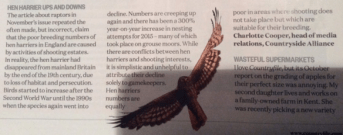
Hen harrier ups and downs

The article about raptors in November’s issue repeated the often made, but incorrect, claim that the poor breeding numbers of hen harriers in England are caused by activities of shooting estates. In reality, the hen harrier had disappeared from mainland Britain by the end of the 19th century, due to loss of habitat and persecution. Birds started to increase after the Second World War until the 1990s when the species again went into decline. Numbers are creeping up again and there has been a 300% year-on-year increase in nesting attempts for 2015 – many of which took place on grouse moors. While there are conflicts between hen harriers and shooting interests, it is simplistic and unhelpful to attribute their decline solely to gamekeepers. Hen harrier numbers are equally poor in areas where shooting does not take place but which are suitable for their breeding.Ā Charlotte Cooper, Head of Media Relations, Countryside Alliance.

It’s not the first time the Countryside Alliance has been in full-blown denial about the extent of hen harrier persecution on driven grouse moors (e.g. see here), and undoubtedly it won’t be the last.

The real reality (not the CA’s version of it) looks like this, this, this,Ā this, this, thisĀ etc etc.Ā The persistent denial of what everyone else knows to be true (including the Westminster & Scottish governments), is yet another reason why DEFRA’s Hen Harrier Action Plan is set to fail. There are many other reasons too, and some of them have been described here.

The e-petition to ban driven grouse shooting closes this Thursday. So far, over 30,000 UK citizens have signed it. It’s a much more effective Action Plan than anything DEFRA and it’s grouse-shooting-hen-harrier-killing-mates have come up with. Please sign HERE

DEFRA finally publishes its Hen Harrier Action Plan

hh LAURIE CAMPBELLDEFRA has today published its long awaited Hen Harrier Action Plan.

As expected, the six ‘actions’ that apparently will contribute to the recovery of the hen harrier are as follows:

  1. Monitoring of hen harrier populations in England and the UK
  2. Diversionary feeding of hen harriers on grouse moors
  3. Analyse monitoring data and build intelligence picture
  4. Nest and winter roost site protection
  5. Reintroduce hen harriers to southern England
  6. Trial a brood management scheme

In its current format, the Action Plan provides a general overview and outline of all six actions. There’s very little detail available, which makes it a difficult plan to critique in full, but a few things did jump out.

Diversionary feeding has proven to be successful at deterring hen harriers from eating loads of red grouse at the Langholm Moor Demonstration Project. However, in this action plan grouse moor owners are only being ‘encouraged’ to use diversionary feeding as a course of ‘best practice’. That means that they are not obliged to implement diversionary feeding as a first course of action to reduce the conflict, which seems a bit odd.

Monitoring of hen harrier populations and the subsequent analysis of those data will continue, to ‘build the intelligence picture’. Nothing new there, and monitoring would continue with or without this action plan anyway. How those data will be used isn’t all that clear. The action plan states that a direct benefit will be ‘increased awareness of any hotspots of illegal activity and may allow better preventative measures to be taken at specific sites‘. That’s hardly inspiring. The hotspots are already well known (just look for the nearest driven grouse moor) and there’s not much that can be done if adult males are being killed away from the nest whilst they forage on neighbouring ground. We saw that last May with the ‘disappearance’ (killing) of five adult males.

Nest and winter roost site protection. Again, the nest sites (when the birds have been allowed to settle) are already well monitored and that would continue without this action plan. Protection of roost sites is much more problematic, especially when the harrier killers are armed with night vision and thermal imaging kit, and there isn’t any information about how this protection might be delivered.

The plan to reintroduce hen harriers to the lowlands of southern England needs much further scrutiny. At the moment the proposal is based on an unpublished feasibility report so it’s hard to comment on that. Nevertheless, the general principle of reintroducing the hen harrier is open to question. One of several IUCN criteria that have to be met before a reintroduction of any species can go ahead is that the cause of the species’ (local) extinction needs to have been both identified and rectified. If persecution of the hen harrier is the main reason for its absence in these areas, where’s the evidence that persecution has been addressed?

The final action point is undoubtedly the most controversial – a trial brood management (meddling) scheme. Brood management, in this context, means removing hen harrier eggs/chicks from driven grouse moors when hen harriers have reached a certain density on that moor (or on nearby moors) and rearing them in captivity and then releasing them at fledging age. We’ve blogged about this a lot, ever since the Hawk & Owl Trust announced almost a year ago that it was the way forward. It’s not an action we would support under any circumstances, no matter what the hen harrier population size is. In our view, it amounts to legalised persecution. If driven grouse shooting can’t exist without the need to remove hen harriers then it either needs to lower its expectations (bag size) or cease to exist.

Nevertheless, it’s interesting to read what this action plan says about the proposed brood meddling trial. It refers to a paper that was published last August (Elston, Spezia, Baines & Redpath: Working with stakeholders to reduce conflict – modelling the impact of varying hen harrier densities on red grouse populations). The action plan says brood meddling will be guided by hen harrier densities as determined in this paper. The generally accepted consensus is that once there are 70 breeding pairs of hen harriers in the English uplands, then brood meddling can be considered (depending on the density of hen harriers at a local scale). However, this calculation was made based on the cyclical boom and bust of red grouse populations. Not only have those natural grouse cycles now been eradicated (by the use of medicated grit – see here), but post-breeding densities of red grouse are currently higher than in previous years (an incredible mean density of 382 red grouse per km2, according to the GWCT – see here), which means that those moors can support a higher density of hen harriers. In real terms, this means the target density for hen harriers should be increased accordingly (i.e. there should be more than 70 breeding pairs before brood meddling is implemented).

Having said that, we’re not too concerned about the immediate onset of a brood meddling trial in England because we simply can’t see the driven grouse shooting industry tolerating 70 (+) pairs of breeding hen harriers. Last year there were six successful pairs in the whole of England – an area capable of supporting 300+ pairs. And that pathetic figure was a result of the driven grouse shooting industry supposedly ‘being on side’ and ‘fully supporting hen harrier conservation’!

Interestingly, Martin Harper (RSPB Conservation Director) has blogged about the launch of the action plan (here) and although he acknowledges it isn’t perfect, he says he welcomes it. Eh? The last we heard, the RSPB was still challenging the brood meddling aspect of the plan – what’s changed?

No doubt we’ll be blogging more about the action plan as the 2016 hen harrier breeding season pans out.

Download DEFRA’s Hen Harrier Action Plan here:Ā DEFRA hen-harrier-action-plan-england-2016