Vicarious liability prosecution: Andrew Duncan (Newlands Estate) part 7

Criminal proceedings continued on 17th June against landowner Andrew Walter Bryce Duncan, who is alleged to be vicariously liable for the crimes committed by gamekeeper William (Billy) Dick in April 2014.

Gamekeeper Dick was convicted in August 2015 of killing a buzzard on the Newlands Estate, Dumfriesshire by striking it with rocks and repeatedly stamping on it (see here). Dick was sentenced in September 2015 and was given a £2000 fine (see here), although he is appealing his conviction.

Here’s a quick review of the proceedings against Andrew Duncan so far:

Hearing #1 (18th August 2015): Trial date set for 23rd Nov 2015, with an intermediate diet scheduled for 20th Oct 2015.

Hearing #2 (20th October 2015): Case adjourned. November trial date dumped. Notional diet hearing (where a trial date may be set) scheduled for 18th January 2016.

Hearing #3 (18th January 2016): Case adjourned. Another notional diet & debate scheduled for 11th March 2016.

Hearing #4 (11th March 2016): Case adjourned, pending the result of gamekeeper Billy Dick’s appeal. Another notional diet scheduled for 4th April 2016.

Hearing #5 (4th April 2016): Case adjourned, pending the result of gamekeeper Billy Dick’s appeal. Another notional diet scheduled for 3rd June 2016.

Hearing #6 (3rd June 2016): Case adjourned, pending the result of gamekeeper Billy Dick’s appeal. Another notional diet scheduled for 17th June 2016.

Hearing #7 (17th June 2016): Case adjourned, pending the result of gamekeeper Billy Dick’s appeal. Another notional diet scheduled for 15th July 2016.

For those interested in gamekeeper Billy Dick’s appeal, we blogged about it here.

Vicarious liability in relation to the persecution of raptors in Scotland (where one person may potentially be legally responsible for the criminal actions of another person working under their supervision) came in to force four and a half years ago on 1st January 2012. To date there have been two successful convictions: one in December 2014 (see here) and one in December 2015 (see here).  One further case did not reach the prosecution stage due, we believe, to the difficulties associated with identifying the management structure on the estate where the crimes were committed (see here).

Henry’s picnic Sat 25 June: Yorkshire Dales National Park

HowMany (2)
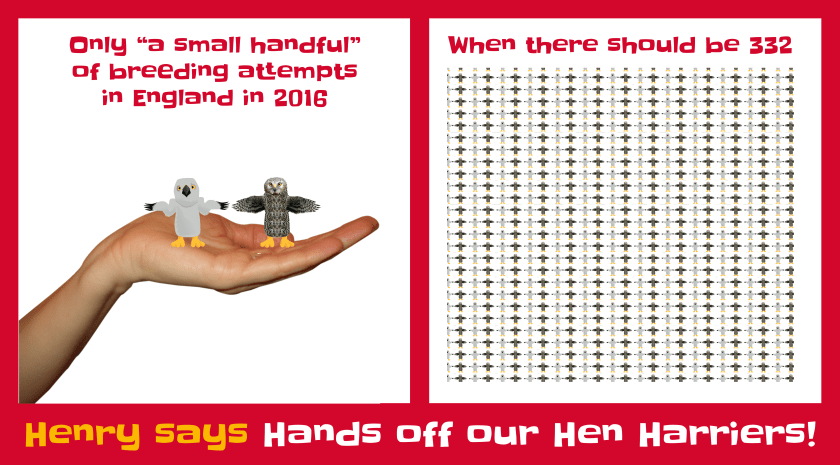
Next week, on Saturday 25 June, whether we have voted Brexit or Remain, there will be a Hen Harrier rally to mark this year’s virtual absence of nesting Hen Harriers from the English uplands.
Full details will appear here and elsewhere next Wednesday but we have now been told by the organisers that it will be in the Yorkshire Dales National Park.  Watch this space.
HandOffRed2

Case against gamekeeper Stanley Gordon re shot hen harrier Part 2

Criminal proceedings continued at Elgin Sheriff Court yesterday against Scottish gamekeeper Stanley Gordon.

Mr Gordon, 60, of Cabrach, Moray, is facing charges in connection with the alleged shooting of a hen harrier in June 2013.

The case continued without plea and the next hearing will be 14th July 2016.

Previous blog on this case here


General Licence restriction not worth paper it’s written on

SNH logo 2Further to yesterday’s blog about the status of the General Licence restriction on Raeshaw Estate (see here), SNH has now provided an explanation.

You’d better make sure you’re sitting down:

Thank you for your email to Andrew Bachell. I am writing to give you an update.

SNH issued a restriction on the use of General Licences in two separate locations in November 2015. Following this, Raeshaw Farms Limited petitioned the Courts to seek a Judicial Review (JR) of our decision. The Court has yet to make a decision as to whether or not a JR will proceed but we expect a decision shortly.

As an interim measure during the petitions process the Judge suspended the restriction up until 10th June 2016. This date has now passed and the use of General Licences on this land is once more prohibited. Our website has been updated accordingly.

In response to an application from Raeshaw Farms Limited, we have granted them an individual licence to carry out some activities otherwise permitted under General Licence. This licence is subject to specific conditions and controls. This will allow the business to continue to operate but under tighter scrutiny rather than the relatively ‘light touch’ approach to Regulation that General Licences afford.

We will issue a press statement once the legal proceedings have concluded.

Yours sincerely,

Nick Halfhide, SNH Director of Operations

END

This is unbelievable, even by SNH standards.

SNH issued a General Licence restriction order on Raeshaw Estate as a sanction for recent alleged raptor persecution crimes, on the basis of evidence provided to SNH by Police Scotland (see here and here). Even though that evidence wasn’t enough for a criminal prosecution, SNH must have been satisfied that it was sufficient to warrant this penalty, otherwise they wouldn’t have issued the GL restriction order.

Raeshaw Estate has been the subject of several police raids in connection with alleged wildlife crime since 2004, although none have resulted in a prosecution (see here).

SNH’s procedures for issuing a GL restriction are now subject to a potential judicial review but the GL restriction is now back in place on Raeshaw Estate after a temporary suspension by the court.

So why the hell has SNH now issued an individual licence to permit the very activities their GL restriction is supposed to prevent?!

What is the point of having a GL restriction in place if SNH is then going to totally undermine it by issuing an individual licence?

SNH says the individual licence is “subject to specific conditions and controls”. And what might they be? Unless you’ve got an enforcement officer shadowing the individual licence holder (wholly impractical and unrealistic), SNH is placing a huge amount of trust in the individual licence user to comply with these ‘specific conditions and controls’. That’ll be the trust that SNH deemed absent from the estate when it issued the GL restriction order.

UNBELIEVABLE. Remember this the next time the Scottish Government says it’s getting tough on wildlife crime.

Mossdale Estate resigns from Moorland Association over illegal pole traps incident

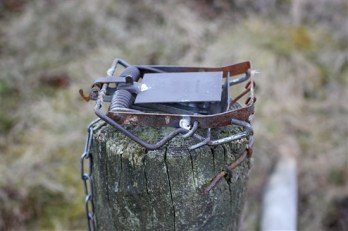
pole trapIt’s been two weeks since the news emerged that a gamekeeper on the Mossdale Estate in the Yorkshire Dales National Park had been filmed setting three illegal pole traps on a grouse moor where a female hen harrier had been observed hunting (see here).

It’s been 12 days since the Moorland Association admitted that the owner of Mossdale Estate was a member of the MA (see here) and how disgusted they were that these crimes had taken place, but not quite disgusted enough to kick the owner out of their organisation.

It’s taken them a while (perhaps because they were still recovering from being “very sad” over the National Trust’s decision to terminate the lease of a grouse moor tenant in the Peak District National Park (see here) but now the Moorland Association is in full damage limitation mode.

The following statement has just appeared on their website:

Illegally set traps – final statement

15th June 2016

Statement from Moorland Association Director, Amanda Anderson:

“The MA has formally reviewed the incident on Mossdale Estate where an underkeeper admitted to setting traps illegally. The keeper is no longer employed by the estate. Mossdale has also resigned its membership of the MA”.

END

So, still not quite disgusted enough to expel this member, then?

And what of the gamekeeper, ‘no longer employed by the estate’? Was he allowed to resign or was he sacked? And is/was he a member of the National Gamekeepers’ Organisation? We did ask this question 12 days ago but the National Gamekeepers’ Organisation hasn’t yet responded. Perhaps they too have been ‘very sad’ about recent events and haven’t yet been able to face the world. Let’s ask them again. Emails to: info@nationalgamekeepers.org.uk 

There’s some other unfinished business also relating to these crimes. We’re still waiting to hear back from Acting Assistant Chief Constable Amanda Oliver of North Yorkshire Police, who 15 days ago promised “a full review” of why this criminal gamekeeper was let off with a police caution instead of being prosecuted (see here). To be fair, she was on holiday when she made this promise so we’re happy to give her a bit more time to publish her findings.

Photo: one of three illegal pole traps found on the Mossdale Estate. (Photo by RSPB Investigations).

Police investigate suspicious death of tenth red kite in North Yorkshire

RKHarrogateNorth Yorkshire Police are investigating the suspicious death of yet another red kite – the tenth red kite to have been either shot or found dead in suspicious circumstances in North Yorkshire in the last few months.

The latest victim was found at Timble Ings near Harrogate, just a short distance from Blubberhouse Moor where another red kite was found shot and critically injured a few weeks ago (see here).

Although the cause of death of this latest red kite has not yet been established, it’s not difficult to see why North Yorkshire Police are treating it as suspicious at this stage. The eastern side of the Yorkshire Dales National Park and the adjoining Nidderdale AONB are notorious black spots for illegal raptor persecution, particularly for hen harriers (see here) and red kites (see here). The area is dominated by driven grouse moors.

Article on the latest dead red kite can be read in the Harrogate Advertiser here

UPDATE 5.30pm: North Yorkshire Police have now confirmed this red kite had been shot. Well done to them for putting out a quick statement and appeal for information (here).

E-petition to ban driven grouse shooting can be signed here

Mountain hare massacres on Scottish grouse moors: no planned monitoring

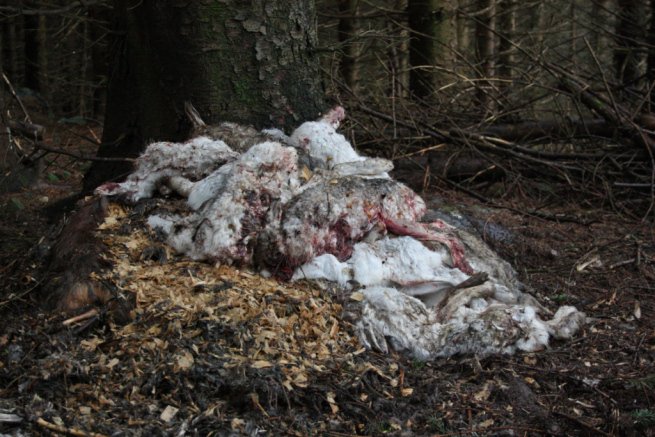
Last month we blogged about a series of Parliamentary questions and answers about mountain hare massacres on Scottish grouse moors and how these unregulated culls are, in our opinion, in breach of EU conservation legislation (here).
mountain-hare-cull-angus-glens-large-copy

Those Parliamentary questions had been lodged by Scottish Greens MSP Mark Ruskell. Now Alison Johnstone, a fellow Scottish Greens MSP, has lodged some more and the Government’s response to those questions is, frankly, shocking.

Question S5W-00222. Date lodged: 25/5/2016:

To ask the Scottish Government what it is doing to establish a working group to help plan the future arrangements for sustainable management of mountain hares.

Answered by Environment Cabinet Secretary Roseanna Cunningham 3/6/2016:

Under the auspices of Scotland’s Moorland Forum (which represents a range of stakeholders involved in moorland management, including the Scottish Government and Scottish Natural Heritage) it has been agreed that guidance on the management of mountain hare be produced by a selected sub-group of specialists and representatives from relevant interest groups. The inaugural meeting of this sub-group took place on 23 May 2016.

The sub-group will produce and publish interim best practice guidance in the autumn. This interim guidance will be updated after the anticipated publication (in 2017) of the findings from a study being undertaken by the James Hutton Institute, the Game and Wildlife Conservation Trust and Scottish Natural Heritage into the most appropriate methods of assessing mountain hare numbers.

The outputs of the study will be used to standardise the method of establishing mountain hare density in conjunction with the promotion of more cooperative working between estates, thus facilitating better informed decisions on sustainable hare management at regional scale.

Question S5W-00223. Date lodged: 25/5/2016:

To ask the Scottish Government what level of estate compliance Scottish Natural Heritage has recorded in relation to its 2014 position statement, ‘SNH-GWCT-SLE position on large-scale culls of mountain hares to reduce louping ill‘.

Answered by Environment Cabinet Secretary Roseanna Cunningham 3/6/2016:

The position statement issued by Scottish Natural Heritage, the Game and Wildlife Conservation Trust, and Scottish Land and Estates sets out a number of different recommendations relating to the management of mountain hares in Scotland. There are no formal arrangements for monitoring the extent to which the recommendations are being followed.

Question S5W-00224. Date lodged: 25/5/2016:

To ask the Scottish Government when SNH plans to require formal mountain hare cull returns from estates in order to inform future sustainable management practice for this species.

Answered by Environment Cabinet Secretary Roseanna Cunningham 8/6/2016:

There are no current plans to require mountain hare bag returns.

END

So ‘best practice guidance’ is to be produced in the autumn by a sub-group of the Moorland Forum. We don’t yet know which organisations have representatives on that sub-group but we can take a guess. One of them is bound to be Scottish Land & Estates – that’s the group that repeatedly says, without any supportive evidence, that widespread and indiscriminate culls are not having a detrimental effect on mountain hare populations.

And will that ‘best practice guidance’ follow the recommendations made in a recent independent review on sustainable moorland management which was submitted to SNH’s Scientific Advisory Committee in October 2015? One of the main recommendations made in that review was that the case for widespread and intensive culling of mountain hares in the interests of louping-ill control has not been made (see here). That should, technically, put a stop to mountain hare massacres on grouse moors. Why hasn’t it?

And what, exactly, is the point of producing best practice guidelines anyway? The estates involved in mountain hare massacres are not obliged to adhere to these ‘guidelines’, and, as we can see from the Government’s responses to the two other Parliamentary questions, there are no formal arrangements for monitoring estate compliance and nor are there any plans to require these estates to submit figures on how many hares they’ve massacred each year.

Why is that? How difficult is it to actually monitor estate compliance? If it is so very difficult, there is no point whatsoever in producing best practice guidelines for an industry with a reputation for long-term criminality. Guidelines can be ignored without suffering a penalty. Legislation can, and often is, ignored by many in this industry but at least there’s the (very slim) possibility of a penalty if they’re caught at it.

And what possible reason is there not to ask for annual cull figures from each estate? Why isn’t the Government demanding these figures? Surely they are obliged to do so in accordance with their obligations under the EU Habitats Directive? It can’t be that difficult for the estates to produce these figures. After all, they claim their culls are already ‘done in accordance with best practice’ and are ‘informed and balanced’ (see here). If they can make such claims then presumably they’ve already got the evidence to back them up? If they haven’t got the evidence then these claims should be treated with the contempt they deserve. It’s just another propaganda exercise to deflect attention from what’s actually going on on those grouse moors.

Hares_Lecht_25Feb2016 (2) - Copy

The Scottish Government’s lack of critical evaluation of this situation, their willingness to ignore the findings of an independent review, and their unwillingness to take any meaningful steps to prevent the ongoing extensive and indiscriminate slaughter of this so-called protected species at the hands of grouse moor managers is nothing short of disgraceful.

Has Raeshaw Estate lost Judicial Review re: General Licence restriction?

Regular blog readers will know we’ve been interested in the General Licence restrictions imposed by SNH on two grouse shooting estates for suspected raptor persecution crimes, see here and see overview of events to date here.

In April 2016, one of those estates, Raeshaw, near Heriot in the Scottish Borders, submitted an application for a judicial review of the process SNH used to implement the General Licence restriction.

While that application was underway, SNH put a temporary suspension on Raeshaw’s General Licence restriction (meaning the estate was now entitled to carry on trapping and killing wildlife under the terms of the General Licence), and in May 2016 SNH announced on its website that the temporary suspension would be in place ‘until further notice’:

Raeshaw SNH temp restriction again 20 May 2016

We just looked at SNH’s website again, and it now appears that the temporary suspension has been lifted and the General Licence restriction on Raeshaw Estate has now been reinstated:

SNHGL14June2016 - Copy

That’s interesting. Does that mean that Raeshaw Estate lost the judicial review against SNH’s procedures? Was there even a judicial review? Perhaps Raeshaw’s application for a judicial review was denied by the court?

It’s hard to know! We can’t find any statement about this, anywhere. No SNH press release, nothing. We tried to contact SNH’s media lead on wildlife crime but she’s away on leave until 5th July.

Marvellous.

It’s important to understand what happened in this case for several reasons. The public needs to know whether Raeshaw Estate is again banned, as it appears, from using certain types of traps, because then we’ll know whether those traps, if found, should be reported to the Police. You’d think SNH, as the agency that has implemented this General Licence restriction, would want to publicise this as much as possible to help with enforcement measures. It’ll be members of the public who play a crucial role in this because the Police can’t just turn up on Raeshaw ‘to have a look’ unless they have reason to suspect a crime has been committed e.g. if a passing hill walker has reported trap use on this estate.

It’s also important to understand what happened in this case because whatever did happen has huge implications for other future General Licence restrictions which SNH may choose to impose. If the judicial review failed because the court decided SNH’s procedures were fair, then this opens the floodgates and SNH can get on with imposing other General Licence restrictions that they may have been sitting on pending the result of the judicial review. If there wasn’t a judicial review because Raeshaw Estate’s application for one was rejected by the court, are there other legal options available to Raeshaw to contest the General Licence restriction? If there are other options, what are they and what impact will they have on SNH’s ability to impose further General Licence restrictions on other estates suspected of raptor persecution?

A bit of transparency from SNH wouldn’t go amiss here.

Emails to Andrew Bachell, SNH Director of Policy: Andrew.Bachell@snh.gov.uk

Vicarious liability prosecution: Andrew Duncan (Newlands Estate) part 6

Criminal proceedings continued on 3rd June against landowner Andrew Walter Bryce Duncan, who is alleged to be vicariously liable for the crimes committed by gamekeeper William (Billy) Dick in April 2014.

Gamekeeper Dick was convicted in August 2015 of killing a buzzard on the Newlands Estate, Dumfriesshire by striking it with rocks and repeatedly stamping on it (see here). Dick was sentenced in September 2015 and was given a £2000 fine (see here), although he is appealing his conviction.

Here’s a quick review of the proceedings against Andrew Duncan so far:

Hearing #1 (18th August 2015): Trial date set for 23rd Nov 2015, with an intermediate diet scheduled for 20th Oct 2015.

Hearing #2 (20th October 2015): Case adjourned. Nov trial date dumped. Notional diet hearing (where a trial date may be set) scheduled for 18th January 2016.

Hearing #3 (18th January 2016): Case adjourned. Another notional diet & debate scheduled for 11th March 2016.

Hearing #4 (11th March 2016): Case adjourned, pending the result of gamekeeper Billy Dick’s appeal. Another notional diet scheduled for 4th April 2016.

Hearing #5 (4th April 2016): Case adjourned, pending the result of gamekeeper Billy Dick’s appeal. Another notional diet scheduled for 3rd June 2016.

Hearing #6 (3rd June 2016): Case adjourned, pending the result of gamekeeper Billy Dick’s appeal. Another notional diet scheduled for 17th June 2016.

For those interested in gamekeeper Billy Dick’s appeal, we blogged about it here.

Vicarious liability in relation to the persecution of raptors in Scotland (where one person may potentially be legally responsible for the criminal actions of another person working under their supervision) came in to force four and a half years ago on 1st January 2012. To date there have been two successful convictions: one in December 2014 (see here) and one in December 2015 (see here).  One further case did not reach the prosecution stage due, we believe, to the difficulties associated with identifying the management structure on the estate where the crimes were committed (see here).

Scarey man on an Angus Glens grouse moor

SCAREY MAN - CopyHere’s another entry for the Mysterious Visiting Fairies’ Guide to Getting Rid of Hen Harriers on Grouse Moors.

Filmed on a grouse moor in the Angus Glens (that well-known ‘wildlife haven‘) last week, it’s really little wonder that hen harriers haven’t bred on these grouse moors since 2006.

This is a Scarey Man Birdscarer. Powered by a 12 volt battery it can be set to display every 18 minutes for 25 seconds. It emits a loud noise (siren) and can also be illuminated for night work.

Turn up the volume, sit back and enjoy the short video HERE