Young satellite-tagged hen harrier ‘Elwood’ disappears on Monadhliath grouse moor just weeks after fledging

ElwoodWith depressing predictability, news has emerged that one of this year’s young satellite-tagged hen harriers (a male called ‘Elwood’) has ‘disappeared’ on a grouse moor in the Monadhliath mountains just a few weeks after he fledged from his nest in Banffshire.

RSPB press release:

Another satellite-tagged bird of prey disappears in the Monadhliath Mountains

RSPB Scotland has today announced that a young male hen harrier, fitted with a satellite transmitter as part of the charity’s part EU funded Hen Harrier LIFE+ Project, has gone missing on a grouse moor in the Monadhliath Mountains, south-east of Inverness.

The bird, named Elwood, was the only chick to fledge from a nest in Banffshire, which was being monitored under the Partnership for Action against Wildlife Crime Scotland (PAW Scotland) ‘Heads-up for Harriers scheme’.

The transmitter’s data, being monitored by RSPB Scotland staff, indicated that the young bird fledged from its nest in the first week of July, but stayed close to the site in the hills above the River Spey until the 20th, when he began to travel more widely. By the 27th, he had moved 20 miles to the south west, and had settled in the hills around Tomatin.

The bird remained in this area, with the transmitter providing detailed information about his daily travels until suddenly, transmissions ceased abruptly on August 3rd. The bird’s last recorded position was on an area of managed moorland a few miles from the Slochd summit on the A9.

Last week, news emerged that eight satellite-tagged golden eagles had also disappeared in the northern Monadhliaths in the last five years, with three of these birds, whose transmitters were also functioning normally, going ‘off the radar’ this spring [see here].

Ian Thomson, RSPB Scotland’s Head of Investigations, said: “This latest disappearance of a satellite-tagged bird is deeply concerning, and joins the long list of protected birds of prey that have been confirmed to have been illegally killed or disappeared suddenly in this area. The transmitters being fitted to these birds are exceedingly reliable, and illegal persecution is therefore the most likely explanation of the disappearance of these birds of prey. The absence of typical breeding raptor species from areas of suitable habitat, or at traditional nesting sites, in large parts of the Monadhliaths is further supporting evidence of a major problem with wildlife crime in this general area.

This case is all the more depressing as the nest from which Elwood successfully fledged was monitored as part of a partnership project between PAW Scotland and the local landowner. It proves, yet again, that despite there being a good number of enlightened estates who are happy to host and protect nesting birds of prey – as soon as they move away from these areas they are being illegally killed.

The denials and obfuscation from representatives of the land management sector, and their consistent failure to acknowledge and address this problem, is one of the main reasons why our bird of prey populations are struggling in the central and eastern Highlands. We repeat our call to the Scottish Government to introduce a robust system of licensing of game bird hunting, where the right to shoot is dependent on legal and sustainable management of the land, in line with approaches adopted in most other European countries.”

END

So what now, Roseanna Cunningham, Cabinet Secretary for the Environment? How are you going to react to this one? Are you going to tell us how ‘disappointed’ you are? Are you going to tell us that more research needs to be done to understand why driven grouse moors in Scotland are almost devoid of breeding hen harriers (and golden eagles and peregrines)? Are you going to tell us that the Partnership for Action against Wildlife Crime is effectively addressing this problem? Are you going to believe the lies of the organisations within the grouse-shooting industry that there is ‘no evidence’ that raptors are routinely and systematically killed on driven grouse moors? Are you going to tell us you’re still looking for ‘a pattern of suspicious activity’? Are you going to tell us that you will ‘not hesitate to take further action if deemed necessary’? Are you going to tell us we need to wait to see whether previous anti-persecution measures are working?

How about you tell us that you’ve had enough, that you believe that further action IS necessary and that you’ll be using your powers as Cabinet Secretary for the Environment to put an end to this shameful slaughter?

You could support the call for an introduction of licensing for all gamebird hunting in Scotland, so that these grouse-shooting estates can finally be held to account for their criminal acts. Well, assuming any licensing system is actually properly enforced, but that’s another matter.

And you really should pay attention to the strength of feeling against driven grouse shooting that has emerged south of the border (with considerable support from Scottish voters, too), which will now result in a parliamentary debate in Westminster later this autumn on the subject of banning driven grouse shooting.

Whatever you do, plenty of people here, and around the world, are watching.

Coordinated hunt & shooting of a hen harrier in 2013 – location revealed

A couple of years ago (20 June 2014) we blogged about the alleged coordinated hunt and shooting of a male hen harrier on a grouse moor in Scotland (see here).

This alleged crime had actually taken place in May 2013 – it was reported to Police Scotland by the two members of the public who had witnessed the event, Police Scotland investigated but no further evidence was available to take the case forward.

For some reason, Police Scotland failed to publicise this incident or appeal for information, despite hen harrier persecution being a UK National Wildlife Crime Priority. Instead, it was left to the RSPB to issue a press release over a year later (see here) as part of a wider call for more sporting estates to take action to protect hen harriers.

At the time, the location of this incident was pretty sketchy. The RSPB press release said it took place ‘on a moor in the eastern Cairngorms, within the boundary of the Cairngorms National Park’.

But then roll on to late 2015 and the publication of RSPB Scotland’s 20-year review of raptor persecution crimes. If you have a look at Table 3 in this report, which details confirmed incidents of persecution or attempted persecution (excluding poisoning) of birds of prey in Scotland 2013, the following information appears:

HH shot Glen Gairn

According to this table, a hen harrier was shot at ‘Glen Gairn’ in Aberdeenshire in May 2013. We presume, given the date and location, this is the same incident as referred to in that 2014 RSPB press release.

So, Glen Gairn. Where’s that then?

Well, would you believe, part of Glen Gairn appears to lie at the eastern boundary of Invercauld Estate, not a million miles from where those illegally-set spring traps were recently discovered at Gellaig Hill. (Map detail created from information provided on Andy Wightman’s Who Owns Scotland website).

Glen Gairn final - Copy

Now, we should urge caution here before anyone jumps to conclusions. This map is slightly misleading because it suggests that Glen Gairn lies entirely within the boundary of Invercauld Estate. It doesn’t. Glen Gairn extends east across the river, beyond the Invercauld Estate boundary, and on to the grouse moors of neighbouring Dinnet Estate.

We don’t know exactly where in Glen Gairn those two members of the public watched the alleged coordinated hunt and then shooting of that male hen harrier in 2013. It could have been on the Dinnet side of the Glen, or it could have been on the Invercauld side of the Glen, or it could have extended across both sides of the Glen. We don’t know, but presumably Police Scotland will know if those two members of the public were able to give accurate grid references.

As so often happens, there was insufficient evidence to proceed with a prosecution so we have no idea who was responsible. It must have been the handiwork of those pesky moorland fairies. They do seem to be quite active in this part of the Cairngorms National Park, don’t they?

More on the General Licence restriction fiasco at Raeshaw Estate

Regular blog readers will know we’ve been writing about the General Licence (GL) restriction order placed on Raeshaw Estate (Scottish Borders) for some time (see here for a summary). The restriction order was implemented due to alleged raptor persecution incidents reportedly taking place on the Estate (according to evidence provided by Police Scotland), even though nobody has been charged with any criminal offence and the Estate has denied any responsibility.

This restriction order, placed by SNH in November 2015, has been on and off for months, temporarily suspended and then reinstated as Raeshaw Estate mounted various legal challenges over the following months.

Currently, the GL restriction order is back in place, although the courts have now authorised a Judicial Review of the process used by SNH to implement this restriction. We don’t know when that Judicial Review will take place.

IMG_6934 - Copy

In the meantime, in June 2016 we learned (see here) that even though the GL restriction order was back in place, SNH had issued what it called an ‘individual licence’, permitting the Estate to carry out some activities (bird-killing) that the GL restriction was supposed to prevent! In our opinion, issuing an individual licence completely defeats the object of implementing a GL restriction order in the first place. But not according to SNH. They issued a statement and we were particularly interested in the following bit:

In response to an application from Raeshaw Farms Limited, we have granted them an individual licence to carry out some activities otherwise permitted under General Licence. This licence is subject to specific conditions and controls. This will allow the business to continue to operate but under tighter scrutiny rather than the relatively ‘light touch’ approach to Regulation that General Licences afford”.

We wanted to know more about this ‘individual licence’, e.g. its duration, what activities were permitted/not permitted, and particularly the details of the ‘specific conditions and controls’ of that licence. So we (and a couple of others, thank you) submitted some FoIs to SNH to try and find some answers.

What we’ve found is a woefully inadequate system that has not received the promised “tighter scrutiny” and is wide open to abuse.

Here is a copy of the ‘individual licence’: Raeshaw Individual Licence 1_June2016

As you’ll see, ‘individual licence’ is a bit of a misnomer as it names one licence holder but then a further five ‘agents’ who are permitted to use this ‘individual’ licence.

This licence is valid from 10 June 2016 to 31 December 2016. The specific conditions include set dates for when certain species can be killed and the area where this killing may take place. Of interest to us:

  1. Carrion crow, magpie and greater black-backed gull may only be taken or killed UNTIL 30 JUNE 2016.
  2. Rook, jackdaw and wood pigeon may only be taken or killed UNTIL 31 AUGUST 2016.

Why are these two conditions of interest to us? Well, because another condition of this licence (condition #5) is that ‘Prior to exercising this licence, SNH licensing must be provided with details of the number, type and locations of deployment (to 6-figure grid reference) of all traps proposed to be used under this licence‘.

We asked SNH how many traps the licence holder had proposed to use, and the date that SNH received this information.

SNH’s reply: ‘The licence holder informed us on 12 July that they intended to deploy 3 multi-catch traps (ladder traps) at specified locations from 15 July“.

So, the individual licence only permits the taking and killing of carrion crows until 30 June 2016, and yet the licence holder notified SNH in mid-July that three crow traps would be deployed from 15 July 2016. Eh? How will the licence holder prevent carrion crows from entering these, er, crow traps, and if the carrion crows do enter, how will SNH know whether those carrion crows have been released unharmed?

Ah, well that’ll be the “tighter scrutiny” employed by SNH, right? They’ll have been monitoring the use of these traps to check for compliance, right?

Well, not quite. We asked SNH how many visits SNH (or an agent thereof) had made to this Estate to check compliance with licence conditions, and the dates those visits took place.

SNH’s reply (on 11 August 2016): “We have not yet visited the estate. However, compliance checks are an important part of the licensing process and will be carried out“.

Yeah, right.

We’ve also discovered that SNH has issued a second ‘individual licence’ to Raeshaw Estate. This one can be downloaded here: Raeshaw Individual Licence 2_July2016

This second licence permits the licence holder (and three agents) to kill certain species on the neighbouring Corsehope Farm. The licence is valid from 1 July 2016 to 31 December 2016.

Under this licence, collared doves, feral pigeons, wood pigeons, jackdaws, magpies, rooks and carrion crows may be taken or killed on this land until 15 October 2016 ‘to prevent damage to crops’ (ahem).

Also under this licence, all the above species plus greater and lesser black-backed gulls and herring gulls may be taken or killed on this land until 31 December 2016 ‘to prevent the spread of disease’ (ahem).

So, although the first licence (covering parts of Raeshaw Estate) only permitted the killing of certain species until 30 June 2016 and some other species until 31 August 2016, this second licence permits the unlimited killing of these same species on neighbouring land until 31 December 2016.

Can somebody please remind us what was the purpose of issuing a General Licence restriction order in the first place? Wasn’t it supposed to be a sanction/punishment for reported raptor persecution incidents? What’s the point of having a licensing system and supposed sanctions, if those sanctions can be sidestepped by simply issuing another licence and then not bothering to monitor compliance with those licence conditions?

Non existent windfarms blamed for ‘disappearing’ eagles in Monadhliaths

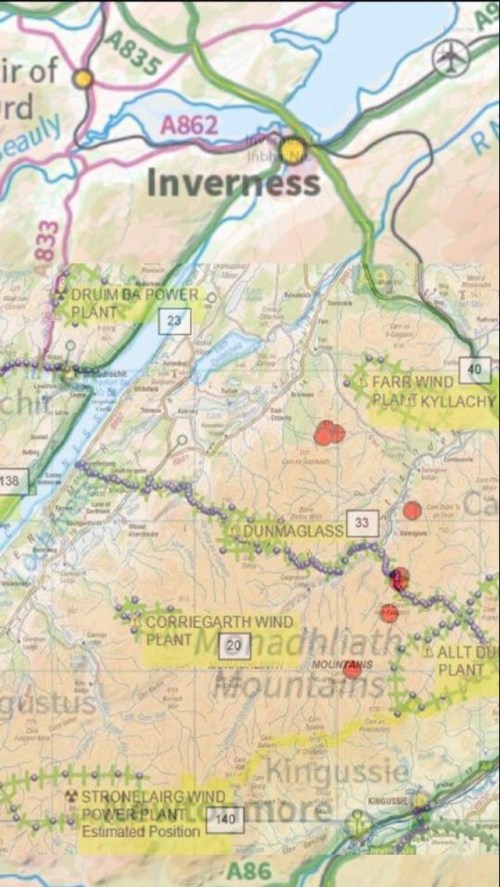
Soon after the recent news broke about the ‘disappearance’ of eight young satellite-tagged golden eagles in the Monadhliath mountains (see here), the following map started doing the rounds on social media. Raptor persecution deniers purported the map showed a landscape littered with eagle-slicing windfarms and suggested that it was turbine strikes, not criminal activity on grouse moors, that was responsible for the demise of these eagles.

windfarms not - Copy

At first glance, it looks quite plausible, doesn’t it? The last known locations of those ‘missing’ golden eagles (shown as red dots on this map) seem to be surrounded by windfarms. And some windfarms are notorious for slicing eagles in two (e.g. the Altamont Pass windfarm in California and the Smola windfarm in Norway are two extreme examples of the damage that can be caused by poorly-sited constructions). If you’re somebody with only a superficial knowledge of this subject, you could be forgiven for thinking, ‘Yeah, those eagles in the Monadhliaths have been killed by wind turbine blades & the windfarm companies have covered this up (by burying the corpses and the sat tags) because they don’t want the bad publicity’.

But when you start scratching at the surface of the above map, you find that not all is as it seems.

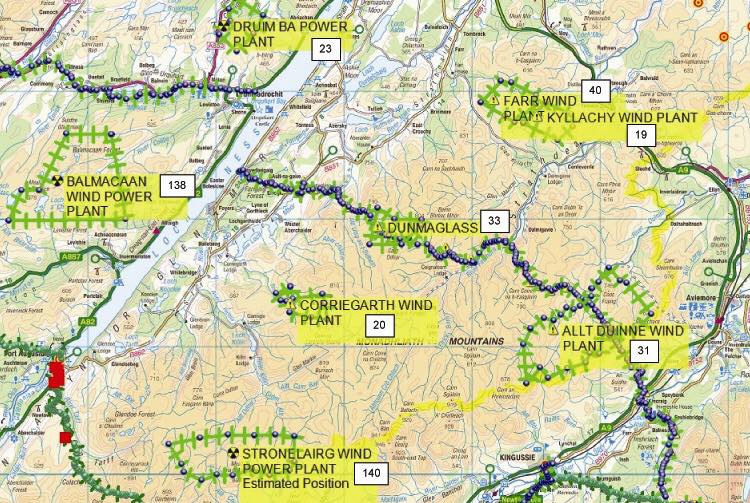
The original source map (showing just the windfarms, not the last known locations of those ‘missing’ eagles) comes from this site, dated 2011. Here it is in its original form:

windfarms wideangle - Copy

It looks pretty bad, doesn’t it? Well, it does if you assume that all these depicted windfarms have been built and are operational. And there’s the problem. You see, this map DOESN’T show operational windfarms at all, and nor did the original author intend that. Rather, this map depicts a number of windfarms that were, in 2011, at various stages of either proposal, scoping, application, construction, or operation.

The persecution denier who overlaid the last known locations of those eight golden eagles on to this map was hoping that nobody would look further than the image of some red dots surrounded by what they would think were a whole load of eagle-killing wind turbines. The hope was that this image would be enough to deflect the blame from the grouse moor estates and cause the unassuming general public to think the windfarms were to blame for the ‘disappearance’ of these eagles.

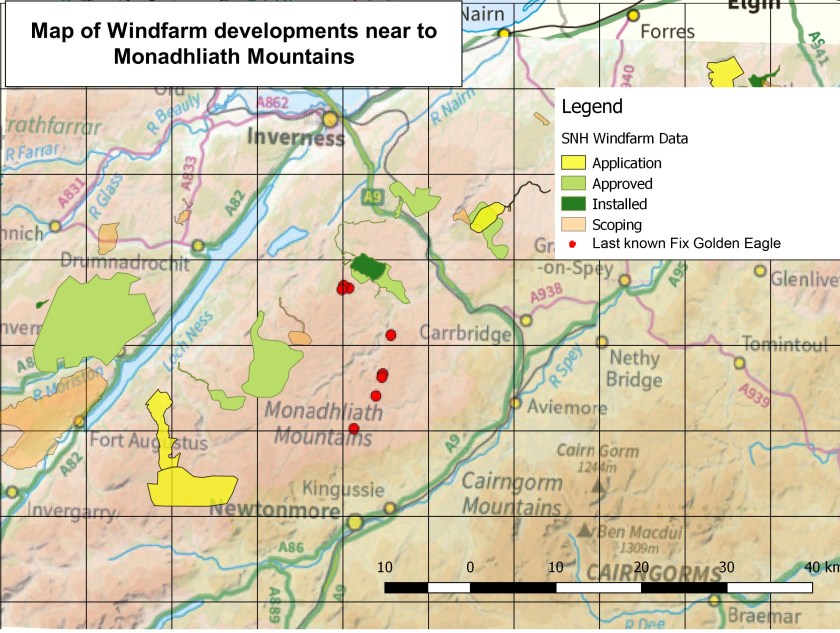
Well, sorry, persecution apologists, it just doesn’t wash. If you look at our map based on SNH data (below), this shows just how many of those windfarms are actually operational in 2016. Er, we make it one (on Farr Estate). The others have either been rejected or are at the early scoping or application stage, or have been approved but have yet to be installed. Oops!

Windfarm Monadhliath copy

Nice try, but given the long history of illegal eagle killing in the Monadhliaths (see here), as well as the long history of illegal eagle killing on driven grouse moors across Scotland (see here), you’d have to be pretty thick, or complicit, (not mutually exclusive, natch) to deny the bleedin’ obvious.

For those who are neither thick or complicit, please consider signing this petition, raised by the Scottish Raptor Study Group, calling for the Scottish Government to introduce a licensing scheme for all gamebird hunting, including grouse-shooting estates in the Monadhliaths. Petition closes 22 August 2016.

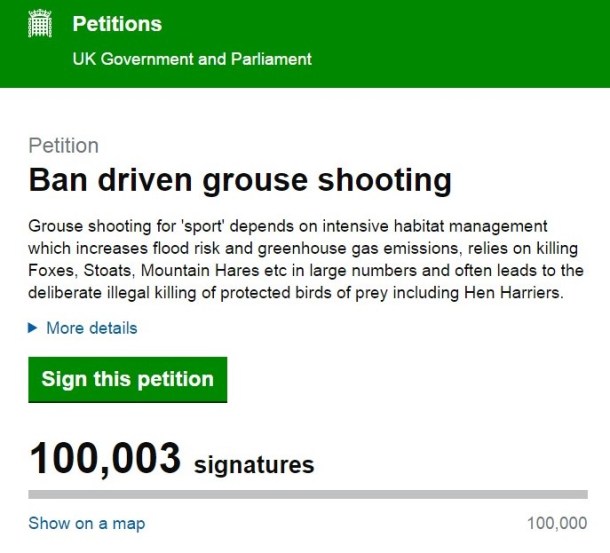
100,000 signatures to ban driven grouse shooting!

Never believe that a few caring people can’t change the world. For, indeed, that’s all who ever have” (Margaret Mead).

100k

Massive, massive kudos to Mark Avery, who started this (3 x petitions ago!) and didn’t give up. Well done, Mark, and thank you.

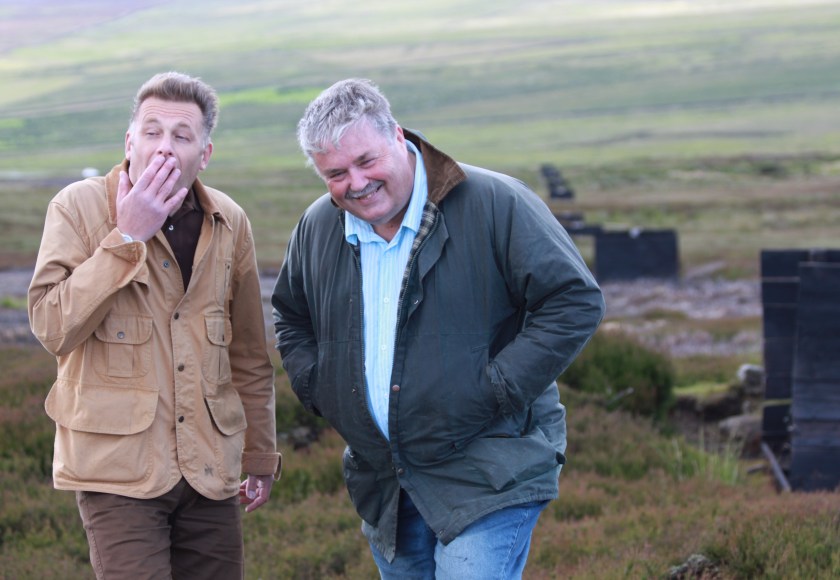
Special mention to Chris Packham, who, like Mark, has endured months of disgraceful abuse and harassment from the grouse-shooting community, much of it played out in the national media. In the end, coupled with the continuing raptor persecution and subsequent denials, it has helped this industry’s fall from grace.

A quote from Chris this morning:

“In the end you can’t argue with science, you can’t argue with evidence, you can’t argue with the truth. And the truth is that people are fed up with this ‘tradition’, the injustice and the lies. One hundred thousand people just started to make the world a better place for wildlife and every single one of them will be remembered for that”.

v happy Copy

The petition is still open (until 20 Sept 2016) – HERE

Game over: Marks & Spencer abandons grouse sales, again

Mon 20 July CopyMarks & Spencer has announced it will not stock red grouse this year.

Using the same excuse as it did last year (see here), M&S claims there are not enough red grouse available from its (unidentified) source estate. What M&S don’t say is that there is probably considerable nervousness amongst the Board that had they stocked red grouse this year, the first customer through the door would be Mark Avery, who had promised (here) to test the M&S grouse for lead levels. It could have been embarrassing for M&S, just as it was for Iceland stores last year (see here).

Read the full M&S statement here.

The statement includes a bit more information about the ‘exclusive’ estate in question, saying that ‘many different raptor species, including hen harriers, thrive there’.

Hmm. Given that they’ve previously said this estate is in Scotland, the only driven grouse moor that we’re aware of where hen harriers could be said to be ‘thriving’ is Langholm. Are other raptors ‘thriving’ there? Many are doing pretty well, although if Mark Oddy has his way (see here), buzzards may not be very welcome for long.

The statement also waxes lyrical about M&S’s unique ‘Code of Practice for sourcing red grouse’ and how M&S hopes this Code will ‘help the whole industry learn and improve’. It would help if M&S published this Code but so far, they’ve refused.

Anyway, for now, the news that M&S will not be selling red grouse this year is a good result.

This is turning in to the best Inglorious 12th ever, especially as the e-petition to ban driven grouse shooting has just soared past 92,000 signatures.

Ministerial reaction to ‘missing’ golden eagles

Following yesterday’s news that eight young satellite-tagged golden eagles have ‘disappeared’ in the Monadhliaths in the last five years (see here), we were interested to read the response from Roseanna Cunningham MSP, the Cabinet Secretary for the Environment.

Here’s the statement that appeared on the Scottish Government’s website:

The Scottish Government has ordered a review of satellite tracking data, following reports from RSPB Scotland that a number of golden eagles have disappeared in the Monadhliath mountains.

Roseanna Cunningham, Cabinet Secretary for Environment, Climate Change and Land Reform, said: “The latest reports of satellite-tagged golden eagles disappearing on or near grouse moors are very disturbing and disappointing. That is why I have instructed officials to analyse the evidence from around 90 surviving and missing satellite-tagged eagles, to discover if there is a pattern of suspicious activity.

Grouse moor management does help species such as curlew and golden plover as well as generating much needed rural employment and income but this cannot be at any price. The public rightly expects all businesses in Scotland to obey the law. Let me be clear: grouse shooting is no exception.

As previously stated, the Scottish Government is prepared to introduce further regulation of shooting businesses if necessary. It will be unfortunate if the activities of a few bring further regulation on the whole sector, but that is the risk those why defy the law and defy public opinion are running“.

END

Yesterday we described her call for a review of satellite-tag data as ‘fatuous’ (see here). Not because such a review is unwelcome; it isn’t. But because the reason given for the review – ‘to discover if there is a pattern of suspicious activity’ – suggests that the pattern of activity is currently unknown. That’s as ridiculous as it gets. Of course the pattern of illegal persecution is already known, and has been for decades. Endless peer-reviewed scientific papers and government reports on golden eagles, hen harriers, red kites and peregrines have unequivocally linked the illegal killing of these raptors with intensively-managed driven grouse moors. Why pretend that this is all news? Why pretend nobody knows what’s been going on?

Taking the example of the Monadhliaths, this area has been a known eagle persecution blackspot since the 1970s! Have a look at this article that was published in the Scotsman on 11 March 1993 (we blogged about it here):

the_mountains_where_eagles_die_map-compressed2

To be fair, in recent years a number of more enlightened landowners in this area have been working closely with conservationists, resulting in a small increase in golden eagle survival on a few local estates, but as clearly seen from yesterday’s news, there are still other estates in the Monadhliaths that have yet to drag their sorry backsides away from the (now illegal) ‘management’ practices of the 19th Century.

Nevertheless, we do welcome the news that the Cabinet Secretary is actually doing something this time, instead of just churning out the same tired old Government rhetoric of ‘We will not hesitate to take further action if necessary’. It is necessary and we do expect to see ‘further action’ without any more stalling or prevarication. If you hear hooves, Cabinet Secretary, look for horses, not zebras.

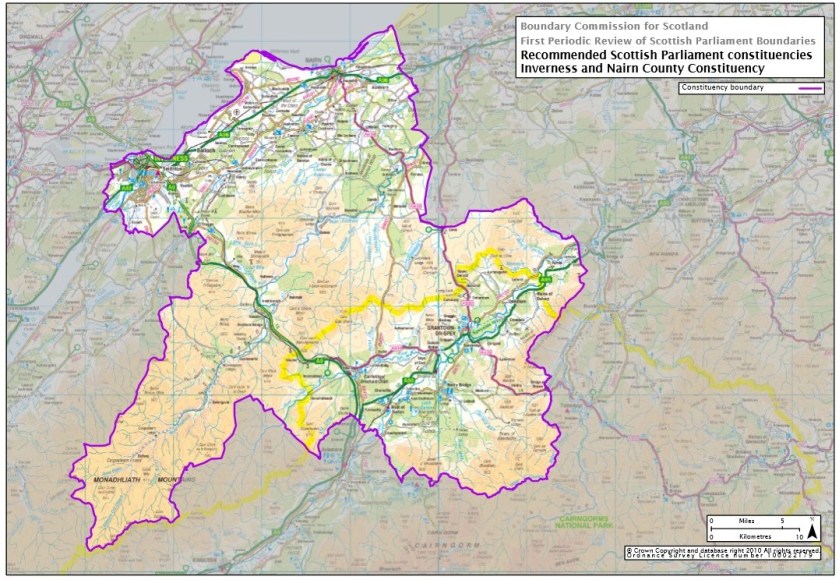
But it’s not just the reaction of the Environment Cabinet Secretary that interests us. It turns out that another Cabinet Secretary should be taking more of an interest than most. Fergus Ewing MSP is the Cabinet Secretary for Rural Economy and Connectivity. He also happens to be the Member of the Scottish Parliament representing the constituency of Inverness and Nairn.

If you look at the map of Fergus’s constituency, and then look at the map showing the last known locations of those eight satellite-tagged golden eagles, you’ll see that a good few of the points where the eagles were last recorded lie within Fergus’s constituency boundary.

Inverness Nairn constituency map

FergusEwing Constituency Monadhliaths

ge disappeared

Now, we know that Fergus’s job is to represent the interests of ALL his constituents (estimated at 66,619 voters, according to his website). We know he does a good job of representing the interests of a tiny fraction of those constituents who are involved with the game-shooting industry – there’s a picture floating around of him attending the Moy Game Fair last weekend – wearing a Scottish Gamekeepers’ Association tie.

But what about the interests of the tens of thousands of his other constituents? We’re pretty sure that most, if not all, will be appalled to discover what’s still going on in their area. What will Fergus be doing about that?

Will he be encouraging his constituents to sign this petition calling for the Scottish Government to introduce a licensing scheme for all gamebird hunting?

A good many of his constituents have already signed this other petition, calling for an outright ban on driven grouse shooting (which has just smashed through 90,000 signatures, on it’s way to 100,000 and a parliamentary debate in Westminster).

We’ll watch with interest to see what both these Cabinet Secretaries do next.

Case against gamekeeper Stanley Gordon re: shot hen harrier, part 4

Criminal proceedings continued at Elgin Sheriff Court yesterday against Scottish gamekeeper Stanley Gordon.

Mr Gordon, 60, of Cabrach, Moray, is facing charges in connection with the alleged shooting of a hen harrier in June 2013.

The case continued without plea and the next hearing will be 1st September 2016.

Previous blogs on this case herehere and here


40 eagles, 10 years, 0 prosecutions

In April 2012, we wrote an article called ’21 eagles, 6 years, 0 prosecutions’ (see here).

In September 2012, we updated it and called it ’26 eagles, 6 years, 0 prosecutions’ (see here).

In July 2013 we updated it again. This time, ’27 eagles, 7 years, 0 prosecutions’ (see here).

In December 2013 we had to do another update: ‘31 eagles, 7 years, 0 prosecutions’ (see here).

In April 2014 we had to do another update: ’32 eagles, 8 years, 0 prosecutions’ (see here).
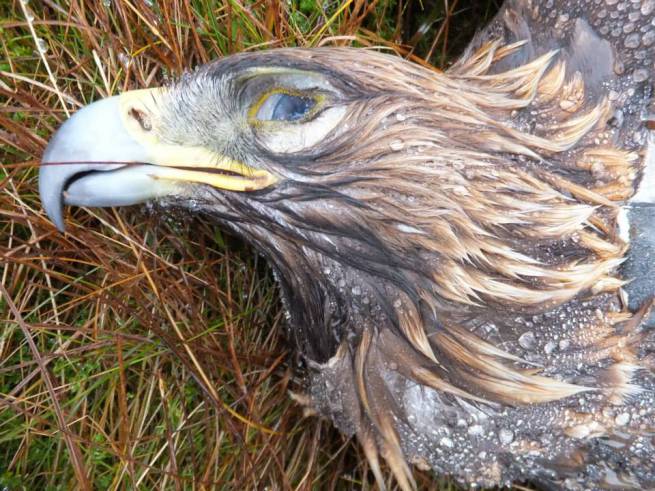
Fearnan Angus Glens Dec 2013 - Copy

After this morning’s news (here) that eight young satellite-tagged golden eagles have ‘disappeared’ on grouse moors in the Monadhliath Mountains over the last five years, we thought it was time for another update. This time it’s called: ’40 eagles, 10 years, 0 prosecutions’.

36 of these 40 eagles have either been found dead on, or have ‘disappeared’ on, Scottish grouse moors. (The other 4 have either died or have ‘disappeared’ in other habitat types).

Three of these 40 eagles have ‘disappeared’ in 2016. So much for the grouse-shooting industry claiming that they’ve cleaned up their act and that persecution is a thing of the past. The tactics of how to kill an eagle have clearly changed (see here) but the persecution continues.

As before, a number of eagles included in this list (16 of them, to be precise) may not be dead. However, they are included here because their satellite tags unexpectedly stopped functioning (i.e. they’d been transmitting perfectly well up until the eagles’ last known location, often a known persecution hotspot). Two further satellite-tagged eagles (‘Angus’ and ‘Tom’) are not included in this list as although their transmitters stopped functioning, there had been recognisable problems with their tags prior to the final transmissions and so the benefit of the doubt has been applied.

Many of these listed eagles from recent years have only been discovered because the eagles were being satellite-tracked. Much kudos to the dedicated teams of fieldworkers who have put in hours and hours of skilled hard work to allow this to happen. Obviously there are many other eagles out there that have not been sat-tagged and on the balance of probability will have been killed at the hands of the game-shooting industry. 40 eagles in the last 10 years is the bare minimum. The number of prosecutions (zero) is indisputable.

MAY 2006: A dead adult golden eagle was found on the Dinnet & Kinord Estate, near Ballater, Aberdeenshire. Tests revealed it had been poisoned by the illegal pesticide Carbofuran. Grampian Police launched an investigation. No prosecution.

JUNE 2006: A dead golden eagle was found on Glen Feshie Estate in the Cairngorms. Tests revealed it had been poisoned by the illegal pesticide Carbofuran. Northern Constabulary launched an investigation. No prosecution.

AUGUST 2007: A dead adult female golden eagle was found on an estate near Peebles in the Borders. She was half of the last known breeding pair of golden eagles in the region. Tests revealed she had been poisoned by the illegal pesticide Carbofuran. Lothian & Borders Police launched an investigation. No prosecution.

NOVEMBER 2007: Tayside Police received a detailed tip-off that a young male white-tailed eagle (known as ‘Bird N’) had allegedly been shot on a grouse moor estate in the Angus Glens. The timing and location included in the tip-off coincided with the timing and location of the last-known radio signal of this bird. The eagle has not been seen again. With no carcass, an investigation isn’t possible.

MAY 2008: A one year old male white-tailed eagle hatched on Mull in 2007 and known as ‘White G’ was found dead on the Glenquoich Estate in the Angus Glens. Tests revealed he had been poisoned by an unusual concoction of pesticides that included Carbofuran, Bendiocarb and Isofenphos. A police search in the area also revealed a poisoned buzzard, a baited mountain hare and 32 pieces of poisoned venison baits placed on top of fence posts on the neighbouring Glenogil Estate. Laboratory tests revealed the baited mountain hare and the 32 poisoned venison baits contained the same unusual concoction of highly toxic chemicals that had killed the white-tailed eagle, ‘White G’. No prosecution.

JUNE 2009: An adult golden eagle was found dead at Glen Orchy, Argyll, close to the West Highland Way. Tests revealed it had been poisoned by the illegal pesticide Carbofuran. Strathclyde Police launched a multi-agency investigation. Three years and 3 months later, estate employee Tom McKellar pled guilty to possession of Carbofuran stored in premises at Auch Estate, Bridge of Orchy and he was fined £1,200. No prosecution for poisoning the golden eagle.

JULY 2009: A two year old female golden eagle known as ‘Alma’ was found dead on the Millden Estate in the Angus Glens. Tests revealed she had been poisoned by the illegal pesticide Carbofuran. Alma was a well-known eagle  – born on the Glen Feshie Estate in 2007, she was being satellite-tracked and her movements followed by the general public on the internet. Tayside Police launched an investigation. No prosecution.

AUGUST 2009: A young white-tailed eagle was found dead on Glenogil Estate in the Angus Glens. Tests revealed it had been poisoned by the illegal pesticide Carbofuran. Tayside Police was criticized in the national press for not releasing a press statement about this incident until January 2010. No prosecution.

MAY 2010: #1 of three dead golden eagles found on or close to Skibo Estate, Sutherland. Tests revealed they had been poisoned; two with Carbofuran and one with Aldicarb. Northern Constabulary launched a multi-agency investigation. One year later (May 2011), Sporting Manager Dean Barr pled guilty to possession of 10.5 kg of Carbofuran stored in premises at Skibo Estate. No prosecution for poisoning the golden eagle.

MAY 2010: #2 of three dead golden eagles found on or close to Skibo Estate, Sutherland. Tests revealed they had been poisoned; two with Carbofuran and one with Aldicarb. Northern Constabulary launched a multi-agency investigation. One year later (May 2011), Sporting Manager Dean Barr pled guilty to possession of 10.5 kg of Carbofuran stored in premises at Skibo Estate. No prosecution for poisoning the golden eagle.

MAY 2010: #3 of three dead golden eagles found on or close to Skibo Estate, Sutherland. Tests revealed they had been poisoned; two with Carbofuran and one with Aldicarb. Northern Constabulary launched a multi-agency investigation. One year later (May 2011), Sporting Manager Dean Barr pled guilty to possession of 10.5 kg of Carbofuran stored in premises at Skibo Estate. No prosecution for poisoning the golden eagle.

JUNE 2010: #1: Leg rings with unique identification numbers that had previously been fitted to the legs of four young golden eagles in nests across Scotland were found in the possession of gamekeeper James Rolfe, during a multi-agency investigation into alleged raptor persecution at Moy Estate, near Inverness. It is not clear how he came to be in possession of the rings. The bodies of the eagles from which the rings had been removed were not found. No further action was taken in relation to the discovery.

JUNE 2010: #2: Leg rings with unique identification numbers that had previously been fitted to the legs of four young golden eagles in nests across Scotland were found in the possession of gamekeeper James Rolfe, during a multi-agency investigation into alleged raptor persecution at Moy Estate, near Inverness. It is not clear how he came to be in possession of the rings. The bodies of the eagles from which the rings had been removed were not found. No further action was taken in relation to the discovery.

JUNE 2010: #3: Leg rings with unique identification numbers that had previously been fitted to the legs of four young golden eagles in nests across Scotland were found in the possession of gamekeeper James Rolfe, during a multi-agency investigation into alleged raptor persecution at Moy Estate, near Inverness. It is not clear how he came to be in possession of the rings. The bodies of the eagles from which the rings had been removed were not found. No further action was taken in relation to the discovery.

JUNE 2010: #4: Leg rings with unique identification numbers that had previously been fitted to the legs of four young golden eagles in nests across Scotland were found in the possession of gamekeeper James Rolfe, during a multi-agency investigation into alleged raptor persecution at Moy Estate, near Inverness. It is not clear how he came to be in possession of the rings. The bodies of the eagles from which the rings had been removed were not found. No further action was taken in relation to the discovery.

JUNE 2010: A golden eagle was found dead on Farr & Kyllachy Estate, Inverness-shire. Tests revealed it had been poisoned by the illegal pesticide Carbofuran. Northern Constabulary apparently did not search the property until July 2011. No prosecution.

JUNE 2010: A white-tailed eagle was found dead on Farr & Kyllachy Estate, Inverness-shire. Tests revealed it had been poisoned by the illegal pesticide Carbofuran. Northern Constabulary apparently did not search the property until July 2011. No prosecution.

DECEMBER 2010: A decomposing carcass of a white-tailed eagle was found and photographed on Logie (Lochindorb) Estate, Morayshire. It was reported to Northern Constabulary. By the time the police arrived to collect it, the carcass had disappeared. The police said they couldn’t investigate further without the body.

FEBRUARY 2011: The signal from a young satellite-tracked golden eagle ( ‘Lee’, hatched in 2010) unexpectedly stopped transmitting after a final signal from the North Angus Glens. A technical malfunction or another mysterious ‘disappearance’?

MARCH 2011: The body of a young golden eagle was discovered on North Glenbuchat Estate, Aberdeenshire. Tests revealed it had been poisoned by the illegal pesticide Carbofuran. Grampian Police launched an investigation and raided the property in May 2011. A poisoned buzzard, a poisoned bait and a shot short-eared owl were found. No prosecution.

APRIL 2011: The body of a white-tailed eagle was found at the base of cliffs on Skye. The person who discovered it (a professional medic) considered it to have been freshly shot with a rifle, decapitated with a sharp implement and thrown from the cliff top. He took photographs and alerted Northern Constabulary and RSPB. There was a delay of two weeks before the now probably decomposed carcass was collected. A post-mortem was inconclusive. This incident was not made public until one year later after a tip off to this blog. No prosecution.

SEPTEMBER 2011: The signal from a satellite-tracked young golden eagle (‘Strathy’, hatched in 2010) unexpectedly stopped transmitting after a final signal from an Aberdeenshire grouse moor. A technical malfunction or another mysterious ‘disappearance’?

NOVEMBER 2011: The signal from a one-year-old satellite-tracked golden eagle (#57124) unexpectedly stopped transmitting after a final signal from a grouse moor in the Monadhliaths. A technical malfunction or another mysterious ‘disappearance’?

MARCH 2012: The body of a young golden eagle being tracked by satellite was discovered in Lochaber. Tests revealed it had been poisoned with the banned pesticides Aldicarb and Bendiocarb. Information about this incident was not made public until three months later. No prosecution.

MARCH 2012: The signal from a satellite-tracked young golden eagle (‘Angus 26′, hatched in 2011) unexpectedly stopped transmitting after a final signal from a grouse moor in the Angus Glens. This bird’s suspiciously damaged sat tag was found in the area. No prosecution.

MAY 2012: The signal from a young satellite-tracked golden eagle (#32857) unexpectedly stopped transmitting when the bird was north-east of the Cairngorms National Park. A technical malfunction or another mysterious ‘disappearance’?

MAY 2012: The dead body of a young satellite-tracked golden eagle (hatched in 2011) was discovered near a lay-by in Aboyne, Aberdeenshire. The data from its satellite tag & the injuries the bird had when found (2 broken legs) suggested it had been caught in an illegal trap on a grouse moor in the Angus Glens and then removed, under cover of darkness, to be dumped in another area where it was left to die, probably a slow and agonising death. Information on this incident was not released until almost five months later, by the RSPB. It appears the police failed to properly investigate this incident as we understand that no search warrants were issued and no vehicles were searched. No prosecution.

JULY 2012: The signal from a one-year-old satellite-tracked golden eagle (‘Foinaven’) unexpectedly stopped transmitting after a final signal from a grouse moor in the Monadhliaths. A technical malfunction or another mysterious ‘disappearance’?

OCTOBER 2012: An adult golden eagle was found shot and critically injured on grouse moor at Buccleuch Estate, near Wanlockhead, South Lanarkshire. The bird was rescued by the SSPCA and underwent surgery but it eventually succumbed to its injuries in April 2013. No prosecution.

MAY 2013: The signal from a two-year-old satellite tracked golden eagle (‘Angus 33′, hatched in 2011) unexpectedly stopped transmitting after its last signal from North Glenbuchat Estate in Aberdeenshire. A technical malfunction or another mysterious ‘disappearance’?

JUNE 2013: A dead golden eagle was found under power lines on an RSPB reserve on Oronsay. This bird had been shot although it is not known whether this was the cause of death or an historical injury.

JULY 2013: The signal from a young satellite tracked golden eagle (‘Cullen’, hatched 2010) unexpectedly stopped transmitting after its last signal in Aberdeenshire. A technical malfunction or another mysterious ‘disappearance’?

DECEMBER 2013: A two year old satellite tracked golden eagle (‘Fearnan’) was found dead on a grouse moor in the Angus Glens. Tests revealed he had been poisoned with the banned pesticide Carbofuran. No prosecution.

MARCH 2014: The signal from a one-year-old satellite-tagged golden eagle (#129002) unexpectedly stopped transmitting after a final signal from a grouse moor in the Monadhliaths. A technical malfunction or another mysterious ‘disappearance’?

APRIL 2014: The signal from a young satellite tracked white-tailed eagle (the first fledged sea eagle chick in East Scotland in ~200 years) unexpectedly stopped transmitting after its last signal from the North Glenbuchat Estate in Aberdeenshire. Police raided the property a couple of weeks later. No prosecution.

OCTOBER 2014: The signal from a one-year-old satellite-tagged golden eagle (#107133) unexpectedly stopped transmitting after a final signal from a grouse moor in the Monadhliaths. A technical malfunction or another mysterious ‘disappearance’?

OCTOBER 2014: The signal from a two-year-old satellite-tagged golden eagle (#119886) unexpectedly stopped transmitting after a final signal from a grouse moor in the Monadhliaths. A technical malfunction or another mysterious ‘disappearance’?

MAY 2016: The signal from a less-than-one-year-old satellite-tagged golden eagle (#00000583) unexpectedly stopped transmitting after a final signal from a grouse moor in the Monadhliaths. A technical malfunction or another mysterious ‘disappearance’?

JUNE 2016: The signal from a two-year-old satellite-tagged golden eagle (#129010) unexpectedly stopped transmitting after a final signal from a grouse moor in the Monadhliaths. A technical malfunction or another mysterious ‘disappearance’?

JULY 2016: The signal from a two-year-old satellite-tagged golden eagle (#129015 ‘Brodie’) unexpectedly stopped transmitting after a final signal from a grouse moor in the Monadhliaths. A technical malfunction or another mysterious ‘disappearance’?

THE UNTOUCHABLES: 40; JUSTICE: 0

Cabinet Secretary for the Environment Roseanna Cunningham has responded to this morning’s news (read her statement here) by calling for an analysis of the satellite tag data from around 90 surviving and missing eagles “to discover if there is a pattern of suspicious activity“. It just beggars belief. We’ll shortly be blogging in more detail about her response and that of the Scottish Moorland Group, which is equally as fatuous.

In the meantime, please sign this petition (here) calling on the Scottish Government to introduce a licensing scheme for gamebird shooting.

And then please sign this petition (here) calling on the Westminster Government to ban driven grouse shooting.


ALMD

Young golden eagles ‘disappearing’ on grouse moors in Scottish Highlands

RSPB press release:

RSPB Scotland has issued an appeal for information following the disappearance of another young golden eagle, the eighth of this species to vanish in the same area in less than five years. The young female golden eagle, named Brodie, hatched two years ago and was fitted with a satellite transmitter shortly before she fledged from her nest. Brodie was being monitored by conservationists as part of a national study to improve our understanding of the movements and survival of young golden eagles. Her last recorded position placed her in the northern Monadhliath mountains, south east of Inverness on 2nd July this year.

Since November 2011, eight golden eagles, all less than three years old, fitted with satellite transmitters have disappeared in the same area. The birds were being monitored by RSPB Scotland, the Highland Foundation for Wildlife, Natural Research Ltd and Forestry Commission Scotland. Satellite transmitters are increasingly being used to study the movements of wild birds to gain an understanding of their behaviour and travels following fledging. They are fitted under special licence by a small number of highly accredited individuals, and golden eagle experts. Satellites continue to transmit if a transmitter becomes detached from a bird, or if a tagged bird dies naturally allowing recovery of the body.

ge disappeared

Despite comprehensive searches, under the authority of the Police, of the areas around the last recorded positions of all eight eagles none of the birds or transmitters have been recovered, and no further data has been received from the transmitters. The first eagle vanished after last being recorded in the hills above Strathdearn in November 2011; following this a second disappeared in July 2012, and a third in March 2014. In October 2014, transmissions from two further eagles stopped at another location across the valley, three weeks apart. Three eagles’ tags stopped transmitting at a scatter of locations in the hills above the River Findhorn, in May, June and the latest bird, Brodie, in early July this year [1].

Since satellite transmitters first began to be fitted to raptors in Scotland around ten years ago several tagged birds were subsequently found to have been illegally killed [2]. All had been poisoned except for one which had been caught and injured in an illegal trap prior to being deliberately moved to another location. More recently, tagged birds have tended to go off the radar [3]. In every case, data received from the transmitters prior to their disappearance indicated the tags were functioning correctly, before suddenly stopping.

The golden eagle that disappeared in May 2016, a young female, had fledged from a nest in Galloway in 2015, one of only two fledged young from the tiny population of this species in the south of Scotland that year. The golden eagles in this area do not tend to leave the south of Scotland and so it was very unusual that this young bird roamed north rather than exploiting the vacant territories close to where she fledged.

DumfriesGalloway GE chick

Dave Anderson from the Scottish Raptor Study Group, who tagged this eagle said: “I was privileged to satellite-tag this large female chick in July 2015 with a fellow member of the SRSG who monitors the site. This bird was the first successful fledging from any nest in this area since 2010. The data we were receiving from her was of great interest as we followed her journey northwards to Cairngorms National Park, with excellent location information.

We were looking forward to seeing if she would head south again later in the year, however the tag stopped transmitting abruptly on the 18th May 2016, shortly after her first birthday. This is a very sad end to arguably one of the most important golden eagle chicks fledged that year in Scotland. There are no words to describe how disappointed I am at this bird’s disappearance”.

RSPB Scotland’s Head of Investigations, Ian Thomson, said “It is surely no coincidence that the overwhelming majority of satellite-tagged birds of prey that have disappeared in Scotland have been in areas intensively managed for gamebird shooting and in areas that have an appalling previous record of confirmed incidents of raptor persecution. These eight birds have all disappeared in an area where driven grouse moor management dominates the landscape, and where there have been many previous cases of illegal killing of protected raptors, including the poisoning of a golden eagle and a white-tailed eagle as recently as 2010 [4].

Given the reliability of the transmitters, the chance of so many birds disappearing over such a short timescale without some kind of human interference is so small as to be negligible. The pattern we see here is consistent with the birds having been killed and the transmitters destroyed.

“Once again, the commendable positive efforts of those landowners and estates who welcome golden eagles and host their nesting attempts, including elsewhere in the Monadhliaths, are being catastrophically undermined by those who have a complete disregard for the law, and who continue to threaten the conservation status of these magnificent birds. All of these eagles were young birds exploring Scotland before establishing their own territories and with their disappearance any potential future breeding by them to aid the population’s recovery is also lost.

“We ask that if anyone can provide information as to the fate of these eagles that they contact Police Scotland or RSPB Scotland’s investigations team.

Notes:

  1. The eight eagles that have disappeared since November 2011 in the Monadhliath mountains are:
Tag no./Bird name Date and place fitted with tag Date last recorded
57124 6th July 2010, at a nest in south Inverness-shire 22nd November 2011
“Foinaven” 29th June 2011, at a nest in north west Sutherland 17th July 2012
129002 1st July 2013 on Mull 5th March 2014
107133 30th June 2013, at a nest in north Perthshire 9th October 2014
119886 29th June 2012, at a nest in Deeside 31st October 2014
00000583 5th July 2015, at a nest in Galloway 18th May 2016
129010 1st July 2014, at a nest in south Inverness-shire 4th June 2016
129015 “Brodie” 26th June 2014, at a nest in east Inverness-shire 2nd July 2016
  1. Satellite-tagged golden eagles found to have been illegally killed:
  • 1 poisoned in Angus, 2009
  • 1 poisoned in Glenbuchat, Strathdon, in 2011
  • 1 poisoned in Lochaber in 2012
  • 1 illegally trapped in Angus in 2012
  • 1 poisoned in Angus in 2013
  1. Other raptors that have gone off radar include three satellite-tagged golden eagles and a white-tailed eagle which disappeared in September 2011, February 2012, May 2013 and April 2014 respectively, all in upper Donside. Other tagged golden eagles have disappeared in west Aberdeenshire (May 2012) and Angus (February 2011).
  1. A golden eagle and white-tailed eagle found dead in the Monadhliath mountains in 2010 were confirmed as having been illegally poisoned with carbofuran at the laboratory of Science and Advice for Scottish Agriculture (SASA) – SASA ref. No. 10123
  1. A Scottish Natural Heritage review of wildlife crime records and other threats found that the golden eagle population in the the Monadhliath mountains had unfavourable conservation status, with poisoning in particular being associated with grouse moors. (“A Conservation Framework for Golden Eagles”, SNH 2008) http://www.snh.org.uk/pdfs/publications/commissioned_reports/193.pdf

END

We’ll be blogging more about this later today…

In the meantime, please sign this petition (here) calling on the Scottish Government to introduce a licensing scheme for gamebird shooting.

And then please sign this petition (here) calling on the Westminster Government to ban driven grouse shooting.

UPDATE: Interesting blog about the use of satellite tags and what they tell us about raptor persecution, written by Head of RSPB Scotland Investigations, Ian Thomson here

UPDATE: Full formal response from Cabinet Secretary for the Environment Roseanna Cunningham here

UPDATE: 40 eagles, 10 years, 0 prosecutions (blog) here

UPDATE: Ministerial reaction to ‘missing’ golden eagles (blog) here

MEDIA COVERAGE

BBC News here

The Guardian here

The National here

The Herald here

Press & Journal here

STV News here

BBC Radio Scotland interview with Ian Thomson (Head of Investigations RSPB) here (starts at 1:50:05) – available for 29 days.

BBC Radio Scotland interview with Tim (Kim) Baynes (Scottish Moorland Group) here (starts at 2:40:00) – available for 29 days.