Video footage shows dozens of dead gamebirds being thrown into a pit to rot

Press release from the League Against Cruel Sports, 27th January 2022.

Damning video shows dozens of dead gamebirds being dumped by Welsh shoot

Damning video evidence has been obtained showing dozens of dead ‘game’ birds being dumped into a natural cavern on the Dyfi Falls shooting estate in mid-Wales.

The footage was captured at the Welsh beauty spot in Powys by professional investigators from leading animal welfare charity the League Against Cruel Sports, which campaigns to end commercial game shooting.

The shocking incident has been reported to Natural Resources Wales and police amid strong concerns that the dead pheasants and partridges will contaminate water flowing into the nearby River Llyfnant, and potentially pose a risk to human life.

Chris Luffingham, director of campaigns at the League Against Cruel Sports, said: “The film shows bird after bird being casually tossed into the cavern, next to one of Wales’ most sensitive and protected pieces of land because of its range, quality and variety of habitats, species and geological features. This scandalous incident shows a blatant disregard by the shooting industry for this environment.

More than 61 million non-native pheasants and partridges are released into the British countryside every year only for them to be cruelly blasted out of the sky. That these birds are just being dumped shows there is no other reason for them to be shot other than for so-called ‘sport’.”

The two-minute video taken on a trail camera set up by the natural cavern shows what is believed to be a shoot employee dump at least 45 dead pheasants and partridges into the cavern, with more loaded up on his quadbike ready for disposal.

Chris added: “This isn’t a one-off. Earlier this year our investigators watched as a man threw dead birds into the cavern – the Dyfi Falls Shoot, run by Cambrian Birds, will have serious questions to answer about the potential pollution to this important site, not to mention the high levels of cruelty involved in the wholesale killing of these birds.”

The cavern is located next to the Pencreigiau’r Llan Site of Special Scientific Interest, and the Nant Y Gog stream which flows into the river Llyfnant.

The Dyfi Falls shooting estate is managed by Cambrian Birds in the Cwm Rhaeadr, which translates as Valley of the Waterfall. It only opened in October 2020 and has already been at the centre of local controversy because of the impact on the environment due to the high density of pheasants and partridges released onto the site and the ugly tracks gouged by the shoot across the valley.

The League Against Cruel Sports is campaigning in Wales for a ban on the manufacture, sale, possession and use of snares – brutal wire traps used by gamekeepers – and for a ban on the caged breeding of game birds.

Chris added: “We’ve seen in recent years reports of game birds being dumped, burnt or buried but never before have we seen a shoot show such a callous indifference to the environment.

We look forward to working closely with the Welsh Government to help eliminate the animal cruelty and poor environmental practices which are endemic to the shooting industry.

You can view the disturbing video here:

ENDS

As the press release says, this isn’t a one-off incident. Shot pheasants and partridges are routinely dumped (fly-tipped, essentially, leaving local communities to pick up the council bill for clearing them away). Examples in recent years have included dumped gamebirds in Cheshire, Scottish borders (here), Norfolk (here), Perthshire (here), Berkshire (here), North York Moors National Park (here) and some more in North York Moors National Park (here) and even more in North Yorkshire (here), Co. Derry (here), West Yorkshire (here), and again in West Yorkshire (here), N Wales (here), mid-Wales (here), Leicestershire (here), Lincolnshire (here), Somerset (here), Derbyshire’s Peak District National Park (here), Suffolk (here), Leicestershire again (here), Liverpool (here) and even more in North Wales (here).

It’s quite incredible that this is the same industry that routinely asks for licences to kill birds of prey because of the perceived threat to these gamebirds before they’re shot for a bit of a laugh and then dumped.

The gamebird shooting industry is barely regulated, unscrutinised by the authorities, incapable of policing itself and as such is out of control.

Well done to the investigators at the League Against Cruel Sports for securing this footage and reporting it to the authorities. I look forward to seeing unequivocal condemnation from the game-shooting organisations, and an investigation and subsequent blacklisting of whichever shoot is involved.

UPDATE 28th January 2022: Shooting estate admits gamekeeper responsible for mass dumping of shot pheasants (here)

UPDATE 1st February 2022: Game-shooting industry scrupulously ignoring the mass dumping of shot pheasants (here)

UPDATE 2nd February 2022: Awkward…..(here)

UPDATE 18 August 2025: Rural villagers ‘at war’ about commercial Pheasant shoot in Wales (here)

Lochan Estate says it will appeal General Licence restriction

It was good to see plenty of media coverage yesterday about Lochan Estate in Strathbraan, Perthshire having a three-year General Licence restriction imposed on it after the discovery of an illegally-killed hen harrier on one of its grouse moors (see here and here).

I saw coverage of this story on the BBC News website (here), STV News (here), in The National (here), The Herald (here), and on the Grough website (here).

Strangely, I didn’t find any statements of condemnation on the websites of any of the game-shooting organisations; you know, those organisations that have trumpeted their supposed ‘zero tolerance’ of raptor persecution when its politically expedient to do so but who never seem to step up with a public denouncement when a crime has been uncovered on a game-shooting estate.

I wonder if Lochan Estate is a member of the landowners’ lobby group Scottish Land & Estates? Or whether its gamekeepers are members of BASC or the Scottish Gamekeepers Association?

[Hen harrier Rannoch‘s corpse found trapped by an illegally-set trap on Lochan Estate. Photo by RSPB Scotland]

I saw one statement from Lochan Estate, reported by the BBC News. An unnamed spokesperson is quoted as follows:

The estate categorically rejects any suggestion of wrongdoing in relation to the welfare of wildlife.

We made very robust representations five months ago and only received the notification this week, which we found surprising given the material we produced.

We will therefore be appealing this decision.”

There wasn’t any explanation about this illegally-set trap being on one of its grouse moors.

The estate’s appeal should be interesting. Let’s hope it’s as entertaining as the (failed) appeal submitted by Leadhills Estate against its General Licence restriction in 2019 (see here).

Incidentally, the information I requested about Leadhills Estate’s most recent appeal against the General Licence restriction extension imposed on the estate in 2021, is due to be released next week. Solicitors acting on behalf of Leadhills Estate have been arguing that the information should be withheld from the public (see here). Let’s see what NatureScot thinks.

Lochan Estate penalised after discovery of illegally-killed hen harrier on grouse moor

Further to this morning’s blog about NatureScot imposing a three-year General Licence restriction on Lochan Estate, a grouse and pheasant-shooting estate in Strathbraan, Perthshire, after evidence of alleged raptor persecution was uncovered (see here), NatureScot has issued a press statement that provides more detail behind the restriction.

Thanks to the blog reader who pointed me to the press release (which isn’t mentioned on NatureScot’s General Licence restriction notices page). Here’s the statement in full:

26 January 2022

NatureScot has restricted the use of general licences on Lochan Estate in Perthshire.  The decision was made on the basis of evidence provided by Police Scotland of wildlife crime against birds.

Evidence included a satellite-tagged hen harrier, found dead on Lochan estate in an illegally set spring trap.

General licences allow landowners or land managers to carry out actions which would otherwise be illegal, including controlling common species of wild birds to protect crops or livestock.

Donald Fraser, NatureScot’s Head of Wildlife Management, said:

We are committed to using all the tools we have available to tackle wildlife crime. In this case, there is clear evidence that crime involving a wild bird occurred on this property. Because of this, and the risk of more wildlife crimes taking place, we have suspended the general licences on this property for three years. They may still apply for individual licences, but these will be closely monitored.

This measure will help to protect wild birds in the area, while still allowing necessary land management activities to take place, although under tighter supervision. We believe this is a proportionate response to protect wild birds in the area and prevent further wildlife crime.

We work closely with Police Scotland and will continue to consider information they provide us on cases which may warrant restriction of general licences. The detection of wildlife crime can be difficult but new and emerging technologies, along with a commitment from a range of partners to take a collective approach to these issues, will help us stop this from occurring in the future.

Restrictions will prevent people from using the general licences on the land in question for three years. This period can increase if more evidence of offences comes to light.

See the full licence restrictions details on our website. 

ENDS

The satellite-tagged hen harrier found dead on Lochan Estate in an illegally-set spring trap is believed to be hen harrier Rannoch, according to a tweet by Ian Thomson, Head of Investigations at RSPB Scotland. You can read about Rannoch’s grisly ending here.

[Hen harrier Rannoch’s corpse found on Lochan Estate showing her foot caught in the illegally-set spring trap. Photos by RSPB Scotland]

Rannoch’s satellite tag data showed she was likely caught in this trap on 10th November 2018. Her body was eventually discovered in May 2019 and was sent off for a post mortem at SRUC veterinary lab, which subsequently concluded:

The bird was trapped by the left leg in a spring trap at time of death. Death will have been due to a combination of shock and blood loss if it died quickly or to exposure and dehydration/starvation if it died slowly. Either way the bird will have experienced significant unnecessary suffering‘.

Does that mean it’s taken NatureScot over three years to impose a General Licence restriction on Lochan Estate? Or were there any further alleged crimes recorded there between November 2018 and now?

NatureScot’s press release doesn’t provide any further detail about any other discoveries, it just says, ‘Evidence included a satellite-tagged hen harrier, found dead on Lochan estate in an illegally set spring trap‘ (emphasis is mine).

I guess the FoI request I’ve submitted to NatureScot will dig out anything else.

I did have a wry smile when reading the penultimate sentence of NatureScot’s press statement:

Restrictions will prevent people from using the general licences on the land in question for three years. This period can increase if more evidence of offences comes to light‘.

It all sounds very serious and convincingly restrictive doesn’t it, but as I’ve already mentioned in this morning’s blog (here) Lochan Estate’s General Licence restriction can simply be over-ridden by the estate if they apply for an Individual licence which will allow their gamekeepers to continue killing wild birds such as crows, rooks, jays, jackdaws etc as if nothing has happened. What sort of sanction is that? A useless one. That’s not NatureScot’s fault – they have to work with the regulations they’re given, but come on, where are all the civil servants pushing for legislative change to close this gaping loophole?

And that bit about the GL restriction ‘can be extended if more evidence of offences comes to light’ – yeah, like the extension applied to Leadhills Estate that runs concurrently with the estate’s original restriction, meaning that in effect, Leadhills has only been penalised for a further 8 months, not the three years claimed by NatureScot (see here).

The system’s a joke and an overhaul is long overdue.

UPDATE 27th January 2022: Lochan Estate says it will appeal General Licence restriction (here)

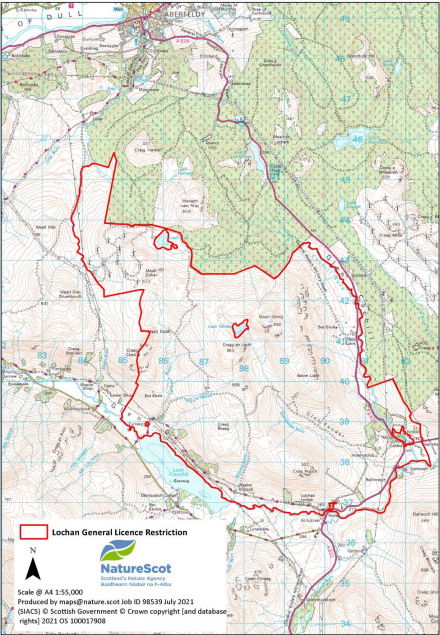
General Licence restriction imposed on Lochan Estate, a grouse-shooting estate in Strathbraan

Scotland’s statutory conservation agency, NatureScot, has today announced its decision to impose a three-year General Licence restriction on Lochan Estate, a grouse and pheasant-shooting estate in Strathbraan, Perthshire.

The statement on NaturesScot’s website reads:

In line with NatureScot’s published General Licence restrictions: Framework for Implementing Restrictions we hereby give notice that a restriction has been applied to the land outlined in red overleaf. This restriction prohibits the use of General Licences 01, 02 and 03 on that land between the 25th January 2022 and 25th January 2025.

Please note that this restriction does not imply responsibility for the commission of crimes on any individuals‘.

NatureScot has not published any further detail about the type of offence(s) uncovered on Lochan Estate or the date(s) of discovery. [See update at foot of blog]

Whilst I commend NatureScot (and Police Scotland, on whose evidence the decision to restrict the use of the General Licences has been made) for imposing the restriction, it’s frustrating that once again, the detail has been suppressed from the public domain. It is surely in the public interest to know what criminal activity has been uncovered on this estate, even though the alleged offences can’t be pinned on any named individual.

I have submitted an FoI asking for these details and I’ll publish the response here in due course.

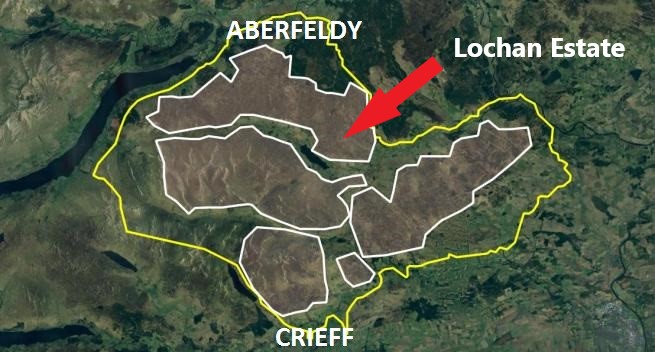
For those of you unfamiliar with the geography, Lochan Estate sits in the Strathbraan area, a region recognised in a Government-commissioned report as being a raptor persecution hotspot (here). Lochan Estate was also within the boundary of the heavily-criticised Strathbraan raven cull back in 2018:

[Map of the raven cull area in Strathbraan in 2018. Yellow line = cull boundary; white line = areas of driven grouse moor where the raven cull was permitted until it was successfully challenged by the Scottish Raptor Study Group]

This three-year General Licence restriction means that the estate cannot kill magpies, carrion crows, hooded crows, jackdaws, jays, woodpigeons, feral pigeons, Canada geese, Greylag geese, or rooks either by shooting, removing nests, pricking eggs, oiling eggs, targeted falconry, or by using traps to capture and then kill them.

Unless of course the estate has applied for, and been granted, an Individual licence, which permits them to do what they were doing before as if the alleged offences never took place. Great, isn’t it?

Way back in December 2019, Ian Thomson (RSPB Scotland) and I gave evidence to the Scottish Government’s Environment, Climate Change & Land Reform (ECCLR) committee where we argued that General Licence restrictions were wholly ineffective as sanctions for wildlife crime, especially (but not limited to) this ridiculous escape clause of being able to apply for an individual licence (see here).

In response, then Environment Minister Mairi Gougeon said that the Government was ‘actively considering’ the need for further, additional sanctions (see here).

It’s all gone deathly quiet since then.

UPDATE 15.07hrs: Lochan Estate penalised after discovery of illegally-killed hen harrier on grouse moor (here)

UPDATE 27th January 2022: Lochan Estate says it will appeal General Licence restriction (here)

UPDATE 22nd March 2022: Lochan Estate in Strathbraan loses its appeal against General Licence restriction imposed for wildlife crime (here)

Cambridge University paper does NOT suggest that setting fire to grouse moors is good for the environment!

The grouse-shooting industry has a well-evidenced reputation for misrepresentation, whether that be of crime statistics, science, technology, opinion or policy, in fact anything it can distort in a desperate attempt to portray itself more favourably, it will do.

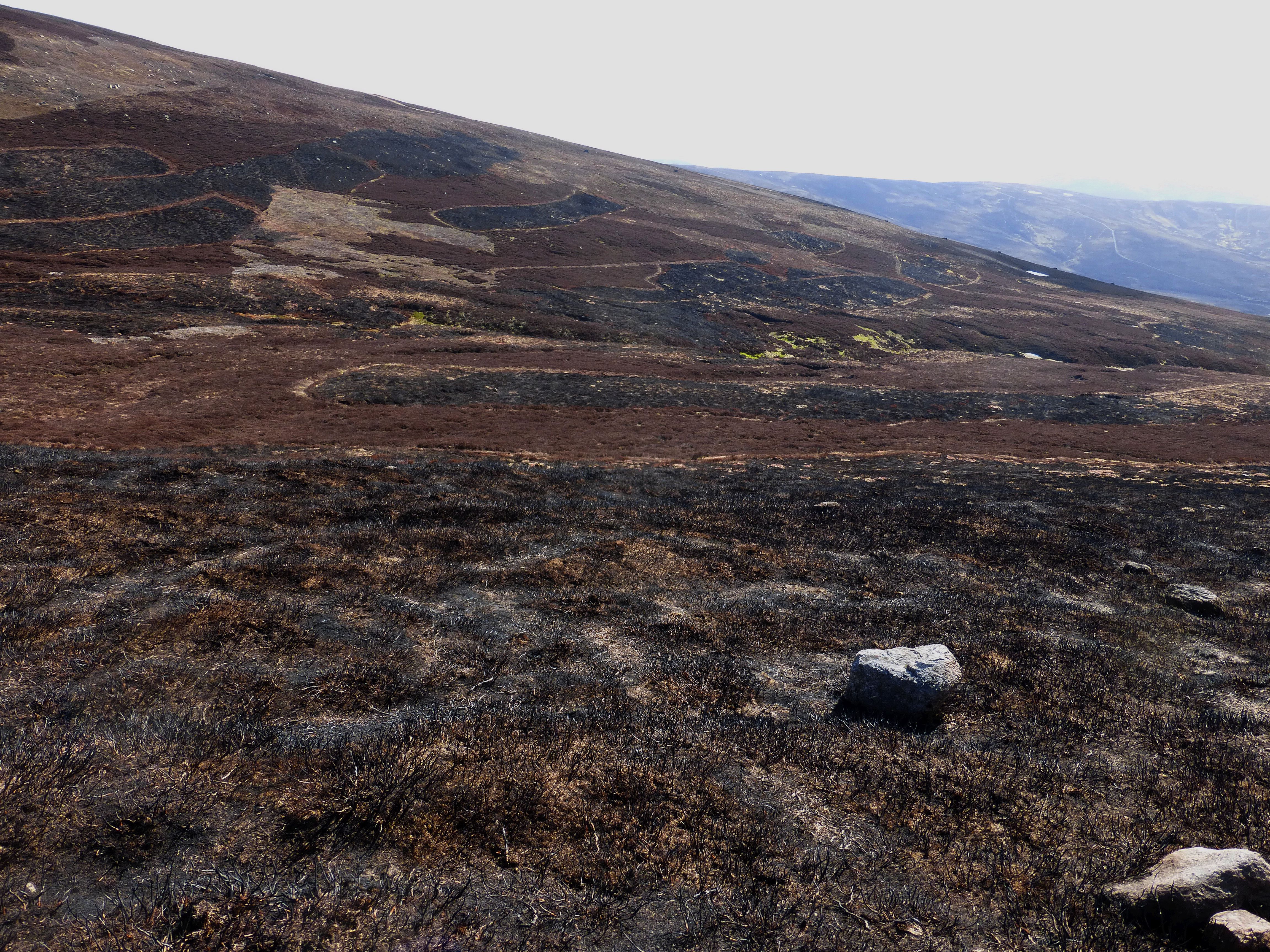
So it should come as no surprise whatsoever to learn that its latest warped presentation of reality relates to the misinterpretation of a new scientific paper from esteemed academics at the University of Cambridge, a paper which the grouse-shooting industry is claiming, falsely, supports the idiotic notion that repeatedly setting fire to peatland vegetation (muirburn) as part of a grouse moor management plan, is somehow good for tackling the climate emergency.

[The horrific sight of muirburn on a UK grouse moor. Photo copyright RPUK]

The paper was recently published in the eminent scientific journal Nature Geoscience. Unfortunately it sits behind a paywall but you can access the authors’ copy here and the abstract is shown below:

This is a review paper, technically demanding for the non-scientific reader, but the general conclusion is that in some environments (note, peatland was not the focus) fire can be an important tool for increasing carbon storage in soils in some circumstances.

Here’s how spin master general Tim (Kim) Baynes, Director of Moorland at landowners’ lobby group Scottish Land & Estates, misinterpreted the findings of this paper in an article he wrote for The Herald on 13th January:

The usual suspects in the grouse-shooting industry took this dreadful piece of propaganda and splashed it across social media, claiming vindication against the ‘antis’. The funniest line came from The Shooting Times who hilariously used this quote from Strathbraan gamekeeper Ronnie Kippen to ratify the Cambridge University research:

This rather blows a hole in the conservation charities’ lies about controlled muirburn“.

Actually, Ronnie, it does no such thing, as pointed out in this blog by Nick Kempe of ParksWatchScotland and in this blog by Dr David Douglas, Principal Conservation Scientist at the RSPB who says:

The paper is a literature review to understand whether fire-driven loss of carbon from soils through combustion, erosion and leaching could be offset by the ability of fire to stabilize carbon and keep it within the soil. The paper concludes that using fire to promote the stability of soil organic matter may be an important means for increasing carbon storage. But the paper focuses largely on savannah, grassland and forest biomes of little relevance to UK moorlands which are subject to burning. Indeed, the paper states that the way in which fire affects the stability of carbon in soils differs across ecosystems – in other words, the results are not automatically generalisable across ecosystems.

The enthusiasm with which the paper has been used by proponents of burning in the UK to justify its continued use on grouse moors is misguided because the review does not evaluate the framework in moorlands or peatlands more generally. In fact, the authors of the paper state that “in ecosystems with deep organic horizons, such as boreal forests and peatlands, the utility and feasibility of prescribed burning to manage SOM [soil organic matter] losses via greater stabilization is less clear“.

Despite these clear caveats, those who wish to burn vegetation in the UK uplands are using the findings of the paper, misleadingly, as evidence of the benefits of burning“.

For anyone who still thinks Tim (Kim) Baynes and/or Ronnie Kippen’s scientific analyses are convincing, it’s probably best to listen to two of the paper’s authors (Pellegrini & Malhotra) responding to a discussion on Twitter about the grouse-shooting industry’s misrepresentation of their work, as follows:

Answer from House of Lords about status of pheasants (livestock or wildlife?)

Last week I blogged about how Green peer Natalie Bennett had posed a question in the House of Lords, asking the UK Government ‘whether they regard captive-reared pheasants released into the environment as wildlife or livestock?‘ (see here).

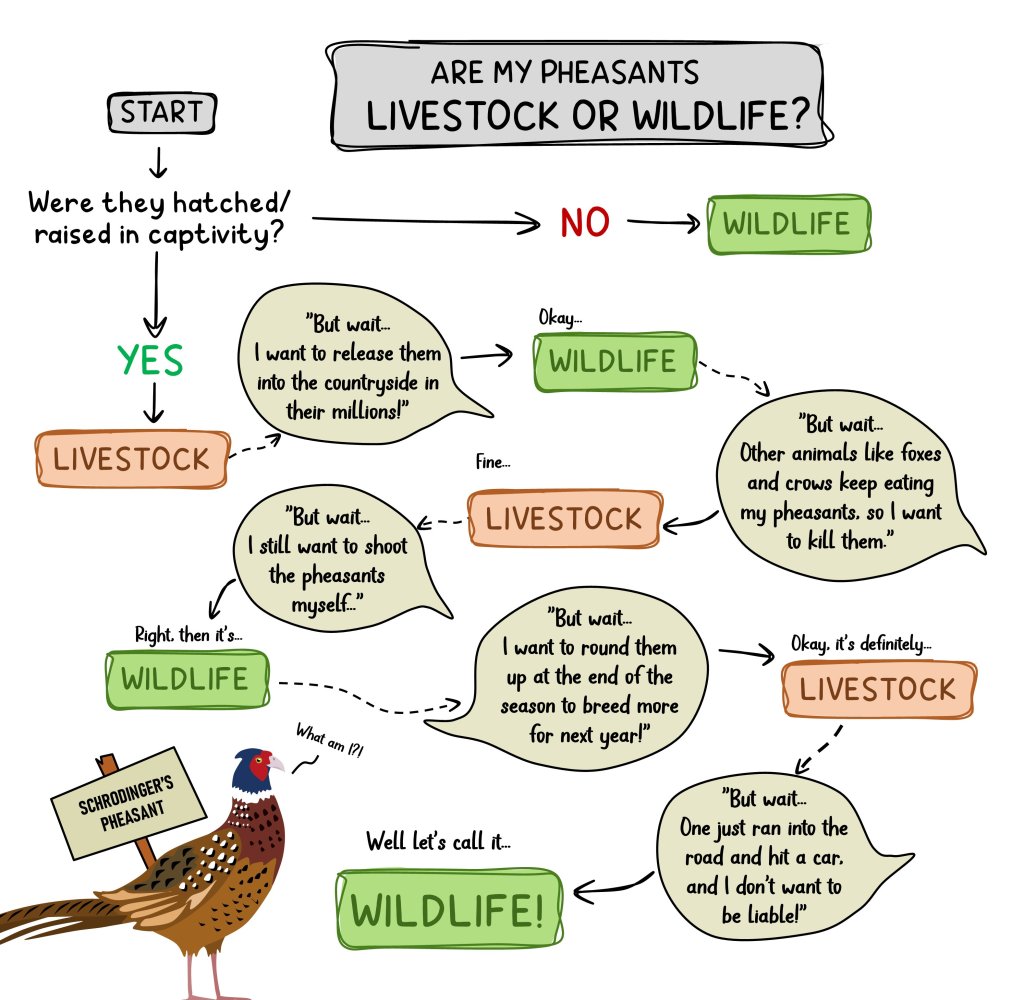
This question stems from the Government’s ongoing contortions relating to the legal status of pheasants, a status that seemingly is able to morph from being ‘livestock’ to ‘wildlife’ and then back to ‘livestock’ at various points in the year, which provides the pheasant owner/keeper with multiple opportunities to kill native predators and avoid legal responsibility for public damage all at the same time. This flow chart from Wild Justice sums it up well:

Conservative life peer and DEFRA Minister Zac Goldsmith has now responded to Natalie Bennett’s question as follows:

A released captive-reared pheasant may be regarded as livestock if it remains significantly dependent on a keeper for their survival, for example for the provision of food, water or shelter‘.

Hmm. That’s not especially helpful when ‘significantly dependent’ hasn’t been defined, although we do know from DEFRA’s new General Licences this year that supplementary feeding of pheasants does not count in this context. Hmm, it’s all very odd.

Wild Justice has taken legal advice on this issue this week and you can expect to hear more from them in due course…. and you’ll hear it first if you subscribe to their free newsletter here.

Tarras Valley volunteers reclaiming the pheasant-rearing woods from Langholm Moor

In 2020 the community of Langholm in the Scottish Borders successfully raised £3.8 million to buy a knackered old grouse moor from the Duke of Buccleugh and transform it into a vast new nature reserve for the benefit of wildlife and the local community (see here).

Many blog readers supported and contributed to this fundraising challenge (thank you) and helped create what is now called the Tarras Valley Nature Reserve.

Kudos to the volunteers who have been busy in recent weeks clearing old fences, netting and feeding barrels from the woods which were formerly used for pheasant-rearing/shooting.

These photos of their efforts were posted on social media yesterday:

In November 2021 the community began fundraising once again, to ‘finish what we started’, and has launched stage two of the biggest community buyout scheme in south Scotland to buy the remainder of Langholm Moor which would effectively double the size of the Tarras Valley Nature Reserve.

If you’d like to make a contribution to help support this impressive lot, please visit their crowdfunder here.

Thank you.

More pheasants shot & dumped, this time in North Wales

Here we go again, one of the most disgusting consequences of releasing approx 60 million non-native pheasants and red-legged partridges into the countryside in their millions. They’re shot for a bit of a laugh and then some of them are simply dumped. Undoubtedly this is driven by an over-supply of birds and little demand by consumers for purchasing game bird meat, especially when it’s contaminated with toxic lead shot.

Unfortunately for the game shooting industry, desperate to portray itself as responsible and law-abiding with the utmost respect for its quarry, this is yet another ongoing, criminal and widespread problem associated with gamebird shooting and such a PR disaster is drawing even more attention to an industry already under intense pressure to clean up its act.

Previous examples include dumped gamebirds in Cheshire, Scottish borders (here), Norfolk (here), Perthshire (here), Berkshire (here), North York Moors National Park (here) and some more in North York Moors National Park (here) and even more in North Yorkshire (here), Co. Derry (here), West Yorkshire (here), and again in West Yorkshire (here), N Wales (here), mid-Wales (here), Leicestershire (here), Lincolnshire (here), Somerset (here), Derbyshire’s Peak District National Park (here), Suffolk (here), Leicestershire again (here) and Liverpool (here).

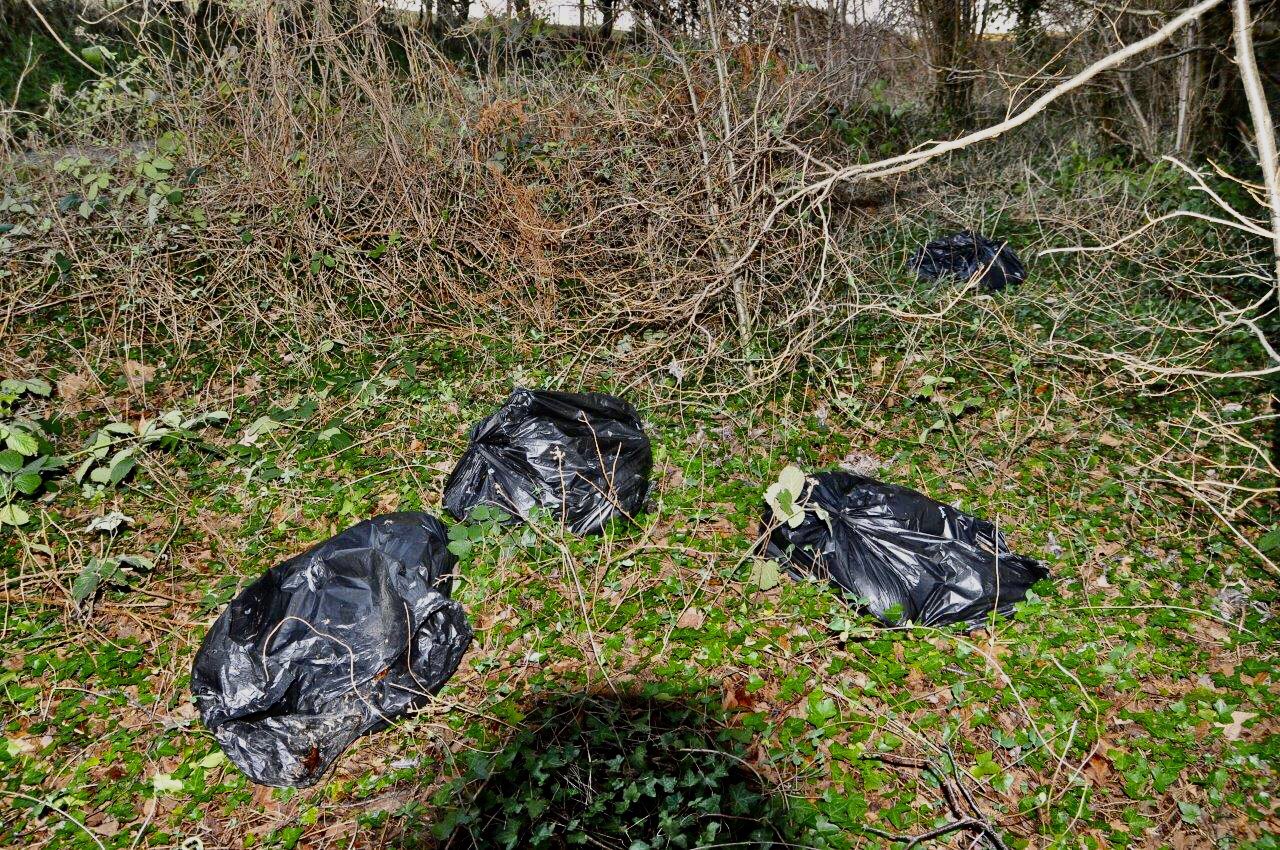
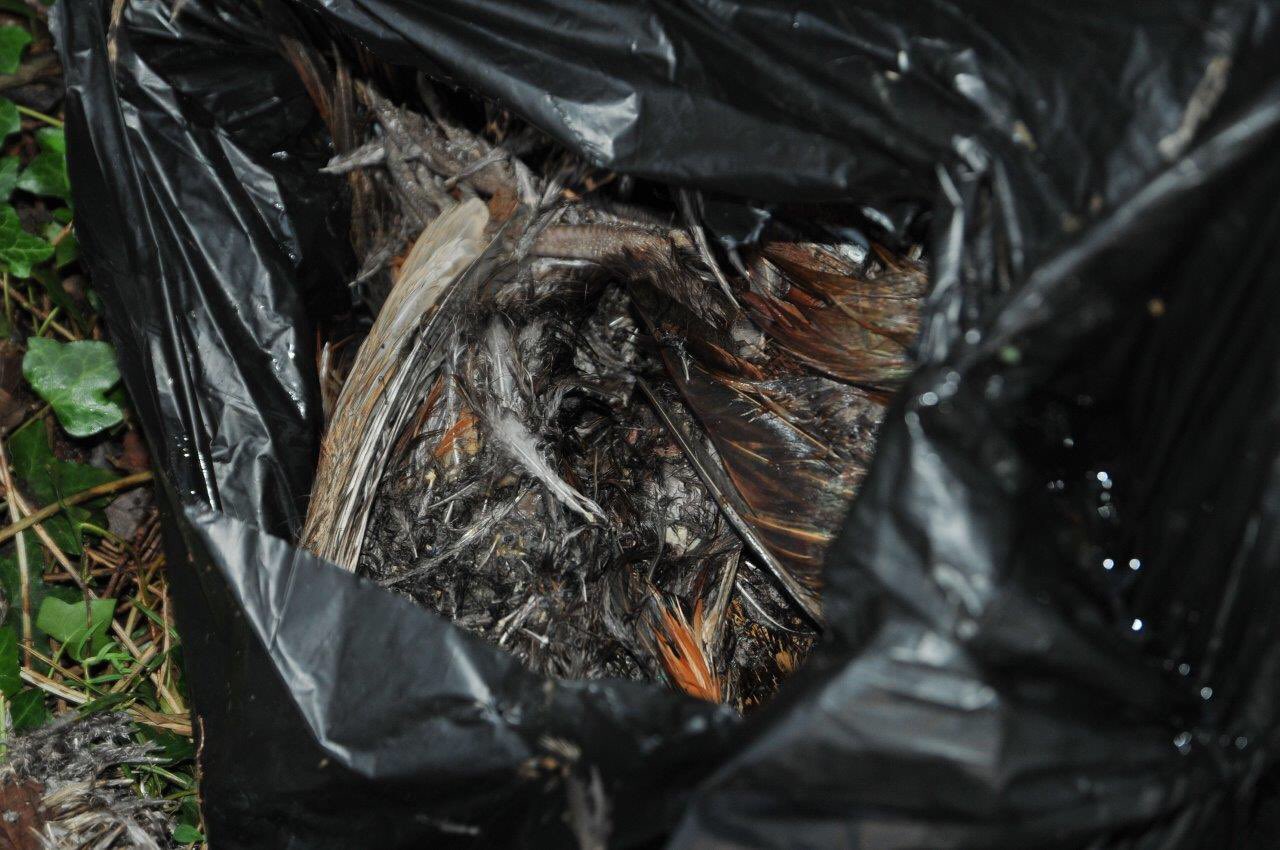
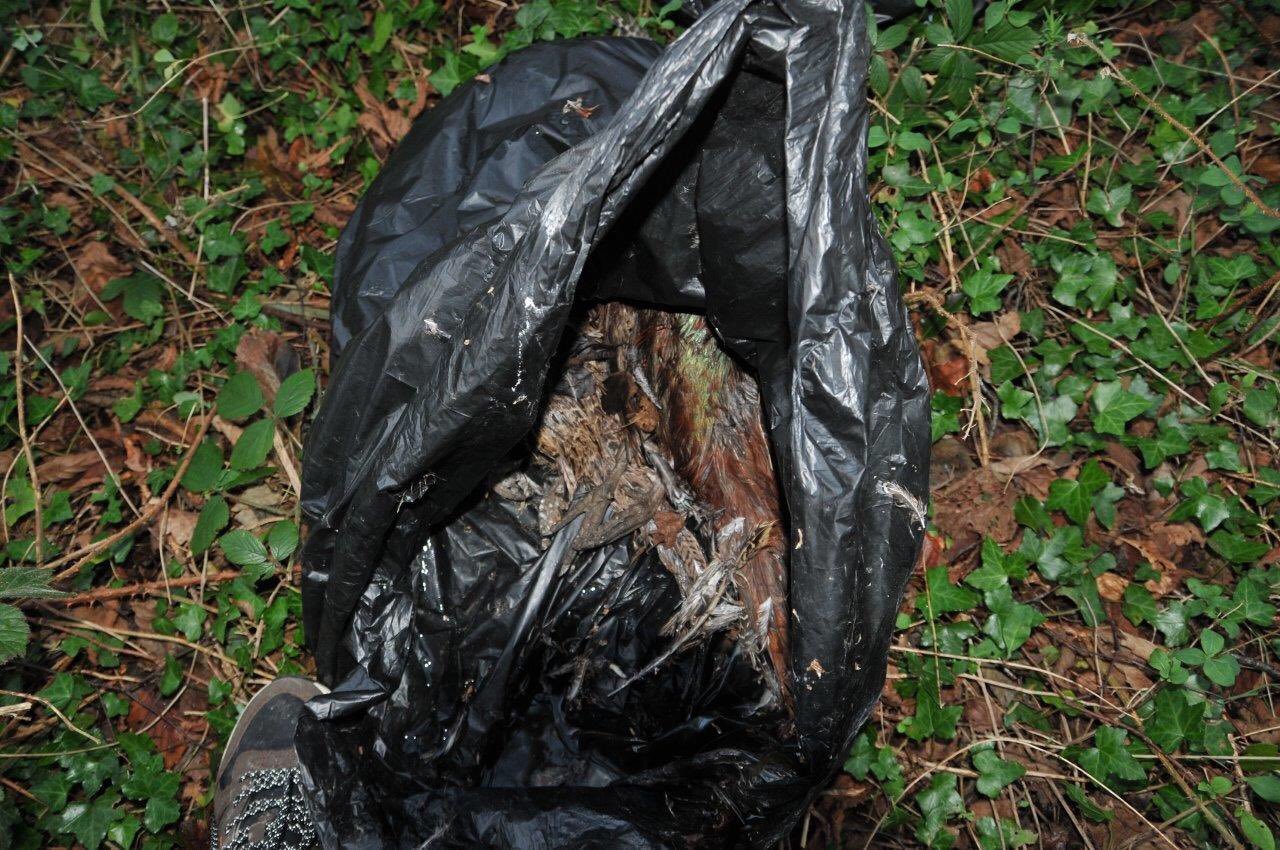
Yesterday, four bin bags stuffed full of dead pheasants were found dumped behind a hedge in Tremeirchion, in Denbighshire, North Wales. Judy Oliver Hewitt posted these photographs on social media:

This obscene behaviour will continue to receive attention on this blog for as long as the gamebird shooting industry demands licences to kill protected birds of prey for the purpose of ‘saving’ gamebirds.

Online abuse from Steve Grant, assistant editor of Countryman’s Weekly magazine

Yesterday I wrote a blog that drew attention to the UK Government’s Environment Food Rural Affairs (EFRA) committee’s inquiry into rural mental health and its call for evidence (here).

It didn’t seem to me to be controversial in any way, it was just simply highlighting the committee’s call for evidence and encouraging people to participate in what I described as a ‘timely inquiry’.

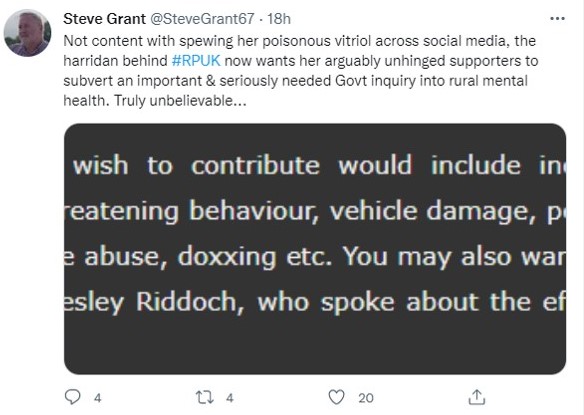
Apparently though, this makes me a ‘harridan’, wanting you ‘arguably unhinged’ blog supporters to ‘subvert’ a Government enquiry, according to a gentleman called Steve Grant who just happens to be the assistant editor of the Countryman’s Weekly magazine.

Here’s what he wrote on twitter yesterday:

The irony of this latest (in a long line) of online abuse from Mr Grant isn’t lost on me. Really I should thank him for providing even more evidence for the committee to ponder, which demonstrates that the problem of rural mental health is an issue that really does need to be addressed, and especially when that abuse, so clearly designed to damage the recipient’s mental well-being, is being propagated by the assistant editor of a national magazine.

You have to wonder what motivates a middle-aged man to spend his evenings abusing women online with 17th century insults? I could speculate, but I won’t.

Many thanks to Alister Clunas for calling him out.

For those of you who wish to submit evidence to the Environment Food Rural Affairs (EFRA) committee’s inquiry into rural mental health, please visit here and remember the deadline for doing this is this Friday (21st January 2022).

Rural mental health survey – this Govt committee needs to hear from you

The UK Government’s Environment Food Rural Affairs (EFRA) committee is hosting an inquiry into rural mental health (see here) and has issued a call for evidence (here).

This is a timely inquiry as there are many in the rural community who suffer huge mental stress and don’t necessarily receive the support they need (e.g. farmers having to deal with violent hare coursers).

I note that the game-shooting industry is urging its members to submit evidence, particularly that of gamekeepers who claim to be the subject of widespread abuse (see here), and you can predict where this will lead if the Government committee only hears from this sector and not from those of us at the receiving end of abuse from the game-shooting industry and others, such as the fox-hunting lot.

The inquiry has been open since November 2021 and it closes this Friday (21st January 2022) so time is short but I would encourage you to contribute if you’re able, so the committee receives views from a wide range of people.

The type of evidence you may wish to contribute would include incidents of harassment, violence, intimidation, direct and indirect threatening behaviour, vehicle damage, pet injury/death through poisoning, shooting, snaring etc, arson, online abuse, doxxing etc. You may also want to listen to this recent recording from journalist and broadcaster Lesley Riddoch, who spoke about the effect of pheasant shooting next to her property:

Here is the link if you’d like to contribute evidence to the committee and remember the deadline is this Friday – see here.

UPDATE 19th January 2022: Online abuse from Steve Grant, assistant editor of Countryman’s Weekly magazine (here)