No prosecution for shooting of a hen harrier in Bowland

On 18 October 2019 a member of the public witnessed what he believed to be the shooting of an adult male hen harrier near White Syke Hill in the Forest of Bowland Area of Outstanding Natural Beauty (AONB).

North Yorkshire Police (whose force area covers that tiny part of Bowland) put out an appeal for information five months later (see here).

A few days later, North Yorkshire Police announced that an arrest had been made in this investigation and the suspect had been released pending the results of a forensic analysis (see here).

Unfortunately the police have now concluded there is insufficient evidence to proceed with a prosecution.

Inspector Matt Hagen of North Yorkshire Police’s Rural Task Force said: “This case is an all too familiar scenario where we have information from a credible source, but unfortunately the evidence is not strong enough to meet the threshold where we would ask the Crown Prosecution Service to make a charging decision, even after the arrest and interview of a suspect.

I would like to take this opportunity to encourage anyone with any information regarding any individuals who are involved in raptor persecution to come forward and report it to the police and assure them they will be taken seriously and the matter will be investigated.”

This is a disappointing result, of course, but as many blog readers will know, securing sufficient evidence in these cases is notoriously difficult. Full credit to North Yorkshire Police for giving it a go. This case didn’t fail for lack of effort and at least that suspect will now be on their radar.

As far as we’re aware, North Yorkshire Police are still investigating the alleged shooting of another hen harrier on another Yorkshire grouse moor (see earlier blog here) so fingers crossed for a prosecution on that one.

Now that the Bowland investigation has ended, part of the eyewitness report of the hen harrier being shot and removed from the moor has been published by the RSPB (see here) and it makes for a disturbing read.

Poisoned hen harrier ‘Mary’ – open letter calls for action

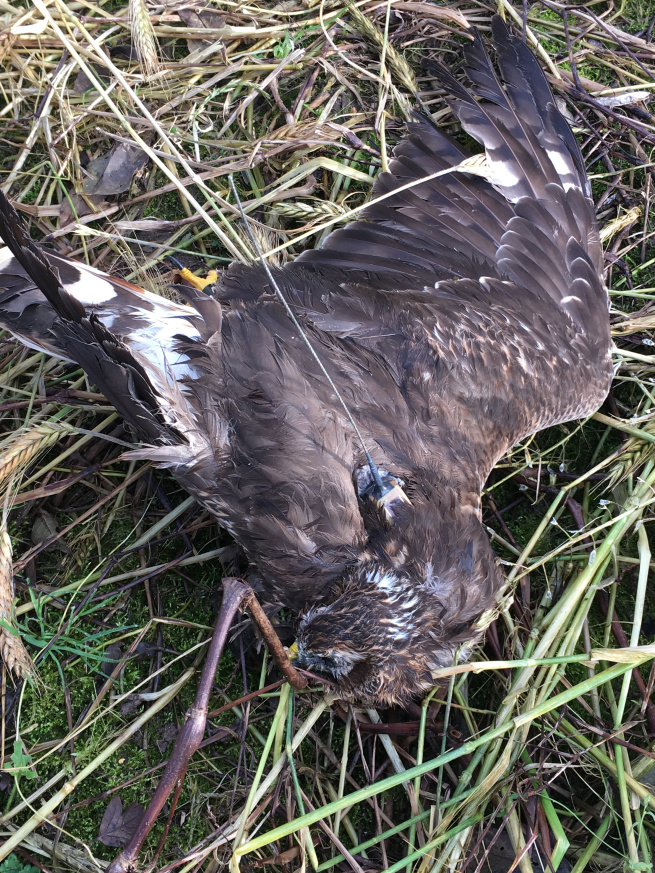
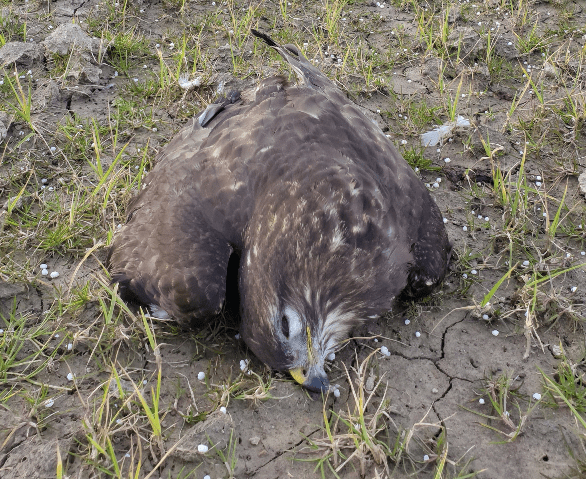
A young hen harrier named Mary that hatched on the Isle of Man in 2019 and had been satellite-tagged by the RSPB’s Hen Harrier LIFE Project was found poisoned on a pheasant shoot in Co Meath in Ireland in November 2019. Tests revealed she had consumed the banned poison Carbofuran which was found on a pigeon bait and on other meat baits next to her corpse.

We blogged about the illegal killing of this hen harrier earlier this year (see here) and it was quite evident from the press statements from both BirdWatch Ireland and the RSPB that there were concerns that the National Parks and Wildlife Service (NPWS) and the Gardai (Irish Police) could be doing more in terms of investigation, enforcement and liaison.

[Hen harrier Mary found illegally poisoned on a pheasant shoot, photo by BirdWatch Ireland]

Seven months on from her death, those early concerns appear to have been justified.

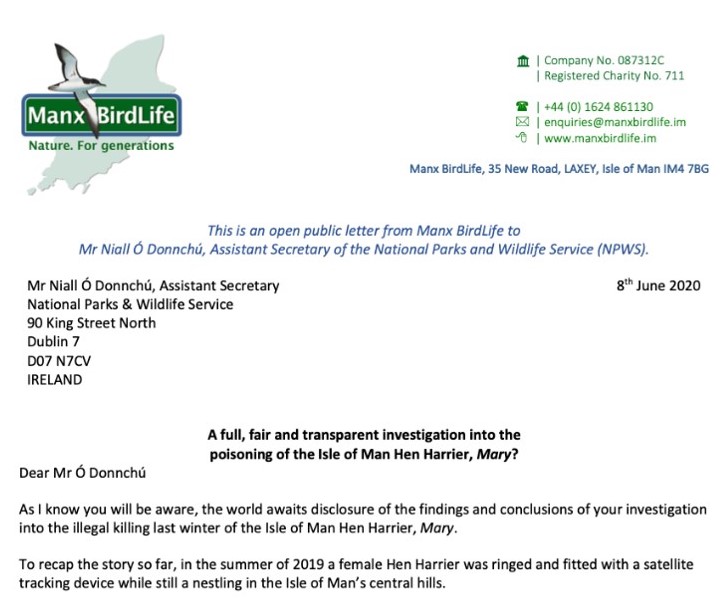
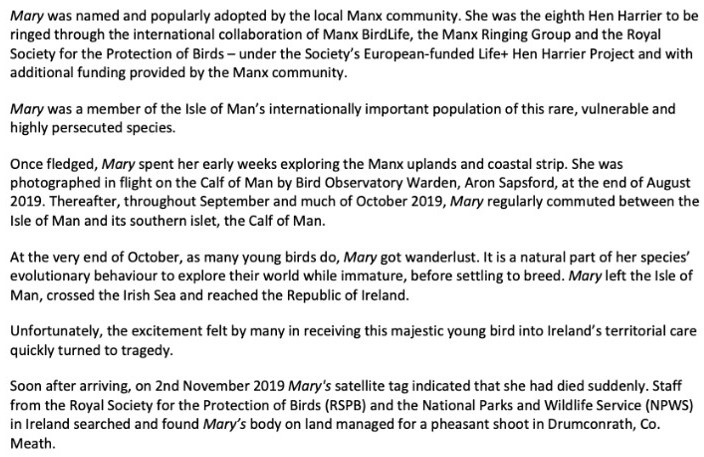
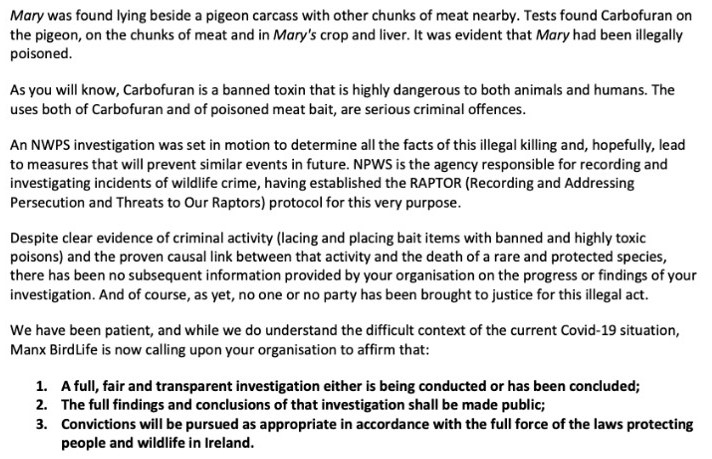
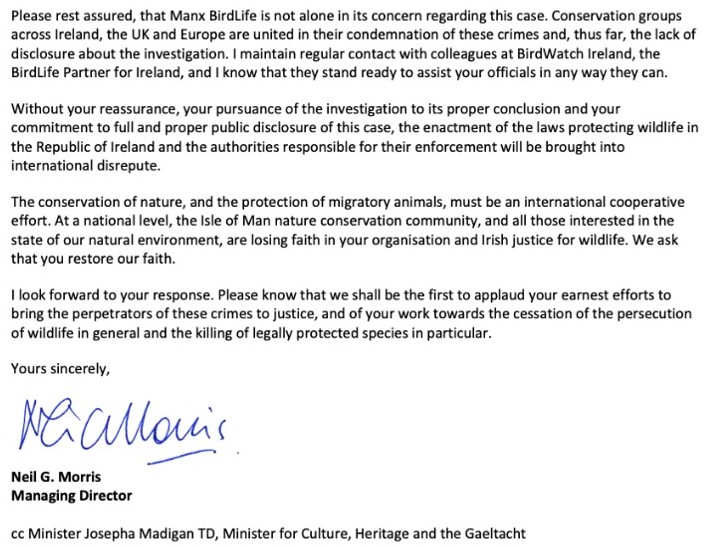
Have a look at this open letter, written by Manx BirdLife (Isle of Man) and addressed to the National Parks & Wildlife Service (Irish Republic) calling for transparency about any criminal investigation which may, or may not, have taken place in to the illegal killing of this hen harrier.

This is a really interesting, and welcome, move by Manx BirdLife. It’s an indication of the growing frustration around the ongoing illegal killing of hen harriers (and other raptors) and demonstrates an unwillingness just to sit back and watch it happen time and time again without anyone being held to account.

For all we know the NPWS may have conducted a thorough investigation and been thwarted by the usual problems of finding sufficient evidence for a prosecution, but that information should certainly be made public because otherwise it looks like they just don’t care and sends a message to other would-be criminals that this sort of offence will go unpunished.

It’ll be interesting to see what sort of response, if any, Manx BirdLife receives from the NPWS.

The five brood meddled hen harriers from 2019 are all ‘missing’

At the end of May we blogged about how Natural England had just issued another licence to permit hen harrier brood meddling on grouse moors again this year (see here).

For new blog readers, hen harrier brood meddling is a conservation sham sanctioned by DEFRA and carried out by Natural England, in cahoots with the very industry responsible for the species’ catastrophic decline in England. For more background see here.

[Photo of an UNMEDDLED hen harrier, by Laurie Campbell]

We had a number of concerns about this second licence being issued on 20 May 2020, not least the complete lack of transparency about the fate of the five hen harrier chicks that had been brood meddled in 2019. The last we’d heard three of the five had ‘disappeared’ on grouse moors in northern England in autumn 2019 (here) although then one came back online (here) and it then became apparent that some of the satellite tags used last year were different to the tags used previously and were not as reliable (see here).

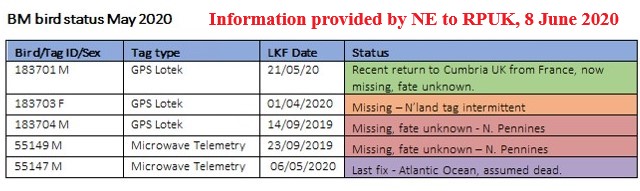
On 28 May we asked Natural England for information about the status of these five birds (amongst other things). Natural England Director Rob Cooke has provided the following information to us this afternoon:

So there we have it. All five birds considered to be ‘missing’. One of the disappearances could be attributed to natural causes (#55147, assumed dead during a sea crossing from France to the UK) but the other four all look highly suspicious.

We do know that the GPS Lotek tags have proven to be unreliable on this species (see here) but the longer the tag silence continues, the worse it looks. (We’ve got more info on these tags and will blog separately about the decision to use this particular tag type for this ‘trial’).

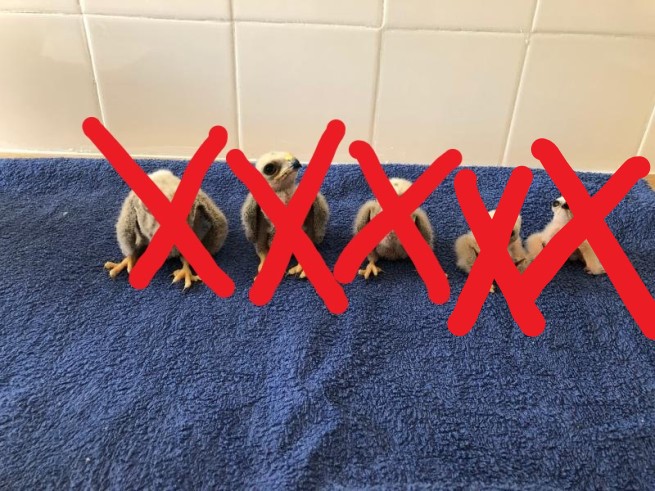
[The five brood meddled hen harrier chicks in 2019, now all ‘missing’]

And questions on tag unreliability aside, the ‘missing’ status of these five is hardly a surprise – it’s a pattern that we’ve seen for years, that’s been confirmed by rigorous scientific analysis (of Natural England’s own bloody data, see here) and a pattern that continues even after the grouse shooting industry has the brass neck to pretend that it’s cleaned up its act – 33 ‘missing’ or confirmed killed HH in last two years alone, and that total does not include the brood meddled hen harriers – see here.

What’s more astonishing than anything is the fact that Natural England has issued another brood meddling licence this year, knowing full well the status of last year’s brood meddled birds, and wrote a blog celebrating the so-called ‘success’ of last year’s trial (see here)!

It simply beggars belief.

Last autumn when two of the brood meddled hen harriers were reported as ‘missing’ in suspicious circumstances, we asked Natural England what was its exit strategy and when would it pull the plug on this ludicrous five-year ‘trial’ (see here)?

Natural England said it would ‘take in to account the results to date’ when considering whether to issue another licence for this year (see here).

It looks like the results have been taken in to account and summarily dismissed.

Today Mark Avery wrote that he is still waiting to hear about another court date to have his appeal against brood meddling heard (along with the RSPB’s legal challenge). He provides a useful time line of what’s happened to date (see here).

Meanwhile, somewhere on a grouse moor in northern England, a brood of hen harriers will be being targeted (if they haven’t already been taken)……

[Illustration by Gerard Hobley]


Two more hen harriers ‘disappear’ in suspicious circumstances on grouse moors in & next to Cairngorms National Park

News has emerged that another two satellite-tagged hen harriers have ‘disappeared’ in suspicious circumstances on two separate grouse moors, one in the Cairngorms National Park and one right next to it.

The source of this news is unusual, in that it isn’t in the form of a police appeal for information, it doesn’t come from the RSPB’s Hen Harrier LIFE Project and nor does it involve hen harriers tagged by Natural England south of the border.

This time the news is from an organisation called Wildland (see website here). This is a collection of estates in the Cairngorms and Sutherland, bought by the Polvsen family and being managed with an impressive vision for conservation. Wildland is also a pivotal partner in the wider conservation project called Cairngorms Connect (see website here) which ambitiously aims to restore ecological processes, habitats and species across an enormous area of the National Park.

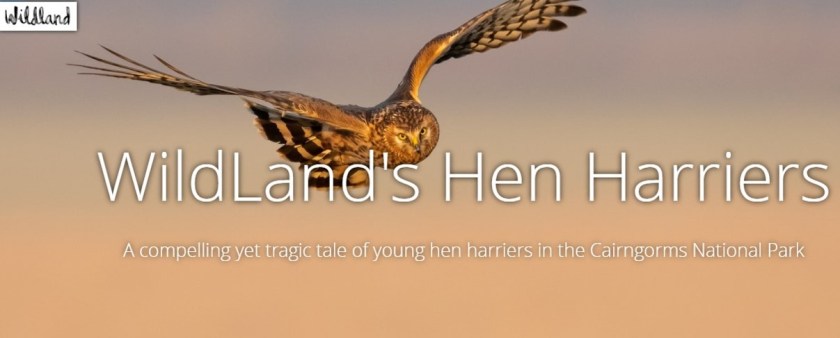
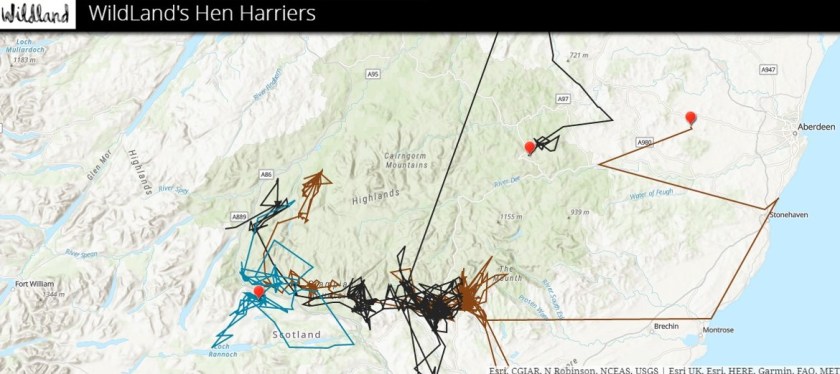
Wildland has been involved with satellite-tracking golden eagles for a while now, and last year it also fitted tags to hen harriers that had hatched on its estates. In a beautifully-produced blog that was published on Friday, the fates of three of those hen harriers have now been publicised.

You can read the blog here

Anyone who knows anything about hen harriers in the UK uplands will not be surprised to learn that two of the three young hen harriers have since ‘disappeared’ and the last known transmission locations of the tags were both on driven grouse moors – one at Dalnaspidal on the SW edge of the National Park (last signal on 5 September 2019) and the other one at Invercauld, Royal Deeside, on the east side of the park (last signal on 24 September 2019). Regular blog readers may be familiar with these areas.

The third hen harrier didn’t disappear in suspicious circumstances over a grouse moor – this one was found dead in a field in Aberdeenshire although the cause of death has not been published.

[An overview of the movements of the three satellite-tracked hen harriers and their last known locations]

Interestingly, the Wildland blog also provides information about the functionality of the three tags with details given about the tags’ battery status (all working perfectly well) – this is a key indication that the ‘sudden stop no malfunction’ scenario of the two tags/hen harriers that vanished is indeed suspicious and not simply a predicted engineering malfunction, which researchers can identify by a steady decline in battery charge (e.g. see here).

The Wildland blog doesn’t provide any information about a police investigation in to the suspicious disappearances of the two young hen harriers, and nor have we seen any publicity about these disappearances even though the birds vanished nine months ago in September 2019. That’s disappointing, especially as the RSPB was publishing information about a suspected shot hen harrier and two others that had vanished on Scottish grouse moors in autumn 2019 (see here).

Nevertheless, now the news is out we can add these two Wildland hen harriers to the ever-expanding list of hen harriers (at least 33 now) believed to have been illegally killed since 2018, the year when grouse shooting industry reps would have us believe that hen harriers were welcomed back on the grouse moors:

February 2018: Hen harrier Saorsa ‘disappeared’ in the Angus Glens in Scotland (here). The Scottish Gamekeepers Association later published wholly inaccurate information claiming the bird had been re-sighted. The RSPB dismissed this as “completely false” (here).

5 February 2018: Hen harrier Marc ‘disappeared’ on a grouse moor in Durham (here)

9 February 2018: Hen harrier Aalin ‘disappeared’ on a grouse moor in Wales (here)

March 2018: Hen harrier Blue ‘disappeared’ in the Lake District National Park (here)

March 2018: Hen harrier Finn ‘disappeared’ near Moffat in Scotland (here)

18 April 2018: Hen harrier Lia ‘disappeared’ in Wales and her corpse was retrieved in a field in May 2018. Cause of death was unconfirmed but police treating death as suspicious (here)

8 August 2018: Hen harrier Hilma ‘disappeared’ on a grouse moor in Northumberland (here).

16 August 2018: Hen harrier Athena ‘disappeared’ on a grouse moor in Scotland (here)

26 August 2018: Hen Harrier Octavia ‘disappeared’ on a grouse moor in the Peak District National Park (here)

29 August 2018: Hen harrier Margot ‘disappeared’ on a grouse moor in Scotland (here)

29 August 2018: Hen Harrier Heulwen ‘disappeared’ on a grouse moor in Wales (here)

3 September 2018: Hen harrier Stelmaria ‘disappeared’ on a grouse moor in Scotland (here)

24 September 2018: Hen harrier Heather ‘disappeared’ on a grouse moor in Scotland (here)

2 October 2018: Hen harrier Mabel ‘disappeared’ on a grouse moor on the edge of the Yorkshire Dales National Park (here)

3 October 2018: Hen Harrier Thor ‘disappeared’ next to a grouse moor in Bowland, Lanacashire (here)

26 October 2018: Hen harrier Arthur ‘disappeared’ on a grouse moor in the North York Moors National Park (here)

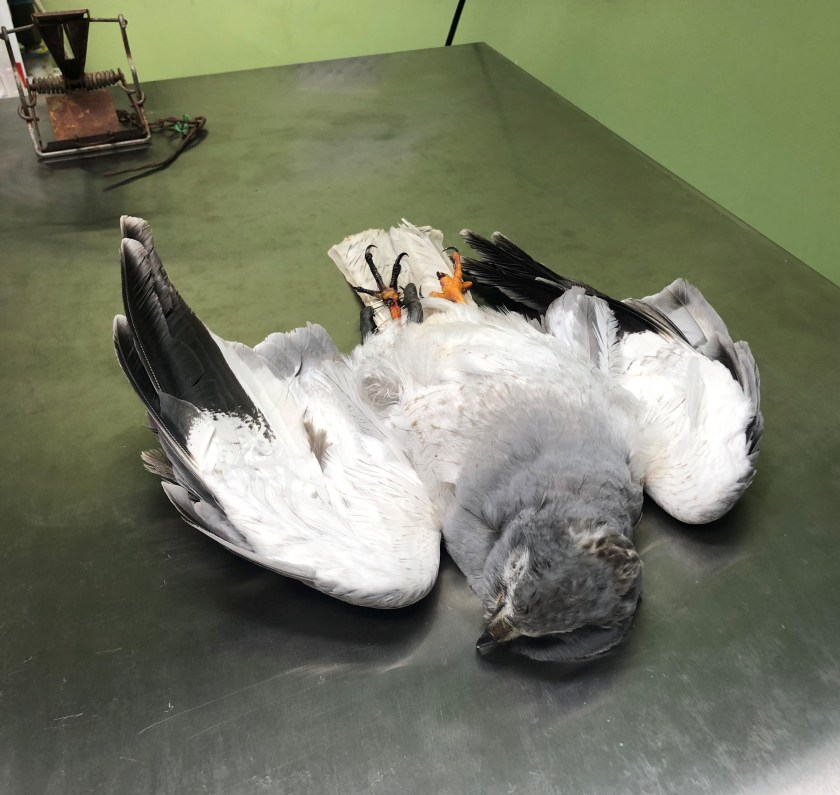
10 November 2018: Hen harrier Rannoch ‘disappeared’ on a grouse moor in Scotland (here). Her corpse was found nearby in May 2019 – she’d been killed in an illegally-set spring trap (here).

14 November 2018: Hen harrier River ‘disappeared’ on a grouse moor in the Nidderdale AONB (here). Her corpse was found nearby in April 2019 – she’d been illegally shot (here).

16 January 2019: Hen harrier Vulcan ‘disappeared’ in Wiltshire close to Natural England’s proposed reintroduction site (here)

7 February 2019: Hen harrier Skylar ‘disappeared’ next to a grouse moor in South Lanarkshire (here)

22 April 2019: Hen harrier Marci ‘disappeared’ on a grouse moor in the Cairngorms National Park (here)

11 May 2019: A male hen harrier was caught in an illegally-set trap next to his nest on a grouse moor in South Lanarkshire. He didn’t survive (here)

7 June 2019: A hen harrier was found dead on a grouse moor in Scotland. A post mortem stated the bird had died as a result of ‘penetrating trauma’ injuries and that this bird had previously been shot (here)

5 September 2019: Wildland Hen Harrier 1 ‘disappeared’ on a grouse moor nr Dalnaspidal on the edge of the Cairngorms National Park (this post)

11 September 2019: Hen harrier Romario ‘disappeared’ on a grouse moor in the Cairngorms National Park (here)

24 September 2019: Wildland Hen Harrier 2 ‘disappeared’ on a grouse moor at Invercauld in the Cairngorms National Park (this post)

10 October 2019: Hen harrier Ada ‘disappeared’ on a grouse moor in the North Pennines AONB (here)

12 October 2019: Hen harrier Thistle ‘disappeared’ on a grouse moor in Sutherland (here)

18 October 2019: Member of the public reports the witnessed shooting of a male hen harrier on White Syke Hill in North Yorkshire (here)

November 2019: Hen harrier Mary found illegally poisoned on a pheasant shoot in Ireland (here)

January 2020: Members of the public report the witnessed shooting of a male hen harrier on Threshfield Moor in the Yorkshire Dales National Park (here)

There are two more satellite-tagged hen harriers (Tony & Rain) that are reported either confirmed or suspected to have been illegally killed in the RSPB’s Hen Harrier LIFE Project Report but no further details are available.

And then there were last year’s brood meddled hen harrier chicks that have been reported ‘missing’ but as they’re carrying a new type of tag known to be unreliable it’s not known if they’ve been illegally killed or if they’re still ok. For the purposes of this mini-analysis we will discount these birds.

So that makes a total of at least 33 hen harriers that are known to have either ‘disappeared’ in suspicious circumstances or have been witnessed being shot or have been found illegally killed in the last two years. And still we’re expected to believe that everything’s perfect, that the grouse shooting industry is not riddled with armed criminals and that hen harriers are doing just fine, thriving even, according to the shooting industry’s propaganda.

Search & Rescue dog dies after eating suspected poisoned bait

The Search and Rescue Dog Association (SARDA) has announced the death of one of its trainee dogs after consuming what is believed to have been a poisoned bait.

SARDA posted the following statement on social media yesterday:

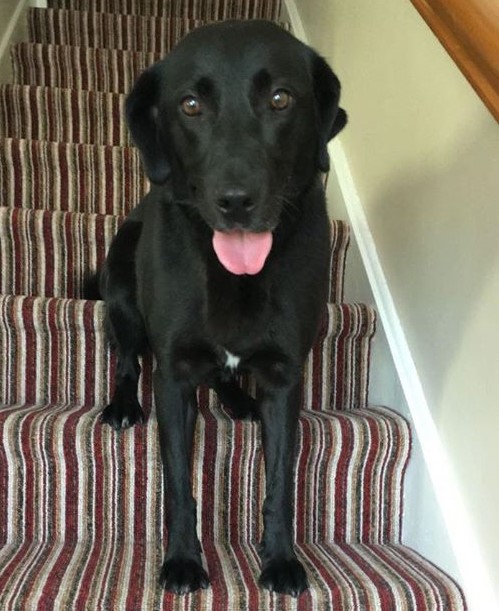
Tragic news in the last few days, as Bonnie, a SARDA Ireland Trainee Trailing Dog died after she ate poison that had been deliberately put out on the hill with the intention of targeting wildlife. She and her handler Jim O’Brien were training in the foothills of the Knockmealdowns when the incident occurred.

Bonnie was a beautiful and talented dog who no doubt would have become one of our first SARDA Ireland Trailing Dogs. A tragic loss for Jim, who has lost his beloved pet, and a huge loss to the SARDA Ireland Trailing Dog Team.

There have also been reports in the media, such as this from Tipp FM:

Investigations are underway following the poisoning of a Search and Rescue Dog in Tipperary.

Bonnie – a Labrador/Collie cross – was being trained by a member of the Search and Rescue Dogs Association of Ireland.

The incident happened last Sunday week in woods on the foothills of the Knockmealdown Mountains near Clogheen. Sadly Bonnie passed away a few days later.

There are just 6 qualified dogs in the country with 4 of them part of the South Eastern Mountain Rescue Association.

Gerry Tobin is a dog handler with SARDA – he says there have been other incidents of poisoning reported in the area.

There are certain individuals who for whatever reason are putting out poisoned baits and targeting wildlife – buzzards, peregrines, badgers you know any animals like this are potentially going to be at risk of poisoning.

And you’re also in a situation where you could have a family dog being exercised on a Sunday afternoon along the Blackwater Way and the following day that family dog could be dead.”

ENDS

The type of poison hasn’t been disclosed in this case but only a few weeks ago we learned that the banned pesticide Carbofuran had been used for the mass poisoning of 23 buzzards in neighbouring County Cork (see here).

Placing poisoned baits to target birds of prey is not only illegal, but it’s also barbaric and indiscriminate. Only last month we heard of the suspected poisoning of two dogs in the notorious raptor-killing hell hole of Nidderdale, a so-called protected area designated as an Area of Outstanding Natural Beauty (AONB) in North Yorkshire. One of those dogs subsequently died (see here).

If you see what you believe is a poisoned bait, DON’T TOUCH IT but call the police immediately.

North Yorkshire police warn public of potential poisonous baits at Pateley Bridge

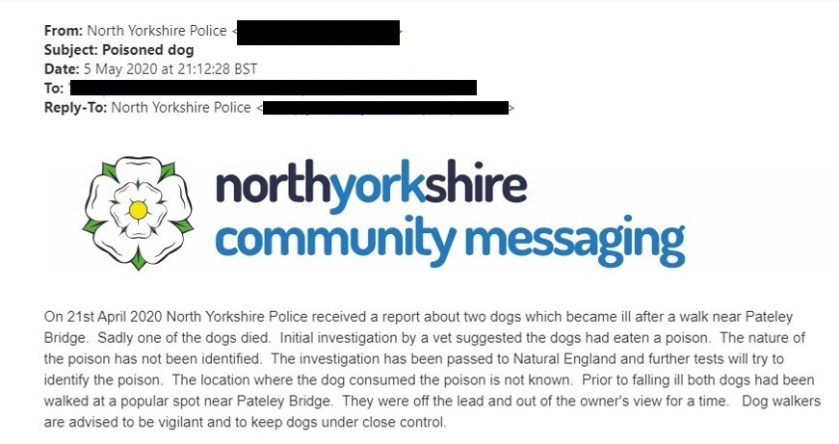
North Yorkshire Police are warning the public of potential poisonous baits at Pateley Bridge in Nidderdale following the suspected poisoning of two dogs in April. [August 2020: See update at foot of blog]

The following message was emailed to members of the local community last week:

This suspected poisoning incident was referred to by the Police in a recent Yorkshire Post article about raptor persecution in the area:

Nidderdale residents will be used to receiving these warnings; there have been several in recent years (e.g. see here, here, here, here, here, here, here) as illegal poisonous baits have been used routinely to kill off red kites inside this AONB and the surrounding area (e.g. see here).

Dog walkers are urged to keep their pets under close control and report anything suspicious to the police. DO NOT HANDLE A SUSPECTED POISONOUS BAIT – some of the chemicals used as poison are so dangerously toxic they have been banned from use in the UK.

UPDATE 1 August 2020: Dog poisoning confirmed in Nidderdale raptor persecution hotspot (here)

23 buzzards illegally poisoned with Carbofuran in single incident

The Irish Raptor Study Group and BirdWatch Ireland have reported the illegal poisoning of 23 buzzards in a single incident in Co Cork.

The following statement has been published by BirdWatch Ireland:

Mass poisoning of buzzards in County Cork

We have recently learned of the illegal poisoning of 23 Buzzards in County Cork. This incident is the single largest poisoning of birds of prey in this country in decades and the largest since the legislation was amended to ban the use of poison meat baits in 2010. We understand that the 23 Buzzards were recovered at the scene last December and were sent for testing under the Raptor Protocol, which subsequently confirmed that all had died due to ingesting the highly toxic and banned substance, Carbofuran.

[Photo via Irish Raptor Study Group]

The targeted use of bait laced with poison to kill protected birds of prey remains widespread and one of the most common substances used is Carbofuran, despite being banned. This incident follows the death of Mary, the satellite-tagged Hen Harrier, late last year, also illegally poisoned, also by Carbofuran (for more details see here and here).

These incidents, along with the countless other similar horrific poisonings of birds of prey, demonstrate that current efforts are simply not sufficient in stopping the persecution of our birds of prey. History dictates that incidents such as this mass poisoning will continue to occur unless appropriate action is taken. While we do not know who is responsible for this incident, we do know that the motives of those that persecute birds of prey are inherently flawed and display an ignorance and lack of understanding of our environment. Buzzards and other birds of prey are indicators of a healthy countryside and perform a vital role in the ecosystem, we cannot and should not tolerate the damaging actions of a minority to eradicate them from our countryside.

We understand that NPWS held an investigation, but that similar to the poisoning of Mary, those responsible were not held accountable. Why is more action not being taken to tackle Carbofuran and other illegal poisons, which are horrendously toxic and pose a serious threat to humans as well as to wildlife? Does an unwitting person trying to assist a stricken bird have to die before the State finally takes action?

We will be liaising with NPWS, we offer our support to them and urge a unified approach to tackling wildlife crimes. Unless proper resources are allocated, to include an established wildlife crime unit and greater powers and resources to investigate and enforce the legislation, incidents such as this one will continue without consequence. We will bring you more on this incident once we have further details.

ENDS

UPDATE 10 May 2020: Local politician seeks ‘full investigation’ in to mass poisoning of buzzards (here)

North Yorkshire Police frustrated at ongoing raptor persecution

Following on from the news that yet another shot raptor has been found in Nidderdale AONB (see here), there’s a topical news feature in today’s Yorkshire Post about the ongoing illegal persecution of birds of prey in North Yorkshire.

The article starts off well and focuses on quotes from Inspector Matt Hagen, who leads the North Yorks Police Rural Task Force and also from Supt Nick Lyall, Chair of the Raptor Persecution Priority Delivery Group (RPPDG – the so-called partnership approach to tackling raptor persecution).

Here’s an extract:

The shooting, poisoning and trapping of birds such as red kites and buzzards is a crime previously described by the RSPB as “a stain on our countryside” and has risen in recent years after they were introduced to Yorkshire in the late nineties.

It is thought the offences have been happening for a long time, although increased awareness from the national police campaign Operation Owl has led to a rise in reports from the public.

Nidderdale in particular has been highlighted as a hotspot for the crime, while shootings of birds of prey have also been reported around West Yorkshire.

Disturbingly, there have also been reports of pets being killed after eating poisoned meat left out in suspected attempts at targeting scavenging birds of prey.

Between November 2018 and March of this year, there were 15 crimes recorded in North Yorkshire alone of birds being shot, poisoned or trapped, or tagged birds reported missing. Of these, nine had been shot, including a barn owl found shot in Ryedale in December 2019.

[A shot buzzard found in North Yorkshire in 2018, photo via North Yorkshire Police]

Inspector Matt Hagen, who is Head of North Yorkshire Police’s Rural Taskforce, said: “These crimes are very difficult to investigate because they happen in isolated places and there is often no one around to witness them.

“From what I have seen, some of the people that persecute birds of prey are of the opinion that they diminish the numbers of pheasants, grouse or partridges.

“Many gamekeepers are very pro-conservation, but it just takes one or two individuals in that industry to make a real impact. This is especially the case with hen harriers because they are so endangered. Many birds of prey that are persecuted we find that they were on a grouse moor, or at least near to one of those areas.

“I do know that with the hen harriers, there are not many left in this country, and if this carries on it may well be that they disappear.”

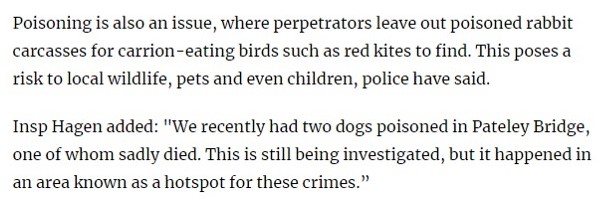
Poisoning is also an issue, where perpetrators leave out poisoned rabbit carcasses for carrion-eating birds such as red kites to find. This poses a risk to local wildlife, pets and even children, police have said.

Insp Hagen added: “We recently had two dogs poisoned in Pateley Bridge, one of whom sadly died. This is still being investigated, but it happened in an area known as a hotspot for these crimes.”

Operation Owl is a campaign originally spearheaded by North Yorkshire Police which has since been made into a national campaign urging the public to be eyes and ears for crimes committed against birds of prey, as most occur in remote areas.

Superintendent Nick Lyall of Bedfordshire Police currently leads the campaign, and has been meeting with the Crown Prosecution Service and senior Government ministers to urge for the crimes to be upgraded from summary-only offences – which can only be dealt with by magistrates and have more lenient sentences – to either-way offences, meaning they can be tried in a crown court.

Supt Lyall said: “We can do search warrants linked to wildlife crimes, but we can’t use our serious crime tactics of covert policing, such as surveillance, to catch these offenders. So for example, if we knew of a nest that was being targeted, we currently can’t put cameras in to see who was disturbing that nest.”

Supt Lyall added that only one or two people are convicted each year for crimes against these birds, with police relying mainly on witnesses as evidence.

“With the remote places these crimes are happening in, that makes it very difficult to prosecute,” he added.

The impact of these crimes is not just felt by the community, but on the environment as well.

A report published by the Nidderdale Area of Outstanding Natural Beauty in September revealed that red kites were failing to expand breeding territory from Wharfedale into neighbouring Nidderdale.

– END OF EXTRACT –

It was pretty accurate reporting up to this point but then it descended in to farce, first with this statement from the journalist:

‘Despite this there is hope, and most gamekeepers and landowners are now strongly committed to conserving all species, with 2019 being a record year for endangered hen harriers breeding’.

There’s a short, but crucially important, word missing from this statement, and that word is ‘say’. As in, ‘…..most gamekeepers and landowners say they’re now strongly committed to conserving all species……’

Of course they’re going to say they’re against raptor persecution – they’ve been saying that for 66 years, ever since the Protection of Birds Act 1954 was enacted. However, all the evidence, of humongous proportions, suggests otherwise!

The article then continues with contributions from Amanda Anderson (Moorland Association) and John Clarke (National Gamekeepers Organisation) both churning out the familiar patter about supposed ‘zero tolerance‘ of raptor persecution and Amanda particularly focusing on the so-called ‘enthusiastic’ support of moorland estates for hen harriers!

She ‘forgot’ to mention the two current police investigations in to the alleged witnessed shooting of hen harriers on two grouse moors and the game shooting industry’s subsequent silence (see here). She also ‘forgot’ to mention the 31 (at least) hen harriers believed to have been illegally killed since 2018, the year when grouse shooting industry reps would have us believe that hen harriers were welcomed back on the grouse moors. She also ‘forgot’ to mention the 2019 research paper that demonstrated that at least 72% of satellite-tracked hen harriers tagged by Natural England were believed to have been illegally killed on British grouse moors.

[This hen harrier was caught in an illegally-set spring trap (which almost severed his leg) on a grouse moor on Leadhills Estate last year. He didn’t survive. Read his grim story here. Photo by Ruth Tingay]

Meanwhile, back in the real world unofficial reports from around the UK but particularly from areas managed for driven grouse shooting in the north of England indicate that raptor persecution crimes are still being committed, and that includes hen harriers being targeted yet again.

There’s a famous quote that springs to mind that some journalists would do well to consider:

If someone says it’s raining, and another person says it’s dry, it’s not your job to quote them both. Your job is to look out the f***ing window and find out which is true“.

Mass poisoning of birds of prey in south Scotland: man charged

Police Scotland press release:

Man charged with wildlife crimes in Stewartry

Police Scotland can confirm that a 64-year-old man has been charged with a number of wildlife crime offences in the Stewartry area of Dumfries and Galloway.

Extensive investigations have been ongoing into the deaths of upwards of 20 birds of prey and other wild birds in the Springholm area near Castle Douglas between 2018 and 2020. Enquiries subsequently established the birds had been poisoned by banned pesticides.

A report has been submitted to the Procurator Fiscal.

Wildlife Crime Officer Constable John Cowan said: “Residents in Springholm and the surrounding area as well as wildlife enthusiasts further afield will be only too well aware of a worrying rise in poisonings in and around the Springholm area over the last few years following on from previous appeals for information.

Working alongside partners such as the RSPB (Royal Society for the Protection of Birds), SSPCA (Scottish Society for Prevention of Cruelty to Animals), SASA (Science and Advice for Scottish Agriculture), SAC (Scottish Agricultural College), SGRPID (Scottish Government Rural Payments and Inspections Division), Scottish National Heritage and Scottish Land and Estates, there has been an overwhelming collective determination to halt these incidents.

I would like to thank members of the public for the information they have provided throughout the investigation. This sends out a strong message that Police Scotland and partners treat wildlife crime very seriously and should act as a strong deterrent to anyone engaging in such activities, irrespective of the underhand tactics that may be used.”

ENDS

We believe this case relates to the illegal poisoning of multiple red kites and buzzards, some of which have been reported here and here.

PLEASE NOTE: As usual, we will not be accepting comments on this case until legal proceedings have concluded. Thanks.

UPDATE 27th February 2021: Mass poisoning of raptors in south Scotland: has there been a conviction? (here)

Two hen harriers shot on two North Yorkshire grouse moors: shooting industry’s response

At the end of January 2020 several prominent organisations from the game-shooting industry (BASC, Moorland Assoc, National Gamekeepers Org, Countryside Alliance) and the Country Landowners Association made a huge thing about acknowledging 66-year-old wildlife protection legislation when they announced a professed ‘zero tolerance’ for the illegal killing of birds of prey (see here).

Since then police in North Yorkshire, the epicentre of UK raptor persecution, have issued two public statements (on 12th and 17th March) about the witnessed shooting of two male hen harriers, one on a grouse moor in the Bowland AONB (here) and one on a grouse moor in the Yorkshire Dales National Park (here). The illegal killing of hen harriers has been identified as a National Wildlife Crime Priority. This species is on its knees, thanks to criminals within the grouse shooting industry.

It was also revealed that, unusually, North Yorkshire Police had been able to make two arrests in relation to these reported crimes; this was welcome news and in both press releases the police asked the public to come forward with any further information as their inquiries continued.

[Conservationist Chris Packham holding the corpse of an illegally trapped hen harrier that was found on a grouse moor in Scotland last year. Photo by Ruth Tingay]

You might think, given the recently professed ‘zero tolerance’ of these offences, that police appeals for information about these two disturbing crimes reported on Yorkshire grouse moors would provide the perfect opportunity for the grouse-shooting industry to offer its full support to the investigations and to encourage members of the public to step forward with info, especially if there was concern about dangerous unidentified armed criminals running amok on privately-owned land, right?

Well apparently not. We’ve looked at the websites of the five organisations to search for statements and this is what we found:

BASC: nothing

Moorland Association: nothing

National Gamekeepers Organisation: nothing

Countryside Alliance: nothing

CLA: nothing

Ah, you may say, well they’re all too busy focusing on the coronavirus so haven’t had time to share information about illegal raptor persecution.

Well, that may have been a credible argument had we not found the National Gamekeepers Organisation and Countryside Alliance yesterday making urgent demands of DEFRA’s Secretary of State George Eustice to issue licences that permit gamekeepers to continue killing stoats and sidestep new restrictions (see here and here).

Meanwhile, with the hypocrisy knob turned up to high, BASC has been howling with moral indignation about the timing of Wild Justice’s decision to challenge the casual killing of birds in Wales (see here).

Zero tolerance of illegal raptor persecution? Yeah, right.