Fundraiser for hen harrier satellite tags

The Nidderdale Raptor Study Group, in conjunction with the Northern England Raptor Forum (NERF) is hosting a fundraiser to support the RSPB Investigations Team to buy satellite tags for hen harriers.

In recent years satellite tags have revealed the extent of hen harrier persecution across the UK. In 2019 a damning scientific research paper demonstrated that at least 72% of tagged hen harriers were presumed illegally killed on or close to driven grouse moors (see here).

And a tally of incidents kept by this blog demonstrates that over the last two years alone at least 45 hen harriers, many of them satellite-tagged, are either ‘missing’ in suspicious circumstances or confirmed illegally killed, many on driven grouse moors (see here). It’s my understanding that this number has since risen but official notification is still pending. More on that shortly.

So, in essence, satellite-tagging has proven to be incredibly important in helping to detect a crime that is otherwise too easily hidden (and which explains the grouse shooting industry’s desperate attempts to undermine the science and the integrity of those who fit and monitor the tags).

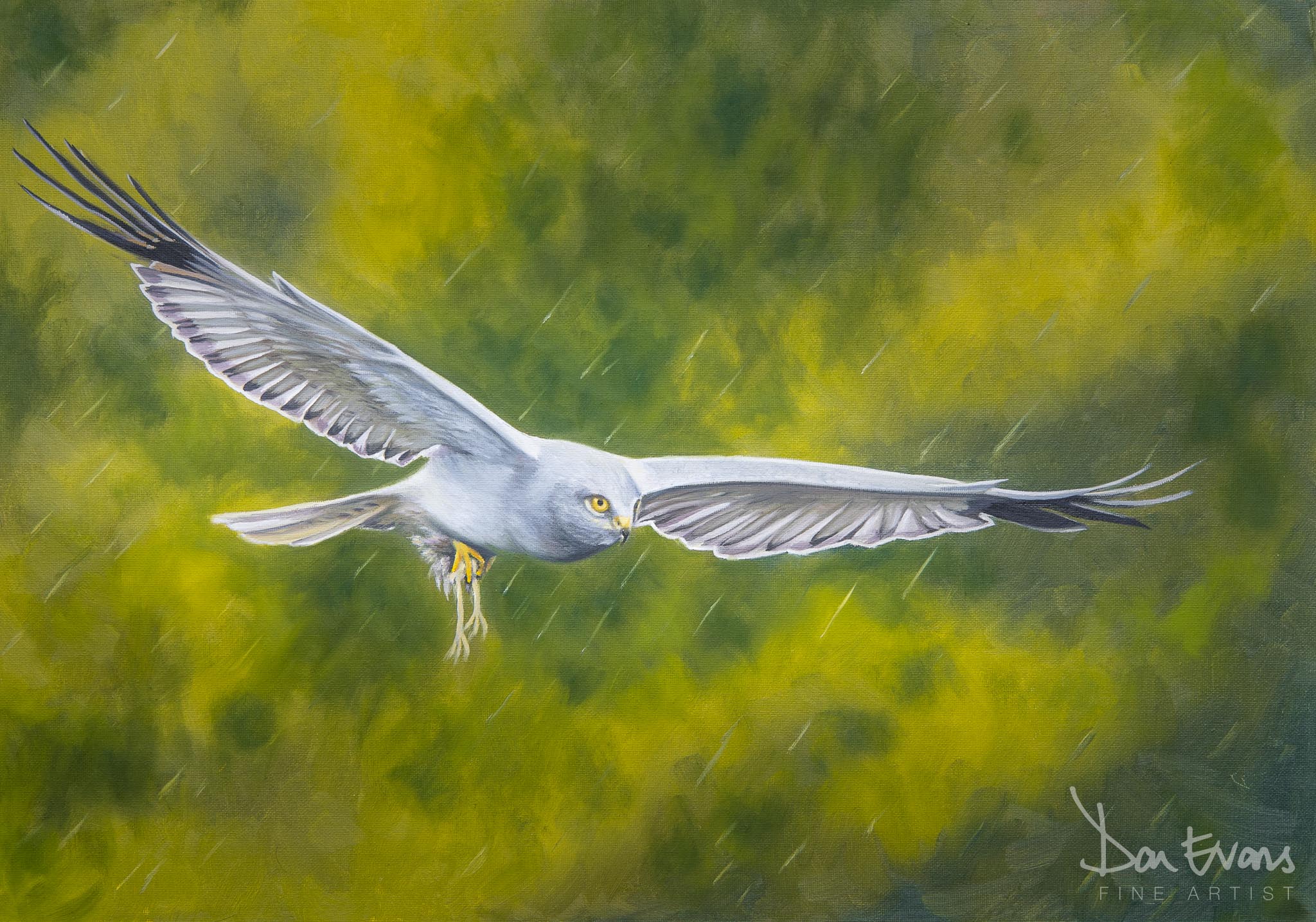
Yorkshire-based artist Dan Evans has donated this A2-sized oil painting for an online auction to help support the purchase of more satellite tags:

If you’d like to bid on this artwork please visit the auction page here. The auction will close on 23 December 2020. There is also an opportunity to buy signed limited edition prints, with all profits being donated to the sat tag fund.

There is also a fundraising page for those who may not want to buy the artwork but who may still be interested in supporting the effort to buy more satellite tags – you can visit the fundraiser page here

Reports of wildlife crime almost double according to new figures from Police Scotland

Press release from Police Scotland (13th November 2020)

Reports of wildlife crime almost double

Wildlife crime reports have nearly doubled, according to the latest figures from Police Scotland.

Between April and September 2020, Police Scotland recorded 203 wildlife crime offences compared to 111 in the same period in 2019/20, an increase of 82.9%.

Detection rates also increased, rising to 55.2% in 2020 compared to 34.2% in the same six month period in 2019.

The latest figures were released in Police Scotland’s Quarterly Performance Report covering April to September 2020/21.

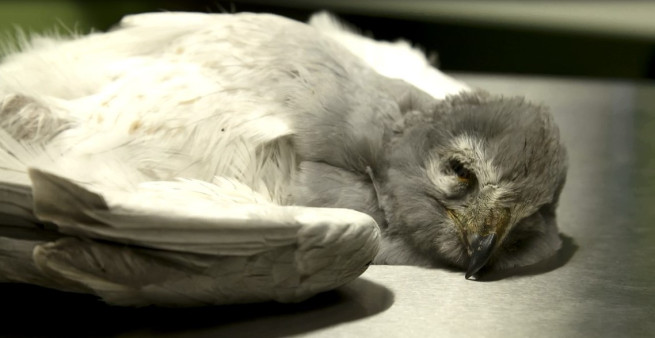
[This hen harrier died after suffering horrendous injuries caused by an illegal trap on a grouse moor on Leadhills Estate, South Lanarkshire. Photo by Ruth Tingay]

Detective Chief Superintendent Gary Cunningham, Police Scotland’s lead for Wildlife Crime, said: “Scotland’s diverse wildlife is one of its greatest assets, yet there are those who seek to destroy it. Wildlife crime has an enormous impact not only on our natural heritage but also on those communities that rely on the employment and tourism it brings.

Investigating wildlife crime can be demanding and complex, it requires specialist skills. Earlier this year we introduced a new training course to build our capability and to enhance the skills and knowledge of our officers.

We will continue to invest in tackling wildlife crime and ensuring our officers are trained to the highest level. But we are also asking the public to be aware and if they see anything suspicious to report it to us“.

ENDS

This increase in reported wildlife crimes in Scotland mirrors a surge in reported raptor persecution crimes in England during lockdown (e.g. see here and here).

SNH grants licence to Leadhills Estate for out-of-season muirburn

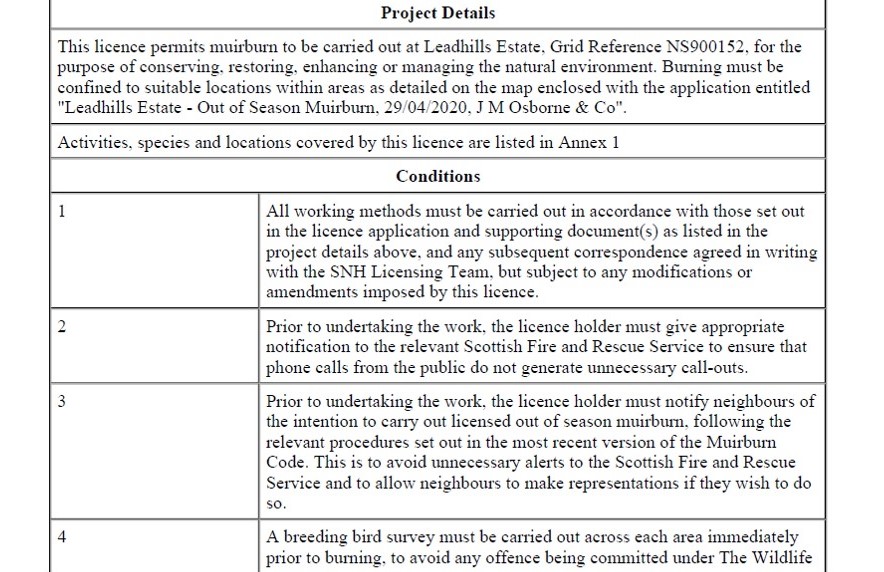
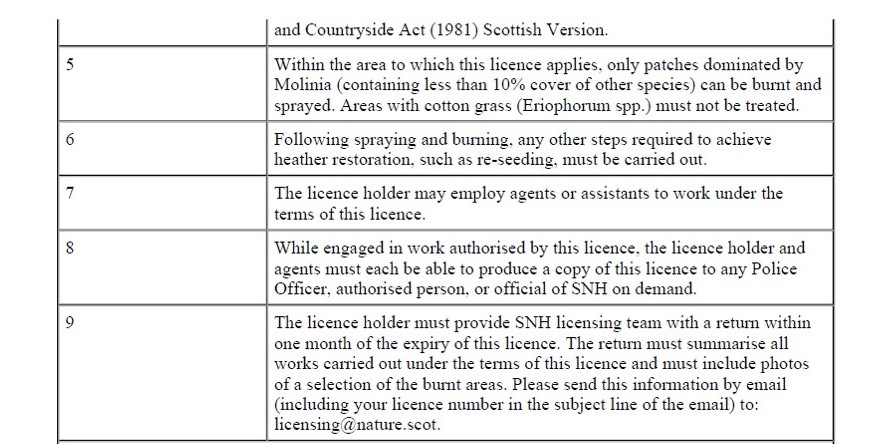
Leadhills Estate, which has been at the centre of over 50 police wildlife crime investigations in the last two decades, has had two gamekeepers convicted for committing wildlife crime offences during that time, and is currently the subject of a three-year General Licence restriction, imposed after Police Scotland found ‘clear evidence’ of wildlife crimes having being committed by persons unknown in recent years, and is under further police investigation since more allegations have been made this year, was granted a licence by SNH to undertake out-of-season muirburn on estate grouse moors in September.

There have been some jaw-dropping revelations on this blog over the years but this one is right up there.

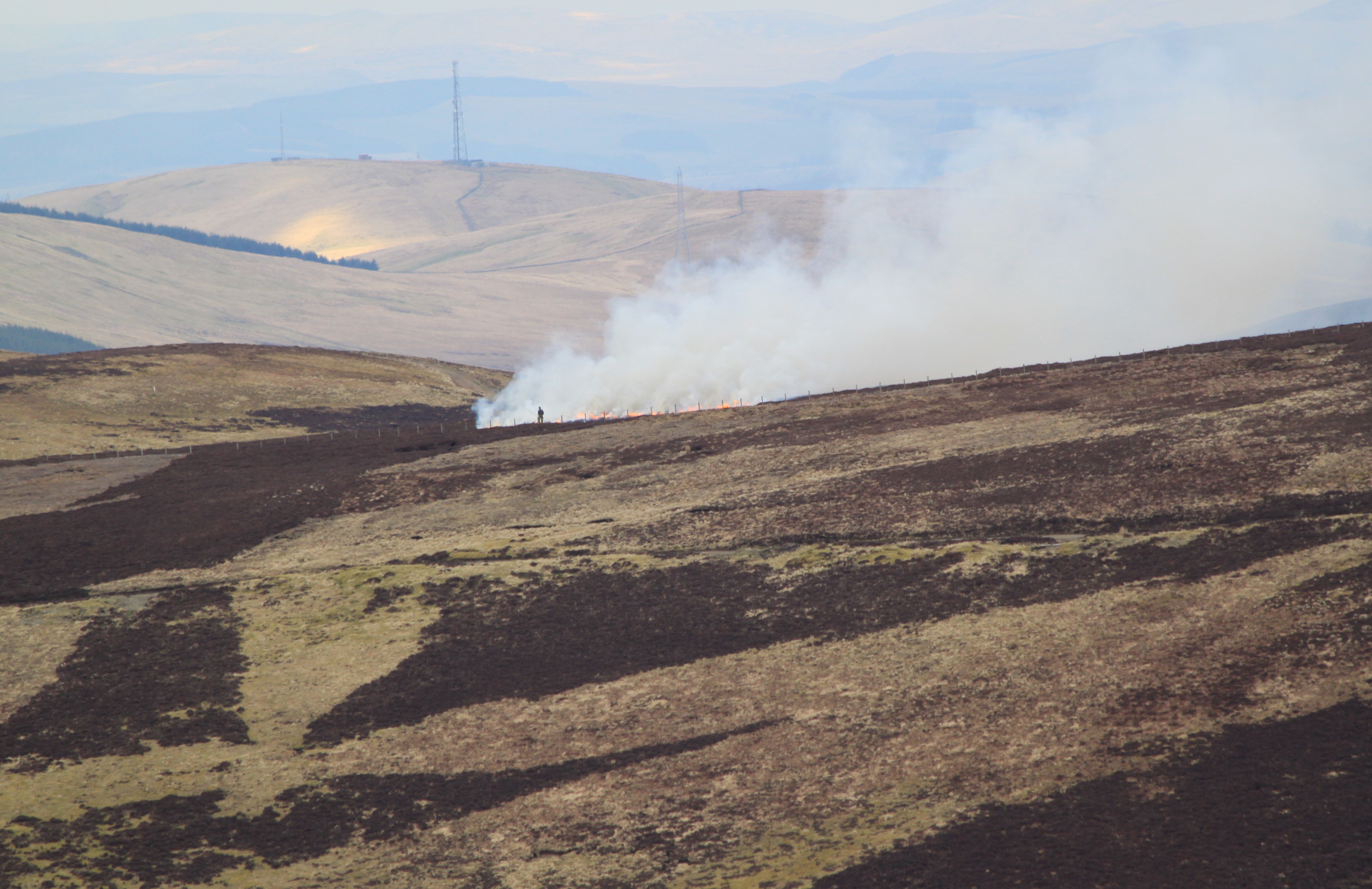
[Muirburn on Leadhills Estate, South Lanarkshire. Photo by Ruth Tingay]

A quick recap of the situation (for those who want more detail please see the links to previous blog posts below).

In April 2020 the Scottish Government temporarily banned all muirburn in Scotland under emergency Coronavirus legislation (see here).

Despite being in the middle of a pandemic, in July 2020 Mark Osborne, acting on behalf of Leadhills Estate, applied to Scottish Natural Heritage for an out-of-season licence to conduct muirburn on the estate in September after spraying some areas with glyphosate (see here).

Scottish Natural Heritage (now rebranded as NatureScot but that’s irrelevant) refused the licence application in August (here) and Osborne immediately appealed the decision (see here).

That’s where we left the saga last time. Here’s what happened next…..

SNH was obliged to consider Osborne’s appeal, although it wasn’t obliged to overturn it’s previous decision to refuse permission.

Here’s how SNH’s reconsideration went:

According to the Freedom of Information documents that have been released, that’s it. That’s the extent of the discussion at SNH about whether Leadhills Estate should be given permission to set fire to its grouse moors out of season and in the middle of a global pandemic.

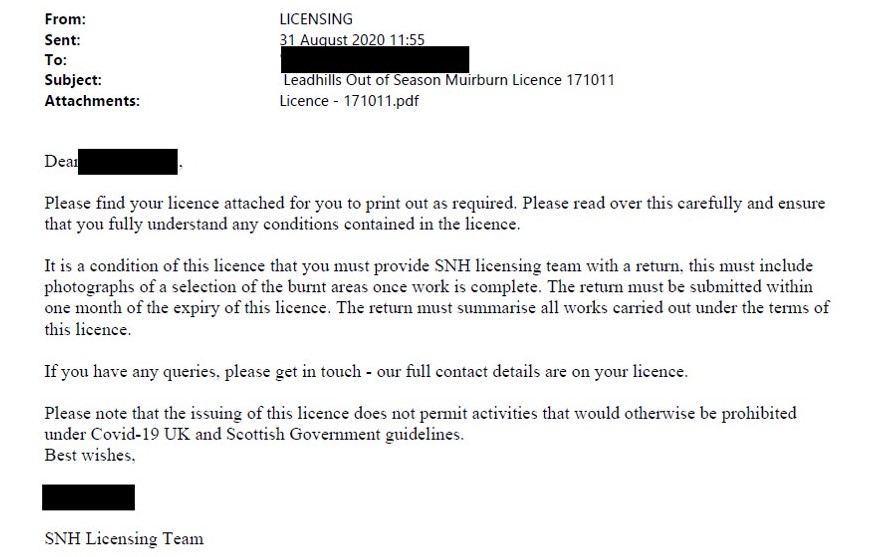
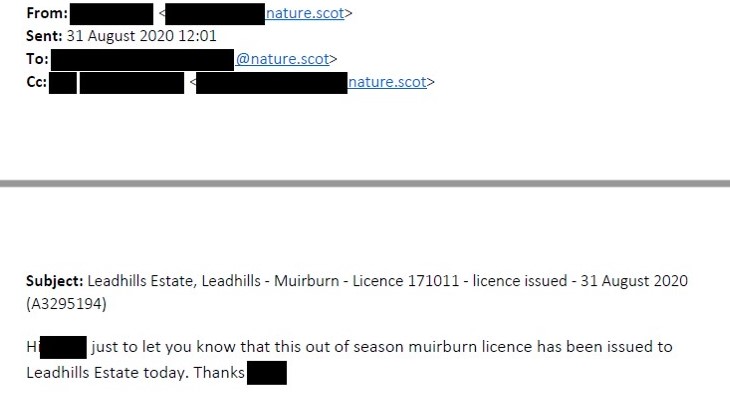
A couple of days later SNH wrote to advise Osborne of its U-turn decision and sent him the licence, as follows:

There has been some discussion amongst RPUK colleagues and associates about whether SNH’s decision to issue this licence was a breach of the Government’s emergency Coronavirus legislation which had temporarily banned muirburn until the official season opened on 1 October 2020. I might return to that topic.

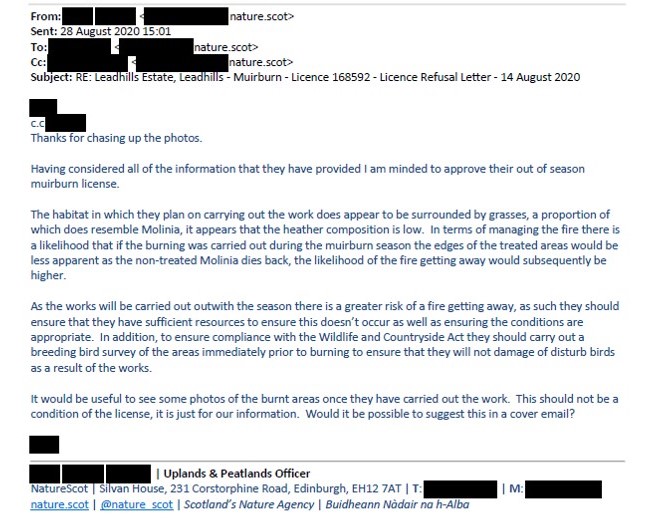
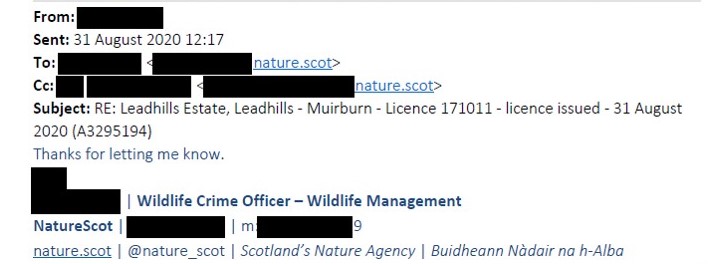
However, of greater interest, to me, is how SNH’s decision-making on whether to issue an out-of-season muirburn licence apparently failed to consider the wider picture of what’s been going on at Leadhills, and especially the current three-year General Licence restriction placed on the estate, by, er, SNH. Didn’t anybody think about that?

Ah, well somebody did, but unfortunately it seems this person’s expert input wasn’t invited as part of the decision-making process:

There’s quite a lot to take in about this case, and the details and circumstances of this particular licence. An FoI has been submitted to SNH to see the licence return which, as detailed in condition #9, should have now been submitted to SNH by Osborne.

And it turns out that this isn’t the first year that SNH has granted an out-of-season muirburn licence to Leadhills Estate. More on that shortly.

For some reason, the phrases ‘taking the piss’ and ‘impotent licensing authority’ are uppermost in my mind.

RSPB publishes latest UK Birdcrime report detailing the illegal killing of birds of prey in 2019

Press release RSPB (1 October 2020)

The law has failed our birds of prey

RSPB Birdcrime report reveals 85 confirmed incidents of bird of prey persecution in the UK in 2019 including shooting, trapping, and poisoning 

RSPB data, peer-reviewed science, and population surveys prove these crimes are concentrated on and near driven grouse moors

Between 2012-2019 half (49%) of the confirmed incidents occurred in protected landscapes

The RSPB calls for urgent action from governments to end bird of prey killing and ensure grouse shooting operates legally and sustainably

Self-regulation from within the grouse shooting community has failed, and urgent action is needed to prevent protected birds of prey being illegally killed and to bring this industry into the 21st century and to help address the nature and climate crises.

That’s the message from the RSPB’s Birdcrime report, out today (1 October), which demonstrates that birds of prey continue to be systematically killed, particularly where land is managed for driven grouse shooting.

The report reveals 85 confirmed incidents of bird of prey persecution, involving birds such as buzzards, red kites, peregrines, golden eagles, and hen harriers being shot, trapped, and poisoned. The highest concentration of these occurred in upland areas of the North of England and Scotland, with North Yorkshire emerging as the worst county for the sixth year running. Half of the confirmed incidents occurred within protected landscapes.

All birds of prey are protected by the Wildlife and Countryside Act 1981. To intentionally kill or injure one is a criminal offence and could result in an unlimited fine or up to six months in jail depending on the jurisdiction.

Yet in the past 10 years, there have been over 1000 confirmed incidents of bird of prey persecution in the UK. Despite hard work by police forces, RSPB Investigations, and volunteers who monitor birds of prey across the UK the law is failing to protect these birds.

The RSPB has stated that, without urgent change, the next decade will be no different. This year, the illegal destruction of birds of prey continued even during COVID-19 lockdown, when the RSPB’s Investigations team reported their busiest ever spring, dealing with multiple reports of bird of prey persecution and assisting police with investigations, many of which took place on land used for gamebird shooting.

As well as illegal killing, a growing number of satellite-tagged birds of prey are vanishing in suspicious circumstances over grouse moors. Since the start of 2018, 45 tagged hen harriers – a rare and heavily persecuted bird of prey – are known to have been illegally killed or disappeared in suspicious circumstances. Only 19 successful nests were recorded in England in 2020, although there is habitat and prey to support more than 300 pairs. The analysis of the government’s own data, published in 2019, showed that illegal killing was the principle factor limiting hen harrier numbers in England.

The RSPB is urging the government to act now, to address the ecologically and environmentally damaging practices involved with the most intensive forms of grouse moor management including raptor persecution and burning of moorland vegetation on peat soils, our most vital carbon stores.

Mark Thomas, RSPB Head of Investigations UK, said: “Once again the Birdcrime report shows that protected birds of prey like hen harriers, peregrines and golden eagles are being relentlessly persecuted, particularly in areas dominated by driven grouse shooting.  

“The illegal killing of birds of prey is just one of the symptoms of a wholly unsustainable grouse shooting industry. The burning of internationally important peatlands is another hugely important issue. This destructive grouse moor management practice not only releases carbon into the atmosphere, it degrades the peat, impoverishes wildlife, and increases the flow of water across the bog surface, causing devastating flooding in some cases in communities downstream. In a climate and ecological emergency, this is simply not acceptable. Today, at the start of the annual burning season, the RSPB is renewing its call for moorland burning on peatland soils to be banned by Government.  

“At a time when the world – and the UK in particular – is seeing catastrophic declines in wildlife populations, the destruction of rare wildlife looks like the opposite of progress. Healthy bird of prey populations are key indicators of the health of our environment. Yet hen harriers are just a few bad breeding seasons away from disappearing from England as a breeding species as a direct result of illegal persecution on grouse moors. The shooting community has had decades to get its house in order, but it is abundantly clear that they cannot control the criminals within their ranks. Current legislation has failed to protect our birds of prey, and the time has come for urgent, meaningful change.  

“UK governments must implement tougher legislation to bring the driven grouse shooting industry in line with the law, stamp out environmentally damaging practices, and deliver on the UK’s nature recovery targets.”

ENDS

Birdcrime 2019 can be downloaded here: birdcrime-report-2019.pdf
 

The all important data appendices can be downloaded here:

Raptor persecution highlighted in House of Lords

Natalie Bennett is a long-time supporter of the campaign for grouse moor reform and particularly against the illegal killing of birds of prey – she’s been a familiar spokesperson at many Hen Harrier Day events over the last few years.

Now Baroness Bennett of Manor Castle, she is using her position in the House of Lords to keep up the pressure.

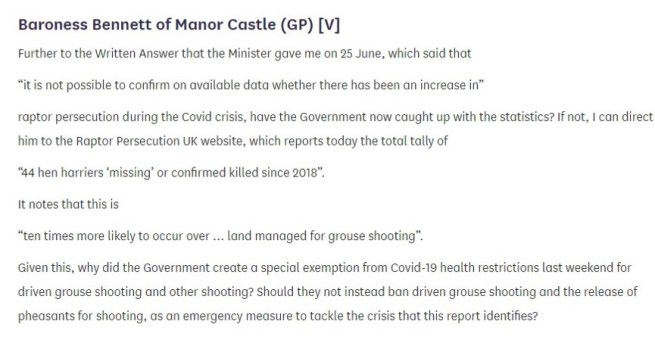
Here’s a question she posed to DEFRA Minister The Rt Honourable Lord Zac Goldsmith on 16th September 2020 (text from Hansard):

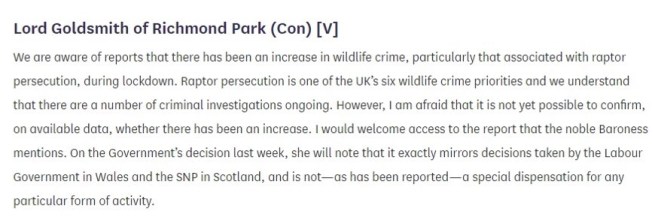
Here is Zac’s response:

Zac said, “I would welcome access to the report that the noble Baroness mentions“.

Here you go, Zac, the report, documenting the 44 hen harriers that have either vanished in suspicious circumstances or have been confirmed illegally killed, most of them on or close to driven grouse moors, since 1 January 2018, can be read here

But that report is now out of date. The running total now stands at 45 hen harriers that have either vanished in suspicious circumstances or have been confirmed illegally killed, most of them on or close to driven grouse moors, since 1 January 2018 (see here for details).

For completeness, although as a DEFRA Minister you must surely already be aware of this, the peer-reviewed science, based on Natural England’s own data, that demonstrates that 72% of satellite-tagged hen harriers in England were ten times more likely to ‘disappear’ or be illegally killed on or close to British grouse moors, can be read here.

The question now is, what do you intend to do about it?

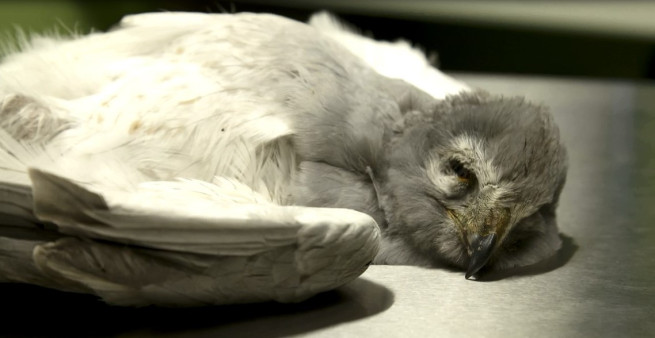
[An illegally killed hen harrier. Photo by Ruth Tingay]

45 hen harriers ‘missing’ or confirmed illegally killed since 2018

Two days ago we blogged that at least 44 hen harriers were ‘missing’ in suspicious circumstances or had been confirmed illegally killed since 2018 (see here).

Today the list is updated to 45 hen harriers, ‘missing’ or confirmed illegally killed since 2018.

Here’s the blog we’ll publish every time this list is updated:

It’s getting to that time of year when the grouse shooting industry pumps out its patently misleading propaganda relating to hen harrier conservation in the UK. The aim is to hoodwink the public in to believing that the industry loves hen harriers and is doing all it can to protect and nurture the tiny remnant breeding population (but conveniently forgetting to mention that the breeding population is only in such dire straits because the grouse shooting industry has been ruthless in its maniacal intolerance of this supposedly protected species).

And the industry’s pursuit of the hen harrier is not simply ‘historical’ or indicative of past behaviour, as some would have us believe. It is on-going, it is current, and it is relentless.

[This male hen harrier died in 2019 after his leg was almost severed in an illegally set trap that had been placed next to his nest on a Scottish grouse moor (see here). Photo by Ruth Tingay]

To illustrate this fact, we intend to keep a running tally of all the hen harriers that we know (because most of these victims had been fitted with a satellite tag) to have either ‘disappeared’ in suspicious circumstances or have been confirmed as being illegally killed since 2018.

Why only since 2018 when we know that hen harriers have been a persecution target for years and years and years? Well, 2018 is the year that the grouse shooting industry ‘leaders’ would have us believe that the criminal persecution of hen harriers had stopped and that these birds were being welcomed back on to the UK’s grouse moors (see here).

This assertion was made shortly before the publication of a devastating new scientific paper that demonstrated that 72% of satellite-tagged Hen Harriers were confirmed or considered likely to have been illegally killed, and this was ten times more likely to occur over areas of land managed for grouse shooting relative to other land uses (see here).

We only started compiling this list of dead / missing hen harriers in June 2020 when we learned that all five of last year’s brood meddled hen harrier chicks were ‘missing’, presumed dead (see here). It has since been updated a few times as we learned about more satellite-tagged hen harriers that had vanished during lockdown in suspicious circumstances on grouse moors in the Cairnorms National Park (here), on a notorious grouse moor in South Lanarkshire (see here) and on a grouse moor believed to be involved with the brood meddling in the Yorkshire Dales National Park (here).

It’s now time to update the death list again, as we’ve learned of yet another satellite-tagged hen harrier that ‘disappeared’ in suspicious circumstances, this time a bird called Fingal who vanished from a grouse moor in the Lowther Hills in May 2020 (see here).

That brings the gruesome tally to 45 hen harriers. (We’re still waiting to hear whether three hen harriers, satellite-tagged by Natural England this year and have since vanished (here), are being treated as suspicious disappearances by the police and if so, they will be added to this list).

Four Five.

Forty five.

In the space of two years.

Nobody has been prosecuted for any of these cases. We have every expectation that this list will be updated again in the near future.

For now, here are the 45:

February 2018: Hen harrier Saorsa ‘disappeared’ in the Angus Glens in Scotland (here). The Scottish Gamekeepers Association later published wholly inaccurate information claiming the bird had been re-sighted. The RSPB dismissed this as “completely false” (here).

5 February 2018: Hen harrier Marc ‘disappeared’ on a grouse moor in Durham (here)

9 February 2018: Hen harrier Aalin ‘disappeared’ on a grouse moor in Wales (here)

March 2018: Hen harrier Blue ‘disappeared’ in the Lake District National Park (here)

March 2018: Hen harrier Finn ‘disappeared’ near Moffat in Scotland (here)

18 April 2018: Hen harrier Lia ‘disappeared’ in Wales and her corpse was retrieved in a field in May 2018. Cause of death was unconfirmed but police treating death as suspicious (here)

8 August 2018: Hen harrier Hilma ‘disappeared’ on a grouse moor in Northumberland (here).

16 August 2018: Hen harrier Athena ‘disappeared’ on a grouse moor in Scotland (here)

26 August 2018: Hen Harrier Octavia ‘disappeared’ on a grouse moor in the Peak District National Park (here)

29 August 2018: Hen harrier Margot ‘disappeared’ on a grouse moor in Scotland (here)

29 August 2018: Hen Harrier Heulwen ‘disappeared’ on a grouse moor in Wales (here)

3 September 2018: Hen harrier Stelmaria ‘disappeared’ on a grouse moor in Scotland (here)

24 September 2018: Hen harrier Heather ‘disappeared’ on a grouse moor in Scotland (here)

2 October 2018: Hen harrier Mabel ‘disappeared’ on a grouse moor on the edge of the Yorkshire Dales National Park (here)

3 October 2018: Hen Harrier Thor ‘disappeared’ next to a grouse moor in Bowland, Lanacashire (here)

23 October 2018: Hen harrier Tom ‘disappeared’ in South Wales (here)

26 October 2018: Hen harrier Arthur ‘disappeared’ on a grouse moor in the North York Moors National Park (here)

1 November 2018: Hen harrier Barney ‘disappeared’ on Bodmin Moor (here)

10 November 2018: Hen harrier Rannoch ‘disappeared’ on a grouse moor in Scotland (here). Her corpse was found nearby in May 2019 – she’d been killed in an illegally-set spring trap (here).

14 November 2018: Hen harrier River ‘disappeared’ on a grouse moor in the Nidderdale AONB (here). Her corpse was found nearby in April 2019 – she’d been illegally shot (here).

16 January 2019: Hen harrier Vulcan ‘disappeared’ in Wiltshire close to Natural England’s proposed reintroduction site (here)

7 February 2019: Hen harrier Skylar ‘disappeared’ next to a grouse moor in South Lanarkshire (here)

22 April 2019: Hen harrier Marci ‘disappeared’ on a grouse moor in the Cairngorms National Park (here)

26 April 2019: Hen harrier Rain ‘disappeared’ on a grouse moor in Nairnshire (here)

11 May 2019: An untagged male hen harrier was caught in an illegally-set trap next to his nest on a grouse moor in South Lanarkshire. He didn’t survive (here)

7 June 2019: An untagged hen harrier was found dead on a grouse moor in Scotland. A post mortem stated the bird had died as a result of ‘penetrating trauma’ injuries and that this bird had previously been shot (here)

5 September 2019: Wildland Hen Harrier 1 ‘disappeared’ on a grouse moor nr Dalnaspidal on the edge of the Cairngorms National Park (here)

11 September 2019: Hen harrier Romario ‘disappeared’ on a grouse moor in the Cairngorms National Park (here)

14 September 2019: Hen harrier (Brood meddled in 2019, #183704) ‘disappeared’ in North Pennines (here)

23 September 2019: Hen harrier (Brood meddled in 2019, #55149) ‘disappeared’ in North Pennines (here)

24 September 2019: Wildland Hen Harrier 2 ‘disappeared’ on a grouse moor at Invercauld in the Cairngorms National Park (here)

10 October 2019: Hen harrier Ada ‘disappeared’ on a grouse moor in the North Pennines AONB (here)

12 October 2019: Hen harrier Thistle ‘disappeared’ on a grouse moor in Sutherland (here)

18 October 2019: Member of the public reports the witnessed shooting of an untagged male hen harrier on White Syke Hill in North Yorkshire (here)

November 2019: Hen harrier Mary found illegally poisoned on a pheasant shoot in Ireland (here)

January 2020: Members of the public report the witnessed shooting of a male hen harrier on Threshfield Moor in the Yorkshire Dales National Park (here)

1 April 2020: Hen harrier (Brood meddled in 2019, #183703) ‘disappeared’ in unnamed location, tag intermittent (here)

5 April 2020: Hen harrier Hoolie ‘disappeared’ on a grouse moor in the Cairngorms National Park (here)

8 April 2020: Hen harrier Marlin ‘disappeared’ on a grouse moor in the Cairngorms National Park (here)

19 May 2020: Hen harrier Fingal ‘disappeared’ on a grouse moor in the Lowther Hills, Scotland (here)

21 May 2020: Hen harrier (Brood meddled in 2019, #183701) ‘disappeared’ on a grouse moor in Cumbria shortly after returning from wintering in France (here)

27 May 2020: Hen harrier Silver ‘disappeared’ on a grouse moor on Leadhills Estate, Scotland (here)

7 September 2020: Hen harrier Dryad ‘disappeared’ on a grouse moor in the Yorkshire Dales National Park (here)

To be continued……..

Anybody still wondering why the grouse shooting industry wants conservationists to stop fitting satellite tags?

44 hen harriers ‘missing’ or confirmed killed since 2018

Last month we blogged that at least 43 hen harriers were ‘missing’ in suspicious circumstances or had been confirmed killed since 2018 (see here).

Today the list is updated to 44 hen harriers, ‘missing’ or confirmed killed since 2018.

Here’s the blog we’ll publish every time this list is updated:

It’s getting to that time of year when the grouse shooting industry pumps out its patently misleading propaganda relating to hen harrier conservation in the UK. The aim is to hoodwink the public in to believing that the industry loves hen harriers and is doing all it can to protect and nurture the tiny remnant breeding population (but conveniently forgetting to mention that the breeding population is only in such dire straits because the grouse shooting industry has been ruthless in its maniacal intolerance of this supposedly protected species).

And the industry’s pursuit of the hen harrier is not simply ‘historical’ or indicative of past behaviour, as some would have us believe. It is on-going, it is current, and it is relentless.

[This male hen harrier died in 2019 after his leg was almost severed in an illegally set trap that had been placed next to his nest on a Scottish grouse moor (see here). Photo by Ruth Tingay]
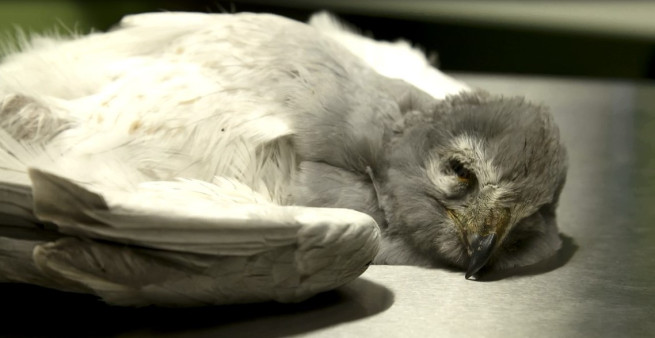
To illustrate this fact, we intend to keep a running tally of all the hen harriers that we know (because most of these victims had been fitted with a satellite tag) to have either ‘disappeared’ in suspicious circumstances or have been confirmed as being illegally killed since 2018.

Why only since 2018 when we know that hen harriers have been a persecution target for years and years and years? Well, 2018 is the year that the grouse shooting industry ‘leaders’ would have us believe that the criminal persecution of hen harriers had stopped and that these birds were being welcomed back on to the UK’s grouse moors (see here).

This assertion was made shortly before the publication of a devastating new scientific paper that demonstrated that 72% of satellite-tagged Hen Harriers were confirmed or considered likely to have been illegally killed, and this was ten times more likely to occur over areas of land managed for grouse shooting relative to other land uses (see here).

We only started compiling this list of dead / missing hen harriers in June 2020 when we learned that all five of last year’s brood meddled hen harrier chicks were ‘missing’, presumed dead (see here). It has since been updated a few times as we learned about more satellite-tagged hen harriers that had vanished during lockdown in suspicious circumstances on grouse moors in the Cairnorms National Park (here) and on a notorious grouse moor in South Lanarkshire (see here).

It’s now time to update the death list again, as we’ve learned of yet another satellite-tagged hen harrier that ‘disappeared’ in suspicious circumstances, this time a bird called ‘Dryad’ who vanished from a grouse moor in the Yorkshire Dales National Park in September 2020 (see here).

That brings the gruesome tally to 44 hen harriers. (We’re still waiting to hear whether three hen harriers, satellite-tagged by Natural England this year and have since vanished (here), are being treated as suspicious disappearances by the police and if so, they will be added to this list).

Four Four.

Forty four.

In the space of two years.

Nobody has been prosecuted for any of these cases. We have every expectation that this list will be updated again in the near future.

For now, here are the 44:

February 2018: Hen harrier Saorsa ‘disappeared’ in the Angus Glens in Scotland (here). The Scottish Gamekeepers Association later published wholly inaccurate information claiming the bird had been re-sighted. The RSPB dismissed this as “completely false” (here).

5 February 2018: Hen harrier Marc ‘disappeared’ on a grouse moor in Durham (here)

9 February 2018: Hen harrier Aalin ‘disappeared’ on a grouse moor in Wales (here)

March 2018: Hen harrier Blue ‘disappeared’ in the Lake District National Park (here)

March 2018: Hen harrier Finn ‘disappeared’ near Moffat in Scotland (here)

18 April 2018: Hen harrier Lia ‘disappeared’ in Wales and her corpse was retrieved in a field in May 2018. Cause of death was unconfirmed but police treating death as suspicious (here)

8 August 2018: Hen harrier Hilma ‘disappeared’ on a grouse moor in Northumberland (here).

16 August 2018: Hen harrier Athena ‘disappeared’ on a grouse moor in Scotland (here)

26 August 2018: Hen Harrier Octavia ‘disappeared’ on a grouse moor in the Peak District National Park (here)

29 August 2018: Hen harrier Margot ‘disappeared’ on a grouse moor in Scotland (here)

29 August 2018: Hen Harrier Heulwen ‘disappeared’ on a grouse moor in Wales (here)

3 September 2018: Hen harrier Stelmaria ‘disappeared’ on a grouse moor in Scotland (here)

24 September 2018: Hen harrier Heather ‘disappeared’ on a grouse moor in Scotland (here)

2 October 2018: Hen harrier Mabel ‘disappeared’ on a grouse moor on the edge of the Yorkshire Dales National Park (here)

3 October 2018: Hen Harrier Thor ‘disappeared’ next to a grouse moor in Bowland, Lanacashire (here)

23 October 2018: Hen harrier Tom ‘disappeared’ in South Wales (here)

26 October 2018: Hen harrier Arthur ‘disappeared’ on a grouse moor in the North York Moors National Park (here)

1 November 2018: Hen harrier Barney ‘disappeared’ on Bodmin Moor (here)

10 November 2018: Hen harrier Rannoch ‘disappeared’ on a grouse moor in Scotland (here). Her corpse was found nearby in May 2019 – she’d been killed in an illegally-set spring trap (here).

14 November 2018: Hen harrier River ‘disappeared’ on a grouse moor in the Nidderdale AONB (here). Her corpse was found nearby in April 2019 – she’d been illegally shot (here).

16 January 2019: Hen harrier Vulcan ‘disappeared’ in Wiltshire close to Natural England’s proposed reintroduction site (here)

7 February 2019: Hen harrier Skylar ‘disappeared’ next to a grouse moor in South Lanarkshire (here)

22 April 2019: Hen harrier Marci ‘disappeared’ on a grouse moor in the Cairngorms National Park (here)

26 April 2019: Hen harrier Rain ‘disappeared’ on a grouse moor in Nairnshire (here)

11 May 2019: An untagged male hen harrier was caught in an illegally-set trap next to his nest on a grouse moor in South Lanarkshire. He didn’t survive (here)

7 June 2019: An untagged hen harrier was found dead on a grouse moor in Scotland. A post mortem stated the bird had died as a result of ‘penetrating trauma’ injuries and that this bird had previously been shot (here)

5 September 2019: Wildland Hen Harrier 1 ‘disappeared’ on a grouse moor nr Dalnaspidal on the edge of the Cairngorms National Park (here)

11 September 2019: Hen harrier Romario ‘disappeared’ on a grouse moor in the Cairngorms National Park (here)

14 September 2019: Hen harrier (Brood meddled in 2019, #183704) ‘disappeared’ in North Pennines (here)

23 September 2019: Hen harrier (Brood meddled in 2019, #55149) ‘disappeared’ in North Pennines (here)

24 September 2019: Wildland Hen Harrier 2 ‘disappeared’ on a grouse moor at Invercauld in the Cairngorms National Park (here)

10 October 2019: Hen harrier Ada ‘disappeared’ on a grouse moor in the North Pennines AONB (here)

12 October 2019: Hen harrier Thistle ‘disappeared’ on a grouse moor in Sutherland (here)

18 October 2019: Member of the public reports the witnessed shooting of an untagged male hen harrier on White Syke Hill in North Yorkshire (here)

November 2019: Hen harrier Mary found illegally poisoned on a pheasant shoot in Ireland (here)

January 2020: Members of the public report the witnessed shooting of a male hen harrier on Threshfield Moor in the Yorkshire Dales National Park (here)

1 April 2020: Hen harrier (Brood meddled in 2019, #183703) ‘disappeared’ in unnamed location, tag intermittent (here)

5 April 2020: Hen harrier Hoolie ‘disappeared’ on a grouse moor in the Cairngorms National Park (here)

8 April 2020: Hen harrier Marlin ‘disappeared’ on a grouse moor in the Cairngorms National Park (here)

21 May 2020: Hen harrier (Brood meddled in 2019, #183701) ‘disappeared’ on a grouse moor in Cumbria shortly after returning from wintering in France (here)

27 May 2020: Hen harrier Silver ‘disappeared’ on a grouse moor on Leadhills Estate, Scotland (here)

7 September 2020: Hen harrier Dryad ‘disappeared’ on a grouse moor in the Yorkshire Dales National Park (here)

To be continued……..

Anybody still wondering why the grouse shooting industry wants conservationists to stop fitting satellite tags?

Four of this year’s satellite-tagged hen harriers already dead or ‘missing’

Earlier today delusional Natural England issued a press statement (along with two organisations that have zero credibility when it comes to hen harrier conservation, the Moorland Association and GWCT) proclaiming this year’s hen harrier breeding season was a ‘wonderful result’ (see here).

The RSPB published its own view, separately (here), pointing out, as if it was necessary, that illegal persecution continues to be ‘the most serious threat’ to hen harrier conservation.

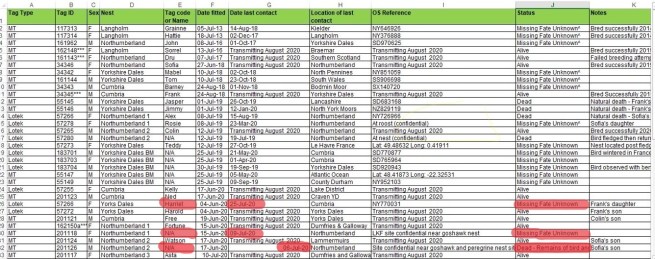
Meanwhile, Natural England, having been justifiably criticised today for publishing inaccurate and ambiguous information about hen harriers (e.g. see here) has quietly updated its spreadsheet on the number of satellite-tagged hen harriers and their fates (see here).

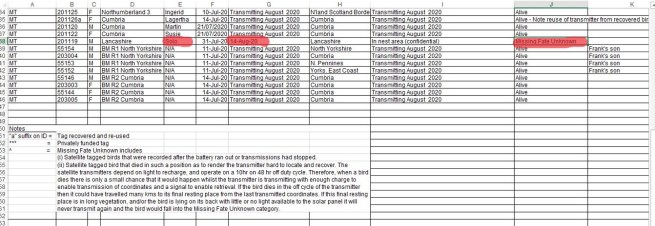
Natural England has fitted satellite tags to 23 of this year’s cohort of 60, but according to the data, four of those 23 are already either dead or ‘missing, fate unknown’.

Here are the details of the four:

Tag #57266, female, Harriet, tagged in Yorkshire Dales on 4 June 2020. Last known fix in Cumbria (actually in the Yorkshire Dales National Park, grid ref NY770031) on 25 July 2020. Listed as ‘missing fate unknown’.

Tag #201118, female, unnamed, tagged in Northumberland (site 1) on 15 June 2020. Last known fix on 9 July 2020 in Northumberland, ‘site confidential nr goshawk nest’. Listed as ‘missing fate unknown’.

Tag #201126, male, unnamed, tagged in Northumberland (site 2) on 15 June 2020. Last known fix on 6 July 2020 in Northumberland, ‘site confidential nr goshawk and peregrine nest sites’. ‘Remains of bird and tag recovered near the nest site post-fledging – most likely avian predation’.

Tag #201119, male, Solo, tagged in Lancashire on 31 July 2020. Last known fix on 14 August 2020 in Lancashire ‘in nest area (confidential)’. Listed as ‘missing, fate unknown’.

It’s not known how many of the three ‘missing, fate unknown’ hen harriers are being investigated as suspicious incidents by the police and without knowing the details or circumstances of the disappearances, it would be unwise to speculate at the moment. We’re not aware of any appeals for information in any of these three cases. We’ll be asking the respective police forces for information on each of them so that the running total of ‘43 dead or missing hen harriers in the last two years‘ can be updated if necessary.

It’s also worth pointing out that one of the ‘missing, fate unknown’ birds was fitted with a Lotek tag rather than the usual MTI tag….we’ve blogged about the apparent unreliability of this tag type previously (see here) and another blog will be published shortly with even more damning commentary on its suitability for tracking hen harriers.

Perhaps the biggest question to ask right now is why Natural England (and its ‘partners’ in the grouse shooting industry) failed to mention in this morning’s press statement the disappearances of three of this year’s cohort?

Can we trust anything Natural England tells us about hen harriers?

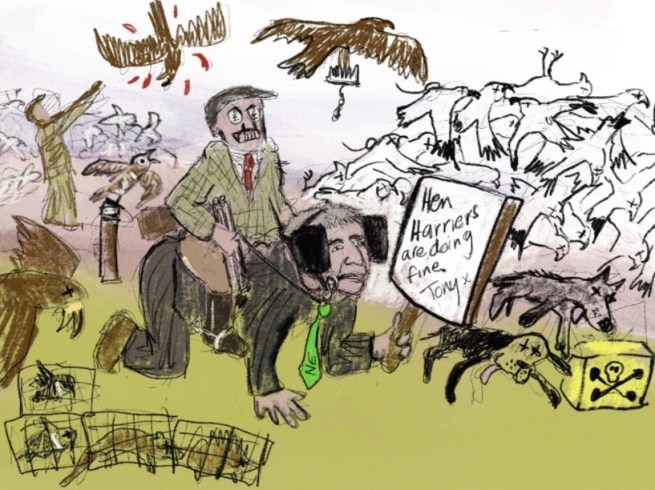
Multi-award-winning author Gill Lewis has neatly summarised the view of many of us with this rather telling cartoon:


Local resident puts up £5,000 reward to find Nidderdale poisoner

In April, during lockdown, two dogs became violently ill on a dog walk near Pateley Bridge in Nidderdale, North Yorkshire.

One of them survived but sadly the other one (Molly) did not.

[Molly, photo by Chloe Ambler]

In August, North Yorkshire Police confirmed (here) that Molly had died after ingesting what has widely become known as the ‘Nidderdale Cocktail’ – a lethal combination of four pesticides (Bendiocarb, Chloralose, Isophenphos and Carbofuran) that has been identified in a number of raptor persecution poisoning crimes in the area.

The police investigation has included conducting high profile raids at several Nidderdale addresses, accompanied by poisons experts from Natural England and persecution experts from RSPB (see here). The police have also issued a warning notice (here) for local residents to take extra care, one in a long line of warnings given Nidderdale’s notorious reputation as a red kite poisoning hotspot (see here).

[Photo by Ruth Tingay]

A local resident has now stepped forward to offer a £5,000 reward for information leading to the poisoner(s). Keith Tordoff, who owns the sweet shop in Pateley Bridge, told BBC news:

It affects tourism. It affects business. Everybody’s affected by this stain on the reputation of Nidderdale and we’ve got to get the message across to these people, this has got to stop.”

You might recognise Keith’s name. It’s not the first time he’s put up a reward for information to help catch the raptor killers and he featured in a recent Channel 4 News documentary about raptor persecution on grouse moors in North Yorkshire, where he told the presenter he’d faced a backlash for speaking out, including having eggs thrown at his windows and receiving anonymous threatening letters (here).

Molly’s owner, Chloe Ambler, wants the poisoner(s) to be held to account. She told the BBC:

“[It’s] absolutely devastating. You feel like you’ve been robbed.

I need someone to be held responsible because at the end of the day we’ve lost amazing Molly.

It’s been so awful for us and I don’t see why people should get away with that.”

Howard Jones, an investigations officer at RSPB, said:

It is absolutely dreadful and this underlines what is the completely irresponsible nature of placing poison out into the countryside.

These people are doing it and know it’s illegal but they don’t care.”

TAKE ACTION

If you’re sick to the back teeth of illegal raptor persecution on driven grouse moors, please consider participating in this quick and easy e-action to send a letter to your local Parliamentary representative (MSP/MP/MS) urging action. Launched on Hen Harrier Day by Wild Justice, RSPB and Hen Harrier Action, over 58,000 people have signed up so far.

This means that over 58,000 pre-written letters complaining about illegal raptor persecution and the environmental damage caused by intensive grouse moor management, are winging their way to politicians of all parties across the UK. If you want your local politician to receive one, Please join in HERE

Thank you

10 year old boy tells First Minister he’s worried about golden eagles ‘going missing’

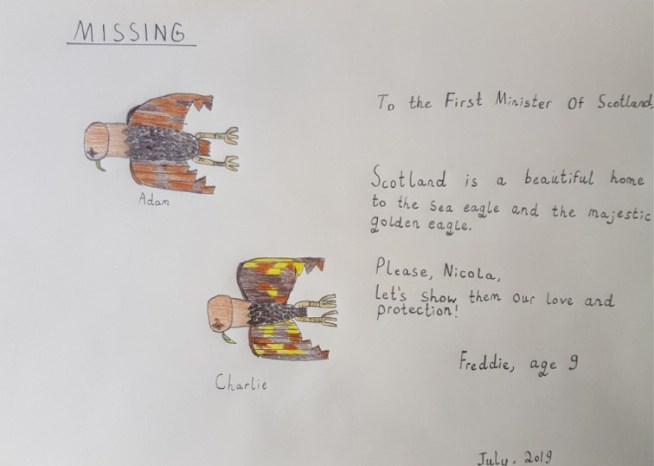
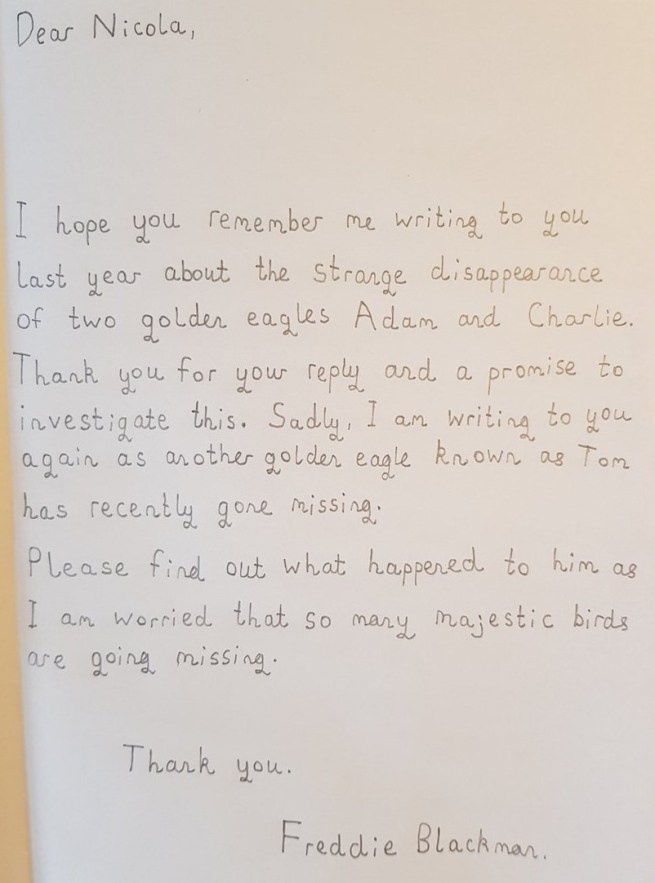
Last year, a nine-year-old boy called Freddie Blackman was so upset about the suspicious disappearance of two satellite-tagged golden eagles (Adam & Charlie) that vanished on a grouse moor in Strathbraan (see here) that he, and many others, wrote to First Minister Nicola Sturgeon urging her and her Government to do more to protect Scotland’s eagles (see here, here, here, here).

Here’s the letter Freddie wrote to Nicola Sturgeon last year:

The First Minister eventually responded to Freddie and wrote him a letter (here) telling him, ‘I believe that the Scottish Government must do everything it can to look after our eagles’ and then going on to fob him off telling him she was waiting for the Werritty review to be delivered.

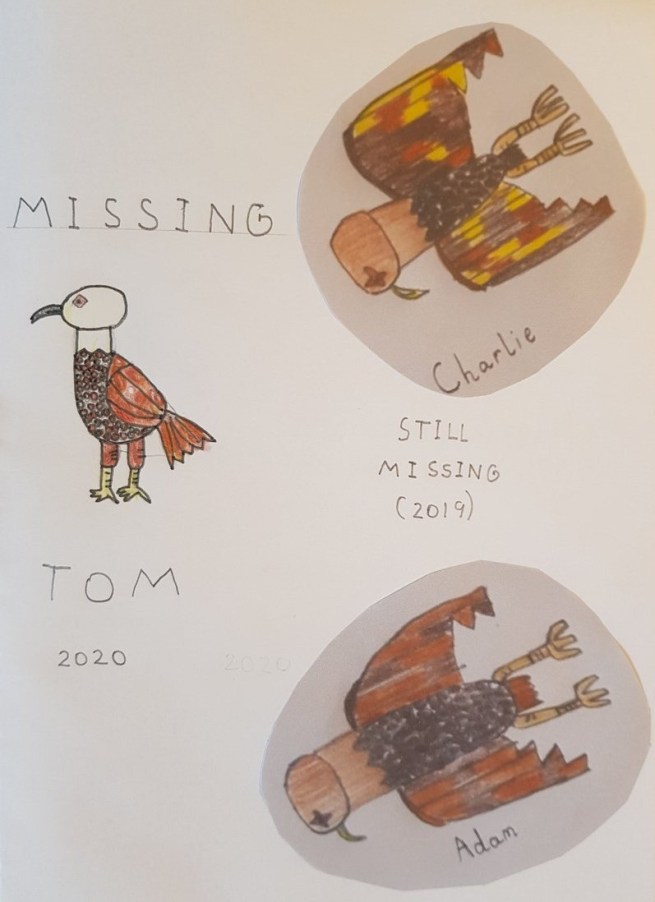
Fast forward 12 months and Freddie is now a year older, another satellite-tagged golden eagle (Tom – see here) has gone ‘missing’ in suspicious circumstances on a Scottish grouse moor, in the same raptor persecution hotspot as where Adam and Charlie disappeared, and we’re still waiting for the Scottish Government to respond to the Werritty review, which cost taxpayers £86,000 and which has been sitting on Ministers’ desks since November 2019 (nine months ago).

Ten-year-old Freddie has just sent another card to the First Minister:

How will the First Minister respond this time?

How embarrassing must it be to have a nine and now ten-year-old calling you out on your failure to protect one of your country’s most iconic species?

How many more letters will Freddie have to write and how old will he be when the Scottish Government finally takes effective action against those who continue to kill these eagles?

YOU CAN TAKE ACTION

If you’re sick to the back teeth of illegal raptor persecution on driven grouse moors, please consider participating in this quick and easy e-action to send a letter to your local Parliamentary representative (MSP/MP/MS) urging action. Launched just nine days ago by Wild Justice, RSPB and Hen Harrier Action, over 53,000 people have signed up so far.

This means that over 53,000 pre-written letters complaining about illegal raptor persecution and the environmental damage caused by intensive grouse moor management, are winging their way to politicians of all parties across the UK. If you want your local politician to receive one, Please join in HERE

Thank you