Raven found poisoned on Ruabon Moor, the ‘grouse capital’ of North Wales

RSPB press release (31/5/19)

(Links have been added by RPUK)

RAVEN FOUND POISONED ON RUABON MOOR

  • The dead bird was found on the same estate near Wrexham, where two satellite-tagged hen harriers recently vanished.
  • Police are now appealing for information from the public. 

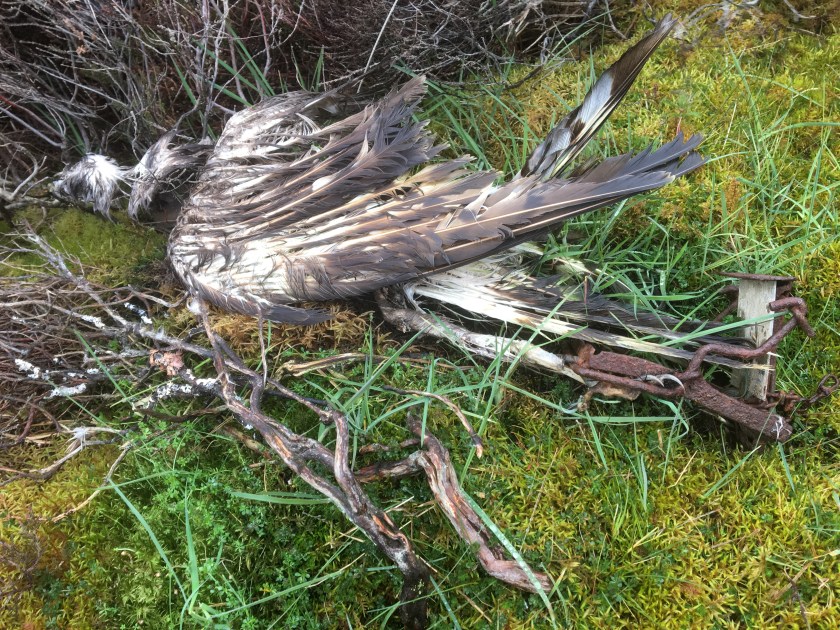
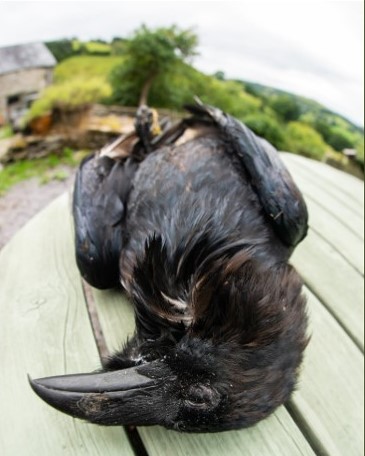
A dead raven found on Ruabon Moor, near World’s End, North Wales, has been confirmed as deliberately poisoned – triggering a police investigation.

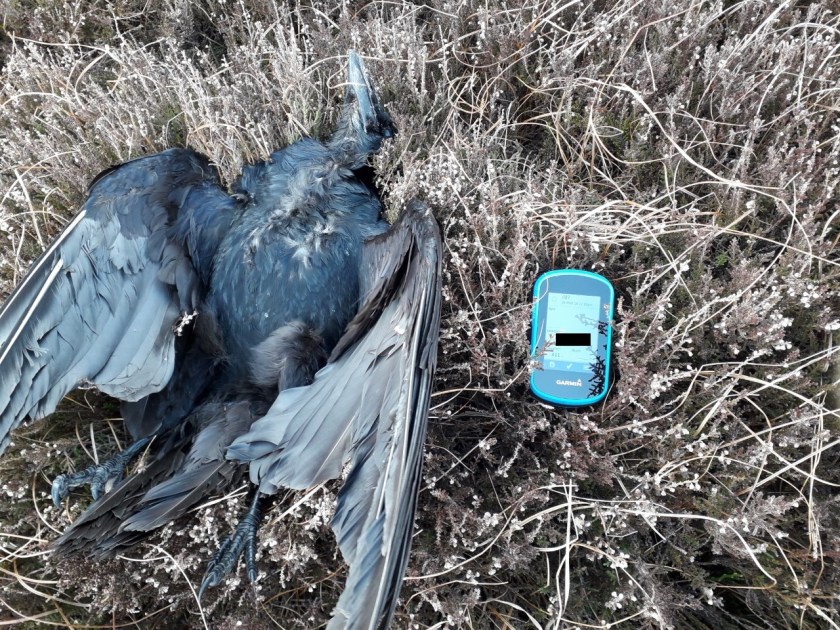
The bird was found dead on 28 August 2018 by a man who had been out photographing birds.

He said: “I was coming home from Wrexham when I noticed the bird on the ground, away from the road in a little clearing of grass. It was upside down, its eyes sunken, and its feet in the air. It didn’t look like it had been dead for long.”

Thinking it may have been shot, he contacted the RSPB’s Investigations Unit. Following liaison with the North Wales Police, Welsh Government arranged for toxicology tests on the bird. This revealed that the raven had been deliberately poisoned with the highly toxic insecticide bendiocarb which had been most likely been applied to a bait. Police enquiries in the area have failed to identify anyone responsible.

[The illegally poisoned raven, photo from @RSPBBirders]

Ravens are protected under the Wildlife and Countryside Act 1981. Killing one is a criminal offence and could result in an unlimited fine or up to six months in jail.

Ruabon Moor holds a significant proportion of the Welsh black grouse population and is an area managed for red grouse shooting. In 2018, two rare hen harriers named Heulwen and Aalin went off the radar in this general area. The birds had been fitted with satellite-tracking devices as part of the EU-funded Hen Harrier LIFE project.

Jenny Shelton, RSPB Investigations, says: “It would seem that ravens and birds of prey are not welcome in this area, and naturally people will be asking why. There is a history throughout the UK of birds of prey and ravens being targeted on areas managed for intensive grouse shooting, due to the perceived threat these natural predators pose to the grouse. However, the law is plain: killing birds of prey and ravens is illegal.

On top of this, placing poison in a public area is hugely irresponsible. Many people will be bringing their families to places like this as the weather warms up. To think that a child or a family pet could have found this bird is outrageous. These crimes must stop before someone is seriously harmed.

Jenny continues: “Ravens are beginning to recover in the UK after decades of persecution, and Wales is a key stronghold for these impressive birds. Spring – the start of the bird breeding season – is sadly a key time for the illegal killing of birds of prey and ravens. If you notice a bird of prey dead on the ground in suspicious circumstances, call the police right away.”

North Wales Police are now appealing for information.

Rob Taylor, North Wales Police Rural Crime Team manager said “The deliberate killing of a bird by poisoning is a serious risk to humans and other animals such as certain birds of prey who frequent the area. We are continuing our investigation and we ask members of the public who have information to contact us or ring Crimestoppers anonymously.”

If you have any information relating to this incident, call North Wales Police on 101.

If you find a wild bird of prey which you suspect has been illegally killed, contact RSPB investigations on 01767 680551 or fill in the online form.

Or, to speak in confidence about bird of prey persecution taking place in your area, call the confidential Raptor Crime Hotline: 0300 999 0101. This number is for bird of prey-related matters only.

ENDS

It’s not clear why it’s taken nine months for this news to emerge. Hopefully North Wales Police were more vocal in the local community at the time, warning the public about the presence of this deadly poison.

Let’s hope they’re also alerting locals and visitors alike that this part of North Wales is earning the reputation of being a wildlife crime hotspot, just like so many other grouse shooting areas across the UK.

The placement of warning signs at these locations is the very least we should be expecting from the authorities.

Case against Scottish gamekeeper accused of 12 wildlife crimes proceeds to trial

The case against a south Scotland gamekeeper has continued this week with an intermediate diet (a type of court hearing) and he has pleaded not guilty to a number of alleged offences.

Alan Wilson, 60, is accused of shooting two goshawks, four buzzards, a peregrine falcon, three badgers and an otter at Henlaw Wood, Longformacus, between March 2016 and May 2017.

He also faces charges of using a snare likely to cause partial suspension of an animal or drowning, failing to produce snaring records within 21 days when requested to do so by police and no certificate for an air weapon.

We also believe he is accused of the alleged possession of the banned pesticide, Carbofuran.

Due to Mr Wilson’s not guilty plea, this case will now proceed to trial at Jedburgh Sheriff Court on 13 June 2019.

Previous blogs about this case: see herehere here  here here and here.

Please note: we will not be accepting comments on this news item until legal proceedings have concluded. Thanks.

Former Edradynate Estate head gamekeeper cleared of crop poisoning charges

David Campbell, the former head gamekeeper of Edradynate Estate in Perthshire, has been cleared of all charges relating to the poisoning of game crops on the estate in April 2017.

It had been alleged that David Campbell had maliciously damaged game crops by spraying them with an unknown substance which caused them to rot and perish. At the time of the alleged offences, Campbell was no longer an employee of the estate, having worked there since 1983 but after falling out with the landowner, millionaire city financier Michael Campbell (no relation), his employment was terminated in February 2017.

[Edradynate Estate, photo by Ruth Tingay]

Michael Campbell had told the court that he believed his former employee had caused the damage ‘in revenge’ and said he could identify David Campbell on CCTV by his distinctive “mutton chop” facial hair. Various witnesses had told the court that David Campbell had been “upset” at having to leave his long-term employment at Edradynate Estate.

Last week, David Campbell’s defence solicitor had argued that the case against his client should be dropped because there was a lack of evidence to show his client was the person caught on the covertly-filmed CCTV. Sheriff Gillian Wade had rejected the argument and said the court had been presented with sufficient evidence for the case to proceed.

However, at Tuesday’s court hearing Sheriff Wade cleared David Campbell after ruling the case against him had not been proved beyond reasonable doubt.

This latest failed prosecution is one of several linked to the Edradynate Estate, although the majority of the previous allegations have related to the alleged illegal poisoning of birds of prey, rather than alleged crop poisoning. Despite at least 22 police investigations over several decades (according to former Tayside wildlife crime officer Alan Stewart), nobody from Edradynate Estate has ever been successfully prosecuted for any of these alleged wildlife crimes.

[A poisoned buzzard at Edradynate in 2015, photo RPUK]

We’ve blogged about this estate a lot over the years (see links here), and most recently in relation to the alleged poisoning of two buzzards in 2015 and the Crown Office’s decision in 2017 not to prosecute one of the Edradynate gamekeepers (un-named), despite Police Scotland urging otherwise (see here).

Edradynate Estate is currently serving a three year General Licence restriction, imposed in Sept 2017 and which we believe relates to the alleged buzzard poisonings in March 2015.

Last year three dogs and two more buzzards were reported to have been “deliberately poisoned” in the area but nobody has been charged (see here) and we are not aware of any suggested link between these poisonings and any current employee of Edradynate Estate.

Don’t laugh, but gamekeepers claim to “care deeply” about protecting hen harriers!

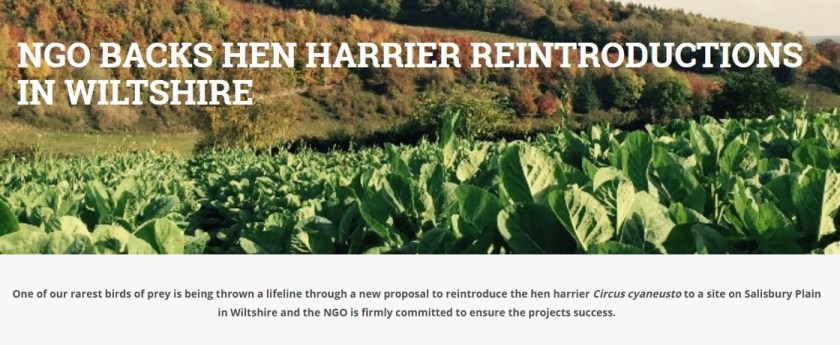
It’s not quite April Fools’ Day but the National Gamekeepers’ Organisation thought it’d get in there early this year.

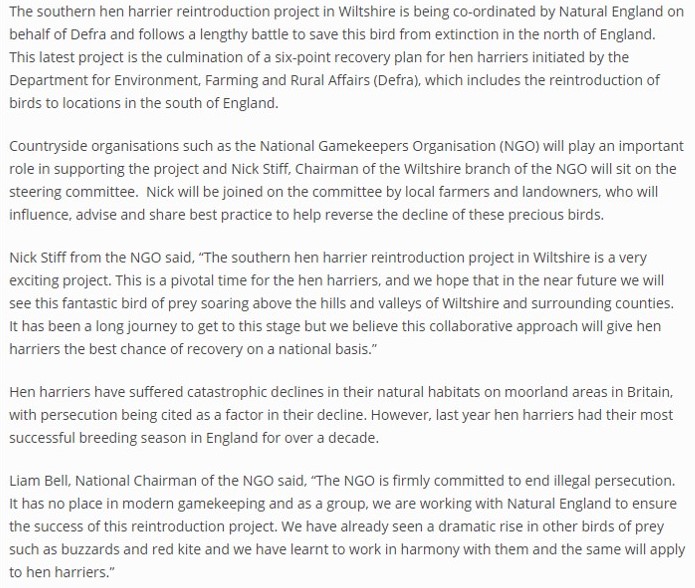
Just a week on from the publication of a scientific paper that demonstrated the catastrophic loss of satellite-tagged hen harriers was undeniably linked to land managed by gamekeepers for grouse shooting (see here), the National Gamekeepers’ Organisation (NGO) published this on its website:

Amazing, eh?

Remind us again, NGO – where was the last known location of the latest hen harrier to ‘disappear’ in suspicious circumstances? Ah yes, in Wiltshire, close to the proposed hen harrier reintroduction site and in an area heavily managed for pheasant and partridge shooting. And what did the NGO say about this bird’s disappearance? Ah yes, that it was “a set up” by the RSPB.

And remind us again, NGO – what examples do you have of the NGO “living in harmony with buzzards“? Ah yes, you supported a gamekeeper (who had a prior poison-related conviction) to get licences to kill buzzards to ‘protect’ his pheasants.

And remind us again, NGO – what was your most recent action on the RPPDG, the group that’s supposed to tackle illegal raptor persecution? Ah yes, it was to resign.

And please could you tell us, NGO, what is “Circus cyaneusto“?! Is this an imaginary harrier species, to match the gamekeepers’ imaginary devotion to hen harriers that we’re supposed to believe?

Not so much April Fools, more like deluded fools.

Responses to hen harrier satellite tag paper: GWCT

The publication of the hen harrier satellite tag paper on Tuesday (here) that provided compelling evidence to highlight, yet again, the link between grouse moors and the illegal killing of hen harriers, has resulted in a flurry of responses from various individuals and organisations.

We’ve be looking at these responses in turn.

So far we’ve discussed the responses of Supt Nick Lyall (Chair, RPPDG) (here), BASC (here), Dr Therese Coffey (DEFRA Wildlife Minister) (here), Northern England Raptor Forum (here) and the Moorland Association (here).

This time we’re examining the response of the Game and Wildlife Conservation Trust (GWCT), a supposedly ‘independent’ charity that seems to attract a good deal of funding from, er, the grouse shooting industry.

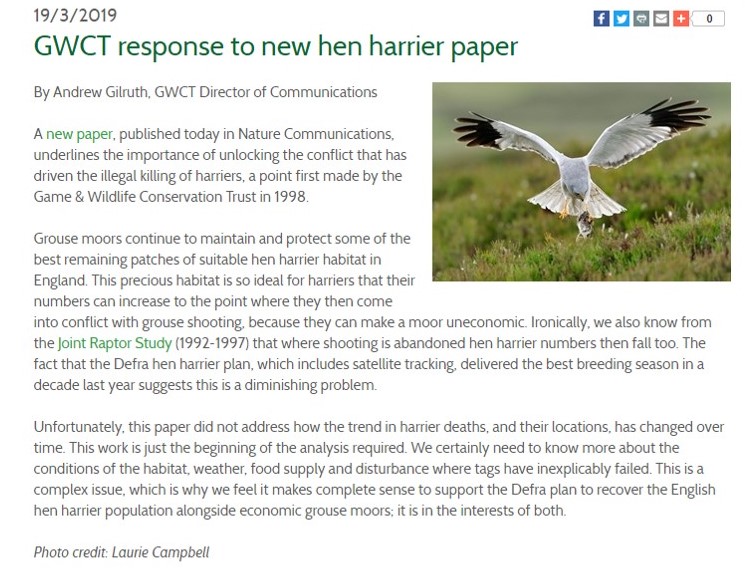
GWCT posted a statement on its website in response to the devastating findings of the hen harrier satellite tag paper. Here it is:

You’ll notice that this GWCT response carefully avoids mentioning the headline figures from the paper – hen harriers are ten times more likely to be killed on grouse moors than any other habitat, and at least 72% of the hen harriers tagged by Natural England between 2006 – 2017 have either been confirmed to have been illegally killed on grouse moors or are highly likely to have been killed on grouse moors, with the researchers saying they can find no alternative, plausible, explanation.

We’re then told by GWCT that the illegal killing of hen harriers on grouse moors is “a diminishing problem” based on last year’s breeding results. Let’s just remind ourselves of those 2018 breeding results – only nine successful nests in England (where there is suitable habitat to support over 300 nests) and not one of those nine nests was situated on a privately-owned grouse moor (see here).

And what happened to the hen harrier chicks that did manage to fledge in 2018? A lot of them ‘disappeared’ in suspicious circumstances on, er, grouse moors:

The final paragraph of GWCT’s statement implies that habitat condition, weather, food supply and disturbance may explain the pattern of hen harriers deaths and disappearances on grouse moors. You’ll note that criminal gamekeepers armed with shotguns and illegal traps are not mentioned.

There was a time, long ago, when the GWCT was a respected, credible, science-based organisation. What happened?

Responses to hen harrier satellite tag paper: Moorland Association

The publication of the hen harrier satellite tag paper on Tuesday (here) that provided compelling evidence to highlight, yet again, the link between grouse moors and the illegal killing of hen harriers, has resulted in a flurry of responses from various individuals and organisations.

We’ll be looking at these responses in turn.

So far we’ve discussed the responses of Supt Nick Lyall (Chair, RPPDG) (here), BASC (here), Dr Therese Coffey (DEFRA Wildlife Minister) (here) and the Northern England Raptor Forum (here).

This time we’re examining the response of the Moorland Association, the lobby group for grouse moor owners in northern England.

The Moorland Association couldn’t be arsed to publish a statement on its website, nor to tweet about this important scientific publication nor to mention it on its Facebook page. Blimey, anyone would think that grouse moor owners aren’t at all bothered that hen harriers are ten times more likely to be killed on a grouse moor than anywhere else, or that 72% of satellite tagged hen harriers had either been confirmed or suspected of being illegally killed on grouse moors.

And let’s not forget, the Moorland Association is supposedly a willing ‘partner’ on the Raptor Persecution Priority Delivery Group (RPPDG), where it’s supposed to be using every opportunity to raise awareness about the illegal killing of birds of prey and stopping these crimes from being committed. Really impressive partnership work, eh?

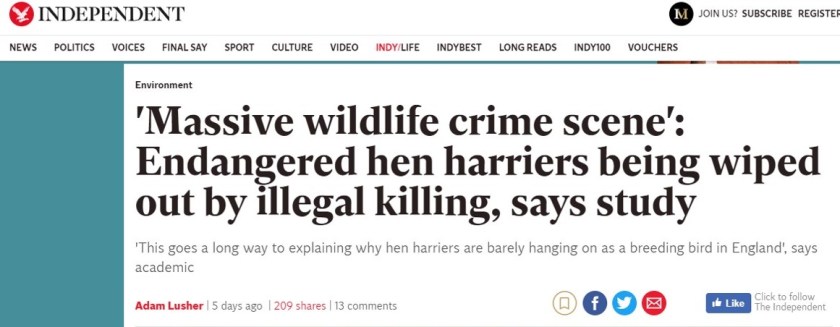
We did find a quote from the Moorland Association’s Director, Amanda Anderson, in this brilliantly headlined article in The Independent (“Massive wildlife crime scene” is a Mark Avery quote from a couple of years ago).

Here’s Amanda quoted in The Independent article:

Amanda Anderson, director of the Moorland Association, which represents grouse moor owners and managers in England and Wales, said the study data, gathered between 2006 and 2017, was before a management scheme put in place as part of Defra’s hen harrier recovery plan.

She said keepers had engaged with tactics such as reporting and monitoring nests and roost sites, as well as reducing conflicts between the birds via feeding strategies.

Ms Anderson said that 2018, the first year of the brood management scheme, was “the most successful hen harrier breeding season in England for over a decade”, continuing: “We know from evidence gathered on the ground there are many areas on grouse moors where hen harriers – with or without satellite tags – are currently thriving.”

But she added: “We want to see more hen harriers on grouse moors. Persecution should not occur and must cease in order to give hen harriers the best chance of survival. Seventy per cent of hen harriers perish in their first year from natural causes. However, when a satellite tag fails unexpectedly, persecution may be a factor.

END

Wow. What’s that saying? More front than Blackpool?

It’s all ok, folks, no need to worry about the extraordinarily high percentage of ‘missing’ (presumed killed) hen harriers on grouse moors, because all that took place before DEFRA’s Hen Harrier Action Plan was put in place. Er, except that in the year after the paper’s data were gathered and the so-called Action Plan was in place (2018), at least 11 satellite-tagged hen harriers all ‘disappeared’ in suspicious circumstances, most of them either on or near a grouse moor, between the months of August and November. How do you explain that, Amanda?

[RPUK map showing the last known locations of 11 satellite-tagged hen harriers that ‘disappeared’ in suspicious circumstances between August – November 2018]

Also according to Amanda, ‘keepers had engaged with tactics such as reporting and monitoring nests and roost sites’. Ah, would that ‘monitoring’ of nest sites include the tactic of repeatedly driving up towards a nesting attempt on a quad bike, disturbing the birds so much that the nesting attempt was abandoned? There are certainly reports of that happening on one particular grouse moor (which was reported to the police).

And would that ‘monitoring’ of roost sites include the tactic of turning up with a gun and a couple of dogs at dusk, to walk around a roost site where three hen harriers had just gone to ground (see here)?

And where is this “evidence gathered on the ground” that shows “there are many areas on grouse moors where hen harriers – with or without satellite tags – are currently thriving”? Have those sites been reported to raptor fieldworkers from NERF, or the RSPB, or Natural England (all partners in the RPPDG), or is this yet another imaginary scene that Amanda’s viewed through her magical kitchen window?

Unfortunately for the Moorland Association, Amanda’s latest episode of propagandist nonsense is looking a lot like a rapidly disintegrating sand castle crumbling in the face of an overwhelming rising tide of evidence.

Poisoned raven found on Peak District grouse moor: Natural England & Police fail to investigate

A year ago in March 2018, a dead raven was found on a grouse moor in the Peak District National Park.

The member of the public who found it, Bob Berzins, was savvy enough to call the RSPB Investigations Team, who collected the corpse.

[Dead raven, photo by Bob Berzins]

Given the location, and the area’s long history of the illegal persecution of birds of prey (e.g. see here), the RSPB asked Natural England to run toxicology tests on the corpse, as is routine when animals have been found dead in suspicious circumstances or risky locations. According to the RSPB, Natural England refused to test the bird.

Instead, the RSPB paid to have the corpse privately tested, first in a post-mortem at the SRUC lab in Scotland and then for toxicology tests at the Science & Advice for Scottish Agriculture (SASA) labs, who have an excellent track record for conducting these forensic examinations.

SASA confirmed that this raven had been poisoned by Aldicarb, a toxin so dangerous that in Scotland if you’re caught even being in possession of it, let alone using it, you’ve committed an offence.

The RSPB reported these lab results to South Yorkshire Police and, according to the RSPB, nothing else has happened since, not even a police search of the grouse moor to look for further poisoned baits or victims.

You can read the details of this pathetic response to a criminal act on the RSPB’s blog here.

The RSPB Investigations Team has also produced a video about this case, here:

What the hell is going on? Why did Natural England refuse to test this raven for banned pesticides when it had been found in an area notorious as a raptor persecution hotspot?

And why did South Yorkshire police fail to investigate further? They should have been all over this, not least with a publicity campaign alerting members of the public, who visit this National Park in their millions, to the dangers of touching any dead animal or suspected poisoned bait. A year has passed and South Yorkshire police appear to have done absolutely nothing.

Disgraceful.

Well done Bob Berzins and well done to the RSPB, not just for paying to have this bird privately tested but also for submitting a formal complaint to South Yorkshire police and for alerting the public to the very serious threat of toxic poisonous baits being laid out on the ground inside this so-called National Park.

Why did this gunman (+ 2 dogs) visit this hen harrier roost site on this Yorkshire grouse moor?

If you’re new to this blog and you’ve ever wondered what happens to satellite tagged hen harriers that suddenly ‘disappear’ in suspicious circumstances on driven grouse moors in Yorkshire (and elsewhere!), the latest video from the RSPB’s investigations team might just provide a clue. Just a little teeny tiny one.

The video was filmed by two members of the RSPB Investigations team shortly after they’d watched three young hen harriers settle down at the roost site for the night. Just as dusk fell, an armed man turned up with a labrador and a terrier and walked through the roost. He spent a few minutes crouching down amongst the vegetation whilst his dogs ‘worked’ the area. Fortunately none of the harriers flushed and the gunman later left in a vehicle.

The RSPB has published a blog describing the evening’s events (see here) and the blog includes the video footage, which is obviously of low quality given the fading light but clear enough to see what’s going on.

Here is a still from the video and we’ve added a red circle to highlight the gunman:

Who might this have been and what do you think he was doing there? How many implausible explanations will be churned out from the grouse shooting industry?

Didn’t sat tagged hen harrier ‘River‘, ‘disappear’ in this area in November 2018, the day before this video was recorded?

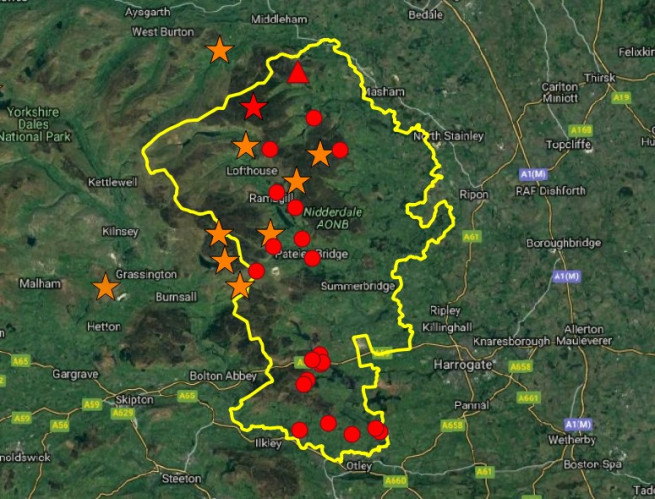
Look how many sat-tagged hen harriers have ‘disappeared’ in the Nidderdale AONB in Yorkshire in recent years, along with illegally killed red kites:

[RPUK map: Nidderdale AONB = yellow boundary. Illegally killed red kites = red circles; sat-tagged hen harriers that have vanished in suspicious circumstances = orange stars & red triangle; illegally shot hen harrier Bowland Betty = red star]

There hasn’t been a single prosecution for any of these incidents.

Do you think the [unnamed] estate has offered its full cooperation to North Yorkshire Police’s enquiries?

Do you think the Moorland Association will publicise this video?

Is anybody still unclear about what happens to hen harriers on driven grouse moors?

Gamekeeper convicted of wildlife crime on Yorkshire grouse moor (where Marsh harrier nest attacked in 2017)

Today at Skipton Magistrates gamekeeper Austin Hawke was convicted of a wildlife crime that took place on a Yorkshire grouse moor in May 2018.

The offence related to a dead badger found caught in a snare close to a stink pit on Denton Moor on 28 May 2018. Hawke was found guilty of failing to check the snare contrary to section 11 of the Wildlife & Countryside Act.

[Photos of the dead snared badger and the stink pit, contributed by a blog reader who wishes to remain anonymous]

On conviction, Hawke was given a 12 month conditional discharge and ordered to pay a £20 victim surcharge and £625 costs.

A pathetically feeble penalty, again, but well done to North Yorkshire Police’s Rural Task Force for pursuing this case and to the Crown Prosecution Service for securing the conviction.

What’s particularly interesting about this case is the location. This offence took place on Denton Moor and within one mile of the location of a Marsh harrier nest that was illegally attacked on several occasions in May 2017. The Marsh harrier nest was under video surveillance by the RSPB and the camera captured a number of armed gunmen, dressed as gamekeepers, who appeared to be shooting at the adult harriers and removing the eggs from the nest.

Despite a thorough investigation by North Yorkshire Police, nobody was ever charged for these alleged offences. As we’ve come to expect, the police received little help from the grouse shooting community when trying to identify the armed suspects.

Here is the map we created at the time, and below that is the RSPB’s video footage of the repeated attacks on the nest.

UPDATE 27 Feb 2019

North Yorkshire Police have issued the following press statement today:

A gamekeeper found guilty of committing a wildlife crime received a conditional discharge at Skipton Magistrates Court.

Austin Hawke, 51, of Ilkley, failed to check a snare following an incident at Denton on 29 May 2018 where a badger was found dead.

The offence is listed under the Wildlife and Countryside Act 1981.

Following a trial on Tuesday (26 February 2019), Hawke was found guilty and received the conditional discharge. He was also ordered to pay £645 costs and surcharge.

Sergeant Kev Kelly, of North Yorkshire Police’s Rural Task Force, said: “This case was reported following a member of the public who was aware of our proactive work under Operation Owl.

From the evidence collected, it was apparent that the badger had suffered before it had eventually died after being caught in the snare. Therefore this case was fully investigated to ensure other animals didn’t undergo the same fate.

If the defendant had been using breakaway snares it is less likely that he would have killed the badger.

I am disappointed as we have been doing some really good partnership working with local Nidderdale keepers who want to show the public good practice and accountability.

Hawke’s conviction will no doubt have an impact on how his profession is viewed. I think he has done his wider colleagues a disservice.”

Geoff Edmond, RSPCA National Wildlife Coordinator, said: “The RSPCA continues to work closely with the North Yorkshire Police’s Rural Task Force and this result highlights the strength of partnership working under Operation Owl.

“This badger will have suffered a horrific and prolonged death having been snared in this way.

“The RSPCA is against the use of snares because they are indiscriminate in what they catch and they cause tremendous suffering. But while they remain legal we hope we can work together with the Police and National Gamekeepers’ Organisation to raise awareness of the good practice guide so as to improve accountability.”

ENDS

Buzzard shot and poisoned in East Yorkshire: police renew appeal for info

Press release from Humberside Police (20 Feb 2019)

Poisoned buzzard East Yorkshire, renewed appeal for information

On the 2nd October 2018 Humberside Police appealed for information regarding the discovery of a dead Common Buzzard, which x-rays showed as having three shotgun pellets within its body [Ed: see RPUK blog here]. These were old injuries but the bird also had more recent injuries to its head, which at that time were suspected to have possibly come about by having been confined within a cage trap.

A detailed examination of the body and its food content has now revealed that the Buzzard had ingested food containing the highly toxic pesticide aldicarb. This substance has been banned for use and possession for over 10 years. It is one of several highly toxic pesticides which are abused by adding them to a bait like a dead rabbit to kill scavengers such as crows and foxes. Carrion eating birds such as Red Kites and Buzzards often become victims.

Several birds of prey including Red Kites and Buzzards have been recorded as being killed by the use of aldicarb in previous years at various locations within the East Riding of Yorkshire including near Market Weighton and Pocklington.

The bird involved in this incident during 2018 was discovered between Millington and Huggate in the East Riding of Yorkshire which is very popular with walkers. The exact circumstances of the bird’s death and how exactly it sustained all its injuries are unclear which is often the case with these offences. What is clear is that it had been shot previously and then ingested a banned toxic substance at a later date. Offences such as this are crimes under the Wildlife and Countryside Act 1981 which are punishable by up to 6 months imprisonment, an unlimited fine or both.

Wildlife and Rural Crime lead Chief Inspector Paul Butler said: ”Enquiries have so far failed to identify who is responsible for this particular crime but are ongoing. The continued use of these chemicals is highly irresponsible and there is no excuse for it whatsoever. Anyone undertaking any form of pest or predator control should ensure they operate within the law and best practice guidance. Those disregarding it for whatever reason should be aware that it is not acceptable and that my Wildlife Crime Team officers are actively seeking them out”.

Anyone with information about who is using these chemicals or involved in the persecution of birds of prey by any means are encouraged to come forward with this information which will be treated with the utmost confidentiality. Raptor persecution is a national wildlife crime priority which Humberside Police takes very seriously and works alongside other agencies to investigate offences.

If you think you have found a poisoned victim or bait do not touch them, cover them over if possible, warn others to keep away, note the exact location, take photos and report it to the police straight away.

Guy Shorrock, Senior Investigations Officer at the RSPB, stated: “There have been a number of incidents in the East Riding area involving the poisoning of buzzards by this highly toxic banned pesticide. We are grateful for police enquires into this latest case and would urge anyone with information to contact them. You can also contact the RSPB in strictest confidence on 0300 999 0101 if you have any information about birds of prey being illegally killed in your area”.

Anyone with information regarding this investigation should call Humberside Police on the non-emergency number 101 quoting investigation number 16/99978/18 which is being dealt with by WCO PC 1529 Day.

ENDS

The RSPB has also written a blog about this case, here