Kestrel found with shotgun injuries in Malton, North Yorkshire

Yet another illegally persecuted raptor in North Yorkshire, the raptor-killing capital of the UK.

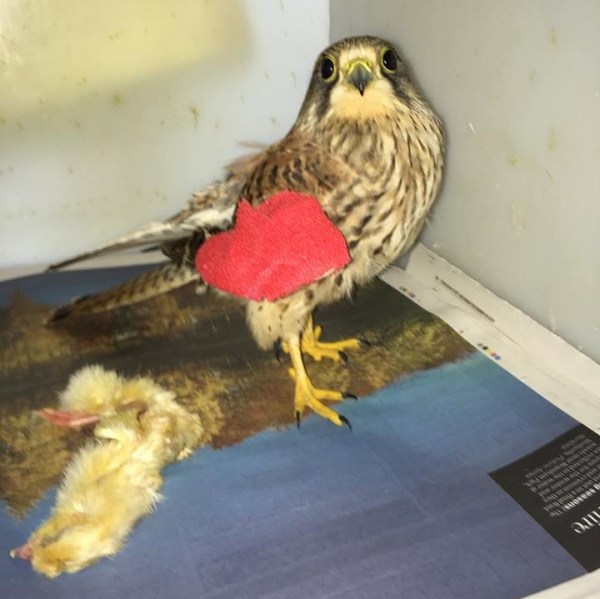
This kestrel was picked up on Christmas Day with shotgun injuries to its wing.

The bird was found close to Amotherby crossroads on Amotherby Lane, Malton, North Yorkshire. An x-ray by Mark Naguib of Battle Flatts Veterinary Clinic revealed the extent of its injuries and the bird is now in the care of the wonderful Jean Thorpe of Ryedale Wildlife Rehabilitation. (Please, consider making a donation HERE to help Jean’s outstanding voluntary work).

If you were in the area and heard a shot on Christmas Eve or Christmas Day, please contact police wildlife crime officer PC Jez Walmsley at Malton Police Station on 101.


Satellite-tagged hen harrier ‘Kathy’ found dead in suspicious circumstances

Press release from Police Scotland, 20 December 2017:

Police Scotland and RSPB Scotland are issuing a joint appeal for information after a young hen harrier was discovered dead with unexplained injuries on an estate near Dunoon.

“Kathy”, a female bird, was satellite tagged as a chick on the Cowal Peninsula in August this year (2017) as part of the RSPB’s EU-funded Hen Harrier LIFE+ Project.

After fledging in late August, Kathy remained in the vicinity of the nest she hatched in for the next month. RSPB Scotland staff monitoring her tracking device became concerned when data suggested she hadn’t moved on October 3.

A search was carried out on October 5 when Kathy’s body was discovered.

The post-mortem results indicated that the bird had unexplained injuries which may be the result of criminality.

PC Donald Mackay from Police Scotland, said: “I appeal for anyone who knows what happened to Kathy to contact Police Scotland so that we can establish how she may have died. Although this would be an isolated incident in my area, it is concerning that a raptor may have been deliberately killed in Argyll. Hen harriers are a particularly fragile bird of prey in terms of their numbers in the UK, and Police Scotland will work with its partners to thoroughly investigate this incident and robustly deal with any person who may have been involved.”

Will Hayward, Investigations Officer for RSPB Scotland, said: “We are advised that this hen harrier has died from unexplained injuries that may be the result of criminality. If criminal cause of death is confirmed, this incident will sadly be another statistic to add to a catalogue of hen harriers that meet their end in this way. Only through the use of satellite technology are we finally getting an accurate picture of the true scale of a human persecution problem that has been denied by some parties for decades. We look forward to hearing the results of the police investigation into this hen harrier death in due course.”

Hen harriers are one of the country’s most threatened birds of prey with the latest national survey recording only 460 breeding pairs in Scotland, a drop of 27% since 2004. Anyone with information is asked to contact Police Scotland on 101 and ask to speak to a Wildlife Crime Officer.

ENDS

Two and a half months to make an appeal for information? Even allowing for the time it takes to conduct a post mortem and interview estate employees, that’s nowhere near good enough.

A photograph of Kathy has not been made available so here’s a photo of another dead satellite-tagged hen harrier (Caroll) found earlier this year. Photo by Northumberland Police.

UPDATE 24 December 2017: MSP urges closer cooperation to protect hen harriers – a futile request while illegal raptor killing continues (here).

New report reveals abject failure to protect birds of prey in the Peak District National Park

The Peak District Bird of Prey Initiative (BoPI) was launched in 2011, mainly in response to two damning reports from the RSPB about the continued illegal killing of raptors in the Dark Peak area of the Peak District National Park (see here & here), as well as all the publicity from a criminal prosecution, and subsequent conviction, of a Derbyshire gamekeeper who had been caught illegally using a trap (see here and here).

The BoPI comprises five organisations (Peak District National Park Authority, National Trust, Moorland Association, RSPB and Natural England), with additional support from two local raptor study groups, who are supposed to be working in partnership to increase the populations of several raptor species within the Dark Peak area of the National Park.

It was initially launched as a five-year project (2011-2015), and at the end of that period a report revealed the BoPI had failed to meet every single target set (see here).

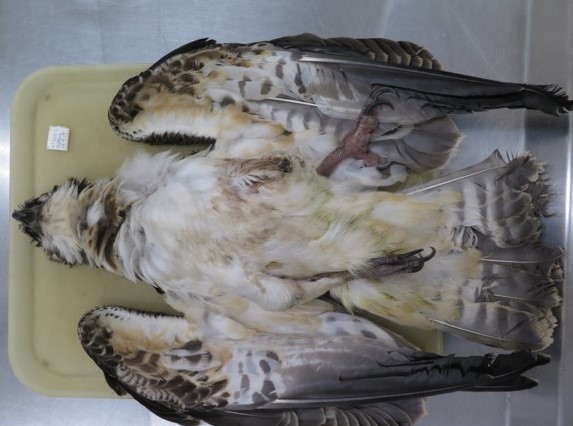
Photo of an osprey found in the Peak District National Park in September 2015. It had two broken legs and succumbed to these injuries soon after being found. The post-mortem stated its injuries were consistent with being caught in a spring trap (Photo by RSPB)

Nevertheless, despite missing each and every one of the five-year targets, the Peak District National Park Authority decided the project would continue and announced a ‘renewed commitment’ from the Project partners, which was derided by us and by Mark Avery (here), who said it was just an opportunity for the National Park authorities to hide behind a failing project for a few more years and avoid taking any real action, like, for example, banning driven grouse shooting within the National Park.

The latest report (read it here), just published, covers the years 2016 and 2017 and surprise surprise, aboslutely nothing has changed.

Interestingly, this latest report has just been slipped out without any fanfare or publicity, presumably because the Peak District National Park Authority doesn’t want to draw attention to this on-going fiasco. The only reason we knew it was available was because we’d asked for a copy via FoI last month and had been told it would appear on the PDNPA website ‘shortly’, so we’ve been checking for it every day.

So, to summarise. No progress, no increased raptor populations, no statements of “renewed commitment”, and absolutely no point continuing with this charade of partnership-working.

Grouse moor owners want licences to kill Marsh harriers

Yes, you did read the headline correctly.

We’ve received reports from a number of independent sources that at the November 2017 meeting of DEFRA’s Raptor Persecution Priority Delivery Group (RPPDG), the Director of the Moorland Association (the mouthpiece for grouse moor owners in England), Amanda Anderson, said that grouse moor managers would be submitting applications to Natural England for licences to kill Marsh harriers.

That’ll be the Marsh harriers that are Amber listed on the UK Birds of Conservation Concern.

The Marsh harriers that are recovering from a virtual population wipeout – down to one known breeding pair in 1971 thanks to a combination of illegal persecution, habitat loss and DDT and currently with an estimated breeding population of 400-450 pairs.

The Marsh harriers that are locally common in some areas such as East Anglia but still extremely rare or absent in many other areas.

The Marsh harriers that most commonly breed in lowland wetland habitat, particularly reedbeds but increasingly on farmland too.

The Marsh harriers that very rarely breed on upland grouse moors although when they do, they are illegally targeted by men dressed as gamekeepers.

[Photo by George Reszeter]

It’s hard to comprehend the news that grouse moor owners want licences to kill this species. It’s so utterly ludicrous to think that a handful of Marsh harriers would pose any serious threat to the hundreds of thousands of red grouse that are raised on grouse moors just to be shot, for fun.

And yet these are the grouse moor owners who claim to want breeding Hen harriers back on these moors!

This latest move makes it quite clear that the grouse-shooting industry is beyond redemption. There’s no reasoning with people who think that Marsh harriers need to be killed because they’re perceived to be a threat to the viability of an upland grouse shoot.

If you’ve managed to pick up your jaw off the floor, you might want to consider signing this e-petition calling for a ban on driven grouse shooting. It really is time to throw this filthy, regressive, Victorian ‘sport’ on to the bonfire of history.

UPDATE 30 November 2017: More on the grouse-shooting industry’s desire to kill Marsh harriers (here)

UPDATE 19 January 2018: Update on claim that grouse moor owners want licences to kill Marsh harriers (here)

UPDATE 12 November 2018: Licences to kill Marsh harriers on grouse moors – an update (here)

MSPs asking questions re: Police Scotland silence on masked gunman in public forest

A couple of weeks ago we blogged about how a masked gunman and his masked accomplice had been captured on camera close to a protected raptor nest in a public (Forestry Commission Scotland) forest (here). The incident was recorded in spring 2017 and was reported to Police Scotland.

There have been no public appeals for information from Police Scotland and no warnings to forest users (such as birdwatchers, cyclists, walkers, visiting families) about this serious threat to public safety.

We asked Justice Secretary Michael Matheson and the Minister for Community Safety & Legal Affairs, Annabelle Ewing, about this issue but neither bothered to respond.

A week later we blogged about how Police Scotland’s reluctance to publicise suspected raptor persecution crimes, such as this one, and others including the use of highly dangerous poisonous baits, was threatening public safety and we urged blog readers to contact their local MSPs and ask them to start asking questions.

We know that some of you have done this (well done and thank you) and we wanted to share some correspondence that one particular couple has received, if only to demonstrate how effective this approach can be.

Let’s call this couple Mr & Mrs Bloggs.

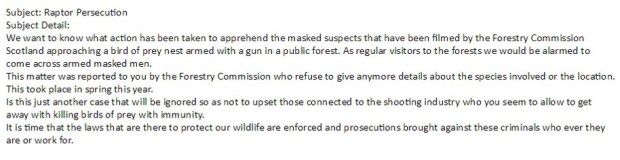
On 16 November 2017, Mr & Mrs Bloggs emailed Police Scotland’s General Enquiries Centre:

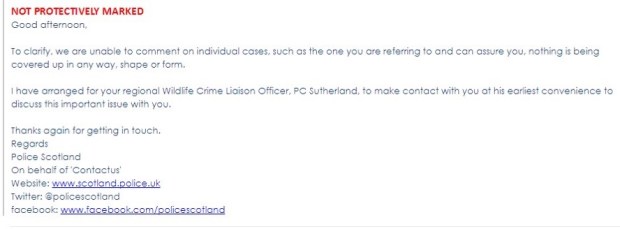
Police Scotland responded on the same day with this:

Not to be deterred, Mr & Mrs Bloggs wrote back to Police Scotland:

On the same day, Police Scotland responded with this:

The next day, local Police Wildlife Crime Officer Daniel Sutherland wrote to Mr & Mrs Bloggs:

Although Police Scotland should be commended for speedy responses, Mr & Mrs Bloggs were unimpressed with Police Scotland’s refusal to discuss this case so they wrote to their local MSPs to see if they could get anywhere with them.

It turns out to have been an inspired move. Three MSPs have responded, as follows:

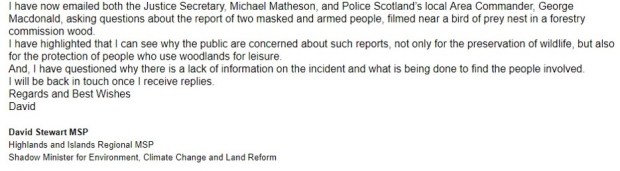
This from David Stewart MSP (Labour, Highlands & Islands, & Shadow Minister for Environment):

This from John Finnie MSP (Scottish Greens, Highlands & Islands):

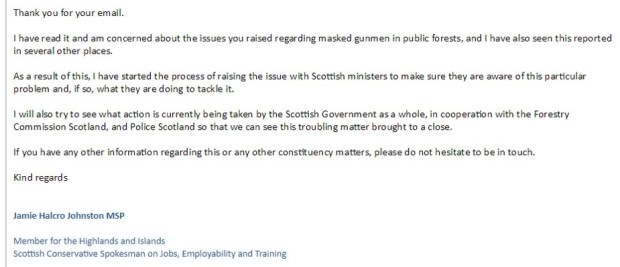
And this from Jamie Halcro Johnston MSP (Scottish Conservatives, Highlands & Islands):

Well done Mr & Mrs Bloggs! Cross-party political interest in under a week.

Let’s see where this goes.

UPDATE 30 December 2017: Masked gunmen at goshawk nest in Moy Forest (here)

Grouse shooting industry response to police appeals re: missing hen harriers

Earlier this week North Yorkshire Police put out a public appeal for information regarding satellite-tagged hen harrier ‘John’, missing in suspicious circumstances and whose last known location was Threshfield Moor, a grouse moor in the Yorkshire Dales National Park.

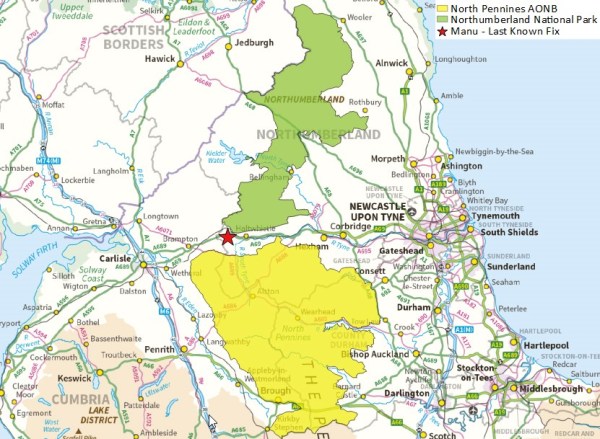
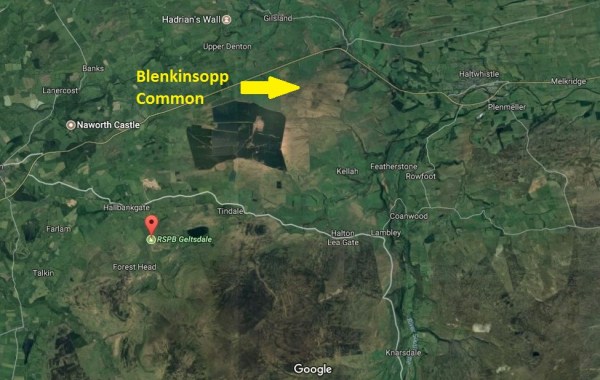
We also saw a public appeal for information from Northumbria Police and the RSPB regarding satellite-tagged hen harrier ‘Manu’, also missing in suspicious circumstances and whose last known location was Blenkinsopp Common in the North Pennines.

We’ve just looked at the News sections of several organisations websites, all of whom are partners in the Raptor Persecution Priority Delivery Group (RPPDG: whose remit includes ‘providing publicity about raptor persecution to build trust and transparency’). Here’s what we found:

Moorland Association – NOTHING

National Gamekeepers Organisation – NOTHING

Countryside Alliance – NOTHING

British Association for Shooting & Conservation – NOTHING

No statements, no urging their members to come forward with any information they might have, no appeals to the public, not even a cut & paste job of the police appeals for information. Absolutely nothing.

It’s the same deafening silence we heard in August when North Yorkshire Police appealed for information about the attempted shooting of nesting marsh harriers and the theft of their eggs on a grouse moor in the Nidderdale AONB, and the same deafening silence that followed the news of a poisons cache buried on another North Yorkshire grouse moor (see here).

Their silence tells us all we need to know.

Satellite-tagged hen harrier ‘Manu’ disappears in North Pennines

RSPB press release:

ANOTHER RARE HEN HARRIER GOES MISSING

Police and the RSPB are appealing for information following the disappearance of a satellite-tagged hen harrier near Carlisle.

The harrier, named Manu, was one of a nest of two chicks monitored and protected by the Northumberland Hen Harrier Protection Partnership and tagged as part of the RSPB’s EU-funded Hen Harrier LIFE+ project in July this year.

Manu’s tag had been functioning perfectly until it suddenly stopped on the morning of 18 October 2017. Data from Manu’s tag indicated he had been in the same location near Denton Fell, on the Cumbria/Northumberland border, for around three weeks. The last signal was sent from Blenkinsopp Common at 0958hrs and he has not been seen or heard of since.

A search was conducted by RSPB Investigations staff but no tag or body was found. Northumbria Police were informed and have made enquiries but with no leads forthcoming.

Hen harriers are one of the UK’s rarest raptors with only three successful nests recorded in England in 2017.

Tim Jones, RSPB Assistant Investigations Officer said: “Hen harriers are facing an uncertain future: these spectacular birds should be flourishing in places like Cumbria and Northumberland but we are down to just a handful of pairs. So it’s alarming when yet another bird unaccountably vanishes like this.”

Andrew Miller, Head of Programmes and Conservation at Northumberland National Park, and Chair of the Northumberland Hen Harrier Protection Partnership, said: “With so few hen harriers breeding in England the loss of even a single bird is devastating. The Northumberland Hen Harrier Protection Partnership, along with many other organisations and individuals across the UK, is putting considerable effort into helping this struggling species recover.”

Don Churchill, Wildlife Co-ordinator & Planning Officer, Northumbria Police, said: “We are very concerned at the disappearance of one of these iconic birds of prey. Hen harriers are fully protected by law and raptor persecution is a national wildlife crime priority. We urge you to come forward if you have any information about the disappearance of this bird.”

If you have any information relating to this incident, call Northumbria Police on 101 or contact them via their website HERE. All calls are anonymous.

If you find a wild bird which you suspect has been illegally killed, contact RSPB investigations on 01767 680551 or fill in the online form.

ENDS

Here is a map we’ve created showing the position of Manu’s last known position (as identified from his satellite tag). This location is just outside two protected areas: Northumberland National Park and the North Pennines Area of Outstanding Natural Beauty (AONB).

This general area is a well known raptor persecution hotspot, which isn’t a surprise given how much of it is intensively managed for driven grouse shooting. Last December hen harrier Bonny ‘disappeared’ on a grouse moor just a few miles south of Blenkinsopp Common (Manu’s last known location), near to the RSPB’s Geltsdale Reserve from where Bonny had fledged.

Over the years, there have been five confirmed hen harrier shootings in this area (the killing of one of these was witnessed by RSPB investigators – see pages 38-40 in Mark Avery’s book Inglorious for a detailed description), there have been at least four attempted shootings of hen harriers, and another hen harrier was found poisoned. In addition, there have been poisoned ravens, poisoned buzzards and some shot peregrines.

Some of these crimes happened on the RSPB Geltsdale Reserve (safe to assume this wasn’t the handiwork of the RSPB wardens) and some of the crimes happened on nearby grouse moors.

We don’t know what’s happened to both Bonny or Manu, and if each case is taken in isolation it might be reasonable to conclude a failed satellite tag. These satellite tags are not perfect and do sometimes fail (e.g. see here), although overall they have a very high 94% reliability rate (see here). So it might just be possible that Bonny and Manu’s tags have suffered a technical malfunction, within that expected 6% failure rate, and that’s the story we’ll be hearing from the grouse-shooting industry over the coming days as they try to suppress any notion of criminal activity. However, what the criminal apologists will fail to mention is that when a tag suffers a ‘natural’ technical malfunction, there is typically a very clear indication several days prior to failure, from the tag’s engineering data, that a technical malfunction is imminent. What we’re seeing from the majority of these ‘missing’ sat tagged hen harriers (and golden eagles) is an abrupt, unexpected failure, often mid-way through a transmission cycle, which points to highly suspicious circumstances.

When you consider the disappearance of Bonny and Manu alongside all the other satellite-tagged hen harriers that have ‘disappeared’ without trace, many of them on or close to driven grouse moors, (at least 45 missing hen harriers since sat tagging began in 2007), and the fact that hen harriers haven’t bred on any English grouse moors for a number of years, then the picture becomes sinisterly clear. Add in the number of missing satellite-tagged golden eagles that have disappeared on or close to driven grouse moors in Scotland (41 of 131 tagged eagles) and the evidence of illegal persecution becomes compelling.

It’s no wonder the grouse-shooting industry objects so strongly to the satellite-tagging of raptors, and wants to control the public release of the data these tags are producing. The shooting industry can see what everybody else can see – they might be better at hiding the corpses these days but there’s absolutely nothing they can do to hide the results of the satellite tag data.

Well done to Northumbria Police and the RSPB for putting out a detailed press release, and especially for including the details of Manu’s last known location. We saw this happen two days ago when North Yorkshire Police revealed the last known location of hen harrier John, another satellite tagged harrier that has gone ‘missing’ on a grouse moor, this time in the Yorkshire Dales National Park.

If you haven’t already done so, please consider signing this NEW e-petition calling for a ban on driven grouse shooting. The Westminster Government continues to turn a blind eye to this carnage and continued public pressure is required to show them that we’re on to them and we’re not going away until they take appropriate action.

Threshfield Moor named as missing hen harrier John’s last known location

Further to blogs about ‘missing’ satellite-tagged hen harrier ‘John’, who disappeared on a grouse moor in the Yorkshire Dales National Park in early October (see here and here), North Yorkshire Police has just issued the following appeal for information:

North Yorkshire Police is appealing for information following the loss of a hen harrier on Threshfield Moor.

John, a sub-adult hen harrier, fledged in Northumberland in 2016. He was fitted with a satellite tag in July 2016 by a hen harrier expert from Natural England. This was John’s second outward migration – he wintered in the same approximate area of Yorkshire in 2016/17, returned to Scotland and the Borders in spring/summer 2017, then back to Yorkshire in September 2017. His tag stopped transmitting on 1 October 2017 in the Threshfield Moor area of North Yorkshire. A search of the area has been carried out but no trace of the bird or equipment has been found.

Natural England reported John’s disappearance to North Yorkshire Police and is working closely with wildlife crime officers, local landowners, and the Yorkshire Dales National Park Authority.

The loss of another juvenile hen harrier brings the total to six within fourteen months across northern England – and is a serious blow to the small English hen harrier population. Interference with hen harriers is a criminal offence.

[Photo by RPUK]
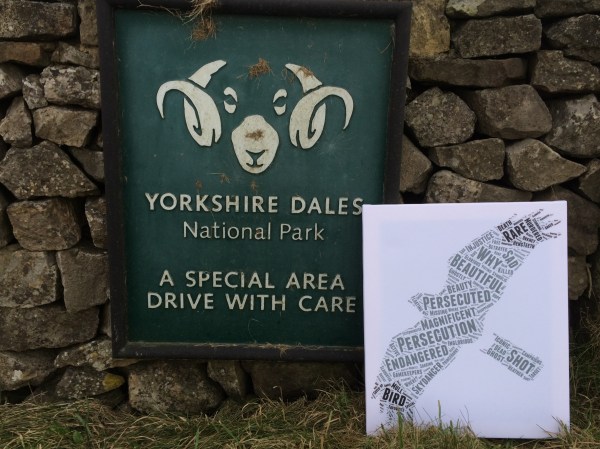
Sergeant Stuart Grainger, of North Yorkshire Police’s Rural Taskforce, said : “Those responsible for bird of prey persecution, either directly or indirectly, should be ashamed – these birds belong to everyone and are part of our natural heritage. It is a disgrace that these beautiful birds appear to be relentlessly destroyed. The fate of this particular hen harrier remains unsolved at this time, but we are appealing for any information to assist the investigation.”

Rob Cooke, a Director at Natural England, said: “The sudden disappearance of the hen harrier, John, is a matter of grave concern. We urge anyone with information to get in touch with North Yorkshire Police.”

David Butterworth, Chief Executive of the Yorkshire Dales National Park Authority, said: “It is highly likely that a crime has taken place on Threshfield Moor. The spotlight is once again on the Yorkshire Dales as a black hole for raptors. This does no one any good. With colleagues in the Ranger service, I am doing all I can to support North Yorkshire Police. Any leads which the police might have had in the six weeks since this hen harrier disappeared have come to nothing, but we should not give up – someone must know something. I urge that person to contact the police.”

Anyone with any information which could help police with their enquiries should contact North Yorkshire Police on 101 – or you can ring Crimestoppers anonymously on 0800 555 111 to discuss this incident or to discuss any other information regarding alleged persecution of birds of prey. Please quote reference number 12170208338 when passing information.

ENDS

Here’s a map we’ve created showing the location of Threshfield Moor, south west of Grassington within the Yorkshire Dales National Park:
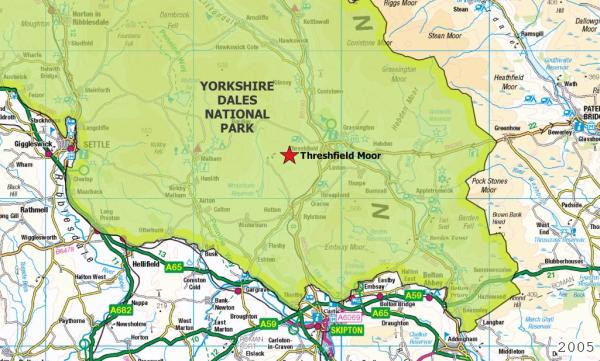
Threshfield grouse moor is believed to be owned by Mark Hancock, who is married to Heather Hancock, former Chief Executive of the Yorkshire Dales National Park Authority and currently Chair of the Food Standards Agency (see Mark Avery’s blog here for some background). Mr Hancock has reportedly been undertaking “a huge amount of work” to improve this moor’s habitat and environment, especially for birds (see here).

Top marks to North Yorkshire Police for providing such a detailed appeal for information and full credit to Police Sgt Stuart Grainger and Chief Exec David Butterworth (Yorkshire Dales National Park Authority) for their strongly-worded statements.

Let’s see how many organisations from the grouse-shooting industry also issue strongly-worded statements in response to this Police appeal.

Hen Harrier John was one of the class of 2016. Here’s what’s happened to the rest of his cohort:

Hen harrier Elwood – ‘disappeared’ in the Monadhliaths just a few weeks after fledging, presumed dead (Aug ’16).

Hen harrier Brian – ‘disappeared’ in the Cairngorms National Park just a few weeks after fledging, presumed dead (Aug ’16).

Hen harrier Donald – missing in northern France, presumed dead (Autumn ’16).

Hen harrier Hermione – found dead on Mull, believed to have died from natural causes (Sep ’16).

Hen harrier Rowan – found dead in Yorkshire Dales National Park. He’d been shot (Oct ’16).

Hen harrier Tarras – ‘disappeared’ in the Peak District National Park, presumed dead (Oct ’16).

Hen harrier Beater – missing in Scottish Borders, presumed dead (Nov ’16).

Hen harrier Bonny – ‘disappeared’ in the North Pennines, presumed dead (Dec ’16)

Hen harrier Mick – ‘disappeared’ in the Yorkshire Dales National Park, presumed dead (Dec ’16).

Hen harrier Carroll – found dead in Northumberland, PM revealed a parasitic disease & two shotgun pellets (Jan ’17).

Hen harrier John – ‘disappeared’ in the Yorkshire Dales National Park, presumed dead (Oct ’17)

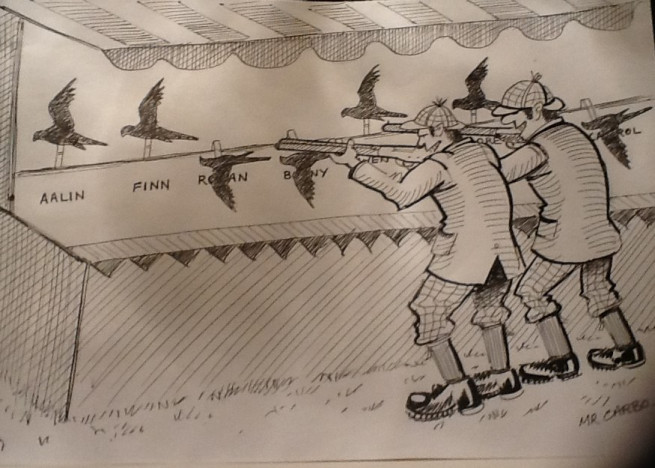
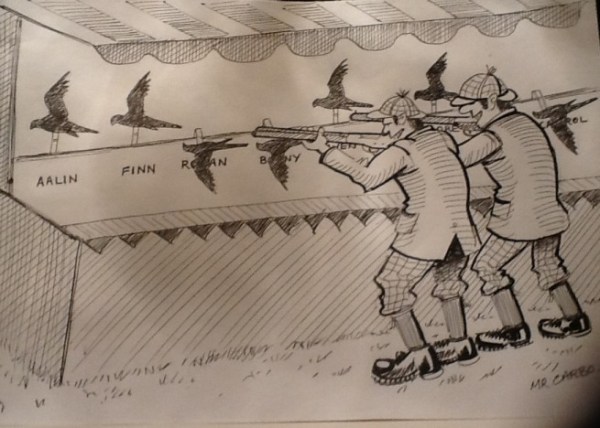
Eleven down, six to go (Aalin, DeeCee, Finn, Harriet, Wendy, Sorrel).
Hen harrier ‘missing’ on grouse moor in Yorkshire Dales National Park is ‘John’

Last month we blogged about yet another satellite-tagged hen harrier that had suspiciously ‘disappeared’ on a grouse moor in the Yorkshire Dales National Park (see here). We only knew about it because North Yorkshire Police mentioned it on Twitter and posted a few photographs from the search scene:

We made a general enquiry to Natural England and asked for further details (which hen harrier it was, where and when it was satellite-tagged, on which grouse moor it had ‘disappeared’ in the Yorkshire Dales National Park). Natural England refused to provide any detail, other than that ‘key stakeholders’ (i.e. the landowner!) had been notified. The landowner had probably been more than ‘notified’ – if Natural England was following the ridiculous ‘satellite tag protocol’, the landowner’s ‘permission’ would have been sought to conduct the police search! Honestly, you couldn’t make this stuff up.

Anyway, back to the hen harrier. We weren’t happy that Natural England was withholding information on what was probably a publicly-funded satellite tag so we submitted a formal FoI to request this information. We managed to find out some details:

Why Natural England didn’t release this information when we first asked for it is anybody’s guess – just following its normal practice of putting obstacles in the way, hoping that we’d shuffle off and forget about it, probably.

Anyway, we now know that this missing hen harrier is ‘John’, who was tagged on 8 July 2016 in Northumberland. We blogged about John in February 2017 (see here) – he was the mystery hen harrier about which little was known. We still don’t know very much about him because Natural England has chosen to remain silent on his movements over the last 14 months [but see UPDATE below], although from the updated spreadsheet that Natural England published in September, we know that his tag was transmitting in September 2017 in Northumberland. See: hen-harrier-tracking-data-2002-onwards

We also know that Natural England realised John’s tag was no longer transmitting on 5 October 2017 and that North Yorkshire Police conducted a search for him ten days later (15 Oct 2017) on a grouse moor in the Yorkshire Dales National Park. What we still don’t know is the name of this grouse moor and whether North Yorks Police found any evidence such as a tag or a corpse.

We’ll be submitting an FoI to North Yorkshire Police to ask about this – it’ll be very interesting to see the response. North Yorkshire Police appear to have upped their game recently in terms of investigating suspected raptor persecution crimes – a very welcome and much-needed change of pace in England’s leading raptor-killing county. Let’s see how open they’ll be about this latest investigation.

Meanwhile, it’s time to update the list of what hapened to the satellite-tagged hen harrier class of 2016, which includes harriers tagged by Natural England and the RSPB:

Hen harrier Elwood – ‘disappeared’ in the Monadhliaths just a few weeks after fledging, presumed dead (Aug ’16).

Hen harrier Brian – ‘disappeared’ in the Cairngorms National Park just a few weeks after fledging, presumed dead (Aug ’16).

Hen harrier Donald – missing in northern France, presumed dead (Autumn ’16).

Hen harrier Hermione – found dead on Mull, believed to have died from natural causes (Sep ’16).

Hen harrier Rowan – found dead in Yorkshire Dales National Park. He’d been shot (Oct ’16).

Hen harrier Tarras – ‘disappeared’ in the Peak District National Park, presumed dead (Oct ’16).

Hen harrier Beater – missing in Scottish Borders, presumed dead (Nov ’16).

Hen harrier Bonny – ‘disappeared’ in the North Pennines, presumed dead (Dec ’16)

Hen harrier Mick – ‘disappeared’ in the Yorkshire Dales National Park, presumed dead (Dec ’16).

Hen harrier Carroll – found dead in Northumberland, PM revealed a parasitic disease & two shotgun pellets (Jan ’17).

Hen harrier John – ‘disappeared’ in the Yorkshire Dales National Park, presumed dead (Oct ’17)

Eleven down, six to go (Aalin, DeeCee, Finn, Harriet, Wendy, Sorrel).

UPDATE 20 November 2017: Thanks to the blog reader who pointed out that John had been recorded at Langholm in the summer of 2017, as mentioned in the hen harrier update on the Langholm Demonstration Project website on 28 June 2017 – here.

UPDATE 22 November 2017: Threshfield Moor named as missing hen harrier John’s last known location (here)

Police Scotland silent after armed masked men filmed at raptor nest in public forest

Forestry Commission Scotland staff routinely install cameras at the nests of several raptor species (e.g. goshawk, osprey, golden eagle, hen harrier, buzzard) to undertake dietary studies and to help identify individually-marked birds by their colour rings. If the cameras happen to film anything suspicious at these nests (e.g. unlicensed visits by armed criminals) the footage would be admissible in any subsequent prosecution because the cameras are placed with landowner permission and there are warning signs alerting visitors that cameras are in use in these public forests.

We submitted an FoI to Forest Enterprise Scotland to find out how many incidents of suspected disturbance had been filmed at raptor nests in Forestry Commission Scotland woodland this year.

According to the FoI response, one incident was captured this year involving “two masked people within 30m of a [raptor] nest site, one carrying a firearm”.

FES refused to name the forest and also withheld details about the raptor species involved, because “the disclosure of this information would adversely affect the protection of the environment to which the information relates“. The incident was reported to Police Scotland.

So, in spring this year, an armed, masked gunman and a masked accomplice were filmed in a public forest near a raptor nest site, and it’s now November and we’ve heard absolutely nothing about it from Police Scotland.

Suspected disturbance of a raptor nest site is one thing, but being armed and masked in a public forest takes this to a whole other level.

Have Police Scotland identified the masked, armed gunman and his masked accomplice? If not, why hasn’t there been a public appeal for information?

Why hasn’t the camera footage been released?

Doesn’t Police Scotland think that the general public should be warned that an armed, masked gunman and a masked accomplice have been filmed wandering around in a public forest? What about warning dog walkers, cyclists, runners, birdwatchers, families on recreational visits, that they are at risk of bumping in to someone wearing a balaclava and brandishing a firearm? Isn’t this a serious threat to public safety?

It just beggars belief.

UPDATE 30 December 2017: Masked gunmen at goshawk nest in Moy Forest (here)