Statement from Wildlife Estates Scotland on membership status of Newlands Estate

Those of you who’ve been following the long drawn-out saga of prosecutions relating to the wildlife crime that took place on Newlands Estate, Dumfriesshire in 2015 will know that we’ve been asking questions of various organisations associated with this estate.

One of those questions has been about the membership status of the Newlands Estate in the ‘Wildlife Estates Scotland (WES)’ scheme, administered by Scottish Land & Estates. Since Newlands Estate gamekeeper Billy Dick’s conviction (for killing a buzzard) was upheld in July this year, we’ve asked this:

‘Will the Newlands Estate’s accredited membership of Wildlife Estates Scotland (WES) now be revoked? The conditions of membership of this scheme include: “the requirements to maintain best practice standards of animal welfare and comply with all legal requirements and relevant Scottish codes of practice”. At the time of Mr Dick’s conviction, a spokesperson for WES said the Newlands Estate’s membership and accreditation of WES had been ‘voluntarily suspended’ pending the outcome of legal proceedings. Well, now the gamekeeper’s criminal conviction for wildlife offences has been upheld, how about answering the question?’

Four months on, and thanks to blog readers for writing to WES, the following statement has appeared on the WES website this morning:
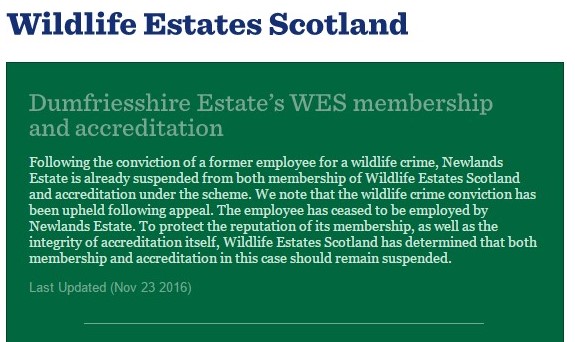
wes-statement-newlands

So, Newlands Estate is still a member of WES, albeit in a suspended state. Presumably, WES is waiting to find out whether the allegation of vicarious liability is proven against landowner Andrew Duncan during forthcoming legal proceedings.

That’s an interesting position for WES to take. A wildlife crime did take place on Newlands Estate and a Newlands Estate employee was convicted for it. Why isn’t that sufficient cause for WES to expel Newlands Estate? Two conditions of WES membership were clearly breached (“the requirements to maintain best practice standards of animal welfare and comply with all legal requirements and relevant Scottish codes of practice“). Whether Mr Duncan is subsequently convicted or acquitted of vicarious liability is irrelevant and will not erase these facts.

Let’s imagine, for example, that Mr Duncan is exonerated and WES decides to lift the suspension on membership. WES will still have a wildlife crime estate on its membership list. How does that ‘protect the reputation of its membership, as well as the integrity of accreditation itself’? Here’s a hint, WES: IT DOESN’T.

Other questions we’ve been asking since Newlands Estate gamekeeper Billy Dick’s failed appeal in July 2016 are yet to be answered:

  1. Is/was criminal gamekeeper William (Billy) Dick a member of the Scottish Gamekeepers’ Association? The SGA refused to comment on Mr Dick’s membership status at the time, saying they ‘wanted to wait until the legal process had concluded’. Well, now Mr Dick’s criminal conviction for wildlife offences has been upheld, how about answering the question? Emails to: info@scottishgamekeepers.co.uk
  2. Will Scottish Land & Estates now expel the Newlands Estate from the ranks of SLE membership? SLE said at the time that Newlands Estate’s membership of SLE had been ‘voluntarily suspended’ pending on-going legal proceedings. Well, now the gamekeeper’s criminal conviction for wildlife offences has been upheld, how about answering the question? Emails to: info@scottishlandandestates.co.uk

Vicarious liability prosecution: Andrew Duncan (Newlands Estate), part 11

They’re having a laugh.

Criminal proceedings continued yesterday (22 November 2016) against landowner Andrew Walter Bryce Duncan, who is alleged to be vicariously liable for the crimes committed by gamekeeper William (Billy) Dick in April 2014.

Gamekeeper Dick was convicted in August 2015 of killing a buzzard on the Newlands Estate, Dumfriesshire by striking it with rocks and repeatedly stamping on it (see here). Mr Dick was sentenced in September 2015 and was given a £2000 fine (see here). Mr Dick attempted to appeal his conviction but this was refused on 15 July 2016 (see here).

Here’s a quick review of the proceedings against Andrew Duncan so far:

Hearing #1 (18th August 2015): Trial date set for 23rd Nov 2015, with an intermediate diet scheduled for 20th Oct 2015.

Hearing #2 (20th October 2015): Case adjourned. November trial date dumped. Notional diet hearing (where a trial date may be set) scheduled for 18th January 2016.

Hearing #3 (18th January 2016): Case adjourned. Another notional diet & debate scheduled for 11th March 2016.

Hearing #4 (11th March 2016): Case adjourned, pending the result of gamekeeper Billy Dick’s appeal. Another notional diet scheduled for 4th April 2016.

Hearing #5 (4th April 2016): Case adjourned, pending the result of gamekeeper Billy Dick’s appeal. Another notional diet scheduled for 3rd June 2016.

Hearing #6 (3rd June 2016): Case adjourned, pending the result of gamekeeper Billy Dick’s appeal. Another notional diet scheduled for 17th June 2016.

Hearing #7 (17th June 2016): Case adjourned, pending the result of gamekeeper Billy Dick’s appeal. Another notional diet scheduled for 15th July 2016.

Hearing #8 (15 July 2016): Case adjourned. Another notional diet scheduled for 2 August 2016.

Hearing #9 (2 August 2016): Proceedings moved to trial. Intermediate diet scheduled for 15 November 2016 and provisional trial date set for 7/8 December 2016.

Hearing #10 (15 November 2016): The case was adjourned for another intermediate diet scheduled for 22 November 2016. A new trial date may be set depending on what happens during this hearing.

Hearing #11 yesterday (22 November 2016): The case was adjourned for yet another intermediate diet scheduled for 6 December 2016. Trial dates expected to be assigned during this Dec hearing, so presumably the provisional trial dates of 7/8 Dec have been dumped.

Vicarious liability in relation to the persecution of raptors in Scotland (where one person may potentially be legally responsible for the criminal actions of another person working under their supervision) came in to force nearly five years ago on 1st January 2012. To date there have been two successful prosecutions/convictions: one in December 2014 (see here) and one in December 2015 (see here).  One further case did not reach the prosecution stage due, we believe, to the difficulties associated with identifying the management structure on the estate where the crimes were committed (see here).

Conviction upheld for buzzard-killing gamekeeper from Newlands Estate

In April 2016 we blogged about a Scottish gamekeeper who was appealing his conviction for killing a buzzard (here).

In August 2015, gamekeeper William (Billy) Dick, now 26, was found guilty of killing a buzzard on the Newlands Estate, Dumfriesshire, in April 2014. Two witnesses had observed him striking the buzzard with rocks and then repeatedly stamping on it (see here). In September 2015 he was sentenced: £1,500 fine for killing the buzzard and £500 for possession of the dead buzzard (see here).

Mr Dick had maintained his innocence throughout the trial and had claimed he was elsewhere when the offence took place (see here).

Mr Dick’s appeal was heard in May (here) and we’ve been waiting for the written judgement from that hearing. Yesterday, that written judgement was published and Mr Dick’s appeal was thrown out.

The judgement itself is well worth a read (see here) as it explains not only the evidence used to convict Mr Dick, but also the grounds for his appeal, which basically centred on what time Mr Dick and his line manager (Head Gamekeeper) had left a BASC training course in Dunkeld. Mr Dick has always argued he couldn’t have been the person observed killing the buzzard because he was still travelling back to Newlands Estate from Dunkeld at the time the observation was made. The Sheriff in the original trial had preferred the testimony of the two witnesses (tenants on Newlands Estate who knew gamekeeper Mr Dick) to the testimony of Mr Dick and his Head Gamekeeper.

You might think that 21st Century technology could easily have resolved this issue. For example, did the vehicle in which Mr Dick and his Head Gamekeeeper were travelling not pass any Automated Number Plate Recognition (ANPR) cameras enroute from Dunkeld to Newlands Estate? Surely that would have provided conclusive evidence about the timing of their journey? Apparently not.

Mr Dick’s appeal was heard by three senior judges: Lord Carloway (Lord Justice General), Lord Menzies, and Lord Bracadale. In the written judgement, each of these three judges state their individual opinion about the case and explain the reasoning behind their decisions. Two of the judges (Carloway and Bracadale) considered that the appeal should be refused. The other judge, Menzies, considered that there were sufficient grounds for appeal. [Interesting to note, according to Wikipedia, Lord Menzies’ interests include shooting]. The appeal was rejected 2:1 against.

This is a rare success and the SSPCA, Police Scotland, and Crown Office deserve credit for their efforts. Special credit to the two witnesses who risked a lot to bring this criminal to justice.

As Mr Dick’s criminal conviction has now been upheld, presumably this will now allow the prosecution to proceed against Andrew Duncan, the Newlands Estate landowner, for alleged vicarious liability of Mr Dick’s crimes. The case against Mr Duncan has been repeatedly delayed (see here) while Mr Dick’s appeal was underway.

Mr Dick’s failed appeal also leads us back to several questions we asked at the time of his conviction in August 2015. These were:

  1. Is/was criminal gamekeeper William (Billy) Dick a member of the Scottish Gamekeepers’ Association? The SGA refused to comment on Mr Dick’s membership status at the time, saying they ‘wanted to wait until the legal process had concluded’. Well, now Mr Dick’s criminal conviction for wildlife offences has been upheld, how about answering the question? Emails to: info@scottishgamekeepers.co.uk
  2. Will Scottish Land & Estates now expel the Newlands Estate from the ranks of SLE membership? SLE said at the time that Newlands Estate’s membership of SLE had been ‘voluntarily suspended’ pending on-going legal proceedings. Well, now the gamekeeper’s criminal conviction for wildlife offences has been upheld, how about answering the question? Emails to: info@scottishlandandestates.co.uk
  3. Will the Newlands Estate’s accredited membership of Wildlife Estates Scotland (WES) now be revoked? The conditions of membership of this scheme include: “the requirements to maintain best practice standards of animal welfare and comply with all legal requirements and relevant Scottish codes of practice”. At the time of Mr Dick’s conviction, a spokesperson for WES said the Newlands Estate’s membership and accreditation of WES had been ‘voluntary suspended’ pending the outcome of legal proceedings. Well, now the gamekeeper’s criminal conviction for wildlife offences has been upheld, how about answering the question? Emails to: info@scottishlandandestates.co.uk

We’ll also be watching closely to see whether the Newlands Estate will now be subject to a General Licence Restriction from SNH. If you recall, this restriction may be imposed by SNH where evidence of raptor crime is apparent and it has been available as a sanction for offences committed since 1 January 2014. Mr Dick killed the buzzard on Newlands Estate in April 2014. Although, even if the GL restriction is put in place, the estate can easily side-step it by applying for an ‘individual’ licence instead (e.g. see here).

Had there been a gamebird licensing scheme in place, the Newlands Estate could now have been facing a temporary ban on pheasant shooting for a number of months/years. At the moment, no such licensing scheme exists, but a petition has recently been launched by the Scottish Raptor Study Group, asking the Scottish Government to introduce such a licensing scheme. You can sign the petition HERE

Goshawks still under threat in Peak District National Park

An interesting blog (here) has just been posted about the tentative success of goshawks this year in the Peak District National Park.

Written by Mark Thomas of the RSPB Investigations Team, the blog documents the appalling persecution of goshawks that has taken place within the boundary of this National Park over the years. It discusses how several active goshawk nests have been visited at night by masked, armed men (an identical tactic has been used to persecute goshawks within the Cairngorms National Park – e.g. see here) resulting in nest failures.

This year, four active goshawk nests have been discovered in the Upper Derwent Valley within the Peak District National Park and three of those are still active, now with recently-fledged young. Another goshawk nest within the NP is known to have failed with all the evidence pointing towards the adults being shot (see here).

Now, some might/undoubtedly will jump on these results (i.e. the three ‘successful’ nests) and use them to claim that raptor persecution is on the decline within the Park. They’d be fools to do so.

Just because these nests have successfully fledged young, it doesn’t mean that those young birds are now safe. Far from it. Cast your minds back to 2010 and another apparently ‘successful’ goshawk nest in the Peak District National Park. Here is what happened to them:

3 dead gos

The above is an excerpt from the Peak Nest Watch 2010 end of season report, which is a(nother) sorry catalogue of raptor persecution involving goshawks and other raptor species within this National Park. The full report can be downloaded here: peak_nestwatch_2010

The RSPB Investigations Team are no fools and their latest blog mentions that their cameras will remain in place at these 2016 nests and monitoring will continue for some considerable time, to find out whether these young birds will be left alone.

As they say, time will tell.

Trial date set for Angus Glens gamekeeper for alleged pole-trapping offences

Last month we blogged about court proceedings in the case of an Angus Glens gamekeeper, Craig Graham, who is facing accusations of alleged pole-trapping offences on the Brewlands Estate (see here).

Graham, 51, is accused of setting and re-setting a pole trap, baited with a pheasant carcass, between 9-17th July 2015.

At a third hearing at Forfar Sheriff Court yesterday, Graham pleaded not guilty to the charges.

This has now triggered a trial, provisionally set for 9th September 2016, with an intermediate diet to be heard on 16 August 2016.

Statement from Cairngorms National Park Authority re: shot goshawk

mon-15-june-copyGrant Moir, Chief Executive of the Cairngorms National Park Authority, has today issued a statement about the recent shooting of a goshawk (here) on land within the National Park:
We are incredibly frustrated to again be putting out a statement condemning the shooting of a raptor in the National Park. We must ensure such crimes become a thing of the past. We will be working with the new Minister for Environment to consider what else we can do in the National Park, building on public support for our wildlife and finding ways of getting more eyes and ears on the ground. We encourage anyone with information relating to this incident to contact the police by calling 101”.

The condemnation is good and is the least we should expect. However, the bit about “We will be working with the new Minister for Environment to consider what else we can do….” shows good intent, but in reality amounts to little more than a PR soundbite.

Remember the Cairngorms Nature action plan, aimed at restoring raptor populations & managing mountain hares for the benefit of golden eagles within the Cairngorms National Park (CNP), launched with great fanfare in May 2013 (see here)?

A resounding failure, as evidenced in May 2013 by the mysterious ‘disappearance’ of a young sat-tagged golden eagle on a CNP grouse moor (here); in May 2013 by the alleged ‘coordinated hunting’ and subsequent shooting of a hen harrier on a CNP grouse moor (here); in April 2014 by the mysterious ‘disappearance’ on a CNP grouse moor of East Scotland’s first fledged white-tailed eagle in ~200 years (here); in May 2014 by this video of masked armed gunmen attacking a goshawk nest within the CNP (here); in October 2015 by the publication of a scientific study documenting the long term decline of breeding peregrines on grouse moors in the eastern portion of the CNP (see here); in February 2016 by the publication of a scientific study documenting the catastrophic decline of breeding hen harriers in the eastern portion of the CNP (here); in March 2016 by the discovery of a dead hen harrier ‘Lad’, suspected shot, found on a grouse moor within the CNP (here); in March 2016 by the news that mountain hares were being massacred on grouse moors within the CNP (here); and again in March 2016 by news that further mountain hare massacres were taking place on grouse moors within the CNP (here); and now in May 2016 by the news that a goshawk was shot on an estate within the CNP (here).

And also remember, the CNPA has already met with the (now former) Environment Minister in January 2015 to discuss the issue of raptor persecution and moorland management within the NP – we blogged about that meeting here. The Environment Minister said afterwards that she ‘welcomed the positive collaboration shown between the CNPA and landowners and looked forward to seeing a real difference on the ground‘.

What is the point of the CNPA having further discussions with another naive Environment Minister? It’s utterly pointless. The grouse moor managers within the Cairngorms National Park are running rings around the Park Authority, and have been doing so for years: Golden eagles poisoned, golden eagles ‘disappearing’, white-tailed eagles ‘disappearing’, hen harriers being shot, breeding hen harriers in catastrophic decline, goshawks being shot, goshawk nests being attacked, breeding peregrines in long-term decline, mountain hares massacred. All within the Cairngorms National Park, the so-called ‘jewel’ of Scottish wildlife. It’s scandalous.

What we need, urgently, from the CNPA is action, not more hand-wringing and platitudes. For a start, the CNPA could be looking at the Sandford Principle (see here and here). There’s an excellent blog called Parks Watch Scotland that has also suggested some courses of action the CNPA could take: see here and here.

The CNPA CEO said today he was ‘incredibly frustrated’. We all are, but the difference is the CNPA has the power to do something about it.

Actually, we do have some power, albeit more indirect than the powers of the CNPA. We have the power to blog about the rampant and persistent persecution of wildlife within the National Park and by doing so, raise awareness amongst an unsuspecting general public of just what is happening to THEIR wildlife within the boundary of THEIR National Park. We’re pretty sure that as more people get to hear about it, the vast majority will be outraged and will join the call for further action to be taken against those grouse moor estates.

Please sign the petition and join 35,000+ calling for a parliamentary debate on the banning of driven grouse shooting: HERE

Guidance for deployment of gas guns on grouse moors – still waiting

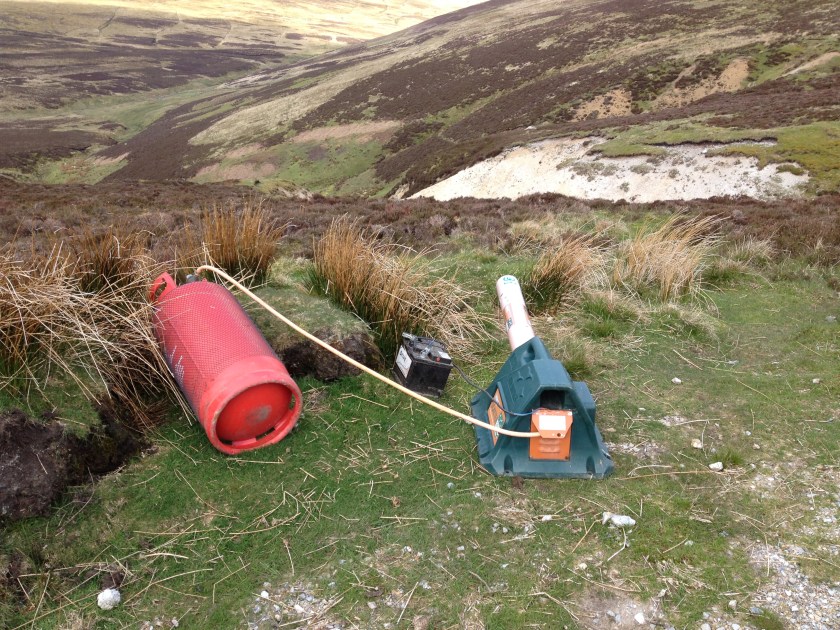
A year ago in May 2015, someone sent us some photographs of three propane gas gun bird scarers that had been deployed on the grouse moor at Leadhills Estate, South Lanarkshire (see here).

Bird scarer 1 - Copy

These gas guns are routinely used for bird scaring on agricultural fields – they are set up to produce a periodic booming noise to scare pigeons, geese etc away from crops. The audible bang can reach volumes in excess of 150 decibels. We wondered why they were being used on grouse moors in the height of the breeding season?

A month later in June 2015, Mark Avery published photographs of gas guns that had also been deployed in the Peak District National Park and on an unnamed grouse moor in the Scottish Borders (see here).

We were interested in the deployment of these bird scarers in relation to (a) their proximity to Schedule 1 (and in Scotland, Schedule 1A) bird species [and thus any potential disturbance to these specially protected species] and (b) their use in designated Special Protection Areas [and thus any potential disturbance caused].

We assumed that the deployment of these gas guns would be subject to guidance and rigorous licensing controls by SNH and Natural England (as they are the licensing authorities for the Wildlife & Countryside Act (as amended)), particularly in relation to the hen harrier, which, as a Schedule 1A species (in Scotland only), is “protected from harassment [including disturbance] at any time“, not just when it’s trying to breed (see here).

So an FoI was sent to SNH to find out if anyone had requested a licence to use a gas gun on a grouse moor in the previous two years. It turned out nobody had.

An FoI was also sent to Natural England – no licence applications there either. It also emerged that NE had received a report in June 2015 of a gas gun being deployed on a SSSI on an estate in the North Pennines, without formal consent. In July 2015 a warning letter was sent to the estate asking them to remove the gas gun. The estate apparently complied and no further action was taken.

In September 2015, we encouraged blog readers to contact SNH and Natural England to ask for urgent guidance to be issued on the use of gas guns in protected areas and in close proximity breeding birds, particularly raptors (see here).

SNH responded quickly and said they would investigate, and depending on their findings, they may provide guidance (see here).

Natural England responded a short time later and said they recognised the need for guidance and that they were in the middle of drafting such guidance, which would be made available prior to the start of the 2016 breeding season (see here). In fact, Alan Law, Chief Strategy & Reform Officer at Natural England said: “I will arrange for you to be sent this guidance as soon as it becomes available, which will be in advance of next year’s breeding season“.

Well, the 2016 breeding season is already underway but we haven’t seen any formal guidance. Have you?

Let’s remind SNH and Natural England of their stated commitments and ask them to produce the following:

Emails to:

Andrew Bachell, Director of Policy & Advice, SNH: Andrew.Bachell@snh.gov.uk

Dear Andrew, Last September you said SNH would investigate the deployment of propane gas gun scarers with regard to the law, and specifically with regard to the recent guidance you issued on Schedule A1 and 1A species under the Wildlife & Countryside Act. You also said, depending on your findings, SNH would issue guidance if it was felt appropriate to do so. Please can you provide the results of your investigation and advise whether you intend to issue any formal guidance or not? Thanks.

And

Emails to:

Alan Law, Chief Strategy & Reform Officer, Natural Engand: alan.law@naturalengland.org.uk

Dear Alan, Last September you said Natural England was drafting formal guidance on the deployment of gas gun bird scarers within Special Protection Areas and their potential impact upon Schedule 1 birds. You also said this guidance would be available in advance of the 2016 breeding season. Please can you direct me to the location of this guidance document, or better still, please send me a copy, as you said you would. Thanks.

Pigeon racing man fined for storing banned poison Carbofuran

A Cumbrian man from the world of pigeon racing has been convicted for the illegal storage of the banned poison Carbofuran.

Keith Mingins, 58, of Main Street, Frizington, Cumbria, pled guilty at Workington Magistrates Court on 29th April 2016, following the discovery of Carbofuran at his pigeon lofts during a police raid in April 2015.

Mingin’s defence was that he had been given the poison by his father in law (who has since died), he didn’t know what it was but he used it anyway, to poison rats, apparently.

He was fined £300 for the illegal storage and ordered to pay costs and a victim surcharge amounting to £115.

Article in North West Evening Mail here.

It’s an interesting one. We wonder what triggered the police raid in the first place? (They would have to have grounds to justify a search of his premises, they can’t just turn up on a whim). And how many times have we heard the defence that someone who was in possession of a banned poison had been given it by someone who had since died? And just how plausible is it that someone gives you a poison, you don’t bother to find out what it is, but decide to use it all the same?

The pathetic fine makes us wonder whether the court received any background information about Carbofuran (banned 15 years ago in 2001) and how it is still commonly used to poison birds of prey and how some pigeon racing men are known to target birds of prey? We are in no way suggesting that’s what Keith Mingins did, but a wider perspective in these cases should help inform the magistrate prior to sentencing.

Frizington has been a hotspot for the attempted poisoning of peregrines over the years. At least twice in 2009, and also in previous years, live pigeons smeared with banned poisons (Carbofuran and Aldicarb) have been found tethered at a quarry (a known peregrine breeding site) at Rowrah, Frizington (see here). In 2010 a peregrine was found dead in ‘suspicious circumstances’ at an allotment in Frizington, although the cause of death is not known (see here).

Let’s hope the publicity of Keith Mingins’ conviction (if not his lame punishment) for storing a banned poison will act as a deterrent for anyone else in the area who may have some Carbofuran or another banned poison stashed away and who may be thinking about using it.

Well done to Cumbria Police, NWCU and Natural England for a successful prosecution.

Angus Glens gamekeeper charged with pole-trapping offences

Scottish gamekeeper Craig Graham, 51, has been charged with repeatedly setting an illegal pole trap on an estate in the Angus Glens.

At a second court hearing yesterday (1st court hearing 31st March 2016), Forfar Sheriff Court heard that Head gamekeeper Mr Graham allegedly set and re-set a pole trap, baited with a pheasant carcass, on a tree stump, between 9th-17th July 2015. A further charge states that Mr Graham set the illegal trap with the intention of killing or taking a wild bird.

The offences are alleged to have occurred between Bridge of Brewlands and Kirkton of Glenisla. According to Andy Wightman’s Who Owns Scotland website, this area comprises part of the Brewlands and Kilry Estate.

The case was continued until 12th May 2016.

BBC news article here

Courier article here

Cairngorms National Park Authority responds to death of hen harrier ‘Lad’

HH Lad July 2015 Dave PullanFollowing on from yesterday’s news about the discovery of a dead hen harrier (suspected shot) on a grouse moor within the Cairngorms National Park (see here), Grant Moir, CEO of the Cairngorms National Park Authority has issued a statement (see here).

We’ve reproduced it here:

It appears likely from the post-mortem carried out by SRUC that a tagged hen harrier has been shot in the National Park. It is a disgrace that there are still people who think shooting a hen harrier is acceptable in the 21st century.

Millions of people visit this incredible Park every year with 12 per cent of visitors coming here for wildlife watching earning millions for the local economy. 43 per cent of people in the Park are employed in tourism and every illegal raptor crime adversely affects this area and Scotland’s reputation. The National Park Authority will work with all our partners to try and ensure that raptor crime is a thing of the past and that populations and ranges recover in the Park.

END

Good on the CNPA for issuing a statement (that’s more than the Environment Minister seems to have done), and this statement is marginally better than the one it issued nine days ago in response to questions about mountain hare massacres taking place on grouse moors within the National Park (see here), but once again it mostly just reads as empty rhetoric.

Pay attention to that last line: “The National Park Authority will work with all our partners to try and ensure that raptor crime is a thing of the past and that populations and ranges recover in the Park“. It’s all very well saying they’ll ‘work with partners’, but how, exactly, will that translate in to action?

The CNPA has talked a lot about partnership working and action, especially to address the issue of illegal raptor persecution on grouse moors within the Park, which it recognises as “threatening to undermine the reputation of the National Park as a high quality wildlife tourism destination” (see here).

For example, in 2013, a new, five-year ‘action plan’ was launched which aimed to ‘restore the full community of raptor species’ and one of the action points was for the SGA and SLE ‘to trial innovative techniques to increase raptor populations’ (see here). How’s that going? Anyone seen an increase in raptor populations? No, of course not. What we’ve actually seen is a long-term decrease of some raptors on grouse moors within the Park: the local hen harrier population has crashed (see here) as has the local peregrine population (see here) and there is no indication that these declines are about to be reversed.

Last year the CNPA hosted a high-level meeting with the Environment Minister and landowners, in which it was stated in a post-meeting CNPA press statement, “Among the topics discussed was raptor persecution and conservation, with a recognition of the progress made in recent years…” (see here).

What progress is that, then?

The last line of the CNPA’s latest statement in response to the death of hen harrier ‘Lad’ could translate as follows: ‘We’re not happy about this, it casts us in a bad light, we wish it would stop but we’re hopeless and helpless to bring about change’.

We’re not. Please sign the e-petition to ban driven grouse shooting HERE.

Photo of hen harrier ‘Lad’ by Dave Pullan