Shot peregrine found dead at Derbyshire Wildlife Trust HQ

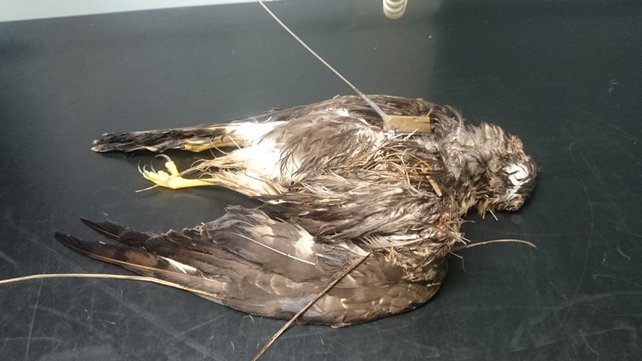
peregrine belper jan 2015A dead peregrine has been found outside the Derbyshire Wildlife Trust’s HQ – an x-ray revealed it had been shot.

A £1,000 reward has been put up by the RSPB for information that leads to a conviction.

Tim Birch, Derbyshire Wildlife Trust’s Head of Advocacy and Conservation said: “We have all been shocked at the Trust by the shooting of the male peregrine at our headquarters in Belper. To have a wildlife crime happening right on our doorstep is both alarming and upsetting. Many people from Belper, and indeed from around the whole region, have been thrilled to watch peregrines around the mill where we work. We feel very privileged to have these birds living alongside us. We strongly condemn the shooting of this bird“.

Press statement from Derbyshire Wildlife Trust here

Article in Derby Telegraph here.

This is the second known peregrine to have been illegally killed this year. Just ten days ago we blogged about the discovery of a poisoned peregrine found dead in January on a Scottish sporting estate (here).

According to the RSPB, there have been at least 54 confirmed illegally persecuted peregrines in the UK in the past six years. We eagerly await the results of last year’s National Peregrine Survey to see how persecution is affecting this species at the population level.

£1K reward for info on buzzard found with horrific leg injuries

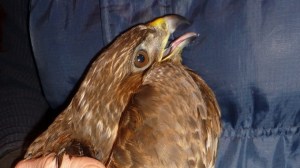
Sledmere buzzard1 Jan 2015A reward of £1,000 has been offered to anyone with information about a buzzard which was found with horrific leg injuries.

The bird was found, alive, on 21st January 2015 on the Sledmere Estate in Yorkshire. One of its feet was missing, causing Humberside Police and the RSPB to suspect it was a victim of illegal trapping.

The leg damage was so severe the buzzard had to be euthanised.

Bob Elliot, RSPB’s Head of Investigations said: “Setting spring traps in the open is a criminal practice, which harms birds of prey in the most horrible way. These devices are the raptor equivalent of a land mine – deadly and indiscriminate. I would urge anyone with information about this incident to contact the police immediately“.

This bird was initially taken to Jean Thorpe’s Ryedale Rescue facility – we recently blogged about Jean’s work (here) and mentioned that she was fundraising to help support her efforts in this raptor persecution blackspot – you can still donate HERE.

RSPB press release here

ITV news article here

Sledmere buzzard2 Jan 2015

Scottish Government launches poisons disposal scheme

PoisonThe Scottish Government has today launched it’s promised ‘pesticides disposal scheme’ – a free service allowing those who are still in possession of these banned substances an opportunity to get rid of them without fear of consequence.

This scheme was initiated by former Environment Minister Paul Wheelhouse whilst he was still in office.

We have mixed views about the scheme.

On the one hand, it’s a proactive approach to rid Scotland of highly toxic substances that are still being used, illegally, with devastating effect on some of our raptor species, notably golden eagles, red kites, peregrines and buzzards. Only yesterday we blogged about the latest victim  -a poisoned peregrine found on a grouse moor (see here).

On the other hand, many of these poisons have been banned for years, and even being in possession of them has been an offence since 2005 (Possession of Pesticides (Scotland) Order 2005), so why, ten years later, are the criminals who are still in possession of these poisons being given yet another opportunity to escape justice?

The bigger concern of these two views undoubtedly has to be that these poisons need to be removed, and that concern outweighs the lesser concern that the criminals won’t be punished, so from that perspective we welcome the new scheme.

However, what we want (expect) to see as a result of the scheme is that anybody caught with these poisons after the scheme has ended MUST be given a more serious sentence for their crime. We fully expect that even after this scheme has ended, there will still be substantial amounts of these poisons being held illegally. Why? Because the criminals who hold and use these poisons have been doing so for a long, long time, despite the legislation and despite previous amnesties, because they know there’s a good chance that they’ll get away with it. And for those who do get caught, the penalty is usually so ineffectual that the risk was worth taking anyway. Those people, when caught, must feel the full force of the law and not some pathetic fine or community service order – nothing less than a mandatory custodial sentence will do.

It’s not clear for how long the free disposal scheme will run, other than a quote from the current Environment Minister, Dr Aileen McLeod, that the scheme will be “short-lived”.

Those wishing to dispose of their banned poisons via this scheme can do so without fear of prosecution, and without their personal details being given to the authorities. The Government will be collecting data about the uptake of the scheme, but these data will be limited to the type and number of poisons handed in, the cost of the scheme, and only the first three letters of the postcode from where the poisons have been collected.

As this is a free and confidential service, there is absolutely NO EXCUSE WHATSOEVER for anyone to still be in possession of these poisons by the time the scheme ends. Mind you, it’s been that way for the past decade and yet….

Scottish Government press release here

Details about how to use the free disposal service here

Frequently Asked Questions about the scheme here

A list of the poisons that will be accepted by the scheme and a description of what they look like and some common generic names here

Poisoned peregrine found on Scottish grouse moor

A poisoned peregrine has been found on a grouse moor in Stirlingshire, resulting in a police raid last Friday (20th Feb).

Incredibly, Police Scotland issued a press statement immediately after the raid. The speed of this publicity and their willingness to inform the public about this crime is warmly welcomed.

Here’s what the press release said:

Today Police Scotland executed search warrants on a shooting estate in the Stirling area after a Peregrine Falcon was found to have been poisoned by the banned pesticide Carbofuran.

A Police Scotland spokesperson said:

“In July 2014, a member of the public contacted police to report a dead Red Kite on the same estate. Subsequent investigation revealed this bird was also poisoned with the same banned pesticide. There was no release of information to the general public at this time for operational reasons”.

“It is evident that an ongoing and intentional effort to poison wildlife is occurring at this location and we will be working closely with the relevant partners and using all investigative techniques at our disposal to identify the offender(s) and bring them to justice”.

“We would appeal to anyone who has knowledge of these incidents, or this type of criminality, to contact us and give any information that would assist us. We all have a duty to protect the environment and it is imperative these criminals are caught”.

“Information can be given by contacting 101 or by calling crimestoppers on 0800 555 111. Information will be treated in the strictest confidence if required”.

END

All quite interesting, especially as they have now revealed this poisoned peregrine was found on the same estate where a poisoned red kite was found dead last July. We blogged about that kite here and here, as we wondered why Police Scotland hadn’t publicised this crime and why SNH hadn’t yet enforced a General Licence restriction on this estate. With the discovery of this latest poisoning victim, we’ll be looking closely to see if, and how quickly, SNH now responds.

Peregrine photo: Martin Eager

Help support raptor rehabber in persecution blackspot

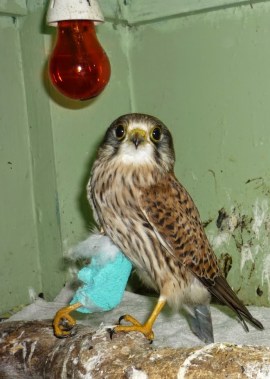
kestrel shot Ryedale 2015 2 - CopyNorth Yorkshire has the dubious distinction of being the UK’s worst known raptor persecution blackspot – a title it has held for several years (see here). With driven grouse moors the dominant land-use in this region, this rating shouldn’t come as any surprise.
At the heart of this blackspot is a remarkable lady called Jean Thorpe, who runs Ryedale Wildlife Rehabilitation, a facility that is wholly dependent on donations to keep going.

Jean works closely with the RSPB and the local Police Wildlife Crime Officers and last year was awarded an MBE for her tireless (voluntary) work.

When she’s not caring for injured raptors, mammals and any other creature that needs some expert help, Jean writes a blog (see here). Her latest entry is a review of the raptors she rehabilitated during 2014: a total of 99 injured birds, including 43 tawny owls, 19 barn owls, 11 buzzards, 9 sparrowhawks, 8 little owls, 7 kestrels, 1 peregrine and 1 red kite. She managed to release 53 back to the wild – an incredible achievement.

Not all were victims of persecution – many were road traffic casualties – but some had most definitely been targeted by the raptor-killing criminals. There’s a photo of a kestrel that she’s currently caring for – someone had blasted it with a shotgun.

Jean is fund-raising to buy/build a new aviary – her target is a modest £500. Let’s try and help her: donations can be made HERE.

Another hen harrier shot dead

Heather_dead_(Barry_ODonoghue_NPWS)With depressing familiarity, news has emerged of the illegal killing of yet another hen harrier.
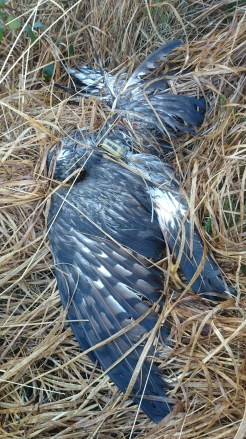
The corpse of the latest victim was found in January at an established roost site in Co. Kerry. The young female, named Heather by local schoolchildren, had been satellite-tracked since 2013 and her progress followed by hundreds of thousands who regularly logged on to the Hen Harrier Ireland blog where movement maps had been posted.

A post mortem has revealed that Heather had been shot.

There’s been plenty of news coverage about this latest crime:

Irish Times here

BBC news here

BirdWatch Ireland here

Irish Independent here

Heather’s fate is really no surprise. Had she been allowed to reach an age to begin her first breeding attempt without being gunned down would have been the real surprise.

For context, it’s worth reading about a disturbing incident from 2003, where a shot hen harrier was mailed to a local newspaper in Co. Kerry as a sinister message for those considering designating Special Protection Areas for hen harriers – see here.

Hen harriers, as you all know, are in serious trouble throughout these isles, whether it be in England, Scotland or the RoI. Those vilifying this species may have different agendas (i.e. in England & Scotland the threat is from the grouse-shooting industry; in the RoI it’s more complex and is based on afforestation and farming issues, not helped by the mysterious disappearance of millions of Euros that should have been given to support farmers working in designated conservation areas e.g. read our recent guest blog here) but the outcome for this species (and certain other raptor species) is always the same – certain death at the hands of those who think they’re above the law. Or, more to the point, at the hands of those who know very well that the chances of them being brought to justice are slim to non-existent.

Heather was an Irish bird. She hatched there, she lived her short life there, and she was killed there. But it’s important to recognise that she was part of a wider population whose range includes England, Wales, Isle of Man, Northern Ireland & Scotland. Some Scottish hen harriers travel to England, Ireland, Northern Ireland etc, just as some Irish harriers travel to England, Scotland, Northern Ireland, just as some English harriers travel to Scotland, RoI, Wales etc etc. If there are persecution issues in any part of the range, the impact will eventually affect the population in every other part of the range. Heather’s pitiful death should be felt just as keenly by those of us in Scotland, England, Northern Ireland etc as it is by those in the Irish Republic who today are mourning her loss. Political boundary lines on a map mean nothing to these hen harriers and they should mean nothing to those of us fighting to protect them.

You might think the campaign to end illegal raptor persecution is futile. You might think it’s too big of an issue and too geographically widespread for any of us to tackle it effectively. You’d be wrong. Over the last few years, thanks to the efforts of many organisations, large and small, as well as the efforts of ‘ordinary’ members of the public using social media, illegal raptor persecution has never had such a high media and political profile. There’s still a long long way to go, and the image of Heather’s wretched corpse is a miserable, poignant reminder of the work ahead of us, but we’ve only just got started.

Hen Harrier Day 2015 (Sunday 9th August) is an opportunity for us all, no matter in which part of the harrier’s range we live, to show our unity and intent. More news on that later this spring.

Heather HH shot Kerry Jan 2015