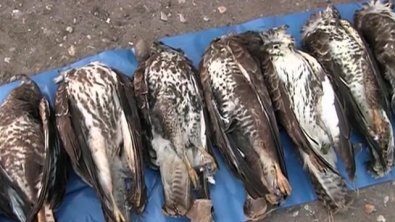
Scottish gamekeeper convicted for using a gin trap on Cardross Estate: gets community service order

James Alfred O’Reilly, 50, a Scottish gamekeeper working on the Cardross Estate in Stirlingshire, has been convicted of four wildlife crime offences, including the use of a gin trap to catch a buzzard. His punishment? It’s the usual pathetic response: he’s been ordered to carry out 240 hours of unpaid work.

Here is the press release from the Crown Office:

At Stirling Sheriff Court today, gamekeeper James O’Reilly was given a Community Payback Order and ordered to carry out 240 hours of unpaid work after having pled guilty to four charges under the Wildlife and Countryside Act 1981.

O’Reilly was convicted at Stirling Sheriff Court on 24 April of a number of charged including the use of an illegal trap for the purposes of taking of wild birds on the Cardross Estate in March 2013. Common buzzards, red kites, goshawks and white tailed eagles can all be found nesting in or as regular visitors to the area.

A man walking his dog on the estate, at a location known as Gartur came to an open area next to a pheasant pen where a distressed buzzard was caught in a trap by its leg next to a decomposed deer carcase.

The man released the jaws of the trap from the buzzard’s leg. When it became apparent that the buzzard was unable to fly he took the bird home and called the SSPCA. The SSPCA reported the incident to the police who continued the investigation. They found an illegal trap, which by its nature and placement by the accused was calculated to cause injury to wild birds.

They also found that the accused had set a number of snares in the area. None of which had identification tags on them as required by law.

It was clear to police that there was an issue in relation to the pest control methods employed by the accused and as a result, a search warrant for his house was obtained and executed on 4 April 2013.

In the course of the search, a snare containing decomposed fox parts was found next to a pheasant pen near to accused’s home address. It was apparent that a fox had become snared and the Accused maintains that he shot the fox after it had become trapped, and left the carcase lying. Staff at the Scottish Agricultural College confirmed that the fox caught in the snare had been there for more than 24 hours and possibly from the back end of 2012.

The buzzard was examined by a veterinary surgeon who found it had a severe injury to the right leg just above the foot. He commented that the injuries would have been extremely painful for the bird and would have taken several days to occur. Treatment was provided to the bird but its condition deteriorated and the bird was euthanized on welfare ground as it would never be suitable for release back into the wild.

Notes to Editor

  1. James Alfred O’Reilly (DOB 30/06/1964) of Stirling pleaded guilty on 24 April 2015 at Stirling Sheriff Court to four offences under the Wildlife and Countryside Act 1981 as below. He was sentenced to 240hrs Community Payback Order, on all charges cumulo:
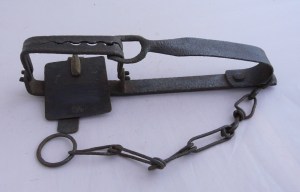
gin trap* Between 22 March 2013 and 25 March 2013 at Gartur, Cardross Estate , Port of Menteith, you JAMES ALFRED O’REILLY did intentionally or recklessly injure and take a wild bird, namely a buzzard in that you did set a gin trap also known as a leg hold trap on open ground or other similar type of trap which was baited with a deer carcass which trapped said buzzard by the leg, injuring it whereby it had to be humanely euthanased due to its injury; CONTRARY to the Wildlife and Countryside Act 1981 Section 1(1)(a);

* between 1 February 2013 and 4 April 2013 at Tamavoid, Cardross Estate, Port of Menteith, you JAMES ALFRED O’REILLY, whilst carrying out an inspection of a snare, did find an animal, whether alive or dead, caught by said snare and did fail to release or remove said animal namely a fox; CONTRARY to Wildlife and Countryside Act 1981, Section 11(3)(A);

* between 1 April 2013 and 4 April 2013 at Gartur, Tamavoid and The Big Wood , Cardross Estate , Port of Menteith you JAMES ALFRED O’REILLY did set in position a snare without having been issued an identification number by the Chief Constable under Section 11A(4) of the aftermentioned Act and did set 2 snares at a stink pit , 4 snares at a pheasant release pen and 1 snare at a stink pit, all of which did not have identification tags attached; CONTRARY to the Wildlife and Countryside Act 1981, Sections 11A(1) and (5);

* Between 22 March 2013 and 25 March 2013 at Garfur, Cardross Estate, Port of Menteith you JAMES ALFRED O’REILLY did set in position a trap, namely a gin trap also known as a leg hold trap being of such a nature and so placed as to be likely to cause bodily injury to any wild birds coming into contact therewith in that said trap was set on open ground next to bait, namely a deer carcass; CONTRARY to the Wildlife and Countryside Act 1981, Section 5(1)(a).

The requirement to tag snares was introduced by the 2011 Wildlife and Natural Environment Act as part of a suite of measures aimed at improving the accountability of snaring. This requirement came into force on 1st April 2013. Under the new regime, those responsible for setting snares were required to attend a training course, prior to being given an identification number. The accused O’Reilly had been issued with such a number on 23rd March 2013 by the licensing office in Pitt Street, Glasgow.

END

So, here are some questions:

1. Is O’Reilly still employed as a gamekeeper on the Cardross Estate (where they offer driven pheasant and partridge shooting)? Emails to: enquiries@cardrossestate.com

2. Is O’Reilly a member of the Scottish Gamekeepers Association, and if so, has he now been booted out? Emails to: info@scottishgamekeepers.co.uk

3. Is the Cardross Estate a member of Scottish Land & Estates, and if so, has it now been booted out? Emails to: info@scottishlandandestates.co.uk

4. When will the review of wildlife crime penalties be published by the Scottish Government (we understand it’s been submitted) and, more importantly, when will the review’s recommendations for change be implemented? Emails to: ministerforenvironment@scotland.gsi.gov.uk

You can perhaps combine this last email with one asking the Minister when we can expect to see a General Licence restriction order enforced on land where a poisoned red kite, a poisoned peregrine, and an illegally trapped red kite have been found – see here.

UPDATE 21st May 2015: some responses to these questions here.

Henry’s Tour: Day 16

Thurs 16 April Copy

Henry’s re-enacting a scene at Dersingham Bog, a National Nature Reserve situated on the Queen’s Sandringham Estate in Norfolk.

On the evening of 24 October 2007, two hen harriers were allegedly shot at this site, according to an eye-witness account. The police were informed and they visited the site the following morning, after seeking access permission from the estate(!). No bodies were found. The police interviewed Prince Harry, one of his mates, and a Sandringham gamekeeper, who were known to be shooting ducks on the estate that evening, but they said they knew nothing about the incident. The CPS couldn’t progress the case based on such limited evidence (see here).

Sandringham Estate was reported to have undertaken its own investigation and, according to the Telegraph, declared ‘that there was probably no such shooting and that the supposed eye witnesses were, at best, mistaken over their claims’. Friends of the royal prince also claimed that it had all been a set-up (see here).

It’s all very familiar, isn’t it?

Eight years on, things have not improved for hen harriers. There was an estimated 20 pairs of breeding hen harriers in England in 2007; last year there were just four, and all needed around-the-clock protection. Scientists have estimated that more than 300 pairs could breed in England if they weren’t being shot, trapped, stamped on or poisoned.

It’s often inaccurately reported that hen harriers are doing okay in Scotland. In relation to the dire situation in England, they are. However, the story in some areas of Scotland is identical to the story in England; hen harriers are being systematically killed on many moors that are managed for driven grouse shooting (see here).

And just as in England, prosecutions for killing hen harriers in Scotland are virtually unheard of.

Whatever happened to the case we blogged about 15 months ago (see here)? It related to the illegal killing of a hen harrier in Aberdeenshire in June 2013 (almost two years ago now!) – a 58-year-old man had been reported by Police Scotland to the Procurator Fiscal in January 2014. It’s all been strangely (or perhaps un-strangely) quiet since then….

Subsidy penalty for Stody Estate?

stody buzzardsOn 1st October 2014, gamekeeper Allen Lambert from the Stody Estate in Norfolk was found guilty of poisoning 10 buzzards and one sparrowhawk, which had been found dead on the estate in April 2013. He was also convicted of storing banned pesticides & other items capable of preparing poisoned baits (a ‘poisoner’s kit’), and a firearms offence (see here and here).

On 6th November 2014, Lambert was sentenced. Even though the magistrate acknowledged that Lambert’s crimes passed the custody threshold, he only received a 10 week suspended sentence for poisoning 11 raptors (suspended for one year), a six week suspended sentence for possession of firearms and nine poisoned buzzards (suspended for one year), and was ordered to pay £930 prosecution costs and an £80 victim surcharge.

On 5th October 2014, we blogged about the millions of pounds worth of subsidies that had been awarded to Stody Estate in recent years (see here) and we encouraged blog readers to contact the Rural Payments Agency (RPA) to ask whether Stody Estate would receive a financial penalty in the form of subsidy withdrawal for being in breach of the terms & conditions of their subsidy-fest.

On 10th October 2014, the RPA responded by saying they would consider what action could be taken against Stody Estate (see here).

Then it all went quiet.

One of our blog readers decided to submit an FoI to the RPA in December 2014, to see what was going on. Here is his letter:

12 DECEMBER 2014

To whom it may concern

I am making this request for information under the Freedom of Information Act.

The information I request relates to the conviction in October 2014 of Mr Allen Lambert, a gamekeeper employed by the Stody Estate, Melton Constable, Norfolk, NR24 2ER for illegally poisoning ten buzzards and a sparrowhawk.

I would be grateful if you could provide me with all the information you hold relating to the following questions:

  1. Whether the RPA consider the illegal poisoning carried out by an employee of the Stody Estate as being in breach of Cross Compliance Statutory Management Requirement 1 – Wild Birds.
  2. Did the RPA investigate any breach of cross compliance at the Stody Estate relating to the illegal poisoning offence and what was the outcome of the investigation.
  3. Whether the RPA has imposed a fine on the Stody Estate’s Single Farm Payment, Environmental Stewardship Payment or any other public subsidy the estate receives and if so, how much.

I look forward to hearing from you.

Yours sincerely

XXXXX XXXXX

On 14th January 2015, the RPA responded with this:

14 JANUARY 2015

Dear XXXXX XXXXX

Re: Freedom of Information – Information Request

Thank you for your request for information dated 12 December 2014 which has been dealt with under Freedom of Information Act 2000 (FoIA).

You have asked:

‘1. Whether the RPA consider the illegal poisoning carried out by an employee of the Stody Estate as being in breach of Cross Compliance Statutory Management Requirement 1 – Wild Birds.’

‘2. Did the RPA investigate any breach of cross compliance at the Stody Estate relating to the illegal poisoning offence and what was the outcome of the investigation.’

‘3. Whether the RPA has imposed a fine on the Stody Estate’s Single Farm Payment, Environmental Stewardship Payment or any other public subsidy the estate receives and if so, how much.’

Having considered your request we regret that we are unable to provide you with any meaningful response as we do not hold any information that answers your questions. However, RPA would like to make clear that it is required to assess cross compliance reductions to CAP subsidy claims based on intent, extent, severity, permanence and repetition of the non-compliance. We can assure you that RPA will take action, including cross compliance reductions to CAP subsidy payments applicable, if this is found to be appropriate.

In order to qualify for most CAP subsidy payments, claimants are required to keep their land in Good Agricultural and Environmental Condition and comply with a set of Statutory Management Requirements (SMRs). This is known as cross compliance. One of the SMRs covers wild birds (SMR 1) and this includes a rule about killing, injuring or taking wild birds.

Further information is published on the GOV.UK website (Page 43 – deals with wild birds).

https://www.gov.uk/government/uploads/system/uploads/attachment_data/file/320833/The_Guide_to_Cross_Compliance_in_England_2014_complete_edition.pdf

If you are not happy with the way we have handled your request, you can ask for an internal review. These requests should be submitted within two months of the date of receipt of the response to your original letter and should be addressed to: Access to Information, Rural Payments Agency, North Gate House, 21-23 Valpy Street, Reading, RG1 1AF.

Yours sincerely

Rural Payments Agency

Not very helpful, is it?

Thanks to the blog reader who followed up with the FoI and shared the response with us. We understand the RPA can expect further FoIs until a satisfactory response is received. Watch this space….

Meanwhile, you might be interested to compare Lambert’s pathetic sentence with that of an anti-badger cull protester. Lambert was given a 10 week suspended sentence and ordered to pay £930 costs for the mass poisoning of protected birds, the illegal storage of banned poisons and a firearms offence. The badger cull protester, who breached the terms of an injunction designed to stop him disrupting badger culls (he filmed someone involved with the cull and stood outside the NFU office wearing a t-shirt that said: ‘FCK NFU’), was given a six month suspended sentence and ordered to pay costs that could amount to £55,000 (see here). The first installment of £25,000 is due on 1st May. A crowd-funding page has been set up for those who want to help – see here.

Subsidy penalty for convicted vicarious liability landowner

Last month we blogged about the Scottish landowner who was the first to be convicted under the new vicarious liability legislation which came in to force on 1st January 2012.

Ninian Robert Hathorn Johnston Stewart of the Physgill & Glasserton Estates was found guilty of being vicariously liable for the actions of his gamekeeper, Peter Finley Bell, who had laid out a poisoned bait which killed a buzzard. Bell was also found to be in possession of three banned poisons (see here).

The landowner’s conviction was met with mixed feelings. Many of us were pleased to see a successful prosecution in what was a landmark case, but there was widespread disappointment in the derisory fine of just £675.

A number of blog commentators asked whether the landowner would also be hit by a Single Farm Payment penalty for cross compliance breaches. We weren’t able to answer that at the time, although we knew that the use of a banned poison to kill a protected wild bird would certainly merit a penalty.

Well, it turns out that Mr Johnston Stewart was indeed hit with a subsidy penalty. According to his defence agent (David McKie),

He [Johnston Stewart] had already been penalised substantially via a high five-figure deduction to his single farm payment“.

We don’t know what that “high five-figure deduction” was (presumably somewhere between £10,000 – £99,999), nor do we know how it was calculated, nor what percentage it was of his annual subsidy payment. Nevertheless, it’s good to hear that a penalty was imposed so well done to SGRPID (Scottish Government, Rural Payments & Inspections Directorate) for being on the ball.

Wouldn’t it be good if this sort of detail was easily available in the public domain? We’d like to know how these public subsidies are being distributed (or revoked) and it surely has a deterrent value for other landowners who might just be persuaded to take a closer look at what their gamekeepers are up to. A section on this in the Scottish Government’s annual wildlife crime report wouldn’t go amiss….

First vicarious liability prosecution: part 4

Criminal proceedings continued yesterday against Mr Ninian Robert Hathorn Johnston-Stewart in the first known vicarious liability prosecution under the WANE Act 2011.

Mr Johnston-Stewart, the landowner of Glasserton & Physgill Estates, is charged with being vicariously liable for the criminal actions of Glasserton gamekeeper Peter Bell, who was convicted in 2013 of laying poisoned bait which killed a buzzard (Carbofuran), and for possession of three banned pesticides (Carbofuran, Strychnine and Alphacloralose) (see here).

Yesterday’s intermediate diet was continued, with another intermediate diet scheduled for 23rd December 2014.

Previous blogs on this case here, here and here

Stody Estate mass poisoner gets…..10 week suspended sentence

Gamekeeper Allen Lambert, convicted of mass raptor poisoning at Stody Estate, Norfolk, has been given a 10 week suspended sentence for poisoning 11 raptors (suspended for one year), a six week suspended sentence for possession of firearms and dead buzzards (suspended for one year) and has been ordered to pay £930 prosecution costs and an £80 victim surcharge.

This sentence will infuriate many. Lambert’s crimes contributed to one of the worst incidents of mass raptor poisoning in the UK. Although it’s not the worst incident, it’s right up there near the top of the list and is certainly the worst mass poisoning of raptors uncovered in England.

District Judge Peter Veits said Lambert’s crimes ‘had crossed the custody threshold’ but that his sentence would be suspended. Why? Sentencing is supposed to serve two purposes. It’s supposed to be a deterrent, not only to the convicted criminal, but also to others who may be contemplating committing the same crime. It’s also supposed to provide a punishment to the perpetrator for having acted criminally.

Does a suspended jail sentence meet any of these aims? No, it certainly does not.

What a wasted opportunity for the judiciary to send out a clear message to those who continue to commit abhorrent wildlife crimes. It’s so rare to actually get a conviction for poisoning; usually it’s the much lesser charge of ‘possession’ of banned poisons [in Scotland] or ‘storage’ of illegal poisons [in England] but here’s a gamekeeper who has been found guilty of actually poisoning 11 protected raptors. Sure, the judge’s sentencing options are constrained within statutory boundaries but the sentence in this case is nowhere near as strong as it could have been. Some of Lambert’s crimes are offences under the Wildlife & Countryside Act. Under this legislation, the maximum sentence, calculated for EACH offence is a £5,000 fine and a six month custodial sentence. That’s just for poisoning 11 birds – in Lambert’s case there are numerous other offences to consider, including firearms offences which usually carry a custodial sentence.

A suspended custodial sentence and a less than £1000 ‘fine’ (prosecution costs) for what Lambert did is absurdly lenient. According to the RSPB, since 2001, four gamekeepers have received suspended custodial sentences for persecution offences. During the same period, 12 egg collectors have actually been jailed. The inconsistency in wildlife crime sentencing is remarkable.

In Scotland there is currently a wildlife crime penalty review underway, at the behest of Environment Minister Paul Wheelhouse. There is an opportunity for you to participate, by filling in a questionnaire which seeks views on whether penalties for wildlife crime offences in Scotland are sufficient deterrent. The closing date is 21 November. Full details here.

So, Lambert’s pretty much got off scot free, but what of his (now former) employers, the Stody Estate? According to the BBC, ‘there is no evidence the estate owner, Charles MacNicol, knew about the poisonings. He wouldn’t tell BBC News whether he knew, or whether he condemned the killings’. Lambert was not sacked by Stody Estate, but instead was allowed to take early retirement, according to ITV news.

What we do know is the Stody Estate has received millions in agricultural subsidies over the years (see here), and as a result of blog readers’ efforts, the Rural Payments Agency is understood to be investigating to see whether financial penalties can be applied for cross-compliance offences (see here).

UPDATE 8/11/14: Here are the judge’s comments on Lambert’s sentencing:  DJ Peter Veits sentencing 6 Nov 2014

Media coverage of Lambert’s sentencing

RSPB press release here

BBC news here

BBC news video here

RSPB Investigations blog here

Daily Mail here

ITV news here

Norfolk Eastern Daily Press here

Telegraph here

Guardian here

Independent here

Norfolk Constabulary press statement here

Lambert 9 bz

Sentencing due for Stody Estate mass poisoner

Allen Lambert, the mass poisoning gamekeeper from Stody Estate, Norfolk, will be sentenced today following his convictions last month.

What sort of sentence does a convicted mass poisoner deserve? He was found guilty of poisoning 10 buzzards and 1 sparrowhawk. He was found guilty of the illegal storage and use of some of the most dangerous pesticides in the world. He was found guilty of having equipment capable of being used to prepare poisoned baits. He was found guilty of having nine dead buzzards in his possession.

Let’s hope the magistrate views this case with the seriousness it deserves.

Previous blogs on this case here, here, here.

Killing with impunity: Birdcrime 2013 published

Birdcrime 2013The RSPB has published its latest annual report on crimes against birds in the UK in 2013.
Their press release here.

The killing goes on, with impunity.

76 individual birds & other animals were confirmed illegally poisoned in 2013. This is more than double the figure from 2012 (29 confirmed victims).

Poisoning victims in 2013 included 30 buzzards, 20 red kites, 1 golden eagle and 1 white-tailed eagle.

68 confirmed incidents involved the shooting or destruction of birds of prey. Victims included two hen harriers, two marsh harriers and 5 peregrines.

These are just the confirmed incidents. A total of 338 incidents were reported to the RSPB in 2013, with North Yorkshire once again being the worst location. There’s also a worrying number of incidents from Powys in South Wales, seemingly relating to poisoned baits.

Birdcrime 2013 is a thoroughly depressing read. The RSPB calls on the shooting industry, again, to clean up its act. Judging by the contents of this report, that’s a seemingly futile request.

Well done and thanks to the RSPB for not only compiling these thorough statistics but importantly, for sharing them in the public domain.

Download Birdcrime 2013: Birdcrime 2013

Hen harrier Bowland Betty, found shot dead on a grouse moor in North Yorkshire. (Photo by Natural England).

Bowland Betty

Interesting bedfellows

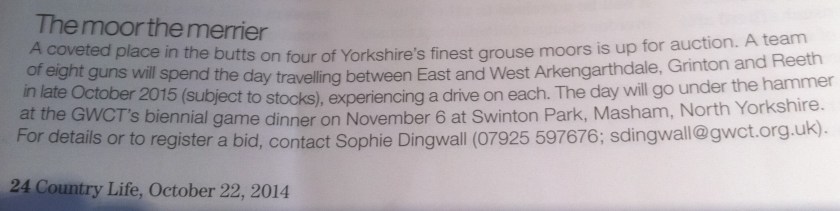
From Country Life Magazine, October 22nd 2014, page 24:

A coveted place in the butts on four of Yorkshire’s finest grouse moors is up for auction. A team of eight guns will spend the day travelling between East and West Arkengarthdale, Grinton and Reeth in late October 2015 (subject to stocks), experiencing a drive on each. The day will go under the hammer at the GWCT’s biennial game dinner on Nov 6 at Swinton Park, Masham, North Yorkshire“.

Fascinating stuff.

Swinton Park is linked with the Swinton Estate. Swinton Estate was where the shot corpse of hen harrier Bowland Betty was discovered in 2012 (see here), although that was likely just an unfortunate coincidence as there was no evidence to link her death to anybody, let alone anyone associated with the estate. According to the Countryside Alliance, she wasn’t shot at all (see here).

A different incident confirmed criminal activity by a Swinton Estate employee. Earlier this year, gamekeeper Ryan Waite was convicted of illegally setting a spring (pole) trap on Swinton Estate (see here).

What an interesting choice of venue for the GWCT to select for their prestigious event, eh?

New five-year hen harrier project launched

A £1.8 million five-year project has been launched, aiming ‘to achieve a secure and sustainable future’ for hen harriers in northern England and parts of southern and eastern Scotland.

Funded by the EU LIFE scheme, this project will include elements of monitoring (at nests and key winter roosts as well as funding a national hen harrier survey in 2016), satellite tagging, habitat management, investigations work (two new RSPB Investigation Officer posts have been funded), community engagement, community consultation and stakeholder engagement.

The project will focus on seven so-called Special Protection Areas (SPAs) designated for breeding hen harriers, two in England and five in Scotland. These are:

Bowland Fells

North Pennine Moors

Glen Tanar

Forest of Clunie

Muirkirk and North Lowther Upland

Langholm-Newcastleton Hills

Glenn App and Galloway Moors

However, given the tiny breeding population in these areas, it’s quite likely that project work will extend in to other areas, too.

RSPB press release here

BBC news article here

It’s good to see that the project is being managed by Blanaid Denman, who led the RSPB’s (award-winning!) Skydancer Project in northern England and did an excellent job of raising awareness about this species’ plunge towards extinction in that region. It’s also good to see that satellite-tagging will play a prominent role – let’s hope the RSPB will allow us to follow the movements of the tagged harriers and that they’ll publicise the locations of where the birds’ transmitters suddenly cease (which of course is bound to happen), unlike Natural England who have failed miserably in this respect for the last 12 years. Given that the RSPB recently published the last known locations of Bowland harriers Sky and Hope, who ‘disappeared’ on a grouse moor in Lancashire last month (see here), we’re optimistic that this information will again be forthcoming with the newly tagged birds.

We were particularly interested in the BBC’s report about this new project (see link above). That article includes the following statement:

The birds continue to face threats. In June 2014 two orphaned hen harrier chicks were hand-reared by wildlife experts after the female bird was illegally shot in East Ayrshire‘.

Why is that statement interesting? Well, because at the time of this harrier’s death, Police Scotland refused to reveal the cause of death (see here). They said:

Whilst at this time we cannot divulge how the bird was killed, we do believe it was the result of a criminal act and we need to establish why this has happened“.

Wonder how their ‘investigation’ is going, and whether they’ve yet worked out why this harrier was found shot on a grouse moor? Idiots.

Talking of investigations in to illegally-killed hen harriers, wonder how this one is coming along – a hen harrier found shot dead on an Aberdeenshire grouse moor a year ago.

Or how about this one? The alleged ‘coordinated hunting’ of a male hen harrier on another Aberdeenshire grouse moor, nearly 18 months ago.

Or how about this one? The allegation that ‘someone’ killed a hen harrier ‘somewhere’ in Aberdeenshire in June 2013. This case was passed to the Crown Office ten months ago….no news since.

The press release about this new EU-funded project is pretty much focused on ‘let’s get everyone working together to help our hen harriers’. Whilst that’s a noble aim (and we sincerely wish Blanaid and her team the best of luck with that), it’s probably not going to happen. The killing will continue, the killers will deny all knowledge and they’ll more than likely get away with it. Where this project may have a greater impact is the bringing forward of more evidence of the killing; not that more evidence is needed – we all know it’s happening and where it’s happening. But more evidence from more satellite tags and more evidence from more investigators on the ground. That evidence can only add to the current evidence base, and to the growing anger, and will help us to apply more pressure on the politicians who have the ultimate responsibility for protecting these birds.

Hen harrier photo by Gordon Langsbury