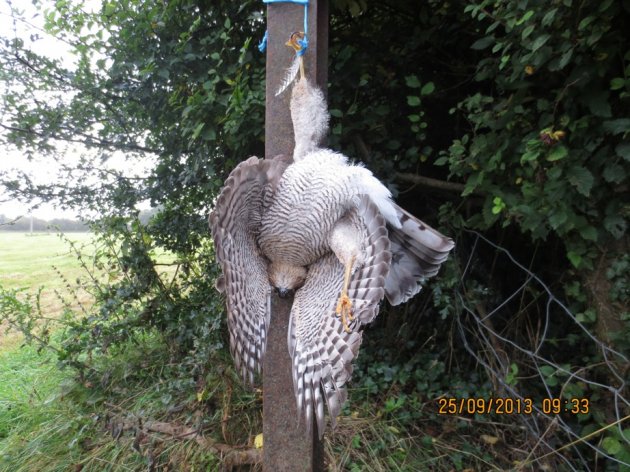
Sparrowhawk shot and strung up from gatepost

shot hung spar IrelandThe Irish National Parks and Wildlife Service are appealing for information after the discovery of a sparrowhawk found hanging from a gatepost. It had been shot and then strung up with a piece of string.

The gruesome discovery was made along a public road in the Rathkenny area of Navan, County Meath.

Further details and a contact telephone number for anyone with information can be found here.

Buzzard dies from gunshot injuries in Northumberland

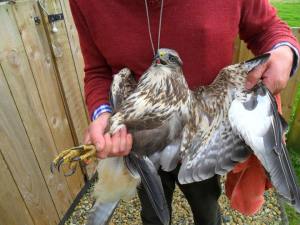
Hexham buzzardAn injured buzzard was found by a member of the public at Blanchland near Hexham, Northumberland at the weekend.

It had been shot.

The bird was taken to a wildlife sanctuary at Ladyhill Farm, Simonburn, Hexham where it later died of its injuries.

More info on the Falconry Days  facebook page here.

UPDATE 25th September: Police have now issued an appeal for information about this case, and a similar one in the same area involving a shot tawny owl. Read the press release here.

Irish Game Council condemns latest red kite poisoning

NARGC,%20logoFollowing on from Thursday’s news that yet another red kite has been illegally poisoned in the Irish Republic (see here), the country’s largest game shooting organisation, the National Association of Regional Game Councils (NARGC) has once again issued a strong statement of condemnation.

NARGC Director Des Crofton’s statement can be read in full here.

This isn’t the first time that Des Crofton has spoken out against the illegal persecution of raptors. Back in January, the NARGC issued an unequivocal condemnation of the illegal shooting of a buzzard (see here).

We’re still waiting to see the same consistent level of leadership and zero tolerance of illegal persecution from Scottish and English game shooting groups.

For example, we note with interest the comments earlier this week from the National Gamekeepers’ Organisation in England regarding the potential criminal background of this year’s buzzard licence applicant. We strongly suspect that the applicant had a very recent conviction for possession of illegal pesticides, including the gamekeepers’ poison of choice, Carbofuran. NGO spokesman Charles Nodder commented on this blog (see here) to say that the NGO “strongly condemns illegal acts“. When asked to clarify whether the buzzard licence applicant had a conviction for possession of banned poisons, Mr Nodder went strangely quiet. Would you expect an organisation that claims to ‘strongly condemn illegal acts’  to support someone with a conviction for the illegal possession of banned poisons?

Poisoned red kite found dead in reservoir

RedKitePoisonedReservoir_largeThe following is a press release from the Golden Eagle Trust in the Irish Republic:

A red kite recently discovered in Vartry Reservoir, Roundwood, Co. Wicklow has been confirmed as poisoned. The bird, identified as Blue Red 42 – an Irish bred kite, was reported by a concerned dog walker to Birdwatch Ireland who informed the local National Parks and Wildlife Service staff. An investigation into the matter was immediately begun.

A National Parks and Wildlife Service Ranger responded to the incident and located the carcass which lay only a few hundred metres from residential houses and a local pre-school. The bird had a mouth and crop full of fresh food, indicating that cause of death was most likely poisoning.

The Vartry Reservoir is used for recreational walking and angling and provides drinking water to the southern suburbs of Dublin.

Minister Deenihan said “The Red Kite is a magnificent bird of prey and is protected by law. I know every effort is being made to find the culprit in this incident, and I would call on any person with any information about this matter to contact the National Parks and Wildlife Service of my Department or An Garda Siochána. The use of this type of poison is strictly limited to the eradication of mice and rats, and should at no time be used in the reckless way it was.”

Tests were immediately ordered under the bird of prey post-mortem protocol, a scheme operated by the National Parks & Wildlife Service, the Regional Veterinary Labs (Department of Agriculture, Food and Marine) and the State Laboratory (Department of Finance). Within 48 hours thanks to the experts within the Regional Veterinary Lab and the State Laboratory, both located at Celbridge, the bird was confirmed as having been poisoned by alphachloralose. The legal use of alphachloralose is restricted to the control of rats and mice. Furthermore the stomach contents of the red kite indicate that the poison was placed on meat bait, a practice now banned, largely for the protection of birds of prey. Searches of the area for further casualties or poisoned baits and door to door enquires were conducted by National Parks and Wildlife Service staff and local Gardaí.

The kite was a wild-bred Wicklow kite from 2012, only 14 months old whose parents were originally brought over from Wales in 2008. The landowner on whose land the kite was born is very disappointed to hear it has been found dead. Red Kites have only recently made their way as far north as Roundwood and it will be disappointing for many of the locals that had been enjoying their presence to hear of the poisoning.

Dr Marc Ruddock, Red Kite Project Manager, for the Golden Eagle Trust said, “This is the height of recklessness and it is imperative that communities and individuals take responsibility for getting the people who are still laying poison to stop immediately. The costs are high for Irish wildlife and the potential human consequences of this incident don’t bear thinking about!” Dr Ruddock, urged people to report any information to National Parks & Wildlife Service (NPWS) or An Garda Siochana and also report poisoning to their local Department of Agriculture office.

The National Parks and Wildlife Service in Wicklow welcomes any information on this case and the use of illegal poisons generally. You can contact the Wicklow Regional Office in Laragh on 0404-45800 or email wmnp@environ.ie The Department of Agriculture can also be contacted about poisons at the Dublin Office on 01 6072000 or email info@agriculture.gov.ie

The Irish Red Kite Reintroduction Project is part of an All-Ireland effort to restore red kites. These were formerly extinct in Ireland. The Golden Eagle Trust (www.goldeneagle.ie), NPWS and Welsh Kite Trust (www.welshkitetrust.org) have collected (from Wales) and released 120 red kites in Co. Wicklow between 2007 and 2011 and 39 red kites in Co. Dublin in 2011. The Royal Society for the Protection of Birds (RSPB) www.rspb.org.uk released 80 red kites in Co. Down between 2008 and 2010. There are now 25-30 pairs of red kites breeding in Co. Wicklow and 10-15 pairs breeding in Co. Down. The Irish Red Kite Project is a partnership with the Welsh Kite Trust and National Parks & Wildlife Service.

RPS footnote: Well done to the lab guys who were able to confirm poisoning within 48 hours of the carcass being submitted, enabling important follow-up searches to take place. This quick turn-around is in stark contrast to the situation in Northern Ireland where long delays for poisoning results are hampering investigations.

Pathetic fine & curfew order for kestrel chick thief

Here’s a very good example of how just how useless the court system is at addressing wildlife crime.

Last week at Wolverhampton Magistrates Court, 38-year-old Cogoo Sherman Bowen was fined £210 and given a six-week curfew after his conviction for being in possession of four x 2-week-old kestrel chicks.

He was caught with the chicks in the dead of night on 19th June in the grounds of St Mary’s Church in Bushbury. The police had been alerted to suspicious activity on the church roof and had turned up expecting to find metal thieves; instead they found the defendant in his car with the bag of kestrels.

Quick-thinking RSPCA officials and the police wildlife crime officer, PC Chris Watson, found the nest ledge on the side of the church and were able to return the chicks, which fledged safely several weeks later.

Great work by the investigating authorities but a pathetic result in terms of the magistrate providing any sort of deterrent to other would-be chick thieves or indeed a meaningful punishment to the convicted criminal in this case.

Full story in the Express and Star here

The untouchables

Last month we blogged about getting our hands on the Leadhills Estate Game Book and our interest in the lists of killed ‘vermin’ dating over several decades (see here). These ‘vermin’ lists include the usual species that are typically referred to as ‘vermin’ by the game-shooting industry: species such as foxes, stoats, weasels and crows. However, also included on these ‘vermin’ lists are supposedly protected species such as birds of prey, ravens, otters and badgers. We said we’d blog about the lists in more detail when we had more time.
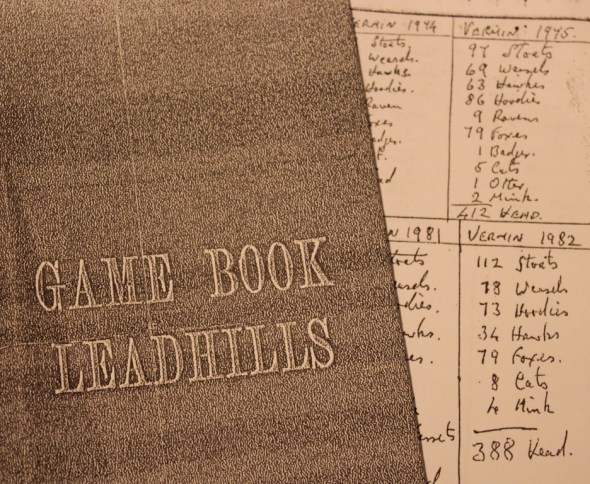
Leadhills game book vermin lists

Since then an independent academic has contacted us to ask whether we’d consider allowing access to the documents so the data could be analysed, in combination with other data sources, to provide a ~50 year dossier of alleged illegal raptor persecution incidents recorded at Leadhills Estate, stretching from the 1970s right up to the present day. These results would be written up as a peer-reviewed paper in a scientific journal. We think that such a paper would hold much more gravitas than a simple analysis of a sub-set of those data written up for this blog so we have agreed to pass the information to the academic. We look forward to seeing the results in due course.

So as not to steal the academic’s thunder we won’t be writing in detail about the contents, but we did want to share one startling statistic.

We looked at the number of killed ‘hawks’ listed in the Leadhills Estate Game Book, just between the years 1980-1987. The vermin lists in the Game Book stretch well beyond these years but we selected this particular period because we wanted to compare the figures with the RSPB’s published figures for all of Scotland during this period (the RSPB data were published in McMillan’s 2011 paper – here).

Here’s what we found:

RSPB: Number of illegally killed raptors recorded for the whole of Scotland between 1980 and 1987 = 91 birds.

Leadhills Estate Game Book: Number of illegally killed raptors recorded on Leadhills Estate between 1980 and 1987 = 383 birds.

The difference between these two figures gives a very clear illustration of a situation that conservationists have been arguing for decades: that is, the ‘official’ recorded figures of illegally-killed raptors that are published each year by the RSPB are just the tip of a bloody great big massive iceberg. Just on this one estate (Leadhills), more than four times as many raptors were recorded illegally killed during this seven-year period than those officially reported throughout the whole of Scotland. That’s just one estate. Think what these figures would look like if we had access to the vermin lists of other estates across Scotland!

Now, there’ll be some in the game-shooting industry who will argue that raking over historical persecution records dating back 30 years is irrelevant. They’ll claim that although persecution was common practice several decades ago, things have now changed for the better and it’s only the odd ‘rogue’ estate that are still at it. This, of course, is absolute nonsense. Anybody who bothers to read through the pages of this blog will know that that is simply not a true statement. Sure, some estates have since got their acts together and are now supporting healthy raptor populations on their land (e.g. see Atholl Estate in McMillan’s 2011 paper above) but these estates seem to be exceptional: there are many, many other estates that are still, even to this day, systematically and illegally persecuting raptors and many of them seem to have a curious immunity to prosecution.
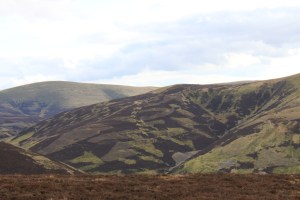
leadhills estateLeadhills Estate has been at the centre of allegations of wildlife crime for a very long time. The list of confirmed reported incidents dating from 2003 to 2011 makes for shocking reading (see here). Of these 41 confirmed incidents, only a couple have resulted in a prosecution and a conviction.

Earlier this year we reported the discovery of a substantial illegal stash of poisoned baits that was reportedly found on the estate (see here). Unsurprisingly, six months later we’re still waiting for Police Scotland to issue a statement.

What was particularly interesting about this incident was the reaction of the Scottish landowners’ organisation, Scottish Land and Estates. They refused to discuss the incident, citing an ‘on-going police investigation’ (how very convenient – this excuse relieves them of having to comment on any alleged persecution incident that never gets resolved – i.e. most of them). They also wrote to the Environment Minister and posted an article on their website complaining about the alleged incident being reported on this blog (see here). They gave an impression of being more outraged by the reporting of the incident than they were of the alleged discovery of a big stash of deadly poisoned baits on a Scottish sporting estate.

Now, compare that reaction to their response to the conviction of gamekeeper Peter Bell earlier this year. Bell was convicted of four offences including the poisoning of a buzzard on the Glasserton and Physgill Estates. Immediately following his conviction, Scottish Land and Estates issued a statement to say that Glasserton had been booted out of their organisation (see here). So why didn’t SLE issue a similarly strong statement when the poisoned baits had allegedly been found at Leadhills? They could argue that nothing is proven until a conviction has been secured, as in the Glasserton case. But if that is their argument, then why didn’t they distance themselves from Leadhills Estate when a Leadhills Estate gamekeeper (Lewis Whitham) was convicted of laying a poisoned bait in 2010 (see here)? Why is Leadhills Estate, with its long, long, long history of alleged wildlife crime, treated so differently to an estate like Glasserton, which in relative terms barely registers on the persecution radar? Back in June we asked SLE to provide some transparency about their relationship with Leadhills Estate (see here). They still haven’t.

There may be some who will argue that things are about to change at Leadhills Estate with the shooting lease now up for sale; the sales document itself makes for an interesting read – note the reason given for the current tenants’ departure and the fate of the gamekeepers currently employed on Leadhills Estate: Leadhills brochure 2013

Yes, there may well be a change in the tenancy but will that make any difference? There have been numerous shooting tenants at Leadhills Estate over the years and yet, if the available data are to be believed, the background level of alleged persecution has remained constant.

The raptor killers, whoever they are, appear to be untouchable.

Rescued peregrine succumbs to its injuries

Last week we blogged about the valiant efforts made by a farmer, an RSPB warden, a politician and a falconer/gamekeeper to save a stricken peregrine that was believed to have been poisoned (see here).

We heard yesterday that she didn’t make it. Her body has now been sent to the veterinary labs at the Agri-Food and Biosciences Institute for testing.

Sparrowhawk shot dead in Wrexham

SparhawkWrexhamThe BBC is reporting the fatal shooting of a kestrel in Wrexham, although judging by the photograph it appears the victim was a sparrowhawk, not a kestrel.
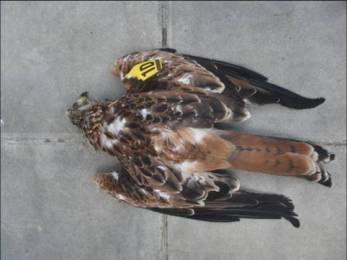
The critically injured bird was discovered by a member of the public on Thursday 29th August in Brynhyfryd, Johnstown and it died shortly afterwards.

The RSPCA Cymru are appealing for information. Tel: 0300 1234 999.

BBC News article here

5th suspected red kite poisoning in Northern Ireland this year

Y1D2013Last week we blogged about the growing concern of suspected red kite poisonings in Northern Ireland, following the discovery of a fourth dead bird in County Down this year (see here). Incredibly, conservationists had not been able to confirm the poisonings as they were still waiting for toxicology results from the lab – from as far back as January!

This week brings news of a 5th dead kite, this time found in the Cairncastle area of County Antrim and also suspected to have been poisoned. It was found by walkers on Sunday 18th August.

This bird (Yellow 1D) was born in May this year and was the offspring of one of the poisoned adults found in County Down.

The RSPB and the Police Service of Northern Ireland (PSNI) are appealing for information. Adam McClure, the RSPB’s Red Kite Officer in Northern Ireland said: “While we can’t say for certain until we have the results of the post-mortem, we strongly suspect that this bird, and potentially some of the others, has fallen victim to poisoning. All birds of prey are protected under the law, but unfortunately this doesn’t mean they are safe from poison. In some cases they are deliberately targeted as some people incorrectly see them as a threat to livestock or game birds. They are also vulnerable to poisoned bait left out with the intention of controlling foxes and crows. However, this is an illegal practice as it is indiscriminate and can affect not only scavenging birds like red kites but also pets, livestock and humans“.

Anyone with information about these suspected poisonings is urged to call PSNI: 0845 600 8000 or contact Crimestoppers anonymously: 0800 555 111.

Dead buzzard in Scottish Borders shot AND poisoned

Back in mid-July we blogged about a dead buzzard that had been found near Heriot in the Scottish Borders – it had been shot, but the precise cause of death was not known (see here).

Fast forward to August and it has now been revealed the buzzard had also been poisoned and that this was the cause of death, according to the BBC (see here). The poison used has not been named.

Enormous credit, once again, to the local Police Wildlife Crime Officer Hannah Medley for pursuing this case and also for publicising the findings in the media. Credit also to the lab folk at SASA for managing to detect poison in what had previously been described as a badly decomposed carcass.

This confirmed poisoning now takes the number of known (reported) poisonings in Scotland this year above the published figure from last year, so hopefully we will no longer have to read the ridiculous claims from the usual suspects that ‘poisoning cases are significantly declining’. The facts show that they are doing nothing of the sort. How ironic in this, the so-called Year of Natural Scotland.

Unfortunately the public haven’t been allowed to see this year’s on-going tally as yet – we know of several poisoned birds that have not yet been reported in the media, even though the birds were poisoned much earlier in the year. We’ll have more to say about these cases later in September and we’ll be asking the usual questions of a particular Police Scotland division about why they’ve kept these poisonings a secret for so long.