More on that vicarious liability prosecution

wane1Regular blog readers will know that we’ve been chasing information about the first potential prosecution under the new vicarious liability legislation for some time.

The case in point relates to the conviction of gamekeeper Peter Bell, who was guilty of poisoning offences on the Glasserton and Physgill Estates in December 2012 (see here).

In July 2013 we asked the Environment Minister for an update on the VL prosecution (see here). He replied in August and said it would be inappropriate to comment as police enquiries had not yet concluded (see here). Fair enough.

By early October we expected the police enquiries to have been completed, ten months after the original offence was committed, so we asked the Environment Minister for an update (see here).

One of our blog readers wrote the following comment a couple of days ago:

I duly sent an e-mail to Mr Wheelhouse about the update on whether or not there would be a prosecution under the vicarious liability following Mr Bells conviction. I’m apparently not allowed to post the reply anywhere but was told Mr Wheelhouse is unable to enter into discussion about such matters and I was pointed in the direction of The Crown Office and Procurator Fiscal Service for any information I might want“.

Interesting. So the first excuse given was that ‘police enquiries had not yet concluded’, and that has now changed to ‘Wheelhouse is unable to enter into discussion’ (and apparently members of the public are not permitted to publish the Minister’s replies to their queries).

Anyone getting the impression that these answers are designed to subdue any further reporting on this case?

Wheelhouse has apparently suggested contacting the Crown Office and Procurator Fiscal Service for the information. Let’s do that, taking note of the word ‘service’ – they are supposedly serving us, the general public.

The thing is, we’re not too sure who within COPFS to contact for this information. Rumour has it that the head of the Wildlife and Environmental Crime Unit (WECU) at COPFS, Craig Harris, has since moved on. Rumour also has it that a new head of unit has been installed although it’s not clear who that person is, although six-figure-Dysart’s name has been mentioned. Hmm.

We could ask the Lord Advocate, Frank Mulholland QC, who is the ministerial head of COPFS, although we’ve been unable to find a direct email address for him.

Let’s try our luck with the COPFS’s general email address and ask the following questions:

Dear COPFS,

Please can you tell us the name of the new head of the Wildlife and Environmental Crime Unit at COPFS? And please could you tell us whether there will be a prosecution under the vicarious liability legislation relating to the poisoning offences carried out at the Glasserton and Physgill Estates in December 2012? Thanks.

Emails to: enquirypoint@copfs.gsi.gov.uk

UPDATE: The email address to use is apparently this: _WildlifeSpecialists@copfs.gsi.gov.uk  Please note the underscore at the beginning of the address. Thanks to the contributors who have provided this new address.

Countryside Alliance disputes evidence that Bowland Betty was shot

Those luminaries of hen harrier conservation, The Countryside Alliance, are claiming that the scientific evidence used to show that Bowland Betty was shot was actually just ‘supposition’.

For those who don’t remember, Bowland Betty was a young satellite-tagged hen harrier who was found dead on a Yorkshire grouse moor in 2012 (see here). There followed a post-mortem carried out by the Zoological Society of London, which showed she had a fractured left leg which led to her death. There was then a pioneering forensic examination by scientists at the University College London Institute of Orthopaedics and Musculoskeletal Science, which found a tiny fragment of lead at the site of the fracture, confirming that she had been shot (see here, scroll down to news item 9th January 2013, and later published in the journal Veterinary Record in 2015: hopkins-et-al-2015_bowlandbetty_vetrecord ).

According to a press statement on the Countryside Alliance website (see here), “The Countryside Alliance team has accessed and reviewed autopsy reports and has serious concerns about this claim“.

Hmm, I wonder how many professional forensic scientists are employed on the CA’s team? Probably the same number as the number of professional veterinary pathologists employed by the SGA when they challenged the findings about what had happened to the Deeside eagle (see here).

Of course, it’s not the first time that the Countryside Alliance have been in denial about the extent of hen harrier persecution – see here, here, here and here for starters. Blimey, even Nick Griffin MEP has a greater grasp of the dire straits this species is in (see here) and that’s saying something!

It’s worth remembering that the Countryside Alliance was a participant in the charade that was the ‘Hen Harrier Dialogue’ – until the RSPB, Northern England Raptor Forum and the Hawk & Owl Trust finally had enough after six years of utter game-playing and walked out. Also interesting to note that the Countryside Alliance is still a participant in the PAW England and Wales Raptor Persecution Priority Delivery Group, along with the likes of the Moorland Association (see here for their view on hen harrier conservation) and the National Gamekeepers’ Organisation (we wrote recently about their contribution to tackling illegal raptor persecution here). Yet another charade, almost identical to the Scottish Raptor Priority Group, portrayed as ‘partnership working’ when it’s anything but.

The illegal killing of Bowland Betty provided tangible evidence of what we all knew was happening to the thousands of ‘missing’ hen harriers on UK grouse moors, just as the Countryside Alliance’s latest denial lays bare what we already knew was their real attitude to hen harrier conservation. Bowland Betty wasn’t the first silent witness and certainly isn’t the last…..watch this space…

Scottish govt and police are concealing poisoning incidents

The fiasco that is wildlife crime reporting in Scotland continues today with the release of the Scottish Government’s poisoning stats for the second quarter of this year (i.e. incidents from April, May and June).

These stats are published by SASA (Science and Advice for Scottish Agriculture), a division of the Scottish Government. A few years ago they used to publish the figures in a timely way – these days they’ve introduced a delay of approximately six months.  Here they are.

The stats are quite interesting. Take note of the number of buzzard deaths attributed to ‘probable starving’. These are the buzzards that are supposedly devouring gamebirds quicker than you can say, “Quick, pass the Carbofuran”. But, there’s something far more interesting in the report than that….or rather it’s not in the report…

For some reason, several known poisoning incidents are ‘missing’ from the data. We know that these incidents took place in March, April and May in Highland and Tayside. For one of them (a poisoned buzzard in March), this incident should have been reported in the stats for Q1 (Jan, Feb, March), but it wasn’t. We didn’t challenge that because it was reasonable to assume that a police investigation/raid may still be on-going and any publicity about the poisoning might have compromised a police operation.

But, now it’s October. These poisonings took place 7, 6 and 5 months ago, respectively. There hasn’t been a whisper of a police press statement about any of them. Why not?

And now the Scottish Government’s quarterly poisoning report has been sanitised to remove any mention of these incidents. Why is that?

Who stands to benefit from the concealment of these incidents? Certainly some organisations with a vested interest in wanting the public to believe that poisoning incidents are still on a downward trend, when actually they are not – they are on the increase from last year’s figures but of course nobody wants to admit that and if the figures aren’t in the public domain then they don’t have to admit to it!

Who told SASA to remove the data on these incidents? Was it Police Scotland?

Why don’t we ask them. Let’s ask Sgt Andrew Mavin, who is the Police Scotland Wildlife Crime Coordinator and who is quoted as saying, “Tackling crime, keeping people safe and building confidence is at the centre of everything the new service in Scotland stands for and this is exactly the approach we take to wildlife crime” (see here).

Is it really, Sgt Mavin? Then how do you justify the concealment of these poisoning incidents from public scrutiny? Why didn’t Police Scotland issue a press statement about them? Why didn’t Police Scotland shout it from the rooftops that highly toxic and illegal poisons are being left out in the countryside putting peoples’ lives at risk? Did Police Scotland ask SASA to remove these incidents from their public report? How can we have any confidence in Police Scotland when we find out that serious crimes are being kept hidden from the general public?

Here is his email address: andrew.mavin@scotland.pnn.police.uk

And while we’re on the subject of official cover-ups….we’ve been having a closer look at the Scottish Government’s Wildlife Crime Annual Report (2012) that was published last week (see here). We’re still not ready to write a detailed review on that report but we did notice something that’s relevant to today’s blog – the 2012 poisoning figures given in that report number three incidents. Conveniently, at least one other poisoning incident is ‘missing’. It involved the death of a raven and a crow and the discovery of poisoned meat bait and 2 rabbit baits, and it happened in the ‘Borders’ in May 2012. We blogged about it (here).

Why was this incident excluded from the Scottish Government’s so-called ‘official report’ on wildlife crime in 2012? Was it because no raptor species was reported as being poisoned? In which case, in the 2013 report are we going to see the exclusion of the 35+ poisoned meat baits found in gamebags on Leadhills Estate this year, because no poisoned raptor was actually found?

Let’s ask Environment Minister Paul Wheelhouse: ministerforenvironment@scotland.gsi.gov.uk

Dear Environment Minister,

Please can you explain why confirmed wildlife poisoning incidents are being concealed from the public and excluded from official government reports?

Thanks.

Buzzard shot – police ‘not currently investigating’

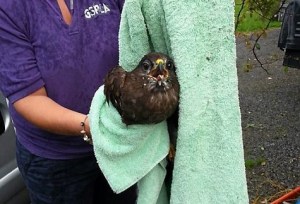
buzzardAn injured buzzard has been rescued on Guernsey – a veterinary x-ray showed it had been shot through the right shoulder with an air rifle.

The buzzard is now being treated in an intensive care unit at a wildlife hospital and is expected to make a full recovery.

Interestingly, according to the BBC, the police have been informed but are ‘not currently investigating’!

Guernsey SPCA are nevertheless appealing for information. Tel: 01481-257261.

Article on Isles News website here

BBC article here

Vicarious liability prosecution?

wane1On July 1st this year, Environment Minister Paul Wheelhouse set out his proposed ‘further measures’ to tackle the continuing problem of illegal raptor persecution (see here).

In response to his announcement, on July 2nd we asked him (see here) for clarification on some of these ‘further measures’ and also for updates on some previously promised measures, including prosecutions under the new vicarious liability legislation.

On August 4th we blogged about the Minister’s responses to our questions (see here).

One of the questions we’d asked him was this:

Question 3:

Please can you advise whether there will be a prosecution under the new vicarious liability legislation following the recent conviction of gamekeeper Peter Bell, found guilty of poisoning offences on the Glasserton and Physgill Estates? If you don’t know the answer (which would be surprising, given that you said in March 2013 that you would be “keeping an eye on this particular area [i.e. vicarious liability] with interest”, please can you provide the contact details of someone who can answer the question?

The Minister’s response was this:

It would be inappropriate to comment further on this case as police enquiries have not yet concluded.

At the time we said we weren’t too impressed with this response, seeing as though 8 months had already elapsed since the original crimes were committed (in December 2012). However, as this was the first time a potential prosecution had been considered under the new legislation, we didn’t have a benchmark for how long these cases might take. We also said we would ask, periodically, for updates on this case so that it couldn’t be quietly swept under the carpet.

It’s now October, ten months after the original crimes were committed, and there’s still no official word. We thought it was time to ask the Minister for another update.

Dear Paul Wheelhouse,

Please could you provide an update on whether there will be a prosecution under the new vicarious liability legislation following the recent conviction of gamekeeper Peter Bell, found guilty of poisoning offences on the Glasserton and Physgill Estates?

Thanks.

Emails to: ministerforenvironment@scotland.gsi.gov.uk

Case against gamekeeper George Mutch: part 2

Criminal proceedings against Scottish gamekeeper George Mutch continued today at Aberdeen Sheriff Court.

Mutch, from Kildrummy Estate in Aberdeenshire, is understood to have been charged with six alleged offences under Sections 1 and 5 of the Wildlife & Countryside Act.

Section 1 of the Act is concerned with the protection of wild birds, their nests and eggs.

Section 5 of the Act is concerned with the prohibition of certain methods of killing and taking wild birds.

This case opened last month (see here) for a pleading diet, but was continued without plea until today’s hearing. The case was adjourned again today, still without plea, until 30th October.

As we wrote last time, this case is of particular interest on several levels and is expected to attract a great deal of interest. Watch this space…

Scottish Government publishes first wildlife crime report (2012)

Wildlife Crime in Scotland 2012 ReportThe long-awaited Scottish Government report on wildlife crime has just been published.

The publication of this annual report became a requirement under the new Wildlife and Natural Environment (Scotland) Act 2011, and this first report relates to wildlife crime incidents recorded in Scotland during 2012. It covers various elements of wildlife crime, including raptor persecution, badger persecution, bat persecution, freshwater pearl mussel persecution and poaching.

As the report has only been published today, we won’t be commenting on it in detail until we’ve had a chance to read and analyse the contents. As you might expect, we’ll be ignoring the gloss of the press release and will be drawing our own conclusions, rather than blindly accepting the usual ‘good news’ spin that typically accompanies this sort of ‘official’ publication.

One thing we did notice straight away though, was that the RSPB has not been acknowledged as a data source. That’s quite interesting, seeing as the RSPB is the ONLY organisation in Scotland to compile comprehensive data on raptor persecution incidents. Instead, the organisations listed include the Scottish Government Justice Department, the Crown Office and Procurator Fiscal Service, Police Scotland, and the National Wildlife Crime Unit. Hmm.

It will be very interesting to compare the number of incidents that have been listed as “police-recorded raptor crimes” with the number of incidents recorded in RSPB Scotland’s 2012 Annual Report, which should be published in the near future.

We’ll be blogging about the Scot Gov annual report in due course. For now, you can read it here: Wildlife Crime in Scotland 2012 Report

Red kite poisoned N Yorkshire: police appeal 11 months later

North Yorkshire Police are appealing for information 11 months after a red kite was found poisoned in Tadcaster. The RSPB has also put up a £1,000 reward for information leading to an arrest and charge.

The dead bird (a three-year old believed to have been part of a breeding pair) was discovered by a member of the public at Toulston Polo Ground in October 2012. Toxicology results have revealed the bird had been poisoned with Carbofuran.

On the face of it, this looks like another farcical mishandling of a raptor persecution crime by the police, with an exceptionally long delay between the discovery of the victim and an appeal for information. However, rumours from colleagues in Yorkshire suggest that the initial testing (post-mortem) was not straightforward, leading to a prolonged delay. It is also rumoured that the bird was eventually submitted for toxicology analysis under a private submission co-funded by the Yorkshire Kite Group and the RSPB, leading to the detection of the banned poison Carbofuran.

The bird is believed to be the 20th poisoned red kite reported in North Yorkshire since 2000.

North Yorkshire police press release here

Environment Minister responds to our questions about his ‘further measures’ to tackle raptor persecution

On July 1st, Environment Minister Paul Wheelhouse laid out his ‘further measures’ to tackle the on-going problem of raptor persecution (here).

Whilst we welcomed his intentions, we wanted further clarification about these ‘further measures’ as well as some updates on previously-promised measures, so on July 2nd we posed five clear questions to him (see here).

This week, one of our blog readers received the following response from Wheelhouse’s wildlife crime policy officer:

Question 1:

Please can you clarify whether the Lord Advocate has instructed COPFS to accept covert video footage as admissible evidence in prosecutions for alleged raptor persecution incidents?

Answer:

The Lord Advocate has instructed the specialist prosecutors in the Wildlife and Environmental Crime Unit to work with Police Scotland to ensure that law enforcement utilises all investigative tools at their disposal in the fight against wildlife crime including tools such as video surveillance equipment where justified and appropriate.

Before instituting any prosecution, the Procurator Fiscal must be satisfied that there is sufficient admissible evidence to justify doing so. Established rules of evidence determine whether a court can take into account certain types of evidence including third party video evidence. If evidence does not comply with these rules, it is inadmissible and the court may not take it into account. In considering any case for prosecution, the Procurator Fiscal will assess, having regard to the particular facts and circumstances of any evidence and the manner in which it was obtained, whether the court will allow it to be considered. For example, the court may refuse to take account of evidence that has been obtained improperly, irregularly or unlawfully.

Our assessment:

It’s hard to know if the Lord Advocate’s instruction will make a blind bit of difference. Covert video evidence is routinely accepted as admissible evidence in England. It has, also, been previously accepted in Scotland, albeit rarely. More often than not, COPFS rejects it and we’re never provided with a transparent answer about why it was rejected. We’ve struggled to understand the legal reasoning behind these repeat rejections, especially when, as we understand it, the decision to accept or reject evidence should be made by the court (the Sheriff), not COPFS. We’ll just have to wait and see how covert video surveillance is treated in any future cases….and it’s quite likely we won’t have long to wait.

Question 2:

Please can you clarify the timescale for SNH’s review for introducing potential restrictions on the use of General Licences in areas where they have good reason to believe crimes against wild birds have been committed? In other words, when can we expect the review to be completed? Also, will their review be made publicly available?

Answer:

Officials are currently discussing with Scottish Natural Heritage how they will carry out the work to examine how and in what circumstances they can restrict the use of General Licences to trap and shoot wild birds on land where they have good reason to believe that crimes against wild birds have taken place. Timescales for completing the work are still to be concluded, but we would expect any new arrangements to be in place for next year and will ensure that we keep stakeholders in PAW Scotland informed of progress. SNH will be clear to all users of General Licences when and in what circumstances their use will be restricted or prohibited.

Our assessment:

This seems a perfectly reasonable explanation. We look forward to watching the developments.

Question 3:

Please can you advise whether there will be a prosecution under the new vicarious liability legislation following the recent conviction of gamekeeper Peter Bell, found guilty of poisoning offences on the Glasserton and Physgill Estates? If you don’t know the answer (which would be surprising, given that you said in March 2013 that you would be “keeping an eye on this particular area [i.e. vicarious liability] with interest”, please can you provide the contact details of someone who can answer the question?

Answer:

It would be inappropriate to comment further on this case as police enquiries have not yet concluded.

Our assessment:

Not very impressed, but as this case is probably the first of its kind to be considered under the new vicarious liability legislation, we don’t have any benchmark to be able to compare the timescales involved. It’s been 8 months since the crimes were committed (December 2012). Is it reasonable to expect Police Scotland to still be conducting enquiries or is this another fob-off to delay telling us that no charges will be brought under VL legislation? If they are still making enquiries, let’s hope they’re making a better job on this case than they did on this one! We’ll keep asking questions about this case every so often so it can’t just be swept quietly under the carpet.

Question 4:

Please can you tell us the status of the Scottish Government’s first annual report (2012) into wildlife crime? As you know, under the Wildlife and Natural Environment (Scotland) Act 2011, there is now a requirement (under section 26B) that ‘Scottish Ministers must, after the end of each calendar year, lay before the Scottish Parliament a report on offences relating to wildlife’. You mentioned in March 2013 that your policy officials ‘are currently working on’ this report. When can we expect this report to be available?

Answer:

Section 26B of the Wildlife and Countryside Act 1981 requires Scottish Ministers, after the end of each calendar year, to lay before the Scottish Parliament an annual report on wildlife crime. We will of course comply with that requirement and it is in preparation. Details about the laying of the report, including the timing, will be given to the Parliament in the first instance in accordance with established parliamentary protocol. We will, of course, ensure that the report publication is communicated to stakeholders and Parliament.

Our assessment:

It’s taking a very long time for this report to be published. We’ll keep asking about it.

Question 5:

Please can you tell us when, exactly, will you open the consultation regarding the increase of SSPCA powers to broaden the range of their work investigating wildlife crime? As you know, this consultation was first suggested by former MSP Peter Peacock as an amendment during the WANE Act debates, way back in February 2011. The then Environment Minister Roseanna Cunningham rejected it as an amendment but suggested a consultation was in order. Seven months later in September 2011, MSP Elaine Murray lodged a motion that further powers for the SSPCA should be considered. In November 2011, Elaine Murray MSP formalised the question in a P&Q session and the next Environment Minister, Stewart Stevenson, then promised that the consultation would happen in the first half of 2012. Nothing happened so in September 2012 we asked you, as the new Environment Minister, when the consultation would take place. In response to one of our blog readers in October 2012 your policy officer said: “The consultation has been delayed by resource pressures but will be brought forward in the near future”. Nine months later and we’re in July 2013 – almost 2.5 years after Scottish Ministers committed to undertaking the consultation. Where is it?

Answer:

We regret that resource pressures did further delay the public consultation on the extension of SSPCA powers. However, I can confirm that the consultation document will be published later this year.

Our assessment:

As far as we’re concerned, this consultation, if it does actually appear this year, could be a game-changer. Forget bringing in new legislation to tackle raptor persecution – we don’t need it. The legislation is all there – it just needs to be enforced. The enforcement process begins with a criminal investigation. Do we have complete confidence in Police Scotland to effectively and efficiently undertake these investigations? Based on their past performance, that has to be a resounding NO, with just a handful of exceptions. Do we have confidence in the SSPCA to undertake these investigations? If we judge them on their track record for successful prosecutions under animal welfare legislation, then YES, we do. We also know that certain organisations associated with the game-shooting industry do not support these extended powers for the SSPCA – they argue that criminal investigations should be carried out by the police. Funny that, because they support extended powers for water bailiffs – is that because the water bailiffs are often acting in the interests of landowners and gamekeepers (e.g. when tackling poachers)? Do they not support extended powers for the SSPCA because they know that with an extra 75+ highly-trained officers on the ground then the chances of raptor persecution crimes being uncovered become greater? You’d think, given that the game-shooting industry claims to be all for stamping out raptor crime, that they’d welcome the SSPCA with open arms.  We’ll be watching closely for this consultation to finally emerge and you can expect a great deal of blogging about it when it is published.

December trial for Morvich Estate gamekeepers

A trial date of 16th December 2013 has finally been set for three gamekeepers from the Morvich Estate, Sutherland, who are accused of committing alleged wildlife crimes.

The case against Mathew Ian Johnston, Jamie Robert Neal and William Robert Docharty was first called in November 2012 at Dornoch Sheriff Court. A series of adjournments (7 so far) have followed – see here for background.