Earlier this month, Environment Minister Stewart Stevenson MSP visited the Langholm Moor Demonstration Project in the Borders. The Langholm Project is an expensive, ten-year project aimed at demonstrating that hen harriers can co-exist with driven grouse shooting. The project is run as a partnership between SNH, Buccleuch Estates, RSPB, GWCT and Natural England. As part of the project, young hen harriers are being fitted with satellite tags to monitor their dispersal movements away from the moor.
The Environment Minister’s visit to Langholm was well publicised with an SNH press release (see here). In this press release, the Minister is quoted as saying: “…it was fascinating to learn that harriers that have been tagged at Langholm are being satellite tracked as far afield as France and Spain”.
Yes, that is fascinating, but of even greater interest is what has happened to the harriers that stayed behind in the UK?
According to the most recent diary entry on the project’s website (October 2011 – see here) written by the Langholm Project’s head gamekeeper, Simon Lester, one of this year’s young harriers has ‘disappeared’ –
“There is good and bad news as far as our satellite-tagged hen harriers are concerned. The ever-intrepid McPedro is certainly heading to France, across the channel from Devon. The sad news is that the hen that hatched in the nest just behind our house — and that I fed for some 60 days — has disappeared in the Moorfoots, having survived well in a relatively small range. The last ‘fix’ (or GPS position transmitted by its satellite tag) was on a shooting estate that co-operated fully when Project staff and the police tried, unsuccessfully, to recover the missing bird. Unfortunately, this bird’s particular satellite tag does not have a ‘ground track’ facility, so it may well have ended up miles away from the last transmitted ‘fix’, as, contrary to popular belief, birds can travel a vast distance in between transmissions. This latest loss is very sad, not just for the Project and our hope that more hen harriers will return to breed here, but is not helpful in our quest to help resolve the on-going raptor/grouse-shooting debate, either“.
Now, this is a fairly one-sided commentary of what might have happened to this young harrier. What Lester failed to mention was that the sporting estate where the harrier’s last known GPS ‘fix’ came from was an estate in the Scottish Borders with a well-documented history of alleged raptor persecution. This particular estate has been the subject of two police raids in the last few years. Illegal pesticides, poisoned baits and poisoned and shot raptors have all reportedly been retrieved from this estate. Apparently, no prosecutions for alleged raptor persecution crime resulted from either raid.
Lester is quite right to point out that just because the last known GPS ‘fix’ of the harrier was on this estate, this doesn’t necessarily mean that the harrier died there. As he says, the harrier could have moved off the estate before the next satellite signal was due, and could have died elsewhere – although if that had happened, why wasn’t there another ‘fix’ from the new location? The transmitter doesn’t die when the bird dies. For all we know though, the bird may not even be dead. It’s possible that the satellite transmitter failed, by coincidence, when the bird was on this estate, and the harrier has since moved away and is alive and well in an unknown location. But there is another plausible explanation too, and one that Lester conveniently chose not to include in his report. That is, this harrier could have been killed illegally on this particular estate, and its body hidden/buried/burnt before the Langholm Project staff arrived to search for it. It’s worth pointing out here that the Langholm Project policy, when searching for missing birds, is to look at the bird’s last known GPS ‘fix’, identify the landowner, and ask for that landowner’s permission before the project staff go searching for the bird, thus giving advance warning of the search.
Why Lester chose not to include this alternative possible explanation in his report about the disappearance of the harrier is not clear. It would seem that the suspicion of foul play had been considered by the project team, given that a wildlife crime police officer accompanied the team to search for the missing bird on this estate. We will wait with interest for the Langholm Project’s formal 2011 annual report to see what information is provided about this particular disappearing harrier, and about all the other tagged harriers from 2010 and 2011. So far, very limited information has been made available about the fate of the six tagged harriers, with the exception of the famed ‘McPedro’, who wisely took off to Spain in his first summer, returned to the UK this spring, and then took off south again this autumn. Given the amount of public funding that is being ploughed into the Langholm Project, a bit more transparency about the fate of some of the other young harriers wouldn’t go amiss.
Langholm Moor Demonstration Project website here

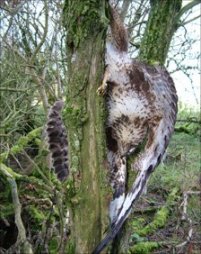 This case has been in the works for some time, first reported a year ago and then delayed for legal technicalities (see here, here and here). Sentencing for his latest conviction has been deferred for background reports and will take place in early January. We will watch with great interest.
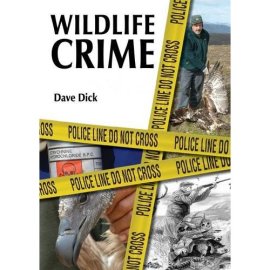 Watch out for this new book in the new year – it’s written by one of our regular contributors and will no doubt become a ‘must-read’ for many who follow this blog. The book will be released on 31 January 2012 but is available for pre-order now (check out the online book sellers).
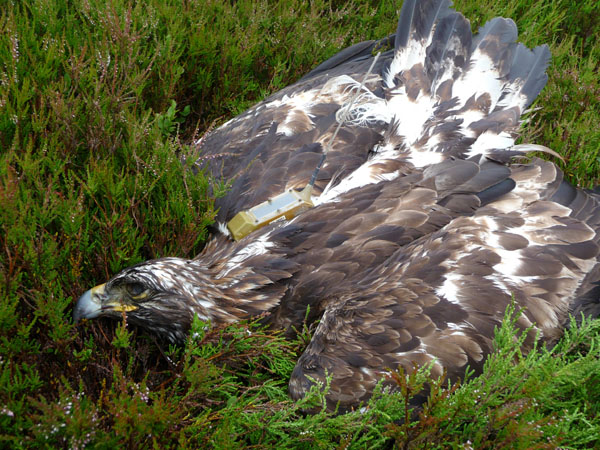 An article in today’s Telegraph reports that Millden Estate, where golden eagle ‘Alma’ was found poisoned in 2009, is no longer up for sale. The estate, owned by investment banker Richard Hanson, was reportedly put on the market earlier this year (see
 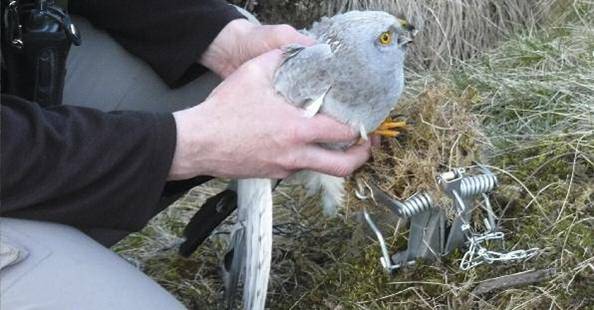 In the November 2011 edition of Birdwatch magazine, Mark Avery calls for our views about hen harriers and grouse moors. He says that if we send our views to the Birdwatch editor, they’ll be summarised and sent to a range of organisations including the Moorland Association, the Game and Wildlife Conservation Trust, the RSPB and the Scottish Raptor Study Groups.
 The Scottish Environment Minister, Stewart Stevenson MSP, has confirmed that the Scottish government will consult on extending the powers of the SSPCA in relation to the investigation of wildlife crime. The consultation is planned to begin in the first half of 2012, a year after it was first agreed to.
 Is it just us, or is anyone else curious about the deafening silence of landowner and gamekeeper organisations following last week’s report about the discovery of poisoned bait on Glenlochy Estate (see
 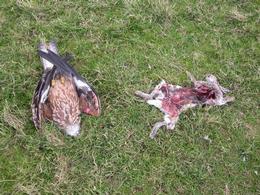 The Irish Times is reporting that three more dead red kites have been discovered near Lusk, North County Dublin. They are suspected to have been poisoned, although post-mortem results are not yet available.
