Blog

Fund-raising sky dive by OneKind investigator – please support him!

We have received the following message from a member of the  investigations team at the Scottish charity OneKind. You may recall OneKind was instrumental in catching criminal gamekeeper Lewis Whitham placing a poisoned bait on Leadhills Estate last year. ‘Steve’ is undertaking a charity sky dive at the end of August to raise funds for field equipment and also to raise awareness about the on-going illegal raptor persecution in this country. Please support him!

Hi, Thank you for this valuable site. Nothing compares to it on the web and is a reminder, if ever some of us need it, to the true and serious problem that we have in Scotland as to the persecution of birds of prey. My investigations and research over recent years has lead me to areas of Scotland where I have not only come across poisoned and shot raptors, but I have even witnessed a gamekeeper setting out carbofurin onto a rabbit in an area where raptors fly.

At every opportunity we must remind the general public that reports of incidents involving raptor persecution are only the tip of the iceburg. Crimes against birds of prey are almost always carried out in isolated areas where the public rarely walk and it is often only chance that these poisoned or shot birds are discovered. For every raptor I hear killed then I times that by ten for those that the perpetrator of these serious crimes takes away, burns, buries or are lost amongst the heather or within the woodlands.

At the end of August I am doing a fund raising skydive to raise funds for the investigations department at the Edinburgh animal charity OneKind and also to highlight the serious problems that we have in Scotland of raptor persecution. Please could I use this opportunity to give you the link to my skydive fund raising page. Anything that people could donate would go directly to obtain equipment to help me keep one step ahead of those that I investigate. Many thanks“.

Please sponsor ‘Steve’ here and read about the equipment he hopes your sponsorship money will buy.

Mull’s sea eagles bring in £5 million per year to local economy

We often hear from the grouse-shooting crowd about the economic value of their ‘sport’, and they use this argument a lot to justify their demands to be allowed to kill protected raptors. What they don’t seem to understand is (a) the general public’s fondness for our magnificent birds of prey and (b) what a financial trick they’re missing by not buying in to this public interest and providing raptor-viewing facilities and associated activities.

A new report has just revealed how the economic benefits delivered by the Isle of Mull’s white-tailed eagle project has tripled in just five years. These eagles bring in at least £5 million to the local economy every year, up from £1.4 million in 2005, according to an independent study by the Progressive Partnership. In addition, tourism generated by the birds supports the equivalent of 110 full-time jobs. The calculations were based on a survey of more than 1,200 people who visited the island in 2010. Almost a quarter of them said the eagles were an important factor in them choosing Mull as a destination.

The Scottish government has estimated that wildlife tourism is now worth £276 million per year to the country’s economy, supporting 2,763 jobs in the sector.

Interesting. Do you think these wildlife tourists would be happier to visit Scottish estates where raptors have been found poisoned, or Scottish estates known to be proactively involved with raptor conservation?

BBC news story here

More on convicted Derbyshire gamekeeper Glenn Brown’s case

It was good to see so much media coverage following the conviction of criminal gamekeeper Glenn Brown on Monday. It made local, regional, national and international news, probably because he committed his crimes on National Trust property – which isn’t somewhere you’d normally expect to hear about wildlife crime taking place. Let’s hope that the National Trust are reviewing the lease of their land to the ‘un-named third party’ as we speak.

Despite the broad media coverage, very few articles mentioned the dead sparrowhawk that was found close to one of the traps that criminal gamekeeper Glenn Brown was operating.  Also found close by was the body of a white pigeon. Mark Thomas, one of the RSPB investigators involved with catching Brown at it, has written an excellent little piece about the investigation here, alluding to what might have happened to the dead sparrowhawk and dead pigeon.

Thomas also writes that since 2006, goshawk and peregrine productivity in the Derwent Valley has collapsed. By coincidence, gamekeeper Brown is reported to have been employed as a gamekeeper since 2006. Amazing.

Thomas and his colleagues from the RSPB Investigations team deserve a great deal of credit, especially for the innovative techniques they used to catch Brown. So too does Derbyshire Constabulary and the CPS. The resulting punishment for Brown, convicted of seven offences – 100 hours community service – delivered by District Judge Caroline Goulborn (famed for the recent cat-in-the-bin-case) is pathetic, especially when you consider the sentencing options available, which include fines up to £5,000 and a six month prison term for each offence. Had Brown not been ordered to pay £10,000 costs, some might have concluded that he had got off very lightly. Depending on who pays for these costs, and whether he keeps his job as a gamekeeper, some may be certain he got off lightly.

Derbyshire gamekeeper guilty of using illegal trap

The long-running trial that began over two months ago against Derbyshire gamekeeper Glenn Brown concluded today, and he was found guilty of using an illegal trap to try and catch birds of prey on the National Trust’s Howden Moor in the Peak District. The court heard that he was interested in protecting the grouse where he worked. The trial began on 11 April 2011 at Chesterfield Magistrates Court.

Brown was caught after RSPB investigators installed covert cameras overlooking a trap and filmed him over a period of time visiting the trap. He was unlawfully using a pigeon as a lure bird – this is illegal and is an indication that birds of prey were the target species he was trying to catch. He operated traps on land in the Upper Derwent Valley owned by the National Trust but leased by another party between 14 April and 25 May 2010.

Brown was found guilty of seven offences under the Wildlife & Countryside Act 1981 and the Animal Welfare Act 2010.

He was given 100 hours community service and ordered to pay £10,000 costs.

BBC news story here including video

More on this story later. Congratulations to the RSPB investigators for catching another criminal gamekeeper at it, and to Derbyshire Police and the Crown Prosecution Service for seeing the case through to trial. In the BBC news video, it is reported that Brown is the 100th gamekeeper to be convicted of crimes against birds of prey. So, Alex Hogg, Chairman of the Scottish Gamekeeper’s Association, still think it’s “unfair to accuse gamekeepers of wildlife crime“?

Suspected poisoning of buzzard found dead in Wester Ross

According to the Ross-shire Journal 20 May 2011, Northern Constabulary are investigating the possible poisoning of a buzzard found dead in May. Discovered by a dog-walker near Dundonnell, Wester Ross on 14 May 2011, the carcass was covered in dead insects. Dead insects on a carcass are often an indication of the presence of a poisonous substance. The buzzard has been sent for toxic analysis.

Thanks to the contributor who sent this in.

Nesting buzzard shot dead in Hertfordshire

Police in Hertfordshire have launched an investigation after a nesting buzzard died after being shot with a shotgun. Full story here

Poisoned golden eagle at Glen Orchy – two years on…

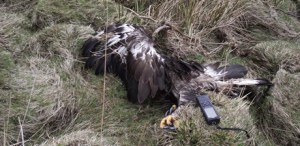
Two years ago today, this dead golden eagle was discovered by hill walkers in Glen Orchy, Argyll. Government tests later showed it had been poisoned by the illegal pesticide Carbofuran. This poisoning incident made the national press (e.g. here).

Several days later, a multi-agency search was conducted in and around Glen Orchy. The police-led operation included the Oban Community Policing Team, specialist wildlife crime officers from three police forces (Strathclyde, Lothian & Borders and Central), experts from the National Wildlife Crime Unit, pesticide experts from the Scottish Government and representatives from the RSPB and Scottish SPCA. The police said afterwards that they were following a positive line of inquiry.

Meanwhile, during the police search two handguns were found in gamekeeper Tom McKellar’s loft. Eighteen months later in December 2010, McKellar was convicted at the High Court in Glasgow for having prohibited weapons. However, he avoided the usual mandatory five year custodial sentence and instead received 300 hours community service. Story here

So what happened to that ‘positive line of inquiry’ in the eagle poisoning investigation? Good question.

Bird boycott

Here is a letter that was published in today’s edition of The Scotsman:

I recently had another holiday in Scotland – my third visit this year – principally to do bird and wildlife watching.

Like many others I have always wanted to go bird watching in Malta and Cyprus, but have boycotted these islands on principal because of their hunting and persecution of birds.

On each visit to Scotland I learn of more illegal poisoning and persecution of raptors – including a major tourist attraction, the iconic golden eagle.

I am beginning to think that my patronage of your tourist industry is somewhat hypocritical in view of my stance on the European countries I mentioned.

It appears that wildlife crime detection is grossly underfunded and that penalties are woefully inadequate.

What good is a fine of a few thousand pounds to a gamekeeper whose multi-millionaire lord and master will pay the fine anyway?

I think a universal boycott by wildlide enthusiasts would be damaging to the economies of Scotland, and I implore the Scottish Government to make a concerted effort to stamp out these crimes.”

P. Bateson, Halifax.

The Scotsman letter here

‘Unfair to accuse gamekeepers of wildlife crime’, says gamekeeper Alex

In an article published in The Courier on 30 May 2011, Ian Thomson, an investigator for the RSPB, expressed his concern about the high number of wild birds illegally killed in Tayside. 14 incidents were recorded there between March 2010 and March 2011.  In the same article, it is reported that PC Bryan Prestwood, a wildlife crime officer based in Angus, ‘believes the biggest problem is with gamekeepers and land managers’. Full article here

In an angry response published on 6 June 2011, Alex Hogg suggested it was ‘unfair to accuse gamekeepers of wildlife crime’. His letter here

I think people will make up their own minds Alex, based on the factual evidence and government statistics. You’ve even said yourself, on many occasions, that if gamekeepers were to be given licences to kill protected raptors then illegal raptor poisoning would stop. This notion was also repeated last week by David Hendry of Cardney Estate in his BBC 2 Landward interview. Quite a strange prophecy from a ‘profession’ that claims not to be involved with wildlife crime, don’t you think?

For those still in any doubt whether some gamekeepers are involved in willdife crime, and specifically raptor persecution, here’s a link to a piece we wrote on the issue last year, including some revealing statistics provided by the RSPB. Here’s a link to another piece we wrote last year, with the most recently-published RSPB statistics. These show clearly that 85% of people who were convicted of illegally killing birds of prey between 2003-2008 were gamekeepers!