Blog

It’s oh so quiet

Is it just us, or is anyone else curious about the deafening silence of landowner and gamekeeper organisations following last week’s report about the discovery of poisoned bait on Glenlochy Estate (see here)?

For two organisations (Scottish Land and Estates and Scottish Gamekeepers Association) who have been making (welcome) press statements about their condemnation of criminal raptor persecution, and their desire to ‘stamp it out’ of their industry, it seems a bit of a missed opportunity. We wonder whether Glenlochy Estate is a member of the SLE? We wonder whether any Glenlochy Estate gamekeepers are members of the SGA? We don’t know, because neither group publishes their membership lists for public scrutiny. And to be fair, neither group is obliged to publish that information, but you’d think that in light of the recent discovery, which isn’t the first for this particular area (see here), these groups would want to grab every opportunity available to publicly distance themselves from what appears to be another incident of alleged wildlife crime on a Scottish sporting estate. Wouldn’t you?

Scottish landowners take another side swipe at sea eagles

Sea eagles have been back in the news recently, with concerns raised about whether the newly-reintroduced eagles are able to ‘cope’ with their environment. The Scottish Land and Estates (SLE) organisation has used the media opportunity to take another side swipe at the reintroduction project.

A couple of weeks ago, the SSPCA reported that nine sea eagles had been rescued in the last year, and five of those were exhausted and weak after heavy rain (see here). The National Farmer’s Union (Scotland) were quick to criticise the East Scotland sea eagle reintroduction project, saying that the east coast reintroduction is an RSPB-led ‘forced expansion’ that is ‘backfiring’. They go on to say: “The birds are clearly struggling to cope with the combination of bad weather and the environment” (see here). An interesting perspective, given that the environmental conditions in Norway (where the young eagles were born) are comparable with the environmental conditions in Scotland where they are released (see here) and that the west Scotland sea eagle reintroduction project (in an area that endures a higher rainfall than east Scotland) has proved a resounding success with over 50 known breeding eagle pairs taking up residence. Yes, of course the issue of nine rescued sea eagles is of concern, especially in such a small population that is still recovering from the effects of persecution, but, is it any different to ‘natural’ levels of young sea eagle mortality?

Meanwhile, Scottish Land and Estates has published a press release about it all, initially focusing on the welfare issue but quickly moving on to the “impact that these released predators are having on game birds” [they don’t provide any supporting evidence for this ‘impact’], “and the potential risk there is to the poultry industry within this area“. They go on to say that Doug McAdam (CEO) tried to join the Sea Eagle Project Team but his request was turned down. He said: “An opportunity to bring some transparency and to give a voice for local business concerns was missed“.

We’re really pleased that Mr McAdam has raised the issue of transparency – this word will feature in our next post…

Scottish Land and Estates press release here

RSPB blog about East Scotland Sea Eagle Project here

three more dead red kites in Ireland suspected to have been poisoned

The Irish Times is reporting that three more dead red kites have been discovered near Lusk, North County Dublin. They are suspected to have been poisoned, although post-mortem results are not yet available.

The article does not say when these dead kites were discovered.

Read the article in the Irish Times here

Things to do list #1

Recognising that the criminal persecution of raptors in Scotland shows little sign of ending, the Scottish Parliament voted in March this year to introduce the offence of vicarious liability as part of the Wildlife and Natural Environment (Scotland) Act 2011 (see here and here). Basically, this will allow prosecutors to take action against the landowner and/or sporting tenant, and not just an individual gamekeeper, when persecution incidents are detected. Whether this will be effective or not remains to be seen; if the landowner/sporting tenant can demonstrate that he/she knew nothing about the persecution and can show that steps were taken to try and prevent it from happening on their estate, then they will have a viable defence. Once the WANE Act is commenced in full, it won’t be long before the effectiveness of vicarious liability will be tested. At least we’ve got something to work with and by voting to accept this new legislation, the Scottish Parliament has acknowledged that the problem still exists.

Unfortunately, the same opportunity is not available in England. Earlier this year, we reported on the Defra Minister’s response to a request for the introduction of vicarious liability in England. You can read MP Richard Benyon’s response here, where he suggests that vicarious liability is not required and that he applauded gamekeepers for their wonderful work!

Well, now there just may be an opportunity to bypass Richard Benyon’s incredible lack of foresight and have the issue debated in the House of Commons. A new e-petition website has been provided by HM government, whereby ordinary members of the British public can start an e-petition on a topic of their choice (within the bounds of decency!). If after 12 months their e-petition has attracted at least 100,000 signatures, then the issue becomes eligible as a topic for debate in the House of Commons.

Yesterday, a new e-petition was established to introduce the offence of vicarious liability for raptor persecution in England. If you are a UK citizen, you can help support this effort by signing the petition online. Your personal details are not publicised and the whole process takes less than a minute. If you care about the ongoing illegal persecution of raptors in England, here’s your chance to add your voice and it won’t cost you a penny. Please also share this post with your friends, family and colleagues.

Please sign the e-petition here

The mysterious case of the Inverinate Estate gamekeeper’s trial

Way back in March 2011, the case against Inverinate Estate gamekeeper, Andrew Malcolm Slaughter, opened at Inverness Sheriff Court. He was reported to be facing charges under the Wildlife & Countryside Act, the Animal Health & Welfare (Scotland) Act and the Agriculture (Scotland) Act (see here).

Over the next eight months, five different court dates for this trial have been and gone (see here). Today was the 6th court date and we were expecting the case to be concluded one way or another. Well, it was and it wasn’t. Apparently, this case has been ‘deserted pro loco et tempore’. We are told that this means the case is finished as far as this court is concerned, but that the Procurator Fiscal may raise it again in the future. No explanation has been given for this decision.

A satisfactory outcome?

By pure coincidence, Alex Salmond MSP (the current First Minister of Scotland), on a recent trip to Dubai earlier this month, met the son of the man believed (but not confirmed) to be the Inverinate Estate owner (the son happens to be the Deputy ruler of Dubai), “to discuss opportunities to strengthen links between the two nations” (see here). What an amazingly small world.

WANE Act 2011 will not commence in full until January 2013

For those of us who had hoped to see the full commencement of the Wildlife and Natural Environment (Scotland) Act 2011 in the near future, prepare to be disappointed.

Last Thursday (10th November), the following took place in the Scottish Parliament:

Elaine Murray (Dumfriesshire) (Scottish Labour): To ask the Scottish Executive when the Wildlife and Natural Environment (Scotland) Act 2011 will be commenced in full.

Stewart Stevenson (Environment Minister): It is planned that all of the provisions of the Wildlife and Natural Environment (Scotland) Act 2011 will be in force in January 2013.

Some of the new provisions created by the Act are already in place (e.g. muirburn season) and we now know that some of the snaring legislation will commence in January 2012 (see the link below to parliamentary questions and answers). However, it is not yet clear whether the new provision of vicarious liability will be introduced prior to January 2013, but given the above statement by Stewart Stevenson, there is now a nice little get-out clause for it to be delayed for over a year if neccessary.

Once again we can thank Elaine Murray MSP for raising pertinent questions. Her later questions (see link below) are also well worth a read, as she tackles the issue of whether the organisations providing training courses for snare operators are actually accredited to do so.

Read the parliamentary questions and answers here

Read the Wildlife and Natural Environment (Scotland) Act 2011 here

Lessons in eagle ecology part 2

Hot off the press from the team who brought you Eagles Could Eat Children (see here), this month’s lesson is all about Why Eagles Don’t Nest on Grouse Moors.

Contrary to the endless scientific papers that show unequivocally that eagles (and lots of other raptor species) are absent from many upland grouse moor areas in the UK due to high levels of persecution, the Scottish Gamekeepers Association has today informed us of the real reason they’re absent:

Many grouse moors do not have the isolated nesting habitat which is required by eagles so it should come as no surprise they don’t nest there“.

Strange then, that there are ‘many’ (see quote below) unoccupied eagle nesting territories in Scotland where eagles are known to have bred historically, and that these old nest sites just happen to be on land that is managed for red grouse shooting! Here’s a quote from the Golden Eagle Conservation Framework Report that was published by Scottish Natural Heritage in 2008 (available here) –

The most serious failures to meet favourable conservation status tests were in Natural Heritage Zones in the central and eastern Highlands where less than half of all known territories were occupied. Based on the production of young golden eagles, the populations in these regions should be expanding markedly, but instead they continue to decline (there was a loss of 15 occupied territories between 1992 and 2003, and 86 vacant territories by 2003). This indicates, in the absence of any evidence for emigration, that survival of subadult and/or adult birds is low“.

It’s also strange that before the sentence about ‘many grouse moors do not have the isolated nesting habitat required by eagles’, the SGA tells us this: “A large portion of all eagles fledging takes place on grouse moors across Scotland“. Eh? How can that be, if the habitat ‘isn’t there’?

The SGA article continues with some name-calling (and this from the group who have recently complained to the Scottish Government about how they were being portrayed!) and then some partly-accurate but mostly inaccurate information about siblicide amongst eaglets, before getting in another dig at the Irish Golden Eagle Reintroduction Project (yawn). This all builds up to a grand finale where we’re told:

If you were to read all the media reports you could be forgiven for thinking that raptors only breed safely on reserves. The truth is there are possibly 500’000 raptors in the UK and 350’000 of them will be breeding successfully on land used for game sport shooting of some kind. This fact is completely ignored by those attempting to take the moral high ground“.

Hmm, I’d be really interested to see the data that this “fact” is based upon. Especially in light of the recently published scientific paper (see here) that shows, again unequivocally, that peregrines nesting on grouse moors in northern England are 50% less successful than peregrines that breed on non-grouse moor habitat.

Interestingly, the SGA article makes no comment about the poisoned buzzard and poisoned bait that was found on Glenlochy Estate and was reported in the media two days ago (see here). The SGA wouldn’t be trying to deflect attention from yet another disgusting and illegal poisoning incident, would they?

SGA article here

Poisoned buzzard found near poisoned bait on Glenlochy Moor

Northern Constabulary has today issued a warning to dog walkers in the Strathspey area after a distressed buzzard was found near a poisoned bait on Glenlochy Moor. The buzzard and grouse bait were found in late September in the Haughs area above Cromdale, and the bait was sent for toxicology testing. The results showed that it had been laced with the banned pesticide Aldicarb. The buzzard apparently recovered and was later released.

This is not the first time poisoned baits and birds have been discovered in this area, which is well known for its driven red grouse moors. Some previous incidents include (but are not limited to) the discovery of a poisoned buzzard and a red kite in 2005 – they had been killed by the banned pesticide Carbofuran. No charges were brought (see here). In 2008, a high-profile police raid was carried out on Glenlochy Moor after the discovery of poisoned buzzards and red kites, and poisoned baits (see here). No charges were brought. In May this year, a poisoned buzzard was discovered in the nearby area – it had been killed by Carbofuran and Aldicarb (see here). We are not aware of any charges being brought. And now this latest incident in September 2011. Hmmm. Anyone else seeing a pattern?

Northern Constabulary are to be congratulated for (a) releasing a press release to warn the general public in the area of the dangers of these lethal pesticides and (b) naming the estate where the poison was found. This is a great improvement on some of their recent responses to alleged persecution incidents in their region. However, an earlier press release would have been better, even if they just suspected that poison was present – rather than waiting for six weeks before the test results came back. West Yorkshire police managed to do it earlier this year (see here) – it should be standard practice for all police forces, unless of course they intend to launch an imminent police raid and don’t want to alert the suspects. Nevertheless, we still do applaud this action by Northern Constabulary and welcome their increased interest in illegal raptor persecution in their area. Well done.

Northern Constabulary press release here

BBC News article here

Poisoning by numbers

Last week the RSPB published its annual UK-wide report on raptor persecution (Birdcrime 2010, see here). We said we’d comment on the report once we’d had a chance to read it. Others chose to comment on the day of its release, or to be more accurate, their commentary was probably written prior to the release and was probably based on the content of the RSPB’s press release, rather than on the actual report’s content (see here).

Birdcrime 2010 held few surprises for many of us. The report carried details of raptor persecution incidents (confirmed, probable and possible) that had been reported throughout 2010, so by not publishing the report until November 2011, many of the items could be considered ‘old news’ (or at least those incidents that had been previously reported in the media – as usual, there were several incidents recorded in this report that were not made public at the time they occurred). That’s not to say the report has no value – it is an immensely important document because it is still the only publication to collate these national statistics in one place. It would just be more useful if it could be published at the beginning of the following year to which the report relates, rather than at the end of the following year, but limited RSPB staff resources may prevent this.

One advantage of publishing the report so late is that information can be provided on the outcome of criminal proceedings for those persecution incidents that actually made it to court. For example, the report provides some previously unpublished information about the trial of gamekeeper Glenn Brown, who was found guilty in June 2011 of operating an illegal trap to take birds of prey (amongst other crimes) on Howden Moor in the Peak District in April and May 2010 (see here, here and here). According to Birdcrime 2010, Judge Caroline Goulbourn “ruled that she viewed the attack on the integrity of the RSPB investigations staff by Bertie Woodcock QC on behalf of Knights Solicitors as an aggravating factor in the case. In addition, she criticised Brown’s employer, Geoff Eyre, who leases Howden Moor from the National Trust, for being evasive and reluctant to answer questions” [Birdcrime 2010, p.17].

Incidentally, there is further detail about this case that has been written in the RSPB’s newsletter, Legal Eagle 65. On page 2 the following has been written: “During the ten day trial, the prosecution relied on expert evidence including Prof Ian Newton, Dr Mick Marquiss, Stewart Scull, Dr Alisdair Wood and Guda van der Burght. The defence case, led by Bertie Woodcock QC, centred on the fact that Brown was not using the trap and the entire investigation was a set up with RSPB officers acting in bad faith throughout”. It’s good to see that Judge Goulbourn ruled against this, although what will happen at Brown’s impending appeal remains to be seen. Legal Eagle 65 reports that this appeal “is expected to take place in 2012”.

In addition to the case studies of earlier persecution incidents, Birdcrime 2010 reports that annual poisoning figures were down from 2009 (128 reported poisoning incidents in 2010, compared to 153 in 2009). It also reports that the 2010 figure is below the average for the last five years (2005-2009 average of 150 incidents). Unsurprisingly, it is this aspect that has been picked up on by the game-shooting lobby (e.g. see here). There has also been much made in the media this year about the ‘low’ poisoning figures for 2011 (e.g. see here) – although the published figures only relate to the first half of 2011; figures from June 2011 onwards are not yet available. So is this a sign of progress, as many of the game-shooting lobby would have us believe, or is it indicative of something else? For example, the lower figures could well be an indication that the gamekeepers have finally seen the light and have decreased their poisoning efforts. On the other hand, it could be an indication that gamekeepers are either (a) getting better at hiding their crimes, (b) switching to other persecution methods such as shooting, which is less likely to be detected, or (c) reporting efforts by the authorities have fallen. At this point I don’t think that either ‘side’ can claim a ‘victory’ in the on-going war of words. It is far too early to tell. For example, if you look at the graph that was published in the RSPB’s earlier report, The Illegal Killing of Birds of Prey in Scotland in 2010 (see here), then this reported decline in poisoning incidents can be seen in much clearer context. The graph I’m referring to appears on page 11 of that report and shows the number of confirmed poisoning incidents in Scotland from 1989-2010. The graph has been recreated for this post – see below (thanks to the contributor who sent it!).
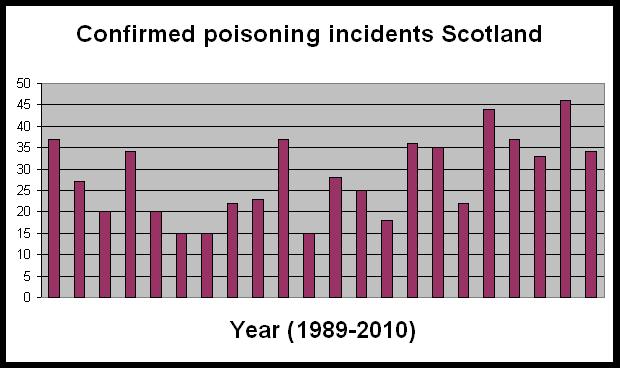
If you look closely at the graph, you will see a great deal of variation between years in the number of confirmed poisoning incidents. Of particular interest are the years 1994 and 1995 – in these two years, confirmed poisoning incidents dropped to a low of 15 from a previous high of 35+. However, if you then look at the following three years, the number of confirmed incidents steadily rose until they reached 35+ again. In 1999, the figure dropped again to 15, and from then until 2010, that figure has steadily risen and fallen, although never reaching the low of 15 again. So what does that tell us? I’m fairly sure that in the years 1994 and 1995, the game shooting lobby would have declared a ‘victory’ as the figures had dropped so much, and would have shouted from the hilltops that they’d changed their ways.  I’m also fairly sure that in the following three years when the figures rose again, the conservationists would have declared a ‘victory’ and pronounced that their claims of widespread persecution had been vindicated. Either way, it is clear that neither ‘side’ can draw conclusions just based on an annual figure; for a trend to be detected, we need to see long-term figures.

But do these figures actually provide the full picture? If you read the recent paper on historical persecution at Atholl Estate (see here), then it’s pretty obvious that the ‘official’ persecution figures are meaningless, in the sense that they don’t tell the whole story. And from a conservation perspective, the figures, whether accurate or not, are not really that important. To steal a line from the recent paper on peregrine persecution on grouse moors (see here), “….it is the population level impact that is important, rather than the number of confirmed persecution cases”. We now have peer-reviewed scientific studies that have shown how persecution on grouse moors is having a population level impact on several vulnerable species (golden eagle, hen harrier, red kite and now peregrine). We have yet to see any peer-reviewed scientific studies that can counter these findings and show that these species are NOT impacted by persecution on grouse moors at a population scale. Why do you think that is, and more to the point, what are our politicians going to do about the published findings, apart from telling us that the Scottish government’s support for grouse shooting “goes beyond words“? (see here). Let’s hope that support doesn’t go beyond action as well.

New study shows extent of peregrine persecution on grouse moors

A new study has just been published in the international scientific journal Biological Conservation. Following hot on the heels of earlier studies that have demonstrated how illegal persecution on UK upland grouse moors is affecting the conservation status of golden eagles, hen harriers, red kites and goshawks, the latest study shows the damage that this disgusting practice is having on a population of peregrines in northern England.

You need to be a subscriber to the journal Biological Conservation to access the full paper (or alternatively you can buy it [see link at foot of this post] or you can google the paper’s lead author, Dr Arjun Amar, to see if he’ll send you a free PDF for your own private use), but here is the published abstract:

Wildlife crime can be difficult to quantify, and its true impact on populations can be underestimated if rates are under-recorded. The illegal killing of birds of prey is an important form of wildlife crime, which in the UK, is often associated with land managed for the recreational shooting of red grouse Lagopus lagopus scoticus. In the UK, increases in peregrine falcons Falco peregrinus following recovery from organo-chlorine pesticides have not been uniform, with slow growth and localised declines in some areas, including those managed for red grouse shooting. In this study, we combined 1081 peregrine nest histories across northern England between 1980 and 2006 with a remotely sensed map of grouse moor management, to test whether breeding performance was lower in areas with active management for grouse shooting. Productivity of pairs on grouse moors was 50% lower than pairs breeding on non-grouse moor habitat. However, clutch size and brood size of successful nests did not differ between habitat types, suggesting that food constraints were unlikely to explain this difference. Population models suggested source-sink dynamics, with populations on grouse moors unable to sustain themselves without immigration. Population data confirmed that growth rates were indeed lower on grouse moors than on non-grouse moor sites. Analysis of wildlife crime data confirmed that persecution of the species was more frequent on grouse moors than in other habitat types. This population will be more secure, and better able to function as a barometer of environmental health and climate change, if illegal persecution of the species ceases on areas of land managed for grouse shooting.

Even more evidence then, yet again, that illegal persecution in the UK is so serious that it is having population-level impacts on several raptor species. I think we can be fairly sure that the game-shooting lobby will try to dismiss these latest findings, especially as the lead author was an RSPB scientist and his co-authors were members of the Northern England Raptor Forum. We await their response(s) with interest.

Full citation:

Amar et al. (2011). Linking nest histories, remotely sensed land use data and wildlife crime records to explore the impact of grouse moor management on peregrine falcon populations. Biological Conservation.

Link to on-line abstract here

RSPB press release on British Birds website here