Blog

More ‘extreme hairdressing’ as Highland grouse moors set alight

Last week, Scottish Land & Estates were warning of a high wildfire risk but said that ‘many grouse moors have already stopped their annual muirburn programme’ (here).

Here are two that haven’t yet stopped (they don’t have to stop until the muirburn season ends on 15 April). First up is Moy Estate – we’ve blogged about the grouse moor hairdressers on this estate a few times (see here and here). Last Saturday (8 April 2017) one of our blog readers took the following photographs:

Here is a series of unattended fires stretching for an estimated 4km.

The fires created a massive plume of toxic smoke, heading towards Nairn. Lucky Nairn residents, eh? You do have to wonder how this all fits in with Scotland meeting its climate change targets.

Meanwhile, a little further to the east on Dava Moor, close to Lochindorb, another blog reader took photos of more trees that had been cut and then burned:

The photographer mentioned that the area around Lochindorb was also being burned, right up to the shore, in gale force winds!

What’s interesting about Dava Moor is that it forms part of the designated Drynachan, Lochindorb and Dava Moor Special Landscape Area:

You really should read the assessment of this SLA – it’s quite something. It says the landscape here (predominantly intensively managed grouse moor) is ‘valued for its homogeneity, characterised by geometric muirburn patterns creating an abstract mosaic of colour and texture’ and there is a ‘strong sense of tranquility’. See pages 144-149: Assessment of Highland Special Landscape Areas

Strong sense of tranquility? Who writes this crap? It’s a barren, biodiversity-poor wasteland, ravaged by the ecological warfare waged against any species that might interfere with the overproduction of farmed red grouse for ‘sport’ shooting.

Buzzard, raven & crow shot in Brecon Beacons National Park

The RSPCA is appealing for information after the shooting of three birds in the Brecon Beacons National Park.

A member of the public discovered a dead raven and a dead buzzard near Pen-y-Cae on 5 April 2017. They were taken to the RSPCA’s Merthyr Tydfil clinic where x-rays revealed they had been shot with a pellet gun (x-ray image by RSPCA).

An injured crow was rescued but later euthanised due to its injuries.

Local residents have reported seeing an unusual white van parked in the area around 5 April.

Anyone with information is urged to contact the RSPCA Appeals Line, in confidence, Tel 0300-123-8018.

BBC news article here

ITV news article here

Vicarious liability prosecution: case dropped (Andrew Duncan, Newlands Estate)

Regular blog readers will know that we’ve been tracking the vicarious liability prosecution of landowner Andrew Walter Bryce Duncan, who was alleged to be vicariously liable for the crimes committed by gamekeeper William (Billy) Dick in April 2014.

Gamekeeper Dick was convicted in August 2015 of killing a buzzard on the Newlands Estate, Dumfriesshire by striking it with rocks and repeatedly stamping on it (see here). Mr Dick was sentenced in September 2015 and was given a £2000 fine (see here). Mr Dick appealed his conviction but this appeal was rejected on 15 July 2016 (see here).

Vicarious liability proceedings against Mr Duncan began in August 2015 and the case has been repeatedly adjourned since then (a total of 13 court hearings) with two trial dates assigned but then later dropped (see here). These repeated delays were due in part to Mr Dick’s appeal against his conviction but in part for other reasons which have not been explained.

The third trial date (24 April 2017) looked set to go ahead but today we’ve learned that the Crown Office & Procurator Fiscal Service has dropped all proceedings. We do not yet know why the prosecution has been dropped.

Whatever the reason for dropping the prosecution, this result does not reflect well on the efficiency of wildlife crime enforcement measures in Scotland.

Vicarious liability in relation to the persecution of raptors in Scotland (where one person may potentially be legally responsible for the criminal actions of another person working under their supervision) came in to effect over five years ago on 1st January 2012 as a provision in the Wildlife and Natural Environment (Scotland) Act 2011. It was introduced as an amendment to the draft WANE Bill in November 2010 by the then Scottish Environment Minister, Roseanna Cunningham. It was a direct response to the unrelenting problem of illegal raptor persecution and the apparent inability/unwillingness of the game shooting lobby to get their own house (grouse moors) in order.

To date there have only been two successful prosecutions/convictions: one in December 2014 (see here) and one in December 2015 (see here). Both related to raptor persecution on low ground shoots, not on intensively managed driven grouse moors. One further case in October 2015 did not reach the prosecution stage due, we believe, to the difficulties associated with identifying the management structure on the estate where the crimes were committed (see here). And now this latest case has failed, for reasons as yet unknown.

Two successful prosecutions in five years is not very impressive, and won’t be much of a deterrent for those who continue to kill raptors safe in the knowledge that the probability of being caught, prosecuted and convicted is still virtually nil.

GWCT’s 2017 Scottish Auction catalogue

The GWCT’s annual Scottish Auction fundraiser is set to take place at Prestonfield, Edinburgh on 4 May 2017. We’ve just been having a read of the auction catalogue. As ever, it’s quite an eye-opener. Have a look and see how many names you recognise: GWCT Scottish Auction 2017-Catalogue

As well as the auction lots, there’s a list of GWCT Scotland events for 2017 (see page 11). There’s an evening farm walk (to be followed by a BBQ) on June 14 2017 at Corsehope Estate.

Would that be the same Corsehope that is currently subject to a three year General Licence restriction (on Corsehope high ground) after the discovery of illegally-set traps during a Police raid in May 2014?

Fascinating.

Red kite shot in Hertfordshire

Hertfordshire police have issued the following appeal for information:

APPEAL FOR INFORMATION ABOUT SHOOTING OF RED KITE

7 April 2017

Police are appealing for witnesses and information after a wounded bird of prey was taken to a vet in Buntingford.

The Red Kite was spotted in Furneux Pelham, Buntingford, in distress and unable to fly. The vet concluded that the Kite had been shot and had suffered injuries which meant that it had to be put down.

Rural Operational Support Team Sergeant Jamie Bartlett said: “All wild birds are protected under the Wildlife & Countryside Act. As a bird of prey Red Kite persecution is monitored by DEFRA and the National Wildlife Crime Unit, as Raptor Persecution is a National Wildlife Crime Priority. Not only is this a serious criminal offence but, this female would have been ready to breed this season and its death will impact on the local Kite population.

If anyone has information about this incident or has seen people shooting or carrying hunting rifles in the area, please contact the Herts Police non-emergency number 101 quoting reference A2/17/197.”

ENDS

Killing red kites is de rigueur in Nidderdale AONB, North Yorkshire

Today the RSPB’s Investigations Team has published a blog focusing on red kite persecution in North Yorkshire.

Many of you will already know that North Yorkshire is consistently rated as the worst county in the UK for recorded raptor persecution crimes and in recent years there has been a steady report of illegally-killed or injured raptors, particularly red kites, being discovered in this region. (Photo: M Ruddock)

In fact in the last ten years (2007-2017), twenty six red kites have been confirmed as victims of illegal persecution in North Yorkshire (18 poisoned, 8 shot), and these are only the ones that have been found. How many other victims were there? (Graph: RSPB)

But North Yorkshire is a huge area and has two National Parks (Yorkshire Dales & North York Moors) as well as two designated Areas of Outstanding Natural Beauty (Howardian Hills & Nidderdale). When the average member of the public hears of a poisoned or shot kite being found in North Yorkshire, they probably think of it as a one off, random, & isolated killing. They’d be wrong.

The RSPB has created a map of where these confirmed red kite killings took place and it’s really quite obvious to see where red kite persecution is de rigueur; parts of the eastern side of the Yorkshire Dales National Park and parts of the Nidderdale AONB. Oh, and guess what the major land use is in these two areas? Intensively managed driven grouse moors. (Maps: RSPB)

Here is a closer view of the Nidderdale map, showing that 22 of the 26 red kite victims were killed here:

When you look at these maps it’s worth remembering that they are only showing confirmed incidents of red kite persecution. These maps do not include other confirmed crimes such as illegally-killed or injured buzzards, illegally-killed or injured hen harriers, illegally-killed or injured peregrines, illegally-killed or injured kestrels, illegally-killed or injured marsh harriers, poisoned baits, illegal poison caches, and illegally-set traps. Nor do they include ‘probable’ crimes against raptors, particularly ‘disappearing’ satellite-tagged raptors, especially hen harriers.

A couple of weeks ago, Police Superintendent Chris Hankinson (who leads the Raptor Persecution Priority Delivery Group in England & Wales) wrote a comment on this blog (here). He said that the RPPDG was ‘working towards publication of a national map showing raptor persecution incidents with the aim of triggering activity from the local police force and community who can assist with information and intelligence to capture those responsible‘.

With the greatest respect, Supt Hankinson, the national maps are already available and have been for years (thanks to the diligent recording work of RSPB Investigations staff and their annual BirdCrime reports) and yet there hasn’t been a single prosecution for red kite persecution in the Nidderdale AONB (or the whole of North Yorkshire) for over ten years. Stop wasting your time pandering to those organisations in the RPPDG ‘partnership’ who are probably contesting every single incident and get on with leading the group to the known hotspot areas. The Nidderdale AONB would be a good start.

UPDATE 16.51hrs: Meanwhile, local business owners are putting up their own money towards a reward to catch the kite killers. Great stuff – the local fight back is on. See article in Harrogate Advertiser here

Red kite shot dead near Toddington, Bedfordshire

Bedfordshire Police and the RSPB are appealing for information following the discovery of shot red kite in Bedfordshire.

A member of the public found the kite’s corpse at Daintry Wood near Toddington (unfortunately no date has been provided. UPDATE: corpse found 27 Feb 2017) and it was sent to ZSL for a post mortem where an x-ray revealed 10 pieces of lead shot lodged in its body, indicating it had probably been shot at close range.

Anyone with information is asked to call Bedfordshire Police on 101.

RSPB press release here

More evidence to be heard on gamebird licensing petition

You may recall last summer the Scottish Raptor Study Group (SRSG) submitted a petition to the Scottish Parliament’s Public Petitions Committee, calling for a state-regulated licensing system for all gamebird hunting in Scotland.

The Petitions Committee took evidence in October 2016 from the SRSG and RSPB Scotland (see here) and then evidence from the Scottish Moorland Group and BASC in December 2016 (see here) before deciding to pass the petition to the Environment, Climate Change & Land Reform (ECCLR) Committee for further consideration.

It’s interesting to note that since that first evidence session, petitioners Logan Steele, Andrea Hudspeth and Duncan Orr-Ewing (pictured above) from the SRSG have been singled out for some pretty nasty personal abuse on social media. No prizes for guessing who was behind this, or why. We really are dealing with a disgusting sector of society.

On 31 January 2017, the ECCLR Committee considered how to progress the petition and they wrote a letter to Environment Cabinet Secretary Roseanna Cunningham asking her (a) when the Government’s review of gamebird licensing in other European countries would be published and (b) what is her opinion of the effectiveness of other measures such as vicarious liability and general licence restrictions and whether the Government had any plans to review the current licensing regime.

Since that meeting, the Government’s gamebird licensing review has been published (see here) and the Cabinet Secretary has written to the ECCLR Committee outlining her thoughts on vicarious liability, general licence restrictions, firearms licensing, and her initial thoughts on the usefulness of introducing a state-regulated licensing system for gamebird hunting (see here).

The final paragraph of the Cabinet Secretary’s letter is worth highlighting here:

In conclusion, I would emphasise that our experience in this area is that there is no short cut to securing hard evidence of criminal behaviour. Changes to the law can only go so far, and always will need to be accompanied by effective, professional law enforcement. A licensing scheme may be a useful addition to the toolbox, but it will still depend on someone gathering evidence of wrong-doing in order to justify removal of a licence to operate a business‘.

She’s right to reiterate the importance of, and need for, effective law enforcement – it’s an issue we’ve been banging on about for years – without it, any new legislation would be worthless. But if she’s concerned about the lack of resources to collect evidence of criminality, then surely she need look no further than the current consultation to give increased investigatory powers to the SSPCA (see here).

In light of the publication of the Government’s gamebird licensing review, and the receipt of the Cab Sec’s letter, the ECCLR Committee had a brief discussion about the gamebird licensing petition during their meeting on 28 March 2017 (see page 21 of this transcript: ECCLR official report 28 March 2017 ).

The Committee has agreed to take evidence from the petitioner (the Scottish Raptor Study Group) and then evidence from a panel of stakeholders including RSPB Scotland, Scottish Gamekeepers’ Association, Scottish Land & Estates and SNH. We believe this evidence session will take place on Tuesday 18 April and we’ll add a link to the live proceedings nearer the time.

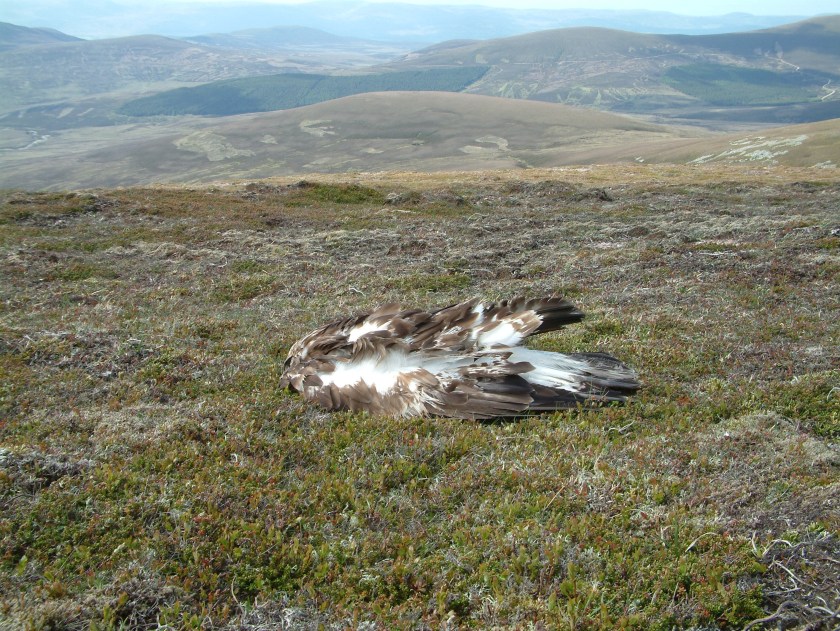
Police confirm RSPB staff did not have covered faces on estate search for missing eagle #338

For the benefit of those not on social media and who therefore may have missed this……

Further to yesterday’s blog (here) about the police search of North Glenbuchat Estate for missing golden eagle #338, Police Scotland has today stated that RSPB staff who assisted them on the search did NOT have covered faces (see twitter account of Ian Thomson, Head of RSPB Scotland Investigations, @Ian_M_Thomson).

So, the hysteria about ‘masked RSPB thugs’, ‘masked intruders’, and accusations that the RSPB is behaving like a ‘balaclava-clad paramilitary outfit’, whipped up by the likes of Bert Burnett (Scottish Gamekeepers’ Association) and other senior representatives of the game-shooting industry, was simply another failed attempt to distort the facts and create a diversion so that the focus of frequently ‘disappearing’ satellite-tagged eagles on grouse moors didn’t get the attention it merits.

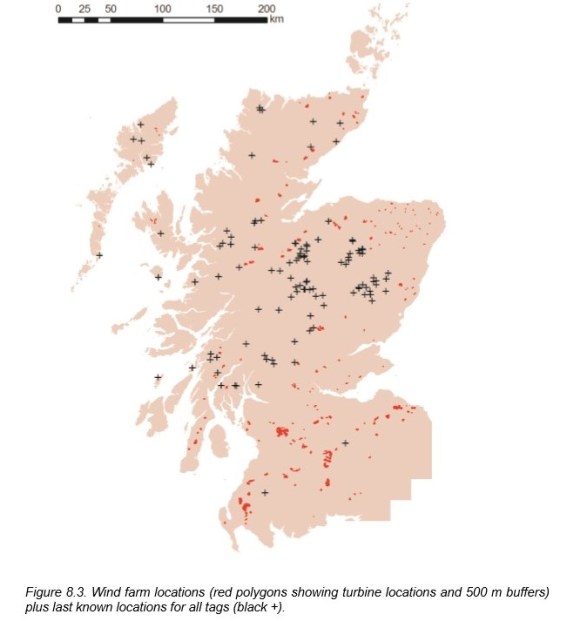
We can expect more of this, in the run up to the publication of the forthcoming raptor satellite-tag review. The net is closing in on those within the game-shooting industry who continue to kill raptors, and they know it.

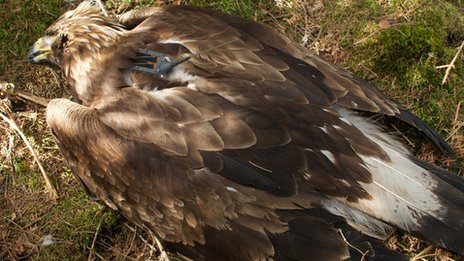
Photo of golden eagle #338 copyright Scottish Raptor Study Group


More on ‘missing’ golden eagle #338, North Glenbuchat Estate

On Saturday 1 April 2017, we blogged about a satellite-tagged golden eagle (#338) that the RSPB reported had ‘disappeared’ after its last sat tag signal pinged in from the North Glenbuchat Estate in the Cairngorms National Park in early March (see here).

The estate, via PR company Media House, issued a robust statement in response and posted a video clip of a young eagle, purportedly filmed on the estate on 30 March, that the estate’s head gamekeeper “firmly believed” to be golden eagle #338.

We commented at the time that the video footage was very poor quality and it was difficult to see whether the eagle in the video was even carrying a satellite tag. We also pointed out that other sat-tagged golden eagles are currently flying around Scotland so even if this eagle in the video was carrying a tag, it would have been virtually impossible for the head gamekeeper to know whether it was eagle #338 or one of the others.

Since then, various expert field ornithologists both in the UK and the USA, all of whom specialise in golden eagles, have contacted us about the video. All of them said that although the video quality was poor, the plumage characteristics of the eagle in the video were not consistent with that of a nine-month old male golden eagle, but appeared to be consistent with what they’d expect of a second year female golden eagle.

On Sunday 2 April 2017, Media House issued another press statement on behalf of North Glenbuchat Estate and published a second video, purportedly of eagle #338, filmed on the estate on Saturday 1 April 2017. The quality of this second video is even worse than the first video (you could be looking at a flying cabbage) so it’s not much use as the supplementary evidence it was clearly intended to be.

The text of this second press release via Media House is well worth a read: North Glenbuchat Estate press release_2

In it, Media House states that the RSPB staff who were involved in the police search of the estate last week (at the invitation of Police Scotland – good, partnership working) “were hooded and kept their faces covered“.

This sentence has been widely abused by the nasty brigade on social media and has been turned into phrases such as ‘Masked intruders‘, ‘Masked RSPB thugs‘ and ‘RSPB representatives conducting themselves like hunt saboteurs wearing intimidating hoods and masks‘. Doubtless spurred on by the following inflammatory commentary from Bert Burnett (Scottish Gamekeepers’ Association) on his facebook page:

So yet again, the focus of attention is dragged away from the issue at hand (the disappearance of yet another satellite-tagged raptor on a grouse moor) and moved on to the usual anti-RSPB rhetoric in an attempt to discredit anybody or anything that might point to on-going concerns about the frequency with which satellite-tagged raptors seem to ‘disappear’ in areas where intensive grouse moor management takes place.

This abuse of the RSPB is nothing new, of course, but it’s interesting that the false claims about the efficiency of satellite tags, the false claims that the RSPB does not follow PAW raptor protocols, and the attempted denigration of raptor workers and those who fit these satellite tags, has been extremely prevalent since August last year when the Cabinet Secretary announced her decision to undertake an independent review of raptor satellite tag data. The abuse will no doubt have not gone unnoticed by the Scottish Government.

But back to the missing golden eagle #338. As we’ve been writing this blog, a very interesting map has appeared on Twitter (see @Ian_M_Thomson). It’s a map showing the recent movements of three other satellite-tagged golden eagles around Glenbuchat in March – April 2017:

Clear evidence that the eagle filmed by the head gamekeeper could have been any one of these other eagles so his “firm belief” that he was filming eagle #338 may have been his genuine belief but in fact is nothing more than hopeful optimism.

Nice try, but no cigar.

Meanwhile, the satellite tag signal from golden eagle #338 remains silent.

UPDATE 5 April 2017 14.38hrs: Ian Thomson (Head of RSPB Investigations Scotland) has just tweeted the following:

@Ian_M_Thomson: ‘Regarding missing eagle #338, Police Scotland has provided clarification to @PAWScotland partners that have contacted them that @RSPBScotland staff assisting them on a search in Glenbuchat last week did NOT have covered faces. We look forward to @PAWScotland partners disseminating this information to their memberships’

UPDATE 31 May 2017: North Glenbuchat Estate identified in Government-commissioned report as one of several hotspots where satellite-tagged golden eagles have regularly ‘disappeared’ in suspicious circumstances (here).