Blog

Nature conservation, Botham style

Thanks to Mr Carbo for submitting this cartoon in response to King of Bollocks Ian Botham’s idiotic suggestion that gamekeepers should be put in charge of RSPB reserves.

You might also want to check out these two letters published today in The Herald.

Barn owl with horrific injuries found in North Yorkshire

A barn owl with horrific injuries has been found near Marishes in the Ryedale district of North Yorkshire.

According to expert raptor rehabilitator Jean Thorpe, the barn owl was found close to death. It had suffered two broken legs and its injuries were consistent with having been caught in a spring trap. Jean believes the owl had been released from the trap and then left to die a lingering death, unable to hunt with badly infected wounds.

The owl was taken to Jean’s wildlife centre but died shortly after arrival.

This area is a notorious raptor persecution blackspot. Spring traps are only legal if they are set within either a natural or artifical tunnel to prevent non-target species getting caught in the trap’s jaws.

Anybody with any information about this horrific case please contact Wildlife Police Officer Jez Walmsley at Malton Police Station (Tel: 101).

Photos by Jean Thorpe. Map by RPUK.

More shot pheasants dumped, West Yorkshire this time

Our marvellous ‘guardians of the countryside’ have been at it again, this time in West Yorkshire.

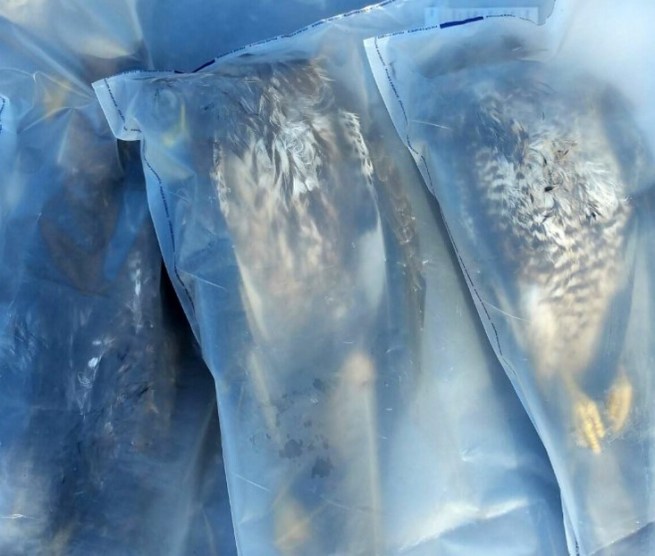
Thanks to the blog reader who sent in these photos of shot dumped pheasants and red-legged partridge, found by a dog walker in Micklefield, West Yorkshire at the weekend.

Even though this is against the Code of Good Shooting Practice (“shoot managers must ensure they have appropriate arrangements in place for the sale or consumption of the anticipated bag in advance of all shoot days“), this dumping of gamebirds is becoming quite common, even in some of our National Parks e.g. see hereherehereherehere, here).

We can expect to see a lot more of it in the future as the game shooting industry struggles to get shot birds in to the human food chain and yet still releases in to the countryside an estimated 50 million non-native gamebirds every year, just to be shot for fun. As the industry is largely unregulated, there is no sign of this number being reduced, either volunatarily or via legislation (see here).

Meanwhile a pile of dead ducks was recently discovered dumped on Anglesey, North Wales. A local councillor out cycling with his young children described it as “wildlife carnage“. North Wales Police Rural Taskforce is currently investigating this case.

SNH indifferent to potential disease epidemic on Scottish grouse moors

Late last year we blogged about the significant spread of disease on intensively-managed driven grouse moors in northern England (see here) following the publication of two scientific research papers from the GWCT.

The disease, respiratory cryptosporidiosis (also known as ‘Bulgy Eye’) has been, until recently, almost entirely associated with captive poultry flocks that have been kept at high density, usually for breeding purposes. It was first detected in wild red grouse in 2010 and since then has spread rapidly, via communal medicated grit trays, and by 2015 had affected high density red grouse on half of the 150 grouse moors in northern England. This disease has the potential to damage shoot economics but more importantly, there are welfare issues and conservation concerns, especially the threat of cross-infection to other species inhabiting the same moors.

Photo: Medicated grit trays, contaminated with grouse faeces, act as reservoirs for disease transmission (Ruth Tingay)

We mentioned in our earlier blog on this subject that the rapid spread of this disease had been well-documented on grouse moors across northern England but information about how far it had spread across Scotland was lacking.

The GWCT had recorded it for the first time in Scotland in 2013 (on the Lammermuir grouse moors), and at a 2015 seminar the audience was told by a GWCT scientist that “since then we’ve heard of much further outbreaks” but we’ve been unable to find any more detail about how far it has spread in Scotland.

So we thought we’d ask SNH. They’d be all over this significant threat to biodiversity, caused by intensive grouse moor management, right?

Apparently not.

The correspondence referred to in SNH’s response to Q4 doesn’t really relate to this subject – its more about SNH’s reaction to our blog about SNH’s ridiculous Natural Larder campaign in 2015 where they were trying to portray red grouse as “natural, healthy and sustainable”. We’ll be publishing that extraordinary correspondence in a separate blog.

So why isn’t SNH monitoring the spread of Cryptosporidiosis across Scottish grouse moors? And if SNH isn’t monitoring it, who is, and what measures are being put in place to stop the spread and to protect red grouse and other wildlife?

Looks like its another question for the Scottish Government’s grouse moor management review group to consider.

Botham determined to hang on to his King of Bollocks crown

Ian Botham, the current King of Bollocks, seems determined to hang on to his title for another year.

Here is his entry for this year’s competition.

George & Zippy, Directors of Botham’s campaign group You Forgot the Birds, said: “We can only apologise. We know he’s been churning out the same old unsubstantiated guff for a number of years now, but it’s not our fault that the right-wing press keep giving him coverage based on his fame as a once-quite-good cricketer. Our advice is to just let him keep the crown for another year because otherwise he might get angry, and that’s just embarrassing for all of us“.

Marsh harrier nest attacked on Yorkshire grouse moor: an update

In August 2017 we blogged about how a marsh harrier nest on Denton Moor in Nidderdale, Yorkshire had been repeatedly attacked by armed men dressed as gamekeepers (see here).

The adult harriers had been shot at and the eggs had been removed from the nest during a series of visits in May 2017, all caught on camera by the RSPB.

North Yorkshire Police launched an investigation, including a public appeal for information, and the RSPB released its video footage in the hope that somebody might be able to identify any of the armed men.

Unsurprisingly, there was a deafening silence from the leading representatives of the grouse-shooting industry (Moorland Association, National Gamekeepers’ Organisation, Countryside Alliance, Game & Wildlife Conservation Trust), which can’t have helped the efforts being made by the police.

As is so often the case we didn’t hear any more about this investigation and we assumed that in the absence of any witnesses or new evidence, and the wall of silence from the shooting industry, the case had been quietly parked along with all the others that never make it to court. However, it seems we’d underestimated North Yorkshire Police’s new Rural Taskforce.

Earlier this week, the RSPB Investigations Team provided an update on this criminal investigation and it’s quite clear that North Yorkshire Police has deployed a certain level of creative determination in its efforts to bring these criminals to justice.

According to the RSPB blog, North Yorkshire Police had tried to use forensic voice analysis to compare the voices caught on the camera footage with the voices of several suspects who had been brought in for interview. Unfortunately, the sound captured on the video footage was of insufficient quality to allow a comparison. That’s a shame, but full marks to the police for trying.

Think how much easier it would be, not to mention the savings to the public purse, if those within the grouse shooting industry stepped forward to help the police identify these criminal gunmen dressed as gamekeepers on this Yorkshire grouse moor.

The Gift of Rogues

Last Thursday, at the invitation of Andy Wightman MSP (Scottish Greens), several conservationists attended the Scottish Parliament for a meeting to discuss illegal raptor persecution with Andy and some of his parliamentary colleagues. It was our privilege to be invited and we are grateful to Andy for the opportunity to contribute to what turned out to be a very productive session.

Prior to the start of our meeting, Andy invited some of us to attend a parliamentary reception for the Gift of Grouse (Gift of Rogues for you anagram fans) hosted by Kate Forbes MSP (SNP) and designed to celebrate red grouse as a ‘healthy and sustainable’ food. We’d actually blogged about this forthcoming event the day before where we’d argued that rather then being ‘healthy and sustainable’, red grouse shot on driven grouse moors were more likely to be toxic, diseased and unsustainably harvested (see here), so we were delighted to be able to attend as invited guests and listen to the speeches.

You can probably imagine the warm and welcoming reception we received from the pack of tweed-clad gamekeepers who’d come along to boost the numbers (the official press statement said the event was attended by “over 60 guests” – it wasn’t, there was about half that number, mostly from the grouse-shooting and game dealer industry and a handful of Conservative MSPs, and us) but all credit to Colin Sheddon (BASC) and Tim (Kim) Baynes (Scottish Land & Estates / Scottish Moorland Group / Gift of Grouse) who came over and introduced themselves. Kate Forbes also made a point of coming over and we had a brief chat about unsustainable driven grouse shooting and its association with the criminal killing of birds of prey.

So, the turn out was lacklustre and to be honest, so were the speeches. We heard from Andrew Hopetoun (of the infamous Leadhills Estate and Chairman of the Scottish Moorland Group) who muttered something about there being “environmental benefits” of driven grouse shooting but failed to elaborate on what those benefits are, and carefully avoided any mention of the long history of recorded raptor persecution at Leadhills, including the alleged shooting last year of a hen harrier and a short-eared owl. (Incidentally, we’re still waiting to see whether SNH imposes a General Licence restriction on this estate).

We heard from Jeremy Dixon of Ochil Foods in Perthshire (the company that supplies red grouse to Michelin-starred chef Andrew Fairlie at Gleneagles – you’ll remember him, he’s the one who falsely claimed red grouse are ‘organic’). Jeremy claimed that his company had seen a “five-fold increase in the demand for red grouse last year” – but then he was hardly going to say that his business is struggling to sell an unpopular product.

Then we heard from Chef Brian Grigor (The Balmoral Hotel, Edinburgh) who made the extraordinary claim that the red grouse that reaches your plate is ‘truly wild’ and has been ‘untouched by human hand’. Really, Brian? Is this the same ‘truly wild’ and ‘untouched by human hand’ bird that has been raised on a moor where all the native predators have been ruthlessly destroyed and the grouse itself has been netted in the middle of the night to have a powerful drug used in chemotherapy forced down its throat and a pesticide band attached to its leg that will transfer the pesticide directly to the grouse to kill off ticks (also used as a topical treatment in humans to treat scabies and pubic lice)?

Brian had produced some grouse canapes for the reception and needless to say we weren’t tempted. We did consider collecting a few to have them tested for excessive quantities of toxic poisonous lead and a dose of the anti-parasitic wormer drug Flubendazole but that seemed a bit rude. We might instead just visit his restaurant later in the year and buy some grouse for testing.

We did check out the goodie bags but they weren’t up to much, either. Although we did find a pamphlet that repeats a false claim that 81 bird species thrive on grouse moors – a claim we debunked over a year ago.

We left the reception wondering what its objectives had been – a group of grouse-shooting industry insiders talking to some other grouse-shooting industry insiders and a few tame Conservative MSPs all seemed a bit pointless. But then we read this, and of course it all became clear: just another PR propaganda exercise designed to portray political support for the industry, although this time they probably hadn’t banked on Andy Wightman MSP having the final word:

There’s no assurance standards around grouse, we don’t know where the source of it is and we know there’s criminality mainly around the illegal culling of protected raptors.

Produce from a system that involves criminal activity should not get to the plates of high end restaurants.

I would also question whether grouse is healthy.”

Amusingly, our presence at this event prompted this outburst from Scottish Gamekeepers’ Association Director, Bert Burnett (thanks to the blog reader who sent us these images). A free Gift of Rogues goodie bag for anyone who can spot the irony!

Scottish parliamentary reception to celebrate toxic, diseased & unsustainably harvested red grouse

The Scottish grouse shooting industry’s propaganda arm, the Gift of Grouse, will be holding a Parliamentary reception at Holyrood tomorrow, hosted by Kate Forbes MSP (SNP, Skye, Lochaber & Badenoch), to celebrate red grouse as a ‘healthy & sustainable’ food:

Oh dear. ‘Healthy and sustainable’? Haven’t we been here before? Ah yes, so we have, back in 2015 when SNH joined forces with BASC to promote red grouse as ‘healthy, natural and sustainable’ as part of its Natural Larder campaign. Remember that? Here’s a quick recap for those that missed it (see here and here).

Nothing has changed since 2015. Red grouse, if sourced from intensively-managed driven grouse moors, are still potentially unhealthy, unnatural and unsustainable. They’re still potentially toxic, still potentially diseased, and still unsustainably harvested. They’re definitely NOT “organic”, as a Gift of Grouse Michelin-starred chef tried to claim last year (see here), and nor are they “100% organic” as the Angus Glens Moorland Group coordinator tried to claim last year (see here).

For any MSPs thinking of attending tomorrow’s celebration, here’s a quick summary of what those ‘healthy’ (potentially contaminated) grouse canapes might contain:

  • Excessive amounts of toxic poisonous lead (over 100 times the lead levels that would be legal for other meat – see here)
  • Unknown quantities of the veterinary drug Levamisole hydrochloride (also used in chemotherapy treatment for humans with colon cancer – see here)
  • Unknown quantities of the anti-parasitic worming drug Flubendazole – see here
  • Unknown quantities of the pesticide Permethrin (used topically to treat scabies and pubic lice; probably not that great to ingest – see here)
  • There’s also a high risk the grouse will be diseased with Cryptosporidiosis (see here).

Andy Wightman MSP (Scottish Greens) posted a tweet yesterday evening to provide some reading material for any MSPs thinking of attending this reception:

The report to which he’s referring is the 2015 publication, The Intensification of Grouse Moor Management in Scotland, published by the League Against Cruel Sports (Scotland). This report provides a succinct summary of all the relevant issues, including the long-running association between illegal raptor persecution and intensively-managed driven grouse moors, although it was dismissed by Doug McAdam, the then CEO of Scottish Land & Estates, as being “poorly researched”. You can read Andy’s response to that accusation here (and it’s well worth a read!).

It’s not the first time the Gift of Grouse has held a Parliamentary reception under what looks very much like false pretences (see here). Will it be the last?

Grouse canape, anybody?

Moorland Association ‘should no longer be treated as equals’ in raptor protection schemes

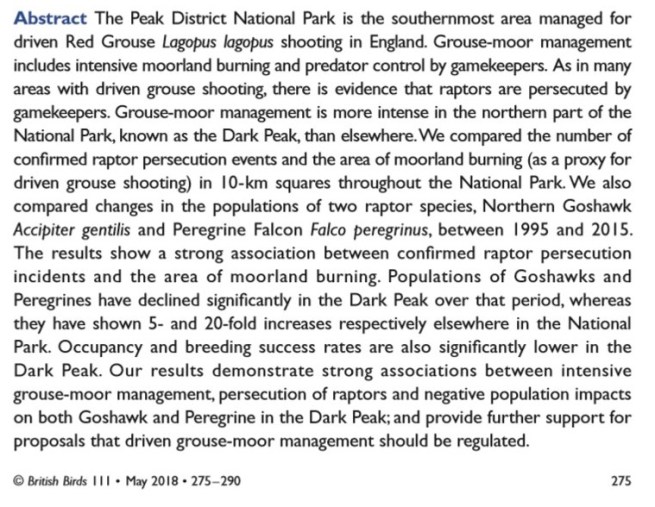
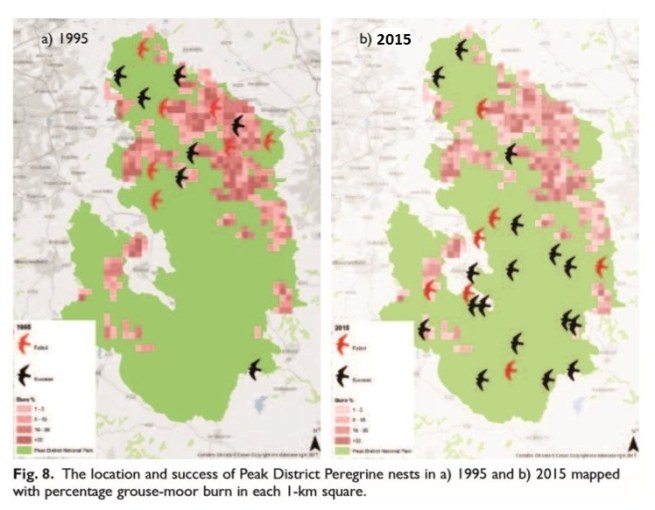
The fall-out from the failed Peak District Bird of Prey Initiative continues.

Following last week’s news about how the Moorland Association had blocked an official press statement about the extent of raptor persecution in the Dark Peak region of the Peak District National Park (here), how the RSPB had terminated its involvement with the failed Initiative (here), how the local gamekeepers had tried to frustrate any progress on the ground (here) and how a former Moorland Association representative had allegedly tried to get the Peak District National Park Authority to ‘dis-allow’ police raids on the homes of suspected gamekeepers (here), now the Northern England Raptor Forum (NERF) has issued a statement.

NERF is the umbrella organisation representing a number of regional raptor study groups across northern England, including the Peak District Raptor Monitoring Group which has been closely involved with the Peak District Bird of Prey Initiative.

In a statement published last night on its website, NERF reiterates its frustration with the failed Initiative and identifies the Moorland Association as being central to the on-going problem, not just in the Peak District but also the role it plays in other bird of prey protection partnership schemes:

What will it take for those in authority, including the Government, to wake up to the fact that the Moorland Association is a lobbying organisation committed only to benefitting their members’ interests?  Of course it is not just within this group where they seek to spread their influence, they are members of PAW and use the same tactics in that forum. It is NERF´s opinion that unless they demonstrate a change in attitude towards species’ protection they should no longer be treated as equals in Bird of Prey protection fora“.

NERF’s full statement can be read here

Well said, NERF. It’s what we’ve all been thinking for years and the more people who are prepared to say it out loud, and often, the better.

Parliamentary questions on Scottish Government’s grouse moor management review

Following the announcement on 24 November 2017 that the Scottish Government’s Grouse Moor Management Review Group had been formed (see here), a couple of Parliamentary questions have recently been lodged about how this group will function:

S5W-14019: Colin Smyth (Scottish Labour, South Scotland) Date lodged: 23/1/2018

To ask the Scottish Government, further to its announcement on 24 November 2017, what progress has been made by the independent group for ensuring grouse moor management practices are sustainable and legally compliant; what the remit of the group is, and what timetable it is working to.

Expected answer date: 6/2/2018

S5W-14020: Colin Smyth (Scottish Labour, South Scotland) Date lodged: 23/1/2018

To ask the Scottish Government, further to its announcement on 24 November 2017, what plans are in place to engage (a) stakeholders and (b) the public in the work of the independent group for ensuring grouse moor management practices are sustainable and legally compliant.

Expected answer date: 6/2/2018

Colin Smyth has also lodged another Parliamentary question, related to those above, which is pertinent to this week’s media attention on mountain hare culls on driven grouse moors:

S5W-14021: Colin Smyth (Scottish Labour, South Scotland) Date lodged: 23/1/2018

To ask the Scottish Government what efforts it has made to prevent large-scale culls of mountain hares this winter.

Expected answer date: 6/2/2018

For those who missed it, mountain hare culling featured on Countryfile on Sunday evening (28th Jan), where they filmed a cull on a grouse moor in Strathdon, Aberdeenshire. The programme is available on BBC iPlayer here for 27 days. The name of the estate wasn’t given but there were gamekeepers from Edinglassie Estate and Candacraig Estate. Whoever advised the Grampian Moorland Group that it would be a good idea (presumably to get the public onside) to showcase gamekeepers shooting mountain hares in the face made a big PR blunder. There was a huge backlash on social media and also in the national press (e.g. Daily Mail article here).

The programme also peddled the usual propaganda from the grouse shooting industry, claiming that all the shot hares would be sold for meat, which one of the gamekeepers claimed ‘showed the respect gamekeepers have for hares both in life and death’.

That’s not quite true though, is it? Here’s a pile of shot mountain hares, left to putrefy in a rotting heap on an Angus Glens grouse moor:

Harry Huyton (Director, OneKind) also featured in the programme to give an opposing view on mountain hare culling. He did a good job, and he’s also written an interesting blog about it (here).

The Countryfile episode was designed to coincide with the publication of a new SNH study which examined different methods of counting mountain hares. One of the fundamental arguments against the mass slaughter of mountain hares on grouse moors (apart from the questionable ethics) has been the issue of nobody knowing the status of the mountain hare population and thus the unknown impact these culls are having on the species’ conservation status (although we understand a forthcoming scientific paper, not yet published, will demolish the grouse shooting industry’s claims that the culls have no negative impact). The results of the new SNH study on mountain hare counting methods  can be read here.

UPDATE 13 February 2018: News on Scot Gov’s grouse moor management review & mountain hare culling (here)