It didn’t take them long.
Following the successful launch yesterday of the new, non-profit organisation, Wild Justice, the gameshooting industry’s lies, spin and blatant fake news has begun.
Check out this ‘article’ on the Fieldsports Channel (here). It opens like this:

It goes on to accuse Wild Justice Director Chris Packham of saying something that he blatantly did not say during an interview on BBC Radio 4’s Farming Today programme (13 Feb 2019):

We have listened to this interview several times, just to be sure, and nowhere during it does Chris say ‘he counts everyone in the fieldsports community as a wildlife criminal’. He says nothing of the sort. Not even a hint of it.
Incredibly, the Fieldsports Channel even provides a recording of the interview, which, when you listen to it, proves without doubt that the Fieldsports Channel’s claim is not just a blatant misreprentation of Chris’s comments, but is an outright lie, designed, perhaps, to whip up more animosity from this sector towards Chris.
In case this recording ‘disappears’, here is a transcript of the full interview:
R4 interviewer Anna Hill: The wildlife campaigner and TV presenter Chris Packham has launched a new non-profit company dedicated to bringing prosecutions against public bodies which break wildlife laws. It’s called Wild Justice and will be funded by public donations and crowdfunding. It’ll consider cases in England and Scotland. I asked Chris Packham what sort of cases he thinks it’ll take up.
Chris Packham: Wild Justice has been motivated by the fact that we think that wildlife crime isn’t adequately recognised as crime in the UK. If we rob a bank, if we rob a post office, if we break the speed limit, there’s no ambiguity about the fact that that’s a crime and it’s seen by society as a criminal offence. We will take action against anyone who is ignoring or conducting wildlife crime, and we want to raise the profile of that. There are many instances where we know that foxes are being hunted illegally, there’s no ambiguity about that, we know that there’s hare coursing taking place, and we just want to make sure that these are properly seen as crimes and the law is implemented properly in line with the rest of the law of the land.
Anna Hill: What about things like the badger culling for instance, which is within the law, or persecution of raptors for instance which is sometimes done by individuals rather than public bodies?
Chris Packham: The culling of bafgers is not illegal, that’s not on our agenda. We are interested in crime here and making sure that the crime is punished. And when it comes to the illegal persecution of raptors it doesn’t matter whether it’s groups or individuals, this is a criminal act and unfortunately its very difficult to get these cases in to court and when we do get them in to court, it’s very infrequent that the sentencing is appropriate. If I go in to an art gallery and I slash a John Constable painting, I’ve committed a criminal act and I would be pilloried for that around the world; I’d damaged a national treasure, in fact a global treasure. If a gamekeeper shoots a golden eagle on a grouse moor in Scotland, from my perspective that’s damaging our natural heritage, that’s as much a crime as me slashing a painting, it’s robbing us of our ability to enjoy an aspect of our environment and in the case of the eagle, one which is playing a critical ecological role.
Anna Hill: Litigation is notoriously expensive. What if you get caught up in a long-term legal wrangle and the money runs out?
Chris Packham: Well I’m confident that we will be properly funded for this. There’s an enormous number of people out there who are fed up with wildlife crime not being properly punished and I think that we see this in social media. We’ve seen a couple of crowdfunding initiatives recently run when we’ve had judicial reviews against a raven cull in Scotland and brood meddling with hen harriers in England, and they’ve raised the money very rapidly because people have grave concerns about these sorts of things. I’m confident that we will find an adequate source of money to pursue our objectives and equally that we will raise the profile of these crimes.
Anna Hill: Are you hoping to change legislation, because your literature mentions, and I’ll quote it, “If you’re breaking the law, if the law is weak, if the law is flawed, we are coming for you”. So do you want to change legislation?
Chris Packham: Indeed we do. We’re going to question the legislation that’s in place, see if it’s adequate, see if it’s useable, and if it isn’t adequate and useable and we’re not able to implement it easily enough to prosecute crimes, we’re talking about criminal acts here, then we will ask for changes in that legislation.
Anna Hill: It’s very interesting, earlier this week we ran a piece about hare coursing and the police were saying they couldn’t use the law that exists at the moment to stop hare coursing, they were using other laws in fact. Farmers would thank you, I think, because many of them have been threatened by people who carry out hare coursing illegally. If you could crack that, that would be quite an achievement, wouldn’t it?
Chris Packham: Yes, I’ve been following a number of campaigns that have been run in Lincolnshire looking at hare coursing and the police have shown a very clear association with people who conduct hare coursing with other rural crime, there is a clear link there, so if we can catch peple for hare coursing and we know that’s going to improve life for people in those rural communities, then why not change the law to make that easier to implement? And that’s just the sort of thing that we’re going to be looking at.
ENDS
Chris Packham is used to being wilfully misquoted and misrepresented in the pro-shooting press – we’ve been blogging about this recently after fake news articles were published by the Telegraph (here) and Shooting Times (here) – all part of a wider and long-running nasty smear campaign to get him sacked from the BBC because he’s vocal about the criminals within the shooting lobby and people listen to him because he has the very thing the shooting lobby lacks – integrity.
We can’t speak for Chris but would guess that were he to be aware of this appalling piece of ‘journalism’ on the Fieldsports Channel he’d probably laugh it off, especially if he reads further down the article and finds them trying to portray members of Scottish Environment LINK as ‘animal rights activists’ and a senior staff member of Ramblers Scotland an ‘anti’ just because she posted some photos of traps on a Scottish grouse moor (see photo below) and questioned such land management techniques (which, incidentally, led to the Scottish Gamekeepers’ Association going in to meltdown, beautifully skewered here)

Overwhelmingly, Wild Justice has been received with huge positivity (thank you!) and we’ve already made some really important connections with unexpected supporters and potential collaborators. More on that in the future.
In the meantime, we’ve now instructed our lawyers to press ‘go’ on our first legal challenge and we hope to have some news about that in approx three weeks.
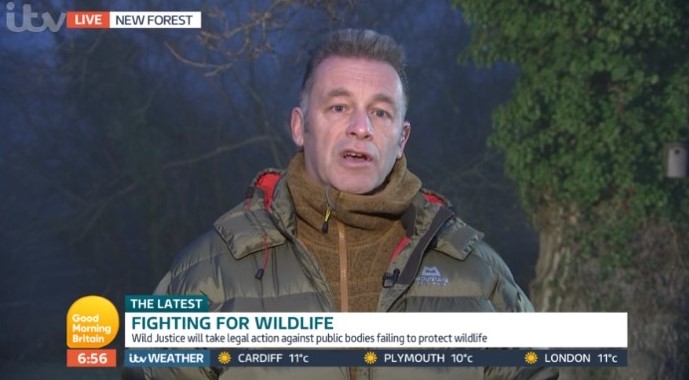
For anyone who missed it, Chris was talking about Wild Justice on Good Morning Britain today which can be watched here for the next seven days (starts at 0:49.09).


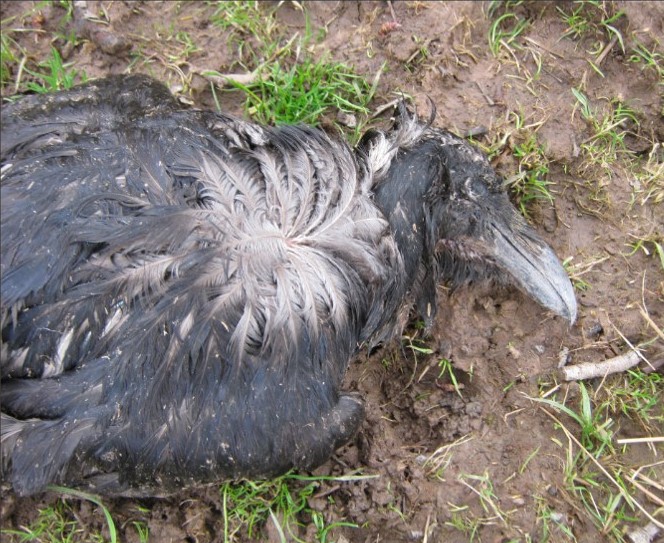

 Ian Thomson (Head of Investigations, RSPB Scotland) opened proceedings with an introduction to raptors, going through some general identification pointers for the non-birders and explaining which species are most likely to become victims of illegal persecution and on which type of land-use, illustrated with a hotspot map showing where high levels of illegal persecution have been recorded in areas intensively managed for driven grouse shooting.