The estate that Dorset Police refused to search after discovery of poisoned eagle is the same location where gamekeeper was today convicted of multiple raptor persecution crimes

After today’s court case, where gamekeeper Paul Allen was found guilty of seven wildlife, poisons and firearms offences, including the possession of six shot buzzards and banned poisons in March 2021 (here), it can now be revealed that the poisoned white-tailed eagle that was found dead on a Dorset estate in January 2022 was on the very same estate – the very same estate (the Shaftesbury Estate) that Dorset Police u-turned on their decision to search during their botched investigation into the poisoning of that eagle (see here).

Now, before I go any further, there are a few things that need to be clarified before anyone jumps to conclusions and makes libellous comments. Firstly, and importantly, there is NO EVIDENCE to indicate that the eagle was poisoned on the Shaftesbury Estate. The eagle was found dead there, yes, that is a statement of fact. However, we know from the eagle’s satellite tag data that in the days preceding its death it visited two or three other estates in the area. We also know that the poison that killed the eagle (Brodifacoum) is not a fast-acting poison and that this eagle’s health deteriorated over a number of days before it died. It is quite feasible that it picked up the bait elsewhere but succumbed to internal haemorrhaging once it had reached the Shaftesbury Estate.

On the same lines, it is also important to clarify that there is NO EVIDENCE that gamekeeper Paul Allen had any involvement in the poisoning of the white-tailed eagle. He just happened to work on the estate where the eagle was found dead. My understanding is that the shoot that Paul Allen worked on, although located on Shaftesbury Estate, was not directly associated with the estate; it was a privately-run shoot (perhaps tenanted) that was not under the management of Shaftesbury Estate.

What is up for discussion though, is Dorset Police’s decision NOT to search the Shaftesbury Estate as part of their investigation into the poisoning of that eagle in March 2022, when they were already acutely aware of the offences that gamekeeper Paul Allen had committed on the very same estate, a year earlier.

Dorset Police’s (now former) wildlife crime officer, Claire Dinsdale, had organised a search of the Shaftesbury Estate after the toxicology results came back on that eagle. She was absolutely right to do so, whether earlier offences had been committed there or not. It’s a no-brainer. This is policing for beginners. You find a poisoned eagle, you go and search the location where it was found to see if there’s any evidence to identify a potential perpetrator. That these other raptor persecution offences were already under investigation on the same estate just ramps up the justification for another search, surely?

Why Claire’s decision to undertake a search was overruled by senior officers, who then repeatedly said, for months afterwards, that their decision not to conduct a search was ‘proportionate’ and that ‘there weren’t any new leads’ to justify a search, just beggars belief. Their decision to u-turn on the search was made despite representations from the National Wildlife Crime Unit (NWCU) and the RSPB, based on the eagle’s satellite tag data and decades of experience investigating raptor persecution crimes. Something happened to cause the police u-turn. But what?

There is a strong stench of something sinister going on at Dorset Police HQ.

I’m certain that this latest revelation will lead to more questions being asked of Dorset Police, and from a much higher authority than this little blog.

Watch this space…

Dorset gamekeeper Paul Allen guilty of multiple raptor persecution, poisons & firearms offences

Further to my blog post on January 1st 2023 (here), this morning gamekeeper Paul Scott Allen, 54, of Baileys Hill, Brockington, near Wimbourne in Dorset, has pleaded guilty to seven charges of raptor persecution, poisons and firearms offences whilst he was working on a privately-run gamebird shoot located on the Shaftesbury Estate in March 2021.

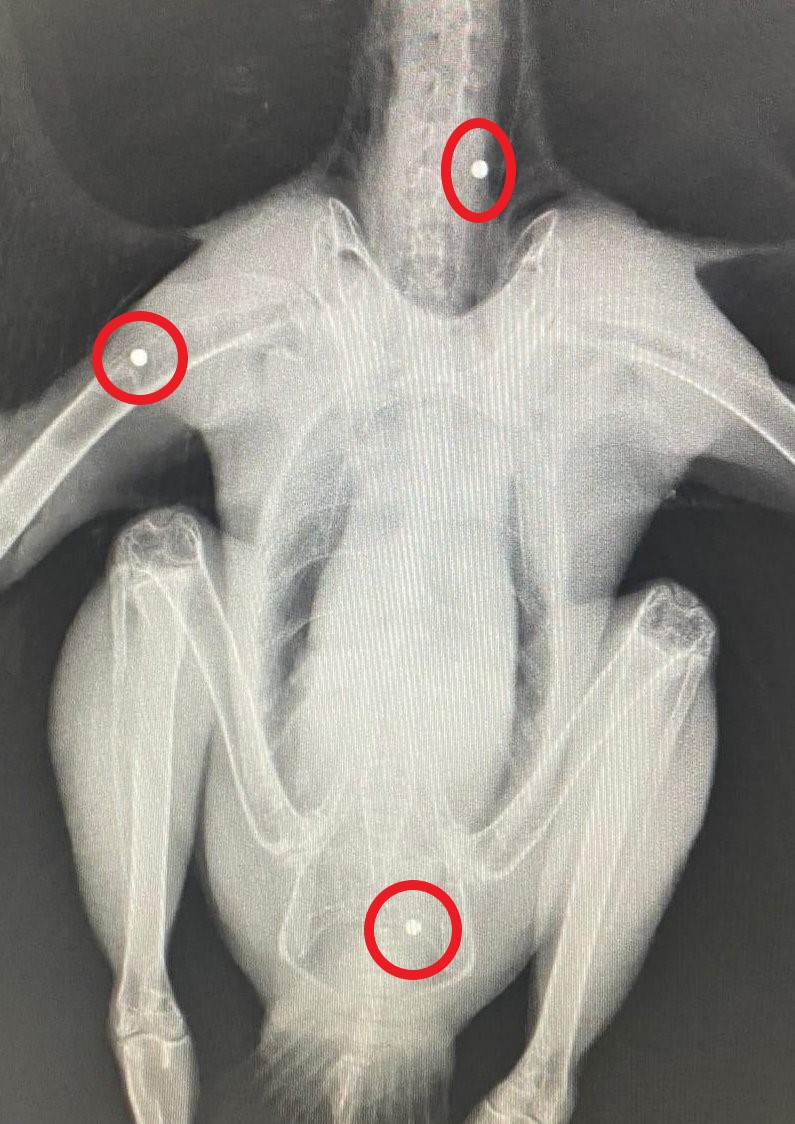
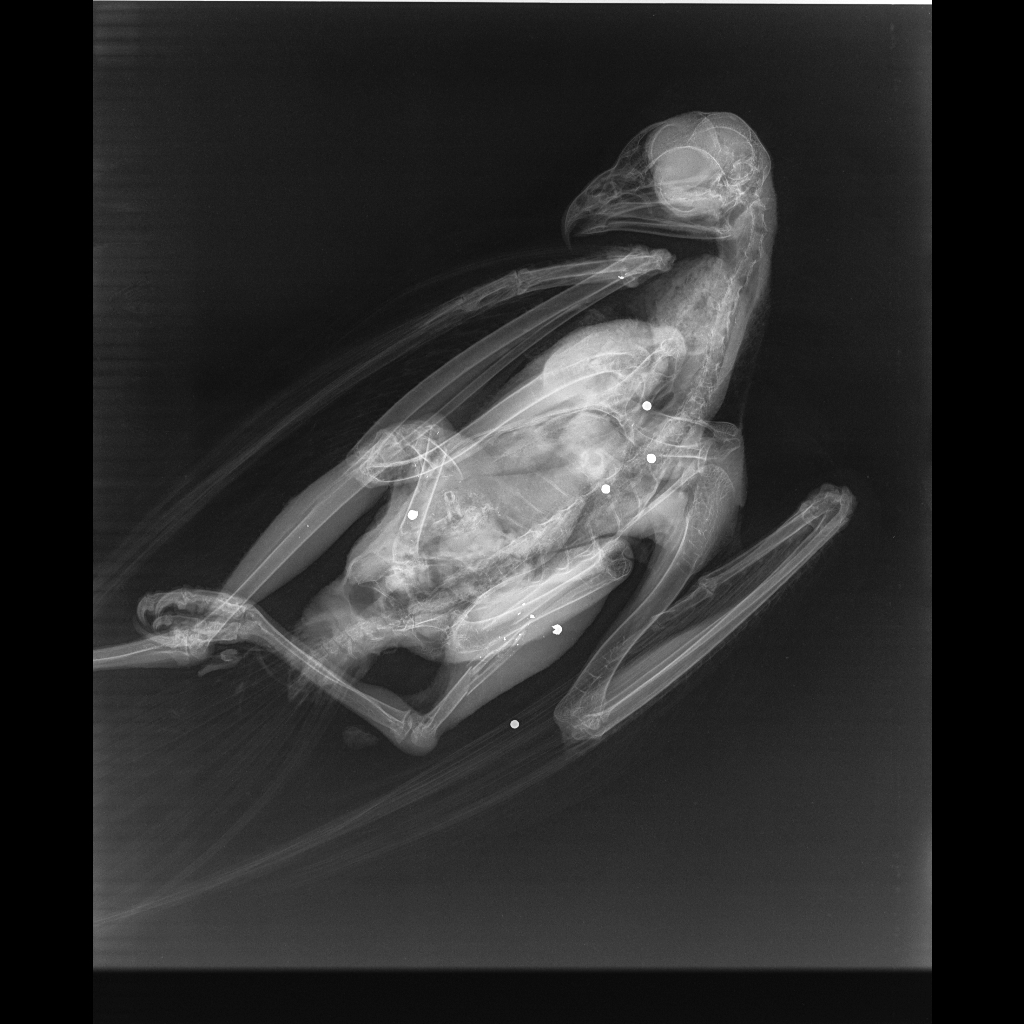
Following the discovery of a poisoned red kite on the estate in November 2020, a multi-agency raid led by Dorset Police’s (now former) wildlife crime officer Claire Dinsdale took place in March 2021 (see here) where the corpses of six dead buzzards were found by a pen behind his house (tests later showed they had all been shot, including one that was was estimated to have been shot in the last 24hrs). Officers also found the remains (bones) of at least three more buzzards on a bonfire.

A loaded shotgun was found propped up behind a kitchen door (!) and 55 rounds of ammunition were found in a shed. Both the gun and the ammunition should have been inside a locked cabinet, by law. The ammunition was not covered by Allen’s firearms certificate.

Officers also found a number of dangerous, and banned, chemicals, including two bottles of Strychnine, two containers of Cymag and a packet of Ficam W (Bendiocarb) in various locations, including in a vehicle used by Allen.

Four of six illegally shot buzzards found during the police raid. Photo by RSPB

The seven guilty pleas included two counts of possessing a live or dead bird, or parts thereof, one charge of failing to comply with the conditions of a shotgun certificate, one charge of failing to comply with the conditions of a firearms certificate, one count of possessing a regulated substance without a license, one count of failing to comply with  regulations in accordance with the Plant Protection Products (Sustainable Use) Regulations 2012 and one charge of contravening a health and safety regulations.

A number of charges were dropped prior to the hearing. More on that shortly.

Sentencing was adjourned for reports and Allen is due back in court on 16th February 2023.

There is plenty to discuss about this case and I will do that over the coming days. In the meantime, press attendance at court was strong so I’ll add the links to the various reports as they come out, below.

MEDIA COVERAGE

DorsetLive here

Bournemouth Echo here

BBC News here

Daily Telegraph here

ITV News (includes RSPB video footage from the crime scene) here

The Times here

RSPB press statement (includes crime scene photos) here

UPDATE 4th January 2023: The estate that Dorset Police refused to search after discovery of poisoned eagle is the same location where gamekeeper was today convicted of multiple raptor persecution crimes (here)

UPDATE 16th February 2023: Convicted Dorset gamekeeper Paul Allen due to be sentenced today (here)

UPDATE 16th February 2023: Criminal Dorset gamekeeper Paul Allen receives suspended custodial sentence despite committing multiple wildlife, poisons and firearms offences (here)

More info revealed on Dorset Police’s relationship with local MP & the botched investigation into the poisoned white-tailed eagle

Dorset Police were never far from the headlines last spring and summer, thanks to their appalling, botched investigation into the poisoning of a white-tailed eagle, found dead on a game-shooting estate and containing seven times the lethal dose of the rodenticide Brodifacoum.

As a recap for new blog readers, the corpse of the young satellite-tagged eagle, which was one of the birds from the high profile reintroduction project on the Isle of Wight, was found on the unnamed shooting estate in January 2022. Dorset Police’s wildlife crime team, led at the time by the exemplary Claire Dinsdale (one of few officers awarded the Queen’s Police Medal for her work), undertook a multi-agency operation to retrieve the corpse, sent it off for toxicology analysis, and when the results came back in early February 2022, she set about organising a warrant for a multi-agency team to search the estate to look for evidence that might identify who was responsible for this serious wildlife crime. She also issued a public appeal for information (here).

The news of this eagle’s death made national news and led to some disturbing criticism of Dorset Police by local Conservative MP Chris Loder, who publicly declared that Dorset ‘wasn’t the place for eagles’ and argued that the police should be focusing their resources on other types of criminality and not on suspected wildlife crime (see here). It also emerged that Chris Loder had some interesting connections with at least one prominent Dorset estate from whom his local party had received considerable donations, although it wasn’t known whether funding had been received from the [unnamed] shooting estate where the eagle had been found poisoned (see here).

By the end of March 2022, Dorset Police issued an astonishing statement, claiming that the toxicology results were “inconclusive” (actually they were anything but!) “and it has therefore not been possible to confirm that any criminal offence has been committed…..As a result, no further police action will be taken in relation to this report“.

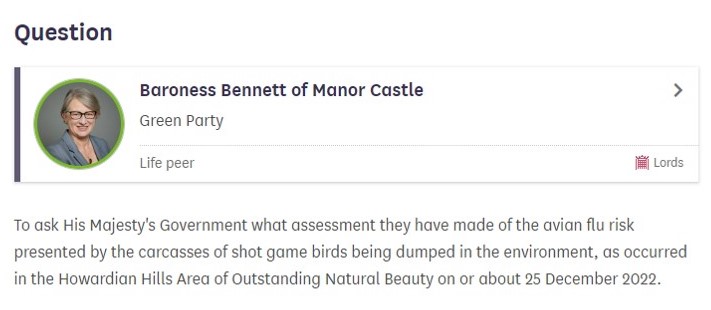
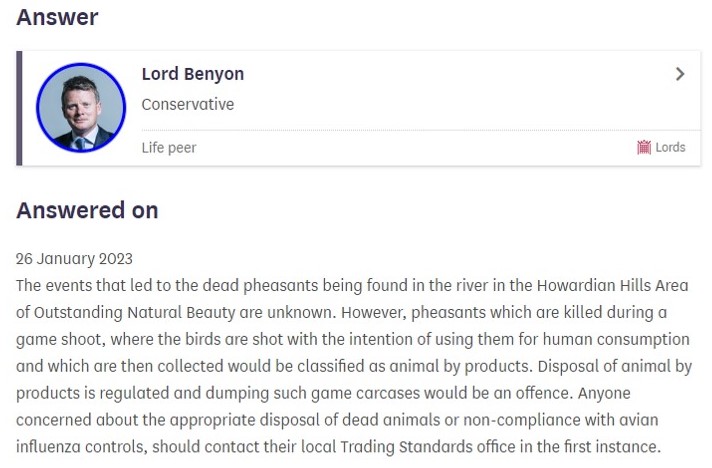
This decision to prematurely pull the planned search and close the investigation made no sense whatsoever, including to the RSPB (here) and it even led to questions being tabled in the House of Lords (here). It was a ludicrous situation. For this dead eagle’s liver to contain seven times the lethal dose of Brodifacoum (i.e. seven times the amount needed to kill a bird the size of an eagle), it could only be the result of either (a) mis-use of the rodenticide or (b) deliberate abuse of the rodenticide. Either way, these are both offences and deserved a full investigation, especially given Dorset’s reputation as a bird of prey persecution hotspot (see here). For Dorset Police to effectively pull down the shutters and shout ‘Nothing to see here’, without conducting a search, looked very dodgy indeed.

Around the same time news also emerged that Claire Dinsdale QPM had gone on ‘long-term sick leave’ with stress and, strangely, Dorset Police’s Rural Wildlife & Heritage Crime Team had a name change, which happened just after MP Chris Loder’s Twitter outbursts about Dorset Police spending time investigating wildlife crime. The words ‘wildlife’ and ‘heritage’ were completely and mysteriously removed from the name, which had now become ‘Dorset Police Rural Crime Team’ (see here).

There followed months of protracted aggro, as FoIs were submitted to Dorset Police who first ignored them (e.g. see here) and then subsequently refused to provide the requested information (e.g. see here), even after appeal. Many people were asking whether there was evidence of political interference by Chris Loder MP and the Dorset Police & Crime Commissioner David Sidwick, influencing Dorset Police’s decision to drop the investigation. All parties denied this, of course, and no hard evidence has emerged to answer the questions, but Dorset Police’s refusal to answer FoI questions simply left these concerns hanging in the air like a bad smell.

Dorset Police then attempted a futile damage limitation exercise where they claimed their decision to prematurely close the investigation before conducting a search was ‘proportionate’ (see here) and then they claimed to have undertaken a review (effectively marking their own homework) which concluded that there was ‘insufficient evidence’ and ‘no outstanding lines of enquiry’ to progress the case. Well of course, if you fail to conduct a search you’re not going to find any evidence, are you?!

In August news emerged that Wildlife Crime Officer Claire Dinsdale QPM had left Dorset Police and was now working at the National Wildlife Crime Unit.

On 7th October 2022, Dorset Police published another statement about this botched case, probably in response to the ongoing criticism that simply refused to go away. The new statement, issued by Dorset Police Assistant Chief Constable Rachel Farrell (here), just reinforced the earlier denials of dodgy policing and repeated the line that, “…there was insufficient evidence to prove an offence of wilful poisoning by an individual – so no one person can be proven to have been criminally responsible for the bird’s death“.

On 16th November 2022, coinciding with the publication of the RSPB’s latest annual Birdcrime report, Claire Dinsdale posted a remarkable comment thread on Twitter as follows:

Tweet 1: 2020 – a series of concerning incidents in Dorset stood out to me & colleagues from various agencies. Progress was being made with multi agency searches & raising nationally at our Bird Of Prey PDG (Priority Delivery Group) meetings. It is clear to anyone with a basic understanding of wildlife crime that Dorset had a problem.

Tweet 2: Up until early 2022, there was thankfully no-one interfering with these specialised cases. Policing must be objective & not influenced by threats or pressure from other parties or their own officers. Without fear or favour. So no surprise to see Dorset is 2nd worst county in UK Bird Of Prey Crime 2021 data, with only 1 less than the No 1 slot.

Tweet 3: I hope lessons will be learned by those who made serious errors of judgement. Policing needs to respect & listen to those experienced & specialist officers on the ground.

Tweet 4: It needs to have the strength & courage to do what is right without personal regard for ambition or self importance. The public are not fools & will rightly hold us to account for the decisions made. When policing or other public servants get it wrong, they should say so.

Tweet 5: If I can correct the statement for the record here by the Dorset Echo and Natures Voice. The eagle case was shut down prematurely in my view & the planned multi agency search I had arranged was cancelled by a new boss with no understanding of wildlife crime and a very senior officer within days of an MPs rebuke & threats on police funding, got the word wildlife removed from our twitter bio. [Ed: I believe the Dorset Echo article to which Claire was referring was this one]

Tweet 6: The previous Chief Constable (who’d retired before these events) advised me should anyone interfere with one of my cases to come straight to him.

Tweet 7: There has been some great work done by WCOs colleagues in other forces. My last Dorset wildlife crime case myself & other agencies worked so hard on, will hopefully show how you can investigate bird of prey crime with searching being a key part of it.

Claire’s tweets earned her considerable support on Twitter – it takes an incredibly courageous officer to speak out on police failings – but by the end of November all but Tweet #7 had been deleted. We can only imagine what hell some senior officers in Dorset Police are now bringing to her door. Nevertheless, her revelations will lead to even more scrutiny of Dorset Police’s obvious mishandling of this case…more on that soon.

Meanwhile, and also in November 2022, MP Chris Loder’s apparently cosy relationship with Dorset Police was once again in the spotlight. Two Dorset residents and long term anti-sewage campaigners, Beverley Glock and Fran Swan, both received police visits to their homes after they’d registered to attend a public meeting to raise concerns with Chris Loder about sewage pollution in the area (see their press release here). [EDITOR UPDATE 4th Jan 2023: the original press release now appears to be unavailable. There is an archived copy (here) and if that also disappears I’ve provided a copy and paste version in the comments section of this blog].

What the actual?!

According to a subsequent article published on the DorsetLive website on 3rd December 2022 (here), Dorset Police & Crime Commissioner David Sidwick (whose astonishing correspondence with Chris Loder (“You and I need to get our ducks in the row on this one“) on the poisoned eagle fiasco was revealed by FoI, here) is now conducting a review about why a uniformed officer visited these two ladies, at night, apparently after police had received an email from Chris Loder’s office about their planned (registered!) attendance at the public meeting.

A spokesperson from Dorset Police is quoted:

Officers from the neighbourhood policing team wished to understand the intentions of those people to ensure that public safety was preserved and any lawful protest could be facilitated. This approach was well-intentioned without any direction from the local MP“.

And David Sidwick is quoted saying he was given a “satisfactory explanation” (from Dorset Police) about why the two women were visited by police. He noted that it is “routine” that the police are notified of attendances to MP events following the murder of Sir David Amess MP, but has promised a review into the incident.

Public confidence in Dorset Police continues to plummet, and I guarantee there’ll be an even bigger shit storm after revelations emerge about Wednesday’s court case concerning a Dorset gamekeeper facing multiple charges of alleged raptor persecution, poisons and firearms offences dating back to March 2021.

Interesting times.

UPDATE 4th January 2023: The estate that Dorset Police refused to search after discovery of poisoned eagle is the same location where gamekeeper was today convicted of multiple raptor persecution crimes (here)

Three barn owls, one tawny owl & one red kite found dumped in ditch – police appeal for information

More detail has emerged about the discovery of five dead birds of prey and two magpies found in suspicious circumstances and the subject of an appeal for information yesterday by Lincolnshire Police’s Wildlife Crime Team (see here).

The five raptors are reported to be three barn owls, one tawny owl and a red kite.

The police appeal for information contained very little detail yesterday – no date of discovery, no specific location and no species identification, although the dismembered wings of a barn owl could be seen in the accompanying police photograph:

Many thanks to BBC reporters Simon Hare and Paul Murphy for providing a bit more information:

If you have any information that could assist the police investigation please contact DC Aaron Flint at Lincolnshire Police, either by calling 101 and quoting incident number 22000747007 or by emailing aaron.flint@lincs.police.uk

UPDATE 27th May 2023: Update from Lincolnshire Police on discovery of raptor body parts found in ditch (here)

Raven poisoned with banned chemicals – Police Scotland withhold information

Last month I wrote about a poisoned red kite that had been found dead on a grouse moor, next to a poisoned bait (a Lapwing), and how Police Scotland had deliberately withheld the details of this crime for over 18 months (see here).

Now there’s another poisoning crime where Police Scotland has deliberately withheld information from the public. This time it’s a poisoned raven, and this time Police Scotland has been nothing short of obstructive when I started to ask questions about it.

A poisoned raven (file copy, photographer unknown)

I found out about this poisoned raven after stumbling across an entry on the database published by the Wildlife Incident Investigation Scheme (WIIS), back in November 2022. The details were as follows:

‘Ref #21094. Raven, found April 2021. Lothian. Category: Abuse. Pesticide(s) involved: Carbofuran, Isofenphos. Case information: Despite extensive enquiries and property searches the investigation carried out by Police Scotland into the illegal poisoning of this raven failed to identify a suspect for the crime and the case is now closed‘.

This incident jumped out at me given that one of the poisons used was Carbofuran – a pesticide so dangerously toxic (to both humans and wildlife) that even possessing it, let alone placing it out in the open on a bait, has been an offence in Scotland since 2005 (Possession of Pesticides (Scotland) Order 2005). The combination of Carbofuran with Isofenphos has been used frequently in the illegal poisoning of birds of prey for years, notably by the game-shooting sector.

I didn’t recall seeing any media about this particular poisoning crime, and the Scottish Government’s annual wildlife crime report is so far behind the curve that we won’t see details of anything found in April 2021 until 2024(!), so I asked a couple of officers from Police Scotland what they could tell me about the case.

Both officers told me that they weren’t allowed to comment, and that I should direct my enquiries to Police Scotland’s media communications team. So I did.

I emailed the news desk and asked for details, giving them all the info that I’d read on the WIIS database.

No reply.

I followed up eight days later to ask again. Here’s the response:

Good morning Ruth, we have been trying to track this one down for you. Apologies, but I need a bit more information. Unfortunately the incident number is not one we use on our systems so that has not enabled me to find it.

Are you able to provide a date in April when this was reported to police. I am afraid it is for the media to provide us with a location rather than the other way round so if you can narrow it down for me please – Lothian is not a county in Scotland – we have East Lothian, West Lothian and Midlothian, so a more accurate location would be helpful at our end“.

Eh? How many poisoned ravens were found in Lothian in April 2021 that triggered a police search? Surely there can’t be that many? And how am I supposed to know the location of this crime when it hasn’t even been publicised?! I wrote back to this effect, and suggested that the media officer could simply ask the Lothian & Borders Wildlife Crime Officer for details, given that his ‘patch’ covers East, West and Midlothian.

Here’s the response I received:

Hi again Ruth, sorry but I really do need to know a more accurate location. As mentioned we have East Lothian, West Lothian and Midlothian. Or if you have the name of a town nearest to where this is supposed to have happened. To speak to officers to find out more I need to know where. Please get back to me when you have that information“.

Needless to say, I was less than impressed. This is a serious wildlife crime, supposedly a national wildlife crime priority, involving the use of a highly toxic poison of which just a few granules could kill a human should they come into contact with it. It seemed to me that Police Scotland’s media team was being deliberately obstructive in releasing any information about it. Not even an appeal for information or a warning to the public that this poison had been used in the area.

I wrote back, asking the media officer where he might suggest I find a more detailed location to help him find the case, given that Police Officers had been directed not to comment about it? I also indicated that I was considering submitting a formal complaint.

Four days later, a different media officer contacted me with the following statement:

Hi Ruth, Regarding your previous enquiry please see our statement below:

A Police Scotland spokesperson said: “We received a report of a poisoned raven in the East Lothian area on Monday, 5 April, 2021. Extensive enquiries have been carried out. Any new information will be thoroughly investigated and anyone with new information should contact police on 101 quoting incident 1314 of 5 April, 2021.”

I really don’t know what’s going on with Police Scotland. They have some fantastic wildlife crime officers on the ground, many of them going above and beyond in their investigations to bring the raptor killers to justice, but they, and we, are being badly let down by the Force’s upper hierarchy who have clearly made a decision about withholding serious wildlife crime news from the public.

Why is that? Who benefits from such censorship?

As I wrote a few months ago on the withheld news of the poisoned red kite found on a Scottish grouse moor, news that Police Scotland had kept hidden for 18 months (here), I don’t understand the rationale at all. Certainly, in the early stages of an investigation it often pays for details to be withheld so as not to compromise searches etc. But 19 months (in the poisoned raven case) after the crime is discovered? It doesn’t make sense, and all it does is undermine public confidence, which really isn’t helpful when Police Scotland needs the public onside to report suspected wildlife crimes.

By the way, according to the WIIS database, a ‘suspected bait’ categorised as ‘abuse’ (name of chemical withheld) was discovered in Lothian in March 2021. The case notes say: ‘This incident is the subject of an ongoing Police Scotland investigation’.

So a poisoned bait was found one month prior to the poisoned raven. Are these crimes linked? Or is there another undisclosed location in ‘Lothian’ where deadly poisons are being laid out?

Where is the warning to both locals and visitors to the area from Police Scotland about this serious threat to public safety?

An MSP is currently in the process of asking formal questions about this ongoing censorship. Watch this space.

Police appeal for information after discovery of five birds of prey & two magpies found in suspicious circumstances in Lincolnshire

Lincolnshire Police’s Wildlife Crime Team has issued an appeal for information after the discovery of five birds of prey and two magpies found in suspicious circumstances.

The details are a bit sketchy – no date, no specific location, no species identification, but there’s a photograph of what looks to be an assortment of avian body parts, some chunks of meat and a strange blue colouring on one of the items:

If you’re able to assist, please contact Lincs Police.

UPDATE 2nd January 2023: Three barn owls, one tawny owl & one red kite found dumped in ditch – police appeal for information (here)

UPDATE 27th May 2023: Update from Lincolnshire Police on discovery of raptor body parts found in ditch (here)

Gamekeeper due in court facing multiple charges of raptor persecution, poisons & firearms offences

A gamekeeper is due in court on Wednesday 4th January 2023 to answer multiple charges of alleged raptor persecution, poisons and firearms offences.

This case relates to the multi-agency raid carried out on a shooting estate in Dorset in March 2021, led by the now former wildlife crime officer Claire Dinsdale (see here).

This prosecution is particularly interesting on a number of levels – watch this space.

As this is a live prosecution, comments won’t be accepted until the case concludes. Thanks for your understanding.

Job opportunity: seasonal fieldworkers for national hen harrier survey

The RSPB is recruiting for eight seasonal fieldworkers (six in Scotland, two in Wales) for the 2023 National Hen Harrier Survey.

These temporary research assistant positions begin in March 2023, for four months, for 37.5 hours per week.

Job description:

These posts require considerable experience of conducting fieldwork in upland areas. The post holders should have a good knowledge of Hen harrier ecology and should also be able to ensure the smooth running of the survey by dealing diplomatically with all interested parties. Fieldwork will involve long and unsociable hours in the field, and will be physically demanding. Extensive travel to remote locations will also be required. If work from home is not possible the post holder will be responsible for finding their own accommodation, although the RSPB will be able to contribute towards costs. Mountain skills training course to be provided at the start of the contract, if needed.

The closing date for applications is 23.59hrs on Sunday 8th January 2023.

For further details and to apply, please click here.

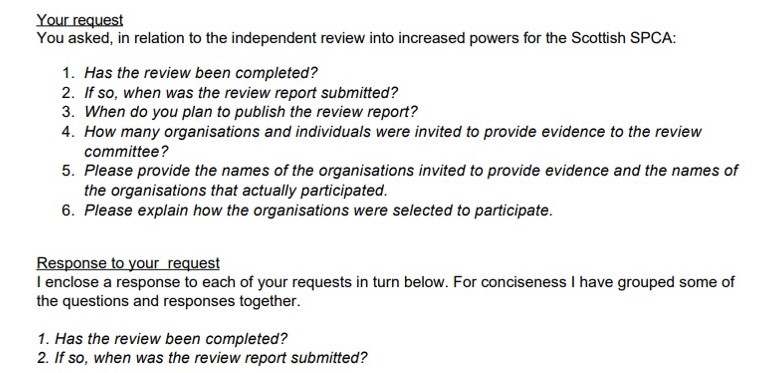
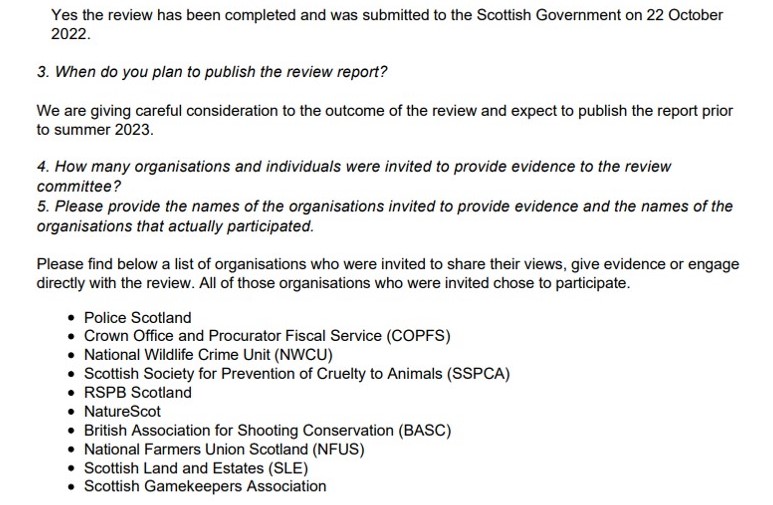
Taskforce review on extra powers for SSPCA ‘will be published within weeks’

The taskforce established by the Scottish Government earlier this year to consider whether the Scottish SPCA should be granted additional powers to help investigate raptor persecution and other wildlife crime has completed its review, which ‘will be published within weeks’, according to an article in yesterday’s Scotsman.

As a quick recap, the SSPCA’s current powers (under animal welfare legislation) limits their investigations to cases that involve a live animal in distress (including some wildlife crimes). The proposed new powers would allow them to also investigate wildlife crimes under the Wildlife & Countryside Act legislation, e.g. where the victim is already dead, and also incidents where a victim may not be present (e.g. if an illegally-set pole trap or a poisoned bait was discovered). See here for further detail.

The taskforce, chaired by Susan Davies FRSB, includes members from the Scottish Government (civil servants), Police Scotland and the Crown Office. Importantly, it doesn’t include anybody from the shooting/landowner brigade, thus thwarting any attempts to disrupt, delay, or water-down the taskforce’s recommendations, in the way the Werritty Review was bastardised three years ago.

This taskforce was established after 11 long years of political can-kicking only because the Scottish Greens insisted on its inclusion in the historic Bute House Agreement, the power-sharing policy document published by the two parties in 2021:

The independent taskforce to consider whether the Scottish Society for the Prevention of Cruelty to Animals (Scottish SPCA) should be given extra powers to investigate wildlife crime will be asked to report back in a timeframe that will allow any changes to the Scottish SPCA powers to be delivered by legislation implementing changes to grouse and other wildlife management in the course of this parliamentary session‘.

The taskforce’s findings will feed into the current draft legislation on grouse moor licensing (the Wildlife Management (Grouse) Bill) that is expected to progress to Stage 1 of parliamentary scrutiny in the new year now that the Government’s consultation on it has just closed. Indeed, the consultation document contained the following statement:

The taskforce’s report is expected to be published later this year. Depending on the recommendations of the review we may include provisions relating to the powers of Scottish SPCA in the Wildlife Management (Grouse) Bill, in which case a separate consultation with interested parties will be undertaken‘.

I look forward to reading the taskforce’s report ‘within weeks’ and trust that the Scottish Government won’t delay its publication, or its response to it, in the same way it has previously dragged its feet (for 11 years!) on this important issue. I think it’s probably crucial that because the commitment was made in the Bute House Agreement, any further delays by the SNP won’t be tolerated or accepted by the Scottish Greens.

Journalist Alistair Grant ‘s article in The Scotsman yesterday includes quotes from me and also from Scottish Greens MSP Mark Ruskell, who has been instrumental in keeping this issue to the fore of the political agenda.

The article is reproduced as follows:

The Scottish Government said a taskforce set up to consider the issue has completed its work and its findings will be published within weeks.

Campaigners have previously highlighted the “extraordinary” timeline of delays over the proposals, with the idea first mooted more than a decade ago.

There are ongoing concerns over the illegal killing of birds of prey in Scotland. Expanding the Scottish SPCA’s current powers would allow it to investigate cases involving animal deaths and illegal traps.

Conservationist Dr Ruth Tingay, author of the Raptor Persecution UK blog, said she had been tracking the debate for 11 years, “watching a succession of eight environment ministers kick it into the long grass“.

She said: “I hope the recommendation of the taskforce brings this excruciatingly embarrassing saga to an end and that the Scottish SPCA is given increased powers to enable its officers to work in partnership with the police and other agencies to finally get a grip on the illegal killing of birds of prey.

These disgraceful wildlife crimes continue because the perpetrators know fine well the chance of being caught and prosecuted is minuscule. There is no deterrent.

The involvement of experienced officers and investigators from the SSPCA will, I’m certain, have a significant impact on bringing those responsible to justice“.

Green MSP Mark Ruskell said the move would be a “crucial step forward“. He proposed new powers for the Scottish SPCA as part of legislation in 2020, but the Scottish Government instead committed to setting up an independently-chaired taskforce to consider the issue. This was then delayed.

Last year, the Government said the group would report before the end of 2022. The taskforce formed part of the co-operation agreement between the SNP and the Greens.

Mr Ruskell said: “The present system is not working, and the only ones benefiting from it are the criminals.

The reality is that wildlife crime has been rife for years, but overstretched police have been unable to take the action that is needed. This has only allowed it to continue unabated.

Every other option that has been tried to improve the detection of wildlife crime has failed. At a time when policing budgets are under increasing strain this is the only practical way forward.

For far too long, Scotland has had to endure persecution of birds of prey and other iconic species.

We have been calling for the SSPCA to have additional powers for a long time and pushed for it in Bute House [co-operation] agreement negotiations. After years of delays, I hope that we can finally make it a reality“.

Scottish SPCA Chief Superintendent Mike Flynn said: “We are pleased that the consideration to award powers to the Scottish SPCA under the Wildlife and Countryside Act 1981 have come to a conclusion. We have committed to help the Scottish Government combat wildlife crime following a suggestion made in 2010 by Peter Peacock MSP. We look forward to reading the findings of the plans over the coming weeks.”

A Scottish Government spokesman said: “We take animal welfare very seriously and in recent years have introduced a variety of measures to combat wildlife crime.

We committed to set up a taskforce that was to consider whether the Scottish Society for the Prevention of Cruelty to Animals should be given extra legislative powers to investigate wildlife crime. The taskforce has completed its work and its report will be published in due course.”

ENDS

For those new to this subject, here’s the political timeline that has led to the current position:

February 2011: Increased powers for the SSPCA was first suggested by MSP Peter Peacock as an amendment during the Wildlife & Natural Environment (Scotland) Bill debates. The then Environment Minister Roseanna Cunningham rejected it as an amendment but suggested a public consultation was in order.

September 2011: Seven months later Elaine Murray MSP (Scottish Labour) lodged a parliamentary motion that further powers for the SSPCA should be considered.

November 2011: Elaine Murray MSP (Scottish Labour) formalised the question in a P&Q session and the next Environment Minister, Stewart Stevenson MSP, then promised that the consultation would happen ‘in the first half of 2012’.

September 2012: Nine months later and nothing had happened so I asked Paul Wheelhouse MSP, as the new Environment Minister, when the consultation would take place. The response, in October 2012, was:

The consultation has been delayed by resource pressures but will be brought forward in the near future”.

July 2013: Ten months later and still no sign so I asked the Environment Minister (still Paul Wheelhouse) again. In August 2013, this was the response:

We regret that resource pressures did further delay the public consultation on the extension of SSPCA powers. However, I can confirm that the consultation document will be published later this year”.

September 2013: At a meeting of the PAW Executive Group, Minister Wheelhouse said this:

The consultation on new powers for the SSPCA will be published in October 2013“.

January 2014: In response to one of this blog’s readers who wrote to the Minister (still Paul Wheelhouse) to ask why the consultation had not yet been published:

We very much regret that resource pressures have caused further delays to the consultation to gain views on the extension of SSPCA powers. It will be published in the near future“.

31 March 2014: Public consultation launched.

1 September 2014: Consultation closed.

26 October 2014: I published my analysis of the consultation responses here.

22 January 2015: Analysis of consultation responses published by Scottish Government. 233 responses (although 7,256 responses if online petition included – see here).

I was told a decision would come from the new Environment Minister, Dr Aileen McLeod MSP, “in due course”.

1 September 2015: One year after the consultation closed and still nothing.

25 February 2016: In response to a question posed by the Rural Affairs, Climate Change & Environment Committee, Environment Minister Dr Aileen McLeod said: “I have some further matters to clarify with the SSPCA, however I do hope to be able to report on the Scottish Government’s position on this issue shortly“.

May 2016: Dr Aileen McLeod fails to get re-elected and loses her position as Environment Minister. Roseanna Cunningham is promoted to a newly-created position of Cabinet Secretary for the Environment.

12 May 2016: Mark Ruskell MSP (Scottish Greens) submits the following Parliamentary question:

Question S5W-00030 – To ask the Scottish Government when it will announce its decision regarding extending the powers of the Scottish SPCA to tackle wildlife crime.

26 May 2016: Cabinet Secretary Roseanna Cunningham responds with this:

A decision on whether to extend the investigatory powers of the Scottish SPCA will be announced in due course.

1 September 2016: Two years after the consultation closed and still nothing.

9 January 2017: Mark Ruskell MSP (Scottish Greens) submits the following Parliamentary question:

Question S5W-05982 – To ask the Scottish Government by what date it will publish its response to the consultation on the extension of wildlife crime investigative powers for inspectors in the Scottish SPCA.

17 January 2017: Cabinet Secretary Roseanna Cunningham responds:

A decision on whether to extend the investigatory powers of the Scottish Society for the Prevention of Cruelty to Animals will be announced in the first half of 2017.

31 May 2017: Cabinet Secretary Roseanna Cunningham rejects an extension of powers for the SSPCA ‘based on legal advice’ and instead announces, as an alternative, a pilot scheme of Special Constables for the Cairngorms National Park (here). It later emerged in 2018 that this pilot scheme was also an alternative to the Government’s 2016 manifesto pledge to establish a Wildlife Crime Investigation Unit as part of Police Scotland – a pledge on which it had now reneged (see here).

November 2019: The pilot scheme of Special Constables in the Cairngorms National Park was an absolute failure as a grand total of zero wildlife crimes were recorded by the Special Constables but plenty were reported by others (see here).

June 2020: Mark Ruskell (Scottish Greens) proposed further powers for the SSPCA at Stage 2 of the Animals and Wildlife Bill. The latest Environment Minister, Mairi Gougeon persuaded him to withdraw the proposed amendment on the basis that she’d consider establishing a taskforce to convene ‘this summer’ to consider increased powers (see here).

December 2020: Mark Ruskell (Scottish Greens) submits two Parliamentary questions asking about the status of the taskforce and who is serving on it (see here).

January 2021: New Environment Minister Ben Macpherson says the taskforce has not yet been appointed but that it is “expected to be established later this year“ (see here).

September 2021: In the 2021 to 2022 Programme for Government it was announced that the ‘independent taskforce [Ed: still to be appointed] will report before the end of 2022’ (see here).

May 3 2022: In an interview with Max Wiszniewski of the REVIVE coalition for grouse moor reform, new Environment Minister Mairi McAllan said: “It’s imminent and I wish I could tell you today but we are just finalising the last few points for the membership but I’m hoping to be able to make an announcement about that in the next few weeks“ (see here).

1 July 2022: Scottish Government announces Susan Davies has been appointed to lead the taskforce review and will ‘publish a report later this year’ (see here).

December 2022: A Scottish Government spokesperson tells Scotsman journalist the taskforce has completed its review and its findings will be published ‘within weeks’.

UPDATE 1st February 2023: Wildlife Crime: key conservation organisations ‘excluded’ from Scottish Government’s review on increasing SSPCA powers (here)

Peak District National Park – who is it for & who runs it? Guest blog by Bob Berzins

Guest blog written by conservation campaigner Bob Berzins, who has featured previously on this blog here, here and here.

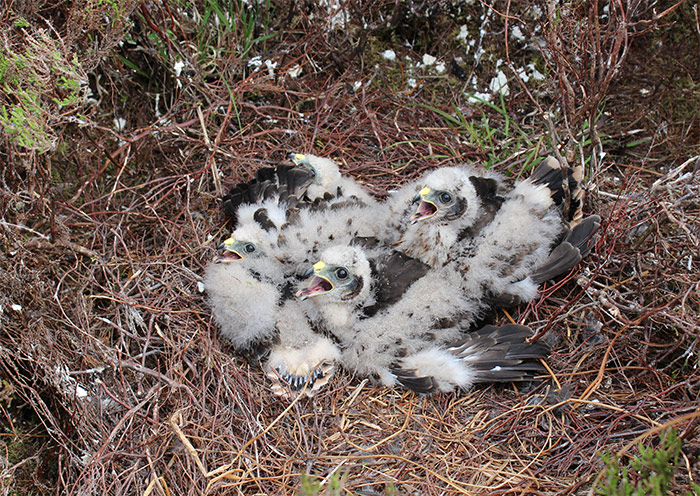
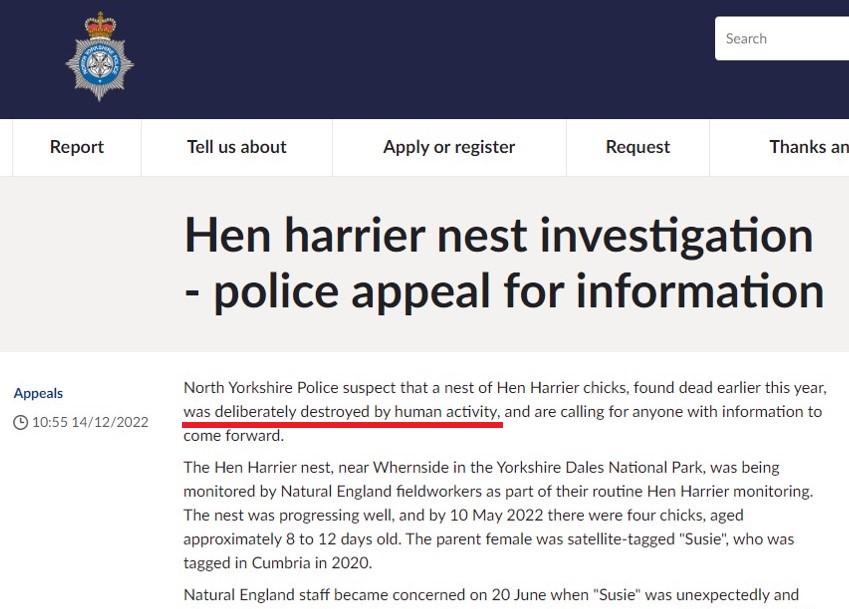
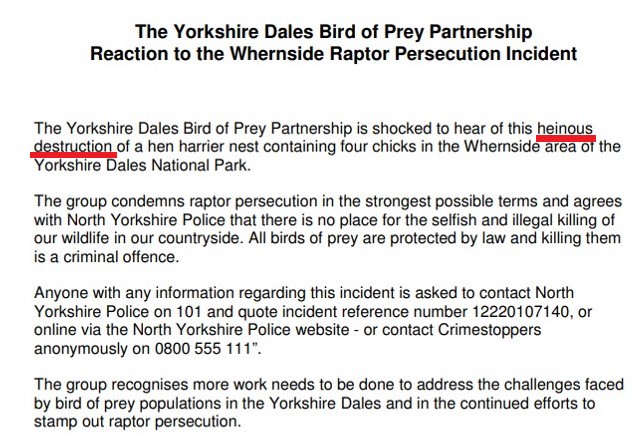
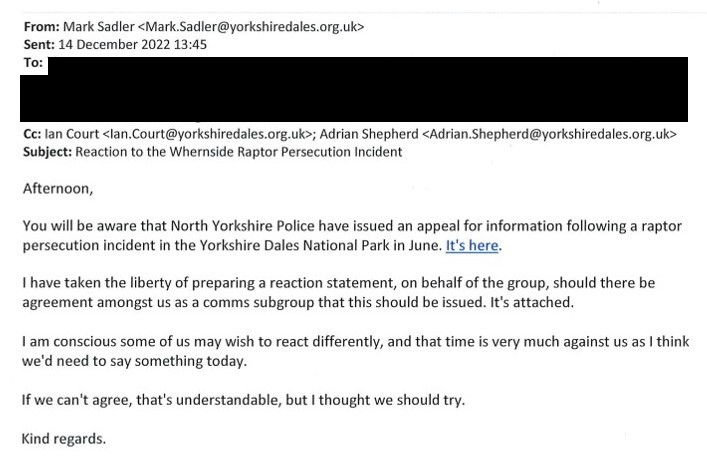
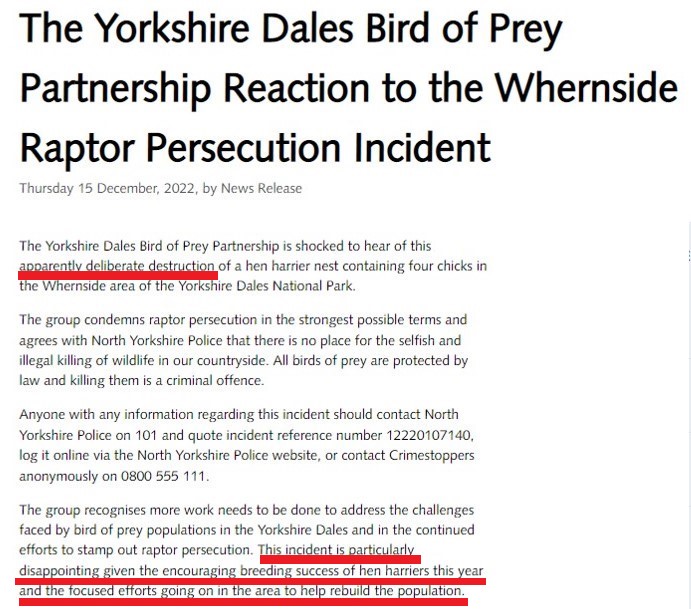
The Raptor Persecution UK blog recently reported the most horrific cruelty towards hen harriers with four chicks stamped to death in a nest on a grouse moor in the Yorkshire Dales National Park [here] and this was compounded by a Yorkshire Dales National Park Authority meeting where one of the Authority Board members stated the Dales is not natural country for hen harriers and red kites apparently because you don’t see them there [here]. Many readers of this blog know you don’t see these raptors because they’ve been killed and we all campaign in our own way to try to stop this happening.

In this guest blog I’ll take a look at the situation in the Peak District, the discussions within the Peak District National Park Authority (PDNPA) about birds of prey, who makes the decisions on policy and where the decision makers’ loyalties lie.

Photo by Ruth Tingay

First of all a little bit about the structure of National Park Authorities, taken from the Peak District National Park Authority’s website:

The National Park Authority is a public body made up of two groups of people – members and officers. The members are the people who make the decisions. They are responsible for setting policies and objectives, ensuring resources are well used and money is well spent. The officers are employees who work to the policies and carry out the decisions made by members. On routine matters members ask officers to take decisions directly, in line with agreed policies. Overall responsibility for the work of the officers lies with the Chief Executive‘.

There was a Peak District National Park Authority Meeting on 20th May 2022 where members discussed progress on delivery of the Park’s Management Plan (2018-2023). Officers were present to provide details of action taken.

Background: over the last year or so there’s been three incidents involving deaths and disappearances of hen harriers in the Peak District: The reported disappearance of a hen harrier in the Stocksbridge area in February 2022 [here], followed by the disappearance of male birds from two nest sites in the Upper Derwent Valley [here] which resulted in the nests failing. The meeting took place just after the nest failures were publicised.

One of the abandoned hen harrier nests in 2022. Photo by Peak District Raptor Monitoring Group.

Audio of the PDNPA meeting in May 2022 [listen here] 1:26:55 to 1:34.

Peak District National Park Management Plan 2018-2023 here.

During the meeting on 22nd May 2022, PDNPA Member Charlotte Farrell asked why the following target in the Management Plan is never met:

Restore populations of birds of prey to at least the levels present in the late 1990s, with the addition of hen harrier as a regularly successful breeding species‘.

She commented that the PDNPA needed to look at moorland management and grouse shooting and to be vocal about this.

Robert Helliwell was the PDNPA Member with responsibility for Natural Environment, Biodiversity and Farming (his term ended 30 June 2022). His response was astonishing:

Rewilding devastates bird populations because you lose the habitat for them.”

This was from the PDNPA Member – the person making decisions in the Peak District National Park – whose area of responsibility was biodiversity. And of course, he obviously sidestepped the request to be vocal on the links between grouse moor management and raptor persecution.

Also during the meeting, PDNPA Chair Andrew McCloy mentioned a “reputational risk” for the Authority but then said it’s an issue “out of our control”.

We need to challenge this derogation of public responsibility especially due to the secrecy of meetings between the PDNPA and shooting representatives and the involvement of pro-shooting groups in the management of the National Park – more of this below.

During the meeting, the Peak Park officer with responsibility for Landscapes described the recent “Chatsworth Moorland Managers Meeting” attended by South Yorkshire Police. There are the usual platitudes about how disappointing it is that two hen harrier nests failed and a complete failure to acknowledge why birds of prey disappear from grouse moors. These Chatsworth meetings are secret – there are no minutes and no list of attendees. If the PDNPA was serious about raptor persecution they would be very open about all the actions they were taking.

The PDNPA meeting in May 2022 provided a snapshot of one lone voice speaking out against wildlife crime. What about the other PDNPA members?

There are 30 members in the PDNPA. Sixteen are appointed by county, district, city or borough councils. Fourteen are appointed by the Secretary of State, eight of these have “specialist” knowledge to help the PDNPA and six are Parish Councillors. In total, eight members register an interest in the Conservative party and the Secretary of State is in a Conservative government. It’s easy to see how a National Park Authority can become a microcosm of the ruling party of government, especially when there’s no clear process for who gets “invited” to be a National Park Authority member.

May 2022 was the final PDNPA meeting for Robert Helliwell and the new person with responsibility for Natural Environment, Biodiversity and Farming is David Chapman, who lists an interest in Bolshaw Crop Nutrition, a local company that produces Industrial Powders, mainly lime based. Limestone quarrying is one of the biggest industries in the Peak District.

David Chapman is also Chair of the Land Managers Forum which was set up in 2006 by the PDNPA and ‘partners’ [here]. Four PDNPA members attend this forum and other attendees are nominated by National Farmers Union and Country Land & Business Association, formerly Countryside Landowners Association and a partner in ‘Aim to Sustain’, a coalition of game shooting interests which promotes game shooting. The PDNPA does not provide a list of the attendees (or their affiliations), no minutes are published and meetings are secret. These meetings are attended by PDNPA members with decision making powers but there is absolutely no accountability. This is supposed to be ‘democracy’.

As far as I’m concerned, there couldn’t be a clearer link between the PDNPA and game shooting. The PDNPA is supposed to be tackling the biodiversity crisis and I’m sure they’ll produce a very nice document to that end. But in the uplands grouse moor owners will look after their own interests, as they always have done and the PDNPA will go along their wishes.

This structure is about as democratic as the pandemic VIP lane for procurements. And until it changes raptor persecution in the Peak District will continue.

The purposes of the PDNPA are to preserve the natural landscape and to help people enjoy these areas. Instead, landowners’ interests are the priority and wildlife crimes are overlooked [Ed: see previous blog on abuse of power used to shield raptor killers in the Peak District NP here]. And don’t forget, National Parks are part of our government – apparently we voted for this.

ENDS