Today was the opening day of Chris Packham’s libel case at the Royal Courts of Justice against three individuals who are accused of a number of alleged defamatory actions against Chris.
There’s a pretty good write up of today’s events in the Guardian – here.
The court heard a small sample of that ‘puerile and offensive’ material as Chris’s barrister laid out the basis for the case. I suspect there may be much more of that to come given the appalling vitriol towards Chris, so obviously on public display over the two years this case has been in preparation.
The judge, the Honourable Mr Justice Saini, was scrupulously fair and reasonable today, clearly setting out, amongst other things, what he would and wouldn’t tolerate in the cross-examination phase, which begins tomorrow. The barrister for defendants 1 & 2, Nicholas O’Brien, was given a very clear direction from the judge about a particular line of questioning he intended to take when cross-examining Chris. Mr Justice Saini reminded Mr O’Brien to consider his ‘professional responsibilities’ when choosing his questions.
Fascinating!
UPDATE 4th May 2023: Chris Packham’s witness statement reveals devastating impact of the hate campaign against him (here)
The Welsh Government has confirmed an outbreak of highly pathogenic Avian Influenza H5N1 at a farm in Powys, mid-Wales.
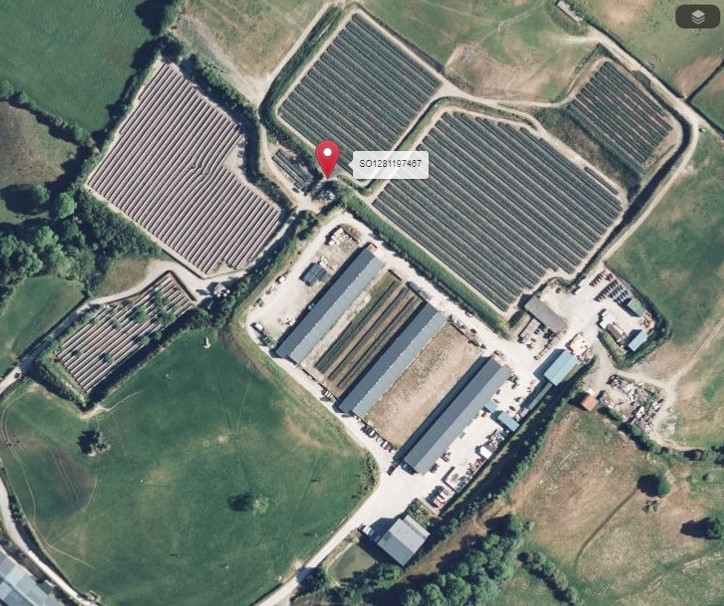
Stringent movement restrictions have been put in place and according to the Government’s declaration notice, the incident centres on grid reference SO12811 97467, which is at Bettws Hall, which describes itself as ‘Europe’s leading game hatchery’, producing pheasant, red-legged partridge and duck chicks for the gamebird shooting industry.
The Welsh Government has imposed a protection zone (blue circle) and a surveillance zone (black circle) around Bettws Hall Game Hatchery in Powys, mid-Wales.
An aerial view of the rows of pheasant and red legged partridge laying cages at Bettws Hall at the centre of the avian flu outbreak (via Google)
Some of the raised laying cages at Bettws Hall. Photo: Animal Aid
The Chief Veterinary Officer for Wales has written a declaration notice, which defines the protection and surveillance zones and details the restrictions now in place (from 27th April 2023 until further notice). The declaration notice can be read here:
This latest outbreak will be a blow, not only to Bettws, who are now unable to release gamebirds on their own shoot, but also to the wider game-shooting industry because Bettws Hall is a significant gamebird producer. Each year, according to its own promotional brochure, Bettws produces ‘in excess’ of 1.7 million pheasants, 35,000 ducks and an unknown quantity of red-legged partridges for gamebird shoots across the UK and the Irish Republic.
At a time when the UK shooting industry is looking to UK-based producers for its gamebird supply, rather than remaining reliant upon the big suppliers in France (and a few other European countries) where bird flu has recently disrupted the supply/delivery chain and caused a huge reduction in the number of shoots and the number of birds available to kill, this news from Bettws will be met with angst and fear from an industry under increasing pressure to survive.
Incidents involve species snares are intended to catch, such as foxes, and non-target species such as dogs, deer and badgers.
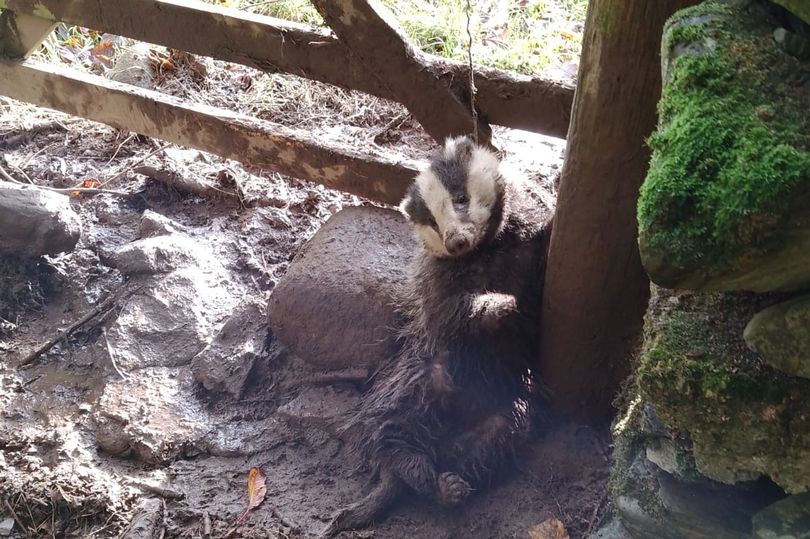
This young badger was left hanging by its neck for at least a day in an illegally-set snare in Dumfries & Galloway in November 2022. Fortunately it was rescued.
Snares are archaic traps used primarily to protect birds such as grouse and pheasants from foxes, so there is a surplus of these birds for people to shoot for ‘leisure’. They can cause considerable physical and emotional suffering to the animals trapped in them, and yet these cruel devices are still perfectly legal across Scotland and the rest of the UK, though a Bill currently going through the Senedd will soon ban them in Wales.
OneKind Campaigner, Eve Massie, said:
“Our latest snaring report, ‘SnareWatch Annual Report 2022: Case studies of snare use in the UK’, highlights the suffering inflicted upon animals by snares and why a ban on these outdated and cruel traps is crucial.
“Snares can cause the animals trapped in them considerable physical and mental suffering and yet unbelievably, these cruel devices are still legal in Scotland. Animals may suffer from deep wounds, internal organ damage or even death due to being trapped in snares. Death may be slow, as snares frequently become twisted or frayed as the animal struggles, leading to strangulation, or the animal succumbing to their injuries. They may also suffer from hunger, thirst, exposure and attacks from other animals.
“Snares also inflict emotional suffering, with trapped animals likely to become fearful and distressed“.
Eve commented on two of the incidents:
“In a particularly worrying case, a local discovered her 15-month-old Border Terrier, 2.5 hours after he had gone missing on his walk, trapped by his neck in a snare, choking in distress. Thankfully, the dog recovered.
“We also heard from a couple who found a distressed deer trapped with a snare around her neck. She was naturally panicking, causing the snare to tighten. She sadly died.
“As these reports show, snares are not only cruel, but indiscriminate to the species that they catch. Indeed, up to 70% of all animals caught in snares are not of the species snares are set for“.
On the Scottish Government’s current consideration of snaring, Eve continues:
“The Scottish Government is planning to introduce provisions on snaring at Stage 2 of the Wildlife Management and Muirburn (Scotland) Bill and a ban on the use of these archaic traps could be a real possibility.
“OneKind believes that there should be a complete ban on the use and sale of snares in Scotland. Thousands of our supporters wrote to the former Minister for Environment and Land Reform, Màiri McAllan, in favour of a ban and are responding to the Rural Affairs and Islands Committee’s call to views on the Bill, urging for a snaring ban.
“You cannot regulate cruelty“.
ENDS
OneKind is a partner in REVIVE, the coalition for grouse moor reform.
OneKind has published an excellent short (2 min 20 sec) film about snares on grouse moors. You can watch it in the link below:
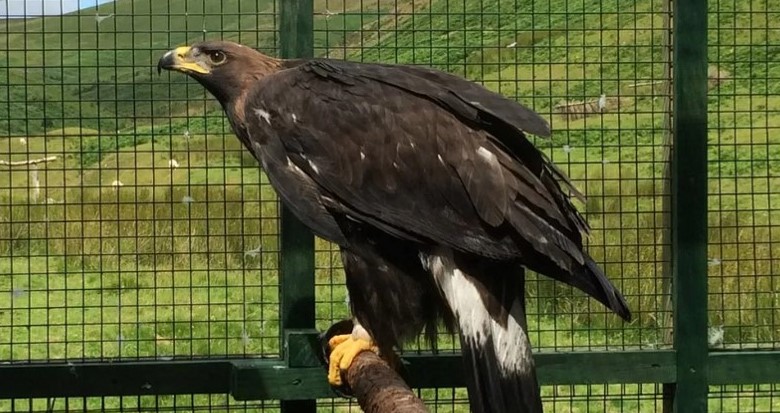
In February this year it was reported that a young golden eagle, named ‘Sula’, had been found dead on the Queensberry Estate, an estate within the Buccleuch portfolio in Dumfriesshire (see here).
She was from the South Scotland Golden Eagle Project, where eagles are being translocated from other Scottish regions in an effort to boost the declining population in the south. Sula had been translocated in 2022.
Photo: South Scotland Golden Eagle Project
The Veterinary Investigation Centre at Scotland’s Rural College (SRUC) in Dumfries conducted a variety of tests (toxicology, histopathology, virology, bacteriology and parasitology) and have now reported that the investigation did not find a definitive cause of death, but did conclude that Sula had been in “very fit condition” before her death. Avian flu was ruled out.
The South Scotland Golden Eagle Project website can be found here.
Last week I blogged about the suspicious disappearance of five more young hen harriers, who all vanished on moorlands in northern England between 17th August – 15th December 2022 (see here).
All five were from Natural England’s ludicrous hen harrier brood meddling scheme. Four ‘disappeared’ on moorlands in the Yorkshire Dales National Park and one ‘disappeared’ on moorland in the North Pennines AONB.
Hen harrier. Photo: Peter Christian
This news was picked up and published yesterday in The i by journalist Daniel Capurro – see here.
I’ve reproduced it here:
Five of Britain’s rarest birds of prey went missing last year, despite being part of an official scheme to reduce conflict with grouse moor managers, data quietly published by the Government shows.
Between August and December 2022, five hen harriers, which were satellite tagged and part of a pilot “brood management” scheme, disappeared.
Four of them went missing in the Yorkshire Dales National Park while one was lost in the North Pennines Area of Outstanding Beauty, both protected areas.
The data was released on the Government website in February without any accompanying announcement.
Campaigners have criticised brood management, which they say concedes too much to grouse moor managers, who see the raptors as a threat to their game, and does little to protect hen harriers. The birds are frequently the targets of illegal persecution.
In June last year, a camera-monitored hen harrier nest in the Dales was attacked and four healthy chicks killed. The camera appeared to have been deactivated and North Yorkshire police said the evidence pointed to human responsibility.
Earlier this week a programme aimed at ending conflict between land managers and raptors in the Peak District was abandoned after a decade following a failure to boost bird numbers or end persecution.
Dr Ruth Tingay, a campaigner who first spotted the disappearances, told i that the scheme was “a conservation sham”.
“The main objective of the trial was to assess whether grouse moor managers would stop illegally killing hen harriers if nesting attempts on grouse moors were disrupted and young birds released elsewhere.
“It’s pretty evident that they haven’t – at least 82 hen harriers have either been killed or have ‘disappeared’ in suspicious circumstances since the brood meddling trial began in 2018.”
She called for Natural England to “come down hard on the criminals in the grouse moor industry”.
Hen harriers, which are commonplace in Eurasia but threatened in the UK, have been the subject of extensive conservation work. They are best known for their delicate and elegant mating dances performed in the air over Britain’s upland areas, which featured in the BBC’s Wild Isles series.
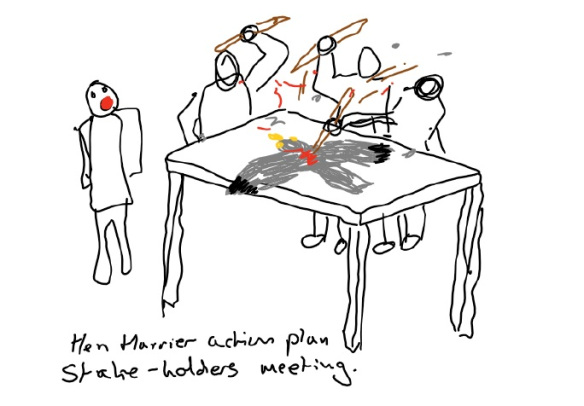
However, they prey on red grouse, which are central to the moorland shooting economy. Brood management was drawn up as part of Natural England’s Hen Harrier Action Plan, alongside conservation and game groups, to boost hen harrier numbers without unduly impacting on grouse moors.
The idea is to remove some eggs from wild nests on grouse moors, raise the birds in captivity and then release them into the wild. This is intended to reduce the so-called predation pressure on red grouse.
According to Natural England it “should lead to changes in some of the negative perceptions and behaviours within moorland communities and reduce illegal persecution of hen harriers”.
Its own data for 2019, the first year of the trial showed a 45 per cent survival rate for brood managed birds, compared to just 24 per cent for tagged birds outside the programme.
Nevertheless, major conservation groups including the RSPB have rejected the idea for various reasons, including that hen harrier numbers are not yet high enough to justify the practice.
They insist that efforts should focus on halting illegal persecution first and foremost, with the level of persecution too high both inside and outside the scheme.
A spokesperson for the RSPB told i: “We’ve made our objections on scientific and ethical grounds to brood management clear for many years. We believe the first step in hen harrier recovery should be the end of illegal persecution, as the evidence is clear that this is the main reason driving the decline of this bird of prey.”
That sentiment was echoed by Jono Leadley, regional manager for Yorkshire Wildlife Trust in North Yorkshire, who told i: “We are absolutely horrified that hen harriers continue to disappear across northern England. Action plans and interventions seem to make little difference – the big issue affecting these birds is illegal persecution and, until this is addressed, the future for hen harriers looks bleak.”
The Moorland Association, which takes part in the trial, referred questions about the tagged harriers to Natural England. Natural England was approached for comment.
ENDS
Those last two sentences are quite telling, aren’t they? The Moorland Association (basically the grouse moor owners’ lobby group in England) and Natural England were both quick to publicise the so-called ‘success’ of the brood meddling scheme after an increase in the number of breeding hen harriers last year (see here), and yet when it’s revealed that five more of their brood meddled hen harriers have ‘disappeared’ in suspicious circumstances, they’ve got nothing to say!
I was also interested in this paragraph from The i article:
‘Its own data for 2019, the first year of the trial showed a 45 per cent survival rate for brood managed birds, compared to just 24 per cent for tagged birds outside the programme’.
I’m not sure from where Daniel sourced this information – presumably from an NE article somewhere. However, it’s inaccurate. The five hen harrier chicks that were brood meddled in summer 2019 had all ‘disappeared’ by May 2020, according to NE (see here), although one of them (Tag ID 183703) may be an unidentified harrier that was breeding in 2021 and 2022, according to NE’s latest satellite tag database. But even if that bird is still alive, the other four are still listed as ‘missing’ which means the first-year survival rate for brood meddled birds in 2019 was 20%, not 45%.
The latest five hen harriers to ‘disappear’ (between Aug-Dec 2022) are not the only ones that NE (and the Moorland Association) is keeping quiet about. A large number of satellite-tagged hen harriers are rumoured to have been bumped off this spring (awaiting official confirmation – how long will it take for the news to emerge this time?).
We’re also waiting for NE to comment on two other satellite-tagged hen harriers that have both been the subjects of police investigations for about a year:
Hen Harrier ‘Free’ (hatched 2020) whose corpse was found on moorland in the Yorkshire Dales National Park on 12th April 2022 (grid ref: NY795013)
and
Hen Harrier ‘Harvey’ (hatched 2021) who went ‘missing’ on a grouse moor in the Yorkshire Dales National Park on 14th May 2022 (grid ref: NY918019).
I look forward to imminent news from NE on these two harriers. And if NE won’t publish the details, then I will.
Environmental campaigner and naturalist Chris Packham CBE will have his defamation case against the editor and two contributors to Country Squire Magazine heard in the High Court in London from Tuesday 2 May at 10.30am. The case is listed for eight days.
Mr Packham vigorously denies all the allegations made against him by the magazine and its contributors and will argue in his legal case that they have embarked on a campaign of online hatred and abuse which has caused him anguish, anxiety and distress.
Chris Packham. Photo by Jo Charlesworth
The defamation trial relates to nine articles, ten social media posts and two videos which it is argued the defendants are responsible for. The defendants are: the editor of Country Squire Magazine Dominic Wightman and contributors Nigel Bean and Paul Read.
The key allegations made in these materials are wholly refuted by Mr Packham and he argues that they are all defamatory, designed to damage his financial interests, credibility, integrity and his personal well-being. The allegations made include:
That Mr Packham dishonestly raised funds from the general public for The Wildheart Trust Sanctuary stating that it had rescued tigers from a circus where they had been mis-treated, when he knew the tigers had been well-treated and had been donated by the circus.
At the start of the COVID-19 pandemic Mr Packham dishonestly sought to raise funds for The Wildheart Trust Sanctuary by appealing for donations whilst concealing that it was due to receive a £500,000 pay-out under its insurance.
That Mr Packham lied when he said that gamekeepers on two Scottish estates were burning peat during the 2021 UN Climate Change Conference (COP 26) in Glasgow, when he knew that no peat was being burnt.
Mr Packham’s case is that the tigers he assisted rehoming from a rescue centre (operated by a leading European animal welfare organisation Animal Advocacy and Protection (AAP)) to The Wildheart Trust Sanctuary had been born into the circus before being moved to an unsuitable holding facility by the circus owners. He had been shown the conditions they suffered and the mistreatment they had been subjected to. The fact that they had been handed over to Animal Advocacy and Protection by the circus and not forcibly seized made no difference to his opinion that they had been rescued and were ultimately rehomed at The Wildheart Sanctuary where they would be properly looked after.
In relation to the allegations of further dishonest fundraising and insurance fraud against The Wildheart Trust Sanctuary Mr Packham‘s case is that in the early stages of the pandemic it was unclear whether the insurance policy would cover loss suffered during the lock-down and it was vital for the sanctuary, as with many other charities, to fundraise to ensure they could keep going. It was only much later that cover was confirmed and the money paid some months after that. However, without the initial fundraising the sanctuary would have likely had to close down and the tigers been returned to AAP.
Mr Packham’s case on muirburning (the burning of heather, gorse and other vegetation to facilitate grouse shooting) is that it cannot be guaranteed that the underlying peat will not be burned, releasing a large amount of carbon into the atmosphere and destroying important habitats for wildlife.
Throughout the course of the litigation the defendants have continued to repeat the initial defamatory allegations, sometimes under the guise of raising money for their own legal costs.
On top of this, the Defendants have continued to generate unpleasant material, including an allegation that Mr Packham wrote a death threat letter to himself, therefore deceiving his family and friends, and wasting police time. The defendants’ case is that a handwriting expert has confirmed that the handwriting from the death threat and a sample from documents taken from Companies House were written by the same person – however, the writing on the Companies House documents was written by Mr Packham’s accountant. Despite this being pointed out to them last year, Mr Wightman and Mr Bean maintain this allegation.
Mr Wightman and Mr Bean have indicated that they intend to rely on the defences to defamation of truth and publishing information in the public interest.
Mr Read is separately represented and his case is that he is not responsible for the publications attributed to him and his retweeting of the articles did not cause Mr Packham serious harm.
Chris Packham said:
“On a daily basis I endure an enormous amount of trolling from the field sports community and I’ve reconciled that this has to become part and parcel of my campaigning life. Occasionally the trolling is about other environmental issues and occasionally it’s about mental health, including my autism. However, in relation to the material at issue in this legal case I felt the defendants had clearly overstepped the mark and printed defamatory statements which were designed to damage my financial interests, my credibility, integrity and my personal well-being. I had no choice but to take civil litigation against these people.
“The actions of the defendants in making and repeating unfounded allegations, and their conduct throughout the course of this litigation, has been draining, exhausting and entirely counterproductive to living what could be described as a typical decent life. Ultimately this is about accountability, in a world where there is an increasing lack of accountability for those that cause harm to others, and this is not acceptable. In addition to their personal attacks about me, it is deeply concerning that in 2023 they still seek to protect and thereby encourage the keeping of big cats in circuses and protect those who want to damage our environment through burning our uplands for grouse shooting.
“Unfortunately, online abuse and hatred is commonplace in our society. People receive this for racial, religious, political, sexual and many other personal reasons. It damages their businesses, their education, their mental health and ultimately and tragically we have seen it can on occasion lead to people taking their own lives. Many people don’t have the financial capacity to go through the process of taking civil action or do not feel invested with the mental stoicism to fight their abusers in court, and I believe it’s important that this case focusses attention on this type of abuse. I believe we need reforms in the law to protect people from this kind of online harm and regardless of the outcome, I will be working closely with support groups addressing the heinous effects of online harm to try to tackle this issue.
“I go to court expecting to be fully vindicated that none of the defendants’ accusations have any truth.”
Carol Day, said:
“Our client feels that the defendants have behaved woefully throughout this litigation, incessantly repeating serious allegations and using the court process to make further damaging and hurtful statements about him. Mr Packham hopes that by taking this legal action the defendants will be held accountable for their actions and that others will realise they cannot make seriously damaging unfounded allegations against people, just because they don’t share their point of view.”
Mr Packham is represented by solicitor Carol Day and partner Tessa Gregory of law firm Leigh Day with Jonathan Price and Claire Overman of Doughty Street Chambers.
Dr Ruth Tingay, a friend and colleague of Mr Packham’s from Wild Justice, a not for profit that campaigns for legal reforms in environmental cases in the UK, has set up a Crowd Justice account to support the case financially. Details here.
ENDS
The judgement from a preliminary hearing on the case, where it was ruled the allegations about Chris were defamatory at common law, can be read here.
For anyone who still wants to pretend that the grouse shooting industry isn’t responsible for the systematic extermination of hen harriers on grouse moors across the UK, here’s the latest catalogue of crime that suggests otherwise.
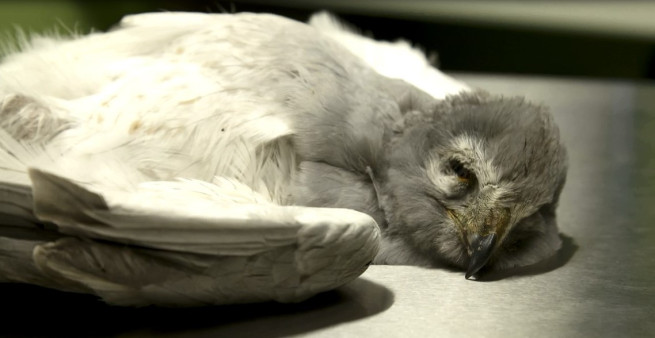
[This male hen harrier died in 2019 after his leg was almost severed in an illegally set trap that had been placed next to his nest on a Scottish grouse moor (see here). Photo by Ruth Tingay]
This is the blog I now publish after every reported killing or suspicious disappearance.
“They disappear in the same way political dissidents in authoritarian dictatorships have disappeared” (Stephen Barlow, 22 January 2021).
Today the list has been updated to include the most recently reported victims, five young hen harriers that ‘disappeared’ in suspicious circumstances between 17th Aug – 15th Dec 2022, four of them on moorland in the Yorkshire Dales National Park, one on moorland in the North Pennines AONB (see here).
I’ve been compiling this list only since 2018 because that is the year that the grouse shooting industry ‘leaders’ would have us believe that the criminal persecution of hen harriers had stopped and that these birds were being welcomed back on to the UK’s grouse moors (see here).
This assertion was made shortly before the publication of a devastating new scientific paper that demonstrated that 72% of satellite-tagged hen harriers were confirmed or considered likely to have been illegally killed, and this was ten times more likely to occur over areas of land managed for grouse shooting relative to other land uses (see here).
2018 was also the year that Natural England issued a licence to begin a hen harrier brood meddling trial on grouse moors in northern England. For new blog readers, hen harrier brood meddling is a conservation sham sanctioned by DEFRA as part of its ludicrous ‘Hen Harrier Action Plan‘ and carried out by Natural England (NE), in cahoots with the very industry responsible for the species’ catastrophic decline in England. For more background see here.
Brood meddling has been described as a sort of ‘gentleman’s agreement’ by commentator Stephen Welch:
“I don’t get it, I thought the idea of that scheme was some kind of trade off – a gentleman’s agreement that the birds would be left in peace if they were moved from grouse moors at a certain density. It seems that one party is not keeping their side of the bargain“.
With at least 82 hen harriers gone since 2018, I think it’s fair to say that the grouse shooting industry is simply taking the piss. Meanwhile, Natural England pretends that ‘partnership working’ is the way to go and DEFRA Ministers remain silent.
‘Partnership working’ according to Natural England appears to include authorising the removal of hen harrier chicks from a grouse moor already under investigation by the police for suspected raptor persecution (here) and accepting a £75k bung from representatives of the grouse shooting industry that prevents Natural England from criticising them or the sham brood meddling trial (see here). This is in addition to a £10k bung that Natural England accepted, under the same terms, in 2021 (here).
Cartoon by Gerard Hobley
So here’s the latest gruesome list. Note that the majority of these birds (but not all) were fitted with satellite tags. How many more [untagged] harriers have been killed?
February 2018: Hen harrier Saorsa ‘disappeared’ in the Angus Glens in Scotland (here). The Scottish Gamekeepers Association later published wholly inaccurate information claiming the bird had been re-sighted. The RSPB dismissed this as “completely false” (here).
5 February 2018: Hen harrier Marc ‘disappeared’ on a grouse moor in Durham (here).
9 February 2018: Hen harrier Aalin ‘disappeared’ on a grouse moor in Wales (here).
March 2018: Hen harrier Blue ‘disappeared’ in the Lake District National Park (here).
March 2018: Hen harrier Finn ‘disappeared’ near Moffat in Scotland (here).
18 April 2018: Hen harrier Lia ‘disappeared’ in Wales and her corpse was retrieved in a field in May 2018. Cause of death was unconfirmed but police treating death as suspicious (here).
8 August 2018: Hen harrier Hilma ‘disappeared’ on a grouse moor in Northumberland (here).
16 August 2018: Hen harrier Athena ‘disappeared’ on a grouse moor in Scotland (here).
26 August 2018: Hen Harrier Octavia ‘disappeared’ on a grouse moor in the Peak District National Park (here).
29 August 2018: Hen harrier Margot ‘disappeared’ on a grouse moor in Scotland (here).
29 August 2018: Hen Harrier Heulwen ‘disappeared’ on a grouse moor in Wales (here).
3 September 2018: Hen harrier Stelmaria ‘disappeared’ on a grouse moor in Scotland (here).
24 September 2018: Hen harrier Heather ‘disappeared’ on a grouse moor in Scotland (here).
2 October 2018: Hen harrier Mabel ‘disappeared’ on a grouse moor on the edge of the Yorkshire Dales National Park (here).
3 October 2018: Hen Harrier Thor ‘disappeared’ next to a grouse moor in Bowland, Lanacashire (here).
23 October 2018: Hen harrier Tom ‘disappeared’ in South Wales (here).
26 October 2018: Hen harrier Arthur ‘disappeared’ on a grouse moor in the North York Moors National Park (here).
1 November 2018: Hen harrier Barney ‘disappeared’ on Bodmin Moor (here).
10 November 2018: Hen harrier Rannoch ‘disappeared’ on a grouse moor in Scotland (here). Her corpse was found nearby in May 2019 – she’d been killed in an illegally-set spring trap (here).
14 November 2018: Hen harrier River ‘disappeared’ on a grouse moor in the Nidderdale AONB (here). Her corpse was found nearby in April 2019 – she’d been illegally shot (here).
16 January 2019: Hen harrier Vulcan ‘disappeared’ in Wiltshire close to Natural England’s proposed reintroduction site (here).
7 February 2019: Hen harrier Skylar ‘disappeared’ next to a grouse moor in South Lanarkshire (here).
22 April 2019: Hen harrier Marci ‘disappeared’ on a grouse moor in the Cairngorms National Park (here).
26 April 2019: Hen harrier Rain ‘disappeared’ on a grouse moor in Nairnshire (here).
11 May 2019: An untagged male hen harrier was caught in an illegally-set trap next to his nest on a grouse moor in South Lanarkshire. He didn’t survive (here).
7 June 2019: An untagged hen harrier was found dead on a grouse moor in Scotland. A post mortem stated the bird had died as a result of ‘penetrating trauma’ injuries and that this bird had previously been shot (here).
5 September 2019: Wildland Hen Harrier 1 ‘disappeared’ on a grouse moor nr Dalnaspidal on the edge of the Cairngorms National Park (here).
11 September 2019: Hen harrier Romario ‘disappeared’ on a grouse moor in the Cairngorms National Park (here).
14 September 2019: Hen harrier (Brood meddled in 2019, #183704) ‘disappeared’ in the North Pennines (here).
23 September 2019: Hen harrier (Brood meddled in 2019, #55149) ‘disappeared’ in North Pennines (here).
24 September 2019: Wildland Hen Harrier 2 ‘disappeared’ on a grouse moor at Invercauld in the Cairngorms National Park (here).
24 September 2019: Hen harrier Bronwyn ‘disappeared’ near a grouse moor in North Wales (here).
10 October 2019: Hen harrier Ada ‘disappeared’ on a grouse moor in the North Pennines AONB (here).
12 October 2019: Hen harrier Thistle ‘disappeared’ on a grouse moor in Sutherland (here).
18 October 2019: Member of the public reports the witnessed shooting of an untagged male hen harrier on White Syke Hill in North Yorkshire (here).
November 2019: Hen harrier Mary found illegally poisoned on a pheasant shoot in Ireland (here).
14 December 2019: Hen harrier Oscar ‘disappeared’ in Eskdalemuir, south Scotland (here).
January 2020: Members of the public report the witnessed shooting of a male hen harrier on Threshfield Moor in the Yorkshire Dales National Park (here).
23 March 2020: Hen harrier Rosie ‘disappeared’ at an undisclosed roost site in Northumberland (here).
1 April 2020: Hen harrier (Brood meddled in 2019, #183703) ‘disappeared’ in unnamed location, tag intermittent (here).
5 April 2020: Hen harrier Hoolie ‘disappeared’ on a grouse moor in the Cairngorms National Park (here)
8 April 2020: Hen harrier Marlin ‘disappeared’ on a grouse moor in the Cairngorms National Park (here).
19 May 2020: Hen harrier Fingal ‘disappeared’ on a grouse moor in the Lowther Hills, Scotland (here).
21 May 2020: Hen harrier (Brood meddled in 2019, #183701) ‘disappeared’ on a grouse moor in Cumbria shortly after returning from wintering in France (here).
27 May 2020: Hen harrier Silver ‘disappeared’ on a grouse moor on Leadhills Estate, Scotland (here).
2020: day/month unknown: Unnamed male hen harrier breeding on RSPB Geltsdale Reserve, Cumbria ‘disappeared’ while away hunting (here).
9 July 2020: Unnamed female hen harrier (#201118) ‘disappeared’ from an undisclosed site in Northumberland (here).
25 July 2020: Hen harrier Harriet ‘disappeared’ on a grouse moor in the Yorkshire Dales National Park (here).
14 August 2020: Hen harrier Solo ‘disappeared’ in confidential nest area in Lancashire (here).
7 September 2020: Hen harrier Dryad ‘disappeared’ on a grouse moor in the Yorkshire Dales National Park (here).
16 September 2020: Hen harrier Fortune ‘disappeared’ from an undisclosed roost site in Northumberland (here).
19 September 2020: Hen harrier Harold ‘disappeared’ on a grouse moor in the Yorkshire Dales National Park (here).
20 September 2020: Hen harrier (Brood meddled in 2020, #55152) ‘disappeared’ next to a grouse moor in North Yorkshire (here).
24 February 2021: Hen harrier Tarras ‘disappeared’ next to a grouse moor in Northumberland (here)
12th April 2021: Hen harrier Yarrow ‘disappeared’ near Stockton, County Durham (here).
18 May 2021: Adult male hen harrier ‘disappeared’ from its breeding attempt on RSPB Geltsdale Reserve, Cumbria whilst away hunting (here).
18 May 2021: Another adult male hen harrier ‘disappeared’ from its breeding attempt on RSPB Geltsdale Reserve, Cumbria whilst away hunting (here).
24 July 2021: Hen harrier Asta ‘disappeared’ at a ‘confidential site’ in the North Pennines (here). We learned 18 months later that her wings had been ripped off so her tag could be fitted to a crow in an attempt to cover up her death (here).
14th August 2021: Hen harrier Josephine ‘disappeared’ at a ‘confidential site’ in Northumberland (here).
17 September 2021: Hen harrier Reiver ‘disappeared’ in a grouse moor dominated region of Northumberland (here)
24 September 2021: Hen harrier (Brood meddled in 2021, R2-F-1-21) ‘disappeared’ in Northumberland (here).
15 November 2021: Hen harrier (brood meddled in 2020, #R2-F1-20) ‘disappeared’ at the edge of a grouse moor on Arkengarthdale Estate in the Yorkshire Dales National Park (here).
19 November 2021: Hen harrier Val ‘disappeared’ in the Lake District National Park in Cumbria (here).
19 November 2021: Hen harrier Percy ‘disappeared’ in Lothian, Scotland (here).
12 December 2021: Hen harrier Jasmine ‘disappeared’ on a grouse moor (High Rigg Moor on the Middlesmoor Estate) in the Nidderdale AONB in North Yorkshire (here).
9 January 2022: Hen harrier Ethel ‘disappeared’ in Northumberland (here).
26 January 2022: Hen harrier Amelia ‘disappeared’ in Bowland (here).
10 February 2022: An unnamed satellite-tagged hen harrier ‘disappeared’ in a grouse moor dominated area of the Peak District National Park (here). One year later it was revealed that the satellite tag/harness of this young male called ‘Anu’ had been deliberately cut off (see here).
12 April 2022: Hen harrier ‘Free’ (Tag ID 201121) ‘disappeared’ at a ‘confidential site’ in Cumbria (here).
May 2022: A male breeding hen harrier ‘disappeared’ from a National Trust-owned grouse moor in the Peak District National Park (here).
May 2022: Another breeding male hen harrier ‘disappeared’ from a National Trust-owned grouse moor in the Peak District National Park (here).
14 May 2022: Hen harrier ‘Harvey’ (Tag ID 213844) ‘disappeared’ from a ‘confidential site’ in the North Pennines (here).
20 June 2022: Hen harrier chick #1 stamped to death in nest on a grouse moor in the Yorkshire Dales National Park (here).
20 June 2022: Hen harrier chick #2 stamped to death in nest on a grouse moor in the Yorkshire Dales National Park (here).
20 June 2022: Hen harrier chick #3 stamped to death in nest on a grouse moor in the Yorkshire Dales National Park (here).
20 June 2022: Hen harrier chick #4 stamped to death in nest on a grouse moor in the Yorkshire Dales National Park (here).
17 August 2022: Hen harrier (brood meddled in 2022, #R1-M1-22) ‘disappeared’ on moorland in the Yorkshire Dales National Park (here).
5 October 2022: Hen harrier (brood meddled in 2022, #R3-M2-22) ‘disappeared’ on moorland in the Yorkshire Dales National Park (here).
10 October 2022: Hen harrier ‘Sia’ ‘disappeared’ near Hamsterley Forest in the North Pennines (here).
1 December 2022: Hen harrier (brood meddled in 2021, #R1-M1-21) ‘disappeared’ on moorland in the Yorkshire Dales National Park (here).
14 December 2022: Hen harrier (brood meddled in 2022, #R3-F1-22) ‘disappeared’ on moorland in the North Pennines AONB (here).
15 December 2022: Hen harrier (brood meddled in 2022, #R2-F1-22) ‘disappeared’ on moorland in the Yorkshire Dales National Park (here).
To be continued……..
Not one of these 82 incidents has resulted in an arrest, let alone a prosecution. I had thought that when we reached 30 dead/missing hen harriers then the authorities might pretend to be interested and at least say a few words about this national scandal. We’ve now reached EIGHTY TWO hen harriers, and still Govt ministers remain silent. They appear not to give a monkey’s. And yes, there are other things going on in the world, as always. That is not reason enough to ignore this blatant, brazen and systematic destruction of a supposedly protected species, being undertaken to satisfy the greed and bloodlust of a minority of society.
Five more young hen harriers have ‘disappeared’ in suspicious circumstances, according to data published quietly and without fanfare by Natural England in February 2023.
All five hen harriers were ‘brood meddled’ birds and all five of them ‘disappeared’ on moorland in what are supposedly protected landscapes: four in the Yorkshire Dales National Park and one in the North Pennines Area of Outstanding Natural Beauty (AONB).
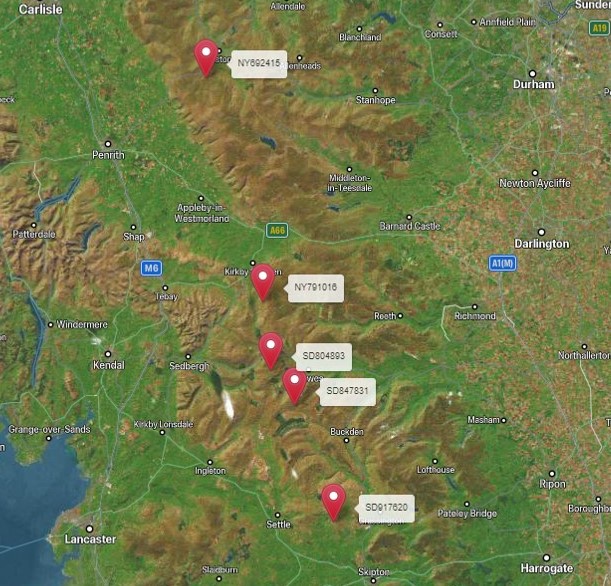
Last known locations of the five ‘missing’ hen harriers
The ‘missing’ hen harriers are as follows:
Brood-meddled Male, tagged July 2022, Tag ID 232637 (R1-M1-22), date of last contact 17th August 2022, grid ref: SD804893 (Yorkshire Dales National Park).
Brood-meddled Male, tagged August 2022, Tag ID 213920a (R3-M2-22), date of last contact 5th October 2022, grid ref: NY791016 (Yorkshire Dales National Park).
Brood-meddled Male, tagged July 2021, Tag ID 55145 (R1-M1-21), date of last contact 1st December 2022, grid ref: SD917620 (Yorkshire Dales National Park).
Brood-meddled Female, tagged August 2022, Tag ID 213921a (R3-F1-22), date of last contact 14th December 2022, grid ref: NY692415 (North Pennines AONB).
Brood-meddled Female, tagged July 2022, Tag ID 213931 (R2-F1-22), date of last contact 15th December 2022, grid ref: SD847831 (Yorkshire Dales National Park).
The data emerged from Natural England’s routine six-monthly update of its hen harrier satellite tag database, dated February 2023 (see here).
It’s interesting, isn’t it, that Natural England didn’t publish an accompanying blog with its data update, to draw attention to these latest ‘missing’ birds?
Why do you think that might be?
My view is that it’s because these latest data are damning of the ludicrous, ongoing hen harrier brood meddling trial on the grouse moors of northern England. For new blog readers, hen harrier brood meddling is a conservation sham sanctioned by DEFRA as part of its ludicrous ‘Hen Harrier Action Plan‘ and carried out by Natural England (NE), in cahoots with the very industry responsible for the species’ catastrophic decline in England. For more background see here.
In August last year, Natural England published a blog where it was claimed the results of the brood meddling scheme were ‘encouraging’ (here). As I and many others have said, repeatedly, nesting productivity is not the issue for hen harriers, survival is. Natural England and its so-called ‘partners’ can brood meddle as many chicks as it likes, it still doesn’t address the illegal killing that takes place once the chicks have fledged/been released.
The fact that all five of the latest ‘missing’ hen harriers are from brood meddled nests (four of them brood meddled in 2022, one in 2021) illustrates this point perfectly.
The latest five harriers ‘disappeared’ between 17th August – 15th December 2022. Four months on and I’m aware of a number of other ‘missing’ harriers whose stories are yet to be told. Watch this space.
Meanwhile, I’ll need to update the running total of hen harriers that have been illegally killed or have gone missing in suspicious circumstances, on or close to grouse moors, since 2018, when the brood meddling scheme began…
UPDATE 14.00hrs: 82 hen harriers confirmed ‘missing’ or illegally killed in UK since 2018, most of them on or close to grouse moors (here)
UPDATE 29th April 2023: Natural England & Moorland Association remain silent on latest ‘disappearance’ of five young hen harriers (here)
The Peak District National Park Authority has issued the following statement today:
PEAK DISTRICT BIRD OF PREY INITIATIVE TO CLOSE AS PERSECUTION CASES CONTINUE
The Peak District Bird of Prey Initiative is to close, with differing views among the group’s stakeholders and continued cases of persecution within the region leading to the initiative ‘no longer being able to deliver meaningful change’ – according to the National Park Authority, convenors of the initiative.
A buzzard and a peregrine found poisoned in the Peak District National Park. Photo: Staffordshire Police
Set up in 2011 by the National Park Authority, the initiative’s goal was for populations of the region’s key birds of prey or ‘raptors’ to be returned to levels last seen during the 1990s, and the re-establishment of hen harrier as a regularly breeding species.
The Peak District has historically been home to populations of iconic species such as the peregrine, goshawk, merlin – the UK’s smallest raptor – and the hen harrier, one of the most persecuted birds of prey in the country. A supporting cast of other raptors includes the short-eared owl, with increasing sightings of red kites and ospreys.
Despite more than a decade of the initiative, which included representatives from the landowning and gamekeeping community, experienced raptor surveyors, conservation groups, the police and other bodies, populations of many of the key species have not increased at the rates initially hoped for with some seeing no improvement at all. Whilst hen harriers have returned to the area, successful breeding currently remains limited.
Those involved in the annual surveying of raptors within the study area – largely comprising the National Park’s ‘Dark Peak’ uplands, have recently stated they no longer felt they could continue supporting the group. The RSPB stepped down as a member of the initiative in 2018.
Although progress has been seen with some species including the goshawk, and with the Initiative acknowledging that other species’ population changes appear to be mirroring those of wider UK trends, direct persecution has remained a factor alongside the initiative’s decade-long existence.
Incidents of shooting, poisoning, trapping, nest destruction or the disappearance of satellite-tracked birds active within the Peak District have featured in every year of the initiative’s monitoring.
The National Park Authority believes that until these illegal activities are tackled, meaningful progress towards population increases in key species will not be possible.
Phil Mulligan, chief executive of the Peak District National Park Authority said: “It is with regret that we are closing the initiative after more than a decade of endeavours to safeguard our charismatic birds of prey that have a rightful place here in the National Park.
“Featuring at the very top of local ecosystems, these species like the hen harrier, peregrine and goshawk should be a flagship for landscapes and habitats at the heart of nature’s recovery.
“The fact that the work of the initiative has failed to reflect those target populations of some 30 years ago remains a cause for real concern, and it is without question that illegal persecution targeted towards some of these species is one factor behind this stuttering progress.
“I would like to extend my thanks to those who have put their time, energies and passion into the painstaking study, sharing of information and analysis of our raptor populations during the initiative’s existence, but we must now look at alternative ways to ensure our birds of prey have a future in the Peak District – free from the risk of illegal actions.”
The Authority has confirmed that it will continue working with a range of local stakeholders on priority actions for the future of birds of prey in the Peak District and potential activities will be outlined as part of the Authority’s ‘Nature Recovery Plan’ due to be released this summer.
ENDS
Hats off to the new Park Authority Chief Executive Phil Mulligan for having the guts to pull the plug on this long-running fiasco and especially for writing such an unequivocal and damning press release about the ongoing raptor persecution in this National Park.
The Peak District Bird of Prey Initiative has been an abject failure, consistently failing to meet its targets year after year. Calls by conservationists for it to be disbanded were routinely ignored by the previous Chief Executive over many years, providing an opportunity for the grouse-shooting organisations to pretend that they were working productively and cooperatively to bring an end to raptor persecution in the Park. Behind the scenes, the reality was somewhat different (e.g. see here and here).
The disbanding of this fake partnership signals a renewed hope for the area’s raptors, removing the persecution deniers from a position of influence. It’s now time for the Park Authority to form a genuine partnership that isn’t constrained by grandstanding propagandists whose sole intent seems to be to shield the criminals, not just from view, but from justice.
Previous blogs on the Peak District Bird of Prey Initiative can be read here, here, here, here, here, here, here.
In February this year, a team of scientists from Cambridge University published a study that found that 94% of pheasants on sale in the UK for human consumption were killed using toxic lead (see here).
It was the third scientific paper published by the ‘Shot-Switch‘ group, which was established in 2020 to monitor the shooting industry’s professed voluntary five-year transition from toxic lead to non-lead ammunition in the UK; a massive U-turn by the shooting industry after defending the use of toxic lead ammunition for years.
The Shot-Switch team buys pheasants from retailers during each shooting season and undertakes rigorous scientific tests to determine whether they’ve been shot with toxic lead or non-lead ammunition.
This third paper, published in the highly-regarded Conservation Evidence journal, documenting that 94% of pheasants on sale during the 2022/23 season were contaminated with toxic lead, demonstrated that the shooting industry’s voluntary initiative to phase out toxic lead shot for pheasant hunting has so far had little impact.
This is fairly embarrassing for the game shooting industry, obviously, and, unsurprisingly, there was very little public response from them when the peer-reviewed paper was published in February.
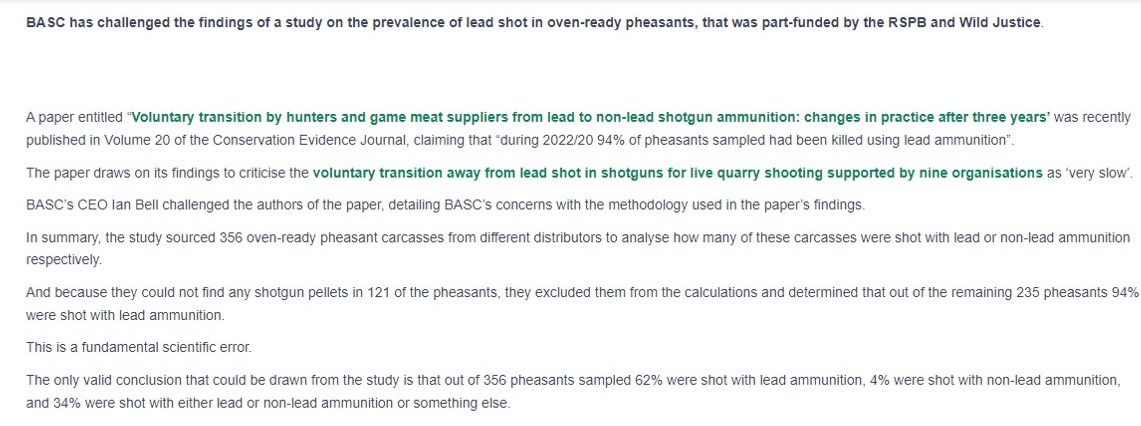
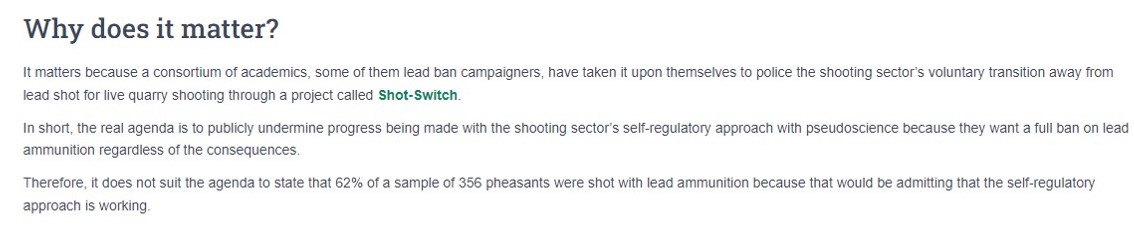
Also unsurprisingly, at least one prominent shooting organisation has raised what it calls ‘significant concerns‘ about the accuracy of the most recent paper’s conclusions.
The Chief Executive of BASC (one of the nine shooting organisations that in 2020 committed to the 5-year voluntary transition away from toxic lead) wrote to the paper’s lead author, Professor Rhys Green, to raise those concerns in March 2023.
You can read what those concerns are, and how the expert scientists have responded, in this letter that’s just been published on the Shot-Switch website:
Astonishingly (or not!), BASC has responded today by publishing an outrageous slur on its website where it describes the Shot-Switch study as “pseudoscience“.
The BASC statement also fails to provide details of the Shot-Switch scientists’ responses to BASC’s concerns:
Of course the shooting organisations will want to undermine and discredit any research that demonstrates the industry’s intransigence and complete failure to self-regulate; it’s their stock response and they’ve been doing it for years (see their endless attempts to discredit scientific reports of ongoing raptor persecution, for example).
And it’s really no surprise that BASC is fronting this latest attack, given the revolt this organisation faced from its own members when it finally U-turned in 2020 and suggested a move away from toxic lead ammunition. I expect BASC’s latest response is to try and placate some of those members (and perhaps entice back some of its now ex-members).
But I’m really surprised at Dr O’Gorman’s accusation that the Shot-Switch project is “pseudoscience“. As someone with a PhD, he’ll know the appropriate process for challenging peer-reviewed scientific rigour is to submit a rebuttal to the journal that published the research, rather than pen a nasty, derogatory article on a website without providing the detailed responses of the expert scientists he’s accusing of false results.
Can we expect to see such a letter in the journal Conservation Evidence? No, thought not.
Fortunately, as the Shot-Switch scientists have had the decency to be transparent and publish their responses in full on their own website, people can read the evidence for themselves and draw their own conclusions.
It’s worth noting the following statement at the foot of the Shot-Switch website:
‘The Royal Society for the Protection of Birds and Waitrose & Partners contribute to the costs of materials and reagents for the study.
SHOT-SWITCH also approached two of the leading science-based organisations that made the joint statement on the 24th of February 2020 (BASC and GWCT) in April-September 2020 when the project was being planned and invited their involvement in its design and funding. Similar approaches were made in August 2021 and August 2022. BASC and GWCT have so far declined to participate in the project’.
UPDATE 16th August 2023: BASC ‘forgets’ to mention evidence showing no difference between penetration level of lead vs steel shot in ‘game meat’ (here)








 Raptor Persecution UK