inquiry after buzzard shot dead in Aberdeenshire

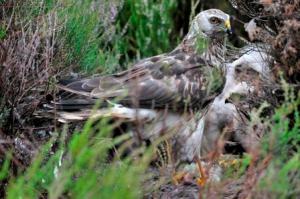
In May 2007, Police appealed for information after a buzzard was shot dead in Aberdeenshire.

The bird was recovered in woodland near St Cyrus, and an X-ray showed four shotgun pellets in its body.

Grampian Police believe it may have been shot several months earlier, and said various lines of inquiry were being pursued.

Buzzards are protected under law and offenders can be jailed for up to six months or fined up to £5,000.

Grampian Police Wildlife Crime Officer Pc Dave MacKinnon said: “I am appealing to anyone who may have information about this incident or the illegal killing of protected species to come forward with their information.”

http://news.bbc.co.uk/1/hi/scotland/north_east/6611821.stm

gin traps and a poisoned buzzard found on balmanno estate, perthshire

After several poisoning incidents in the Glenfarg area of Perthshire over a number of years, a buzzard poisoned by carbofuran was found on the Balmanno Estate in November 2001.

Tayside Police, the Scottish Executive Environment and Rural Affairs Department and the RSPB searched the shooting estate, as well as the premises of the gamekeeper, on 15 March 2002, under powers of the Food and Environment Act. On the estate, they found a freshly dead crow, which was later found to contain carbofuran. At the keeper’s premises they found a small quantity of carbofuran, a small egg collection and several gin traps with pieces of fur on the jaws. The keeper was detained and admitted that he had used the gin traps to take fox cubs. Admissions were also made in relation to the buzzard’s egg.

A poisoned buzzard

After many hearings, stretching back to an original trial date of 19 November 2002, the keeper changed his pleas to guilty. On 12 November 2003, at Perth Sheriff Court, he pleaded guilty to charges of possession of carbofuran in an unlabelled container, possession of several gin traps for use against foxes and possession of one buzzard egg.

The Procurator Fiscal accepted a ‘not guilty’ plea to poisoning a crow with carbofuran. The keeper was fined £250.


In Scotland, gin traps were only banned for use against foxes in 1974; in England and Wales, they were banned in 1958.

http://www.rspb.org.uk/Images/23-0617-03-04_legal%20eagle40%20v2_tcm9-132963.pdf

Gamekeeper convicted of poisoning 5 buzzards at tillyrie farm, perthshire.

On 21st November 2001, at Perth Sheriff Court, a gamekeeper was convicted of placing a bait containing carbofuran at Tillyrie Farm, Milnathort, Perthshire,  poisoning five buzzards and a carrion crow and possessing the banned substance carbofuran for the purpose of committing offences against the Wildlife and Countryside Act 1981. He was also convicted of illegal carbofuran storage under the Control of Pesticides Regulations 1986.

He was fined a total of £2,400.

 At the time of the offence, the keeper leased the shooting rights at Tillyrie Farm and ran it as a pheasant shoot. Tillyrie Farm is owned by racehorse trainer Dorothy Thompson, who praised her gamekeeper by saying, “He makes a very good job of rearing the birds [pheasants] and wildlife on the estate has increased for the better”.

The keeper subsequently appealed his conviction at the High Court of Judiciary Appeal, Edinburgh, in September 2003. The appeal was unsuccessful and the keeper was ordered to pay the original £2,400 imposed by the Court.

http://www.telegraph.co.uk/news/uknews/1339741/Gamekeeper-denies-coffee-jar-poisoning-of-buzzards.html

Golden eagle found poisoned on Cawdor Estate, Invernesshire

A golden eagle found dead on Cawdor Estate, Invernesshire, on 6 August 2001 had been poisoned by Carbofuran. The dead eagle’s decomposed remains were found by a hillwalker.

Cawdor Estate Factor John Higson and Head Gamekeeper Roddy Forbes denied any wrong-doing and suggested that the dead eagle could have been brought in by someone in their rucksack and planted on the estate to cause trouble. This explanation is commonly used by Alex Hogg, Chairman of the Scottish Gamekeepers Association, to account for the numbers of dead raptors that turn up on shooting estates. Our sources suggest that recent DNA evidence has proven these claims unfounded.

Since 1988, there have been six other incidents involving the illegal use of poisons connected to the Cawdor Estate. These include:

1988: A pet labrador dies after consuming the deadly poison, strychnine, while walking on Cawdor estate.

1992: A buzzard, magpie and sheep all laced with strychnine are discovered on the estate.

1993: A buzzard found poisoned by the toxin, alphachloralose, on Forestry Commission land 100 metres from the boundary of Cawdor estate.

1994: Three buzzards and rabbit bait found poisoned by alphachloralose on Cawdor.

1996: Three baits discovered containing poisons: a hare laced with alphachloralose, a goat with aldicarb and a wigeon with strychnine.

1996: A hidden pit containing a suspected birds of prey poisoning kit uncovered by investigators three miles from Cawdor Castle.

1999: A report sent to the procurator fiscal alleging that mountain hares were illegally persecuted in snares.

2000: A second report submitted to the fiscal claiming mistreatment of hares.

2001: A dead eagle found on Cawdor estate confirmed to contain the lethal poison, carbofuran.

No convictions have been made as it has not been possible to identify the individual who laid the bait.

For further information: http://findarticles.com/p/articles/mi_qn4156/is_20010826/ai_n13961693/?tag=content;col1

2nd white-tailed sea eagle poisoned nr Mallaig, western Scotland

This is the second poisoned eagle found at this site in little over a year

In February 2003, a hillwalker found the corpse of a white-tailed sea eagle on the Morar peninsular near Mallaig, Western Scotland. Tests revealed this was the female of a nearby breeding pair and she had been poisoned. Her mate had been poisoned in the same area a year earlier, on land farmed by the Mackay family. Both birds were part of the sea eagle reintroduction project in Western Scotland.

Further information: http://www.snh.org.uk/publications/on-line/magazines/teachdantir/seaeagle.asp

Although many members of the local community welcome sea eagles (and especially the revenue they generate from tourism), there is a small group of sheep farmers who want the government to remove the eagles because they consider them a threat to their lambs. No convictions have been secured for this incident.

gamekeeper guilty of shooting hen harrier on Craigmill Estate, Morayshire

In May 2001, a part-time gamekeeper on Craigmill Estate, Morayshire was convicted of shooting a young female hen harrier. He pleaded not guilty to killing a 2nd harrier on the same day, not guilty to having both dead birds in his possession, and not guilty to carrying a shotgun for the purpose of killing a wild bird. The court accepted his not-guilty plea. He was fined £2,000 for killing the harrier.

In July 2000, the hen harrier nest had been under close observation by RSPB workers because eggs had been destroyed in previous years. They recorded video footage of the keeper as he approached the nest and shot the bird. In his defence, the keeper stated he had been attempting to restore the area for grouse shooting and he had shot the bird in “acute frustration”. There is a long history of hen harrier persecution on grouse moors in the UK, making it the most persecuted raptor in Britain.

Further info: http://news.bbc.co.uk/1/hi/uk/1352092.stm

white-tailed sea eagle poisoned nr Mallaig, western Scotland

In March 2002, an adult white-tailed sea eagle was found dead on the Morar Peninsular near Mallaig, Western Scotland. Tests revealed this was the male of a breeding pair and he had been poisoned with Aldicarb.

This eagle had been donated by Norway as part of the sea eagle reintroduction project, and he had been released in Wester Ross in 1997. In 2000, when only three years old, he found a mate and they successfully raised one chick that year. Breeding at such a young age is unusual – normally, sea eagles do not breed until they are at least five years old.

Sadly, his female partner was also poisoned in the same area in the following year.

Dumfriesshire gamekeeper fined for setting illegal trap

On 12th January 2009 at Dumfries Sheriff Court, part time gamekeeper Jonathon Charles Galbraith of Hightae, Lockerbie, pleaded guilty to two charges under the Wildlife and Countryside Act. These related to the illegal use of a spring trap against wild birds and animals listed under section 6 of the Act.

He was fined £1,400

Example of a Fenn spring trap as used by Galbraith.

On the 21st August 2008 the Scottish SPCA received an anonymous complaint that there was an injured bird in a trap at Kirkhill Farm near Dalton where Galbraith had sole responsibility for the management of a pheasant shoot.

The following day SSPCA officers visited Kirkhill Farm to look for the injured bird and subsequently discovered an un-set spring trap beside a dead pheasant poult next to an active pheasant release pen.

 As officers widened their search of the area they were alerted to an approaching motor vehicle. They then observed Mr Galbraith set the spring trap and place it on top of the dead pheasant poult.

The officers approached Galbraith and interviewed him about the trap. He admitted setting the trap and claimed that “something” was killing his pheasants. Presumably he was referring to a raptor.

Spring traps are often illegally set in this manner or on top of posts to catch raptors and corvids by the legs.

Young golden eagle poisoned in Ireland

The body of the poisoned golden eagle found in Ireland in February 2010.

Raptor persecution is not just limited to Scotland. It is also prevalent in other parts of the UK and the Irish Republic. We will be highlighting these incidents on this blog in due course, beginning with the young golden eagle that was found poisoned in Ireland in February 2010.

Any golden eagle poisoning event is tragic, but this one particularly so. This 10 month old eagle hatched in the wild in Donegal in 2009 and became one of the first wild-bred golden eagles in Ireland for over 100 years. The Golden Eagle Trust has been working hard to re-establish a population of golden eagles in Ireland, after they were persecuted to extinction during the last century. Young golden eagle chicks have been donated from nests across Scotland (typically from nests containing two chicks where usually only one chick would survive naturally) and released and monitored throughout north-west Ireland.

This eagle had been poisoned by Nitroxynil, which had been poured over the fleece of a dead lamb.

For further detailed information, please see: http://www.goldeneagle.ie/news_viewnews.php?x=5&z=132&news_id=11&article=262

Paltry Fine for Cabrach Estate Gamekeeper who Shot Trapped Buzzards

According to a report in the Press and Journal, on 27 April 2006 a gamekeeper on the Cabrach Estate in NE Scotland shot two buzzards he had caught in a crow trap and was seen burying them down a nearby rabbit hole. The keeper, David Scott, was subsequently charged and due to the seriousness of the offence, the matter was fast-tracked by the Fiscal. He appeared at Egin Sheriff court in May 2006, pleaded guilty and was fined a paltry £200 when potentially the fine could have been ten times this level.

Apparently an additional 11 buzzards that had been shot were found buried in rabbit holes near the crow trap, according to the RSPB’s 2006 Annual Persecution Report.

From the Press & Journal, 9 May 2006 (written by Raymond Shewan):

A Gamekeeper shot two buzzards which had become caught in a trap designed to control crow numbers, Elgin Sheriff Court heard yesterday.

It was claimed that David Scott, 40, killed the protected birds of prey rather than risk injury trying to release them.

His solicitor, William Park, said Scott now realised he had not chosen the right course of action in shooting them.

Fiscal depute Geoff Main told the court that witnesses walking on the Cabrach estate, near Dufftown, had seen a trap containing two crows and two buzzards and had watched as Scott drove up in a Land Rover before shooting the buzzards and disposing of them in rabbit holes.

Mr Park said Scott was an under-keeper on the estate which had a serious problem with carrion crows and hooded crows killing the chicks of ground-nesting birds, including grouse.

The estate had given its keepers permission to trap crows and it had seven traps which were designed to lure them with a live decoy.

On April 25 Scott, of the Kennels, Cabrach Lodge, had checked one of the traps and found two buzzards which had found their way in, attracted by rabbit bait put down for crows.

Mr Park said Scott, who admitted two charges of breaking wildlife and countryside legislation by intentionally killing the buzzards, was in a situation where he had to make a choice of what to do.

He said one option would have been to open the trap and release the birds, but that would also have meant releasing the crows.

Alternatively, he could have gone into the trap – which measured 6ft by 6ft by 5ft – to manually remove the buzzards, although Mr Park claimed that would have put him at some risk of “significant harm”.

“In the circumstances, he elected to shoot the birds,” said Mr Park. “He realises the decision he took was a serious error of judgment on his part and one he must accept responsibility for. He realises that such offences can provoke strong feelings, but there was no cruel intent or malice on his part.”

Sheriff Robert Brodie said he found it difficult to understand Scott’s decision to shoot two protected birds.
He noted that Scott was a first offender and fined him £200.

END

Eight years earlier, police raids in February and March 1998 reportedly revealed widespread poisoning across the estate – 10 rabbits, 6 pigeons, 6 grouse and 2 hares were laced with the lethal poison Carbofuran and laid out on the hill. Three illegal pole traps and an owl whose legs had been smashed by a trap were also reportedly found, along with a dead peregrine in the back of the estate’s landrover. Tests revealed the peregrine had been poisoned with Carbofuran. The head gamekeeper was convicted at Elgin Sheriff Court in October 1998 and was fined £700.

The estate is reportedly owned by multi-millionaire Christopher Moran, a businessman with an interesting past. See here for details.