
 A news article (here) has appeared on the SGA website this morning claiming that “Gamekeepers are the unsung heroes of conservation“. Let’s look at the ‘evidence’ produced to back up this claim.
It apparently comes in the form of a new report by “independent” charity GWCT, detailing the results of a UK-wide gamekeeper survey. Earlier this year, gamekeepers were asked to write down what species were found on their shoots. It’s not clear what scientific field surveys, if any, were conducted, because the GWCT report has not yet been published. Let’s give them the benefit of the doubt and assume that scientifically-rigorous transects were repeated across the shooting lands to support these ‘scientific’ findings.
According to the SGA website, “over 80% of respondents reported having kestrels, buzzards, sparrowhawks, barn and tawny owls on their patch.” The article doesn’t say if these were dead or alive. It also doesn’t say how many reported having golden eagles, white-tailed eagles, hen harriers, goshawks, red kites, short-eared owls or peregrines on their patch, which would have been far more interesting. We’ll have to wait for the publication of the report.
The article continues – “The area of land managed by gamekeepers who took part in the survey (1,337,454 ha) is five times the total area of all Britain’s National Nature Reserves (255,789 ha) and 13 times the total area of all RSPB reserves (101,581 ha).” SGA chairman, Alex Hogg interprets this as: “It’s clear that there’s more wildlife on the land managed by keepers in Britain than on all the nature reserves and special protection areas put together.” Erm, I don’t think that’s clear at all, Alex. What these figures show, if they are accurate, is that gamekeepers ‘manage’ five times the total area of NNRs and RSPB Reserves (which is a worrying statistic in itself). What the figures do not show is a comparison of wildlife density between these managed areas. Unless of course gamekeepers have been conducting their scientifically-rigorous transects across NNRs and RSPB Reserves as well. Again, we’ll have to wait for the publication of the report.
The article goes on to disclose the ‘informal’ working relationship between gamekeepers and the law enforcement agencies and generally tells us all what great guys (“heroes“) the UK’s gamekeepers are. Most sensible people will look at the annual raptor persecution statistics and the annual convictions of gamekeepers for wildlife crime offences, and make up their minds about how ‘heroic’ some of these keepers are. It’s a shame, because undoubtedly there are a handful of truly ‘good guys’ in the industry, but as we keep seeing, there are an awful lot who repeatedly bring the industry into disrepute by their criminal activities.
An article about the forthcoming report appeared in The Telegraph (here). Written by Environment Correspondent Louise Gray, it’s littered with inaccuracies including, “A number of gamekeepers have even been imprisoned for illegally poisoning rare birds of prey“. Er, no they haven’t.
A note of interest – the “independent” charity GWCT who organised this survey (see here for a recent post on this so-called ‘independence’) has listed William Powell amongst its list of “dedicated supporters and corporate partners” (sponsors?) at this year’s CLA Game Fair (see here). Would this be the same William Powell (Gunmakers) that was sold to Mark Osborne in January 2008?
 Police have today raided a sporting estate near Inverness to investigate allegations of wildlife crime. Although we know the name of this estate, we are acting upon advice not to release it at this time.
 The case against former Holkham Estate Head Gamekeeper Nicholas Parker was finally heard yesterday at Norwich Magistrate’s Court. He was given a conditional discharge.
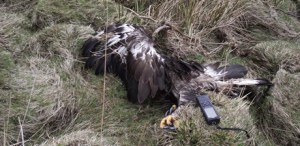 The latest figures detailing illegal animal poisoning incidents in the first quarter of 2011 have just been released by Science and Advice for Scottish Agriculture (SASA) on behalf of the Scottish Government.
 Two years ago in July 2009, Alma, a two-year golden eagle who had been satellite-tracked across Scotland from her birth place on the Glenfeshie Estate,
  Raptor Persecution UK