Stand up and take a bow, Rognvald (Rog) Wood, who wrote the following article in The Herald this week, under the headline, “Pity the graceful hen harrier in grouse season“.
Today may well be the “Glorious 12th” for the landed gentry and the privileged few who can afford to shoot grouse, but spare a thought for the unfortunate “muir cocks” for whom today will be their last.
Over the past few days I have been receiving press releases from estate agents revealing the prospects for the coming season on the various grouse moors around Scotland.
While the breeding success of grouse this year is of interest to a minority, there are a lot more folk who would like to know about the breeding success of graceful hen harriers, another bird that lives on our heather-clad hills, but has the misfortune to be a predator of grouse.
I can reveal that, once again, hen harriers have had an unsuccessful breeding season.
A report published in February of this year by the UK’s nature conservation co-ordinator on hen harriers in the UK said that persecution is a significant factor limiting growth of the hen harrier population.
Persecution was considered to be a particular problem in areas associated with grouse moor management in Scotland where numbers of the raptors are kept at rock-bottom.
Not surprisingly, the report came under heavy fire from the shooting fraternity and landed gentry who claimed it contained serious scientific flaws that undermined its conclusions.
Those allegations were strongly rebutted by Professor Des Thompson, SNH principal adviser on bio-diversity, who said: “The report is not flawed and is a robust piece of scientific work carried out by some of Britain’s leading raptor scientists.”
Underlining the extent of persecution – that includes destroying nests and eggs as well as shooting the raptors – Prof Thompson went on: “This study supports an independent study published last year by Prof Steve Redpath and colleagues that calculated there should have been 500 successful hen harrier nests on Britain’s grouse moors in 2008 when there were only five – just 1% of the predicted number.”
Farmer, author and journalist, Rog Wood has been farming correspondent for several specialist farming publications. Writing as Tom Duncan in the Sunday Post for 19 years, he is currently farming editor of The Herald. He is also a former columnist with the Standard.

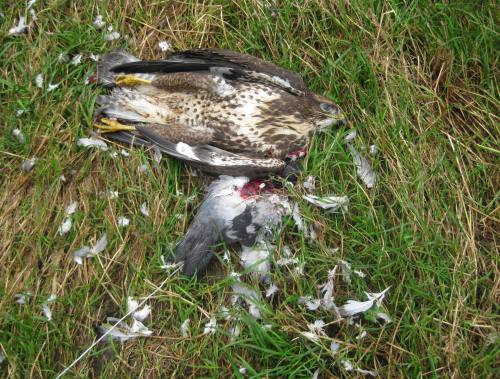 Two young buzzards and a sparrowhawk have been illegally poisoned in Ireland. The bait this time? Live pigeons, that were smeared with the banned pesticide Carbofuran, tethered to the ground with wire with their wings clipped.
 Sentencing options for criminals convicted of wildlife crime offences in Northern Ireland, including the illegal killing of birds of prey, have been brought into line with the rest of the UK. For the first time, anyone convicted of a wildlife crime offence in Northern Ireland can face a maximum six month prison term. Fines have also been doubled up to a maximum £5,000.
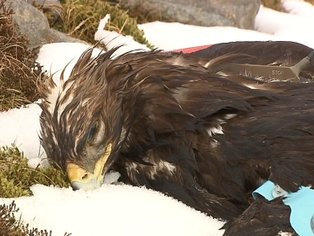 Today the Scottish government has published its latest report on animal poisoning in Scotland. The figures relate to recorded incidents in 2010 and demonstrate a sharp rise in the number of wildlife poisonings, including the widespread illegal poisoning of raptors. The report shows that 69% of all ‘abuse’ cases involved the poisoning of birds of prey, covering a wide area including Borders, Dumfries & Galloway, Highland, Lothian, Strathclyde and Tayside. The illegal pesticide Carbofuran was detected in half of these incidents. The raptors that tested positive for poisons included 40 buzzards, 4 golden eagles, 1 sea eagle, 1 kestrel, 5 barn owls, 2 tawny owls, 2 peregrines, 21 red kites and 11 sparrowhawks.
 In February 2011, it was announced that a team of three full-time specialists would be appointed to tackle wildlife crime in Scotland (see
 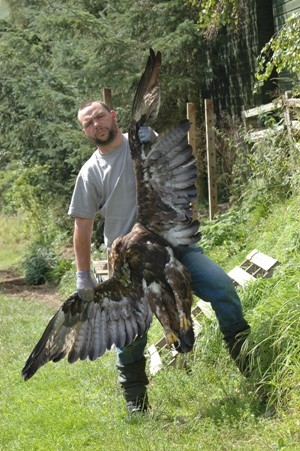 Today is the inglorious 12th, the start of the four-month grouse shooting season in the uplands of northern England and Scotland. Today, and for many days to come, ridiculously rich people will dress up in clownish outfits and head for the moors in the hope of shooting dead some birds. Many will pay an estimated average of £15,000 for the experience. I wonder how many of them will enjoy the sight of a hunting hen harrier or a golden eagle quartering across the moor? Very few, infact probably none of them because scientific evidence shows that hen harriers and golden eagles have been exterminated on most grouse moors in the UK, with just a few notable exceptions. Has anyone been convicted? One person was once convicted for killing a hen harrier, and that’s it. Nobody has ever been convicted for killing a golden eagle (someone was once taken to court a few years back but the case was dropped). Even though several dead eagles and the UK’s biggest stash of the poison they died from were all found on a sporting estate last year, still nobody has ever been convicted.
 Raptor Persecution UK