Langholm harrier update

On 25th September 2012, the blog (see here) showing us the satellite-tracked movements of this year’s Langholm hen harriers had this statement:

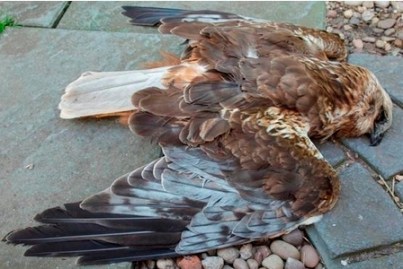
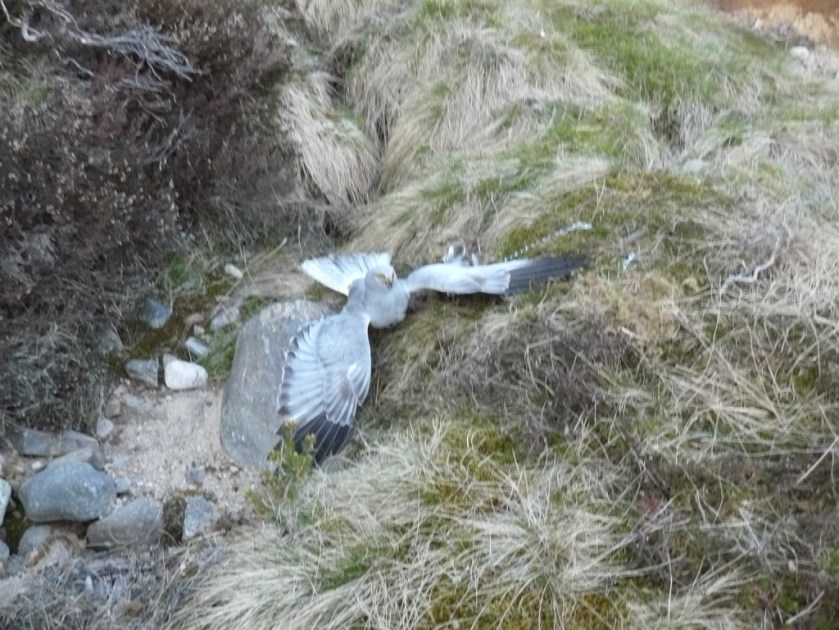
As you will have noticed, it has been a week or so since I have posted any data from Blae, the young female from Langholm. Sadly Blae’s signal indicated that she had died south of Edinburgh about two weeks ago, her carcass was recovered and is undergoing a postmortem“.

So, when that statement was written, “about two weeks ago” would place this harrier’s death ‘about’ 11th September. Today is 8th October, so we’re coming up to ‘about’ a month since she died.

Today there’s a new statement on the Langholm harrier blog:

No news yet on Blae’s postmortem results“.

How long does it take to do a simple postmortem on a single harrier carcass?! Even if it took, say, a week for the bird’s dead body to be recovered, the lab has had almost three weeks to conduct a procedure that shouldn’t take more than a couple of hours at most.

An article published in the Southern Reporter on Sunday (see here) includes a quote from Langholm Project Manager Graeme Dalby, who says:

The timescale for results being released can vary from a couple of weeks to much longer depending on the lab’s workload“.

So either this lab is inundated with the carcasses of dead animals or not enough urgency is being afforded to this case. Or perhaps we are being unfair on the lab – perhaps they have already done the PM and released the results but the Langholm Project folk are not sharing them? We know there are quite a few things that the Langholm team are keeping quiet about…more on those in a later blog.

Meanwhile, Blae’s sibling, Barry, appears to be still alive, for now (see here).

Previous blogs on Blae here, here, here.

Court case updates

The ridiculously lengthy legal proceedings against Keith Liddell continue. First reported on this blog in July 2011 (here) and subsequently in February 2012 (here), May 2012 (here) and June 2012 (here), Liddell’s case will have another intermediary diet at Inverness Sheriff Court tomorrow (9th October). Liddell is accused of various offences including the alleged trading of raptor eggs.

Another lengthy case has also been continued at Inverness Sheriff Court. The so-called ‘hare-snare’ case, which began back in 2009 (!!) was heard at Inverness last Thursday and Friday. It is now set to continue on 16th November. Two gamekeepers from the Lochindorb Estate originally faced trial but now the charges are only being heard against one of them, David Taylor. Previous posts on this case here, here, here, here, here, here.

And the 3rd specialist wildlife fiscal is….

Remember a year ago we were blogging about the newly-appointed specialist wildlife fiscals at COPFS, brought in to improve the efficiency and effectiveness of wildlife crime prosecutions in Scotland (see here)? We noted at the time that only two of the promised three positions had been filled, even though we’d heard there were several well-qualified fiscals who’d applied for the final slot.

Word has it that the third position has now been filled. Guess who? Former COPFS lead on wildlife crime, Tom Dysart. Mr Dysart supposedly ‘retired’ earlier this spring, but now, if the rumours are true, he’s back.

Whether you think this latest appointment (if reports are accurate) is a good thing depends very much on how you viewed Dysart’s previous performance at COPFS. Although it’s worth noting that there is now a new head of the COPFS Wildlife & Environment Unit – a Mr Craig Harris, who presumably Mr Dysart will be reporting to. We’ll be watching with interest.

RSPB 2011 Birdcrime Report published

The RSPB has published its annual report ‘Birdcrime’, detailing offences against wild bird legislation throughout the UK in 2011.

We’ll comment on the report once we’ve had time to read and digest.

The report can be downloaded here

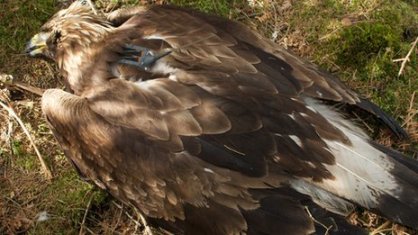
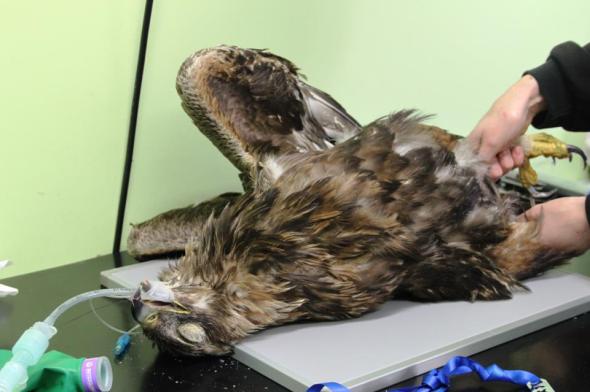
Photo: a poisoned golden eagle on a Scottish grouse moor

Thanks to the contributor who sent in these images. This dead eagle was found on a Scottish grouse moor in 2010. Tests showed it had been poisoned with a banned pesticide. Nobody has been charged.

It seems that unless the poisoner is actually seen placing the bait AND unless the eagle is actually seen eating from that bait (how unlikely is that?!) a prosecution will not be forthcoming. We know from experience that even with filmed evidence of illegal activities a prosecution is not guaranteed. This ludicrous situation sends a clear message to the poisoners: carry on, you are immune from prosecution.

Where’s the promised gov consultation on increasing SSPCA powers?

In light of recent events, showing continued evidence that some Scottish police forces are incapable of taking wildlife crime seriously, even though raptor persecution has been identified as a ‘national wildlife crime priority’, the time is right to once again call for additional investigative powers to be given to the SSPCA.

You may remember we’ve blogged about this before (see here and here for detailed background information), after the former Environment Minister, Stewart Stevenson MSP promised a consultation “in the first half of 2012” to consider this option and ask for the views of the various stakeholder groups. Although we already know that the SGA doesn’t support it (see here). It’s now the second half of 2012, so where is this consultation?

Perhaps we should give the new Environment Minister a nudge in the right direction, or at least ask him when we can expect this consultation to open. Email Paul Wheelhouse MSP directly at: ministerforenvironment@scotland.gsi.gov.uk

Photo: a Scottish gamekeeper’s illegal gin trap

Thanks to the contributor who sent in this photo and the following information:

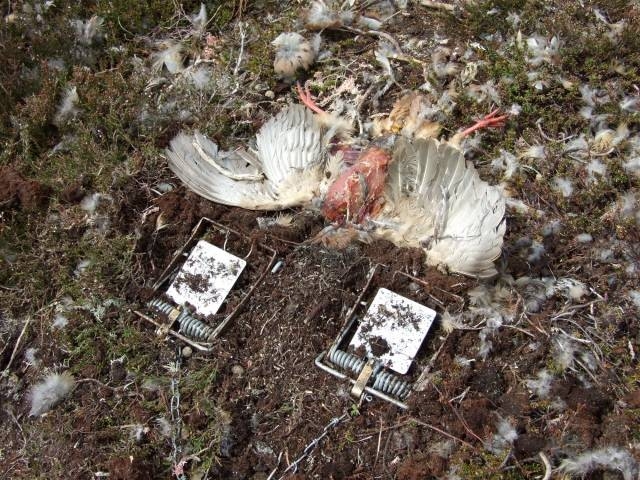
Given the appalling news story about a golden eagle found with injuries from a leg-hold trap…here’s my photo of a freshly used gin trap and stake seized by the police and RSPB from a keeper in 2003. One of a bagful.

To my certain knowledge these traps, outlawed finally in Scotland in 1974 (20 years after England…seems it was ok to torture foxes legally up to that point), have been used (and are probably still being used) under a bait to trap golden eagles, wild cats and foxes..

The most likely trap to have been involved in the recent golden eagle case. Eagles are strong enough to rip one of these up and fly or hobble away…if stake isn’t well tied down. They can snap bailer twine (the usual attachment for Fenn/Springer pole traps) like it was thread”.

Langholm harrier ‘Blae’ is dead

For fuck’s sake.

Confirmation here.

Previous posts here, here, here

26 eagles, 6 years, 0 prosecutions

In April we wrote a blog called ’21 eagles, 6 years, 0 prosecutions’ (read it here). It’s now five months later and we thought we’d update it. It’s now called ’26 eagles, 6 years, 0 prosecutions’.

As we discussed before, some of these eagles are just ‘missing’ and may not be dead, although the frequency with which these sat-tagged eagles & harriers are going ‘missing’ is indicative of something more sinister, of that there’s no more doubt. It’s also reasonable to point out that there may be (probably will be) a hell of a lot of other eagles that we haven’t included in this list because we just don’t know about them. We only see the tip of a very very large iceberg, as is becoming clearer to everyone by the day.

So, here we go….

MAY 2006: A dead adult golden eagle was found on the Dinnet & Kinord Estate, near Ballater, Aberdeenshire. Tests revealed it had been poisoned by the illegal pesticide, Carbofuran. Grampian Police launched an investigation. Six years and 4 months later, nobody has been prosecuted.


JUNE 2006: A dead golden eagle was found on Glen Feshie Estate in the Cairngorms. Tests revealed it had been poisoned by the illegal pesticide, Carbofuran. Northern Constabulary launched an investigation. Six years and 3 months later, nobody has been prosecuted.


AUGUST 2007: A dead adult female golden eagle was found on an estate near Peebles in the Borders. She was half of the last known breeding pair of golden eagles in the region. Tests revealed she had been poisoned by the illegal pesticide, Carbofuran. Lothian & Borders Police launched an investigation. Five years and 1 month later, nobody has been prosecuted.


AUTUMN 2007: Tayside Police received a detailed tip-off that a young male white-tailed eagle (known as ‘Bird N’) had allegedly been shot on an estate in Angus. The timing and location included in the tip-off coincided with the timing and location of the last-known radio signal of this bird. Five years later, the bird has not been seen again. With no body, an investigation isn’t possible.

MAY 2008: A one year old male white-tailed eagle hatched on Mull in 2007 and known as ‘White G’ was found dead on the Glenquoich Estate, Angus. Tests revealed he had been poisoned by an unusual concoction of pesticides that included Carbofuran, Bendiocarb and Isofenphos. A police search in the area also revealed a poisoned buzzard, a baited mountain hare and 32 pieces of poisoned venison baits placed on top of fenceposts on the neighbouring Glenogil Estate. Laboratory tests revealed the baited mountain hare and the 32 poisoned venison baits contained the same unusual concoction of highly toxic chemicals that had killed the white-tailed eagle, ‘White G’. Four years and 4 months later, nobody has been prosecuted.

JUNE 2009: An adult golden eagle was found dead at Glen Orchy, Argyll, close to the West Highland Way. Tests revealed it had been poisoned by the illegal pesticide, Carbofuran. Strathclyde Police launched a multi-agency investigation. Three years and 3 months later, estate employee Tom McKellar pled guilty to possession of Carbofuran stored in premises at Auch Estate, Bridge of Orchy and he was fined £1,200. Nobody has been prosecuted for poisoning the golden eagle.

JULY 2009: A two year old female golden eagle known as ‘Alma’ was found dead on the Millden Estate, Angus. Tests revealed she had been poisoned by the illegal pesticide, Carbofuran. Alma was a well-known eagle  – born on the Glen Feshie Estate in 2007, she was being satellite-tracked and her movements followed by the general public on the internet. Tayside Police launched an investigation. Three years and 2 months later, nobody has been prosecuted.

AUGUST 2009: A young white-tailed eagle was found dead on Glenogil Estate, Angus. Tests revealed it had been poisoned by the illegal pesticide, Carbofuran. Tayside Police were criticized in the national press for not releasing a press statement about this incident until January 2010. Three years and 1 month later, nobody has been prosecuted.

MAY 2010: Three dead golden eagles were found on or close to Skibo Estate, Sutherland. Tests revealed they had been poisoned; two with Carbofuran and one with Aldicarb. Northern Constabulary launched a multi-agency investigation. One year later (May 2011), Sporting Manager Dean Barr pled guilty to possession of 10.5 kg of Carbofuran stored in premises at Skibo Estate. Two years and 4 months later, nobody has been prosecuted for poisoning the three golden eagles.

JUNE 2010: Leg rings with unique identification numbers that had previously been fitted to the legs of four young golden eagles in nests across Scotland were found in the possession of gamekeeper James Rolfe, during a multi-agency investigation into alleged raptor persecution at Moy Estate, near Inverness. It is not clear how he came to be in possession of the rings. The bodies of the eagles from which the rings had been removed were not found. No further action was taken in relation to the discovery.

JUNE 2010: A golden eagle and a white-tailed eagle were found dead on Farr Estate, Inverness-shire. Tests revealed they had been poisoned by the illegal pesticide, Carbofuran. Northern Constabulary apparently did not search the property until July 2011. Two years and 3 months later, nobody has been prosecuted.


DECEMBER 2010: A decomposing carcass of a white-tailed eagle was found and photographed on Logie (Lochindorb) Estate, Morayshire. It was reported to Northern Constabulary. By the time the police arrived to collect it, the carcass had disappeared. The police said they couldn’t investigate further without the body.

MARCH 2011: The body of a young golden eagle was discovered on North Glenbuchat Estate, Aberdeenshire. Tests revealed it had been poisoned by the illegal pesticide, Carbofuran. Grampian Police launched an investigation and raided the property in May 2011. One year and 4 months later, we are not aware of any pending prosecutions.

APRIL 2011: The body of a white-tailed eagle was found at the base of cliffs on Skye. The person who discovered it (a professional medic) considered it to have been freshly shot with a rifle, decapitated with a sharp implement and thrown from the cliff top. He took photographs and alerted Northern Constabulary and RSPB. There was a delay of two weeks before the now probably decomposed carcass was collected. A post-mortem was inconclusive. This incident was not made public until one year later after a tip off to this blog. We are not aware of any pending prosecutions.

NOVEMBER 2011: The signal from a satellite-tracked young golden eagle (hatched in 2010) stopped functioning when she was at a location in the Monadhliaths, a well-known raptor persecution black spot in the Highlands. Her last known location was checked by researchers but there was no sign of the bird. Another technical malfunction of a satellite transmitter or another ‘disappearance’ in suspicious circumstances?

MARCH 2012: The body of a young golden eagle being tracked by satellite was discovered in Lochaber. Tests revealed it had been poisoned with the banned pesticides Aldicarb and Bendiocarb. Information about this incident was not made public until three months later. As far as we are aware nobody is being prosecuted for poisoning this bird.


MARCH 2012: The signal from a satellite-tracked young golden eagle (hatched in 2011) stopped functioning when the bird was in the eastern glens, a well-known raptor persecution blackspot. Another technical malfunction of a satellite transmitter or another ‘disappearance’ in suspicious circumstances?


MAY 2012: The dead body of a young satellite-tracked golden eagle (hatched in 2011) was discovered near a lay-by in Aboyne, Aberdeenshire. The data from its satellite tag & the injuries the bird had when found (2 broken legs) suggests it had been caught in an illegal trap in the Angus glens and then removed, under cover of darkness, to be dumped in another area where it was left to die, probably a slow and agonising death. Information on this incident is only released almost five months later, by the RSPB. It appears the police failed to properly investigate this incident as no search warrants were issued. As far as we are aware, nobody is being prosecuted for killing this bird.

MAY/JUNE 2012: The signal from a young satellite-tracked golden eagle stopped functioning when the bird was north-east of the Cairngorms National Park. Another technical malfunction of a satellite transmitter or another ‘disappearance’ in suspicious circumstances?


If reading this list has left you wondering how can this still be happening in 21st century Scotland, and questioning why it seems to be impossible to prosecute anyone for these killings even with what appears to be plenty of supporting evidence to back the cases, then you probably want to ‘do’ something about it. The best thing you can do, right now, is to email the new Scottish Environment Minister, Paul Wheelhouse MSP. Tell him that this scandalous situation has to stop once and for all and ask him how he intends to address the problem. Tell him you are sick of being asked to consider all possibilities to explain these dead or missing eagles except the most likely one. Tell him that the Scottish Government is in a position to bring in changes to stop this disgrace and that they haven’t already speaks volumes. Tell him enough is enough and you want to see ACTION. He probably agrees with all these sentiments already but it’s important that he hears it from us all directly. Think about the details of the slow and agonising death of that poor young golden eagle that we read of yesterday and make it’s death mean something. ministerforenvironment@scotland.gsi.gov.uk

why is it so difficult to investigate the illegal killing of a golden eagle?

Way back in June, we blogged about a golden eagle that had been found dead in suspicious circumstances in Grampian in May (see here). Four and a half months after the dead bird was found, a press release has now been issued by the RSPB which provides the sickening details of how this eagle is believed to have been destroyed (read it here, if you’ve got a strong stomach). It is reproduced below:

CONSERVATIONISTS APPALLED BY EAGLE DEATH

RSPB Scotland has today issued an appeal and a reward for information, following the discovery of the body of a golden eagle on Deeside.

The bird, fitted with a satellite transmitter, was found on 5 May 2012, after signals sent by the transmitter indicated that the bird had not moved for several days.

The body was found, lying face down, with its wings folded, under a tree branch, close to a lay-by on a quiet country road near Aboyne, and was seized as evidence by officers from Grampian police.

The carcass was then taken for a post mortem at the Scottish Agricultural College laboratory in Aberdeen. This concluded that the bird had suffered two broken legs due to trauma ‘that could be consistent with an injury caused by a spring type trap’ and that the severity of these injuries ‘would prevent the bird from being able to take off.’

The bird had been fitted with a transmitter by RSPB Scotland staff, in full partnership with a local landowner, a few days before it had fledged from a nest in the Monadhliath Mountains, south-east of Inverness, in July 2011.

By re-examining the satellite data, staff discovered the young bird spent its first few months in its natal area before venturing further afield. By April 2012 it was frequenting an area of upper Deeside, before moving south-west into Glenshee.

On 28 April, the bird moved eastwards into Angus. The following day, at 6am, the bird was located on a hillside overlooking Glen Esk. Over the next 15 hours, a succession of satellite tag readings, accurate to within less than 20 metres, showed that the bird did not move from this precise spot until at least 9pm that evening, after nightfall.

However, by 4am the next morning, 30 April, according to transmission data, it appeared to have travelled during the hours of darkness, some 15km north, to the location where its body was subsequently discovered some five days later. Satellite readings revealed that whilst the bird did not move from this position, it was probably alive until 4 May.

Follow-up enquires by both Tayside and Grampian Police found no further evidence as to how the eagle came to suffer its injuries, nor could it be established how the eagle came to move from Glen Esk to a position under a tree branch on Deeside overnight. However, a number of eagle down-feathers were found between the lay-by and the bird’s final resting place.

Ian Thomson, RSPB Scotland’s Head of Investigations, commented: ‘It is disgraceful that this magnificent bird was subjected to such suffering. The post mortem evidence suggests that this bird was caught in an illegally set-trap, smashing both legs. The data obtained from the satellite transmitter indicated that the eagle did not move from one spot on a hill high above Glen Esk, for over 15 hours. Then, during the night, when eagles do not readily fly, it has inexplicably moved to a new position, hidden under a tree and close to a road. Here, over the next four days, this eagle suffered a lingering death.’

Stuart Housden, RSPB Scotland Director, added: ‘Anyone who cares about our wildlife will be disgusted by what appears to be an appalling crime and the lengths taken to hide the facts from discovery. Whilst efforts to stamp out the illegal poisoning of birds of prey are perhaps beginning to yield results, this dreadful case shows that the persecution of our raptors continues through the use of traps and other means.

We call upon anyone who can provide further information about this case to contact the wildlife crime officer at either Tayside or Grampian Police without delay. Cases like this really do have a negative impact on Scotland’s reputation as a country that respects and values all its wildlife heritage. I am today offering a £1,000 reward for information that will assist a successful prosecution.’

ENDS

Yet again, as in so many other alleged persecution cases, there has been an unexplained and lengthy delay in releasing this information to the public. It should not take this long, especially for such a high-profile incident of such an appalling nature. Isn’t investigating wildlife crime a supposed ‘priority’ amongst Scottish police forces? That’s what we’re told! The reality still seems somewhat removed from that ideal, even after all this time and all these other cases with which to fine tune a response. Note that it’s the RSPB that has released this information today; not Tayside Police and not Grampian Police.

We’ve been given some interesting information about this incident. The press release states that this eagle’s satellite tag sent signals from “a hillside overlooking Glen Esk” and those data apparently suggested the eagle didn’t move from that precise spot over a 15-hour period, until it inexplicably moved, under cover of darkness, close to a layby 15 km north over the border into Grampian. Well, according to the grid reference provided by the sat tag, which may or may not be accurate because accuracy can be affected by a number of variables, this location is on Millden Estate. Millden Estate may be a familiar name to some as it was where a young sat-tagged golden eagle named ‘Alma’ was found poisoned in 2009 (see here). Nobody has ever been charged in connection with her death.

It appears the police trusted the accuracy of the sat tag data enough to pinpoint a location for an informal ‘search’ on Millden although the extent of this ‘search’ was apparently limited to the precise grid reference  from the sat tag. We understand that a search warrant was not requested to examine vehicles or the wider estate for potential evidence. Why not? It’s also worth noting that there are two other sporting estates in Glen Esk – were either of these also searched as part of this inquiry? If this eagle had been caught in an illegal spring trap in Glen Esk, as is being alluded to in the media, who’s to say on which estate the trap was located? (although that assumes the trap was un-anchored, which would be highly unusual). That’s where a wider search, especially of vehicles, might have come in useful.

So here we are again. YET ANOTHER eagle persecuted in Scotland and YET ANOTHER profoundly unsatisfactory response from those with a  statutory duty to investigate. How many more of these (e.g. see here for a long list of others) do we have to endure before we see a fundamental change in the way these offences are investigated and prosecuted?

UPDATE 25th September: If you would like to use your anger about this case in a positive way, please send an email to the new Scottish Environment Minister, Paul Wheelhouse MSP, to tell him how you feel about this disgraceful crime: ministerforenvironment@scotland.gsi.gov.uk He already knows about the incident – he tweeted about it last night: @PaulWheelhouse “Absolutely appalling – disgusted with whoever did this“. What he might not know is the strength of feeling of the rest of us.

UPDATE 26 February 2013: Deeside golden eagle fiasco rumbles on as SGA release their ‘report’ (here)