Lochindorb hare snare trial to continue in October

The long-running Lochindorb Estate hare-snaring trial is set to drag on until October (see here, here and here for background to this case).

An important point of law was established during deliberations at Inverness Sheriff Court yesterday – whether a snare could be considered to be a trap. Although this question might sound ridiculous to us (of course a snare is a type of trap – they’re used for the sole purpose of trapping animals, aren’t they?), it was important to establish the legal definition of a snare in this particular case because if a snare wasn’t considered to be a trap, then there would be no case for gamekeeper David Taylor to answer. Anyway, the Sheriff apparently decided that a snare is a trap, and that there was sufficient evidence for the case to be continued in October (the defence had argued that there was insufficient evidence against Taylor).

Northern Times article reporting on yesterday’s court hearing here

Leadhills & Hopetoun: getting closer to the truth? Part 1

You may recall back in March we blogged about the RSPB’s baffling decision to hold their inaugral Scottish Birdfair at Hopetoun House. This decision raised eyebrows (see here and here) due to the alleged connection between Hopetoun Estate and the ‘notorious’ Leadhills Estate.

At the time, the RSPB defended their choice of venue by saying:

We understand that there is a clear separation between land managed in hand by Hopetoun Estate in West Lothian, and the Leadhills Estate, which is let on a long lease to American tenants. It is the American sporting tenants on Leadhills Estate, through a UK sporting agent, who employ and manage the land and the employees at this site, and who are therefore ultimately responsible with ensuring that birds of prey are protected on this land. We accept that Hopetoun Estate do not condone any illegal practices on their land.”

A spokesperson for the Earl of Hopetoun is reported to have said this:

The Earl of Hopetoun’s position on wildlife crime is unequivocal. He has constantly condemned any such activity. More importantly, Hopetoun Estate has no role whatsoever in the management of Leadhills Estate. Leadhills Estate is run on a sporting lease completely separately and there is no connection between Hopetoun Estate and the sporting management of Leadhills“.

Those last two sentences were designed to leave us in no doubt. We were barking up the wrong tree. Or were we?

We’ve since received a copy of a lease agreement made between the Leadhills Estate landlords (Andrew Victor Arthur Charles Hope, Earl of Hopetoun and his father Adrian John Charles Hope, Marquess of Linlithgow) and the sporting tenants (via the agency Leadhills Sporting Limited). The information provided in this lease suggests that the management of the Leadhills Estate grouse moor is perhaps not quite as straightforward as some have claimed.

Before we discuss the lease content, readers should be made aware that this particular lease may not accurately reflect the content of the current lease. The lease we’re about to discuss relates to a 20-year agreement (between Hopetoun & Leadhills Sporting Ltd) running from 2003 to 2023. However, five years into the lease in 2008, it was reported that the sporting rights at Leadhills were being sold on (see here). We understand that the current lease is for 16-years duration and is still held by Leadhills Sporting Ltd, albeit with a personnel change at Leadhills Sporting Ltd – Edward Dashwood & Mark Osborne, along with several others, had all resigned from the company by July 2008, and at least two new Directors were appointed in the same month. The big question is, was the content of the lease that we’re about to discuss carried over to the new tenants, or was the content considerably changed for the new tenants? This is important, because if the content wasn’t changed and is still current, then it looks like somebody might have been telling porky pies about the role of Hopetoun in the sporting management of Leadhills grouse moor. And we’re not talking those mini pork pies that you get in packs of six in the posh supermarkets. We’re talking big fat pork pies you get in your local butchers shop.

For Part 2, click here

Red kites accused of ‘annihilating’ other birds

The Scottish Gamekeepers’ Association is calling for a government probe to investigate the impact of reintroduced red kites in Galloway, following claims that the kites are ‘annihilating’ other birds, including lapwings, oystercatchers and sand martins.

Unsurprisingly, the claims have been made by a farmer, a pigeon racer and a gamekeeper.

Alex Hogg said: “I think everyone would agree that protection of one species, when it is to the detriment of others, is a flawed way to achieve ecological balance“. Er, what, like the protection of 40 million exotic pheasants and unnaturally-high populations of red grouse to the detriment of buzzards, kites, harriers, sparrowhawks, goshawks, eagles, peregrines, owls, corvids, foxes, stoats, weasels? How about a government probe into that?

Hopefully the SGA’s request will be met with the same contempt the Scottish Government gave to their earlier request to evaluate the risk to small children posed by reintroduced sea eagles.

SGA’s article on the red kite ‘problem’ here.

Your chance to comment on proposed wildlife law changes

The Law Commission has opened a public consultation to assess ways of modernising wildlife legislation. Here are the Law Commission’s explanatory notes:

“The current law regulating wildlife is spread over a collection of Acts dating back to 1831. The original purpose of much of the law was to govern activities such as hunting and fishing, including poaching. Over the years it has expanded to conserve certain species, ensure the welfare of wildlife and protect local biodiversity from invasive species.

The result is a legal landscape that is out of date, confused and often contradictory. For example, the hunting, management and welfare of pheasants is governed by four separate statutes. Much of the older legislation is out of step with modern requirements, and the principal modern Act – the Wildlife and Countryside Act 1981 – has been amended to such a degree that it is difficult for any non-specialists to use.

The proposals we are putting forward in this consultation aim to simplify the existing complex framework, placing wildlife law into a single statute. The new regime would reduce the current dependency on criminal law, by allowing an appropriate mix of regulatory measures such as guidance, advice and a varied and flexible system of civil sanctions – such as fines and bans”.

The consultation period opened on 14 August 2012 and will close on 30 November 2012. The Law Commission’s recommendations are not expected to be published until mid-2014.

Although the consulation paper may look complex and daunting, it actually isn’t when you look at it section-by-section. The paper poses specific questions e.g. Do consultees think that the current sanctions for wildlife crime are sufficient? as well as more general questions, e.g. Do consultees think that there should be a wildlife offence extending liability to a principal….? (in other words, they’re asking for your view on vicarious liability).

The consultation only covers a review of wildlife legislation in England and Wales – not Scotland. However, this limited scope does not exclude any Scottish participants, so if you’ve got views on wildlife laws, this is the time to be heard. Already, the huntin’, shootin’, fishin’ brigade are mobilising their troops to encourage a mass response. You can imagine what their responses to most of the questions will be. It’s essential that the conservationists are heard with equal force. Don’t just leave it to the big groups (e.g. RSPB) to speak out – have your own say and let’s make sure the Law Commission reviewers understand our collective strength of feeling.

The Law Commission’s wildlife law consultation paper here

Not counting properly, and accountability

On the subject of counting, in his latest blog the ever-sharp Alan Tilmouth examines Alex Hogg’s apparent inability to count (see here). This is well worth a read if you’re interested in understanding what ‘evidence’ the game-shooting industry uses to support its claims that raptors (especially buzzards) are decimating pheasant poults.

On the subject of accountability, George Monbiot has written a response to Magnus Linklater’s latest attack on the RSPB. This is also well worth a read, especially as Monbiot confirms Linklater’s association with game-shooting and uses it to suggest that journalists should be made to declare their interests so that readers can judge the independence of the journalist’s opinions. Monbiot’s article here.

Some not so good eagle news

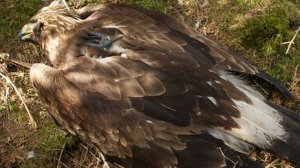
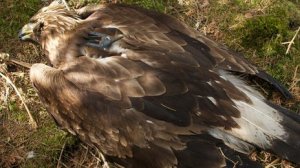
We have it on very good authority that another satellite-tagged golden eagle has gone ‘missing’ in the Monadhliaths in the last couple of weeks.

Going ‘missing’ doesn’t equate to ‘being dead’ of course, but it’s really stretching the boundaries of credibility to believe that yet another disappearance is the result of yet another dysfunctional tag, especially when the area of its last known movements just happens to be one of the country’s persecution hotspots.

How many’s that since the sat-tagging began several years ago? We’ve lost count. Just looking at this year’s reports, in addition to this latest eagle, we know about this ‘missing’ satellite-tagged golden eagle (here), this ‘missing’ satellite-tagged golden eagle (here), this dead satellite-tagged golden eagle (here), and this dead satellite-tagged golden eagle found poisoned in Lochaber (here). How many don’t we know about?

Some good eagle news for a change!

It’s refreshing to be able to report some ‘good’ eagle news for once. And not just one story – we’ve got two!

First up – the legal eagles. Solicitors Innes & Mackay of Inverness have sponsored two satellite-tagged golden eagles, raised on the Strathspey Estate in the Cairngorm National Park. The eagles, named Innes & Mackay (what else?!) have been tagged by Roy Dennis and their movements will appear shortly on his excellent RaptorTrack website (here). The solicitors also hope to involve a local school in monitoring the eagles’ progress. Their press release here. Well done to all involved, especially Strathspey Estate, whose continued efforts to support golden eagles in what is otherwise known as a persecution hotspot is unusual and very welcome.

The second piece of good news is that funds raised through the Mull Eagle Hide have been given to provide support for the Mull and Morven Agricultural Show. A grant of £250 from the Sea Eagle Partnership has contributed towards new cattle pens and hurdles for highland cattle. Press release here. Let’s hope this funding will help persuade those doubters from within the farming community that the reintroduced sea eagles, and the tourism they generate, can be of benefit. Although judging by this article (here) from 2009, some people may need more persuasion than others. The article includes a quote from a crofter who was claiming that “sea eagles took half my lambs” and he described hearing a pair of sea eagles “scraping their talons on the rock“. Presumably they were re-sharpening their claws after piercing the skin of the hundred babies they stole from prams earlier that morning. Well done to the Mull Eagle Hide team for all their efforts in the face of some astounding ignorance.

N Yorks police appeal for info 3 months after kite found poisoned on moor

North Yorkshire police have taken three months to appeal for information after the discovery of a poisoned red kite on moorland.

The kite was found by a raptor fieldworker on Lofthouse Moor, Nidderdale, in May 2012. Toxicology tests revealed it had been poisoned ‘by a combination of banned pesticides’. The press release doesn’t offer any further detail about which banned pesticides were used, but it also states that rodenticides were discovered during the tests. Confusingly, the police wildlife crime officer focuses on the ‘common problem’ of accidental rodenticide poisoning rather than the other common problem of deliberate poisoning using banned chemicals.

Why has it taken the police three months to make this appeal? Where’s the sense of urgency? Where’s the indication that this crime is being taken seriously? Does anybody know whether Lofthouse Moor is managed for grouse shooting?

North Yorkshire Police press release here

News article on the Grough website here

Magnus Linklater’s article

A fascinating article appeared in The Observer on Sunday, reproduced in The Guardian, presumably timed to coincide with the Inglorious 12th. Called ‘Why the claws are out for the RSPB‘, it would score pretty highly on the shite-o-meter and is exactly what we’ve come to expect from Magnus Linklater, whose name produces the amusing anagram ‘Glum Anal Stinker’.

It would take forever to address every single inaccuracy in the article and to be honest, in keeping with the theme, who can be arsed? Fortunately there are more hardy critics who have ripped the article to shreds in the comments section underneath the article (see here). Magnus has something of a track record, going back several years, for slagging off the RSPB and for advocating raptor ‘control’ (see here, here, here etc etc….yawn). Rumour also has it that he might just have grouse-shooting interests in Perthshire, although these alleged ‘credentials’ were not revealed in his mini-biography at the top of the article.

The SGA described this article on their Facebook page as “quality investigative journalism“. That ringing endorsement should probably tell you all you need to know about the ‘quality’ of this piece. Ironically, the article has probably been the best advert for joining the RSPB in the last ten years! You can join here.

RSPB: 1  –  Magnus: 0

SSPCA wins conviction for poison & dog neglect

A man from North Ayrshire has been convicted of causing his dogs unnecessary suffering and possessing a banned pesticide (Cymag) following an SSPCA investigation back in March 2010.

William Ralph Trivett, 40, pled guilty to five charges at Kilmarnock Sheriff Court last Friday (10 August). He was fined £600 and received a three-year ban on keeping any more than twelve dogs.

The SSPCA had removed seven dogs from make-shift kennels at Mid-House Farm, Kilbarchan, Johnstone. The jar of Cymag was found during a further search of Trivett’s home at nearby Milton Quadrant.

Well done to the SSPCA for another successful prosecution. Full story on their website here.