Ross-shire raptor death toll rises to 11….and counting

The incident we blogged about two days ago concerning the discovery of five dead red kites and two buzzards in Ross-shire, north Scotland (see here) has just got a lot worse.

The current figure is 11 corpses, according to the BBC, and we suspect more may yet to be found.

We know that at least eight of these corpses are red kites.

This is the worst single persecution incident to have been discovered for several years. Poisoning is strongly suspected.

More on this soon.

Red kite photo by Mali Halls.


Correspondence between SLE and Scot Gov re: poisoned eagle Fearnan

McAdam 2A freedom of information request has revealed some interesting correspondence between Doug McAdam, the CEO of the landowners’ organisation Scottish Land and Estates, and Paul Wheelhouse, the Scottish Environment Minister, on the subject of ‘Fearnan‘, the poisoned golden eagle found dead on a grouse moor in the Angus Glens in December 2013.

McAdam wrote to the Minister in January, setting out SLE’s “total condemnation” of the poisoning incident. He went on to say that SLE members in the area where Fearnan’s corpse was found were “perhaps more keen than anyone” that the culprit was found and prosecuted. He assured the Minister that these landowners had conducted their own enquiries and were sure that none of their staff were involved. He said that gamekeepers were “helping the police in all aspects of the investigation” (presumably this doesn’t mean giving a “no comment” response to any questions they are asked, as recommended by official SGA policy!). McAdam also emphasised how the introduction of vicarious liability had had an impact on best practice sporting management and besides, that gamekeepers love golden eagles, so much so that plans were under way to initiate ‘a golden eagle monitoring or conservation project’ in the Angus Glens.

You can read his letter here: SLE letter to Wheelhouse re Fearnan Jan 2014

Environment Minister Paul Wheelhouse, to his credit, wasn’t convinced.

In what we would call a fairly robust response, Wheelhouse told McAdam that he was going to be frank with him. He pointed out that the illegal poisoning of Fearnan was just one of “a catalogue of incidents associated with the Angus Glens area“. He went on: “I understand in fact that there has been something like a dozen incidents in this area since 2008“. [We actually know of at least 26 incidents since 2008, (36 if you go back to 2004) and we also know that several others have never been publicised: see here].

Wheelhouse continued: “In the absence of any other credible explanation, I can only conclude that, despite all our efforts, there remains an element of sporting managers and owners who continue to flout the law and defy public opinion for their own selfish ends…”.

He also pointed out that any carcasses or baits that were discovered were probably representative of “only a fraction” of those put out by the criminals (in other words, he agrees with the long-held view that what is discovered is just the tip of a very large iceberg).

He warned McAdam that if persecution didn’t stop he would be put under increasing pressure to impose further measures and he suggested that the game-shooting industry would do well to stop issuing media statements of condemnation [about persecution] that give the impression of being defensive and resentful.

You can read his letter here: Wheelhouse response to SLE Fearnan letter Feb 2014

We were quite pleased with Wheelhouse’s response – a definite baring of the teeth – but as we’ve often said, it’s his actions that count, not just words. We’re waiting to see whether he can bite.

It’s interesting that he hasn’t yet made a public comment about the discovery of those five red kites and one buzzard that was all over the news yesterday, suspected to have been poisoned. We understand the death toll has since risen but more on that later. We’ll be watching with very close interest to see whether SNH will now enforce the new enabling clause to restrict the use of General Licences on the land where these corpses were found. A conviction is not required for them to exercise this new clause; SNH must just have ‘reason to believe that wild birds have been taken or killed by such persons and/or on such land other than in accordance with the general licence’ (see here).

DEFRA ignores 10,000+ voices calling for grouse moor licensing

Bowland Betty2
Bowland Betty, a young satellite-tracked hen harrier found shot dead on a North Yorks grouse moor in 2012

Thousands of you will have received a message in your inbox this morning from DEFRA. Thousands of you will not have been the tiniest bit surprised by the content of the message.

DEFRA’s message was one they were forced to send because the e-petition calling for the licensing of grouse moors and gamekeepers had reached the 10,000 signature trigger mark (see here). Thanks to e-petition rules, they were compelled to issue a response. They needn’t have bothered.

For those who haven’t read DEFRA’s response to the e-petition, you can find it here.

In a nutshell, DEFRA thinks that conservation policies for birds of prey are working well (er….Hen Harriers??!) and thus they have no intention of restricting sport shooting in England.

In other words, get lost you plebs and leave us and our chums to get on with our fun.

Their response really shouldn’t come as any surprise to anybody who has been following the Westminster government’s wildlife policies of late. Badgers, buzzards, bees, fracking….

Was it worth our time and effort to sign the petition? Yes, it absolutely was. Anything that raises public awareness of the raptor persecution issue is well worth the time taken to type your name in a box and click ‘send’. Awareness- raising over the next 14 months will be particularly important as England approaches the next General Election in 2015….

Well done again to John Armitage (who started the e-petition) and to the 10,000+ of you prepared to stand alongside him. Onward..

Six dead raptors found in suspicious circumstances in Ross-shire

Five red kites and a buzzard have been found dead in suspicious circumstances in Ross-shire in the last week.

The birds were reportedly found at different but nearby locations in the Conon Bridge and Muir of Ord area between 18-24 March 2014.

Police Scotland say it is currently unclear how the birds died but it was likely the deaths involved “some form of criminality”.

A local source has told us that poisoning is suspected, although toxicology results are not yet available to confirm this.

This is a surprisingly fast response from Police Scotland. Anyone with information about these dead birds is encouraged to contact the police on Tel: 101.

BBC news article here

Photo of a red kite by Mali Halls

Verdict against Scottish gamekeeper James Marsh: ‘not proven’

The eight-day trial of Scottish gamekeeper James Marsh ended at Stirling Sheriff Court last week with a verdict of ‘not proven’.

The case centred on the discovery of a Larsen trap on the Duntreath Estate on 1st April 2012. The trap, found by a walker, was situated underneath a crag and contained a Jay (in the trap’s decoy compartment) and a Tawny Owl (within the catching compartment). The Tawny Owl was reportedly close to death. The trap had an identification tag which was registered to Duntreath Estate and the walker alerted the SSPCA to the trap. It was suspected that gamekeeper Marsh was using the Jay as a lure to trap birds of prey. It is not permitted under general licence to use a Jay as a decoy within a Larsen trap. [As a point of interest, since January 1st 2014 it is now no longer permitted in Scotland to use a Jay as a decoy inside a crow cage trap either, so if you see one, you should report it immediately].

Marsh, 49, of Middle Ballewan near Blanefield, Stirling, was reported to the Procurator Fiscal by the SSPCA for a number of alleged offences including:

1. Section 5(1)(b) of The Wildlife and Countryside Act 1981 (Use of an unlawful trap);

2. Section 19 2(a)(b) Animal Health and Welfare (Scotland) Act 2006 (Causing suffering to a Tawny Owl and a Jay);

3. Section 24 3(a)(b)(c)(e) Animal Health and Welfare (Scotland) Act 2006 (Failure to ensure the welfare of a Tawny Owl and Jay);

4. Section 1(1)(a) of The Wildlife and Countryside Act 1981 (Unlawfully taking a Tawny Owl);

5. Section 1(1)(a) of The Wildlife and Countryside Act 1981 (Unlawfully taking a Jay);

6. Section 1(2)(a) of The Wildlife and Countryside Act 1981 (Unlawfully possessing a Tawny Owl);

7. Section 1(2)(a) of The Wildlife and Countryside Act 1981 (Unlawfully possessing a Jay).

In defence, Marsh admitted to having set the trap [lawfully] some weeks prior to its discovery in order to catch a Carrion Crow which he intended to use as a decoy. He argued that the trap had been moved up hill and reset in the location where it was found and despite searching he had been unable to find it. He claimed the Jay may have squeezed into the trap decoy compartment by itself and attracted the Tawny Owl which had become trapped. He was unable to explain why the Jay, having squeezed into the trap, would not have been able to get back out.

The verdict of ‘not proven’ is an interesting one. In Scottish law, there are three possible outcomes to a criminal trial. These are ‘Guilty’ [a conviction], ‘Not Guilty’ [an acquittal] and ‘Not Proven’ [an aquittal]. Wikipedia offers an explanation for the use of ‘not proven’:

The modern perception of the ‘not proven’ verdict is an acquittal when the judge or jury does not have enough evidence to convict but is not sufficiently convinced of the accused person’s innocence to bring in a ‘not guilty’ verdict. Essentially, the judge or jury is unconvinced that the suspect is innocent, but has insufficient evidence to the contrary. In popular parlance, this verdict is sometimes jokingly referred to as ‘not guilty and don’t do it again’.

Out of the country, the ‘not proven’ verdict may be referred to as the ‘Scottish verdict’, and in Scotland itself it may be referred to colloquially as the ‘bastard verdict’, which was a term coined by Sir Walter Scott, who was sheriff in the court of Selkirk“.

Despite the ‘not proven’ verdict, well done to the SSPCA for taking on the case. It is widely recognised that this type of investigation requires specialist knowledge, especially with the continuing difficulties of proving who has set a trap (or laid out a poisoned bait, chopped down a nest tree, stamped on eggs or young birds, shot a bird etc etc) and the SSPCA and the Fiscal did well to bring this case to court.

The Tawny Owl survived and was eventually released following extensive veterinary care.

For previous blogs on this case see here and here

Shooters speak out against raptor persecution

not in my nameThere have been very few examples of people within the shooting industry turning against the raptor killers. Oh sure, the representative game-shooting organisations will often trot out a statement or two following the latest atrocity to have been uncovered on land managed for game-shooting, but we rarely believe their sincerity. Why? Because their statements of ‘condemnation’ are often accompanied by outlandish claims such as the poisoned eagle carcass had been ‘planted’ [by anti-shooting campaigners], or the shot red kite must have been shot miles away and it just happened to fly to a grouse moor and die there.

In addition to such claims, there are quite a number of estates that are notorious for the frequency with which illegally-killed raptors are discovered, and yet these estates are not blacklisted by the industry. The representative organisations point to a lack of criminal convictions as a defence for not blacklisting, when we all know, and they know, too, how difficult it is to secure a conviction in this particular arena of crime. That excuse might be convincing for a single incident, but when those persecution incidents keep occurring, time and time again, year after year, sometimes decade after decade, on the same estates, then the excuse simply becomes ridiculous. Some of the estates do actually have convictions against their staff, and yet still they’re not shunned by the game-shooting community. That’s really quite telling.

How refreshing then, to see some recent examples of individual people from within the shooting industry standing up and speaking out against raptor crime.

We blogged about one such incident earlier in the week – where a Facebook user was reported to the police by a community of individual shooters after he posted information suggesting he had killed a sparrowhawk that was ‘stalking’ his friend’s racing pigeons – see here.

Now there are two more examples. This time, individual shooters writing letters to the Shooting Times to condemn the continuing persecution of raptors on driven grouse moors. The last paragraph of the first letter sums it up for us:

To those who are worried about their sport being further regulated, my suggestion is not to look to the RSPB, SSPCA and RSPCA or the more extreme animal rights groups. Look to the heather-clad glens of Angus or the Yorkshire Moors. The people responsible for your sport being banned are there“.

The two letters can be read below – thanks to Ronnie Graham for sending us the details:

Ronnie Graham’s letter: Shooting Times (R. Graham letter)

G. Porter’s letter in response: Shooting Times (G. Porter reply)

Two more raptors shot dead in Norfolk

Norfolk is becoming quite the raptor persecution hotspot….

Norfolk Constabulary are investigating two separate persecution incidents following the discovery of a dead sparrowhawk and a dying buzzard in February.

The sparrowhawk was found with gunshot injuries on 16th February  by walkers on the Brisley Road in Whissonsett, near Fakenham.

One week later walkers heard shooting in Narford Wood near Swaffham and found the dying buzzard which had been shot.

Any information, please call Norfolk Constabulary on 101.

News article from EDP24 here.

Shooting Times publishes astonishing denials about eagle persecution on grouse moors

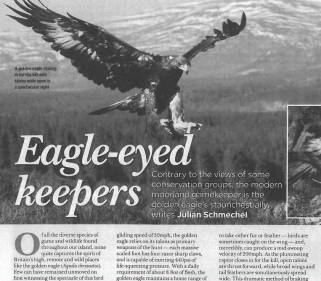
Eagle eyed keepers shooting times March 2014Talking of very, very stupid people….

An article has appeared in the latest edition of the Shooting Times & Countryside Magazine that once again repeats the ludicrous notion that gamekeepers on Scottish grouse moors are a force for good as far as eagle conservation goes, and suggests that accusations to the contrary are ‘unfair’.

We’ve provided a PDF of the article here: Eagle-eyed keepers Shooting Times March 2014

Really? How many times do we have to go over this? The evidence is there for all to see. These continuous denials just serve to further entrench positions and frankly make a laughing stock of those pumping out this clearly inaccurate guff.

So, let’s lay out the facts once again for the benefit of those new to the issue.

Scotland’s golden eagle population is not ‘stable’. On a superficial level it appears to be stable, but the overall population figure (estimated at ~430 pairs, give or take a few) masks some very big differences in regional abundance. For example, there has been a substantial increase of golden eagles in the Western Isles over the last ~20 years, largely thanks to a reduction in illegal persecution in that region. In contrast, there has been a significant decrease in the number of golden eagles in the central, eastern and southern uplands (hence all those vacant territories), thanks largely to illegal persecution on driven grouse moors. That is a fact, backed up by a suite of scientific peer-reviewed studies. That’s why the population appears to be ‘stable’ – because all the losses in the east are being counterbalanced by the gains in the west. We’ve blogged about this in greater detail here.
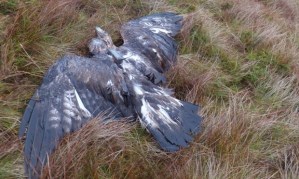
posioned GE Lethnot 2013The golden eagle in Scotland does face a variety of threats or potential threats, including afforestation and the construction of wind farms. We don’t dispute that. However, the main scientific report on this issue has shown that the single biggest threat to golden eagles in Scotland is illegal persecution on driven grouse moors. That is a fact, backed up by scientific peer-reviewed evidence (see link above).

The article says: “Unfortunately, even in recent times, a handful of Scottish golden eagles have been found dead as a result of poisoning“. What the article fails to say is that the majority of those poisoned birds have been found on driven grouse moors. And not only poisoned, but shot and trapped as well. In addition, plenty of satellite-tagged golden eagles have ‘disappeared’ – unsurprisingly their last signals emitted from driven grouse moors. Oh, and it’s more than ‘a handful’. Our latest count is 31 eagles in 7 years, either illegally persecuted or mysteriously ‘disappeared’, with the majority of them on driven grouse moors (see here). And those are only the birds we know about because the majority of them were wearing satellite tags. How many more are being killed that we don’t know about? Plenty more if you look at the population figures and the rather telling ‘gaps’ in distribution.

The article says it is “unfortunate and unfair” to blame sporting estates when these illegally-killed eagles are discovered on, er, grouse moors. It is neither unfortunate nor unfair. The blame is fairly and squarely put at the feet of those involved with grouse moor management based on decades of scientific evidence. The link between driven grouse moors and raptor persecution (not just of eagles but of several raptor species) has been clearly established as this suite of scientific papers demonstrates (see here for a recent blog on this).

The article cites the SGA’s recent claims of ’55 active eagle nests on keepered grouse moors in eastern and central Scotland’ as evidence that golden eagles are doing just fine on driven grouse moors. We blogged about that claim here. We also blogged about the Scottish Raptor Study Group’s research into that claim (see here). Here’s part of what we wrote:

According to the SGA, there are ‘at least 55 active golden eagle nests’ in these ‘keepered grouse areas’; the SRSG is saying that there are 52 ‘active nests’ in the area, and of those 52, only 8 are on driven grouse moors. Crucially, the SRSG also includes information about the vacant golden eagle territories in the area – information that the SGA conveniently ‘forgot’ to include. According to the SRSG, there are an additional 57 ‘non-active’ golden eagle nests in this area, and 31 of them (54%) happen to be on driven grouse moors.

Hmm. The picture doesn’t look quite so rosy now, does it?”
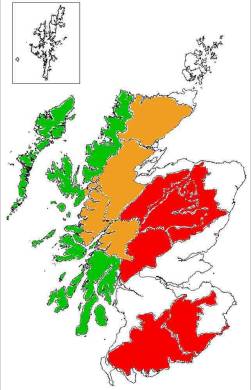
GE conservation status 2003The article goes on: “It is interesting to note that eagle numbers are highest in eastern Scotland, where grouse moors are actively managed“. Er, no, they’re not. Try looking at the scientific data (see here especially) and pay particular attention to territory occupancy rates:

Western Isles = 91%

Western Highlands = 89.5%

Argyll West & Islands = 81.5%

Central Highlands = 48%

Cairngorms Massif = 42.4%

North East Glens = 17.6%

Also pay particular attention to the map which shows the species’ conservation status across Scotland. You’ll find that the golden eagle only has favourable conservation status (green colour on the map) in three of sixteen regions, and those three regions are nowhere near the driven grouse moors of the eastern and central uplands.

This incredible article finishes with this: “The fact remains, however, that far from being the purveyor of poison and pole traps – so often portrayed in the popular press – the 21st century moorland keeper is probably the golden eagle’s staunchest ally“. Aye, right.

You carry on chucking out this fantastical image of the raptor-friendly moorland keeper and we’ll keep publishing the facts which show that the majority of them are anything but.

Facebook braggers get caught out

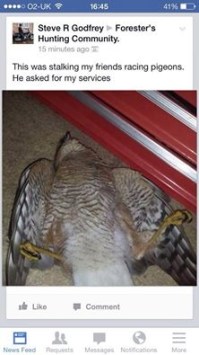
dead sparSome people are just very, very stupid.

A couple of days ago someone called Steve R Godfrey posted a picture of a dead sparrowhawk on a private Facebook forum called Forester’s Hunting Community. This group is for those interested in air rifles and shooting. He included the following statement with his photograph:

This was stalking my friends racing pigeons. He asked for my services“.

In response, many, many group members wrote of their utter disgust and outrage at the inference that Godfrey had killed this bird. The group’s moderators banned Godfrey from the group and reported him to the police.

An update on the group’s Facebook page yesterday stated that Derbyshire police were actively investigating the incident following the high number of complaints that had been received from the shooting community.

Steve R Godfrey’s Facebook account appears to have vanished.

Kudos to the members of the Forester’s Hunting Community for reporting him and to Derbyshire Constabulary for following up.

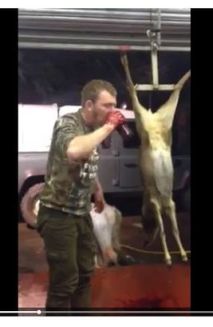
neknominateAnother investigation has been launched after a video of a man slitting a deer’s throat and drinking its blood was posted on Facebook last month. The ‘stunt’ was allegedly part of the ‘neknominate’ craze where someone drinks alcohol, performs a stunt and then nominates someone else to take part. The video was posted by someone called Shaun Wilson from Newcastle. An article in the Newcastle Chronicle (see here) suggests that the person in the video is a gamekeeper and that he has been suspended from his position on a Northumberland estate.

The National Gamekeepers’ Organisation has confirmed that the gamekeeper is one of their members and they have apparently launched a disciplinary investigation. A committee hearing next month will decide whether the man’s actions are ‘relevant to gamekeeping and whether he has damaged the reputation or profession of gamekeeping’. Don’t hold your breath – this is the same organisation that thinks a conviction for possession of a banned poison is not enough to warrant expulsion from the organisation because ‘it’s not a wildlife crime’ (see here).

Environment Minister refuses to recommend golden eagle as national bird

Fearnan2We’ve been following the progress of the RSPB’s submission to the Scottish Parliament to have the golden eagle declared as Scotland’s national bird.

The process began in November 2013 when RSPB Scotland launched a public petition to have the golden eagle named as Scotland’s national bird (see here). 1836 signatures were gathered and the petition was duly submitted for consideration by the Scottish Parliament’s Public Petitions Committee on 7th December 2013.

On 28th January 2014 the Petitions Committee took evidence in support of the petition from RSPB Scotland’s Duncan Orr-Ewing and wildlife cameraman Gordon Buchanan (see here).

The hearing descended in to farce when one of the Committee members suggested the golden eagle was an unsuitable candidate as it was representative of Nazi symbolism (see here).

The official report of the hearing can be read here: Public Petitions Committee official report 28 Jan 2014

Nevertheless, the Committee agreed to progress the petition by seeking advice from SNH, the Scottish Raptor Study Group (SRSG) and the Scottish Government.

Later in February, written submissions were made by SNH and the SRSG. The SRSG was in full support of the petition, arguing that the designation of the golden eagle would go some way to reducing the current illegal persecution of this species. SNH, however, refused to support the designation, suggesting that other species were also worthy of consideration, including the red grouse!! (see blog here).

SRSG submission: SRSG response to petition 1500 Feb 23 2014

SNH submission: SNH response to petition 1500 Feb 19 2014

We argued that SNH was engaging in double standards given their response to an earlier petition to designate the Scots Pine as Scotland’s national tree. In that response, SNH supported the nomination of the Scots Pine and dismissed other potential contenders. We also argued that SNH had missed an important opportunity to promote the conservation of the golden eagle – a species known (in part from SNH-commissioned research) to be in trouble in large areas of the country (notably in areas managed for driven grouse shooting).

Last week, the written advice from Environment Minister Paul Wheelhouse was submitted to the Petitions Committee. You can read it here: Wheelhouse response to petition 1500 Mar 13 2014

In a nutshell, Wheelhouse recognises the continued persecution that this species faces and is “not opposed to the idea of the golden eagle as a national bird” but he will not recommend the golden eagle as Scotland’s national bird.

His reasoning is more than a little ironic given the current debates surrounding independence. The main thrust of his argument is this: “I am not yet convinced that there are compelling arguments in support of having a national bird“.

Eh? Isn’t he a member of the Scottish National Party? What’s the problem with having a national bird? Is it so unusual for a country to designate a national bird? What damage has designating a national bird ever caused to any other country? Would designating a national bird cause irreparable damage to Scotland?

Scots pine wheelhouseIt’s all very strange, especially when you consider Wheelhouse’s response to the recent designation of the Scots Pine as Scotland’s national tree. Following that designation, Wheelhouse revealed plans were in place to have a National Tree Week and to set up a special fund to help promote Scotland’s national tree! He was quoted as saying that having a national tree was a “clear symbol of our affinity with Scotland’s trees, woods and forests, and their importance to us all” (see here). That’s what we should expect from an Environment Minister. His response to the petition to designate the golden eagle as Scotland’s national bird is, frankly, absurd.

So where does this leave the petition? We’re not sure. We had expected that a public consultation would be called but it now seems even that is in doubt, as Wheelhouse is first urging a wider debate on the concept of having further national symbols.

Very, very disappointing.