Satellite-tagged hen harrier from Tarras Valley Nature Reserve ‘disappears’ on grouse moor in North Pennines

Press release from RSPB (20 February 2025)

SATTELITE-TAGGED HEN HARRIER DISAPPEARS IN SUSPICIOUS CIRCUMSTANCES

  • The rare bird was being monitored by the RSPB and the sudden failure of the bird’s tag is being treated as suspicious
  • Hen Harriers are on the red list of conservation concern, with illegal killing the key factor limiting their recovery.
  • The RSPB is pressing Westminster to introduce licensing in England for all gamebird shooting, to afford birds of prey greater protection

Durham Police and the RSPB are appealing for information after a protected Hen Harrier disappeared in suspicious circumstances in County Durham in January.

The young female bird hatched on a Scottish nest in 2024 and was named Red by local schoolchildren. Whilst still a chick, Red was fitted with a satellite tag in 2024 as part of an RSPB programme to gather more information about this rare and persecuted species. The tags, fitted when the birds are still in the nest, are worn like tiny rucksacks and continue to transmit even after a bird dies.

Hen harrier ‘Red’ hatched on the Tarras Valley Nature Reserve in 2024

After fledging her nest, Red flew into England and spent the winter in the North Pennines. On 15 January, her tag showed her to be roosting on a grouse moor near Hamsterley Forest. After this, the daily transmissions unexpectedly ceased.

Durham Police carried out a search of the area but found no sign of the bird or the tag.

Another Hen Harrier, Sia, disappeared in similarly suspicious circumstances nearby in 2022 [Ed: see here]. Her tag had also been functioning normally until that point.

The RSPB is urging the government to introduce a licensing scheme for grouse and gamebird shooting, as is now law in Scotland. If criminal activity – such as raptor persecution – is detected on an estate, then this licence can be removed.

Hen Harriers are rare breeding birds and fully protected by law. They are known for their acrobatic ‘skydancing’ courtship display which they perform above upland moors in spring. There were just 25 successful Hen Harrier nests in England 2024, despite a previous independent government report finding that there is enough habitat and food to support over 300 pairs. Illegal killing continues to be the main factor limiting the recovery of the UK Hen Harrier population.

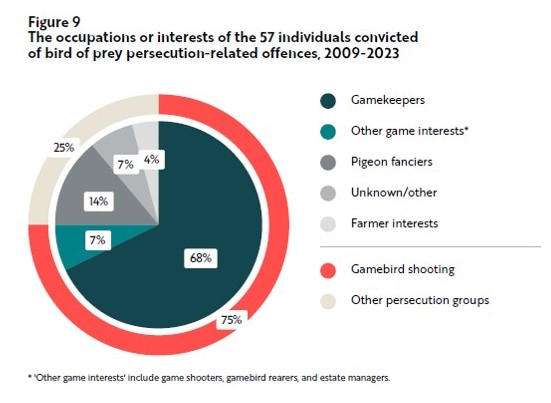
A scientific study published in the journal Biological Conservation found that survival rates of Hen Harriers were ‘unusually low’, and illegal killing was identified as a major cause. And previously, a 2019 Government study concluded that Hen Harriers suffer elevated levels of mortality on grouse moors, most likely as a result of illegal killing. The RSPB’s Birdcrime report also found that 75% of all individuals convicted of bird of prey persecution-related offences from 2009 to 2023 were connected to the gamebird shooting industry.

Howard Jones, RSPB Senior Investigations Officer, said:

The disappearance of Red is a huge blow for a struggling species where every bird counts. Should a tagged bird die, its tag would continue transmitting, allowing us to recover the body. This was not the case, which strongly suggests human interference.

This latest incident follows a clear pattern of Hen Harriers disappearing on driven grouse moors. It’s overwhelmingly clear that action must be taken to protect these birds in these landscapes. Licensing of driven grouse shooting estates must be implemented to ensure all estates are operating within the law, and to protect birds like Hen Harriers from persistent persecution“.

If you noticed a dead or injured bird of prey in suspicious circumstances, please call the police on 101 and fill in the RSPB’s online reporting form: https://www.rspb.org.uk/birds-and-wildlife/advice/wild-bird-crime-report-form/  

If you have information about anyone killing birds of prey which you wish to report anonymously, call the RSPB’s confidential Raptor Crime Hotline on 0300 999 0101.

ENDS

So here we are again. Yet another hen harrier ‘vanishes’ on yet another grouse moor. The name of the grouse moor hasn’t been made public but we know that Hen Harrier ‘Red’ disappeared in the same area where another young hen harrier, called ‘Sia’, also disappeared in suspicious circumstances in 2022.

The hen harrier killers couldn’t even get through the first month of a new year without committing yet another offence.

Why does it keep happening? Simple. Nobody has been caught or prosecuted in any of the (now) 134 cases we know about in recent years, and the chances of anyone being caught or prosecuted are virtually none existent, so there is absolutely no deterrent whatsoever to stop this happening again and again and again.

We know that Natural England is currently undertaking a review of the ludicrous Hen Harrier Brood Meddling ‘trial’ which ran from 2018 – 2024 (see here) and was supposed to bring an end to the routine, systematic slaughter of these birds. My understanding is that this review is being done relatively quickly because representatives of the grouse shooting industry have apparently applied for another brood meddling licence for 2025, laughingly termed a ‘conservation’ licence, and I’ll be writing about that soon.

Meanwhile, the RSPB says it is urging the Government to introduce a licensing scheme for grouse shooting in England, along the same lines as the new scheme in Scotland. They’re wasting their time – the legislation in Scotland has already been sabotaged by the grouse shooting industry resulting in a severely weakened licensing system that is virtually unenforceable.

Instead, Wild Justice has launched a petition calling for a ban on driven grouse shooting as the only viable option on the table. The petition is live until 22 May 2025 and needs 100,000 signatures to qualify for a debate in Westminster Hall. It’s currently on 64,000 signatures. If you haven’t yet signed it, it’s here.

I’ll shortly be updating the hen harrier death list, which now stands at 134 hen harriers confirmed ‘missing’ or illegally killed in the UK since 2018, mostly on or close to grouse moors. If the additional six dead hen harriers currently still awaiting post mortems turn out to have been illegally killed, the death list will stand at 140 hen harriers.

UPDATE 22 February 2025: 134 hen harriers confirmed ‘missing’ or illegally killed in UK since 2018, most of them on or close to grouse moors (here)

More shot pheasants dumped in Lincolnshire as Avian Flu risk increases

Hot on the heels of my recent blog about the discovery of shot & dumped pheasants and geese in Nottinghamshire (here), another fly-tipping incident has been reported, this time involving the dumping of four shot pheasants inside a black plastic bag in Lincolnshire.

These were discovered on 16 Feb 2025 by a member of the public at the edge of farmland in Bourne, Lincolnshire. The finder said the bag had split open and she’d observed red kites feeding on the carcasses, evidenced by the amount of plucked feathers next to the bag. What’s the betting these pheasants were shot with toxic lead ammunition, now slowly poisoning the native wildlife? If the lead poisoning doesn’t get them, the Avian Influenza probably will.

The orange baler twine shown in the photograph is indicative that these pheasants had been killed on a nearby shoot (gamebirds are often tied together in a brace with baler twine and hung up to allow the air to get to them). It’s likely these four birds were given to a shoot participant to take home and he/she decided to dump them instead because they’d already served their purpose as live targets shot for entertainment.

Regular blog readers will know that the dumping of shot gamebirds is a common and widespread illegal practice that has been going on for years, despite the repeated denials by the shooting industry. Who else do they think is doing this if not the people involved in gamebird shooting?! The disposal of animal by-products (including shot gamebirds) is regulated and the dumping of these carcasses is an offence.

Previous reports include dumped birds found in Cheshire (here), Scottish borders (here), Norfolk (here), Perthshire (here), Berkshire (here), North York Moors National Park (here) and some more in North York Moors National Park (here) and even more in North Yorkshire (here), Co. Derry (here), West Yorkshire (here), and again in West Yorkshire (here), N Wales (here), mid-Wales (here), Leicestershire (here), Lincolnshire (here), Somerset (here), Derbyshire’s Peak District National Park (here), Suffolk (here), Leicestershire again (here), Somerset again (here), Liverpool (here), even more in North Wales (here) even more in Wales, again (here), in Wiltshire (here) in Angus (here), in Somerset again (here), once again in North Yorkshire (here), yet again in West Yorkshire (here), yet again in mid-Wales (here), even more in mid-Wales (here), more in Derbyshire (here), Gloucestershire (here) more in Cheshire (here), some in Cumbria (here), some more in the Scottish Borders (here) and again in Lincolnshire (here) and in Nottinghamshire (here).

Unless someone was seen dumping these shot gamebirds there’s no way of knowing who did it or from which gamebird shoot they originated. There’s no requirement for shoot managers to fit identifying markers to their livestock, which would make them traceable, because gamebird ‘livestock’ absurdly changes legal status to ‘wildlife’ as soon as the birds are released from the rearing pens for shooting (see Wild Justice’s blog on Schrodinger’s Pheasant for details).

Obviously, it’s irresponsible (and illegal) to dump shot gamebirds at any time but especially so when the UK Government (and Scottish Government and now also the Welsh Government) has declared a nationwide Avian Influenza Prevention Zone (AIPZ) due to the heightened risk of the spread of highly pathogenic Avian Influenza (Bird Flu) amongst captive and wild birds.

These declarations make it a legal requirement for all bird keepers to follow strict and enhanced biosecurity measures to help protect their flocks from the threat of Avian Influenza. In some areas, the risk is considered so severe that mandatory housing measures have also been declared.

The Mandatory Housing Avian Influenza Prevention Zone was previously declared in the East Riding of Yorkshire, City of Kingston Upon Hull, Lincolnshire, Norfolk, Suffolk, Shropshire, York and North Yorkshire. However, as of 16 February 2025, this has now been extended to cover Herefordshire, Worcestershire, Cheshire, Merseyside and Lancashire, as shown on this map:

The latest dumped pheasants found inside a black sack were discarded in Bourne, Lincolnshire, which also happens to be inside the regional Mandatory Housing Avian Influenza Prevention Zone.

I can’t imagine that the farmers in this area, who are having to implement the very highest levels of biosecurity measures and cover the financial strain of all that entails, will be impressed with the thoughtless, feckless and unaccountable actions of the gamebird shooting industry who yet again do what they like, when they like and to hell with the consequences because there aren’t any.

Northern Ireland Raptor Study Group Conference, 22 February 2025 – booking open

Booking is open for The Northern Ireland Raptor Study Group (NIRSG) conference taking place this Saturday (22 February 2025) at the Killyhevlin Hotel, Enniskillen.

The conference is open to everyone – you don’t need to be a member of the NIRSG to attend. To find out more information and details of how to book, please visit the NIRSG website (here).

You’ll see that Phase 2 of the NIRSG’s campaign to ban dangerous, raptor-killing pesticides will be launched on Saturday morning. I wrote about this campaign a few days ago (see here) and wanted to drum up support to help the petition reach 50,000 signatures before this coming Saturday (it had been stubbornly stuck at 46, 206 signatures for a while).

This petition/campaign was initiated after the discovery of two young white-tailed eagles that were found dead on Northern Ireland’s only driven grouse moor in 2023 – they’d both been illegally poisoned by the toxic pesticide Bendiocarb.

Many, many thanks to the approx 1,500 of you who have signed in the last few days – the current total is 47, 761 signatures. We need a couple more thousand people to pledge their support to reach the target.

Can you help? You don’t need to be a resident of Northern Ireland to sign – the petition is open to anyone, anywhere, who cares about the illegal use of these dangerous poisons to kill birds of prey (and any other wildlife that comes into contact with indiscriminately placed poisonous baits).

If you’d like to sign and/or share the petition with others, please click HERE.

Thank you.

Shot gamebirds & geese dumped in Nottinghamshire

Here we go again. The remains of shot gamebirds and geese have been found dumped at the side of the road, this time in Nottinghamshire in early February 2025.

Many thanks to Helena M who has given permission for these photographs to be published. She writes:

Hi, yesterday in my village of Carlton in Lindrick Worksop Notts, I came across a very distressing sight of many dead birds at the side of the road.

Some of these birds were intact, others were in many pieces.

Please find attached photos of these poor birds remains.

This sad event has got to be the result of a barbaric act by humans, and if so can anything be done to try prevent it happening again? I think I know the answer but you can but hope that the needless suffering of animals at the hands of people may one day cease to exist.’

Regular blog readers will know that this is a common and widespread illegal practice that has been going on for years. The disposal of animal by-products (including shot gamebirds) is regulated and the dumping of these carcasses is an offence.

Previous reports include dumped birds found in Cheshire (here), Scottish borders (here), Norfolk (here), Perthshire (here), Berkshire (here), North York Moors National Park (here) and some more in North York Moors National Park (here) and even more in North Yorkshire (here), Co. Derry (here), West Yorkshire (here), and again in West Yorkshire (here), N Wales (here), mid-Wales (here), Leicestershire (here), Lincolnshire (here), Somerset (here), Derbyshire’s Peak District National Park (here), Suffolk (here), Leicestershire again (here), Somerset again (here), Liverpool (here), even more in North Wales (here) even more in Wales, again (here), in Wiltshire (here) in Angus (here), in Somerset again (here), once again in North Yorkshire (here), yet again in West Yorkshire (here), yet again in mid-Wales (here), even more in mid-Wales (here), more in Derbyshire (here), Gloucestershire (here) more in Cheshire (here), some in Cumbria (here), some more in the Scottish Borders (here) and again in Lincolnshire (here).

Unless someone was seen dumping these shot gamebirds (and geese) there’s no way of knowing who did it or from which gamebird shoot they originated. There’s no requirement for shoot managers to fit identifying markers to their livestock, which would make them traceable, because gamebird ‘livestock’ absurdly changes legal status to ‘wildlife’ as soon as the birds are released from the rearing pens for shooting (see Wild Justice’s blog on Schrodinger’s Pheasant for details).

Bizarrely, the legs/feet of the geese and one of the pheasants appear to have been cut off – you can see some of them scattered around in photo 4 – but they don’t appear to have been de-breasted (the meat removed for human consumption).

As ever, it’ll be the taxpayer who has to pay for these bird remains to be removed, not the senseless, arrogant moron who dumped them. And presumably the council workers tasked with the job will have to be wearing full protective clothing given the recent declaration of a nationwide Avian Influenza Prevention Zone (AIPZ).

Thanks, gamebird shooting industry, for yet another example of your magnificent custodianship of the countryside.

BBC rejects Scottish Gamekeepers Association’s complaint about programme that linked raptor persecution to land managed for gamebird shooting

Last November the BBC aired an episode of Highland Cops (Series 2, Episode 4) that featured a Police Scotland Wildlife Crime Officer, PC Dan Sutherland, investigating the suspicious disappearance of a satellite-tagged golden eagle on a grouse moor in the Highlands (available for next 9 months on iPlayer here, starts at 35.15 mins).

The programme followed PC Sutherland, along with an RSPB Investigations Officer, searching the moor for evidence of either the eagle or its tag.

PC Sutherland is an experienced WCO and he explained that this wasn’t the first time he’d been involved in an investigation into this type of incident and he gave a comprehensive commentary on the lengths that offenders will go to to hide the evidence of their crimes (e.g. tags being burned, tags being tied to rocks and dumped in lochs).

He also said: “So within Highlands & Islands, 100% of all birds of prey that are being killed happen on or near land that’s managed for gamebird shooting“.

The Scottish Gamekeepers Association (SGA) lodged a formal complaint to the BBC about what the SGA described in its quarterly members’ rag as having “caused unfair reputation [sic] damage” to the game-shooting industry and wanted the BBC to make “a prominent correction“.

Here’s the response from the BBC’s Executive Complaints Unit, published 13 February 2025:

It shouldn’t come as a surprise to anyone, not least the SGA, that this complaint was not upheld. The Scottish Parliament voted overwhelmingly last year to introduce new legislation (Wildlife Management & Muirburn (Scotland) Act 2024) precisely because raptor persecution, and particularly the illegal killing of golden eagles, persists on many driven grouse moors.

Well done PC Sutherland for saying it as it is, and well done to the BBC for not pandering to the histrionics of the SGA.

Petition to ban possession of dangerous, raptor-killing pesticides in Northern Ireland approaches deadline: please sign

Your help is needed to ensure a petition, calling for a ban on the possession of dangerous, raptor-killing pesticides in Northern Ireland, passes the target of 50,000 signatures before next week.

The petition was launched by the award-winning Northern Ireland Raptor Study Group (NIRSG) in July 2023 following the illegal poisoning of two young White-tailed Eagles that were found dead, side by side, on Northern Ireland’s only driven grouse moor at Glenwherry, in the Antrim Hills.

The two poisoned white-tailed eagles. Photo: Northern Ireland Raptor Study Group

The eagles had both ingested the highly toxic insecticide, Bendiocarb, which is currently only licensed for indoor use in Northern Ireland. This chemical is so dangerous that it’s an offence to even possess it in Scotland, let alone place it out in the open on a bait to attract any passing predators.

The petition calling for a ban on the possession of Bendiocarb and a range of other dangerous chemicals used to illegally target birds of prey currently has 46,206 signatures. The target is 50,000 signatures and ideally this target can be met before next week, when the NI Raptor Study Group will be announcing Phase 2 of its campaign to get these pesticides out of circulation. A petition with 50,000+ signatures will help get the attention of the politicians the NIRSG will be approaching.

You don’t need to be a NI resident to sign the petition; any decent human being with an interest in protecting birds of prey and other wildlife can sign it.

If you haven’t already signed, and want to help this important campaign, please sign the petition HERE.

Thank you.

Two job opportunities with award-winning charity Birds of Poole Harbour

The award-winning charity Birds of Poole Harbour (BOPH) is advertising two rare job opportunities.

The first one is for the role of maternity cover for the BOPH Manager, starting in spring 2025.

Salary: £36,500

Hours: 40 hours per week with occasional weekend work required. Primarily Poole and Wareham-based with occasional optional home-working.

Location: Primarily Poole and Wareham-based with occasional optional home-working.

Key Responsibilities:

  • Providing overall management of the charity, working closely with our Chair of Trustees to make sure that the charity’s operations are guided by the our core values, aims and strategy, while operating sustainably.
  • Overseeing the management of our team, providing support where required, including line management of 4-5 staff members and recruitment of new team members.
  • Ensuring the organisation fulfils its legal, statutory and regulatory responsibilities, with support from our trustee board.
  • Working with our Operations Manager to prepare and review the charity annual budget and annual report.
  • Maintaining effective communication with our Chair of Trustees, and regularly supply the board with charity updates and reports with support from the Operations Manager.
  • Providing management support for our conservation and engagement projects.
  • Identifying funding opportunities to diversify the charity’s income streams.
  • Maintaining and growing relationships with charity partners.
  • Working with our engagement team to develop our annual events calendar and providing support with the delivery of our events when required.
  • Ensuring a high standard of delivery for our outreach projects and events, overseeing feedback from the public to continue our growth.

Closing Date: 9am on Wednesday 26 February 2025.

For a job specification and details of how to apply, click here.

The second job opportunity is for a Part-time Osprey Engagement Officer from April to August 2025.

Salary: £12.60 per hour (Real Living Wage)

Hours: 15 hours per week, w/b 14th April – 31st August. Due to the nature of our events, this position will require working regular Saturdays and outside of regular working hours.

Location: Wareham and Poole based.

What you’ll be working on: You’ll be helping our team to deliver an ambitious events schedule through the spring and summer, including our Carey Osprey Tours led in partnership with Careys Secret Garden, as well as our Osprey Cruises during August.

During the spring and early summer you will primarily be responsible for delivering three 2-hour sessions per day to view and interpret the nesting Ospreys at Careys Secret Garden with groups of up to 12 people, informing them about the exciting Poole Harbour Osprey Translocation Project, the nesting pair, and engaging them with the other birdlife that can be found onsite. Later in the summer, you will provide support with spotting and commentary on our award-winning Osprey Cruises around Poole Harbour. This role will be well-suited to an aspiring and enthusiastic ornithologist with excellent communication skills and a good knowledge of British birds.

Closing Date: 9am on Monday 3 March 2025.

For a job specification and details of how to apply, click here.

“The Toxic Restaurant” – spoof video highlighting toxic lead ammunition sends BASC into meltdown

In the build up to a forthcoming decision by the DEFRA Secretary of State (and his counterparts in the devolved governments) whether to accept the HSE’s recommendations to ban the use of toxic lead ammunition (see here), the Wildfowl & Wetlands Trust (WWT) has today released a spoof video highlighting the dangers of poisonous lead shot to the environment, wildlife and human health.

The video is set in a fictional restaurant called the Duck and Cover and features Megan McCubbin ordering the toxic lead roast pheasant…

This is a welcome new campaigning approach by the WWT, using humour to get across an important message about toxic lead ammunition, an issue with which this organisation has long-standing interest and expertise.

The idea is not only to educate the public about the harm caused by toxic lead ammunition, but also to encourage people to join in with the wider campaign to send a strong message to DEFRA Environment Secretary Steve Reed MP urging him to make lead history (see here for how you can help).

Predictably, not everyone is happy with the campaign, and particularly the spoof video. The British Association for Shooting and Conservation (BASC) has published the following apoplectic statement on its website:

The BASC statement is actually funnier than the spoof video.

BASC considers the video to be damaging to the reputation of game shooting and food-related businesses linked to sustainable shooting“.

Really? I’d argue the damage being caused to the reputation of game shooting and food-related businesses lies firmly with the game shooting industry’s embarrassing failure to (a) comply with the legislation that forbids the use of toxic lead ammunition in sensitive wetland environments in England (e.g. see here) and in Scotland (e.g. see here), and (b) to meet its own commitment to a five-year voluntary transition away from toxic lead ammunition across the whole of the UK, as evidenced by the continued sale of lead-contaminated gamebirds in supermarkets and other stockists (e.g. see here and here).

BASC is also astounded that the video can be released by an organisation whose Chief Executive – Sarah Fowler – enjoyed an evening as a guest of the sector-leading Eat Game Awards in 2024‘.

Astounded‘? Why? Does BASC think that just because someone attended an industry event in a professional capacity that should prevent her organisation from ever criticising that industry’s ongoing criminality and dirty, dangerous practices? Just because Natural England signed up to such an agreement doesn’t mean that the silence of others in the conservation sector can also be bought so easily.

And by the way, the ‘sector-leading’ Eat Game Awards gave the prize of ‘Best Large Game Retailer‘ in 2024 to Waitrose, you know, the supermarket that has claimed for at least three years not to be selling game meat contaminated with toxic lead ammunition but has been caught with its pants down three times, leading to an official complaint being made to the Competition and Marketing Authority about Waitrose’s untruthful and inaccurate advertising.

Garry Doolan, BASC’s Deputy Director of Communications & Public Affairs said (amongst other things), “The inclusion of species such as pheasants and grouse – neither of which are wetland birds – further highlights the lack of focus and accuracy in their [WWT’s] messaging“.

That’s hilarious, Garry. An ex- tabloid hack from the Daily Mail telling a highly-respected conservation charity to stay in its lane and stick to ‘accuracy’! Besides, its perfectly legitimate for the WWT to focus on pheasants and grouse because the shooting of these species is a significant source of the dumping of 7,000 tonnes of toxic lead ammunition into the environment every year (not that the WWT needs the approval of BASC for its campaign output).

At least he didn’t attack Megan this time – perhaps he’s learned from his previous outburst of targeted, abusive and aggressive commentary.

Garry also claims that the video “has only served to diminish WWT’s reputation“. Actually, I’d argue it’s done the exact opposite. I applaud WWT’s willingness to put its head above the parapet and shine a big spotlight on the atrocities of the game-shooting industry and the charity has gone up in my estimation because of it.

This WWT video will likely reach a new audience who were previously blissfully unaware of the damage being caused by gamebird shooting and that’s probably what BASC is afraid of, hence it’s attack.

If you’ve enjoyed the spoof video and want to join over 10,000 others who have already sent an e-action to Steve Reed MP urging him to accept the HSE’s recommendation to ban the use of toxic lead ammunition, you can take action here.

Parliamentary questions lodged on grouse moor licensing shambles in Scotland

Regular blog readers will know that NatureScot made a sudden and controversial decision last autumn to change its approach and amend the brand new grouse moor licences that had been issued to sporting estates in Scotland under the new Wildlife Management & Muirburn (Scotland) Act 2024.

See previous blogs herehereherehere, and here for background details.

The changes made by NatureScot significantly weakened the licence by changing the extent of the licensable area from covering an entire estate to just the parts of the estate where red grouse are ‘taken or killed’, which on a driven grouse moor could effectively just mean a small area around a line of grouse butts. The licence was further weakened by NatureScot reducing the number of offences outside the licensable area that could trigger a licence revocation.

Photo of a line of grouse-shooting butts by Richard Cross, annotated by RPUK

Freedom of Information responses later revealed that NatureScot had capitulated on grouse moor licensing after receiving legal threats from the grouse shooting industry. Secret and extensive negotiations then took place between NatureScot and a number of grouse shooting organisations, excluding all other stakeholders. NatureScot refused to release the legal advice it had received and on which it had apparently based its changes to the licence.

Thanks to those of you who wrote to the Scottish Government’s Minister for Agriculture & Connectivity, Jim Fairlie MSP, last month to ask what the Scottish Government intended to do to fix the massive loophole that now exists in the amended licence. I’ve yet to see any substantial response from him.

Meanwhile, it seems other politicians have taken a keen interest in proceedings and Colin Smyth MSP (Scottish Labour) has now lodged the following parliamentary questions:

S6W-34517: To ask the Scottish Government whether it will publish the (a) legal and (b) other advice obtained by NatureScot regarding which areas of land should be covered by a 16AA licence under the Wildlife Management and Muirburn (Scotland) Act 2024.

S6W-34518: To ask the Scottish Government what its response is to the reported criticisms from members of the conservation sector regarding the changes made to grouse shooting licences by NatureScot and, in the light of this, what steps it plans to ensure that the operation of section 16AA licences fulfils the intentions of (a) it and (b) the Parliament.

S6W-34519: To ask the Scottish Government on what dates NatureScot met (a) Police Scotland and (b) the National Wildlife Crime Unit before seeking approval for a new grouse licensing condition regarding raptor persecution from land and estates.

S6W-34520: To ask the Scottish Government what its position is on (a) the comment by NatureScot on 19 July 2026 that “raptor persecution undertaken in connection with grouse moor management could take place anywhere on a property, not just on the grouse moor itself”, and (b) whether the Wildlife Management and Muirburn (Scotland) Act 2024 needs to be amended to ensure that the 16AA grouse shooting licence covers an applicant’s whole landholding and not the grouse moor only.

These questions were lodged on 6 February 2025 and answers are expected by 6 March 2025.

There’s more going on behind the scenes. Watch this space.

Osprey cruises run by Birds of Poole Harbour charity win gold in Dorset Tourism Awards

HUGE congratulations to the fantastic team behind the charity Birds of Poole Harbour whose Osprey Cruises have won GOLD in the 2024/25 Dorset Tourism Awards (Experience of the Year category)!

The Birds of Poole Harbour team collecting their gold award earlier this week. Photo by Ian Plested, IPVisuals, Dorset Tourism Awards 2024/25

If ever there was a well-deserved award, this is it, because the work of this small, passionate and knowledgeable team expands far, far beyond the popular Osprey Cruise boat trips that they run every summer.

In the world of UK raptor conservation, the charity is probably best known for successfully bringing back Ospreys to the south coast of England, working in close partnership with the Roy Dennis Wildlife Foundation. Ospreys were translocated from Scotland over a number of years, starting in 2017, and are now regularly breeding in Poole Harbour, with the first chicks hatching in southern England in almost 200 years.

The Osprey project is just one of several high impact conservation projects this team is involved with and they are currently working towards a Chough reintroduction on the Purbeck Coast. They are also heavily involved in various annual bird surveys and bird ringing projects around this important wetland site.

Public engagement and education has always been one of the core objectives of the Birds of Poole Harbour charity, and boy, do they deliver on that front!

They run a School Bird Boat Project during the winter and spring, offering local primary schools free two-hour harbour boat trips, including free coach travel to and from Poole Quay. There are free binoculars for the pupils to use and they’re encouraged to participate in identifying and recording different species whilst on board, as well as learning about natural history, conservation and their local environment. Imagine the impact those boat trips have on those kids.

In addition to the school boats, the charity delivers an extraordinary events calendar throughout the year which members of the public can pay to attend. They do guided walks and ID courses, talks and free pop-up events, but probably the most popular events are the various boat cruises which attract thousands of visitors a year, many of them selling out quickly and attracting visitors from far beyond Dorset.

I’m one of those visitors and I’ve been making the trip down to join these boat trips since 2017. Initially it was to see the Ospreys, but more recently the big draw for me is the resident pair of White-tailed Eagles that have set up home in Poole Harbour. There are plenty of other raptor species too, notably Marsh Harriers and Peregrines, and because of the diversity of habitats around the harbour there are many, many more bird species to see.

These boat trips usually last for three hours and members of the BOPH team are always on board to provide a running commentary (and they also know where the eagles like to hang out). The trips are hugely enjoyable and massively informative. You don’t need to be an expert birder to attend – the passengers are often an eclectic mix of backgrounds and experience, ranging from the expert to the novice and everything inbetween. If you want a brilliant, fun and engaging day out, look out for this year’s boat trip dates on the BOPH website (being announced shortly). You can also organise a private, bespoke boat trip, e.g. as a corporate event or as an event for supporters as Wild Justice did in 2023.

BOPH boat trips – photos by Ruth Tingay

For those who can’t visit the harbour in person, Birds of Poole Harbour provide a daily blog of bird sightings, a regularly-updated website with news from their various projects, and they provide live-streaming webcams so people from around the world can follow the fortunes of the Ospreys’ breeding seasons.

Another winner at the 2024/25 Dorset Tourism Awards was Careys Secret Garden, based on the western side of the harbour, who won GOLD in the Ethical, Responsible & Sustainable Tourism category, SILVER in the Small Visitor Attraction of the Year category, and took home the WINNER OF WINNERS award, too! Careys Secret Garden works in partnership with Birds of Poole Harbour and offers a wide range of events, courses and activities from March to October, including the Careys Osprey Tours where small groups can book to visit a viewing platform to watch the famous nest belonging to Ospreys CJ7 & 022. If you’re in the area for a BOPH boat trip, I’d highly recommend a visit to this special, secluded location.

Congratulations again to both organisations on winning the richly-deserved recognition these awards will bring.

I wonder if former Conservative MP Chris Loder was at the awards ceremony?