Police appeal after buzzard found shot in North York Moors National Park

APPEAL FOR INFORMATION FROM CLEVELAND POLICE, 17th May 2018:

SHOT RAPTOR APPEAL

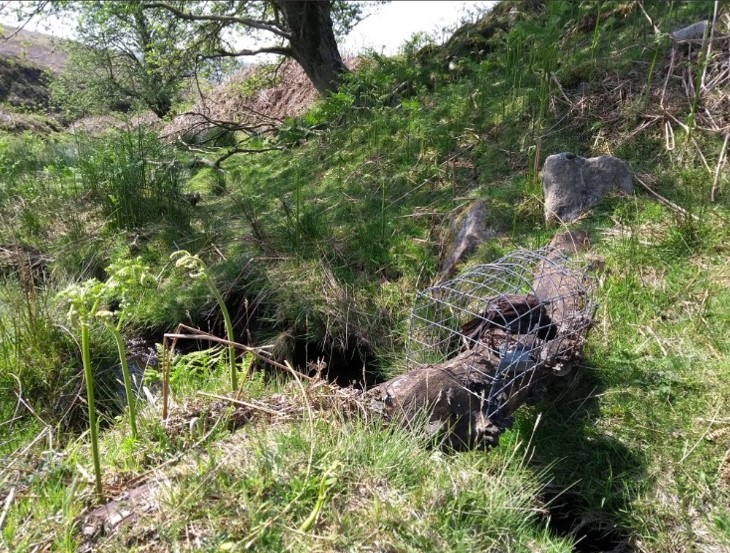
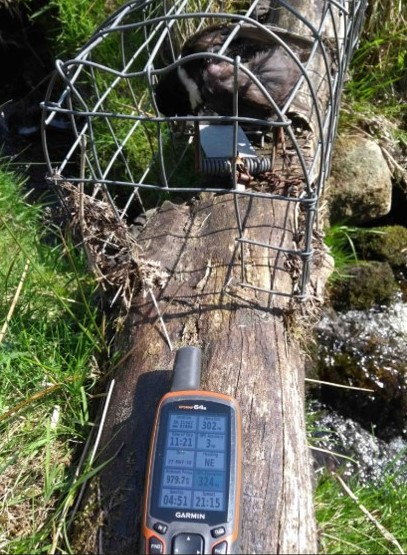
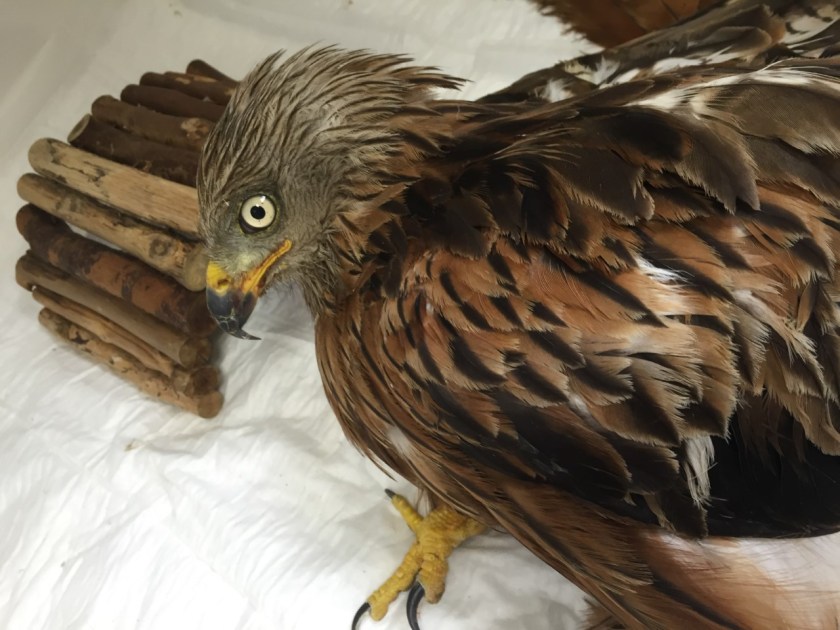
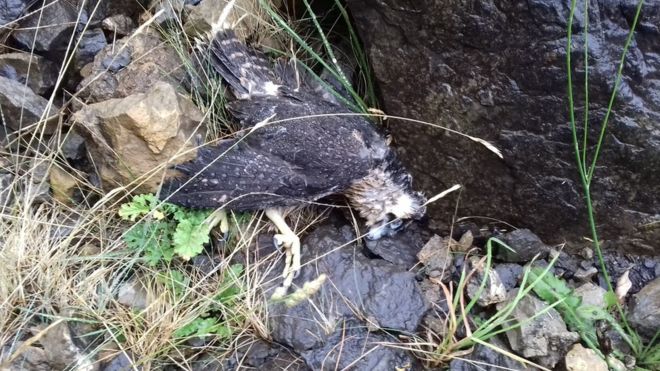
At some point on Friday 4th May between 1pm – 6pm a buzzard was shot near to Lockwood Beck Reservoir in East Cleveland.

The buzzard had received serious wounds to its legs and unfortunately had to be put to sleep by a local vet.

We are appealing for anyone who may have been in the area at the time and seen person / persons / vehicles acting suspiciously.

Please contact Police on 101 quoting event no: SE18078559 and for the attention of PC Ward 542

ENDS

Lockwood Beck Reservoir is in the North York Moors National Park:

New podcast: the illegal persecution of satellite-tagged eagles in Scotland

An excellent new podcast is now available on the illegal persecution of satellite-tagged eagles in Scotland.

Charlie Moores (a producer at LUSH) interviews Ian Thomson (RSPB Scotland Head of Investigations) about the suspicious disappearance of satellite-tagged golden eagles and white-tailed eagles in areas intensively managed for driven grouse shooting, and how the raptor killers’ tactics have changed since satellite tags became more commonly used.

Well worth 25 minutes of your time.

Listen to the podcast on the LUSH player HERE

[Ian with Chris Packham holding a picture of satellite-tagged golden eagle Fred who ‘disappeared’ in suspicious circumstances earlier this year, photo by Ruth Tingay]

Good grief, Cairngorms National Park!

For those of us hoping to see a progressive move away from intensive grouse moor management inside the Cairngorms National Park, we may have a long wait.

We’ve just found the following written on the VisitCairngorms website (‘the official website for the Cairngorms National Park’). It’s so bad it could have been written by one of the large grouse-shooting estates……..oh, it was.

Good grief! How the hell did that get approved for publication?

A couple of years ago, Will Boyd Wallis, Head of Land Management & Conservation for the Cairngorms National Park Authority wrote an excellent and encouraging blog about how the Park needed to ‘move with the times’, referring specifically to issues associated with intensive grouse moor management within the Park (well worth a read, see here).

He said, “We need to see practical action and clear demonstration that moorland managers are universally responding to modern needs and demands“.

There doesn’t appear to be any evidence of that response in the VisitCairngorms article with talk of Highland retreats for wealthy owners, killing ‘vermin’ (whatever that is), controlling predators by shooting and trapping, protecting game from poachers, and breeding gamebirds for release in to the wild.

A National Park, long considered a jewel in Scotland’s environmental crown? Or just a private playground for shooting parties, where killing wildlife for fun (‘sport’) is celebrated, even by the Park Authority?

Come on Cairngorms National Park, get a grip on this. There are some fantastic, forward-thinking estates within the Park and there are also many conservation-oriented staff at the CNPA. Remove the website guff about how Victorian-styled gamekeepers are the ‘life blood’ of the Park’s estates and let’s hear more about some of the conservation initiatives that some estates, and CNPA staff, are pushing forward.

UPDATE 17 May 2018: We’ve been asked to clarify that the VisitCairngorms website is not run by the Cairngorms National Park Authority and the CNPA has no editorial control. The VisitCairngorms website is run by the Cairngorms Business Partnership (the Chamber of Commerce) on behalf of their business members, and even though the website is adorned with the CNP logo and claims to be the Cairngorms National Park’s ‘official website’, it has its own Board and staff and its views are not neccesarily those of the CNPA. Clear? As mud.

Interestingly, the current Chair of the Cairngorms Business Partnership is Angus McNicol. By coincidence, the Factor of Invercauld Estate is also called Angus McNicol.

Missing sea eagle Blue T: statement from Cairngorms National Park Authority

Following last week’s news that a young satellite-tagged sea eagle (Blue T) had ‘disappeared’ on Invercauld Estate, the Cairngorms National Park Authority’s CEO, Grant Moir, has published a statement:

The frustration is evident and it’s clear that a great deal of thought has gone in to this statement, which is a huge improvement on previous CNPA statements about ‘disappearing’ satellite-tagged raptors in the National Park (e.g. see here), but we wanted to pick up on a few things.

The news that SNH will shortly be launching the next phase of its raptor tracker project is great – any technological developments that might provide more detail about the fate of ‘missing’ satellite-tagged raptors will be warmly welcomed by most (but probably not by the criminals within the grouse-shooting industry).

However, Grant seems to think that knowing exactly where and when a tagged bird was killed will “take the ambiguity away from the situation“. It won’t.

As we’ve blogged before, if the tag/raptor is destroyed on an estate that employs multiple gamekeepers, the issue of identifying the individual culprit(s) will remain, especially if all the staff give the standard ‘no comment’ police interview. There will also be the sometimes plausible argument that the raptor had been shot/poisoned on a neighbouring estate and died just over the boundary of the estate under scrutiny. And as we’ve seen in recent years, even with clear video evidence of an individually identifiable gamekeeper killing a raptor, a successful prosecution is highly unlikely because the Crown Office will declare the evidence inadmissible or will claim it’s not in the public interest to proceed.

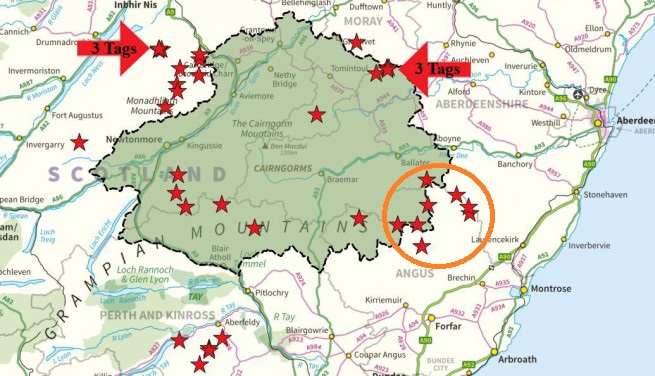
Sorry, Grant, but the so-called ‘ambiguity’ will remain – although there’s nothing ambiguous about the robust & statistically significant findings of the golden eagle satellite tag review, which demonstrated a clear relationship between suspicious raptor disappearances and land managed for intensive driven grouse shooting in and around the Cairngorms National Park:

One other thing in Grant’s statement that we wanted to pick up on –

Invercauld Estate is part of the East Cairngorms Moorland Partnership and I genuinely do believe that progress has started to be made across a wide range of subjects with the Estates involved……”

Really? What progress is that, then? Any progress on stopping the illegal persecution of raptors?

The East Cairngorms Moorland Partnership was established in December 2015 and comprises six estates working in ‘partnership’ with the CNPA.

The Partnership’s statement of purpose can be read here.

Here are the estates (boundaries sourced from Andy Wightman’s Who Owns Scotland website):

  1. Glenlivet Estate. 2. Glenavon Estate. 3. Mar Lodge Estate (National Trust for Scotland). 4. Invercauld Estate. 5. Mar Estate. 6. Balmoral & Birkhall Estate.

Last October, almost two years after this Partnership was established, we wanted to find out what progress had been achieved. We submitted an FoI to the CNPA asking for copies of all correspondence relating to the East Cairngorms Moorland Partnership since 1 January 2016.

Here’s the reply we received in November 2017:

We have searched our Corporate Drives for the period as above and we hold no information‘.

Impressive amount of progress, eh?

We do know that in February this year the CNPA was advertising for a part-time East Cairngorms Moorland Partnership Officer, on a decent salary of £28,770 – £34,633 pro rata.

Assuming someone has now been employed in this new position, they’ve certainly got their work cut out in delivering the objectives set out in the Cairngorms National Park Management Plan 2017-2022, which includes improving raptor populations in the National Park. Recent peer-reviewed science has revealed that the local hen harrier population has crashed (here) as has the local peregrine population (here).

Oh, and satellite-tagged hen harriers keep going ‘missing’ in highly suspicious circumstances inside the National Park, just like hen harrier Calluna, as do satellite-tagged eagles such as sea eagle Blue T and golden eagle #338.

National Park or National Disgrace?

Stink pits – the disgusting reality of 21st century grouse moor management

Over the weekend, charities OneKind and the League Against Cruel Sports Scotland released the following video footage, filmed on a Scottish grouse moor earlier this year.

It shows a ‘stink pit’ (also known as a ‘midden’) which is a pile of rotting animal carcasses (including the corpses of native wildlife and sometimes domestic pets) that are dumped in a heap and surrounded by snares. The putrefying stench from the corpses attracts predators to the pit who are then caught in the snares, killed and thrown on to the pile of death.

WARNING – GRAPHIC FOOTAGE:

This is the grisly reality of how the so-called ‘Custodians of the Countryside’ deal with native wildlife, including inside the boundaries of our National Parks. Snared, trapped, shot, killed and then dumped, like a pile of rubbish.

You have to wonder how this is still legal in the 21st Century, especially given the strict regulations imposed on farmers who generally cannot bury dead livestock unless at certain remote, designated locations. Gamekeepers? They can do what they like, even hanging the corpses of dead foxes over tree branches so their stench can be carried further afield.

We’ve blogged about stink pits before, as have others, e.g. see this blog written last year by OneKind and this article published by The Ferret (but beware, both contain more disturbing photographs).

In May 2017, Christine Grahame MSP (SNP) lodged a Parliamentary motion on the continued use of stink pits on game-shooting estates (see here). Her motion received cross-party support and resulted in a Parliamentary debate, in which Environment Secretary Roseanna Cunningham said the use of stink pits would be reviewed as part of the grouse moor management review, which is currently underway.

Case against grouse moor gamekeeper Timothy Cowin: part 3

Criminal proceedings continued on Friday (11 May 2018) against grouse moor gamekeeper Timothy Cowin, who is accused of a series of alleged wildlife crimes, including the shooting of two short-eared owls in April 2017 at Whernside, Cumbria in the Yorkshire Dales National Park. It is further alleged he was in possession of items (a shotgun and an electronic calling device) capable of being used to kill wild birds.

Following a farcical hearing at Preston Magistrates Court in March 2018 (see here), the case was due to be heard last Friday but it was adjourned, again, at the request of the defence.

The next hearing is scheduled for July 2018.

For legal reasons, we won’t be accepting any comments on this post.


Grouse shooting industry insider lifts lid in interview with Chris Packham

For the benefit of those not on social media, last week Chris Packham posted a series of daily tweets under the heading ‘Top 20 raptor crimes’, to highlight the extent of illegal raptor persecution in the UK, how often these crimes go unpunished, and when cases have reached court, how feeble and inadequate the sentences have been.

To round off the week, Chris posted this video interview with a (now former) grouse-shooting insider, who tells it as he’s seen it:

Raven cull: please ask your MSP to support this Parliamentary motion

A few days ago we blogged about this Parliamentary motion that had been lodged by Alison Johnstone MSP (Lothian, Scottish Greens) raising concerns about the raven cull licence:

Motion S5M-11986

That the Parliament expresses concern that Scottish Natural Heritage (SNH) has granted a licence to the Strathbraan Community Collaboration for Waders, which authorises the killing of 300 ravens; notes that this will take place in an area of Perthshire where eagles, which have been satellite-tagged have, it understands, previously disappeared and where the illegal persecution of raptors is believed to be well-documented; understands that this is as part of an experiment, which reportedly has no control measure in place, to assess the impact of such a cull on the wader population; regrets what it sees as the lack of consultation with expert organisations, including the Scottish Raptor Study Group and the RSPB; understands that these groups maintain that there “is no justification for this extreme course of action”; believes that there is a lack of robust scientific evidence to support this action; understands with regret that it is only now, following a notable and concerted public outcry, that SNH is calling on its Scientific Advisory Council to scrutinise the cull, and calls for the withdrawal of the research licence and the removal of the open general licence in this area as a matter of urgency.

Alison lodged this motion on 30 April but so far only five MSPs have supported it:

Patrick Harvie MSP (Greens), Christine Grahame (SNP), John Finnie (Greens), Andy Wightman (Greens), Ross Greer (Greens).

We believe that if this licence (and the process used to approve it) remains unchallenged, it is likely to be replicated in other areas dominated by driven grouse moors, and we’re likely to see similar applications for other species, especially buzzards, to be killed ‘just to see what happens’. If you think we’re being overly-dramatic, read the comments made by SNH’s Nick Halfhide last week, including the words: “Let’s have more trials [culls] whether it’s about ravens or other things so we can really test to see what we can learn from this kind of approach“.

This kind of approach” means SNH basing future conservation decisions on rural myth and old wives’ tales instead of peer-reviewed scientific evidence.

It’s crucial that this issue is debated in the Scottish Parliament but for that to happen, at least 30 MSPs from at least two different political parties need to sign Alison’s motion before 11 June 2018.

If you are a Scottish voter, we urge you to email your MSP and ask them to support the motion S5M-11986. If you’re not sure who your MSP is, please enter your postcode here to locate them.

Wherever you live, please consider adding your name to this petition opposing the raven cull, which has already attracted over 157,000 signatures.

And for those who have been asking, yes, we have been taking legal advice on whether to apply for a judicial review of SNH’s decision to grant this licence. Discussions are ongoing so more on that later.

Satellite-tagged sea eagle ‘disappears’ on Invercauld Estate in Cairngorms National Park

A satellite-tagged white-tailed eagle has ‘disappeared’ on Invercauld Estate in the Cairngorms National Park.

Apparently its last tag signal came from a roost wood close to the River Dee, near to Braemar, on Saturday.

[Map showing Invercauld Estate in the Cairngorms National Park. Estate boundary sourced from Andy Wightman’s Who Owns Scotland website]

There are scant details at the moment, other than an article published on the BBC news website (here) where the reader is told that Invercauld Estate (intensively-managed for driven grouse shooting) is ‘committed to conservation’, and that its gamekeepers were ‘working hard’ to find the missing eagle ‘in case there has been a technical malfunction of the tag and the eagle returns to roost again’.

Interestingly, there hasn’t been any press statement from the RSPB or Police Scotland, so we don’t know whether a police-led search has already taken place or whether any other investigative leads are/were being followed. It looks very much like Invercauld Estate has jumped the gun on this news, issuing its own press release in what appears to be a damage-limitation exercise. If that’s the case, it would be a clear breach of the Partnership for Wildlife Crime (PAW) Scotland media protocol.

Funnily enough, a similar thing happened a couple of weeks ago following the suspicious disappearance of another sat-tagged sea eagle (Blue X) in the Strathbraan area of Perthshire, when the Scottish Gamekeepers Association published a press statement while the police search was still underway – again, a clear breach of the PAW Scotland protocol.

What the estate / BBC article didn’t mention was how the disappearance of this latest satellite-tagged eagle fits the pattern of 45+ other cases where satellite-tagged eagles have disappeared in suspicious circumstances on or close to a driven grouse moor, and in areas where other raptor persecution incidents have been recorded, as reported in the Scottish Goverment’s Golden Eagle Satellite Tag Review published last year:

We’ve blogged about Invercauld Estate and the wider area of Deeside many times before –

There was the discovery of an illegally shot peregrine at the Pass of Ballater in 2011, the reported coordinated hunt and subsequent shooting of an adult hen harrier at Glen Gairn on the border of Invercauld and Dinnet Estates in 2013, and then there were the illegally-set traps that were found nr Geallaig Hill on Invercauld Estate in 2016, which resulted in ‘secret action‘ being taken against a gamekeeper but no prosecution followed, and nor has SNH imposed a General Licence restriction for this incident (and SNH has refused to discuss its decision saying ‘it’s not in the public interest‘ to tell us). Last year satellite-tagged hen harrier ‘Calluna’ disappeared in suspicious circumstances on a grouse moor in this area (here), although it’s not clear whether this was on Invercauld Estate or neighbouring Dinnet Estate.

This part of the Cairngorms National Park is identified as a wildlife crime hotspot, but not to worry, the Scottish Government has it in hand. It recently launched a pilot scheme deploying five police special constables (i.e. part-time volunteers) in the Cairngorms National Park, tasked with addressing wildlife crime (see here). What a joke.

Illegal raptor persecution is out of control and the Scottish Government needs to act, now. No more procrastination, no more excuses, no more chances.

We’ll be blogging more about the missing white-tailed eagle later today when more details become available.

UPDATE 16.30hrs: RSPB Scotland statement:

UPDATE 12 May 2018: Article in The National: ‘Gamekeepers and RSPB at loggerheads over sea eagle’s disappearance’ (here)

UPDATE 15 May 2018: Missing sea eagle Blue T: statement from Cairngorms National Park Authority (here)

Moorland Association giving false hope for an end to raptor persecution in Peak District National Park

The Moorland Association’s long-term ability to deny and undermine the proven link between illegal raptor persecution and driven grouse moor management is legendary (see here for just one of many examples).

Never far from the headlines, they’ve been churning out the propaganda again, this time during an interview on BBC Radio 4’s Today programme, broadcast 2 May 2018, in response to the recently published scientific paper linking illegal raptor persecution in the Dark Peak area of Derbyshire’s Peak District National Park with driven grouse moor management.

The interview is available on iPlayer for the next 21 days here (starts at 53:15 mins).

Here’s the transcript:

John Humpries: There’s new research seems to show a clear link between grouse shooting and the decline in the number of birds of prey, specifically the goshawk and the magnificent peregrine falcon, the fastest bird in the world. Mark Thomas of the RSPB has done the work, Amanda Anderson is the Director of the Moorland Association. They are both on the line.

Mr Thomas, haven’t we heard this before?

Mark Thomas: We have, John, lots of times. The difference here is you’ve got a National Park, a place where the public can go, 10m visitors a year.

John Humphries: The National Park being ?

Mark Thomas: The Peak District National Park. It is highly protected yet half of the park, the northern bit with the grouse moors, are a no go zone for the very birds that you’ve just discussed.

John Humphries: Because?

Mark Thomas: Because we’ve done some research and what we’ve done is we’ve looked at all the crimes against birds of prey. So this is shot peregrines, poisoned buzzards, shot buzzards, pole trapped ospreys, it goes on and on, and all those crimes, we’ve matched them statistically with the area used for driven grouse shooting in the Dark Peak, the northern area.

John Humphries: But I’m not quite sure how you link the crimes, as you put it, to legitimate grouse shooting.

Mark Thomas: Because what we’ve basically done is we’ve matched the places where the crimes occur and then we’ve put a layer on showing where the grouse moors are and statistically that is significant. It overlays each other and we’ve proven a correlation between the two. If you are a bird of prey, you do not want to be in the Dark Peak.

[RSPB map from the new scientific paper showing the number of confirmed raptor persecution incidents in the Peak District National Park 2000-2016 overlaid with areas managed for grouse shooting]:

John Humphries: Amanda Anderson, do you accept that?

Amanda Anderson: Good morning John, good morning Mark. I have to refute that Mark thinks the northern area is a no go zone for birds of prey. The National Park is a massive area, the size of London, and in the north of the park this year we have 8 pairs of peregrines and 7 or 8 pairs of goshawk. Now it’s early in the season, it’s a very cold late spring, I’m sure you’ll agree, so we can’t guarantee that these pairs will turn into nests and eggs turn into chicks.

John Humphries: But it’s this correlation between the crime and the areas where grouse shooting happen.

Amanda Anderson: One incident of a bird of prey being persecuted is too many but we must look at the instances of this, the amount of crimes reported. I don’t know the definition of a confirmed crime but it is over a 16-year period so there are 3-4 incidents per year and there have been 2 prosecutions in the area that Mark refers to and bird of prey numbers are now increasing.

John Humphries: That presents a slightly different picture, Mark.

Mark Thomas: That’s not exactly right. When you look nationally, 69% of all people convicted for killing birds of prey, gamekeepers, let’s get to it, they are the people killing birds of prey in this park. And, as I’ve said, we have a whole catalogue of incidents. The confirmed ones is when we’ve got a body, we’ve physically got a body where nobody can refute that that bird has not been poisoned, hasn’t been trapped. In terms of the birds that are there at the moment, we’ve had this situation year on year. At the beginning of the season it looks good. Ask Amanda. Last year not one single peregrine falcon was successful in the northern Dark Peak where the grouse moors are.

Amanda Anderson: That’s absolutely true. Last year peregrine were very disappointing. As I say, this year it’s looking very exciting with about 8 pairs on the go at the moment.

John Humphries: So there we are, that’s it, it does fluctuate, doesn’t it Mark?

Mark Thomas: It does but what our data is looking at is over a long period of time. Amanda’s reflecting on one year. We must acknowledge Amanda has tried very hard with her moorland managers to self regulate but that is not working.

John Humphries: So what would you do? Would you ban grouse shooting?

Mark Thomas: No, the RSPB is not saying that and we are not going as far as that. We are saying we want licencing. If a shoot has committed a crime then the licence to shoot on that moor is removed for a period of time. That would focus and we think that would solve this problem.

John Humphries: And would you accept that, Amanda?

Amanda Anderson: If a shoot has committed a crime then somebody should be in court and prosecuted and that is a fair system and is working. The conclusion the RSPB draw to legislate to help birds of prey is flawed when the population is increasing.

ENDS

Wow. Amanda’s final comment deserves a whole blog to itself but that’s for another time.

For now, we want to concentrate on Amanda’s claim that this year is “looking very exciting with about 8 pairs [of peregrines] on the go at the moment” and “7 or 8 pairs of goshawk“.

That sounds promising, doesn’t it? But just how accurate are these figures?

Not very, according to local raptor group fieldworker Mike Price from the Peak District Raptor Monitoring Group.

We asked Mike to comment and here’s his response:

“Thank you for your email. Whilst we are not able to publicly share the figures of breeding, highly threatened raptor species at this point in the season, we can tell you that the activity of Peregrine Falcons has followed the pattern of previous years, with several sites occupied earlier in the season. Approximately 50% of these sites are no longer occupied. 

We know that there has been an incident near to one site that led to an injured bird being photographed by a member of the public. It was described as immobile, on the ground and covered in blood. Unfortunately, despite extensive searching the bird has not been recovered and we do not know what caused the bird’s injuries.

[Photos of the injured peregrine, found 14 April 2018, published on Twitter by @RSPBBirders]

Occupied Goshawk sites appear to be lower than in 2017, although known breeding pairs remain in line with 2016 and 2017. Several sightings of pairs exhibiting breeding behaviour at historic breeding sites appear to have fizzled out and at a number of sites this appears to be happening annually and without any reasonable explanation.

With all of that in mind the figures quoted by Amanda Anderson for the north of the Peak District National Park, are in our opinion, inaccurate. We would welcome a recovery for both Peregrine and Goshawk in the area mentioned but after seven years of failed collaborative working we are understandably cautious”.

Hmm, this report paints quite a different picture to the one Amanda was suggesting, doesn’t it?

To be fair though, Amanda did say it was still early in the season and it’d been a cold, late spring so there was a chance that not all the peregrine and goshawk breeding attempts would be successful. That’s true, and the weather may well have played a role in some of these early failures (we’ll find out when the 2018 report is published). But take a look again at that bloodied, injured peregrine laying in the heather. Was that a victim of the cold, late spring?

It’s a critical time for breeding birds, and especially for breeding raptors in the Peak District National Park. According to a statement made by the Peak District National Park Authority in January this year, it is “looking for an increase in birds in the breeding season before committing to working with the other organisations in the Peak District Bird of Prey Initiative beyond 2018″.

It’s no wonder the Moorland Association is keen to pretend things are on the up.