Shooting industry hilariously claims ‘significant progress’ made on the failed voluntary transition away from toxic lead ammunition

Further to this morning’s news that a new study by leading UK academics has shown the shooting industry’s complete failure to achieve its much-heralded five-year voluntary transition away from using toxic lead ammunition (here), some within the gamebird shooting sector are continuing to shoot themselves in the foot.

Yesterday the Shooting Times published a news article that included the following statement:

While there are claims from anti-shooting groups that the voluntary move away from lead use has yielded few results, the evidence for this suggests otherwise“.

I’m not sure whether the Shooting Times author and/or editor was aware of the impending publication of the Shot-Switch paper showing the failure of the five-year voluntary transition away from toxic lead ammunition and that this news item was his/their attempt to spin the results, or whether it is simply an unhappy coincidence (for Shooting Times) that this embarrassing nonsense was published the day before the scientific findings were published.

Either way, it makes them look ridiculous. Describing five years worth of peer-reviewed scientific evidence from leading experts at the University of Cambridge as “claims from anti-shooting groups” just exposes the lengths they’ll go to to push their propaganda.

News article published in Shooting Times, 6 March 2025

It’s apparent that the Shooting Times article was probably based on a recent blog published on the BASC website on 24 February 2025 (although the BASC blog does not slur the scientific credentials of the Cambridge University research team, at least not this time – BASC does have form for doing this – see here).

The BASC blog, marking the fifth year of the shooting industry’s pledge to undertake a five-year voluntary transition away from using toxic lead ammunition, claims:

As we reach this milestone, significant progress has been made. Market-led solutions have emerged, education and awareness have increased, and the sector has demonstrated its ability to adapt and innovate“.

That so-called “significant progress” ignores entirely the five years of research evidence produced by the Shot-Switch project and instead focuses on the “major strides” made by the shooting industry in terms of the availability of alternative, non-toxic ammunition and a claim that, “thousands of people have attended BASC’s sustainable ammunition events since 2020, before then switching to lead-free ammunition themselves“.

I’ve never understood the shooting industry’s arguments about there being a lack of availability of non-toxic ammunition. If you go to any large hunting retailers in the US you’ll see entire aisles stocked to the brim with non-toxic alternatives such as steel shot and bismuth:

Steel shot cartridge boxes widely available in the US (photo by Ruth Tingay)
Bismuth cartridge boxes widely available in the US (photo by Ruth Tingay)

Perhaps these products, or similar, aren’t easily available in the UK? I don’t know, I’ve never tried to buy any but if non-toxic ammunition isn’t easily available in the UK then what are all the waterfowl hunters using? They’ve been banned from using toxic lead shot for killing certain species and over wetland environments in the UK for decades (although compliance is low in England and in Scotland) so where are the compliant hunters sourcing their non-toxic ammunition?

BASC’s blog also makes the following claim:

The impact of the transition is already being seen in the field. Many shoots have embraced lead-free ammunition, game dealers are increasingly sourcing lead-free game, and retailers are responding to consumer demand for more sustainable products. Through a combination of industry innovation and engagement with the shooting community, BASC and its members have demonstrated that sustainability and shooting can go hand in hand“.

This claim seems to be at odds with the particularly candid opinion of Louisa Clutterbuck, CEO of Eat Wild (the development board for ‘wild meat’ in the UK, although claiming that non-native reared & released gamebirds are ‘wild’ seems to be stretching it a bit!).

In an article published online in May 2024, Louisa said this:

I have heard from several game dealers recently that some shoots are returning to lead on shoot days which is most alarming and retroactive. They don’t feel there is any benefit to them as a shoot but surely having all your game collected and knowing it is entering the food chain is the largest benefit of them all?

When we are speaking to retail outlets we never bring up lead shot, we presume they are happy with it unless stated otherwise. Unfortunately, there has been a steep rise in these conversations and so we are discussing the options of lead-free shot more and more. I say unfortunately because there still is not enough supply of lead-free game to fulfill our current supermarkets as well as any new markets

AND

Waitrose cannot get enough supply of lead-free birds that they need, and their sales have dramatically fallen because of this, it will be no skin off their nose if they have to switch to selling farmed guinea fowl, we are fooling ourselves if we think otherwise“.

BASC is correct in saying that supermarkets are indeed responding to consumer demand for more sustainable products but that’s nothing to do with ‘the impact of the transition‘, as BASC claims, because so far, despite disturbingly inaccurate claims, evidence has shown that not one of the supermarkets has been able to ensure that all its gamebird products are lead-free.

Hopefully, by this time next week Defra’s Secretary of State Steve Reed MP and his colleagues in the devolved governments will have made an announcement about whether they intend to accept the recommendations of the Health & Safety Executive to ban the use of lead ammunition.

UK gamebird shooting industry fails to meet voluntary pledge to stop using toxic lead ammunition – new study

Press release from the University of Cambridge (6th March 2025)

Pledge to phase out toxic lead ammunition in UK hunting by 2025 has failed

A voluntary pledge made by UK shooting organisations in 2020 to replace lead shot with non-toxic alternatives by 2025 has failed, analysis by Cambridge researchers finds.

The pledge, made in February 2020 by the UK’s nine leading game shooting and rural organisations, aimed to benefit wildlife and the environment and ensure a market for the healthiest game meat food products.

But a Cambridge team, working with the University of the Highlands and Islands, has consistently shown that lead shot was not being phased out quickly enough to achieve a complete voluntary transition to non-toxic ammunition by 2025. In a final study, published today in the journal Conservation Evidence, the team concludes that the intended transition has failed.

The team has closely monitored the impact of the pledge every year since its introduction, recruiting expert volunteers to buy whole pheasants from butchers, game dealers and supermarkets across Britain and recover embedded shotgun pellets for analysis.

A pheasant carcass bought in Waitrose containing toxic lead shot. Photo by Mike Price

In 2025, the study – called SHOT-SWITCH – found that of 171 pheasants found to contain shot, 99% had been killed with lead ammunition.

This year, for the first time, the team also analysed shotgun pellets found in red grouse carcasses shot in the 2024/25 shooting season and on sale through butchers’ shops and online retailers. In all 78 grouse carcasses from which any shot was recovered, the shot was lead.

Many members of the shooting community had hoped that the voluntary pledge away from lead ammunition would avert the need for regulation. But the voluntary route has now been tested – with efforts made by many people – and it has not been successful,” said Professor Rhys Green in the University of Cambridge’s Department of Zoology and lead author of the report.

Eating game meat killed using lead shot will expose people unnecessarily to additional dietary lead. Lead is toxic to humans even in very small concentrations; the development of the nervous system in young and unborn children is especially sensitive to its effects. As a result, many food safety agencies now advise that young children and pregnant women should avoid, or minimise, eating game meat from animals killed using lead ammunition.

Discarded shot from hunting also poisons and kills many tens of thousands of the UK’s wild birds each year.

Despite proposing the voluntary change, many shooting organisations and some individual shooters do not support proposed regulatory restrictions on lead ammunition.

Green said: “Private individuals pay a lot of money to shoot pheasants on some private estates – and people don’t like to change their habits. It’s a bit like wearing car seatbelts, or not smoking in pubs. Despite the good reasons for doing these things, some people were strongly against using regulation to achieve those changes, which are now widely accepted as beneficial. The parallel with shooting game with lead shotgun ammunition is striking.”

Danish shooters now say that the legal ban on lead introduced in Denmark around 30 years ago was justified. They say it has not reduced the practicality or popularity of their sport, and has increased its acceptability to wider society.

Although a few large UK estates have managed to enforce non-lead ammunition on pheasant shoots, some have had to be quite draconian in order to do it, with the estate gamekeepers insisting on loading the guns for the shooters,” added Green.

In the 2020/21 and 2021/22 shooting seasons, over 99% of the pheasants studied were shot using lead ammunition. This figure dropped slightly to 94% in 2022/23 and 93% in 2023/24, with the remaining pheasants killed by ammunition made of steel or a metal called bismuth, before rising to 99% again in 2024/25.

Retail pressure

The researchers also checked up on a pledge made by Waitrose in 2019 to stop selling game killed with lead ammunition.

They found that the retailer had been largely let down by suppliers, and that some of their shooters continued to shoot using lead despite making assurances to the contrary. As a result, Waitrose did not sell oven-ready pheasants at all between 2021 and 2023. It sold pheasants again in January 2024 and the 2024/25 season, but the researchers showed that the majority had been killed using lead shot.

In 2022 the National Game Dealers Association (NGDA), which buys game and sells it to the public and food retailers, also announced it would no longer sell game of any kind that had been shot using lead ammunition. But this pledge has since been withdrawn. The researchers bought 2024/25 season pheasants from three NGDA member businesses and found that all had been shot with lead ammunition.

Inside influence

The researchers also analysed all articles relating to the voluntary transition published in the magazine of the UK’s largest shooting organisation, the British Association for Shooting and Conservation. They found that articles near the beginning of the five-year pledge communicated clear, frequent and positive messages about the effectiveness and practicality of non-lead shotgun ammunition.

But by 2023, mentions of the transition and encouragement to follow it had dropped dramatically.

The upshot

At the request of the Defra Secretary of State, the UK Health & Safety Executive (HSE) has assessed the risks to the environment and human health posed by lead in shot and bullets. Its report, published in December 2024, proposes that the UK Government bans the use of lead shot and large calibre bullets for game shooting because of the risks they pose to the environment and health. This recommendation is currently under review by Defra ministers, with a response due in March 2025.

Steel shotgun pellets are a practical alternative to lead and can be used in the vast majority of shotguns, as can other safe lead-free alternatives. But the results of this study indicate UK hunters remain unwilling to make the switch voluntarily.

Since 2010, UK governments have preferred voluntary controls over regulation in many areas of environment and food policy and have suggested that regulation be used only as a last resort.

Shooting organisations did a lot of questionnaire surveys when the pledge was introduced in 2020, and the results suggested many shooters thought the time had come to switch away from lead ammunition. Those responses stand in contrast to what we’ve actually measured for both pheasant and grouse,” said study co-author Dr Mark Taggart at the University of the Highlands and Islands.

Toxic lead

previous study led by Green and colleagues found that pheasants killed by lead shot contained many fragments of lead too small to detect by eye or touch, and too distant from the shot to be removed without throwing away a large proportion of otherwise useable meat. This means that eating pheasant killed using lead shot is likely to expose consumers to raised levels of lead in their diet, even if the meat is carefully prepared to remove whole shotgun pellets and the most damaged tissue.

Lead has been banned from use in paint and petrol for decades. It is toxic to humans when absorbed by the body and there is no known safe level of exposure. Lead accumulates in the body over time and can cause long-term harm, including increased risk of cardiovascular disease and kidney disease in adults. Lead is known to lower IQ in young children and affect the neurological development of unborn babies.

The studies were part-funded by the RSPB, Waitrose & Partners, and an anonymous donor. They were supported by a group of unpaid volunteers, who are co-authors of the reports.

ENDS

The new paper, published today in the journal Conservation Evidence, can be read/downloaded here:

UPDATE 6th March 2025: Shooting industry hilariously claims ‘significant progress’ made on the failed voluntary transition away from toxic lead ammunition (here)

Natural England quietly releases intriguing grouse moor location where two shot brood meddled hen harriers found dead

Just before Christmas 2024, Natural England published a blog that included information on the fates of two satellite-tagged brood-meddled hen harriers that had previously been listed as ‘Missing, Fate Unknown’.

These two young brood-meddled harriers (R3-F1-22 and R2-F2-20) had both ‘disappeared’ two years earlier, in December 2022, within days of each other, from the same winter roost site in the North Pennines.

Natural England’s December 2024 blog was the first time that NE had announced that the corpses of the two hen harriers had been found (one in April 2023 and the other in June 2023) and that both corpses contained shotgun pellets (three and two pellets, respectively).

In January 2025 Natural England updated its hen harrier satellite tracking database. Thanks to a sharp-eyed blog reader (you know who you are!), it was noticed that NE had finally, and quietly, published the grid references of where the dead hen harriers had been found (previously this detail had been withheld, apparently at the request of the police).

Natural England’s database now provides the following information about these two harriers:

Female, [Brood meddled]: R3-F1-22, Tag ID: 213921a, Date of last contact (i.e. date the satellite tag stopped functioning): 14th December 2022. Dead. Location: North Pennines NY708423. ‘Suspected illegally killed’. [Body found 10 April 2023].

Female, [Brood meddled]: R2-F2-20, Tag ID: 55144, Date of last contact: 7 December 2022. Dead. Location: North Pennines NY730372. ‘Suspected illegally killed’. [Body found 29 June 2023].

When I mapped these two grid references they were just under 5.5km of each other:

The dead hen harriers were both found on moorland managed for grouse shooting near Garrigill, in Cumbria:

Nobody has been charged with shooting these two harriers, presumably due to a lack of evidence – there’s no doubt they’d been shot at but where, and when, and by whom, remains unproven in a court of law.

The fact that the harriers disappeared from the same roost site within a week of each other, and their shotgun pellet-riddled corpses were found within 5.5km of one another on an area of grouse moor, is obviously just another one of those pesky coincidences that seem to happen so frequently unfairly in the world of driven grouse shooting (e.g. see here, here and here).

So keen is Natural England not to attribute the shooting of these birds to their deaths, the NE database states: ‘suspected illegally killed‘ [emphasis by me].

I was curious about this area of grouse moor and who owned it, so I looked up Guy Shrubsole’s earlier mapping work on his fantastic Who Owns England? website:

Guy’s map shows an area he calls ‘Townshends’ although he clarifies in his 2016 grouse moor database that this was the name of the owners, not the name of the estate. His database shows the owner as The Honourable Mrs Charlotte Anne Townshend and he reports that a CAP payment of £12, 178.33 was paid in 2014 registered under ‘The Honourable Mrs Townshend’.

The grid reference where the dead brood meddled hen harrier R2-F2-20 was found seems to be right in the middle of the estate area mapped by Guy, but the grid reference for the other dead hen harrier, R3-F1-22 appears to be outside of Guy’s mapped area, just to the north.

But it looks like Guy has only partially mapped this estate. The notes that accompany Guy’s map indicate that he mapped 4,200 acres but I think it extends further than this, and that the estate actually covers 9,500 acres of moorland and a further 2,000 acres of grassland.

Why do I think that? Well, it was actually revealed in written evidence submitted by another of the estate’s owners, a Mr James Townshend, to a Westminster parliamentary committee taking evidence on grouse shooting in 2016 prior to the debate of Mark Avery’s petition to ban driven grouse shooting.

Not only does Mr Townshend identify himself as one of the owners of Garrigill Estate, he writes quite specific details about the extent of the landholdings, hence why I think Guy’s map provides only partial coverage of this estate.

Ironically, Mr Townshend also writes about how he thinks “good grouse moor management…has a significant beneficial impact on…hen harriers“.

Here’s his full written submission:

I think that the Garrigill Estate extends further north than Guy’s map (and if so would likely include the area where hen harrier R3-F1-22’s shot corpse was found).

Why do I think it extends to the north rather than in any other direction?

Well, because in March 2021 a sporting agency published this job advert for a trainee grouse moor gamekeeper on the ‘Garrigill & Rotherhope Estate“. Rotherhope lies to the north of Guy’s mapped area.

It’d be interesting to know whether the Garrigill [and Rotherhope] Estate is a member of the Moorland Association. It’d also be interesting to know whether this area has been classified as a hen harrier persecution hotspot by the Hen Harrier Taskforce. The criteria for classification include ‘repeat locations for suspected crimes involving hen harriers’. I’d say that finding two dead hen harriers within 5.5km of one another, both with shotgun injuries, would qualify as a hotspot.

Unfortunately the identities of these hotspots are being kept ‘secret’ by the police in order to “build trust” (see here). There’s clearly an armed criminal at large in the area – why wouldn’t you want to warn the public about that?

I can see why prominent landowners might not want a ‘persecution hot spot’ status made public but I’m pretty sure the Honourable Mrs Townshend would want the criminal caught if his actions were threatening the wildlife on Garrigill Estate. She was a former patron of Dorset Wildlife Trust until her resignation in 2013 and her spokesman was quoted in the Dorset Echo at the time, saying: “Mrs Townshend… will continue to ensure that her estates are managed to the highest standard for the benefit of wildlife and conservation“.

No doubt she was furious last month then when her Ilchester Estate in Dorset was fined nearly £28,000 by the Environment Agency for “deliberately flouting” the conditions of a licence to abstract water from an ecologically sensitive chalk stream, using ‘the equivalent of three Olympic-sized swimming pools worth of water during a drought’ (see here).

Hang on a minute. The Ilchester Estate? That rings a bell. Ah yes, that’s the estate that made several donations to support West Dorset’s Conservative MP Chris Loder, he of “Dorset is not the place for eagles” fame.

It’s a funny old world, isn’t it?

Hen Harriers – are we heading for yet another pointless ‘dialogue’ process to address the ongoing illegal killing?

I’ve read two blogs recently that suggest we might be heading for yet another pointless and futile ‘dialogue’ process, purportedly to find a ‘solution’ to the ongoing illegal killing of hen harriers on grouse moors.

Representatives of the criminals within the driven grouse shooting industry would be on one side of the table and conservationists and the police on the other.

This hen harrier was euthanised after suffering catastrophic leg injuries in an illegal trap set next to its nest on a grouse moor in Scotland in 2019. Photo by Ruth Tingay

The first public indication that this dialogue process was being mooted appeared in a blog published by the charity Hen Harrier Action at the end of January 2025 (here). The charity had interviewed Detective Inspector Mark Harrison of the National Wildlife Crime Unit, who leads on the Hen Harrier Task Force.

In that interview, DI Harrison is quoted as follows:

We are applying for funding from DEFRA to use the IUCN Human-Wildlife Conflict and Coexistence Guidelines as a tool for building for the future. This funding will bring in independent facilitators to collaborate with key stakeholders to find and implement long term solutions. We hope that this funding will be for three years“.

The second blog which refers to the same dialogue process is this one, posted three days ago on the Northern England Raptor Forum’s website (NERF represents raptor fieldworkers across northern England).

The NERF blog starts off with a response to the suspicious disappearance of satellite-tagged hen harrier ‘Red’, who hatched on the Tarras Valley Nature Reserve last year but then vanished on a grouse moor in the North Pennines in January 2025 (here).

It then moves on to the so-called ‘conflict resolution’ dialogue process, as follows:

In the meantime, the MA [Moorland Association] are demanding that NE and Defra undertake another round of conflict resolution claiming that the killing of Hen Harriers is the result of human animal conflict as defined by the ICUN Guidelines. This assertion is dismissed by conservation groups, including by NERF, as irrelevant. The so-called conflict is entirely the result of criminals who consistently break the law at will killing Hen Harriers throughout the North of England. It is evident that there are many in the grouse shooting industry who will not be satisfied until Hen Harriers are extinct in the North of England.

If the rumours are correct and a new round of conflict resolution is being entered into it will be yet another victory for the grouse shooting industry who will have kicked the problem into the long grass, again. Apparently, the plan is for the process to last for 3 years and cost £400, 000. If past experience is anything to go by the process will last longer and cost significantly more than the original estimate. How much of the estimated cost will come from the public purse is not known at the moment, however any intent to squander tax payer’s money on this flawed idea should be resisted. Hardly a day goes by without a Cabinet Minister reminding us that they inherited a £22 billion ‘black hole’. Government Departments are having their budgets slashed and staff numbers are being reduced. Natural England’s Hen Harrier field team is being reduced from 3 to 2. £400k could pay for that field worker to be retained for up to 10 years“.

The earlier conflict resolution process that NERF refers to was known as the ‘Hen Harrier Dialogue’ which began nineteen years ago in 2006 and was hosted by The Environment Council. It dragged on until 2013, by which time the breeding population of hen harriers in England had fallen to just a single, successful pair, the RSPB had walked away from the dialogue (here), later followed by NERF (here) and then the Hawk & Owl Trust (here).

The dialogue process was a complete and utter failure. It achieved absolutely nothing in terms of hen harrier conservation but was used by the grouse shooting industry as a politically-pleasing gesture and a useful delaying ploy.

The sham hen harrier brood meddling trial followed, between 2018 – 2024, which proved that attitudes in the grouse shooting industry towards hen harriers remained firmly in the Victorian era with at least 134 hen harriers ‘disappearing’ or confirmed illegally killed since the trial began, most of them on or close to grouse moors.

*n/a – no hen harriers were brood meddled in 2018. **Post mortem reports on a further six hen harriers found dead in 2024 are awaited.

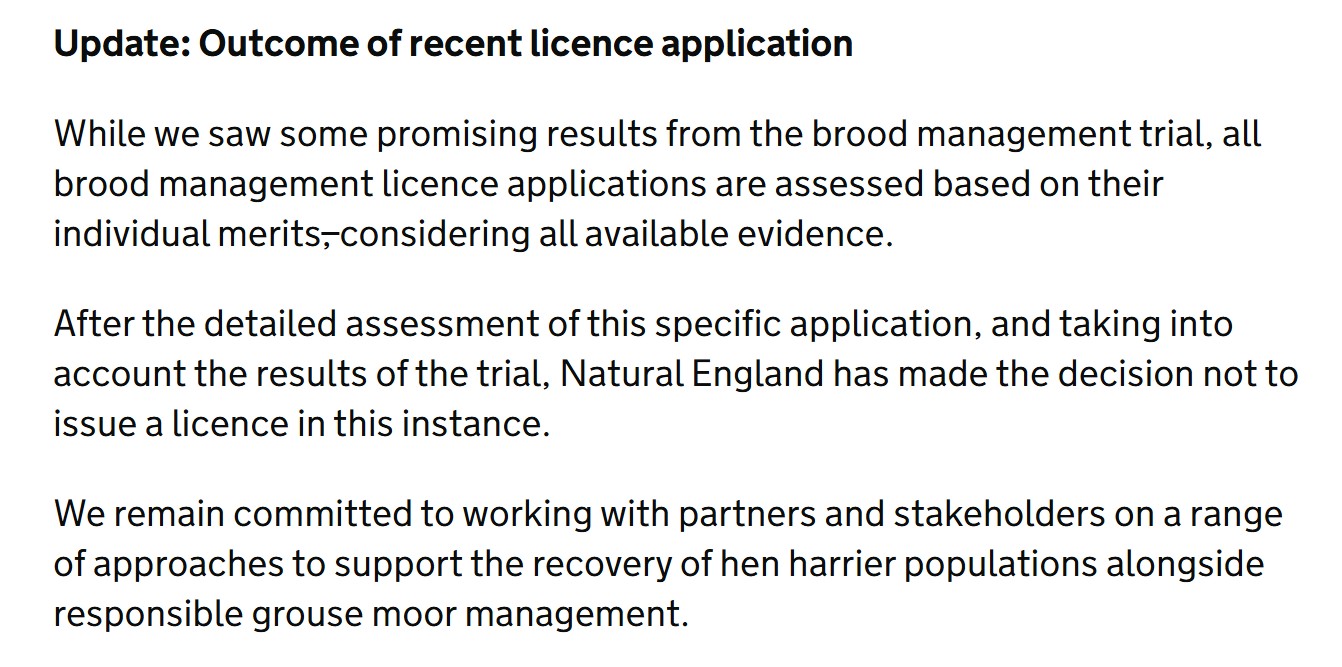
We are currently awaiting a formal review of the brood meddling sham by Natural England and a decision on whether NE will issue a licence to the grouse shooting industry for further brood meddling this year and in the years ahead (see here).

It’s an oft-repeated phenomenon that whenever someone ‘new’ gets involved in the issue of hen harrier persecution, indeed the issues relating to all raptor persecution, that they call for all ‘sides’ to sit down together, build partnerships and reach a resolution that will end the illegal killing.

It’s an understandable and seemingly sensible idea. That is, until you look back at the history of this issue and realise that one ‘side’, i.e. the criminals within the shooting industry, simply aren’t prepared to tolerate hen harriers / raptors on ‘their’ grouse moors because of the perceived threat to ‘their’ red grouse.

Pseudo ‘partnerships’ with the game-shooting industry have been set-up so many times, only to fail miserably in the face of ongoing illegal persecution and abject denial from the shooting industry’s representatives (e.g. see here, here, here, here, here, here, here).

As far as I can see, nothing has changed to suggest that setting up yet another sham partnership to address the illegal killing of hen harriers on driven grouse moors will do anything other than provide the criminals with yet another opportunity to masquerade in public as law-abiding, responsible custodians whilst in private continuing to shoot, trap, stamp on, and pull the heads and wings off any hen harrier that dares to go anywhere near a driven grouse moor.

The time for talking ended years ago.

Sign the Wild Justice petition calling for a ban on driven grouse shooting HERE. It is currently supported by 69,000 people. It requires 100,000 people to sign it, before 22 May 2025, to trigger a debate in the Westminster parliament.

UPDATE 9 July 2025: Defra refuses funding for another futile ‘dialogue’ process to address ongoing killing of Hen Harriers on grouse moors (here).

RPUK blog reaches 15th birthday & passes 12 million views

Today marks 15 years since this blog was started and it happily coincides with the blog passing 12 million views – two milestones in one day!

RPUK blog views, 2010-2025

Thanks as ever to everyone who follows and supports this work, and particular thanks to the generous sponsors who help fund my time – without them it would be impossible to sustain the blog.

50,000 people support the Northern Ireland Raptor Study Group’s petition to ban possession of dangerous, raptor-killing pesticides

Many, many thanks to all of you who signed the Northern Ireland Raptor Study Group’s (NIRSG) petition calling for a ban on the possession of dangerous, raptor-killing pesticides.

The petition has just passed its target of 50,000 signatures and the NIRSG has issued the following press release:

The NIRSG held a recent Raptor Conference which provided incredible insights into a range of topics locally and globally. Many of the talks raised a consistent theme of targeted persecution of birds of prey. Not least amongst these was the on-going issue in Northern Ireland of the Possession of Dangerous pesticides.

Some of the NIRSG 2025 conference attendees supporting the call for a ban on dangerous, raptor-killing pesticides. Photo by Marc Ruddock

The NIRSG highlighted that 63 raptors have been killed between 2009 and 2023 with a range of poisons, dominated by Carbofuran which has been banned for nearly 25 years. There have been at least 30 buzzards, 16 peregrine falcons, 13 red kites, 3 white tailed eagles and 1 golden eagle all poisoned in this time frame.

This evidence is collated by the Partnership for Action Against Wildlife Crime in Northern Ireland (PAW NI) and published in raptor persecution reports, which include ‘hotspots’ of illegal killing of our native birds of prey. These reports are publicly available on the PAWNI webpage available here and also aggregated in the RSPB Bird Crime reports available here.

In 2011, the wildlife legislation in Northern Ireland was strengthened, resulting in increased sentences of £5,000 fines (per offence) and up to 6 months imprisonment. The updated laws included a provision to ban the possession of prescribed ingredients under “Section 15B Possession of pesticides harmful to wildlife” of the Wildlife (Northern Ireland) Order 1985 as amended.

As part of that legislation there should have been an attached Order listing the banned chemicals. That list has never been created. Wildlife has continued to be poisoned by these dangerous and banned substances.

The legislation states in Section 15B Part 2: “A prescribed ingredient is one which is prescribed for the purposes of this Article by an order made by the Department; but the Department may not make an order under this Article unless it is satisfied that it is necessary or expedient to do so in the interests of protecting wild birds or wild animals from harm”. [Emphasis added by NIRSG]

There is significant evidence of continued harm from banned pesticides to birds of prey, based on robust post-mortem and laboratory results, which has been published in many reports. We believe it is indeed expedient for Minister Andrew to implement this Order to protect our birds of prey from harm. 50,000 people agree with us. Thank you to everyone who has supported the petition and helped give a voice to our wildlife.

The NIRSG will be seeking a meeting with Minister Andrew Muir to present the petition now that it has surpassed 50,000 signatures.   

ENDS

Vermin or not vermin? How do gamekeeper’s decide?

A spoof guide from Wild Justice:

Please sign the petition to ban driven grouse shooting HERE

Cairngorms National Park Authority condemns latest shooting of red kite

Following yesterday’s news that a red kite has been found shot dead in the Glenbuchat area of Strathdon (here), the Cairngorms National Park Authority has issued the following statement:

STATEMENT ON RED KITE

28th February 2025

The Cairngorms National Park Authority has issued the following statement in relation to the death of a red kite in the Glenbuchat area of Strathdon:

“The Park Authority have been informed by Police Scotland that a red kite was found dead in the Glenbuchat area of Strathdon earlier this month. Police Scotland have confirmed that the red kite had been shot.

The shot red kite. Photo by RSPB Scotland

“The Park Authority condemns the illegal killing of raptors in the strongest possible terms. Raptor persecution has no place in 21st century Scotland but sadly incidents such as this are still taking place. It is an unacceptable crime that not only harms our raptor populations, but also damages the reputation of those land managers that act lawfully and work hard to care for wildlife.

“We are committed to working with partners to make sure the National Park is a safe haven for raptors and to establish the full circumstances of this incident. Anyone with information is asked to contact Police Scotland on 101, quoting incident number 0846 of Thursday 27 February. Alternatively, you can contact Crimestoppers on 0800 555 111 where information can be given anonymously”.

ENDS

Red kite found shot dead in Strathdon area of Cairngorms National Park – Police Scotland appeals for information

Press release from Police Scotland (28 February 2025):

APPEAL FOR INFORMATION AFTER BIRD OF PREY SHOT NEAR STRATHDON

Officers are appealing for information after a bird of prey was shot near Strathdon.

On Wednesday, 26 February 2025, we received a report of a red kite having being shot sometime between Monday, 3 and Tuesday, 4 February in the Glenbuchat area of Strathdon after being found by a member of the public.

The bird was recovered with the assistance of the Royal Society for the Protection of Birds (RSPB) where the cause of death was not apparent at that time. Following further investigations, it has been established that the bird had been shot and police were contacted.

Detective Constable Danny Crilley of the Wildlife Crime Unit said: “Red kites are protected under the Wildlife and Countryside Act and it is illegal to kill any protected species.

Enquiries are ongoing and we are working with our partner agencies to establish the full circumstances of this incident.

I would appeal to anyone with any information that may assist our investigation to contact us. Your information could be vital in in establishing what has happened. If you were in the Glenbuchat area on Monday, 3 or Tuesday, 4 February, and saw anything suspicious or have any information about shooting activity in the area, please contact us.

Anyone with information is asked to contact Police Scotland on 101, quoting incident number 0846 of Thursday, 27 February.  Alternatively, you can contact Crimestoppers on 0800 555 111 where information can be given anonymously.”

ENDS

First of all, well done to Police Scotland for issuing a speedy appeal for information, just two days after being notified about this shot red kite.

It’s not clear from the press release whether this shot raptor was found on or next to a grouse moor. However, the ‘Glenbuchat area of Strathdon’ is certainly in close proximity to land managed for driven grouse shooting.

The Strathdon area of the Cairngorms National Park has long been recognised as a raptor persecution hotspot, as this map demonstrates:

This is a map I published in 2020 following the discovery of a poisoned White-tailed eagle on an unnamed grouse moor in the area (here).

The black dots on the map represent raptor persecution incidents recorded between 2005-2020, based on data from the RSPB, the golden eagle satellite tag review, and other data in the public domain. The Strathdon area is circled.

Those incidents in Strathdon include a poisoned raven (2006), a poisoned common gull (2006), multiple poisoned baits (2006), a shot buzzard (2009), a poisoned golden eagle (2011), a poisoned buzzard (2011), poisoned bait (2011), a shot short-eared owl (2011), two satellite-tagged golden eagles ‘disappearing’ (2011), another satellite-tagged golden eagle ‘disappearing’ (2013), a satellite-tagged white-tailed eagle ‘disappearing’ (2014), a goshawk nest shot out by masked men (2014), a shot goshawk (2016), another satellite-tagged golden eagle ‘disappearing’ (2017), a satellite-tagged hen harrier ‘disappearing’ (2018), another satellite-tagged hen harrier ‘disappearing’ (2019), and another satellite-tagged hen harrier ‘disappearing’ (2020).

Nobody was prosecuted in any of these cases.

The Strathdon area was also identified as a golden eagle persecution hotspot in the Scottish Government-commissioned scientific report, Analyses of the fates of satellite-tracked golden eagles in Scotland, published in 2017 and eventually leading to the introduction of the grouse moor licensing scheme in 2024:

It would be interesting to know whether this shot red kite was found on or next to a grouse moor and if it was, whether an associated grouse moor licence will be revoked as a consequence, which was the clear intention of the Scottish Parliament when it voted through the Wildlife Management & Muirburn (Scotland) Act 2024 almost a year ago last March.

My guess is that it won’t lead to a licence revocation, even if the red kite was found on or close to a grouse moor, because it will be virtually impossible to connect its death to the management of the grouse moor (as the new, shambolic and unenforceable licence condition now specifies).

Just like the shot osprey found in the Angus Glens on the opening day of the grouse-shooting season in August 2024 (here) and the shot peregrine, also found in the Angus Glens, in September 2024 (here), there won’t be any consequences for those responsible.

The raptor killers are still at, and they’re still getting away with their crimes.

For those who think the grouse moor licensing scheme is failing, and that the Scottish Government hasn’t shown any signs of intending to fix it even though it acknowledges there are issues (e.g. see here), there’s an alternative option – and that is to ban driven grouse shooting.

Wild Justice currently has a live petition calling for such a ban. It’s been supported by 67,432 members of the public so far but needs 100,000 signatures to trigger a Parliamentary debate. Please sign here to support it.

UPDATE 1st March 2025: Cairngorms National Park Authority condemns latest shooting of red kite (here)

UPDATE 2 May 2025: Two men charged in relation to illegal killing of Red Kites in Cairngorms National Park (here)

More parliamentary questions on grouse moor licensing shambles in Scotland

The Scottish Greens MSP Mark Ruskell is the latest politician to lodge parliamentary questions about the grouse moor licensing shambles in Scotland.

As a recap, regular blog readers will know that NatureScot made a sudden and controversial decision last autumn to change its approach and amend the brand new grouse moor licences that had been issued to sporting estates in Scotland under the new Wildlife Management & Muirburn (Scotland) Act 2024.

See previous blogs herehereherehere, and here for background details.

The changes made by NatureScot significantly weakened the licence by changing the extent of the licensable area from covering an entire estate to just the parts of the estate where red grouse are ‘taken or killed’, which on a driven grouse moor could effectively just mean a small area around a line of grouse butts. The licence was further weakened by NatureScot reducing the number of offences outside the licensable area that could trigger a licence revocation.

Photo of a line of grouse-shooting butts by Richard Cross, annotated by RPUK

Freedom of Information responses later revealed that NatureScot had capitulated on grouse moor licensing after receiving legal threats from the grouse shooting industry. Secret and extensive negotiations then took place between NatureScot and a number of grouse shooting organisations, excluding all other stakeholders. NatureScot refused to release the legal advice it had received and on which it had apparently based its changes to the licence.

A couple of days ago, Minister Jim Fairlie responded to a series of parliamentary questions on this subject, lodged by Colin Smyth MSP (Scottish Labour). The Minister readily acknowledged there were issues with the changes that had been made to the grouse moor licences, but it was quite clear that he didn’t have any immediate plans to address the significant weakening of the licences (see here for his responses).

Now Mark Ruskell MSP from the Scottish Greens has lodged four more parliamentary questions about NatureScot’s behaviour and decision-making:

S6W-34987 Mark Ruskell: To ask the Scottish Government for what reason NatureScot reportedly did not invite each of the groups involved in the development of the Grouse Code of Practice to (a) meetings and (a) engage in consultation with it to discuss grouse licence conditions.

S6W-34988 Mark Ruskell: To ask the Scottish Government how many (a) meetings and (b) other discussions NatureScot and Scottish Land and Estates have held to discuss (i) the legal opinions regarding the wording of the Wildlife Management and Muirburn (Scotland) Act 2024 and (ii) what land should be included in a 16AA licence to shoot grouse.

S6W-34989 Mark Ruskell: To ask the Scottish Government whether NatureScot will release the notes of (a) meetings and (b) any other discussions it has had with Scottish Land and Estates to discuss grouse shoot licensing.

S6W-34990 Mark Ruskell: To ask the Scottish Government what (a) meetings and (b) other discussions took place between ministers and/or its officials with NatureScot in advance of the agency introducing new guidance related to “area of land” and new conditions to 16AA licences; whether these changes were approved and, if so, (i) by whom and (ii) when.

These questions were lodged on 18 February 2025. Responses are due by 4 March 2025.